JBL L100 Century
The King of Rock & Roll (1970‑1978)
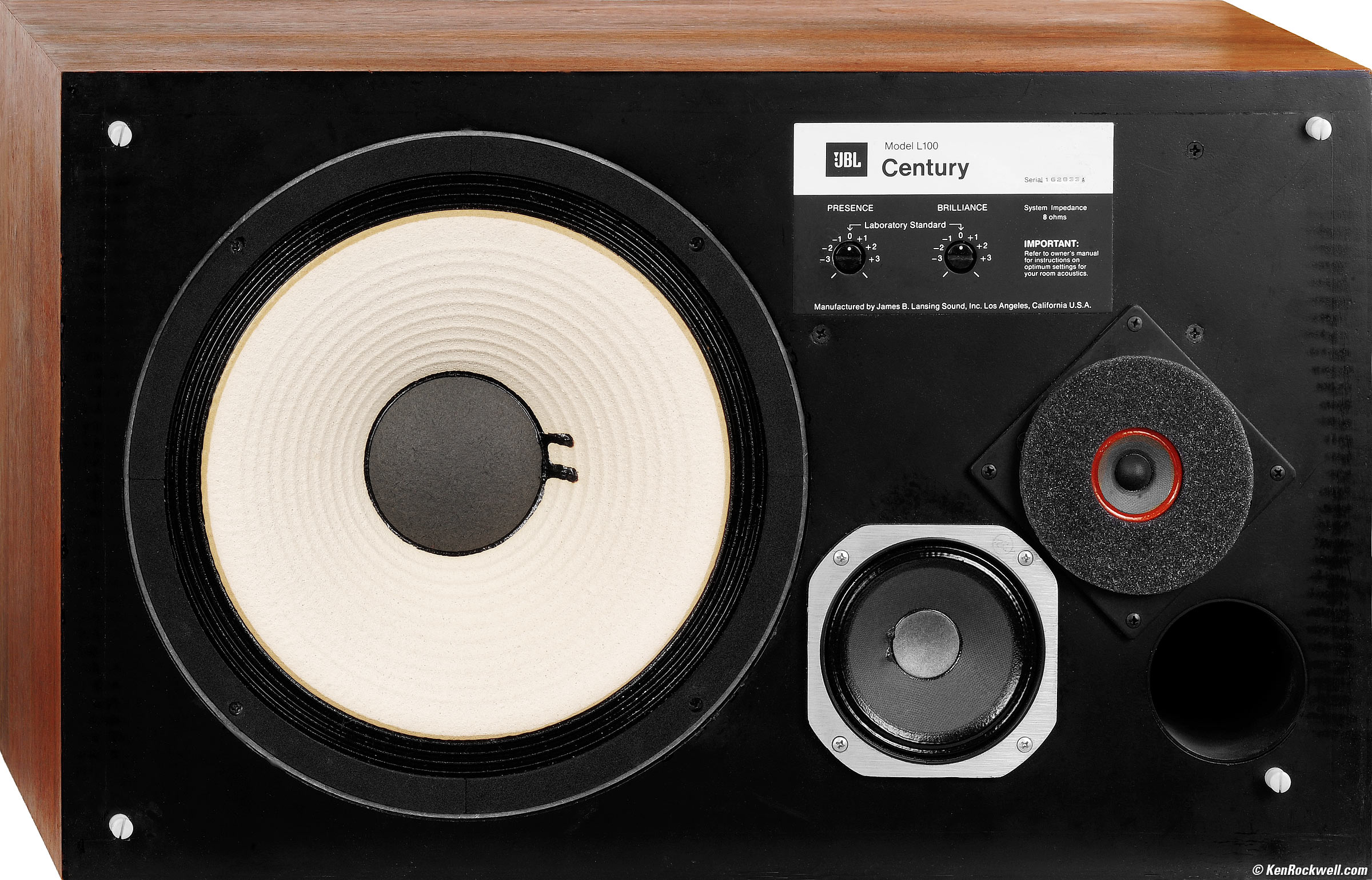
JBL L100 Century (8Ω, my sample is from 1975, 12" accordion-edge woofer, 5" midrange, 1.4" paper cone tweeter, 45 pounds, 1.6 cu. ft. vented box, 23½ × 14¼ × 13⅝″ WHD, about $2,000/pair used if you know How to Win at eBay (you will probably have to save a search and wait a month or two for a nice set to be offered), or pay $2,400 new (each) at Crutchfield.) bigger.
This all-content, junk-free website's biggest source of support is when you use those or any of these links to approved sources when you get anything, regardless of the country in which you live. Thanks for helping me help you! Ken.
September 2024, November 2021 Audio Reviews Headphone Reviews Tube Amp Reviews All

Introduction top

I buy only from these approved sources. I can't vouch for ads below. |



The JBL L100 is JBL's, if not the world's, greatest selling speaker of all time. These were everywhere in the 1970s because they sounded great, were small compared to other speakers that sounded this good, and played very loudly without needing much power. JBL sold a quarter-million of these!
They sold like crazy from their introduction at the 1970 Spring CES in Chicago until they were discontinued in 1978. The only reason they were discontinued is that people finally realized that the professional model 4311 was the same speaker, for less money. People then bought the 4311 like crazy, and even I bought a brand-new pair of 4311 in 1985. The superior model L112 replaced these for home use in 1981, and JBL has sold Chinese-made copies called "Classic" since 2018 (more at Versions).
While 1970s L100s are awesome rock speakers and were often used as monitors in the studios where our favorite classic rock was recorded, they never sounded great for serious classical music listening. They always sounded like the music was coming from paper drivers put in an empty wooden box, which is exactly what these are.
I made a big mistake buying my 4311 in 1985. I had moved from New York to Los Angeles and brought my original English QUAD ESL (57) Electrostatic loudspeakers with me. I figured I should get with the times and get some pro JBLs, since the factory was only 5 miles away. I did, and they sounded awful for anything other than rock & roll. Close your eyes and listen to an acoustic recording, and you'll hear honky paper drivers mounted in a hollow wooden box. I got smart, and replaced those with the newer QUAD ESL-63, which I have to this day almost 40 years later.
Audio engineers have little respect for these L100s today, other than nostalgia. I got these from another audio engineer neighbor's garage sale for $50 — the pair. I bought his Dynaudio speakers, and he really wanted me to take these out of his garage as well. I already knew how bad they would sound since I already had them brand new, so I wasn't interested. Even though he knew what they sold for on eBay, he just wanted them to go to someone who knew what they were, so I carried them home and put them in my photo studio for background music.
For those of you used to wimpy compact smart speakers that sound "bigger than they are," these astonish young people as these are the "big" speakers that all the little Bluetooth speakers wished they were.
With a full 12" woofer in each speaker, you have stereo bass and none of the distortion that plagues little speakers that try to get "big speaker" sound with electronic fortification — which leads to much more low-frequency distortion.
Two 12" woofers have the same output as one 17" driver (12 × √2 = 17"). Dig it?
The L100 is designed for rock & roll, efficiency, power handling, sine wave frequency response and sharp musical transients. Mine love reproducing the solid fundamentals of Genesis' Taurus bass pedals, old & new Eric Clapton, Pink Floyd and everything is deep and punchy. Your favorite classic rock acts were probably recorded with JBL monitors, maybe even these or their 4310 or 4311 brethren.
My 4311 and L100 manuals said that so long as you don't clip your amplifier that you probably will want to leave the room long before the speakers give out from too much power. These are extremely efficient, and they are designed so that the woofer's huge 3" voice coil handles most of the power up to the 1.5 kHz midrange crossover. Tweeter crossover is 6 kHz, keeping a lot of the power in the woofer and not blowing out the other drivers.
They're born for bookshelf, wall and soffit mounting, coming from the pro 4310 Studio monitor of 1968 that was intended for soffit or wall mounting. Don't waste your time with stands in the middle of the room, which look foolish and result in weaker bass output.
You can drive these with anything due to their high efficiency. A Crown D-75 was and is perfect; they need little power to become deafening. I only drive my American speakers with American-made Crown electronics like we used in the studios back in the day of passive speakers. These are also perfect for use with low-powered Tube Amps and your class-A experiments. Doe, they're all yours if you want to borrow them for a party! Just a few watts and the joint will be jumping!
The loudness contour of the Crown Straight Line Two is perfect for boosting the deepest bass. Find the right spot for these speakers and drive them with these classic electronics and you can feel what all the crappy little imported stereos and smart speakers of today are trying to imitate.
I was in middle school in the mid 1970s when L100s ruled the world. Our band, orchestra and choir rehearsal rooms (and music appreciation classes) all had L100s mounted 40 feet apart up in the corners on opposites sides of these huge rooms. When teachers played something through whatever crappy Lafayette solid state amp was on hand it always sounded great. One time our band teacher played us the Frederick Fennel (good) version of whatever he was trying to get us to play, and we were all simply sat stunned in silence. What the heck was that? Could humans actually play this piece that well? Holy cow! It was unbelievable, and all we heard was the music, not the speakers.
Expensive speakers aren't expensive. Unlike electronics and digital cameras that go obsolete every few years, speakers last a lifetime. I'm still using my original L100s; mine came with cloth grills and none of these use foam in the drivers so the 1970s L100 drivers should last forever so long as no one has damaged them. (I did replace my foam tweeter rings; I doubt they actually improve the sound as originally claimed.)
My B&W 801 from 1983 play like new; the speakers you buy today are a very long-term investment over which your kids will be fighting when you pass on to the great concert hall in the sky. As you can see at eBay, used 1970s L100s sell for more today than they sold for new, and have doubled in resale value in 2024 compared to when I first wrote this page in 2021.
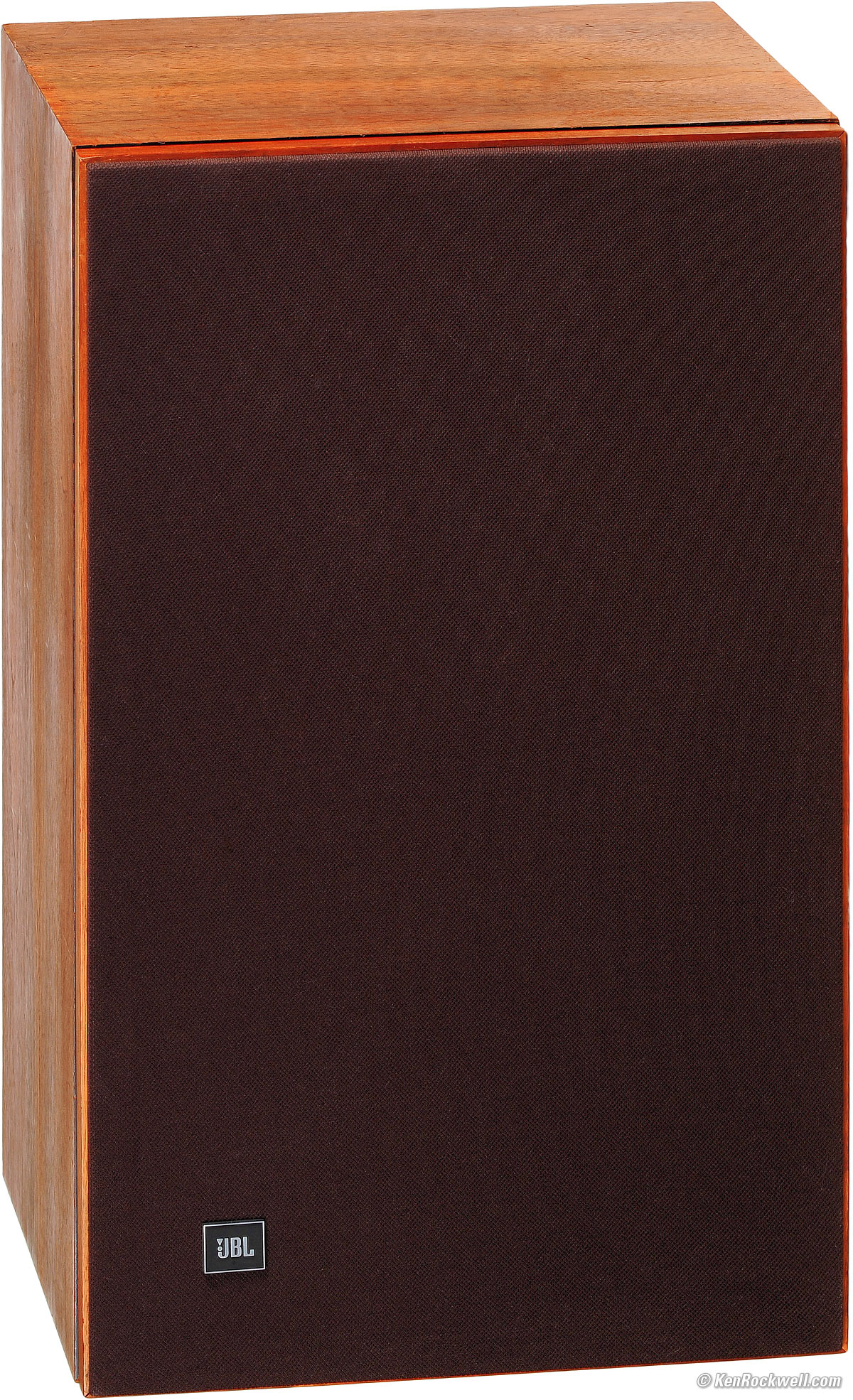
JBL L100. bigger.
Versions & History top
This review is about the classic 1970s made in the United States of America L100 Century described above.
Below are newer models. The recent models with "Classic" in their names are most definitely not classics.
1981: L112
The similar L112 came out in 1981 as a greatly improved replacement, designed by pianist and recording engineer John Eargle. I knew John Eargle back when he was still with us.
The L112 uses a plastic-dome 044 tweeter. The plastic dome has a metallic coating.
The cast-aluminum frame LE5-12 midrange has a cloth surround.
The L112's cast-aluminum-frame 128H woofer uses foam surrounds rather than the pleated cloth surrounds of the original L100 Century shown here. While pleated cloth holds up fine for decades (my 50-year-old L100s are completely original), the L112's foam woofer surrounds almost certainly have fallen apart and have been or need to be replaced ("refoamed") by today. In my experience, JBL foam surrounds last about 20 years. Therefore any L112s you buy today won't be completely original.
The L112 has a completely different and far superior crossover. While the L100 Century shown here uses only two capacitors as a "crossover," the L112 has a legitimate LRC crossover with film capacitors and air-core inductors.
The L112 comes in left-right mirror-image versions for better stereo imaging when used vertically, while all the other variations lack this.
The L112s had a $450 list price (each) in 1981, or $1,550 corrected for inflation in 2024.
2018: L100 Classic
JBL reintroduced this classic 3-way 12" vented speaker in 2018 as the L100 Classic. They used an all-new design with different drivers (thank goodness) and a new crossover, so they should sound way better than the originals, while retaining the look of the original, down to the crazy cubical foam grilles.
While it's called "classic," it is in no way a classic as are the L112 and the L100 Century reviewed here.
This version is rated 4Ω rather than the original 8Ω.
The originals used woofers with pleated cloth surrounds, paper cone tweeters and a primitive crossover that consisted of only two capacitors and two L-pads, period. All the technology was in the drivers, certainly not the cosmetics or crossovers!
The L100 Classics try to fix that with an internal brace to stop the box from sounding like a box, and using modern drivers — not paper-cone tweeters!
The L100 Classic had the same 5-year warranty as the originals.
I haven't heard the 2018 version so I can't speak to them precisely, however the 2018 versions should sound much, much better, and as a full-sized speaker should sound worlds better than smaller speakers, especially if you're used to needing subwoofers which screw up the music by sending different parts of it to different places in your room. With real speakers, all the music comes from the same place without being chopped up before it even gets out into your room.
The 2018 versions, as full size speakers, should astonish anyone used to using dinky little 2-way 8" speakers with the crutch of a single subwoofer.
The L100 Classics were sold as single speakers at $2,200 each. You needed to get two for stereo, four for quad and five for 5.1 movies.
The L100 Classics were offshored to China or Indonesia.
Much better than neighborhood stereo stores in the 1970s, today (and also back in the 1970s when they first opened) Crutchfield gives us 60 days to enjoy our speakers in our own home or studio with our own music and electronics, and if we don't love them, no big deal, just send them back for a full refund. This sure beats wasting time in a stereo store wondering how they'll sound back at home — and we don't have retail stereo stores today anyway.
2024: L100 Classic MkII
JBL claims slight driver tweaks from the 2018 version, but I don't see any differences at all:
The 12" cast-frame "Pure Pulp" (paper) woofer claims a more efficient motor structure with dual spiders — and looks the same.
The 5-1/4" polymer-coated "Pure Pulp"(paper) midrange claims a rigid cast basket - and looks the same.
The 1" titanium dome tweeter now uses a custom acoustic lens and waveguide — which looks exactly like the 2018 version's tweeter.
It's rated 4Ω, like the 2018 version.
The only new thing I can see new since 2018 are silly "biwire" connections on the back, rather than the normal ones from before. Biwiring was a sales ploy invented some time ago to help dealers sell twice as many expensive speaker cables, which of course are completely unnecessary.
It's an inch deeper and an inch wider (when placed vertically) than the 1970 version.
It still has a 5-year warranty as they always have had since 1970.
The L100 Classic MkII are offshored to China.
Good top
 Full-range punchy sound perfect for rockin' the house.
Plays loud without much power.
Full bass response, no stinking subwoofers needed.
Full-sized sound from a compact speaker. Yes, in their day these were small speakers.
Front-panel midrange and tweeter controls to let you fine-tune these to your room and taste.
Made in the United States of America.
Bad top
 For classical music these sound like paper drivers in a wooden box, which they are. While JBL worries about lack of power compression and flat on-axis sine-wave response, they completely ignore the effects of what happens to the half of the sound that goes into the box and comes back out through the lightweight cones that give them such high efficiency. Use these for rock and pop, but pass for symphonic and choral music.
Original 1970s samples that haven't been destroyed by hobbyists "modding" them are very hard to find.
New ones are expensive and are made overseas.
Specifications (1970s version) top
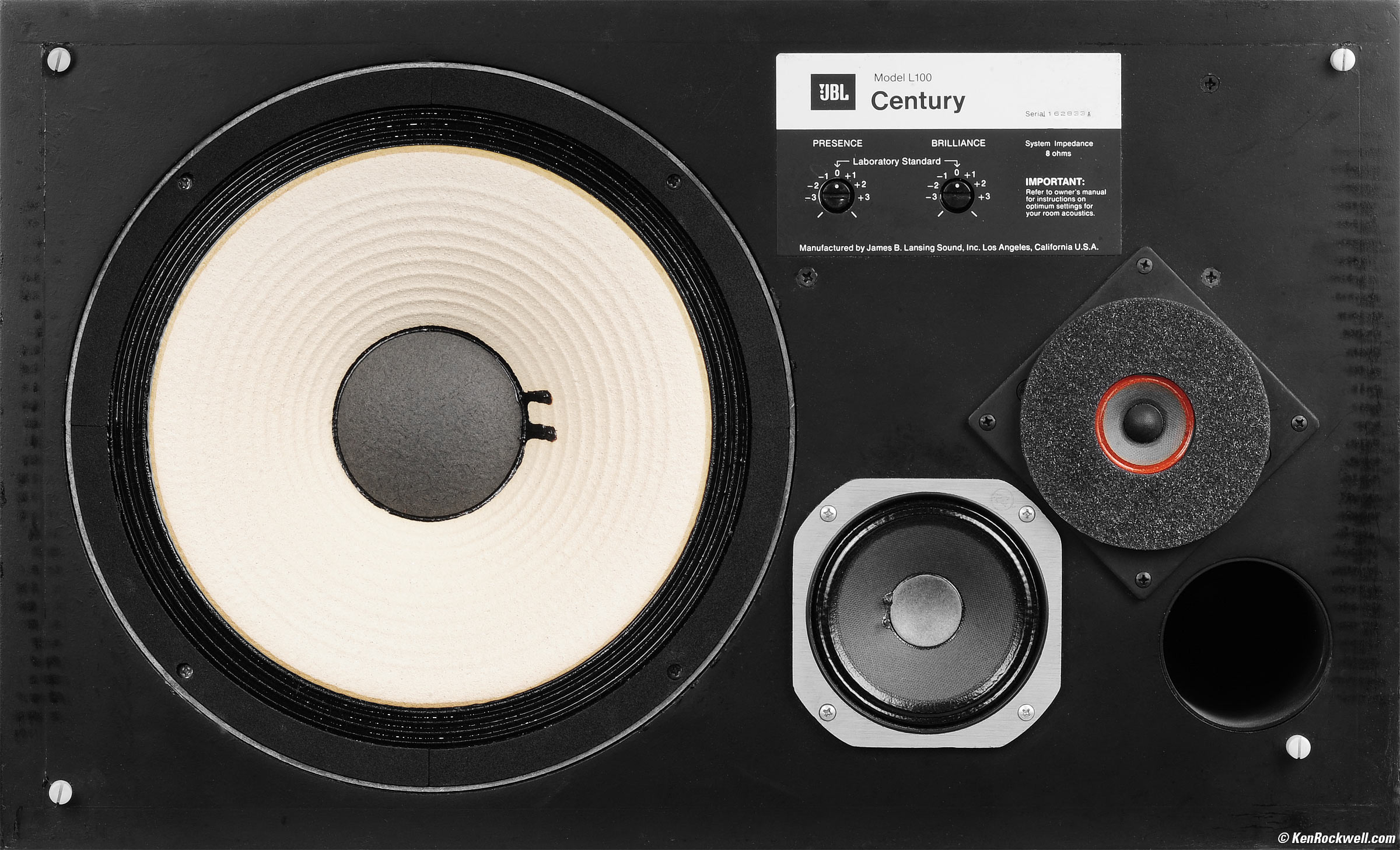
JBL L100. bigger.
System Impedance specifications top
8Ω.
Sensitivity specifications top
91 dB SPL at 1 meter with 1 watt (2.83V) input.
(JBL rates it as 78 dB SPL at 1 watt input at 15 feet, same as 91 dB at 1 meter).
Optimum Rated Amplifier Power specifications top
10 watts to 150 watts.
Rated Power Capacity specifications top
50 watts program.
That means a long-term RMS average of 50 watts wideband, more or less. They never really came clean on explaining this one, mostly pointing out correctly that these will easily play far louder than you could ever stand without damage so long as your amplifier doesn't clip and toast the tweeters.
Cabinet specifications top
3/4" particle board.
No internal bracing.
Oiled American black walnut veneer (grill frames are solid American black walnut).
The port has a 90º bend at the back to fit in a box this shallow. It also means you don't see the insides of the speaker through it.
Foam grills came in Burnt Orange, Ultra Blue or Chocolate Brown.
Drivers specifications top
The genius and expense of the L100 are in its drivers, all of which are designed and made in-house by JBL in Northridge, California.
12" Woofer 123A-1
8Ω.
4.5 - 5.5Ω DC.
310mm (12.20") measured basket diameter.
255mm (10.04") measured effective piston diameter
3" edge-wound copper ribbon voice coil gives a higher copper-to-air ratio than using regular round wire.
6.75 pound Alnico V magnet.
1.04 Tesla (10,400 Gauss) flux density across 0.045" gap. Gap made to 0.0005" precision.
92 dB SPL at 1 meter with 1 watt (2.83V) input, 100~500 Hz warble.
27 Hz free-air resonance.
Box tuning (minimum cone motion and impedance) is at about 30 Hz.
Same accordion edge as JBL's newest state-of-the-art $25,000 M2 monitors.
Cast aluminum frame.
Shallow cone designed to have good dispersion even at the 1,500 Hz crossover frequency.
The white stuff is the "Aquaplas" or "Lansingplas" damping material claimed to keep reverberations from bouncing around inside the cone material, but tapping the cone makes it ring like a bell so I'm unsure how much this is effective rather than cosmetic.
5" Midrange LE5-2
8Ω.
5.5 - 6.5Ω DC.
7/8" voice coil.
2.75 pound Alnico V magnet.
1.65 Tesla (16,500 Gauss) flux density across 0.040" gap.
Inverted (concave) dust cap.
96 dB SPL at 1 meter with 1 watt (2.83V) input, EIA.
1.4" Tweeter LE-25
8Ω.
3.7 - 4.2Ω DC.
5/8" voice coil.
1.6 pound magnet.
1.5 Tesla (15,000 Gauss) flux density across 0.029" gap.
97 dB SPL at 1 meter with 1 watt (2.83V) input, averaged above 2 kHz.
Impregnated cloth suspension.
Foam surround claimed to eliminate unwanted reflections and radiations, but looks and sounds more cosmetic to me.
Crossover specifications top
Frequencies
1,500 and 6,000 Hz.
Design
It's two capacitors, two L-pads, and that's it.
The woofer is driven full-range. There is no high-frequency cutoff.
The midrange has an 8 µF series capacitor and an L-pad, and like the woofer, no high-frequency cutoff!
The tweeter has a 3 µF series capacitor and an L-pad, and you're done.
It can't get simpler than this! As I said, the brilliance is in the drivers and definitely not the crossover or cabinet.
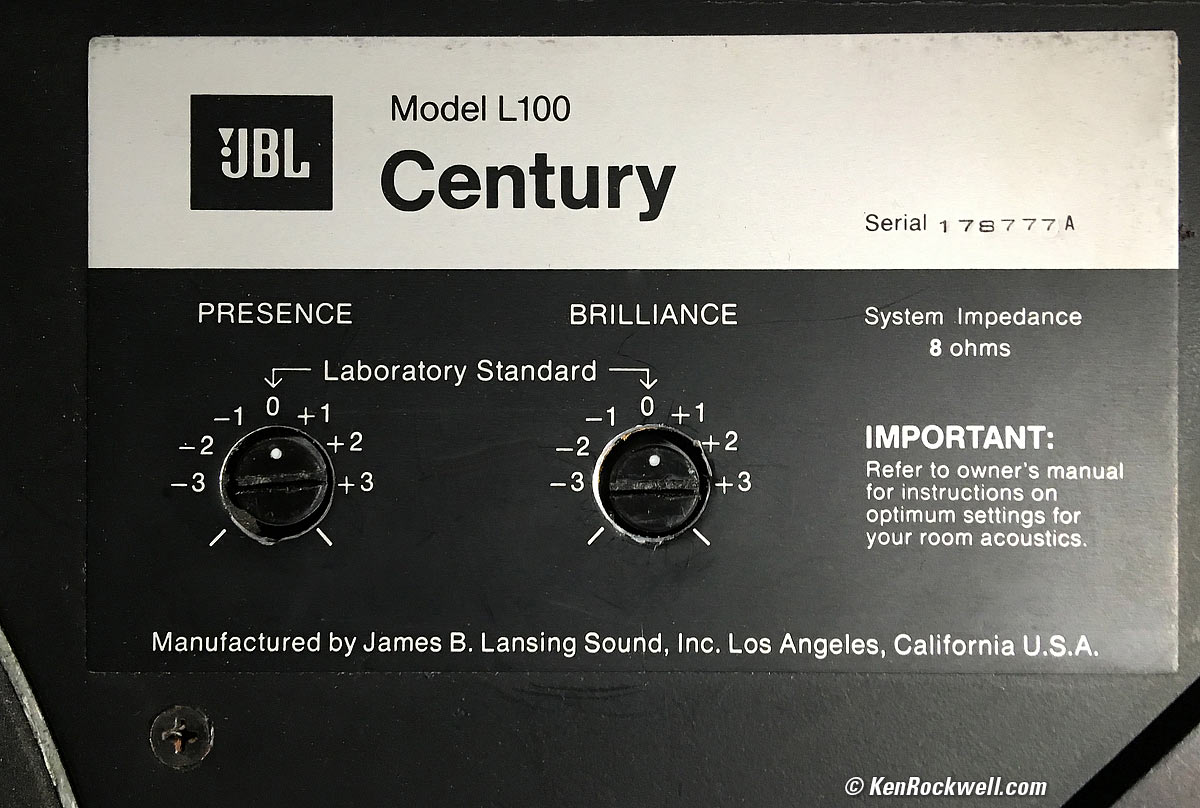
1975 JBL L100 Century Crossover Controls. bigger.
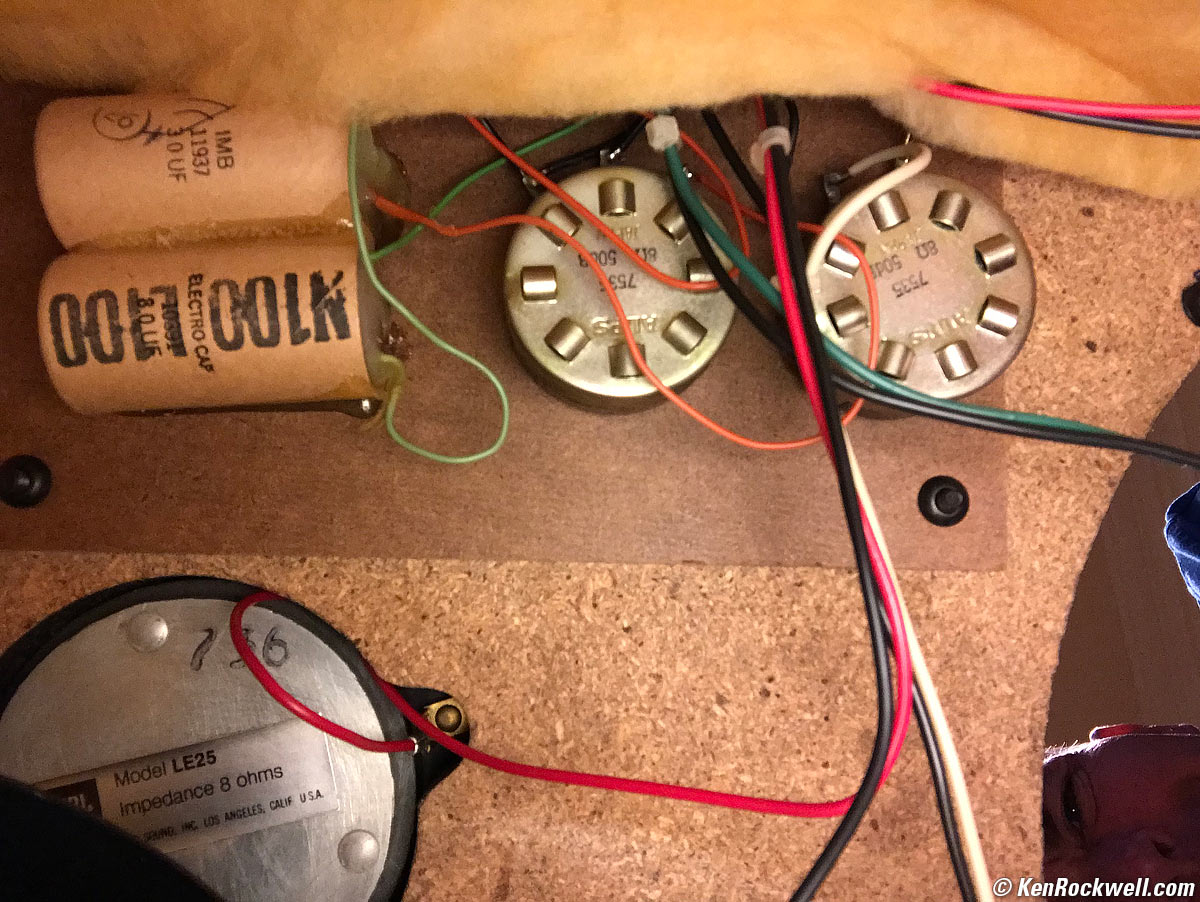
1975 JBL L100 Century Crossover Components - all two capacitors and two L-pads! bigger.
Size specifications top
23½ × 14¼ × 13⅝″ WHD placed horizontally (HWD placed vertically).
597 × 362 × 364mm WHD placed horizontally (HWD placed vertically).
Weight specifications top
45 pounds each.
55 pounds as shipped.
Quality specifications top
Made in U. S. A.
2024's L100 Classic MkII version is made in China.
2018's L100 Classic version was made in China or Indonesia.
Date Code specifications top
None on the speaker, but the L-pads in the crossover usually have a four-digit YYWW (year/week) date code. The speakers would have been made some weeks or months after the L-pads were made.
Price, U. S. A. specifications top
September 2024
About $2,000/pair used if you know How to Win at eBay. They'll vary from about $1,800 to $2,400 for a pair that works and looks reasonably well; which is rare. Most examples offered for sale today are garbage after 50 years of abuse. As I explain at How to Win at eBay, you'll have to be patient and probably wait a couple of months to get a nice set that you'd actually want to own.
$2,400 new (each), 2024 L100 Classic MkII version not tested here.
November 2021
About $1,000/pair used if you know How to Win at eBay.
$2,200 new (each), 2018 L100 Classic version not tested here.
1970
$273 each, new. That's equivalent to $2,200 in 2024 considering inflation.
Recommendations top
Like all popular consumer products, JBL made many minor modifications to it over the years to keep it looking fresh and encouraging people to buy the "new version" which was 95% the same as the previous one. Don't sweat driver alignment or A versus non-A models; they're all 95% the same L100.
Most of these are seen with whacky cubical foam grills. 1970s foam has all fallen apart today and people sell replacements. Mine came with cloth grills that have survived, in fact they are so nice that they have two layers of cloth a half inch (1 cm) apart to ensure that you never see the drivers through the grill so your house looks like a home and not a science lab.
Don't waste your time modifying these attempting to "improve" them. No matter what you do they are still paper cones in an empty and mostly undamped wooden box. Their simple crossovers are part of the sound. These are not modern Genelec or B&W monitors with rock-solid drivers and cabinets that eliminate internal sound leakage, stored energy, resonance and re-radiation, so don't waste your time trying to get them to sound totally neutral.
After decades of abuse, my 1975 walnut veneer perked right up with a simple wipe of a paper towel with Howard Products Restor-a-finish as shown in these photos. It should look even better when I polish it with Howard Products Feed-N-Wax next.
If your midrange or tweeter is either distorted or not working, it's probably just a dirty level control, not a defect in the driver. Rotate its front-panel level control back and forth several times and this may cure it. Sadly I've never been able to contort myself inside of my L100's through the woofer's mounting hole to be able to try to spray contact cleaner on the L-pads. You would have to peel off and destroy the aluminum foil around the crossover on the front of the speaker to remove the crossover, so don't do that. It's nearly impossible to work on the crossover from behind while it's in the speaker, and impossible to remove without destroying the L100's cosmetics.
These descend from professional studio monitors used to create recordings from live performances — not for playing records at home. If you're playing records rather than modern digital sources, you probably want to use the Rumble or Subsonic filter in your preamp to keep record warps and turntable rumble from making the woofer cone wander in and out. While the acoustic suspension (sealed) speakers popular in the 1970s didn't have this problem because their woofer cones were held in place at subsonic frequencies by the air in the sealed box, vented (open-box) speakers like these will have a load of cone motion if driven by frequencies below box resonance, which is about 30Hz in the L100.
The woofer should not wobble while playing; if you can see it moving (rather than vibrating) then that can lead to harmonic or intermodulation distortion as the cone moves away from its rest position.
JBL varied from year to year as to the polarity of their speakers. Positive voltage at the red terminal may make your woofer go out or in, so know this if you're trying to integrate these in a larger system. Today's speakers have the cone move out with positive voltage at the red terminal.
Back in the 1970s many people settled for less expensive "mid-fi" amplifiers made overseas by Pioneer, Sony, Lafayette, Marantz and others, while serious music lovers spent much more for serious American amplifiers like McIntosh, Crown, Hafler, Apt, Adcom and many others. In the studios we always ran these with Crown amplifiers. Today I'd use nothing other than a classic American amp (or Bryston) to drive these; there's no reason to waste time with lesser amps today since used American classics are almost free.
This all-content, junk-free website's biggest source of support is when you use those or any of these links to approved sources when you get anything, regardless of the country in which you live. Thanks for helping me help you! Ken.
Thanks for helping me help you!
Ken.
More Information top
Lansing Heritage L100 history page.
Lansing Heritage's 1973 L100 flyer.
© Ken Rockwell. All rights reserved. Tous droits réservés. Alle Rechte vorbehalten. Alla rättigheter förbehållna. Toate drepturile rezervate. Omnia jura reservata. Ken Rockwell® is a registered trademark.
Help Me Help You top
I support my growing family through this website, as crazy as it might seem.
The biggest help is when you use any of these links when you get anything. It costs you nothing, and is this site's, and thus my family's, biggest source of support. These places always have the best prices and service, which is why I've used them since before this website existed. I recommend them all personally.
If you find this page as helpful as a book you might have had to buy or a workshop you may have had to take, feel free to help me continue helping everyone.
If you've gotten your gear through one of my links or helped otherwise, you're family. It's great people like you who allow me to keep adding to this site full-time. Thanks!
If you haven't helped yet, please do, and consider helping me with a gift of $5.00.
As this page is copyrighted and formally registered, it is unlawful to make copies, especially in the form of printouts for personal use. If you wish to make a printout for personal use, you are granted one-time permission only if you PayPal me $5.00 per printout or part thereof. Thank you!
Thanks for reading!
Ken.