Nikon 70-300mm f/4-5.6G
FX (2000-)
Intro Format Compatibility Specs
Performance Compared Recommendations
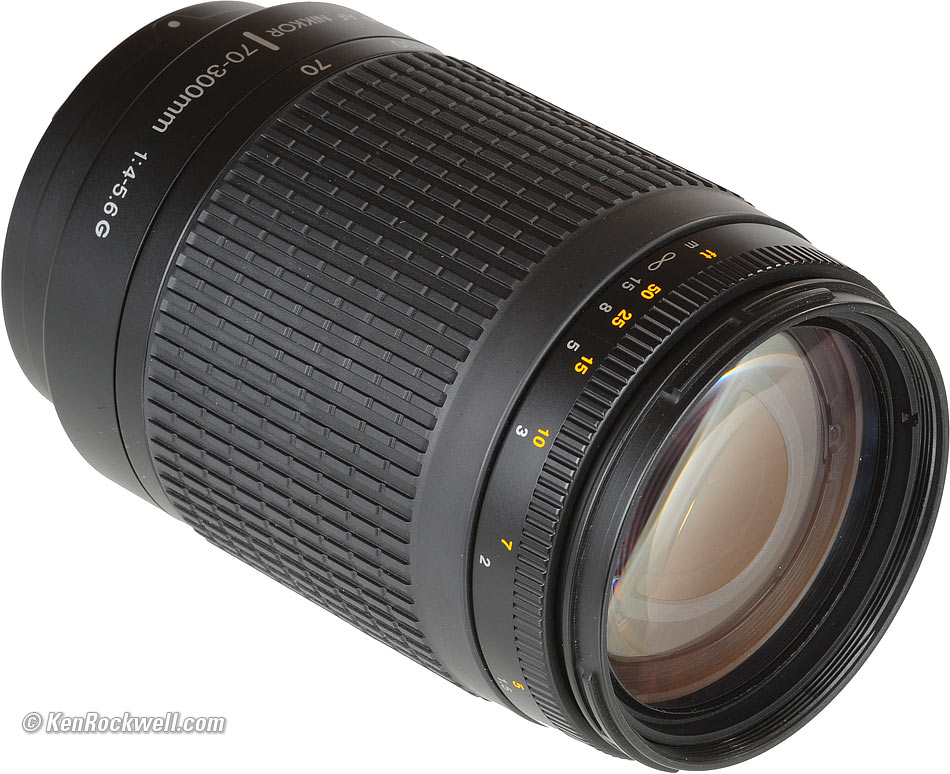
Nikon 70-300mm f/4-5.6 G (62mm filters, 17 oz./480g, 4.9'/1.5m close focus, about $50 used if you know How to Win at eBay; also available used at Amazon). bigger.
This all-content, junk-free website's biggest source of support is when you use those or any of these links to my personally-approved sources when you get anything, regardless of the country in which you live. Nikon does not seal its boxes in any way, so never buy at retail or any other source not on my personally approved list since you'll have no way of knowing if you're missing accessories, getting a defective, damaged, returned, non-USA, store demo or used lens. Get yours only from the approved sources I use myself for the best prices, service, return policies and selection. Thanks for helping me help you! Ken.
September 2024, April 2018 Nikon Reviews Nikon Lenses Nikon Flash All Reviews

Introduction
Top Intro Format Compatibility Specs
Performance Compared Recommendations

I buy only from these approved sources. I can't vouch for ads below. |



This lens has always beeen very inexpesnsive. I've used this lens and it works just great on FX DSLRs if you're cheap, especially if you use a tripod, but since it lacks stabilzation, will often give blurry photos hand held. This lens will not autofocus on mirrorless cameras on the FTZ or FTZ II adapter.
A much better lens is the AF-s 70-300mm f/4.5-5.6 VR, which has stabilzation for sharp photos and autofocuses and works fine on mirrorless with the FTZ and FTZ II.
For DX digital cameras, get a DX lens, not this one.
The 70-300mm G is very lightweight and has a broad zoom range. At 200mm - 300mm it's soft at large apertures, which may be great for portraits but bad for landscapes. If using it for landscapes just put it on a tripod and stop down to f/11 at 300mm.
If you want complete sharpness wide open at 200 mm and beyond get either of the newest FX 70-300mm AF-P VR or DX 70-300mm AF-P VR.
It's about $50 used if you know How to Win at eBay and also available used at Amazon.
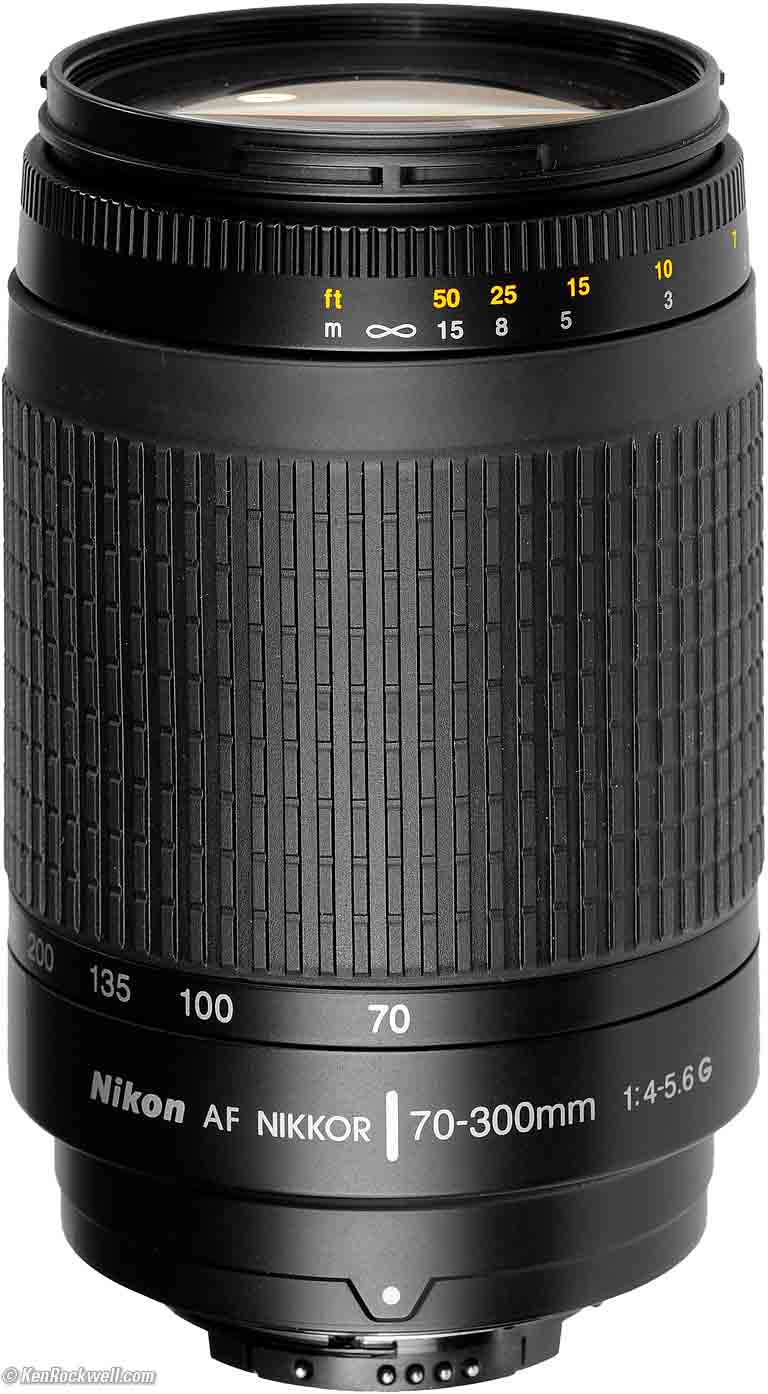
Nikon 70-300mm G. bigger.
Format
Top Intro Format Compatibility Specs
Performance Compared Recommendations
It's about $50 used if you know How to Win at eBay and also available used at Amazon.
This is a full frame FX lens, and I'm reviewing it as such.
It usually works on DX cameras, but any DX tele works much better.
Compatibility
Top Intro Format Compatibility Specs
Performance Compared Recommendations
It's about $50 used if you know How to Win at eBay and also available used at Amazon.
This lens works perfectly with every FX digital camera.
It also works on better DX cameras, but won't autofocus on many DX cameras. For DX cameras, any DX telephoto is worlds ahead of this lens.
This lens works great with most 35mm autofocus cameras, but won't work with any manual-focus cameras.
See Nikon Lens Compatibility for details on your camera. Read down the "AF, AF-D (screw)"and "G" columns.
Specifications
Top Intro Format Compatibility Specs
Performance Compared Recommendations
It's about $50 used if you know How to Win at eBay and also available used at Amazon.
Name
Nikon calls this the Nikon AF Nikkor 70-300mm f/4-5.6G.
AF: Autofocus.
NIKKOR: Nikon's brand name for all their lenses.
G: Gelded; has no aperture ring.
Optics
13 elements in 9 groups.
Front-group focus.
Pumper zoom.
Coverage
Diaphragm
9 straight blades.
Close Focus
4.9 feet (1.5m), which is pretty good at 300mm.
Filters
Plastic 62 mm filter thread.
Hood
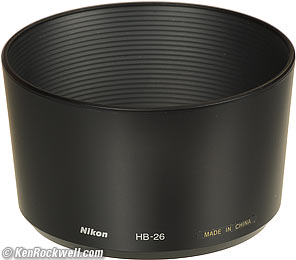
Nikon HB-26 hood.
It takes the HB-26 hood which seems identical to the HB-15 hood of the 70-300 ED lens.
Size
4.6" (117mm) long by 2.9" (74mm) around.
Weight
17 oz (480g).
Nikon Product Number
1928.
Price, USA
September 2024
About $50 used if you know How to Win at eBay.
April 2018
$170 at Adorama, at Amazon or at B&H.
April 2008
$140. (the gray-market version was the deal of the century for only $110 here).
Nikon 70-300mm G USA box.
Performance
Top Intro Format Compatibility Specs
Performance Compared Recommendations
Overall Autofocus Distortion Maximum Apertures
Mechanics Vibration Reduction Sharpness
It's about $50 used if you know How to Win at eBay and also available used at Amazon.
Overall
Fine at most focal lengths, soft at 200 to 300 mm wide open. Stop it down for best results at longer zoom settings.
Autofocus
Autofocus speed is identical to the 70-300mm f/4-5.6D ED AF, which is slow.
One full turn of the AF screw brings one from infinity to 40 feet.
The 70-210mm f/4-5.6D AF is much, much faster.
Distortion
On DX:
70mm: tiny bit of barrel distortion
90mm: no distortion.
100mm: fairly neutral, just the tiniest bit of pincushion.
135mm: very minor pincushion
200mm: pincushion
300mm: pincushion
Maximum Apertures
70mm: f/4
100mm: f/4.2
135mm: f/4.2
200mm: f/5
240mm: f/5.3
300mm: f/5.6
Mechanical Quality
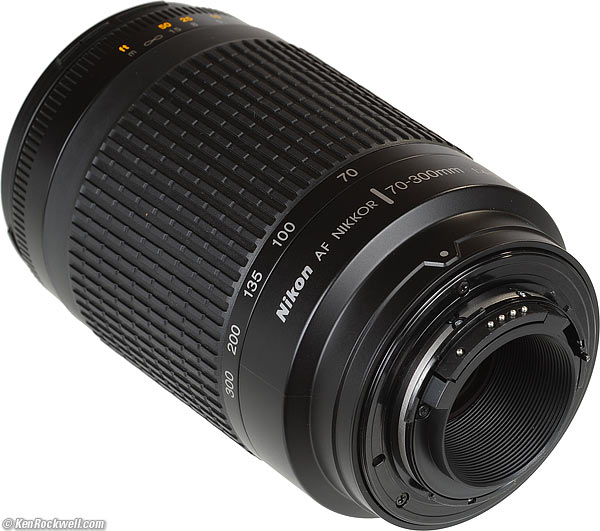
Plastic mount.
Hood
Plastic bayonet.
Front Bumper
None.
Filter Threads
Plastic.
Hood Bayonet Mount
Plastic.
Front Barrel
Plastic.
Focus Ring
Plastic.
Zoom Ring
Rubber-covered plastic.
Rear Barrel
Plastic.
Identity
Printed around the barrel near the mount.
Internals
Plastic.
Dirt Seal at Mount
No.
Mount
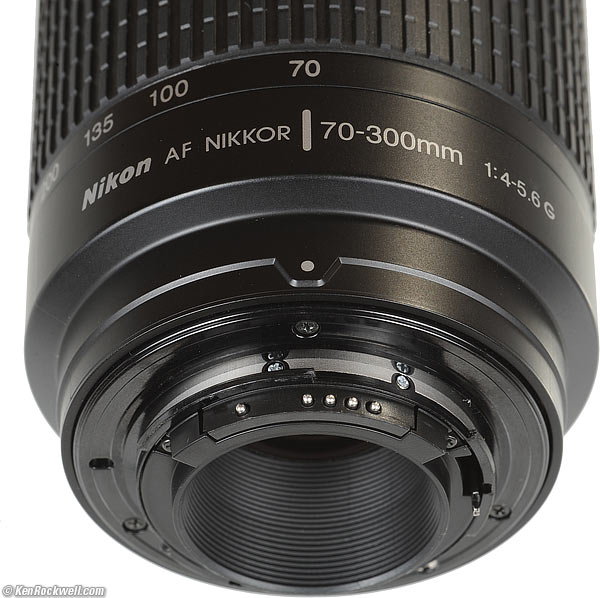
Nikon 70-300mm G plastic mount.
Plastic.
Markings
Paint.
Serial Number
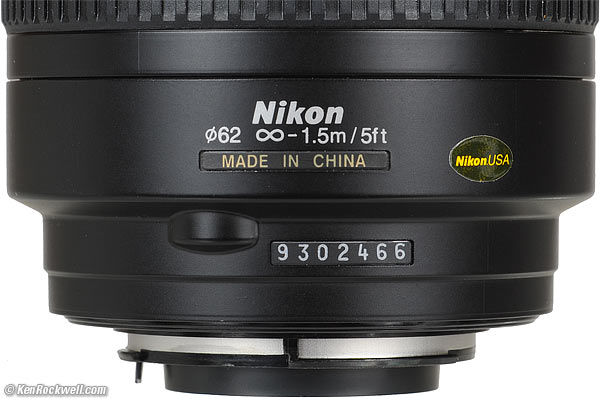
Nikon 70-300mm G bottom.
Sticker glued into recess in the bottom of the lens barrel.
Made in
China.
Vibration Reduction
On my D70 I can hand-hold it fine down to about 1/125 at 300 mm, at which point only about 50% of my shots are clear.
Light weight works against you here, since a heavier lens would do a better job of stabilizing the setup.
Of course the 80 - 400 VR lens stabilizes everything, but for over ten times the price you get less than ten times the stabilization with the 80 - 400 VR.
Sharpness
As tested on a DX digital camera.
It will be difficult for many people to get sharp images at the longer focal lengths because one will need to use smaller apertures, but that leads to longer shutter speeds and more potential for blur. Blur is also a problem because this such a lightweight lens. Big fat telephotos help stabilize camera shake due to their weight alone, and others incorporate additional special active stabilization. This $170 G lens has none of that, so don't blame softness on just the lens since it just as likely could be your technique.
70 mm:
f/4: sharp center,
a little soft corners
f/5.6: sharp center, just a tad softer in the farthest corners
f/8: sharp all over
f/11: sharp all over
100 mm:
f/4.2: sharp center,
softer corners
f/5.6: sharp all over, a little bit softer corners
f/8: sharp all over
f/11: sharp all over
135 mm:
f/4.2: reasonably
sharp center, soft corners
f/5.6: reasonably sharp center, slightly soft corners
f/8: sharp center, slightly softer corners
200 mm:
f/5: soft; secondary
lateral chromatic aberration
f/5.6: soft; secondary lateral chromatic
aberration
f/8: reasonably sharp and less secondary
lateral chromatic aberration
f/11: reasonably sharp.
300 mm:
f/5.6: Soft, or pleasant
spherical aberration for portraits. Secondary
lateral chromatic aberration.
f/8: Soft. Secondary lateral chromatic
aberration.
f/11: Much better, still has secondary
lateral chromatic aberration.
At 300 mm focus isn't always dead-on, either. Watch out for narrow depth of field as well at f/5.6. Try f/5.6 for deliberate soft focus effects, since that's what happens at f/5.6.
Compared
Top Intro Format Compatibility Specs
Performance Compared Recommendations
It's about $50 used if you know How to Win at eBay and also available used at Amazon.
It seems identical to the $310 AF 70-300mm f/4-5.6D ED with the exception of being half the price and having a plastic lens mount bayonet instead of metal. The ED version is also mostly plastic. Even the hoods and AF gearing are the same.
I doubt the glass is any different between the ED and this G version. Remember that the ED version really seems to be made by Tamron and only one small internal element claims to be ED probably for marketing and promotional reasons, not any of the important front elements. I don't really consider that the "ED" moniker means anything on the ED version.
The only visible differences between the G and ED are:
1.) ED lens has metal mount, G has plastic. (also a slight difference in weight)
2.) ED has aperture ring, G does not. The G is easier to use for cameras made in the past ten years, and the ED can work even on ancient and manual focus film cameras.
The similarities are:
1.) Same specs for number of lens groups and elements
2.) Same size
3.) Same AF speed and gearing
4.) Same close focus distance
5.) Same nice 9-blade diaphragm
6.) Looks like the same optics inside and identical movement of the lens groups while zooming and focusing
Yes, compared to a professional lens like the huge $900 80 - 200 mm f/2.8 or $1,500 80 - 400 VR it's dinky.
This is Nikon's cheapest and nastiest 70-300mm lens ever. In the right hands it takes great pictures, but do have a look at the new state-of-the-art FX 70-300mm AF-P VR and DX 70-300mm AF-P VR for much better results, especially because of Vibration Reduction.
Recommendations
Top Intro Format Compatibility Specs
Performance Compared Recommendations
It's about $50 used if you know How to Win at eBay and also available used at Amazon.
If you are looking for a cheap, lightweight zoom for film or FX this is excellent for the price. I can't see any reason to buy the so-called ED version over this except for the metal mount and compatibility with my manual focus cameras.
For DX digital cameras, I'd suggest any Vibration Reduction (VR) lens instead, especially the 55-300mm VR or DX 70-300mm AF-P VR.
For $170 US how can you go wrong? Idiots on eBay keep bidding the prices of these up above what they could buy them for new from a legitimate dealer! Try one and if you hate it send it back.
If you stop it down a little or don't zoom beyond 200 mm its images look the same as the $1,000 lenses. Just don't expect it to last in heavy, daily professional abuse.
It keeps your money in your pocket where it belongs. You could spend a week in France for the $1,000 difference and make a zillion eye-popping photos you wouldn't get with a more expensive lens sitting at home. It's well worth the $170 - on FX. Don't use this on DX; use a DX lens.
I use a clear (UV) protective filter instead of a cap (exactly like an iPhone) so I'm always ready to shoot instantly. I only use a cap when I throw this in a bag with other gear without padding — which is never. The UV filter never gets in the way, and never gets lost, either.
The very best protective filter is the Hoya multicoated HD3 62mm UV which uses hardened glass and repels dirt and fingerprints.
For less money, Olympus makes an PRF-ZD62 PRO Clear Protection Filter which is also optically superb, and the Nikon 62mm NC (No Color) protective filter is also an excellent choice, especially if you don't expect to abuse your filter and keep your fingers off the glass, but the Hoya HD3 is the toughest and the best.
Filters last a lifetime, so you may as well get the best today. The Hoya HD3 stays cleaner than the others since it repels oil and dirt. I use my classic Nikon 62mm L37c (multicoated 370 nanometer UV) filters because I bought them back in the 1980s when they were the best, and they never wear out. Putting a 1980s 62mm L37c on this new lens gives a tip of the hat to when Nikon ruled the photography world.
If I was working in nasty, dirty areas, I'd use an uncoated 62mm Tiffen UV filter instead. Uncoated filters are much easier to clean, but more prone to ghosting.
For color slides like Fuji Velvia 50, I use a 62mm 81A outdoors.
For B&W film outdoors to make clouds look natural in the sky I use a 62mm Hoya HMC K2 Yellow, or usually a 62mm Orange for a stronger effect, or a 62mm Hoya HMC Red for the most dramatic skies or to hide pimples on skin.
All these filters are just as sharp and take the same pictures, the difference is how much abuse they'll take and stay clean and stay in one piece. Since filters last a lifetime or more, there's no reason not to buy the best as it will last you for the next 40 years. Filters aren't throwaways like digital cameras which we replace every few years, like it or not. I'm still using filters I bought back in the 1970s!
It's about $50 used if you know How to Win at eBay and also available used at Amazon.
This all-content, junk-free website's biggest source of support is when you use those or any of these links to approved sources when you get anything, regardless of the country in which you live. Nikon does not seal its boxes in any way, so never buy at retail or any other source not on my personally approved list since you'll have no way of knowing if you're missing accessories, getting a defective, damaged, returned, non-USA, store demo or used lens. I use the stores I do because they ship from secure remote warehouses where no one gets to touch your new camera before you do. Buy only from the approved sources I use myself for the best prices, service, return policies and selection.
Thanks for helping me help you!
Ken Rockwell
© Ken Rockwell. All rights reserved. Tous droits réservés. Alle Rechte vorbehalten.
Help Me Help You
I support my growing family through this website, as crazy as it might seem.
The biggest help is when you use any of these links when you get anything. It costs you nothing, and is this site's, and thus my family's, biggest source of support. These places always have the best prices and service, which is why I've used them since before this website existed. I recommend them all personally.
If you find this page as helpful as a book you might have had to buy or a workshop you may have had to take, feel free to help me continue helping everyone.
If you've gotten your gear through one of my links or helped otherwise, you're family. It's great people like you who allow me to keep adding to this site full-time. Thanks!
If you haven't helped yet, please do, and consider helping me with a gift of $5.00.
As this page is copyrighted and formally registered, it is unlawful to make copies, especially in the form of printouts for personal use. If you wish to make a printout for personal use, you are granted one-time permission only if you PayPal me $5.00 per printout or part thereof. Thank you!
Thanks for reading!
Ken Rockwell