Nikon EM
Nikon's First Crappy 35mm SLR (1979 ~ 1983)
Introduction New Good Bad Missing
Specifications Optional Accessories
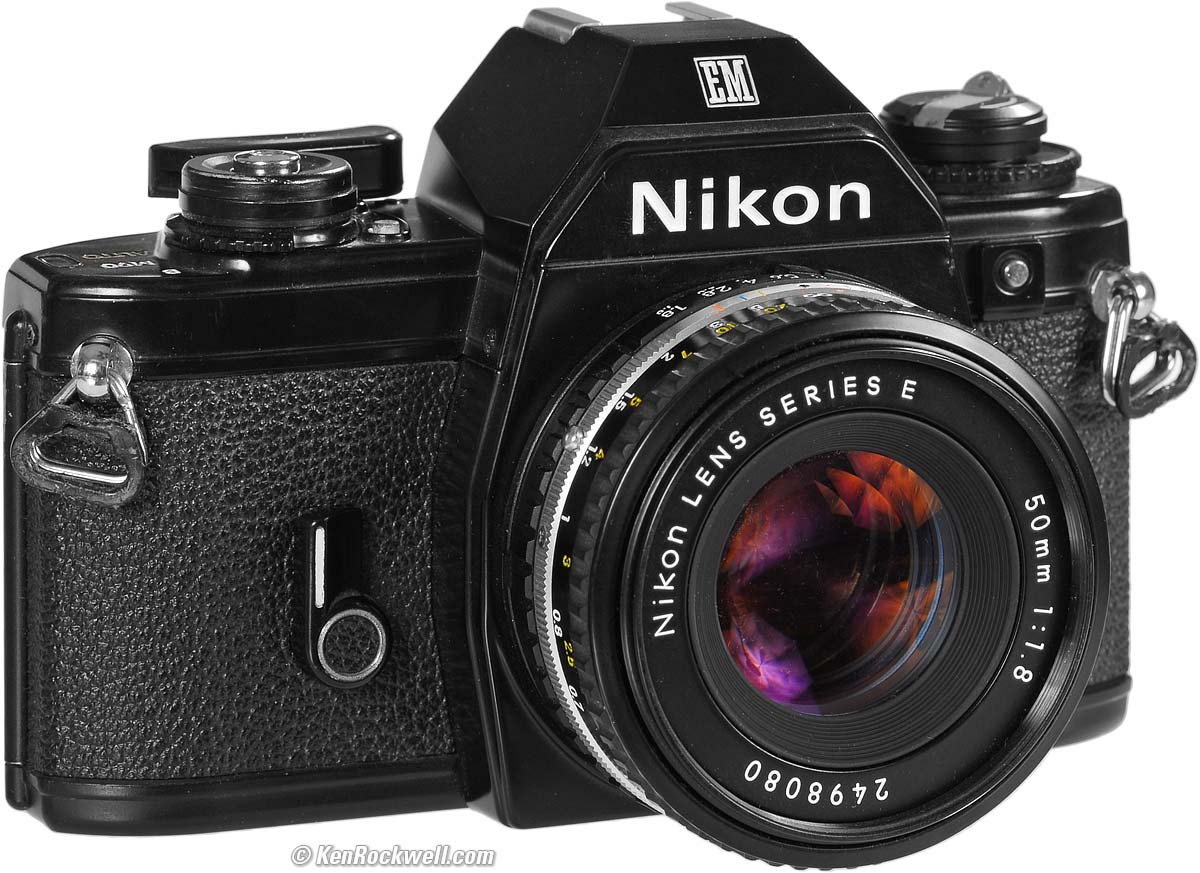
Nikon EM (16¼ oz./460g empty, runs on two A76 cells) and 50mm f/1.8 SERIES E. bigger.
The EM body-only is about $50 used if you know How to Win at eBay, and about $85 used with the 50mm f/1.8 SERIES E as shown if you know How to Win at eBay.
This all-content, junk-free website's biggest source of support is when you use those or any of these links to approved sources when you get anything, regardless of the country in which you live. Thanks for helping me help you! Ken.
March 2025 Better Pictures Nikon Nikon 35mm SLRs Nikon Lenses Manual-Focus Lenses Flash All Reviews
Why Fixed Lenses Take Better Pictures

Nikon EM and 50mm f/1.8 SERIES E. bigger.

Nikon EM. bigger.

Introduction top
Introduction New Good Bad Missing
Specifications Optional Accessories

I buy only from these approved sources. I can't vouch for ads below. |



This is one of Nikon's worst 35mm SLRs.
The EM was a very basic 35mm SLR designed to cash-in on the popularity of consumer 35mm SLRs and sell a Nikon to people like my mom who just wanted a "good" camera for vacations and general picture-taking, but today I'd pass on it because 1.) if you're wanting a 35mm camera, this is entirely too basic for someone with a genuine interest in photography, and 2.) you can get a much better Nikon for about the same price today in 2025.
If you own one, read on, but if you want to buy a 35mm camera today, you're much better off paying about the same amount for a professional Nikon like the Nikon FE, FE2, FM, FM2 or FA, which sell for about the same price today as this awful EM. The Nikon FM3a is the newest, and still sells for a premium.
Back in the 1980s these were all very expensive, like VCRs, so you had to really push if you wanted an upmarket camera and spend the equivalent of thousands of dollars, so you’d settle for an EM at $400 or FG at $500, rather than getting an FA at $2,500 or an F2 or F3 at $5,000 (very rough price equivalents today).
Today we can get pro Nikon 35mm cameras used for about the same price as much lower performance consumer models like the EM or lower 35mm brands like Olympus or Canon. I lived through when these were all sold new; back in the day if you could get a pro Nikon for the same price as a Canon or something like this EM, you'd jump at the chance.
This is why I’m amazed that anyone bothers with anything other than Nikon for 35mm manual-focus SLRs today, and also wonder why people bother looking at the low models like the EM and FG. I guess it's ignorance of the reality from which these cameras come.
Ever since 1946 Nikon, coming from a military background, made only the finest and most expensive professional 35mm cameras. Getting greedy in the 1970s when 35mm SLRs became the rage, Nikon decided to make its first consumer camera, this EM, and a series of optically wonderful but mechanically weak lenses, the SERIES E.
The EM outraged Nikon shooters, as it was unworthy of the Nikon name because it was horrendously plastic by the standards of its day. Even Canon's AE-1 made its plastic top and bottom covers appear to be metal, which the EM simply looked and felt like plastic. Arrrgh! The EM was widely hated as a crappy plastic camera, Nikon's only non-pro SLR at the time.
The EM was a very light and inexpensive consumer camera, although today people don't realize how basic it was and pay about as much for it as the good Nikon 35mm cameras.
This EM works with all Nikon AI, AI-s, AI-updated, AF, AF-D and AF-S lenses, so long as they have an aperture ring. See Nikon Lens compatibly as well as the EM section of that page here; you don't need to use the SERIES E lenses unless you want to.
As of March 2025, the EM body-only is about $50 used if you know How to Win at eBay, and about $85 used with the 50mm f/1.8 SERIES E as shown if you know How to Win at eBay.
What were SERIES E lenses?
The Nikon EM works with all of Nikon's professional NIKKOR manual-focus lenses, as well as the cheap SERIES E lenses that were announced along with this cheap EM.
The SERIES E lenses had very simple but sharp and proven optics. Instead of being made to Nikon's usual bulletproof professional standards with all-metal precision, the SERIES E lenses had plastic barrels, plastic aperture rings and were only single coated, not multicoated. That was OK because they used proven, simple designs that were super sharp and didn't need multicoating.
Nikon was so embarrassed by the SERIES E lenses that it was honest, and are among the only lenses that Nikon honestly admitted weren't worthy of the NIKKOR trademark. There is no such thing as a NIKKOR SERIES E; it's just SERIES E. No SERIES E lens will ever say NIKKOR and anyone trying to sell you one that claims a SERIES E is a NIKKOR is lying.
Today the SERIES E lenses are wonderful if you want an ultralight plastic-barreled manual focus lens, but don't pay much for it. I digress; the SERIES E lenses came out with this camera, but you can use the same lenses on the EM as with every other Nikon 35mm SLR.
The SERIES E were discontinued after several years. Nikon was too honest, advertising them as second-rate. Nikon learned that no one pays good money for second rate, when the SERIES E still sold for more than third-party lenses. LEICA failed to learn from this, and discovered exactly the same thing with their failed series of second-rate SUMMARIT-M f/2.5 lenses.
New intro top
 Nikon's first crappy plastic 35mm SLR.
Good intro top
 Ultralight weight.
Simple controls.
Modern bright focus screen.
Good electronic auto exposure system.
Excellent shutter-speed needle in the finder.
It will cheerfully make very long automatic exposures at night.
The unmarked button on the front is a +2 stop backlight control; press it to add exposure for backlit portraits or shots in snow or of mostly overcast skies.
Two mechanical shutter speeds, Bulb and M90 (1/90) in case your battery died.
Dedicated to the Nikon SB-E flash, which while the flash exposure was still read by a sensor on the flash, automatically set the exposure based on the ASA (ISO film speed ) and lens aperture set on the camera and lens; you didn't have to make any other settings other than turn-on the flash.
Bad intro top
 The EM has a flaw where its simple mechanics lacked a proper mirror damper, so especially with its ultra-low weight and lightweight lenses, often would make slightly blurry pictures at some shutter speeds due to mirror bounce shaking the camera.
No exposure compensation or auto exposure lock button for serious shooting; only a +2 stop unmarked backlight button on the front.
No metered manual or other exposure modes, AUTO aperture-priority only.
Missing intro top
 Only one AUTO (aperture priority) exposure mode other than unmetered manual at Bulb or 1/90.
No power switch. Set the EM to M90 or BULB if you're worried something might press the shutter and wake up the camera.
No exposure compensation or auto exposure lock button; only a +2 stop unmarked backlight button on the front.
No TTL flash metering.
No Matrix Metering; center-weighted only.
Specifications top
Introduction New Good Bad Missing
Specifications Optional Accessories
As of March 2025, the EM body-only is about $50 used if you know How to Win at eBay, and about $85 used with the 50mm f/1.8 SERIES E as shown if you know How to Win at eBay.
Basics
Mostly metal innards with plastic top and bottom covers.
Runs on two A76 cells.
Shutter
Electronic metal focal plane shutter rated 1s ~ 1/1,000, but will make much longer metered automatic time exposures if needed for night exposures.
Two manual mechanical shutter speeds (in case the battery dies): Bulb and 1/90.
Flash Sync: 1/90.
10s self-timer.
Meter & Exposure
Silicon Photo Diode center-weighted meter, AUTO (aperture priority) exposure mode only.
Rated LV 2 ~ LV 18 metering and exposure range with the 50mm f/1.8 SERIES E, while it actually works great over a much wider range.
Finder
92% coverage.
0.86× magnification with 50mm lens.
Modern laser-cut bright screen with split-image rangefinder, microprism collar and matte surround.
Analog shutter speed needle and flash ready LED on the left side.
Size
3.4 × 5.3 × 2.1 inches HWD.
86 × 135 × 54 mm HWD.
Weight
16¼ oz. (460g) empty.
Optional Accessories top
Introduction New Good Bad Missing
Specifications Optional Accessories
Standard threaded cable releases.
Lenses
Works magnificently with all Nikon AI, AI-s, AI-P and AI-updated manual-focus lenses.
Also works great with any autofocus lens with an aperture ring.
Will not work properly (will underexpose severely) with any lens not having an aperture ring.
Will not focus at all with any AF-P lens.
Nikon Z lenses use a different mount and won't attach at all.
Flash
Dedicated to the Nikon SB-E flash; should work with other Nikon flash. There's an in-finder ready light LED, and when the flash is on the camera in AUTO it magically sets the camera to the 1/90 sync speed.
Motor Drive (Winder)
System Case
There was an optional Nikon FB-E molded polypropylene system waist-case with closed-cell polystyrene inside with spaces for the camera and 50mm f/1.8 SERIES E, Nikon SB-E flash, Nikon MD-E winder, spare 100mm f/2.8 SERIES E, another spot for the 28mm f/2.8 SERIES E or 35mm f/2.5 SERIES E and space for a few more small items.
User's Guide top
Introduction New Good Bad Missing
Specifications Optional Accessories
As of March 2025, the EM body-only is about $50 used if you know How to Win at eBay, and about $85 used with the 50mm f/1.8 SERIES E as shown if you know How to Win at eBay.
Read all 34 short pages of Nikon's original printed EM booklet (user's manual) and you'll know far more than spending hours reading online forums.
It runs on two A76 cells.
There's no power switch; it wakes automatically when you lightly tap the shutter button. Set the EM to M90 or BULB if you're worried something might press the shutter and wake up the camera.
ASA means ISO today when setting film speed.
This EM works with all Nikon AI, AI-s, AI-updated, AF, AF-D and AF-S lenses, so long as they have an aperture ring. See Nikon Lens compatibility as well as the EM section of that page; you don't need to use the SERIES E lenses unless you want to.
The small silver button on top near the shutter release is the battery test, which should light the red LED below it.
The unmarked button on the front is a +2 stop backlight exposure control.
There is no exposure compensation dial; you change exposure by changing the ASA (ISO) setting.
There is only one exposure mode, the AUTO setting, which is aperture priority. You set the aperture on the lens, and the camera uses whatever shutter speed it needs to for the correct exposure. Look at the needles and avoid the slower speeds in red to avoid blur. It also beeps at the slower speeds (1/30 or slower) to warn of blur and if you need a shutter speed faster than its maximum of 1/1,000.
It will cheerfully make very long metered automatic time exposures at night. Put it on a tripod, chose a larger aperture like f/2.8, set the self timer and let it do its thing. If the camera makes such a long exposure that it won't close the shutter, turn the selector to M90 to stop it (I believe).
Recommendations top
Introduction New Good Bad Missing
Specifications Optional Accessories
Forget this camera. If you do get one out of nostalgia, be sure to get a complete set with Nikon's wonderful literature, manuals, and the SB-E flash at a minimum.
If you want to shoot 35mm today you really want a rangefinder camera for sharper images like a LEICA M or CONTAX G2, not a 35mm SLR. Even Nikon's newest AF DSLR lenses look like they're broken by comparison since they look so much softer than the ZEISS or LEICA lenses used with the rangefinder cameras. In olden days 35mm was only shot professionally for news, sports and action where speed was more important than sharpness. Today in 2025 when we shoot 35mm, we usually are shooting things that hold still and care about sharpness.
If you want a 35mm SLR, then at least get a professional Nikon 35mm SLR like the Nikon FE, FE2, FM, FM2 or FA, which sell for about the same price today as this awful EM. The Nikon FM3a is the newest 35mm Nikon manual-focus SLR, and still sells for a premium today.
If you insist on buying an EM, know that the first and crappiest versions had a blue backlight exposure compensation button on the front. These earliest versions used paper variable-resistance elements in the meter system to read lens apertures. Most EMs you'll see and as I show here are the better, newer versions with a silver compensation button and have ceramic variable resistance elements.
Always use Nikon NIKKOR manual-focus lenses on manual focus cameras. AF lenses work fine (see Lens Compatibility), but they are plasticy and gross. For the authentic Nikon experience, revel in the immortal precision of Nikon NIKKOR manual-focus lenses, on whose reputation Nikon still rests today.
As of March 2025, the EM body-only is about $50 used if you know How to Win at eBay, and about $85 used with the 50mm f/1.8 SERIES E as shown if you know How to Win at eBay.
This all-content, junk-free website's biggest source of support is when you use those or any of these links to approved sources when you get anything, regardless of the country in which you live. Thanks for helping me help you! Ken.
© Ken Rockwell. All rights reserved. Tous droits réservés. Alle Rechte vorbehalten. Alla rättigheter förbehållna. Toate drepturile rezervate. Omnia jura reservata. Ken Rockwell® is a registered trademark.
Help Me Help You top
I support my growing family through this website, as crazy as it might seem.
The biggest help is when you use any of these links when you get anything. It costs you nothing, and is this site's, and thus my family's, biggest source of support. These places always have the best prices and service, which is why I've used them since before this website existed. I recommend them all personally.
If you find this page as helpful as a book you might have had to buy or a workshop you may have had to take, feel free to help me continue helping everyone.
If you've gotten your gear through one of my links or helped otherwise, you're family. It's great people like you who allow me to keep adding to this site full-time. Thanks!
If you haven't helped yet, please do, and consider helping me with a gift of $5.00.
As this page is copyrighted and formally registered, it is unlawful to make copies, especially in the form of printouts for personal use. If you wish to make a printout for personal use, you are granted one-time permission only if you PayPal me $5.00 per printout or part thereof. Thank you!
Thanks for reading!
Ken.