Zeiss 150mm f/4
Sonnar T✻ CF (1982-2013)
Sample Images Intro Compatibility Format Specifications
Performance Compared Usage Recommendations More

ZEISS Sonnar T✻ 150mm f/4 CF (fits Hasselblad V system, this sample from 1987 (B78 = February 1987), B60 filters, 27.5 oz./780g, 4.5'/1.4m close focus, about $410 ($260 ~ $500) used if you know How to Win at eBay.) bigger. I got mine at this link directly to them at eBay.
This all-content, junk-free website's biggest source of support is when you use those or any of these links to my personally-approved sources when you get anything, regardless of the country in which you live. Use only the approved sources I use myself for the best prices, service, return policies and selection. Thanks for helping me help you! Ken.
January 2025, January 2016 Hasselblad Zeiss Contax Mamiya LEICA Nikon Canon All Reviews
Why fixed lenses take better pictures
Sample Images
Top Sample Images Intro Compatibility Format Specifications
Performance Compared Usage Recommendations More
From Route 66, February 2016:
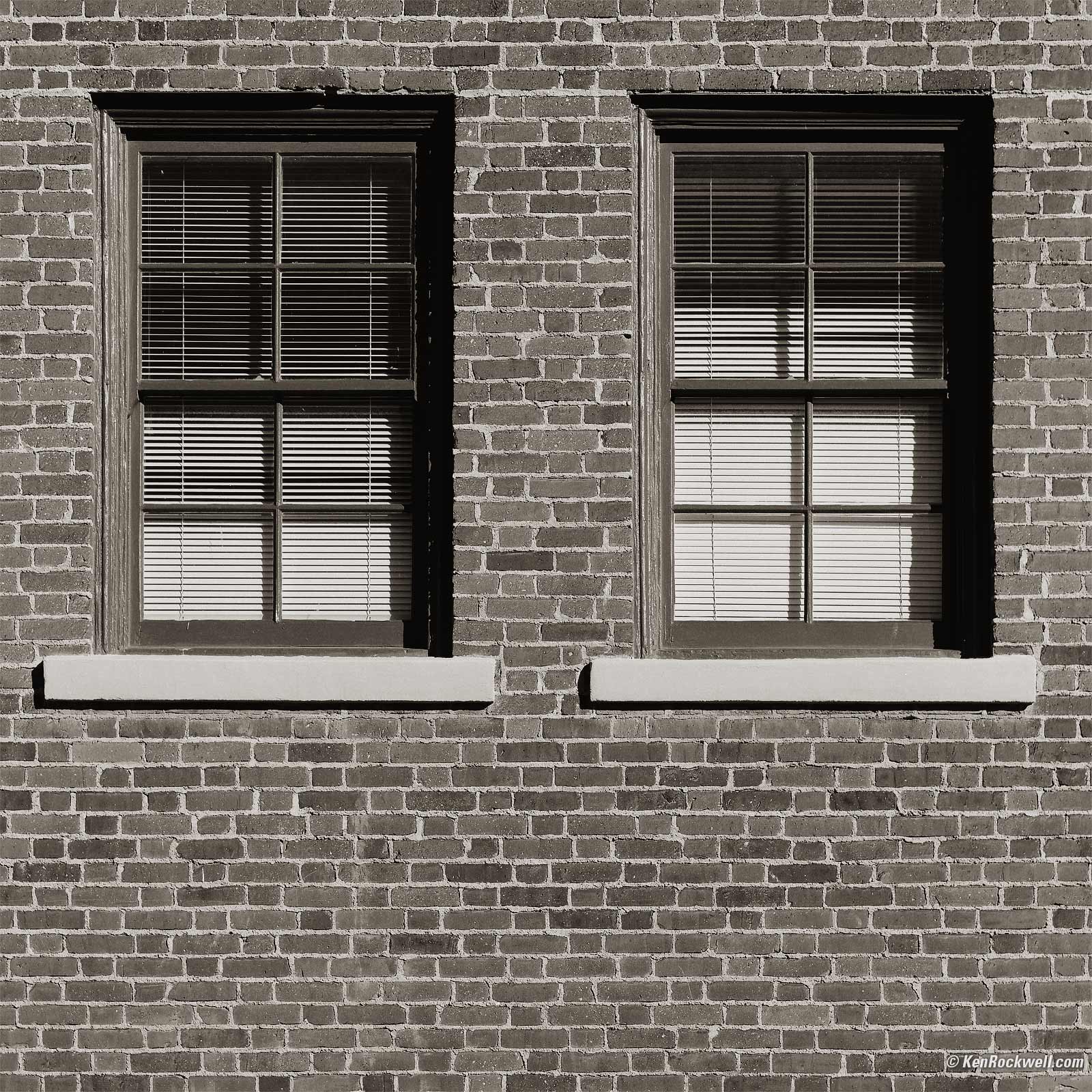
Brick Wall Outside Route 66 Museum, 3:06 P.M. 1987 Zeiss Sonnar T✻ 150mm f/4 CF with B60 Heliopan Yellow filter, 10 meters focus distance, 1992 Hasselblad 503 CX with 1985 PME metered prism, Kodak T-Max 100 in 1993 A12 magazine, f/13.5 at 1/125 (EV 14/15). More technical details. bigger.
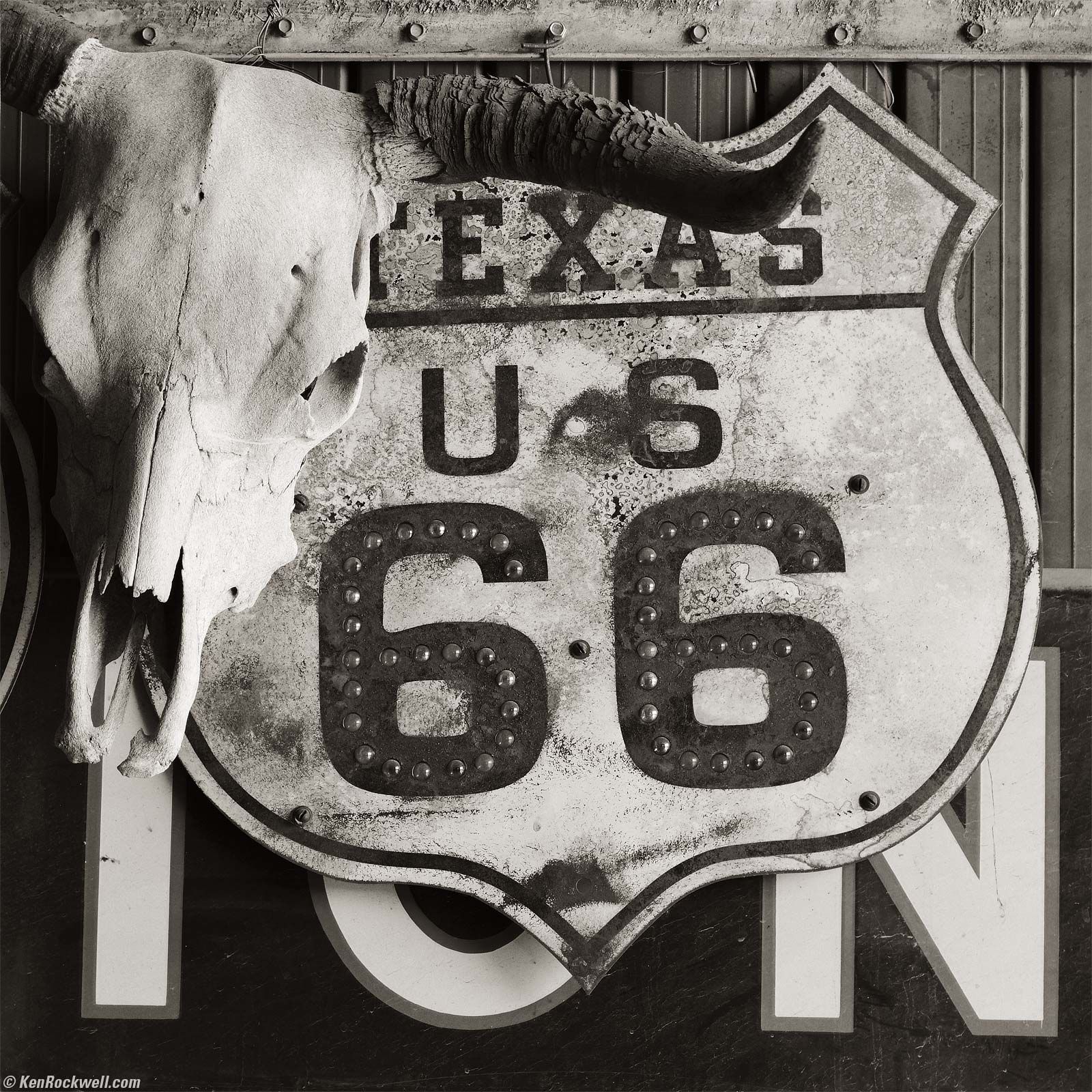
Texas Route 66 Sign with Skull, 4:14 P.M. 1987 Zeiss Sonnar T✻ 150mm f/4 CF, no filter, 7.2 foot focus distance, 1992 Hasselblad 503 CX with 1985 PME metered prism that says EV 8, Kodak T-Max 100 in 1993 A12 magazine, f/22 for 3 seconds to add ½ stop for reciprocity failure. More technical details. bigger.
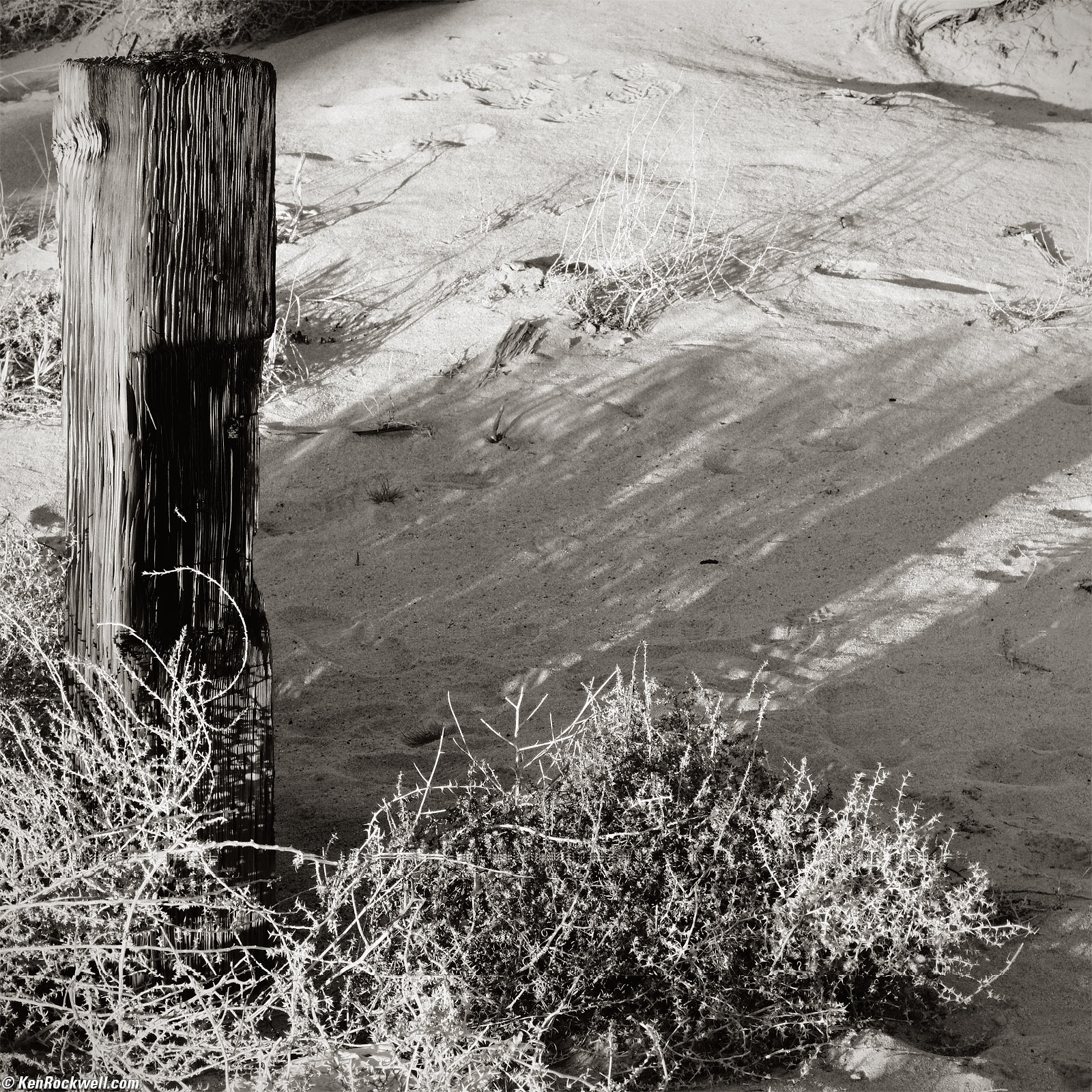
Post and Weeds in Last Light, 5:07 P.M. 1987 Zeiss Sonnar T✻ 150mm f/4 CF with B60 Heliopan Yellow filter, 4.2 meters focus distance, 1992 Hasselblad 503 CX with 1985 PME metered prism, Kodak T-Max 100 in 1993 A12 magazine, PME reads EV 11, f/32 at 1/2. More technical details. bigger.
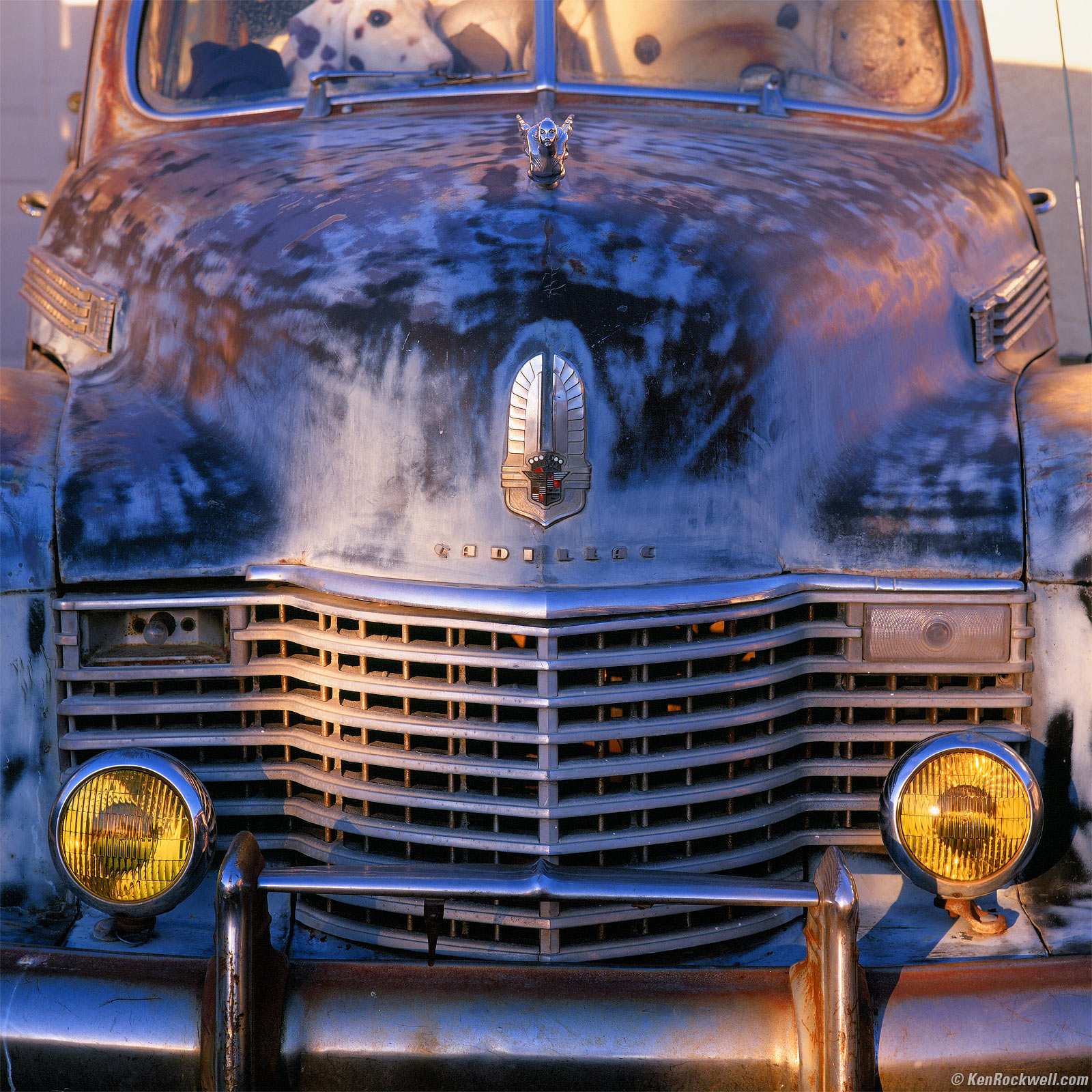
Cadillac with Yellow Eyes, Route 66, 7:19 A.M. 1987 Zeiss Sonnar T✻ 150mm f/4 CF with B60 Hasselblad CR 1,5 warming filter, 3.5 meters focus distance, 1992 Hasselblad 503 CX with 1985 PME metered prism reading EV 10/11, Fuji Velvia in 1996 Hasselblad E24 magazine, 1/8 second at f/13. More technical details. bigger.
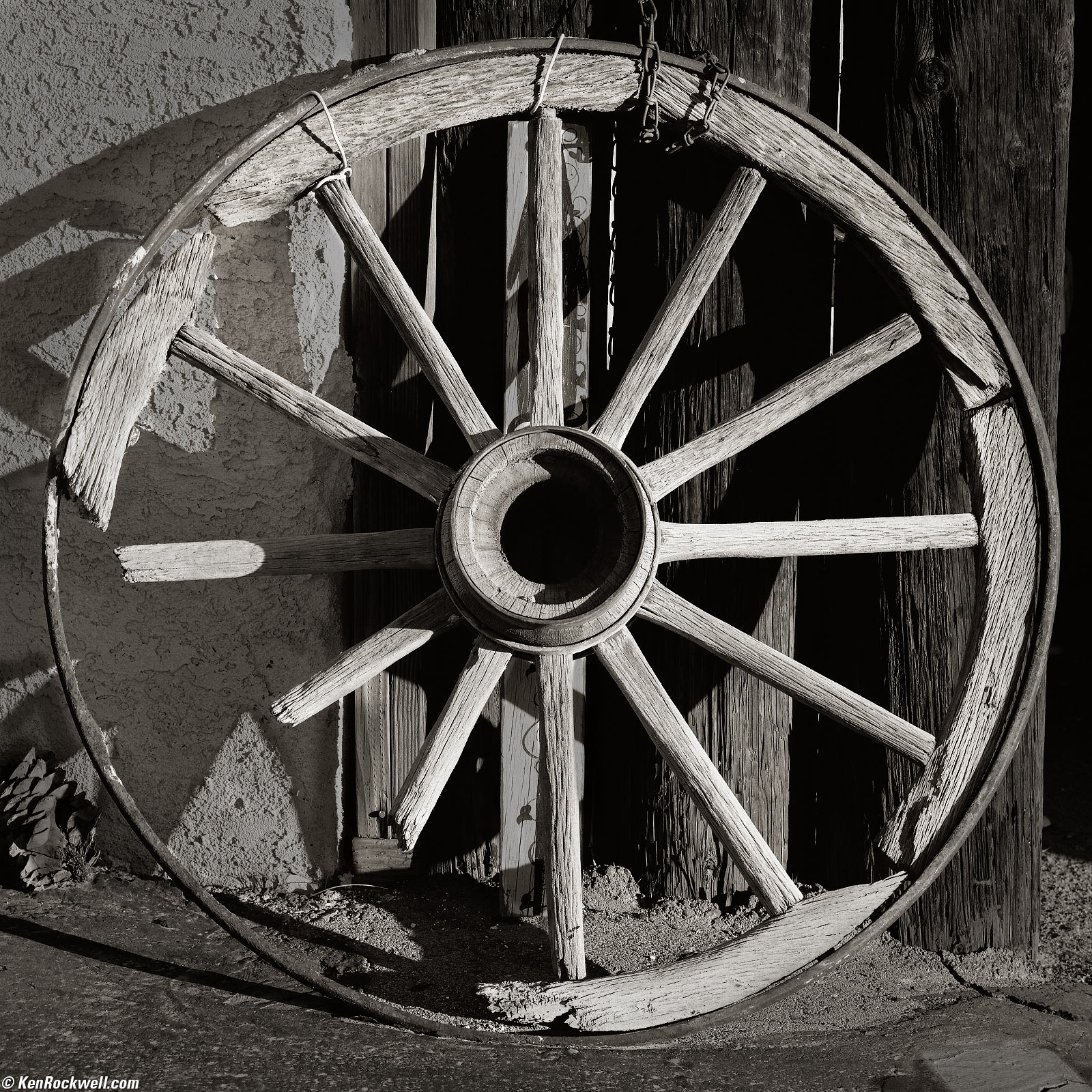
Weathered Wagon Wheel, Route 66, 7:34 A.M. 1987 Zeiss Sonnar T✻ 150mm f/4 CF with no filter, 3.5 meter focus distance, 1992 Hasselblad 503 CX with 1985 PME metered prism which read EV 13, Kodak T-Max 100 in 1993 A12 magazine, f/16 at 1/30. More technical details. bigger.
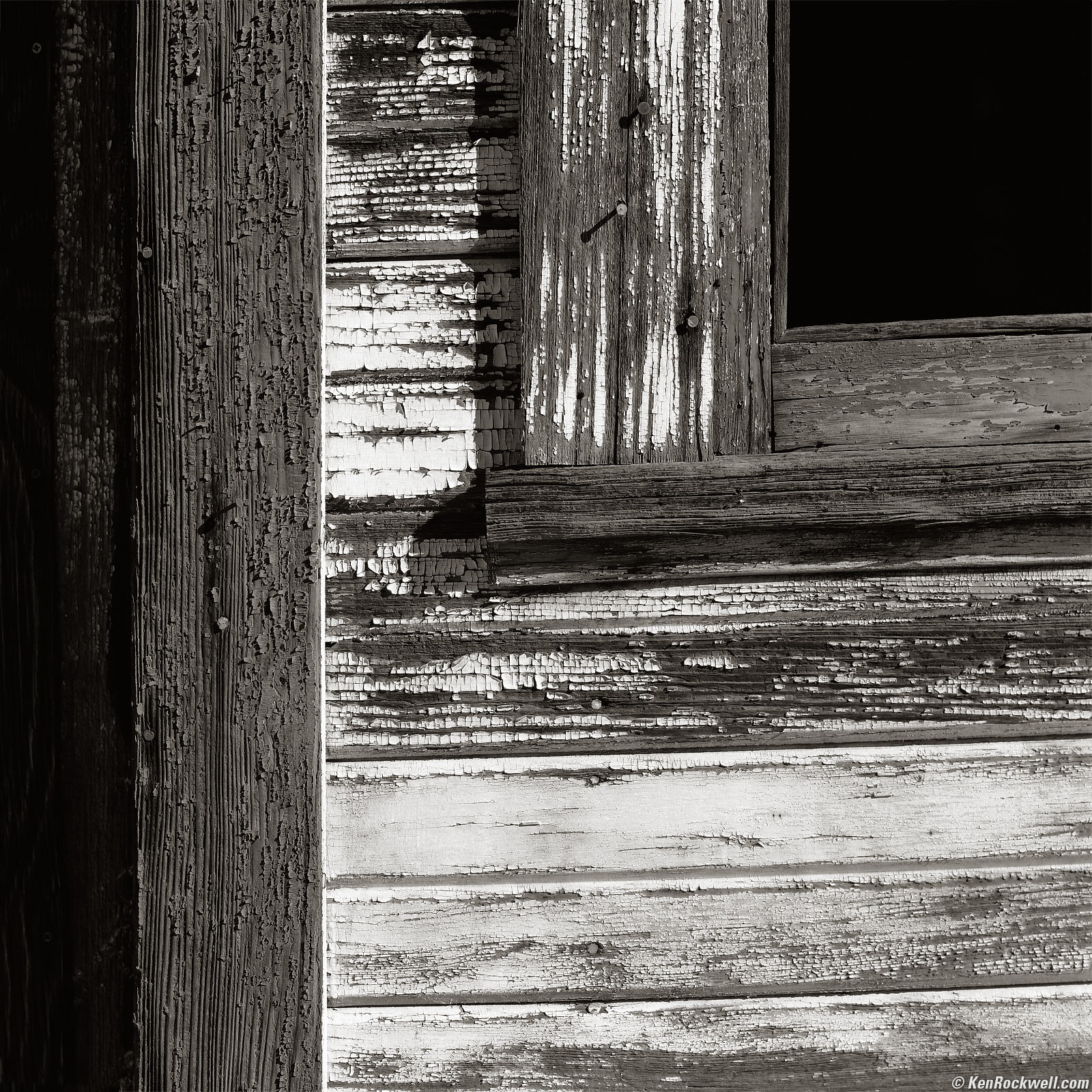
Weathered Wood Door and Window, Daggett, Route 66, 9:32 A.M. 1987 Zeiss Sonnar T✻ 150mm f/4 CF with Heliopan B60 Yellow filter, 1992 Hasselblad 503 CX with 1985 PME metered prism which read EV 14, Kodak T-Max 100 in 1993 A12 magazine, f/8 at 1/250. More technical details. bigger.
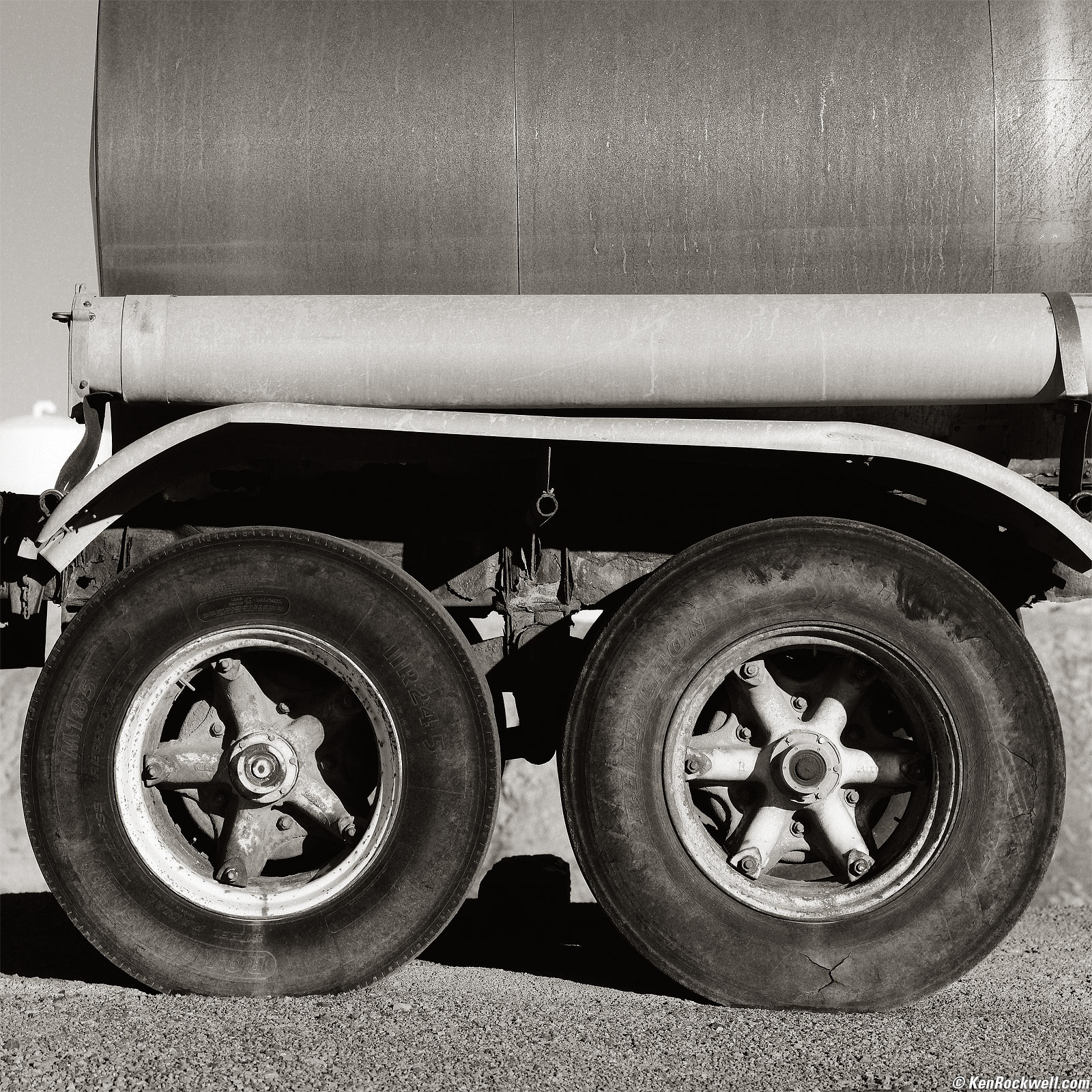
Two Wheels on an Old Abandoned Trailer, Route 66, 4:00 P.M. 1987 Zeiss Sonnar T✻ 150mm f/4 CF with Heliopan B60 Yellow filter, 1992 Hasselblad 503 CX with 1985 PME metered prism, Kodak T-Max 100 in 1993 A12 magazine, f/9.5 at 1/125. More technical details. bigger.
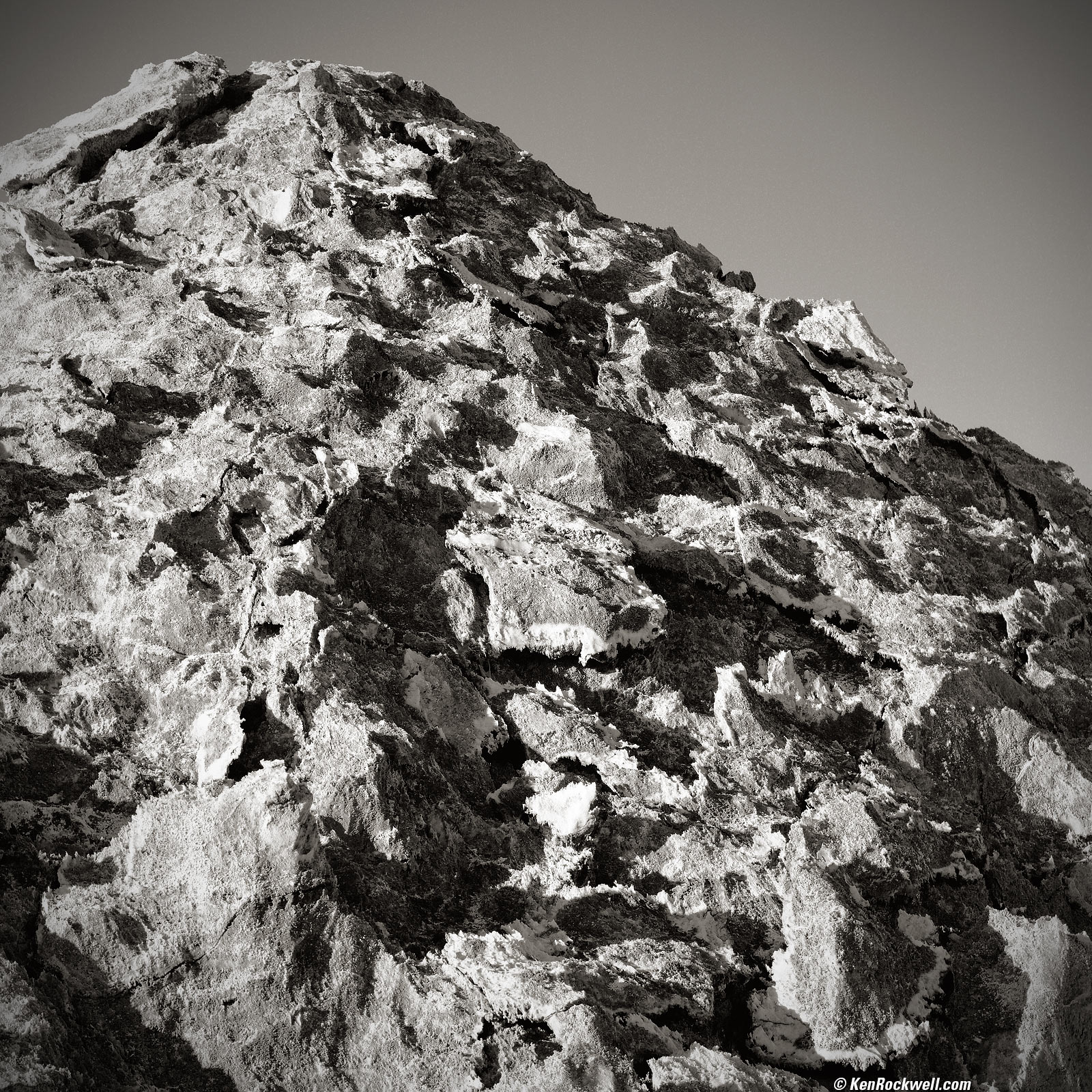
Slag Mountain, Route 66, 4:05 P.M. 1987 Zeiss Sonnar T✻ 150mm f/4 CF with Heliopan B60 Yellow filter, 10 meter focus distance, 1992 Hasselblad 503 CX with 1985 PME metered prism, Kodak T-Max 100 in 1993 A12 magazine, f/16 at 1/30. More technical details. bigger.
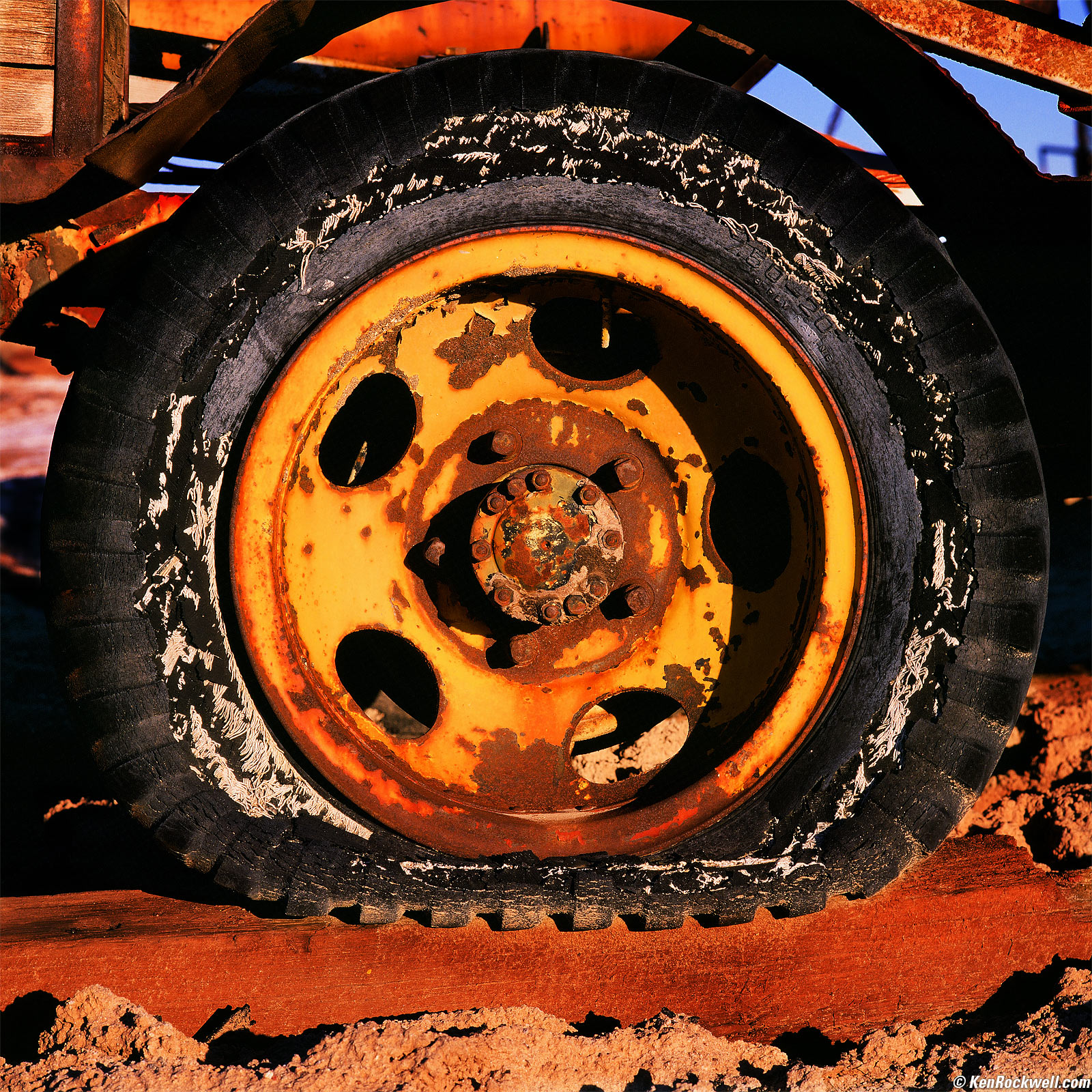
Decaying Truck Tire and Wheel, Route 66, 4:21 P.M. 1987 Zeiss Sonnar T✻ 150mm f/4 CF with B60 Hasselblad CR 1,5 warming filter, 3.4 meters focus distance, 1992 Hasselblad 503 CX with 1985 PME metered prism reading EV 12/13, Fuji Velvia in 1996 Hasselblad E24 magazine, f/13 at 1/30. More technical details. bigger.
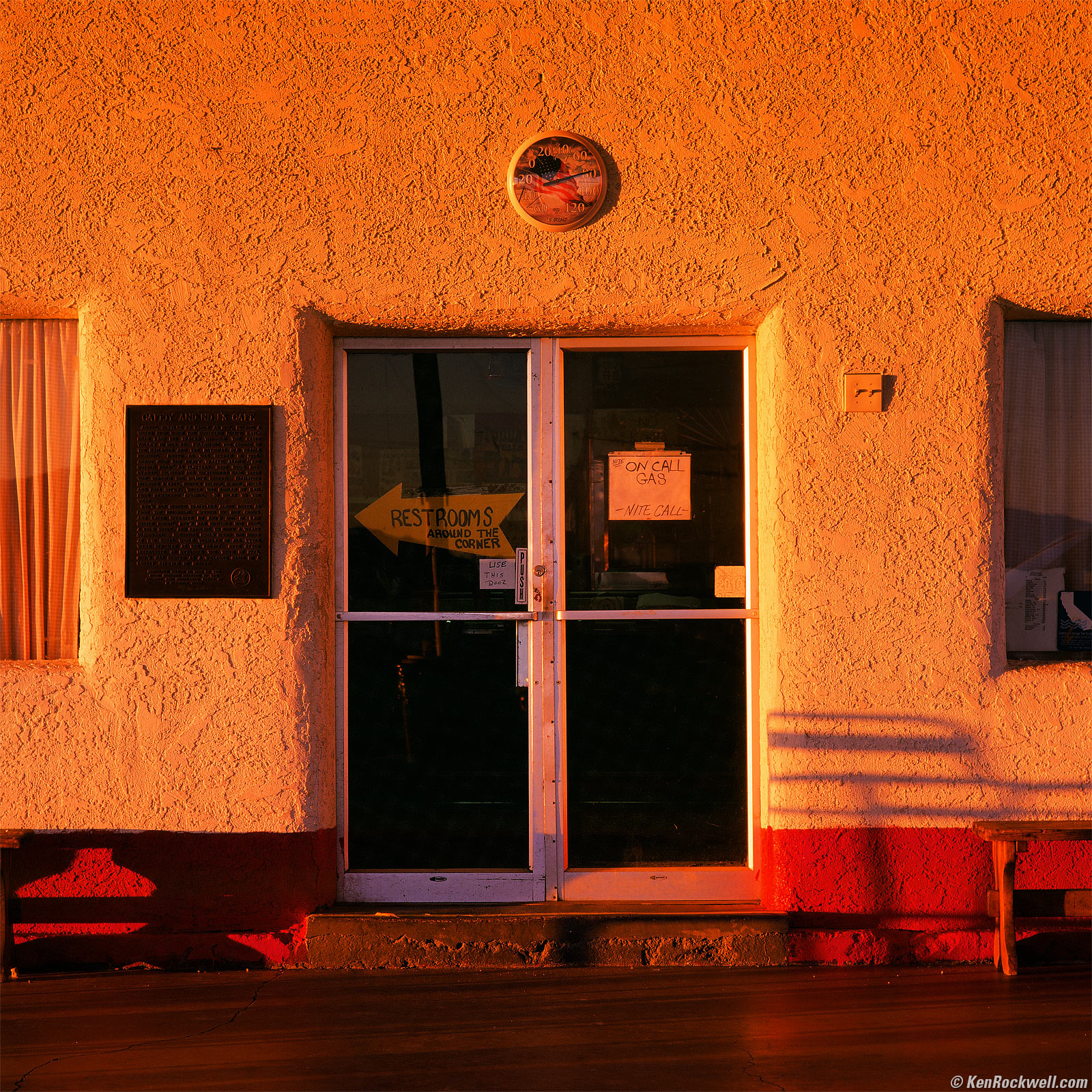
Gas Station Doors at Sunset, Route 66, 5:06 P.M. 1987 Zeiss Sonnar T✻ 150mm f/4 CF with B60 Hasselblad CR 1,5 warming filter, 10 meters focus distance, 1992 Hasselblad 503 CX with 1985 PME metered prism reading EV 10, Fuji Velvia in 1996 Hasselblad E24 magazine, f/11 at 1/8. More technical details. bigger.
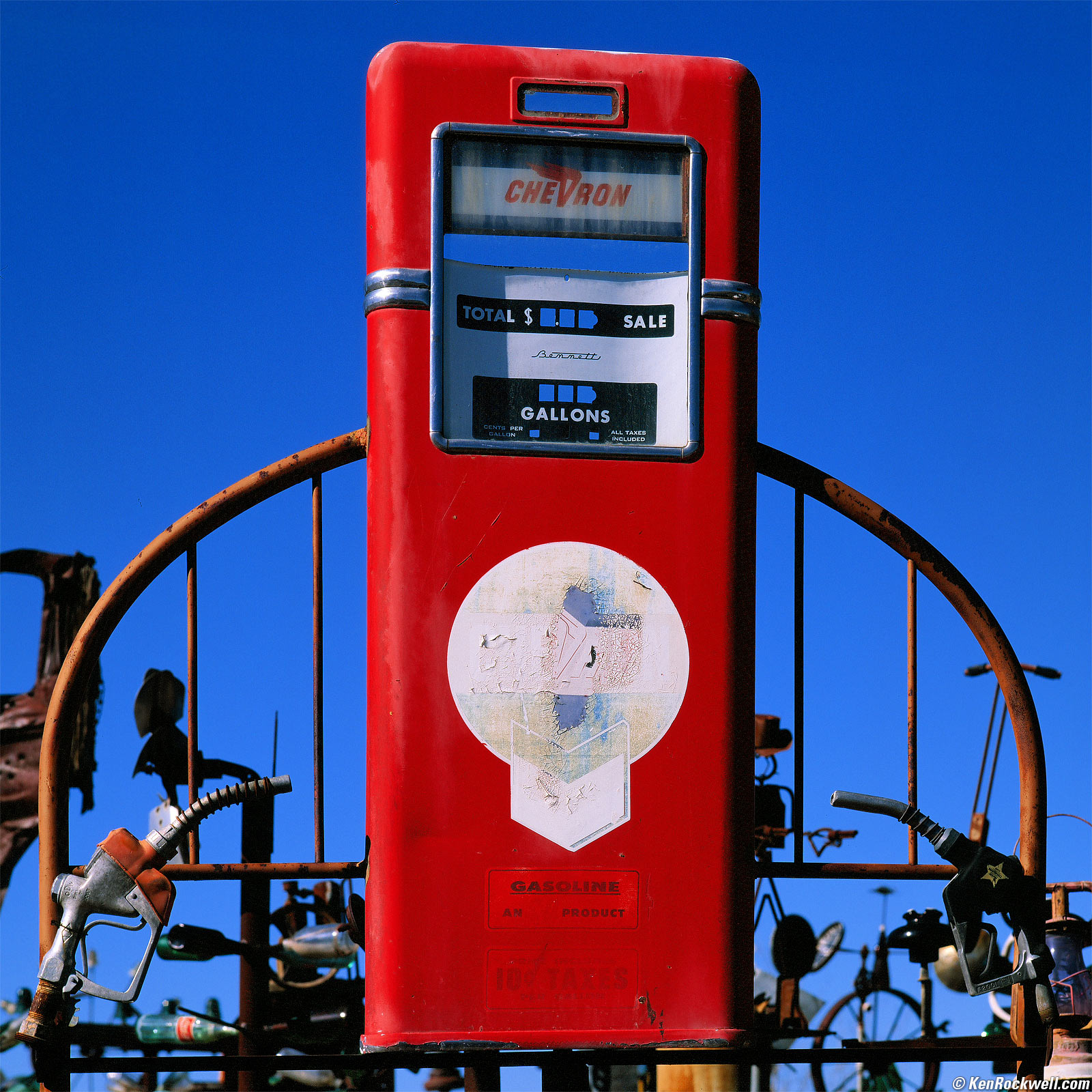
Gas Pump at the Bottle Tree Farm, Route 66, 10:24 A.M. 1987 Zeiss Sonnar T✻ 150mm f/4 CF with Hasselblad B60 CR 1,5 warming filter, 1992 Hasselblad 503 CX with 1985 PME metered prism reading EV 13⅚, Fuji Velvia in 1996 Hasselblad E24 magazine, f/11 at 1/125 (EV 14; my Gossen Luna Pro SBC said EV 12⅚ at ISO 40 and the meter app in my iPhone said 13, both at ISO 40 to compensate for the CR1.5 filter not on the stand-alone meters). More technical details. bigger.

Introduction
Top Sample Images Intro Compatibility Format Specifications
Performance Compared Usage Recommendations More

Adorama pays top dollar for your used gear.
|

The 150/4 is so good there’s nothing to write about; it’s optically flawless.
It’s so superb that HASSELBLAD NEVER CHANGED THE OPTICS from 1957 to 2013! It’s perfection. Remember that this was like a $10,000 lens back in the day; not something you picked up for a song on eBay as we can today. It was the most popular portrait lens in pro photography!
If you’re considering one, don’t worry about the optics. Worry about which barrel you want: chrome or black “C” will probably need an overhaul, and CF ought to be OK. The newer CFi versions cost more but have more plastic; see my HASSELBLAD guide to lens types.
Although there are many cosmetic variations from 1957 through 2013, its optics never changed.
T* multicoating was added in the 1970s, but since this is a very simple optical formula, it delivers great images even uncoated. All versions work great since all are at least single coated. The T* multicoating doesn't add any significant contrast or color boost; it's just marketing and good practice.
What did change over the years is cosmetics, shutters and filter sizes.
The first C version came in chrome, then black. It's not marked "C" anyplace; you just have to know. It takes 50mm bayonet filters.
All newer versions are black.
The CF version shown here moved to a rubber focus ring and a larger bayonet filter mount 60mm (B60 or Bay 60) filter. They have a newer Prontor shutter that also works with the focal-plane shutter HASSELBLADs.
The CFi version replaced the metal filter bayonet mount with a plastic one.
HASSELBLAD has abandoned making new lenses or bodies for the V system, but that's no big deal because they last forever and it's easy to get digital backs for it. That's right; for the same piece as a typical DSLR it's easy to get a used medium format back today; you don't have to hock your Mercedes to buy a new one anymore.
I got my ZEISS 150mm f/4 used at eBay (How to Win at eBay.)
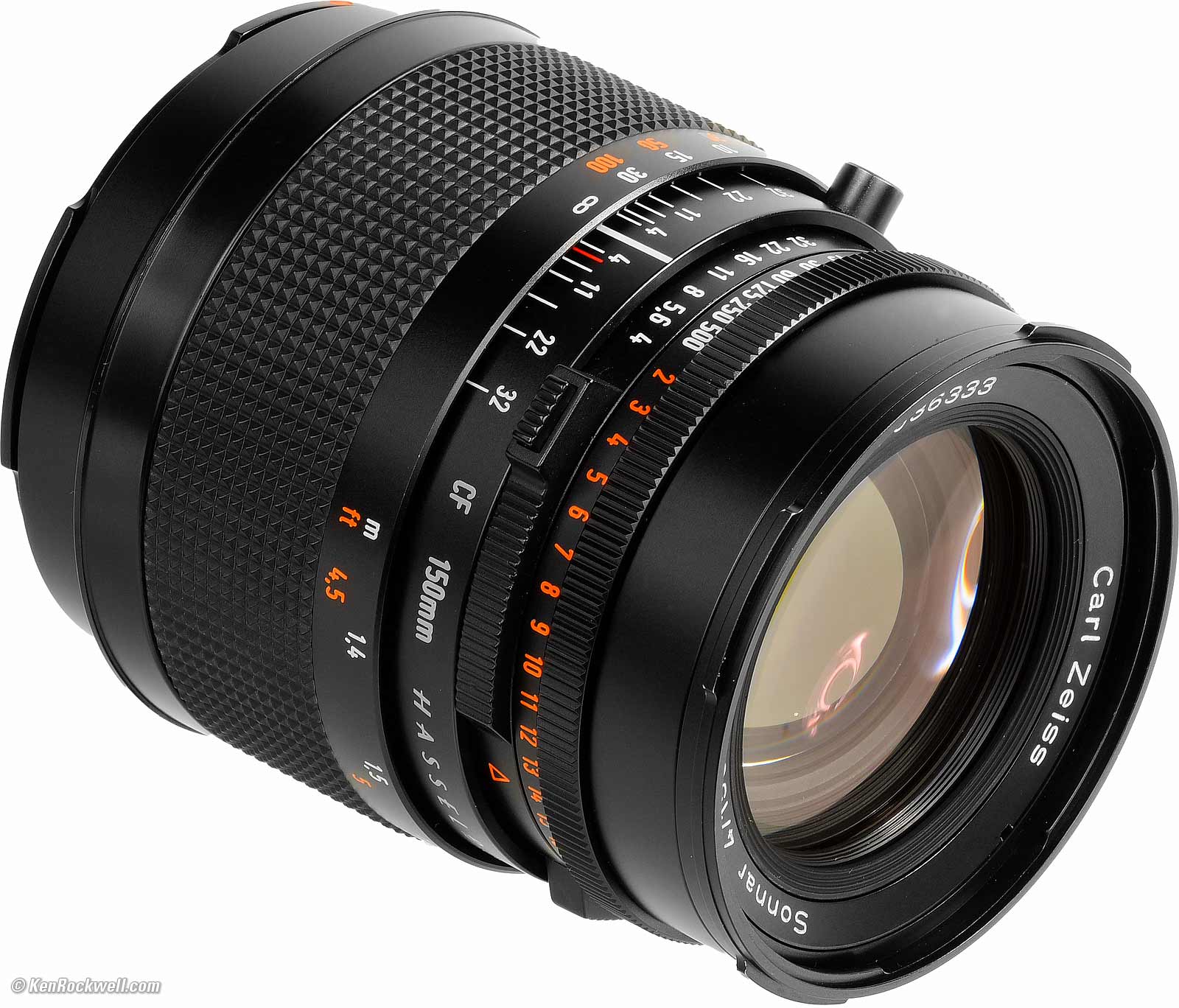
Zeiss Sonnar 150mm f/4 CF. bigger.
Compatibility
Top Sample Images Intro Compatibility Format Specifications
Performance Compared Usage Recommendations More
I got my ZEISS 150mm f/4 used at eBay (How to Win at eBay.)
The Hasselblad Zeiss 150 4 works on all V system Hasselblad cameras, but not today's H system from the Orient.
None of the Hasselblad system works with the ancient 1600 and 1000 focal plane cameras from 1948-1957.
All versions of the 150/4 all work on all the usual 500, 501 and 503 series.
Only the CF and CFi versions work on the focal-plane cameras like the 200 and 2000 series.
Format
Top Sample Images Intro Compatibility Format Specifications
Performance Compared Usage Recommendations More
I got my ZEISS 150mm f/4 used at eBay (How to Win at eBay.)
It covers 2¼" (56.5 mm) square, or a 3.15" (150mm) diagonal.
Specifications
Top Sample Images Intro Compatibility Format Specifications
Performance Compared Usage Recommendations More
I got my ZEISS 150mm f/4 used at eBay (How to Win at eBay.)
Name
This is the Zeiss 150mm f/4, often suffixed CF or CFi.
It's made by Zeiss for Hasselblad.
Optics
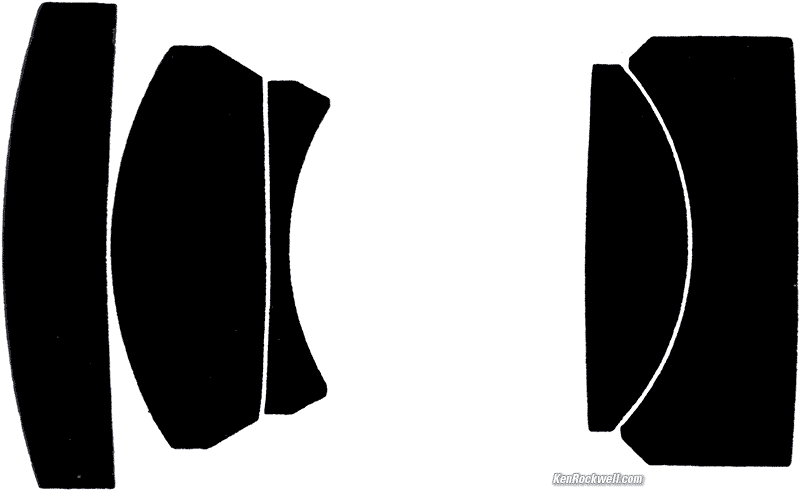
150mm f/4 internal diagram.
5 elements in 3 groups.
The first versions are single coated mostly in blue, and most later versions are multicoated, which Zeiss brands T*.
Flange focal distance: 74.9mm.
Close Focus
4.5 feet (1.4 meters) from the image plane.
Maximum Reproduction Ratio
1:7.1 (0.14 x).
Minimum Field Size
400mm (15.75") square.
Diaphragm
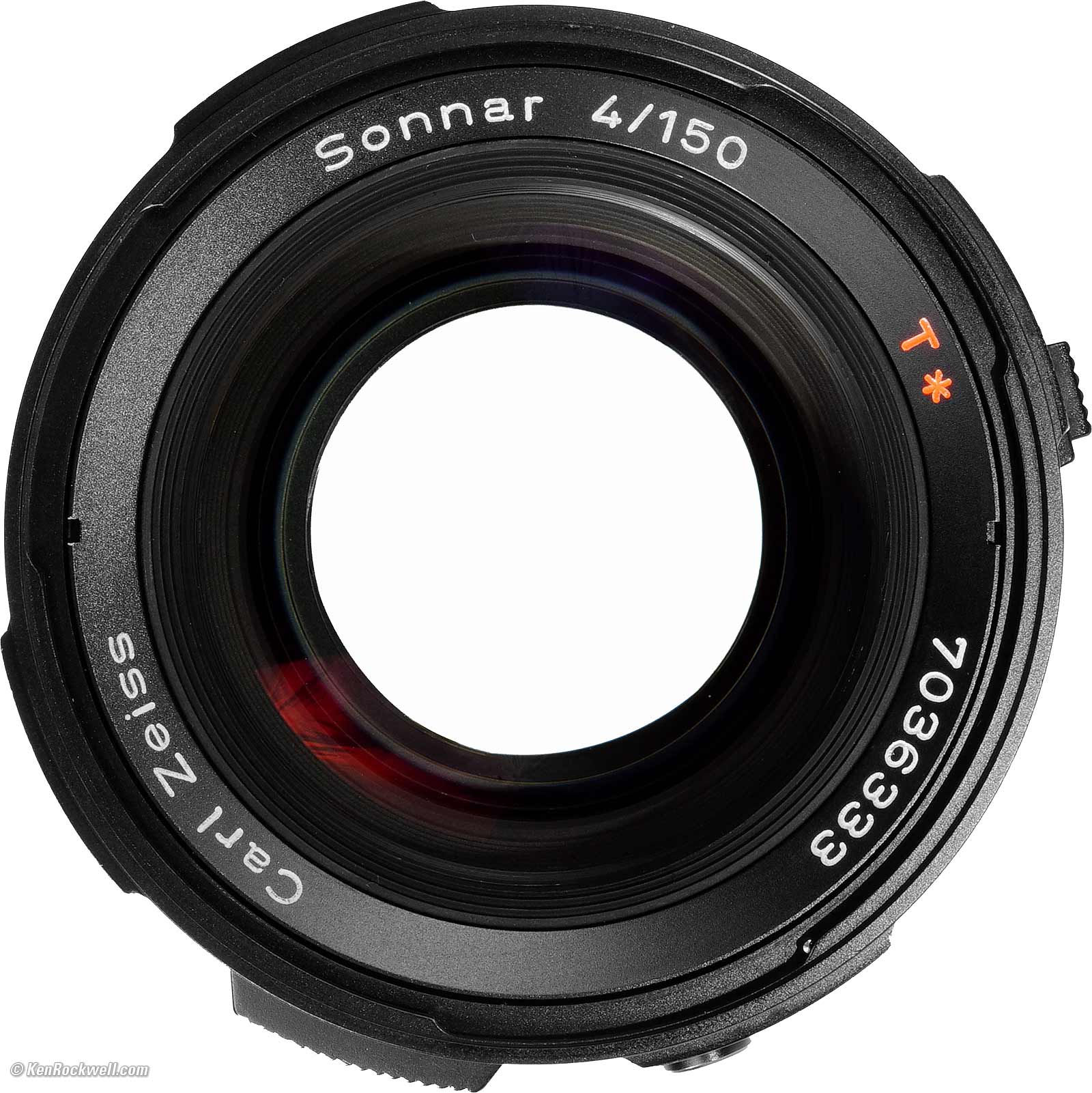
Zeiss Sonnar 150mm f/4 CF (diaphragm not shown). bigger.
5 straight blades.
Stops down to f/32.
Focal Length
150mm; actually 151.2mm.
When used on a HASSELBLAD camera with 6x6cm back, it sees an angle of view roughly similar to what an 80mm lens sees when used on a 35mm or full frame camera.
Angles of View
29° diagonal.
21º horizontal and vertical.
Hard Infinity Focus Stop?
Yes.
Just set it to the stop and you're all set for astronomical photography.
Focus Scale
Yes.
Depth-of-Field Scale
Yes.
Depth of fields are indicated for a 60 micron circle-of-confusion, which is twice the size usually used for 35m cameras.
Infra-Red Focus Index
Yes.
Aperture Ring
Yes.
Filter Mount
CF version: metal 60 mm Bayonet (Bay 60 or B60).
Hood
Special square bayonet hood.
Size
3.21" (81.5 mm) diameter by 3.94" (100.1 mm) long overall.
Weight
27.530 oz. (780.4 g) actual measured weight.
Quality
Made in Germany.
Introduced
1957.
Discontinued
2013, with the end of the V system.
Prices, USA
January 2025
About $410 ($260 ~ $500) used if you know How to Win at eBay.
January 2016
About $300 ($200 ~ $500) used if you know How to Win at eBay.
Performance
Top Sample Images Intro Compatibility Format Specifications
Performance Compared Usage Recommendations More
Overall Focus Distortion Ergonomics
Filters Macro Mechanics Sharpness Shutter
I got my ZEISS 150mm f/4 used at eBay (How to Win at eBay.)
Overall
The Hasselblad Zeiss Sonnar 150mm f/4 is big, beautiful hunk of precision.
The one I have here was made in 1987, and still works perfectly.
Focus
Even my 1987 sample still focuses smoothly.
It's wonderfully precise; the ring turns about 300º from infinity to close-focus distance.
Distortion
The Hasselblad Zeiss Sonnar 150 has no visible distortion.
For more scientific use, use a value of -0.5 in Photoshop's Lens Distortion tool to remove the distortion.
Ergonomics
It's a handful, and feels great. it's got all the controls you need, and none you don't.
Filters, use with
Typical for a long lens, there's no need for thin filters.
Use Bayonet 60mm filters for fast on/off; or you can use an adapter ring to use conventional screw-in filters.
On the older C version that wants B50 filters, an ordinary 52mm screw-in filter will sit inside in the front of the lens. Hold or tape it there and you're good in an emergency. 52mm filters just have enough glass to work without vignetting; don't use adapters to anything smaller.
Macro
Macro gets close enough to fit something 15.75" (400mm) square to fill the 2¼" frame.
This isn't that close; use an extension tube to get closer.
Since it extends 32mm at its close-focus distance, using a 32mm extension tube will let you focus in two ranges down to about 4 feet (1.2 meters).
Personally I prefer a bayonet HASSELBLAD PROXAR close-up lens. These are very good dual-element achromatic lenses.
Mechanics
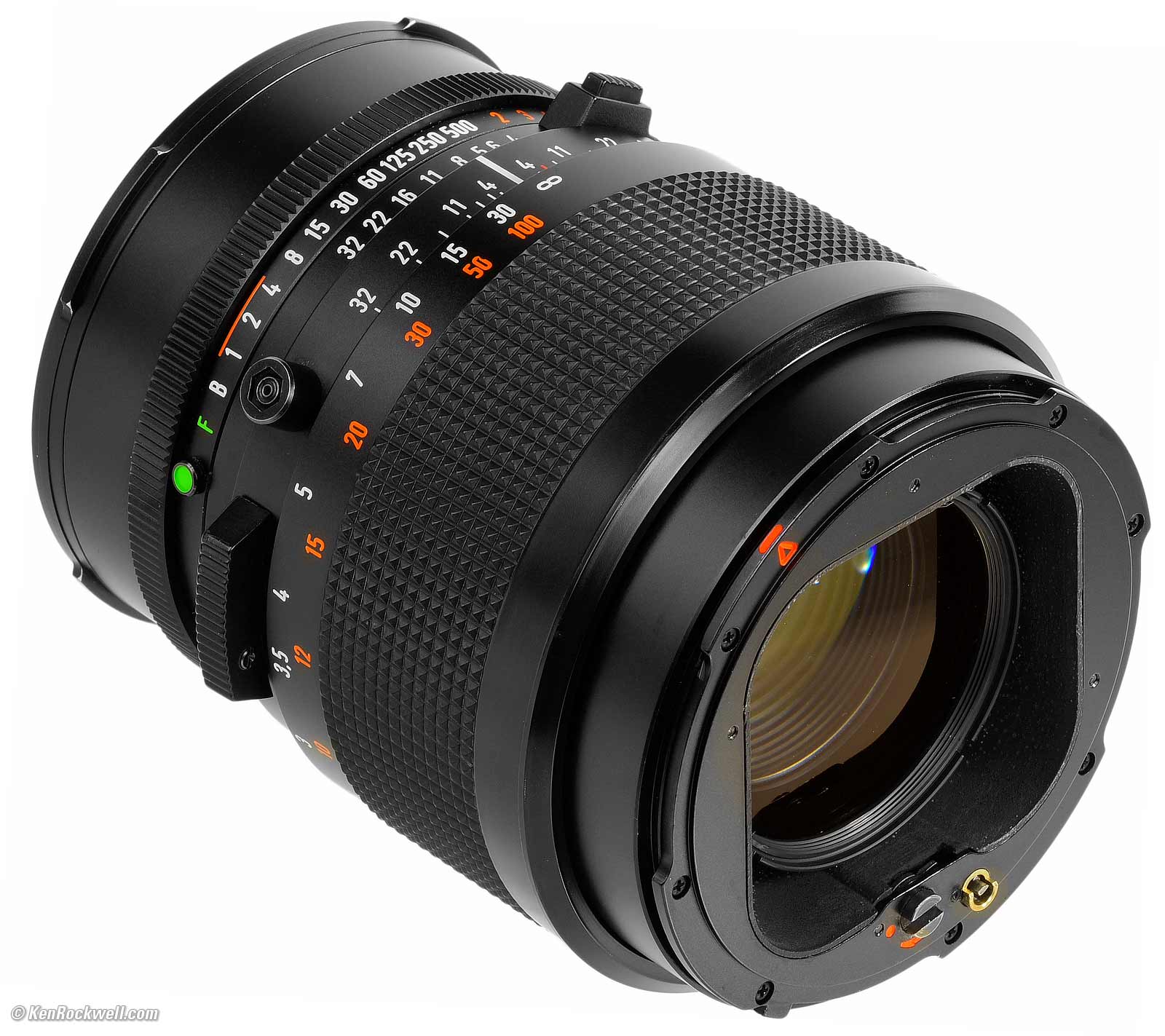
Zeiss Sonnar 150mm f/4 CF. bigger.
Lenses don't get any better than this. The Hasselblad Zeiss Sonnar 150 4 C shown here is solid metal, with a rubber focus grip over a metal ring.
Filter Mount
Anodized aluminum.
Hood Mount
Anodized aluminum.
Front Barrel
Anodized aluminum.
Focus Ring
Metal.
Internals
All metal.
Rear Barrel
Metal.
Identity
Engraved into ring around front element and filled with paint.
Mount
Metal.
Markings
Printed.
Serial Number
Engraved into ring around front element and filled with paint.
Date Code
Zeiss serial numbers have been sequential forever, so we use these to date Zeiss lenses.
There's also a red date code stamped inside the rear barrel. Once you have that number:
CF version: The letter is the month (A ~ L = January ~ December) and the two digits are the year, reversed. Thus F38 means June 83.
Noises When Shaken
Mild clicking.
Made in
Germany.
Sharpness
Lens sharpness has nothing to do with picture sharpness; every lens made in the past 100 years is more than sharp enough to make super-sharp pictures if you know what you're doing. The only limitation to picture sharpness is your skill as a photographer. It's the least talented who spend the most time worrying about lens sharpness and blame crummy pictures on their equipment rather than themselves. Skilled photographers make great images with whatever camera is in their hands; I've made some of my best images of all time with an irreparably broken camera!
If you're not getting ultra-sharp pictures with this, be sure not to shoot at f/22 or smaller where all lenses are softer due to diffraction, be sure everything is in perfect focus, and use ISO 100 film or slower.
People worry waaaaay too much about lens sharpness. It's not 1968 anymore when non-HASSELBLAD lenses often weren't that sharp and there could be significant differences among them; ever since about 2010 all new lenses are all pretty much equally fantastic. These lenses sold for the equivalent of $10,000 back in the day and were the standard against everything else was measured.
This lens is super sharp corner-to corner at every aperture, limited by your vision as an artist and of course by diffraction at the smallest apertures. Avoid f/22 and smaller unless you really need them for extreme depth of field because diffraction takes its toll. See also How to Calculate the Sharpest Aperture.
This Hasselblad Zeiss Sonnar 150mm f/4 is equally sharp all across the field at every aperture. Corners are as sharp as the center, presuming you're in perfect focus.
It doesn't get sharper as stopped down; go ahead and shoot wide-open if you like. What will improve stopped down is depth of field and evenness of illumination.
Shutter
My shutter is within a third of a stop at every speed, including 1/500. Except for 1/125, it's actually within a sixth of a stop or better, and only 1/10 of a stop slow at 1/500. This is excellent:
Marked |
Actual |
Actual |
Error |
1 |
1.00 s |
1/1 |
±0 dead-on |
2 |
565 ms |
1/1.77 |
0.18 stops slow |
4 |
251 ms |
1/4 |
±0 dead-on |
8 |
114 ms |
1/8.8 |
0.13 stops fast |
15 |
55.5 ms |
1/18 |
0.17 stop fast |
30 |
28 ms |
1/35.7 |
0.16 stops fast |
60 |
14.1 ms |
1/70.9 |
0.15 stops fast |
125 |
6.5 ms |
1/154 |
0.27 stops fast |
250 |
3.6 ms |
1/278 |
0.12 stops fast |
500 |
2.1 ms |
1/476 |
0.10 stops slow |
These are measured wide-open, 7:48 PM, 16 December 2015
Compared
Top Sample Images Intro Compatibility Format Specifications
Performance Compared Usage Recommendations More
I got my ZEISS 150mm f/4 used at eBay (How to Win at eBay.)
C, CF and CFi
They all use the same optics; the differences are your preference for cosmetics, weight, filter size and of course shutter design and compatibility.
I prefer the C; it weighs the least, is built the best, takes the smallest filters, has a built-in self-timer so I can skip the cable release and pre-release, costs the least, and has the same optics as the newest versions.
Usage
Top Sample Images Intro Compatibility Format Specifications
Performance Compared Usage Recommendations More
I got my ZEISS 150mm f/4 used at eBay (How to Win at eBay.)
Exposure
Exposure sets in half-stop clicks; shutter speed of course only in full stops.
To set an EV (exposure value) from your meter (or guess based on experience), move the two rings until the triangle points to the EV number you want.
The aperture and shutter speed rings usually turn freely from each other. To lock them together to keep the same exposure (EV) as you select different shutter and aperture combinations, press down the little tit on the aperture ring to the right of f/4 as you move them.
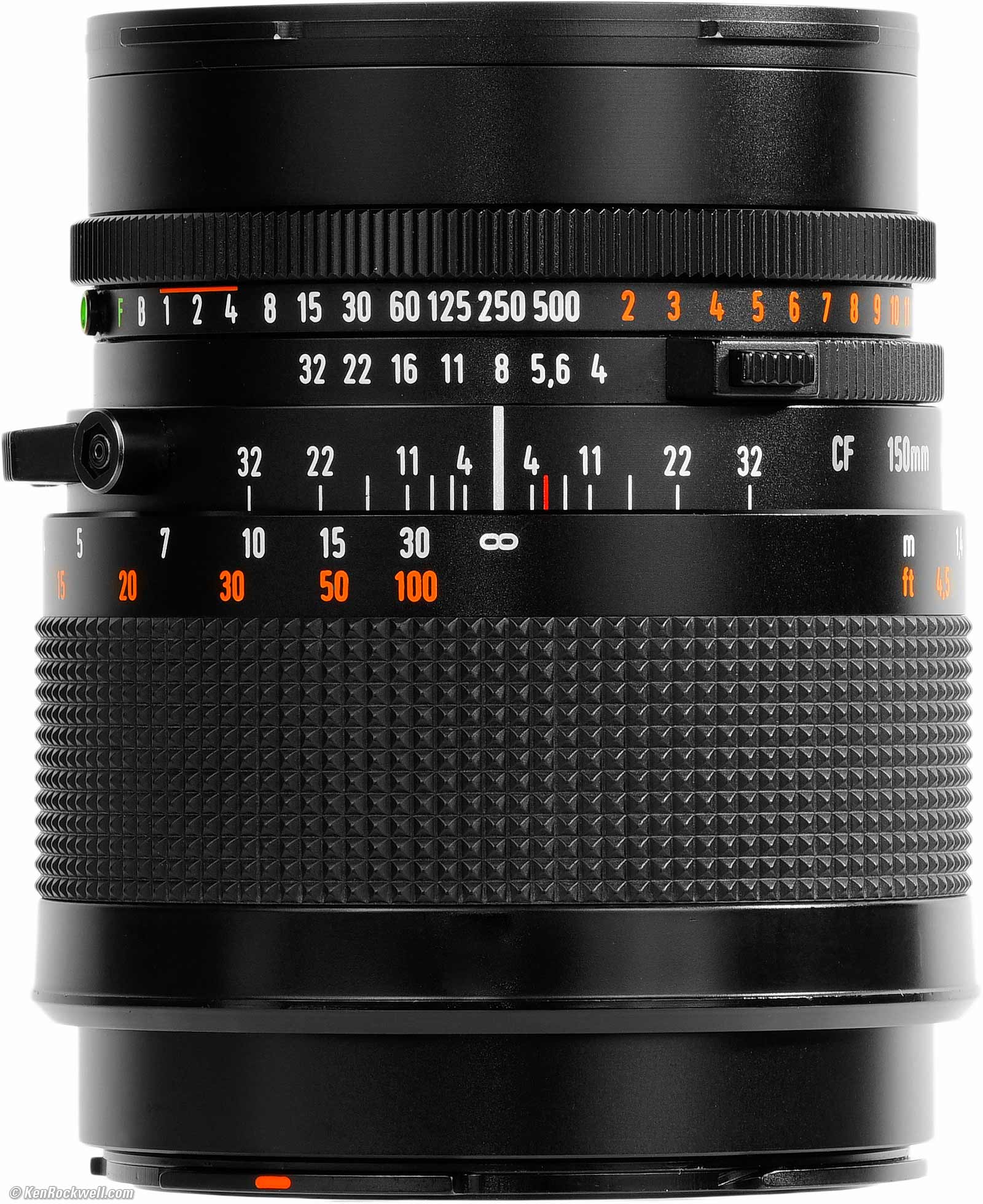
Zeiss Sonnar 150mm f/4 CF. bigger.
Depth of Field
To preview the depth of field, press down (towards the bottom of the camera) the lever to the left of the f/32 on the depth-of-field scale.
To open the diaphragm again for focus, press the bottom of this lever towards the center of the lens.
The depth-of-field marks are calculated for a 60 micron circle of confusion.
To calculate the aperture that will give optimum sharpness when you need depth-of-field and don't want diffraction to soften the image, put a new scale over the depth-of-field scale and use these half distances (see here for details of how to use these):
Focal length = 151.2 mm (actual design value)
f/ |
feet |
meters |
Aperture on Zeiss' scale |
8 |
889 |
270 |
|
11 |
443 |
135 |
(f/2) |
16 |
222 |
67.6 |
f/4 |
22 |
111 |
33.8 |
f/8 |
32 |
55.4 |
16.9 |
f/16 |
Recommendations
Top Sample Images Intro Compatibility Format Specifications
Performance Compared Usage Recommendations More
I got my ZEISS 150mm f/4 used at eBay (How to Win at eBay.)
This is a perfect lens for head and shoulder shots, and just about everything we shoot with HASSELBLAD.
For head-only shots, stand further away and use the 250mm to get the best facial rendering.
T* multicoating is unnecessary with the simple optical formula of this lens, so don't worry about it. The reason to get a newer model like this one is because it's more likely that the shutter will work fine without having to send it out for overhaul, as is usually the cas with the older C lenses.
Don't bother adapting this to smaller format cameras. A Nikon 135mm f/2.8 is a stop faster, a fraction of the size and weight, and focuses closer for use on 35mm format cameras.
I got mine at this link directly to them at eBay; they're also at Amazon. Never buy at a retail store or other dealers; you'll pay way too much and have very limited options if you don't like it.
This all-content, junk-free website's biggest source of support is when you use those or any of these links to my personally-approved sources when you get anything, regardless of the country in which you live. Use only the approved sources I use myself for the best prices, service, return policies and selection. Thanks for helping me help you! Ken.
More Information
Top Sample Images Intro Compatibility Format Specifications
Performance Compared Usage Recommendations More
Zeiss' 150mm Sonnar C data sheet, 1980
Zeiss' 150mm Sonnar CF data sheet, 1996
Zeiss' 150mm Sonnar CFi data sheet, 2000
NASA's page about this lens and Apollo photography.
NASA's page showing on what Apollo flights this lens flew.
© Ken Rockwell. All rights reserved. Tous droits réservés. Alle Rechte vorbehalten. Alla rättigheter förbehållna. Toate drepturile rezervate. Omnia jura reservata. Ken Rockwell® is a registered trademark.
Help Me Help You top
I support my growing family through this website, as crazy as it might seem.
The biggest help is when you use any of these links when you get anything. It costs you nothing, and is this site's, and thus my family's, biggest source of support. These places always have the best prices and service, which is why I've used them since before this website existed. I recommend them all personally.
If you find this page as helpful as a book you might have had to buy or a workshop you may have had to take, feel free to help me continue helping everyone.
If you've gotten your gear through one of my links or helped otherwise, you're family. It's great people like you who allow me to keep adding to this site full-time. Thanks!
If you haven't helped yet, please do, and consider helping me with a gift of $5.00.
As this page is copyrighted and formally registered, it is unlawful to make copies, especially in the form of printouts for personal use. If you wish to make a printout for personal use, you are granted one-time permission only if you PayPal me $5.00 per printout or part thereof. Thank you!
Thanks for reading!
Ken.