How to Learn Lens Design
This all-content, junk-free website's biggest source of support is when you use any of these links to approved sources when you get anything, regardless of the country in which you live. Thanks for helping me help you! Ken.
February 2025 Better Pictures Canon Nikon Sony Fuji OM SYSTEM LEICA Zeiss HASSELBLAD All Reviews
Why Fixed Lenses Take Better Pictures

I buy only from these approved sources. I can't vouch for ads below. |


I've been curious about optics and lens design ever since I was a very little kid. I found an older edition of Arthur Cox' "Photographic Optics" at my local library, and it gave me most of what I needed to know for all these past decades.
Arthur Cox' "Photographic Optics" covers the basics and simple math about how lenses work and focus, explains all the aberrations in simple English as well as the history and development of all the classic photographic lens types (doublet, triplet, Tessar, Gauss, double-Gauss, telephotos, wide-angles, zooms and more). It's a great read for anyone interested in learning more about how lenses work and how to get the best out of them.
The 1960s version I read as a kid covered up to zoom lenses. It made sense to me as a kid probably even before I was taught algebra. My 1960's edition was wonderful, and any edition you find today probably will be newer and more helpful. Arthur Cox' "Photographic Optics" is all a technical photographer needs to know about lenses.
I have an engineering as well as artistic background, and realize that any and every design involves the fine art of trading-off which aspects of performance are most important. You can have inexpensive, small and/or good: pick any two. The more you ask a lens to do, the more difficult it is to design and the bigger, heaver, more expensive and/or softer it gets.
Sidney Ray's book "Applied Photographic Optics," (now in its third edition as of 2025) is more for people looking to design their own lenses from scratch. It goes much deeper into the physics of optics and light and uses a lot of math right from the start, skipping the basics photographers need to know as covered in Arthur Cox' "Photographic Optics." It's more advanced than a photographer would need, unless he's going to design his own lenses. You'll want to read Arthur Cox' "Photographic Optics" first.
If you want to design lenses for a living, the best and most modern book about photographic lens design is "Lens Design Fundamentals" by Barry Johnson and Rudolf Kingslake, now in its second edition as of 2025. It's a very detailed work used to teach lens design at universities around the world. Undergraduate science and engineering students and Master's students use it. Many non-students have also used it. It assumes you understand the basics as taught in Arthur Cox' "Photographic Optics." Johnson & Kingslake's Lens Design Fundamentals is very advanced and goes into a lot of math and detail not needed by a photographer rather than a designer. By page three it's already covering specifics of how to choose lens element thickness, and on page six it's already covering how to establish tolerances for your design, assuming you already know the basics of what it is you're designing.
My lens designer friends have Ph. D.s in physics, and also recommend other books by Rudolf Kingslake. I'm unsure if these are casual reads as is Arthur Cox' "Photographic Optics," or if they most likely are also for Ph. D. students.
If you're going to do this for a living, first get a B.S. degree in Physics, Electrical or Mechanical Engineering. A few universities teach beginning lens design as an undergraduate class, but your most serious study will be getting your M.S. A few universities have very advanced courses at the Ph.D. level. Most lens designers have a Master's degree; get one and you're good.
I asked a lens designer why lenses have gotten so much better since about 2010, and his answer was simple. He said that for most of history, including with computer-aided design, that manual calculations or computer software could analyze, and then optimize a design. Usually a person would hash out the basic design, and let the computer optimize it. This was called a single maximum, where the software experiments with every possible parameter in that one design until it finds the very best solution — to the design that was started by a human.
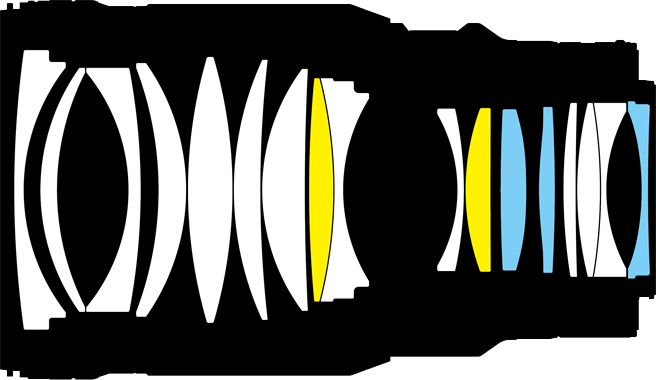
As of about 2010 computers became powerful enough to start trying completely different solutions on their own. They could start trying very different approaches to a design and then looking across many more possible solutions for an even better design. The computers can now optimize over a range of different approaches, which leads to many more sorts of lens designs that no longer fit into the classic layout like "double Gauss" or "telephoto." This discovers "multiple maxima" (idealized versions of different designs), and is why we'll see very complex designs for what used to be simple lenses, like a 50mm f/1.8, which in olden days would have just six elements in a double-Gauss design, adds an aspheric element in the Canon RF 50mm f/1.8, and today the Nikon Z 50mm f/1.8 has 12 elements in 9 groups!
Hint: I prefer my own printed hard-cover copy of Arthur Cox' Photographic Optics, and you may be able to borrow a complete online copy from The Internet Archive's loan program if you register. You can't keep or download the online copy and without registering all you'll see is a couple of preview pages, but register and if it's not already checked out, you can read the whole thing online.
Hint: Google has a partial preview of 70 pages of Sidney Ray's "Applied Photographic Optics" here.
Hint: Here's a preview of Lens Design Fundamentals by Barry Johnson and Rudolf Kingslake.
© Ken Rockwell. All rights reserved. Tous droits réservés. Alle Rechte vorbehalten. Alla rättigheter förbehållna. Toate drepturile rezervate. Omnia jura reservata. Ken Rockwell® is a registered trademark.

Help Me Help You top
I support my growing family through this website, as crazy as it might seem.
The biggest help is when you use any of these links when you get anything. It costs you nothing, and is this site's, and thus my family's, biggest source of support. These places always have the best prices and service, which is why I've used them since before this website existed. I recommend them all personally.
If you find this page as helpful as a book you might have had to buy or a workshop you may have had to take, feel free to help me continue helping everyone.
If you've gotten your gear through one of my links or helped otherwise, you're family. It's great people like you who allow me to keep adding to this site full-time. Thanks!
If you haven't helped yet, please do, and consider helping me with a gift of $5.00.
As this page is copyrighted and formally registered, it is unlawful to make copies, especially in the form of printouts for personal use. If you wish to make a printout for personal use, you are granted one-time permission only if you PayPal me $5.00 per printout or part thereof. Thank you!
Thanks for reading!
Ken.