Canon EF 50mm f/1.4 USM
1993 ~ Today; use with EF-RF adapter on mirrorless
Intro Specifications Performance Compared Recommendations
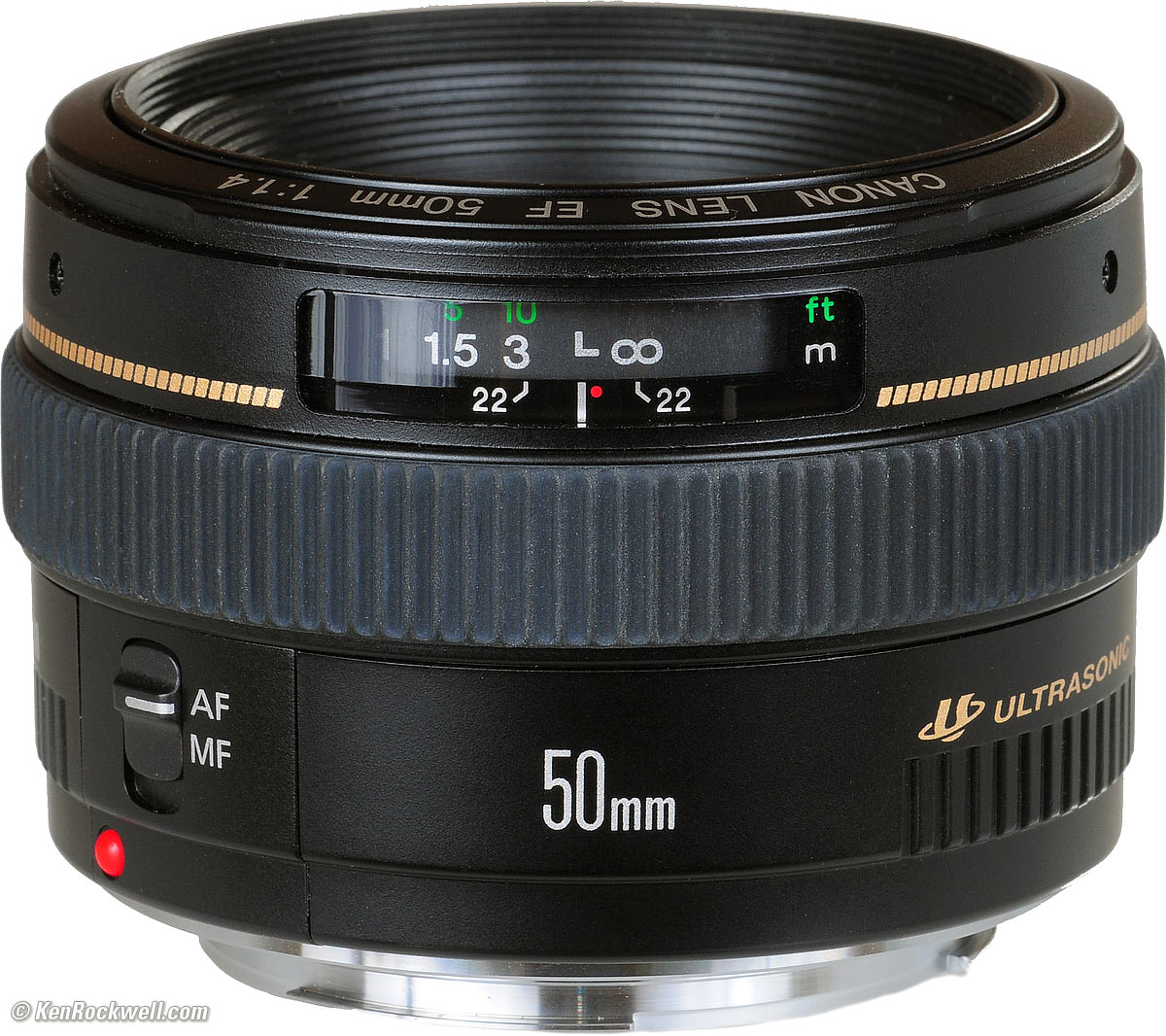
Canon 50mm f/1.4 USM (58mm filters, 9.5 oz./268g., 1.5'/0.45m close focus, 0.15× macro ratio, $299 new or about $160 used). enlarge. I'd get mine at B&H, at Crutchfield, at Adorama or at Amazon, or used at this link to them at eBay (see How to Win at eBay).
This 100% all-content, junk-free website's biggest source of support is when you use those or any of these links to my personally approved sources I've used myself for way over 100 combined years when you get anything, regardless of the country in which you live — but I receive nothing for my efforts if you take the chance of getting it elsewhere. Canon does not seal its boxes in any way, so never buy at retail or any other source not on my personally approved list since you'll have no way of knowing if you're missing accessories, getting a defective, damaged, returned, dropped, incomplete, gray-market, store demo or used lens — and my personally approved sources allow for 100% cash-back returns for at least 30 days if you don't love your new lens. I've used many of these sources since the 1970s because I can try it in my own hands and return it if I don't love it, and because they ship from secure remote warehouses where no one gets to touch your new lens before you do. Buy only from the approved sources I've used myself for decades for the best prices, service, return policies and selection.
January 2025 Better Pictures Canon Reviews RF Lenses EF Lenses Flash All Canon Reviews All Reviews
Canon 50mm Lenses Compared 05 Nov 2013

Introduction top
Intro Specifications Performance Compared Recommendations
| Optics: |  |
| Ergonomics: |  |
| Usefulness: | |
| Availability: | |
| Overall: | |
Ideal Uses: Perfect for use on every Canon SLR made since 1987, which is every EOS (AF) film and digital SLR. If you shoot in low light, you need one of these, period.
Not for: Won't work on pre-1986 manual focus Canon FD cameras.
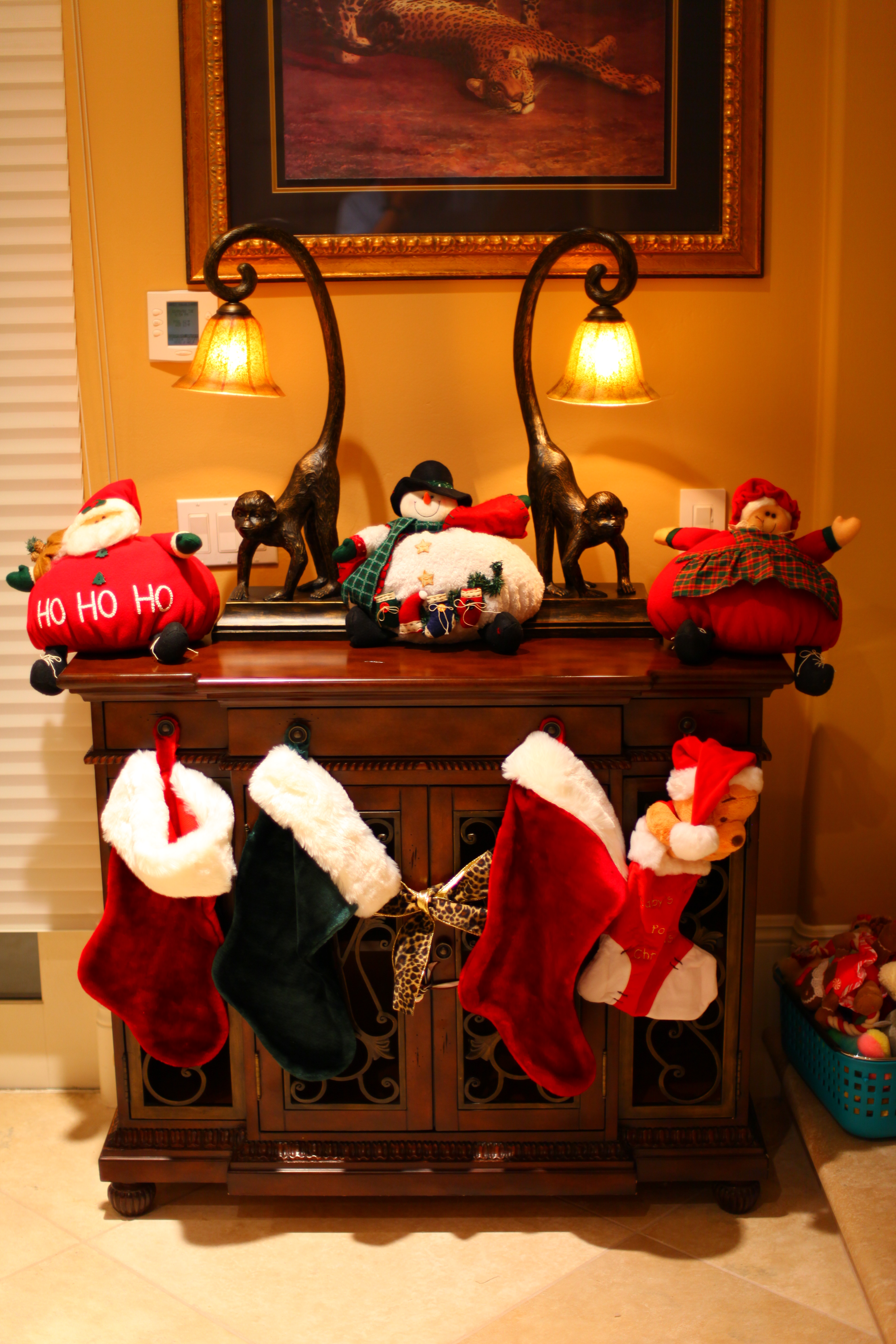
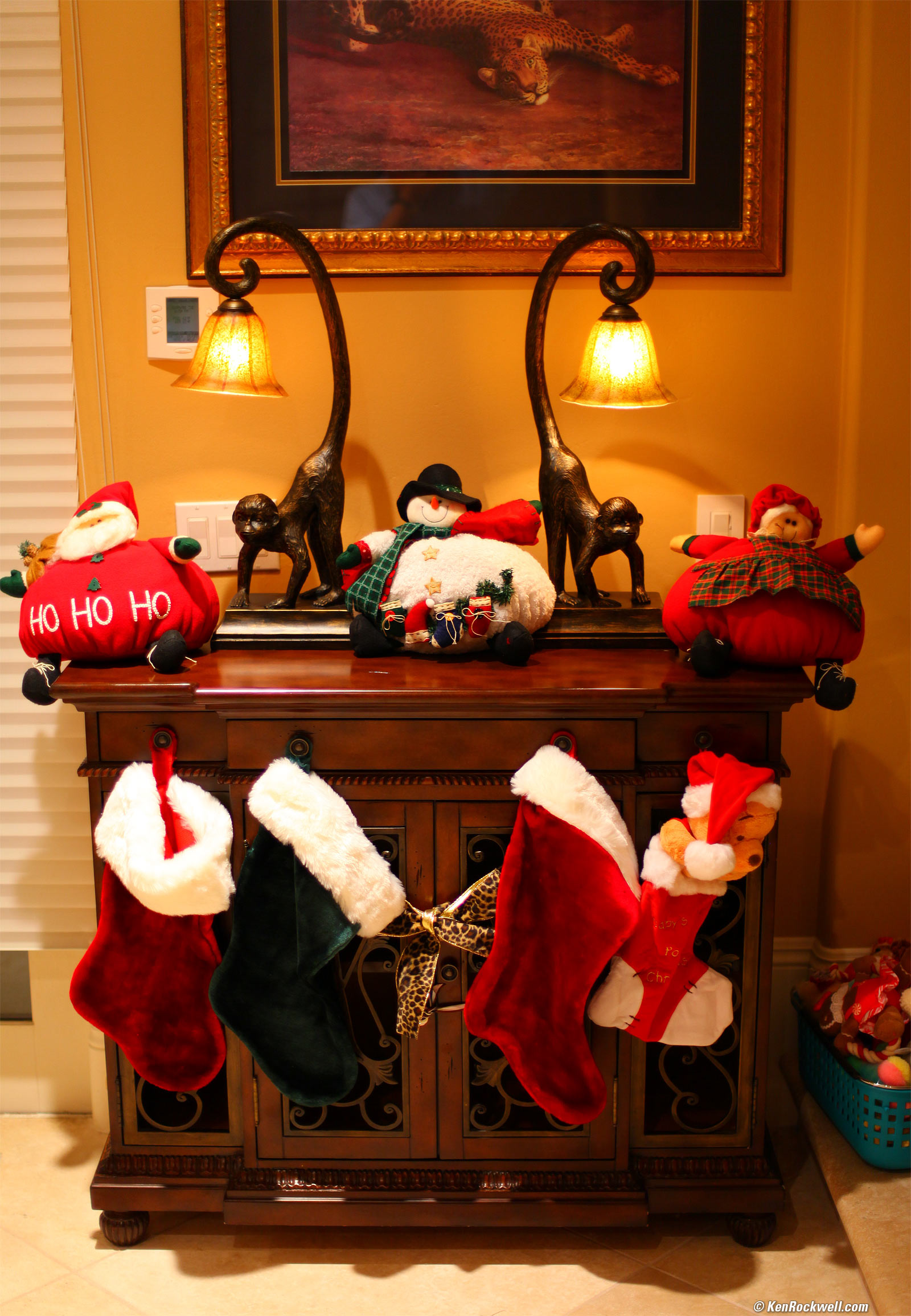
Christmas, Aviara, 6:00 PM, Thursday, 09 December 2008. Hand-held at 1/40 at Auto ISO 250, Canon 5D Mark II, as shot. bigger or camera-original 21 MP © 2.8MB JPG file.

I buy only from these approved sources. I can't vouch for ads below. |



Introduction top
Intro Specifications Performance Compared Recommendations
This 50mm f/1.4 USM has been in Canon's catalog unchanged since 1993. If you shoot just about anything that moves in available light, you need one of these. It allows you to shoot with ISOs of only one-quarter, or shutter speeds four times as fast, or shoot in light only one-quarter as bright as with any exotic f/2.8 L zoom. End of review.
The $1,400 50mm f/1.2 L doesn't do anything much differently, is much bigger and heavier, and doesn't focus as consistently. The 50mm f/1.2 is for astronomers, not action shooters.
Either of these is better for use in low light and handles faster than the clumsier $85 50mm f/1.8, which requires you move a switch to get into manual focus. If you only shoot in good light, you might also want to have a look at Canon's 50mm f/2.5 Macro, which shares the clumsier 1980s-designed AF system of the 50mm f/1.8. Unlike the f/1.8 and f/2.5, the f/1.4 and f/1.2 lenses offer instant manual focus override just by grabbing the focus ring.
Optical construction and performance of the 50mm Canon f/1.4 is the same as every other 50mm f/1.4 from Canon, Nikon and Zeiss since the 1970s. No news here. The only better 50mm f/1.4 is Nikon's newest 50mm f/1.4 AF-S, which is the first new 50mm f/1.4 SLR optical design since the 1970s.
I'd get mine at B&H, at Crutchfield, at Adorama or at Amazon, or used at this link to them at eBay (see How to Win at eBay).
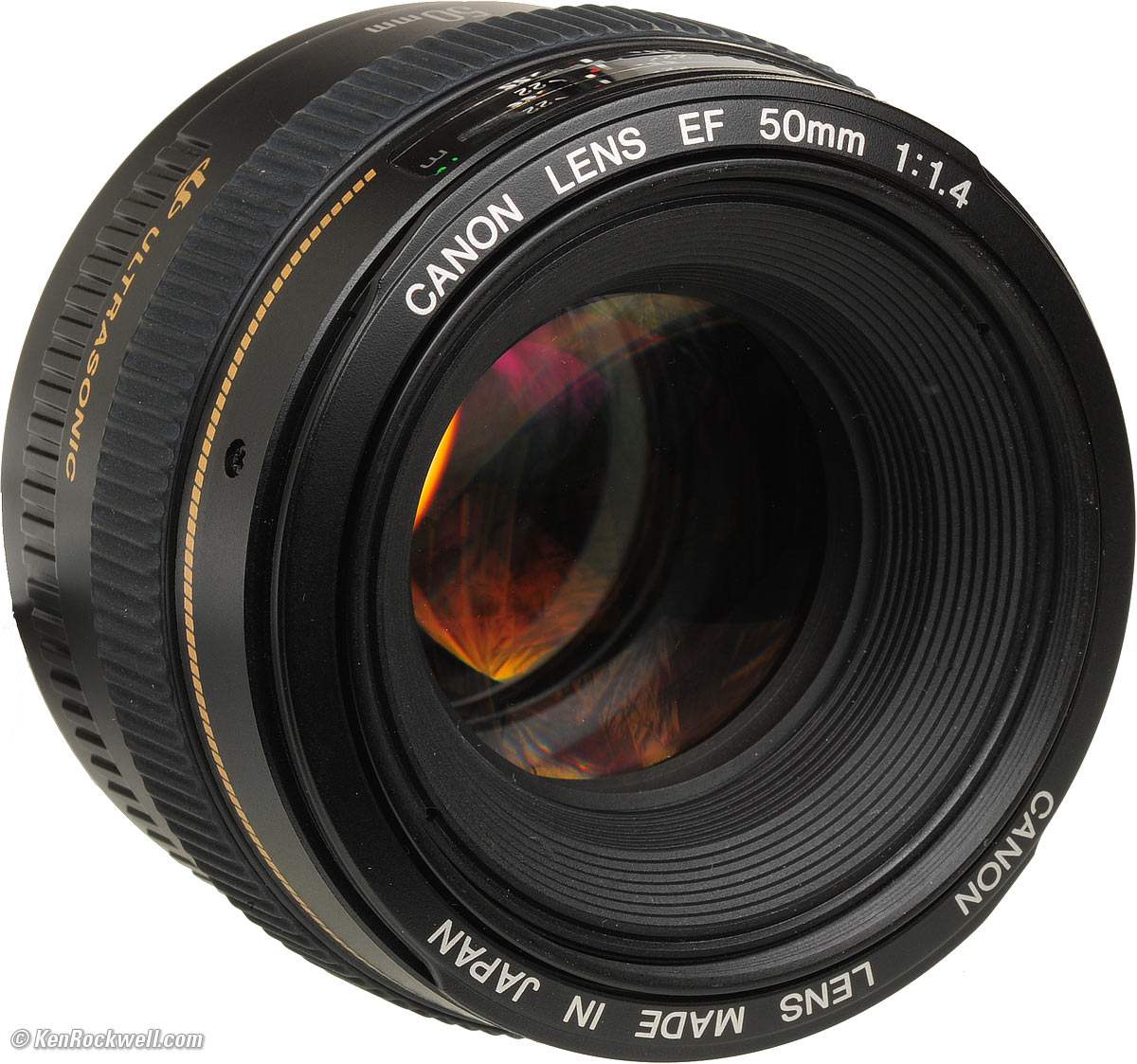
Canon EF 50/1.4 USM. enlarge.
Specifications top
Intro Specifications Performance Compared Recommendations
I'd get mine at B&H, at Crutchfield, at Adorama or at Amazon, or used at this link to them at eBay (see How to Win at eBay).
Name
Canon calls this the Canon Lens EF 50mm f/1.4 USM.
EF: Electronic Focus. All modern Canon lenses do this.
USM: UltraSonic Motor. This means it autofocuses almost silently.
Focal Length
50mm.
On Canon's 1.6x digital cameras, it gives a field of view similar to what an 80mm lens does on a 35mm camera. On Canon's 1.3x factor cameras, gives a field of view similar to what a 65mm lens does on a 35mm camera.
Optics
7 elements in 6 groups, multicoated.
Diaphragm
8 blades.
Stops down to f/22.
Close Focus Distance
1.5 feet (0.45m), same as every other 50mm SLR lens made since the 1970s.
Maximum Reproduction Ratio
1:6.66.
Focus Scale
Yes.
Infra-Red Focus Index
Yes.
Filter
58mm, plastic thread.
It doesn't rotate, but it does move in and out as you focus.
Hood
ES-71II dinky plastic bayonet, not included.
Case
LP1014, not included.
Quality
Made in Japan.
Size
2.9 x 2.0" (73.8 x 50.5mm).
Weight
9.460 oz. (268.1g), measured.
10.2 oz (290g) specified.
Introduced
June 1993.
Price, USA
December 2024 ~ January 2025
$299 at B&H, at Crutchfield, at Adorama and at Amazon.
or used at this link to them at eBay (see How to Win at eBay).
Also comes with free UV filter for $299, or with even more free goodies & filters: $299 or with loads of free goodies, filters & flash for $424.
About $160 used if you know How to Win at eBay.
$314 new or $250 used, November 2013.
$400, May 2013.
$400, 2012 December.
$310, 2007 May.
Box, Canon EF 50 1.4 USM.
Performance top
Intro Specifications Performance Compared Recommendations
Overall Focus Bokeh Coma Distortion Falloff
Filters Lateral Color Fringes Mechanics Sharpness
I'd get mine at B&H, at Crutchfield, at Adorama or at Amazon, or used at this link to them at eBay (see How to Win at eBay).
Overall back to Performance top
This is a swell lens. It works great and it's easy to use.
Autofocus back to Performance top
AF is as expected, or a little slower.
Manual Focus
Manual focus is easy! Just grab the focus ring at any time.
Bokeh back to Performance top
Background bokeh is fair to poor at large apertures, and neutral at smaller apertures.
Coma back to Performance top
Coma is typical for every other 50mm f/1.4 made since the 1970s. Coma is in-focus bright points of light turning into little bat-winged flare blobs in the corners of the image
It has a lot of coma at f/1.4, and gets better as stopped down. Coma is gone by f/4.
This is typical for all 50mm f/1.4 lenses, even the expensive Zeiss 50mm f/1.4.
Distortion back to Performance top
The Canon 50mm f/1.4 has the same barrel distortion as every other 50mm f/1.4 SLR lens made since 1975. You'll see it if you're looking for it, but unless you're shooting brick walls, you won't.
If you do see it, dial in +1.5 in Photoshop's lens distortion tool to correct it, on full frame.
Falloff back to Performance top
As expected, falloff is strong at f/1.4, much better at f/2, and gone at f/2.8 for normal use. This is just like every other 50mm f/1.4 lens.
If it bothers you, the peripheral illumination correction of the Canon 5D Mark II, which is ON by default and knows this lens without any need to waste time downloading, works great. Even at f/1.4, there is no visible falloff for real images on the 5D Mark II.
I've greatly exaggerated the effects of falloff by shooting a blank field and then highlighting them on top of a flat gray background.
Canon 50mm f/1.4 USM falloff on film and full-frame at infinity. On a Canon 5D (or film):
On a Canon 5D Mark II with Peripheral Illumination Correction turned ON:
© 2009 KenRockwell.com. All rights reserved.
|








Use with Filters back to Performance top
The Canon 50mm f/1.4 USM takes 58mm filters.
There's no need for special thin filters; even thick ones work great on full-frame.
The front of the lens moves in and out as it focuses, but the filter ring does not rotate.
Lateral Color Fringes back to Performance top
There are no lateral color fringes, even on the 21MP Canon 5D Mark II.
Mechanics back to Performance top
Overall
Plastic exterior and switches with metal mount.
I like this: it uses plastic where it can to save weight, and metal where it needs it.
Filter Threads
Plastic.
Hood
Plastic bayonet, not included.
Barrel Exterior
Plastic.
Switches
Plastic.
Focus Ring
Plastic; rubber covered.
Depth-of-Field Scale
Only for f/22.
Internals
Internals unknown, looks mostly plastic and metal.
Mount
Dull-chromed brass.
Markings
Paint.
Identity
Painted on front of barrel.
Serial Number
Laser engraved onto bottom plastic of lens mount.
Moisture seal at mount
No.
Sharpness back to Performance top
Sharpness is just like every other 50mm f/1.4: soft in the corners at f/1.4 and sharp but hazy in the center, and gets much better as stopped down.
f/5.6 to f/8 is optimum.
If sharpness at infinity at f/1.4 is critical to you, the 50mm f/1.2 L is far superior, and priced accordingly.
On a 21 MP 5D Mark II at infinity:
At f/1.4
Veiled in the center from spherical aberration. Blurry in the corners from coma. Under all the contrast-robbing haze, there is a core of a sharp image.
At f/2
Contrast picks up in the center and coma improves in the corners, but still far from optimum.
At f/2.8
Much better than f/2.
At f/4
Much better than f/2.8.
At f/5.6
Still better than f/4. The center is as sharp as it gets: f/5.6 is the optimum aperture for the center.
At f/8
About the same as f/5.6, with slightly less contrast in the center due to diffraction, and slightly better than f/5.6 in the corners. Either f/5.6 or f/8 is the optimum aperture, depending on if you're more worried about center sharpness (use f/5.6) or overall and corner sharpness (use f/8, presuming a flat subject).
At f/11
Slightly softer all around from diffraction.
At f/16
Worse than f/11 due to more diffraction.Only about as good as at f/4.
At f/22
Worse than f/16 from even more diffraction. Only about as good as at f/2.8.
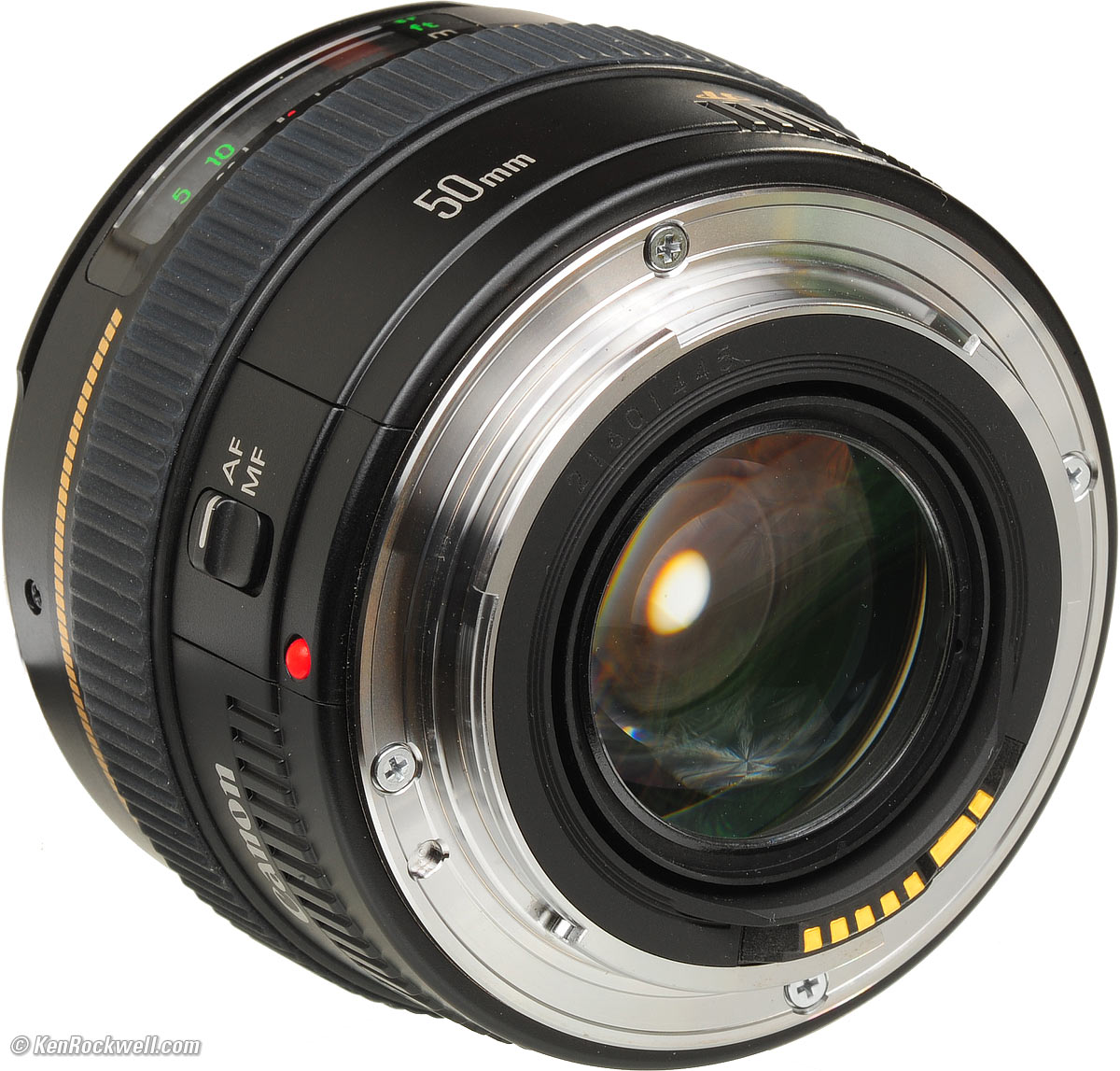
Back, Canon 50mm f/1.4. enlarge.
Spherochromatism back to Performance top
The Canon 50mm f/1.4 has some spherochromatism, which is common in fast normal lenses. You may see green or magenta fringes on out-of-focus highlights.
Compared top
Intro Specifications Performance Compared Recommendations
I'd get mine at B&H, at Crutchfield, at Adorama or at Amazon, or used at this link to them at eBay (see How to Win at eBay).
NEW: Canon 50mm Lenses Compared 05 Nov 2013
I shot the Canon 50mm f/2.5 macro directly against this 50mm f/1.4 USM at the test range on a 5D Mark II. The f/1.4 lens is much softer at every aperture, especially from f/2.5 - f/8. At 100% on-screen, the f/1.4 lens looks broken by comparison at the larger apertures.
The less expensive macro was much sharper at large apertures. By f/11, the f/1.4 lens improved to be about as good as this macro, where most lenses have the same sharpness due to diffraction anyway.
The macro also had much less distortion, and of course could focus much more closely.
If you split pixels, the inexpensive 50mm lens is clearly superior to this f/1.4 version.
The 50mm macro had a slightly shorter effective focal length than the f/1.4; in other words, the f/1.4 sees a slightly smaller angle of view.
Recommendations top
Intro Specifications Performance Compared Recommendations
I'd get mine at B&H, at Crutchfield, at Adorama or at Amazon, or used at this link to them at eBay (see How to Win at eBay).
For available-light photography, this is a must-have lens.
A fast (f/1.4) lens like this is far more important than having the latest high-ISO camera. At f/1.4, you can shoot at one-tenth the ISO and have the same low-light ability as an f/4.5 zoom lens. For example, an f/4.5 zoom lens will need to be shot at at ISO 4,000 to get the same short exposure time as this lens shot at ISO 400 and f/1.4!
Deployment
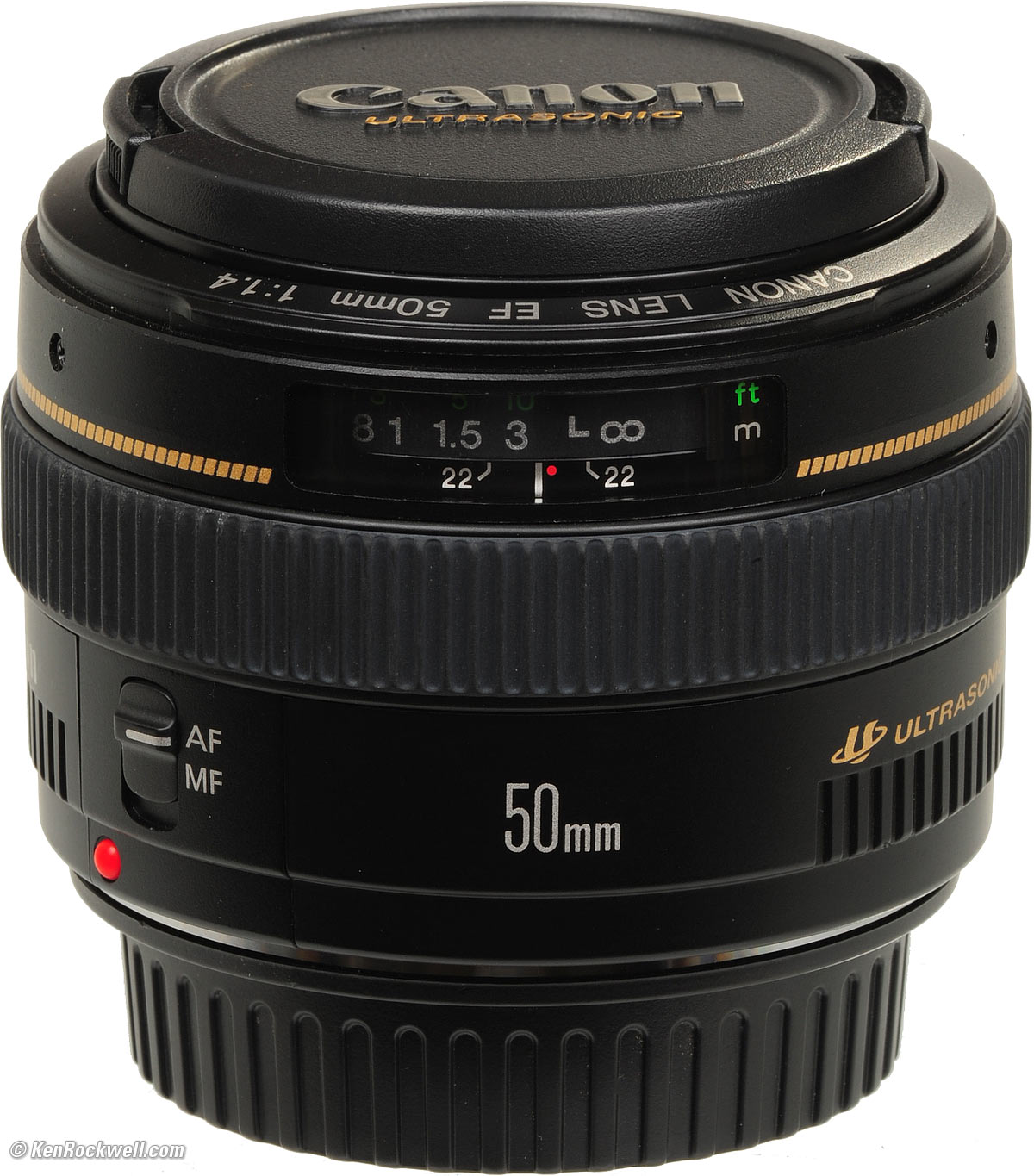
Canon 50/1.4, capped. enlarge.
I use a clear (UV) protective filter instead of a cap (exactly like an iPhone) so I'm always ready to shoot instantly. I only use a cap when I throw this in a bag with other gear without padding — which is never. The UV filter never gets in the way, and never gets lost, either.
The very best protective filter is the Hoya multicoated HD3 58mm UV which uses hardened glass and repels dirt and fingerprints.
The very inexpensive Hoya multicoated 58mm UV works as well but doesn't stay as clean, and for very basic use in filthy environments the uncoated Tiffen 58mm UV works almost as well and is much easier to clean.
Filters last a lifetime, so you may as well get the best. The Hoya HD3 stays cleaner than the others since it repels oil and dirt.
For color slides like Fuji Velvia 50, I'd use a 58mm Heliopan 81A outdoors.
To make clouds look natural with B&W film outdoors I use a 58mm Hoya HMC K2 Yellow, or usually a 58mm Hoya HMC YA3 Orange for a stronger effect, or a 58mm Hoya HMC Red 25 for the most dramatic skies or to hide skin imperfections.
Filters last a lifetime, so you may as well get the best. The Hoya HD3 stays cleaner than the others since it repels oil and dirt.
All these filters are just as sharp and take the same pictures, the difference is how much abuse they'll take and stay clean and stay in one piece. Since filters last a lifetime or more, there's no reason not to buy the best as it will last you for the next 40 years. Filters aren't throwaways like digital cameras which we replace every few years, like it or not. I'm still using filters I bought back in the 1970s!
I'd pitch the flat Canon cap that came with this lens new, and get a new Nikon pinch-type cap. I'm not kidding: the new fatter caps are much easier to use in the field.
This 100% all-content, junk-free website's biggest source of support is when you use those or any of these links to my personally approved sources I've used myself for way over 100 combined years when you get anything, regardless of the country in which you live — but I receive nothing for my efforts if you take the chance of getting it elsewhere. Canon does not seal its boxes in any way, so never buy at retail or any other source not on my personally approved list since you'll have no way of knowing if you're missing accessories, getting a defective, damaged, returned, dropped, incomplete, gray-market, store demo or used lens — and my personally approved sources allow for 100% cash-back returns for at least 30 days if you don't love your new lens. I've used many of these sources since the 1970s because I can try it in my own hands and return it if I don't love it, and because they ship from secure remote warehouses where no one gets to touch your new lens before you do. Buy only from the approved sources I've used myself for decades for the best prices, service, return policies and selection.
Many thanks to Jerry Johnson of Orange County, California who loaned me his lens for this review back around 2009.
© Ken Rockwell. All rights reserved. Tous droits réservés. Alle Rechte vorbehalten. Alla rättigheter förbehållna. Toate drepturile rezervate. Omnia jura reservata. Ken Rockwell® is a registered trademark.
Help Me Help You top
I support my growing family through this website, as crazy as it might seem.
The biggest help is when you use any of these links when you get anything. It costs you nothing, and is this site's, and thus my family's, biggest source of support. These places always have the best prices and service, which is why I've used them since before this website existed. I recommend them all personally.
If you find this page as helpful as a book you might have had to buy or a workshop you may have had to take, feel free to help me continue helping everyone.
If you've gotten your gear through one of my links or helped otherwise, you're family. It's great people like you who allow me to keep adding to this site full-time. Thanks!
If you haven't helped yet, please do, and consider helping me with a gift of $5.00.
As this page is copyrighted and formally registered, it is unlawful to make copies, especially in the form of printouts for personal use. If you wish to make a printout for personal use, you are granted one-time permission only if you PayPal me $5.00 per printout or part thereof. Thank you!
Thanks for reading!
Ken.