Vivitar VMC 70-210mm f/3.5 Series 1
Intro Specs Performance Recommendations
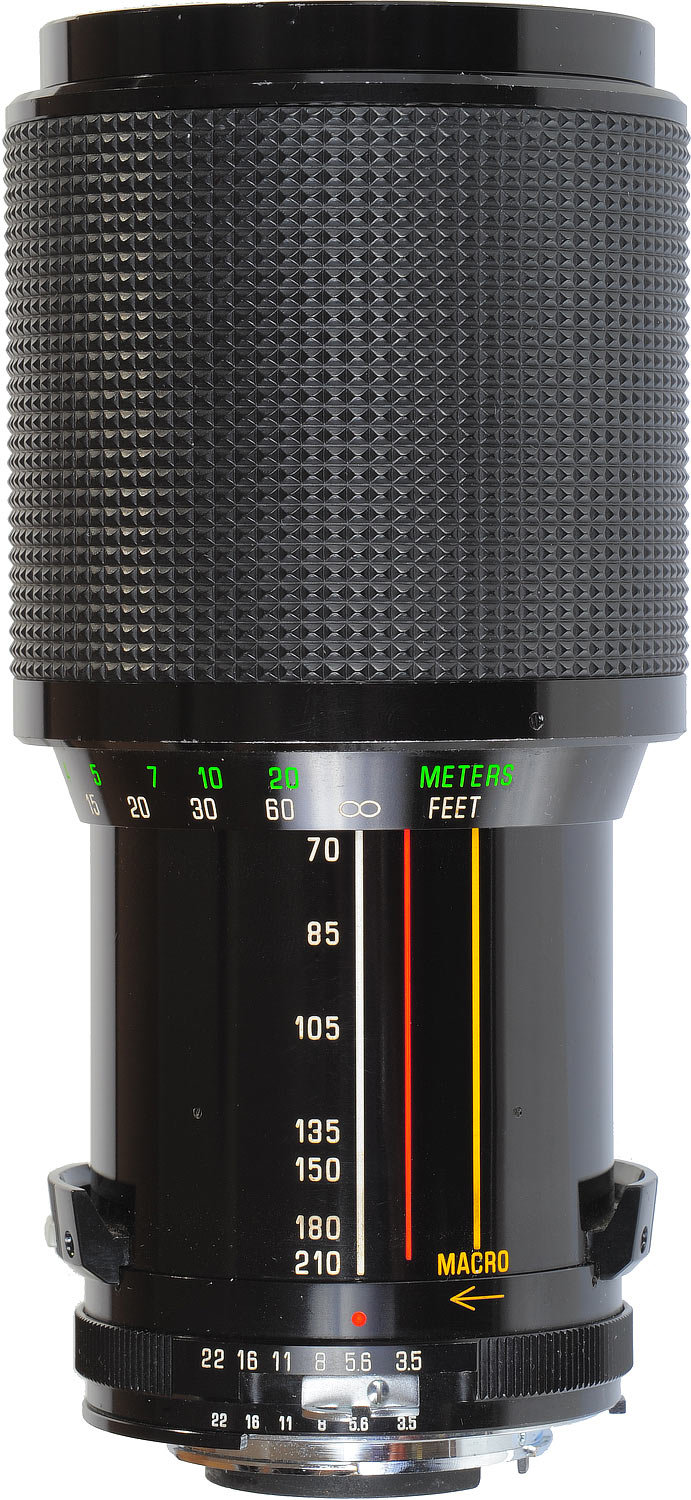
Vivitar VMC 70-210mm f/3.5 Series 1 (67mm filters). enlarge. About $30 used at eBay, which is where I got mine (How to Win at eBay), or I'd get it used at KEH .
This all-content, junk-free website's biggest source of support is when you use those or any of these links to approved sources when you get anything, regardless of the country in which you live. Thanks for helping me help you! Ken.
July 2025, March 2008 Better Pictures Canon Nikon Sony Fuji OM SYSTEM LEICA Zeiss HASSELBLAD All Reviews
Best for: High optical quality in a very inexpensive FX or film manual focus tele zoom.
Optical Quality: Very Good.
Ease-of-use: Fair: focus ring turns backwards and macro mode requires a gear shift.
Usefulness: Excellent, if you need a manual-focus tele.

Intro Specs Performance Recommendations
The Vivitar 70-210mm Series 1 is the classic of classics of third-party lenses. Like many Vivitar lenses, it was made for Vivitar by fourth parties, and its design varied over the years. Apocryphal data suggests this version was made by Kino Precision (Kiron) in December, 1978.
The version seen here has always been the classic of these 70-210mm Series 1 to me, since its what my smart friends had back when I was a photo editor at a New York newspaper back in 1980-1984. (I was still trying to shoot sports with my fixed Nikkors.)
It offers very high performance, and today sells used for next to nothing.
I got mine used at eBay (How to Win at eBay), or I'd get it used at KEH.
Compatibility
These are best used on manual-focus film cameras or FX digital cameras, like the Nikon D3. They work OK on DX digital, but there are much better choices.
The 70-210mm Series 1 was made throughout quite a few years in several versions. The earliest ones were not AI, and won't do much of anything with most cameras. Avoid these, since newer ones cost no more used. Get at least an AI version as shown here, which is identified by its two sets of duplicate numbers along the aperture ring.
On the D3, D300, D200, D2 and F6, use the "Non-CPU Lens Data" menu option to get full matrix metering, EXIF data, and finder read-out of set aperture. It works great in aperture-preferred as well as manual modes on these cameras.
If you want the EXIF to read the correct focal length as you zoom, assign as many memories as you like to the various focal lengths. For instance, set 70mm and f/3.5, 85mm and f/3.5, 105mm and f/3.5, 135mm and f/3.5 and 200mm and f/3.5. Set the function button to let you select among these settings as you zoom. Exposure will be fine, even if you don't bother to change it to get the EXIF data correct as you zoom.
The meters of cheaper digital (D80 and below) and cheaper film cameras (N80 and below) will not work with this lens, so you'll be on your own guessing exposure using the rear LCD or an external meter.
It works perfectly every professional film camera (F, F2, F3, F4, F5, F6), and adds Matrix metering on the F6. This version doesn't have all the correct lugs to trigger Matrix metering on the FA and F4. Newer versions may.
See Nikon Lens Compatibility for details on your camera. Read down the "AI Converted" column for this particular lens shown here.
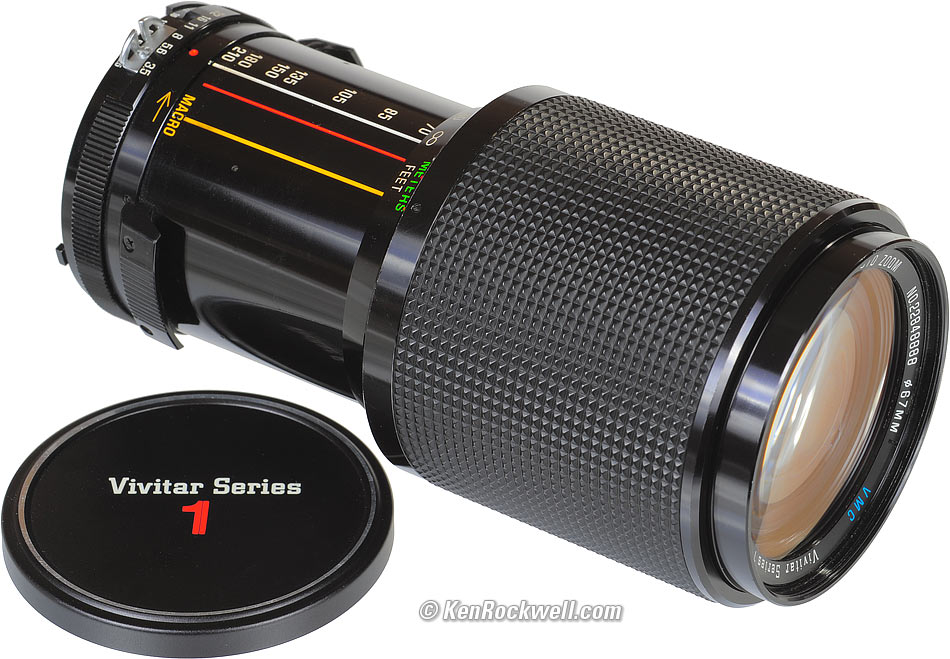
Vivitar 70-210mm Series 1. enlarge.
Specifications with commentary back to top
Intro Specs Performance Recommendations
I got mine used at eBay (How to Win at eBay), or I'd get it used at KEH.
Name
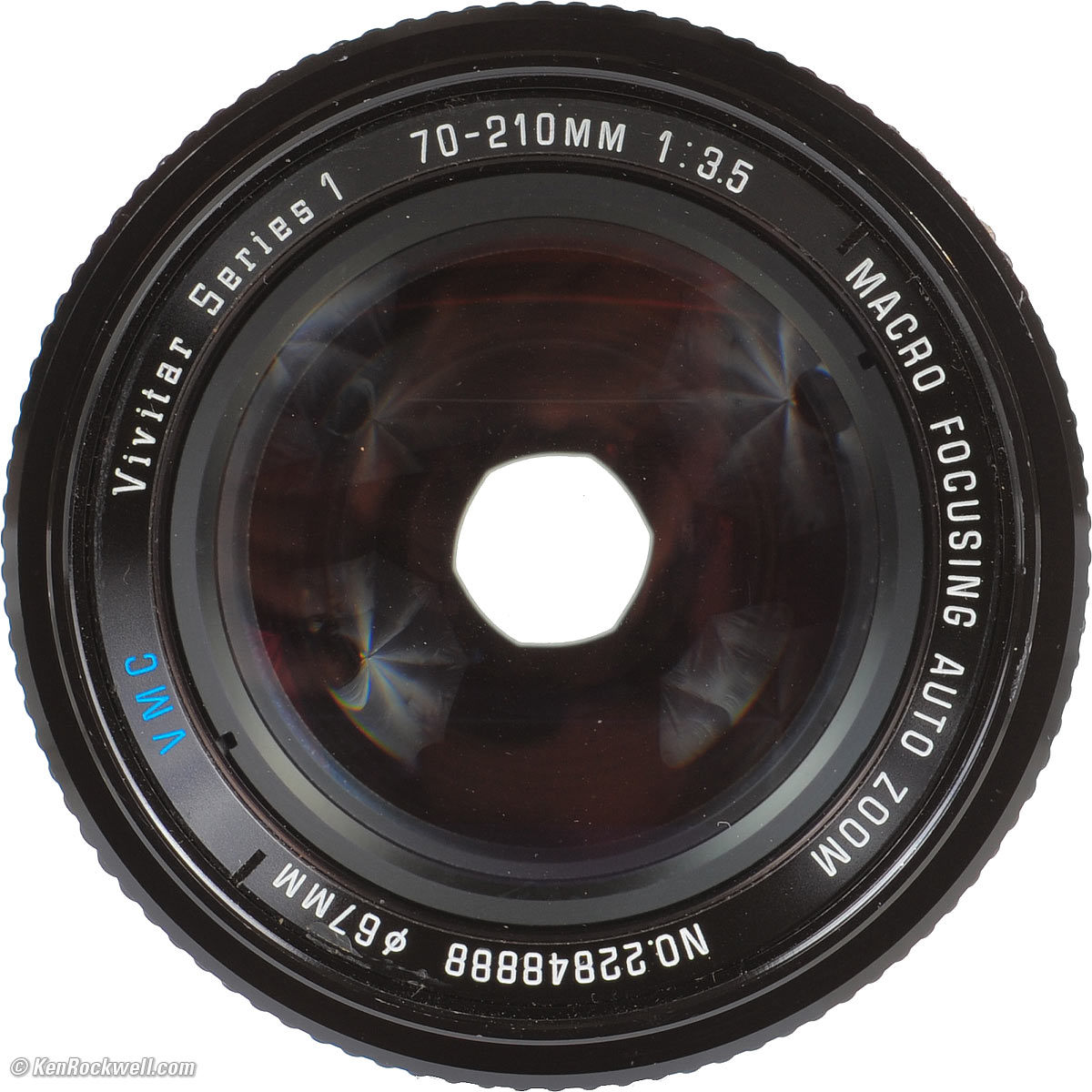
Vivitar calls this the Vivitar VMC Series 1 70-210mm f/3.5 Macro Focusing Auto Zoom.
VMC means Vivitar Multi-Coated.
Focal Length
70-210mm. On a DX camera, it gives angles of view similar to what a 105-315mm lens would give on an FX or 35mm film camera. See also Crop Factor.
Optics
15 elements in 10 groups. VMC Vivitar Multi Coating. The efficiency of the coatings don't seem anywhere near as efficient as the coatings of the Nikkors. Looking into the Vivitar lens I see a lot more and brighter reflections than I do looking deep into a Nikkor lens.
Diaphragm
Vivitar 70-210mm Series 1. enlarge.
6 blades, stopping down to f/22. Annoying arbitrary half-stop clicks added as a sales feature to impress innocent amateurs: it doesn't have twice as many settings as the Nikkor (all lenses may be set anyplace along their aperture scale), and this confuses pros who click off apertures by feel.
Focus Ring
Rubber-covered metal. ROTATES BACKWARDS.
Hard Infinity Focus Stop?
Yes.
Close Focus
6.4 feet (1.95m), per focus scale. Additional macro mode.
Maximum Reproduction Ratio
About 1:2.2 in macro mode, almost as good as a real Nikkor manual focus micro lens!
Focus Distance Scale?
Yes.
Depth-of Field Scale?
NO.
Infra-Red Focus Index?
There is a red line next to the focus index which could be an IR index, however it's straightness makes it suspect, since every other zoom, cheap or good, varies with focal length setting. It would be intriguing if the IR shift didn't vary with focal length.
Filter Thread
67mm.
Size
6.20" extension from flange x 3.076" diameter (157.5 x 78.12mm), measured when focused at infinity. The widest part are the rubber focus nubbins. The length changes as focused, but not when zoomed.
Weight
33.280 oz. (943.45g), measured.
Front Cap
Stamped anodized aluminum slip-on cap with painted "Vivitar Series 1" logo. Inner felt lining to keep it attached.
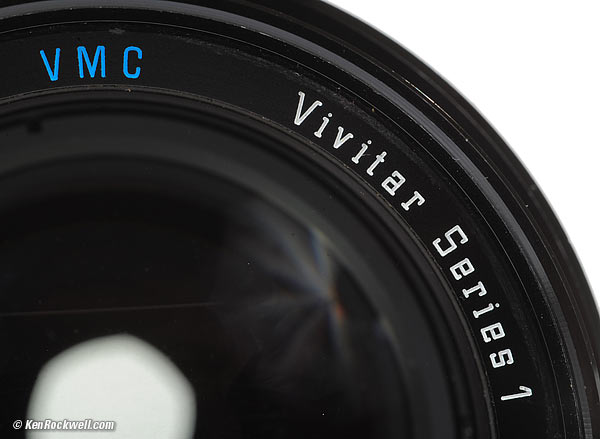
Vivitar 70-210mm Series 1. VMC is Vivitar Multi Coating.
Performance back to top
Intro Specs Performance Recommendations
I got mine used at eBay (How to Win at eBay), or I'd get it used at KEH.
Except for the one serious compromise of the focus ring turning backwards, optics and handing are excellent.
The focus goes the wrong way, which is a huge block to usability since the rangefinders of every Nikon camera will tell you to turn the ring the wrong way, because Vivitar supplied these lenses in mounts for every brand of camera. Since most other brands of cameras focus in the other direction from Nikon and Vivitar was too cheap to use a different focus system for the Nikon mount version, Nikon users are screwed.
Used on AF Nikons like the Nikon D3 and F6, try to imagine the little electronic focus arrows telling you in which way to turn the bottom of the focus ring.
Bokeh
Bokeh is neutral.
Lateral Color Fringes
None, on the D3 which corrects for anything minor or moderate.
I haven't tried it on film or old non-correcting digital cameras like the D200.
Distortion
Distortion is as good as the Nikkors. It is slightly more balanced from one end of the zoom range to the other, while the Nikkors have more barrel distortion at the shorter end with less pincushion distortion at the longer end.
Use these numbers in Photoshop CS2's lens distortion filter to rectify it. These aren't facts or specifications, they are the results of my research that requires me to climb a bluff on a very clear day and shoot the ocean's horizon.
For scanned film, use the FX full-frame figures.
FX, infinity |
FX, 10' (3m) |
DX, infinity |
|
70mm |
+2.5 |
+2.0 |
+1.0 |
85mm |
+1.1 |
||
105mm |
0.0 |
0.0 |
0.0 |
135mm |
-0.5 |
-1.7 |
-0.1 |
210mm |
-2.0 |
-2.1 |
-0.2 |
© 2008 KenRockwell.com
Focus
Focus, except for being backwards, feels great. It's smooth and feels just about perfect.
Vivitar used the wrong colors. Nikon lenses have meters in white and feet in yellow. This vivitar colors the meters in green and leaves the feet in white, meaning that you're going to get confused if you use the focus distance scale.
Infinity-Focus Holding
Infinity focus is pretty close to the stop at most focal length settings.
The 80-200mm Nikkors which have no macro setting rings are better at this. The other, shorter, zoom Nikkors which have separate macro levers, as this lens does, are often worse.
Macro
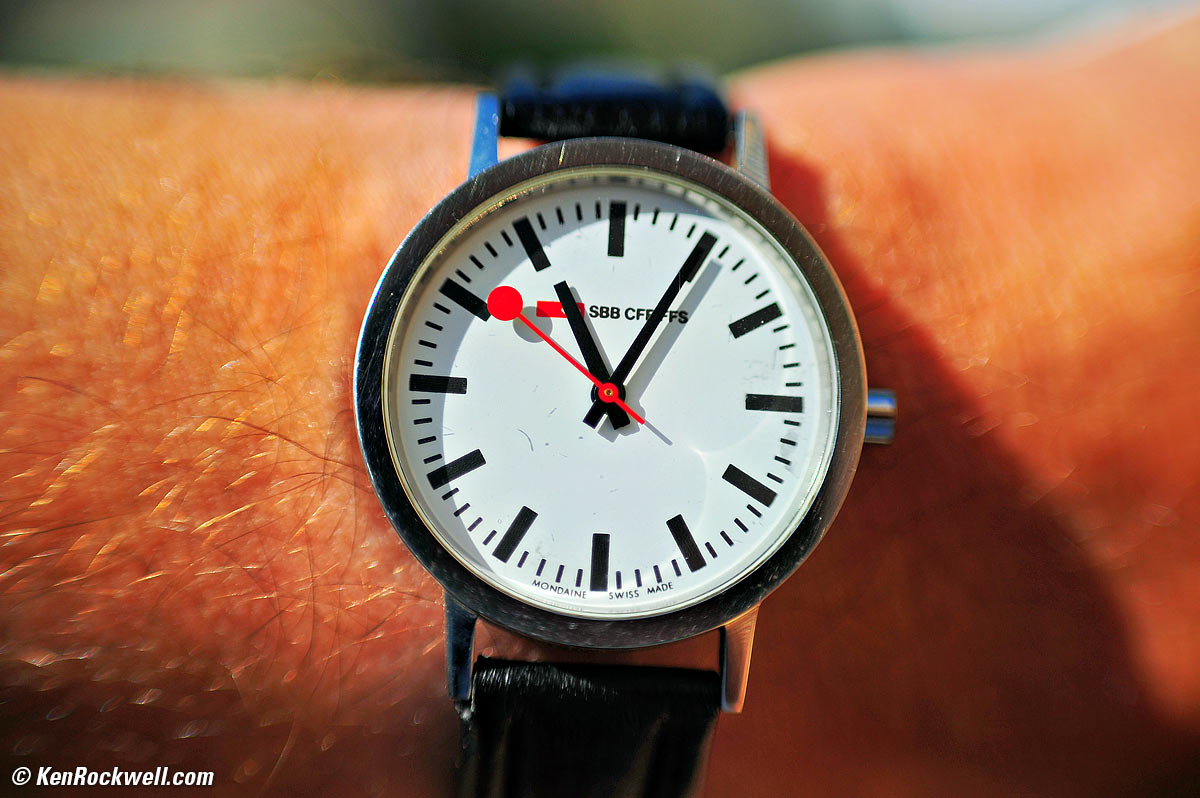
Full-frame image as closest macro setting, wide open aperture.
The macro range is impressive, to almost half life size. The shot above is what you'll get on film or FX. On a DX digital camera, you'd fill the frame vertically with the watch face.
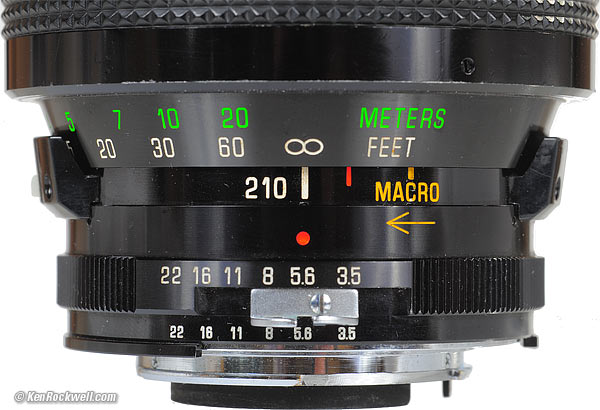
Press the small white button on the left and rotate the two wings.
To use the macro mode, pull the zoom ring to 210mm. Now squeeze the little white button on one of the two little wings that come off the lens, and rotate in the direction of the yellow arrow until the yellow "MACRO" is lines up with the red dot.
You focus in the macro mode by sliding the zoom ring forward and back. Closest focus is with the zoom ring at the 70mm position.
Sharpness
Sharpness is excellent, corner-to-corner at ever setting.
It has a little lower contrast wide open, but is always sharp. Contrast picks right up a stop closed down.
Zooming
Zooming is very good. The zoom slides reasonably freely and smoothly. It feels almost as good (which means not as good) as a Nikkor.
It's a hand-job style zoom: the focus and zoom ring slides up and down while the lens doesn't change size.
It's cammed just about perfectly: it's a perfect combination of speed versus precision, and it's easy to set a precise focal length at any part of the range. it has a reasonably accurate log curve at about 3 cm/octave.
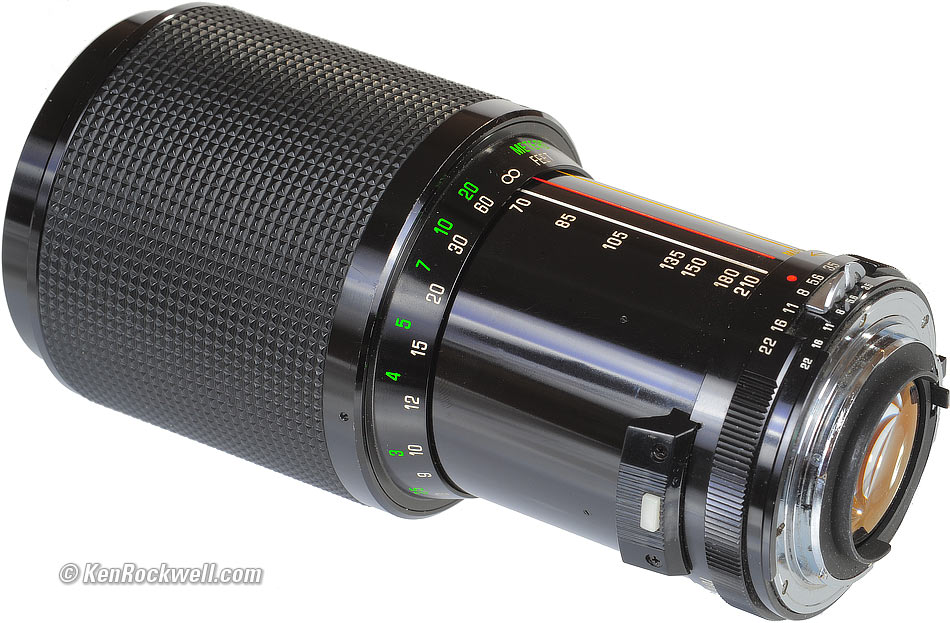
Vivitar 70-210mm Series 1. enlarge.
Recommendations back to top
Intro Specs Performance Recommendations
I got mine used at eBay (How to Win at eBay), or I'd get it used at KEH.
If you own one, use it, but if not, spring the extra fifty bucks (used) for a real Nikkor 80-200mm f/4 AI-s. If you're on a budget, get an older 80-200mm AI f/4.5 Nikkor, which is also superior and sells used for about the same price.
Performance is excellent for a non-Nikkor lens, but no big deal compared to a real Nikkor.
Skip it for DX digital cameras and get at least the 55-200mm AF Nikkor instead, if you're on a budget. The lack of autofocus will drive you crazy.
I use a clear (UV) protective filter instead of a cap (exactly like an iPhone) so I'm always ready to shoot instantly. I only use a cap when I throw this in a bag with other gear without padding — which is never. The UV filter never gets in the way, and never gets lost, either.
The very best protective filter is the nearly indestructible Hoya multicoated HD3 67mm UV which uses hardened glass and repels dirt and fingerprints.
For less money, the Nikon 67mm NC (No Color/Neutral Clear), Hoya 67mm NXT Plus UV and Hoya 67mm UV MC are all excellent filters, but the Hoya HD3 is the toughest and the best.
The least expensive coated filter is the Chiaro 67mm 95-UVAT UV, which I haven't tried but ought to be swell.
If I was working in nasty, dirty areas, I'd use an uncoated 67mm Tiffen UV filter instead. Uncoated filters are much easier to clean, but more prone to ghosting.
Nikon's 67mm Circular Polarizer II is excellent.
For color slides like Fuji Velvia 50, I use a 67mm 81A, preferably multicoated, outdoors.
For B&W film outdoors to make clouds look natural in the sky I use a 67mm Hoya HMC K2 Yellow, or usually a 67mm Hoya HMC Orange for a stronger effect, or a 67mm Hoya HMC Red for the most dramatic skies or to hide pimples on skin.
Filters last a lifetime, so you may as well get the best. The Hoya HD3 stays cleaner than the others since it repels oil and dirt.
All these filters are just as sharp and take the same pictures, the difference is how much abuse they'll take and stay clean and stay in one piece. Since filters last a lifetime or more, there's no reason not to buy the best as it will last you for the next 50 years. Filters aren't throwaways like digital cameras which we replace every few years, like it or not. I'm still using filters I bought back in the 1970s! The Hoya HD3 stays cleaner than the others since it repels oil and dirt, and you'll be using it long after you've thrown this lens away in 50 years.
More Information: Mark Roberts has the best historical data on the various versions. Mr. Roberts refers to my version shown here as "Version 1."
© Ken Rockwell. All rights reserved. Tous droits réservés. Alle Rechte vorbehalten. Alla rättigheter förbehållna. Toate drepturile rezervate. Niciun vampir nu a fost implicat în crearea acestei lucrări. Doe! Omnia jura reservata. Ken Rockwell® is a registered trademark.
Help Me Help You top
I support my growing family through this website, as crazy as it might seem.
The biggest help is when you use any of these links when you get anything. It costs you nothing, and is this site's, and thus my family's, biggest source of support. These places always have the best prices and service, which is why I've used them since before this website existed. I recommend them all personally.
If you find this page as helpful as a book you might have had to buy or a workshop you may have had to take, feel free to help me continue helping everyone.
If you've gotten your gear through one of my links or helped otherwise, you're family. It's great people like you who allow me to keep adding to this site full-time. Thanks!
If you haven't helped yet, please do, and consider helping me with a gift of $5.00.
As this page is copyrighted and formally registered, it is unlawful to make copies, especially in the form of printouts for personal use. If you wish to make a printout for personal use, you are granted one-time permission only if you PayPal me $5.00 per printout or part thereof. Thank you!
Thanks for reading!
Ken.