ZEISS PLANAR 80mm f/2.8 C
For HASSELBLAD (1957-1982)
Sample Images Intro New Good Bad Missing
Compatibility Format Specifications
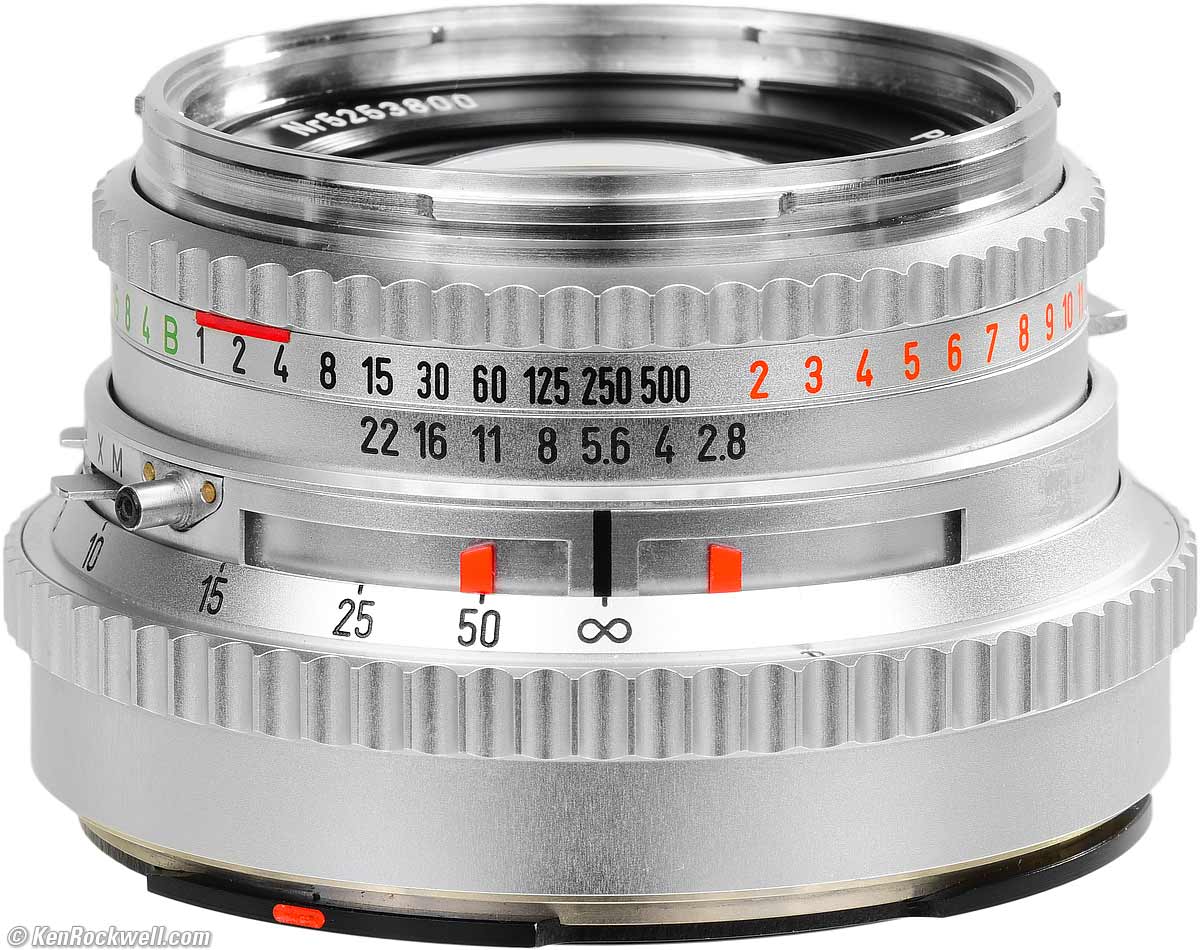
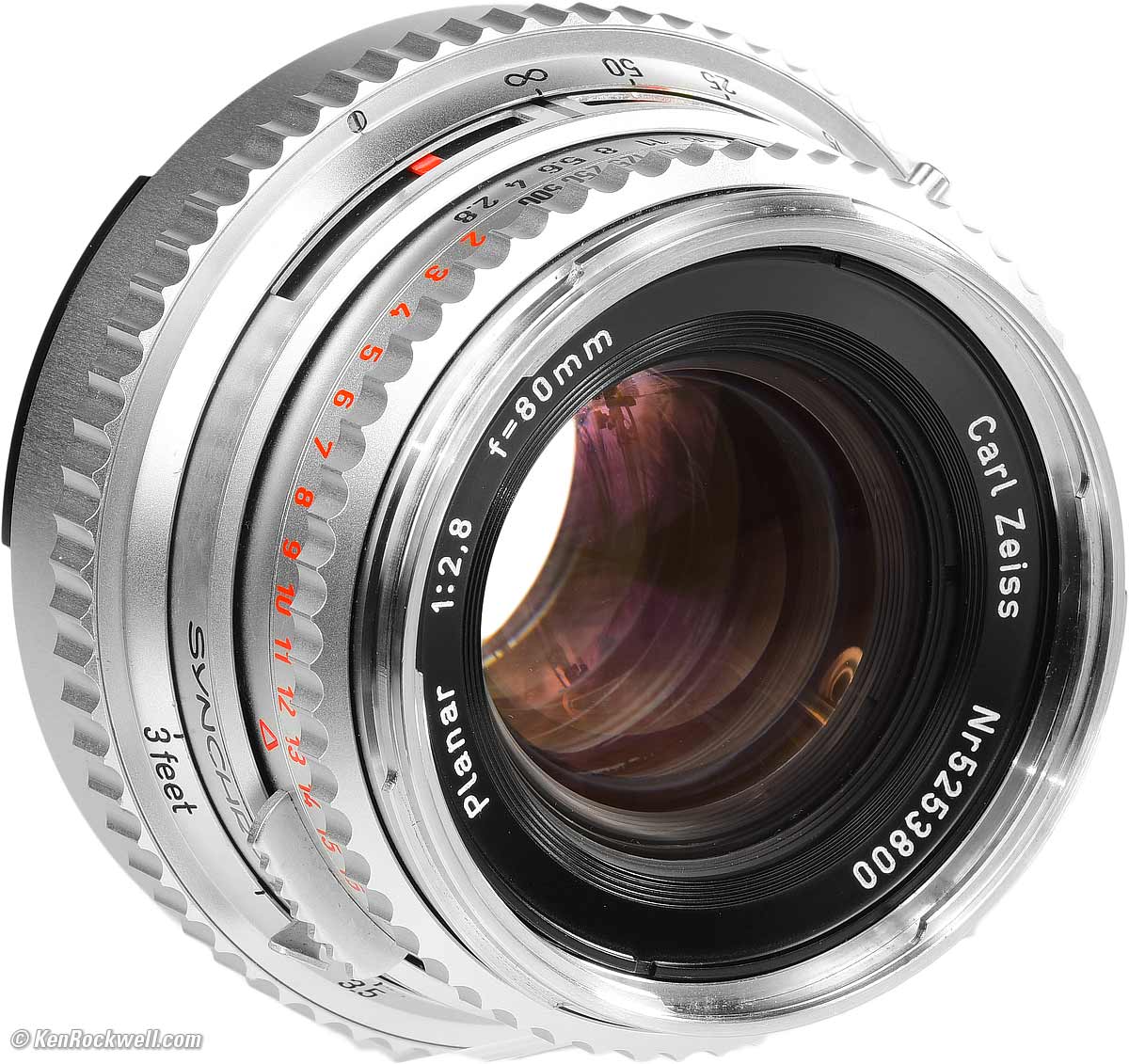
ZEISS PLANAR 80mm f/2.8 C (fits HASSELBLAD V system, this sample made in February 1970, B50 bayonet filters, 16.5 oz./467g, 3'/0.9m close focus, about $725 used if you know How to Win at eBay.) bigger.
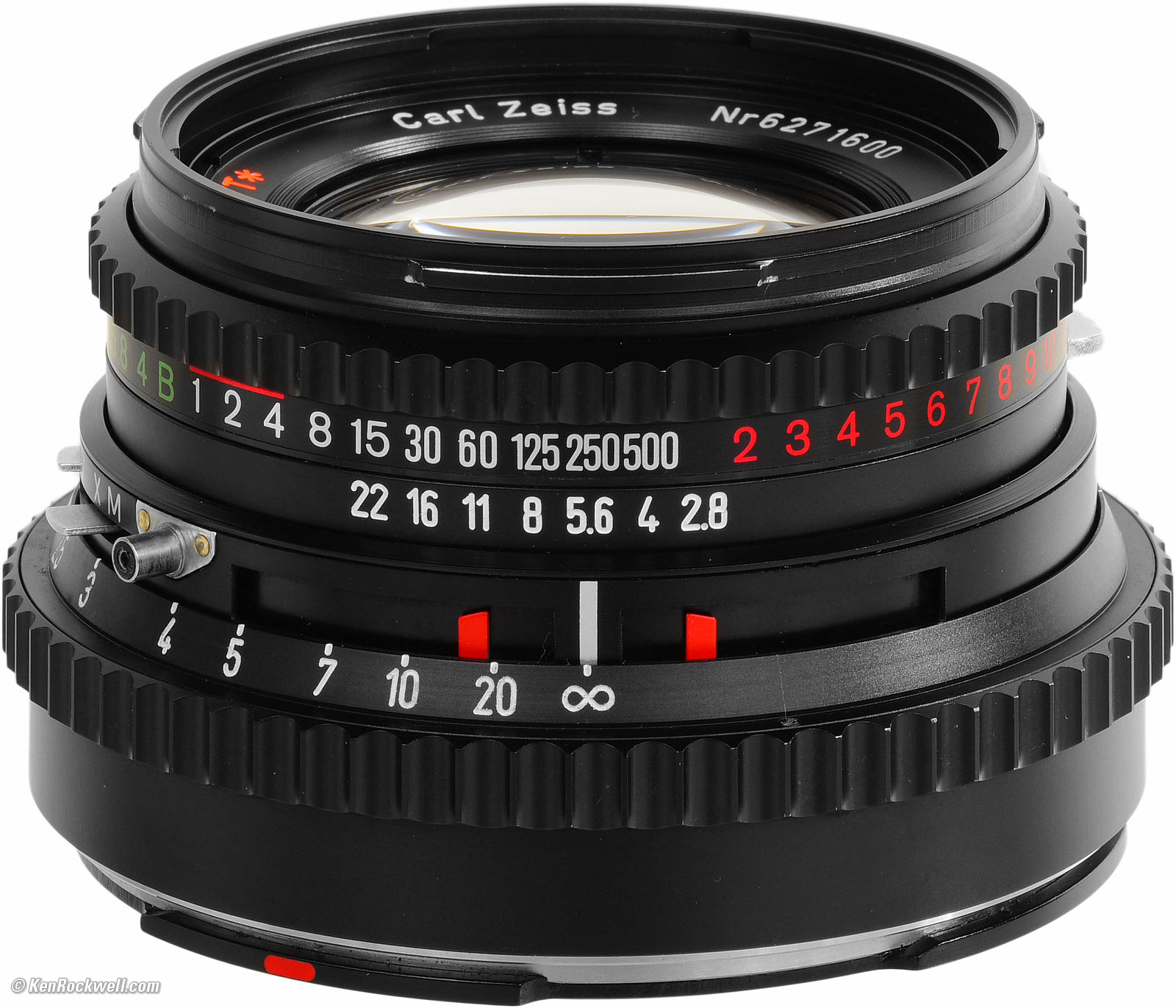
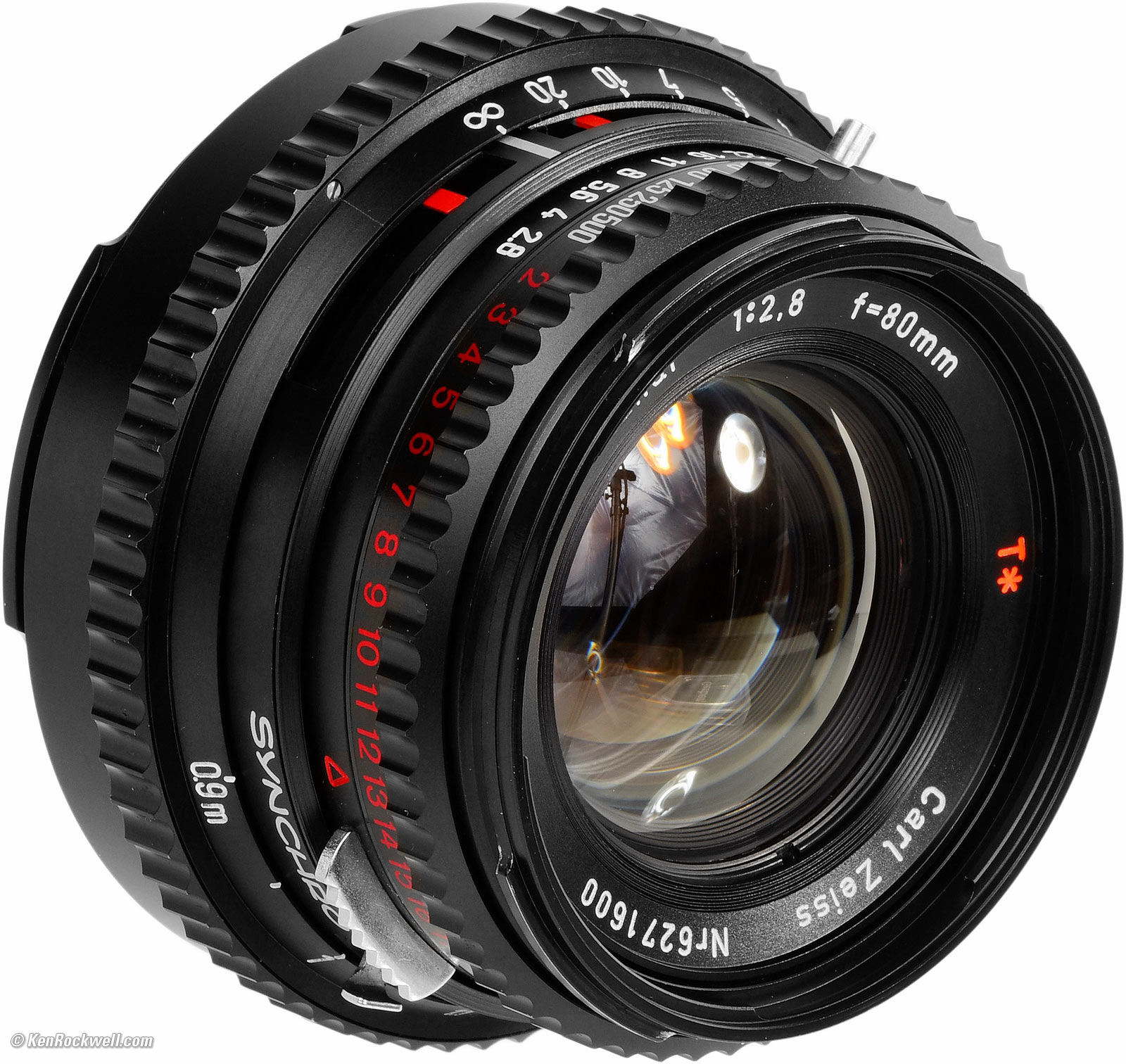
ZEISS PLANAR T✻ 80mm f/2.8 C (fits HASSELBLAD V system, this sample made in 1980, B50 bayonet filters, 15.2 oz./430g, 3'/0.9m close focus, about $725 used if you know How to Win at eBay.) bigger. I got this one at this link directly to them at eBay. Never buy at a retail store or other dealers; you'll pay way too much and have very limited options if you don't like it.
This all-content, junk-free website's biggest source of support is when you use those or any of these links to my personally-approved sources when you get anything, regardless of the country in which you live. Use only the approved sources I use myself for the best prices, service, return policies and selection. Thanks for helping me help you! Ken.
June 2024 HASSELBLAD ZEISS CONTAX Mamiya LEICA Nikon Canon All Reviews
NEWER STYLE: ZEISS PLANAR T✻ 80mm f/2.8 CF (1982-1999; same optics as this lens).
NEWEST STYLE: ZEISS PLANAR T✻ 80mm f/2.8 CFE (2000-2013, adds electronic contacts, same optics as this lens).
Why fixed lenses take better pictures
How to Use Filters (mandatory when shooting film)
Sample Images top
Sample Images Intro New Good Bad Missing
Compatibility Format Specifications
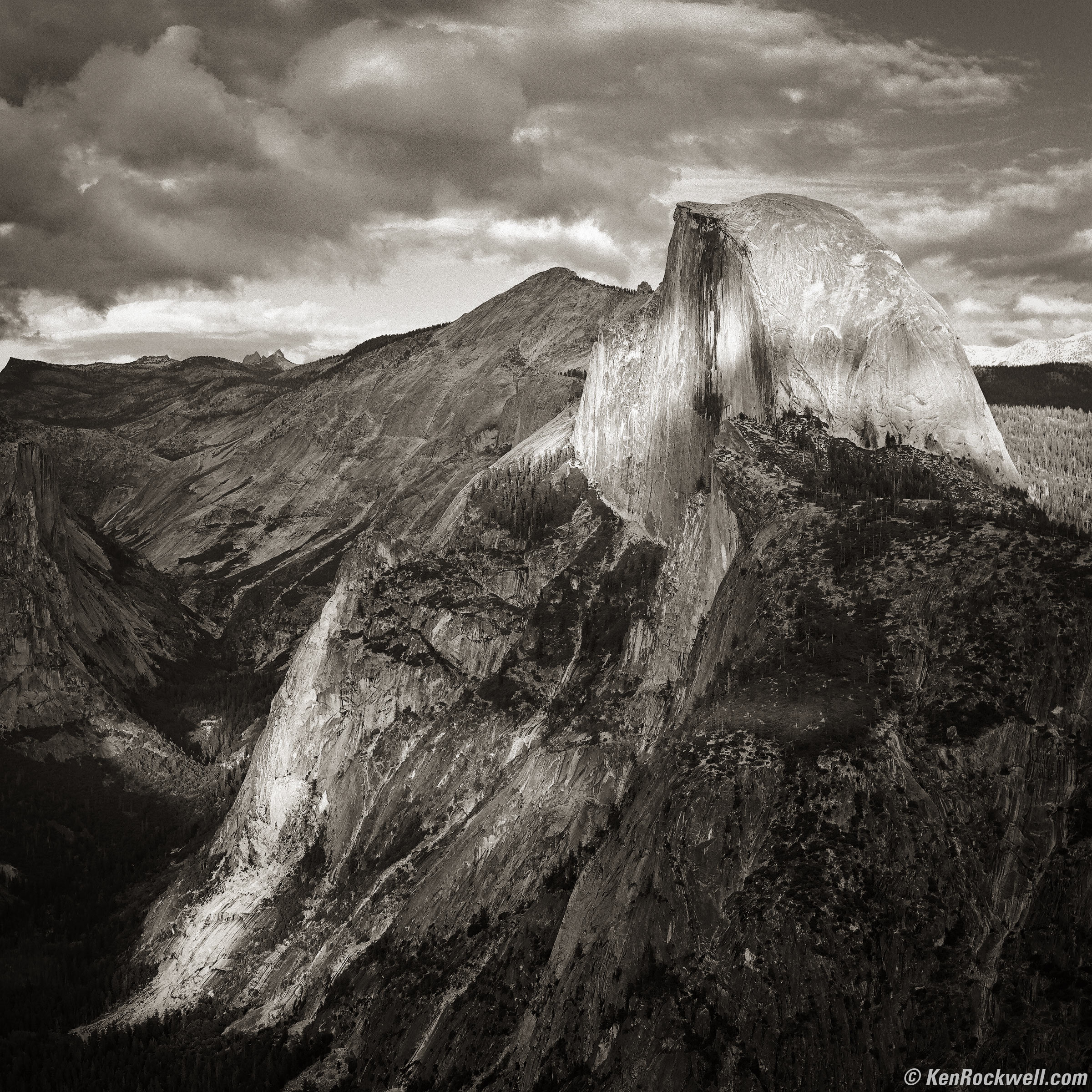
The Half Dome as Seen From Glacier Point, Yosemite National Park, 5:21 PM, Monday, 24 October 2016. HASSELBLAD 500C/M, klassisch silber non-T✻ ZEISS PLANAR 80mm f/2.8, B50 25A red filter, f/9.5 at 1/8 of a second on Fuji ACROS 100, Great American Photo Lab develop & scan, Radiant Photo and Skylum Luminar Neo software for emphasis, split-toned print. Photo: Ken Rockwell. bigger.
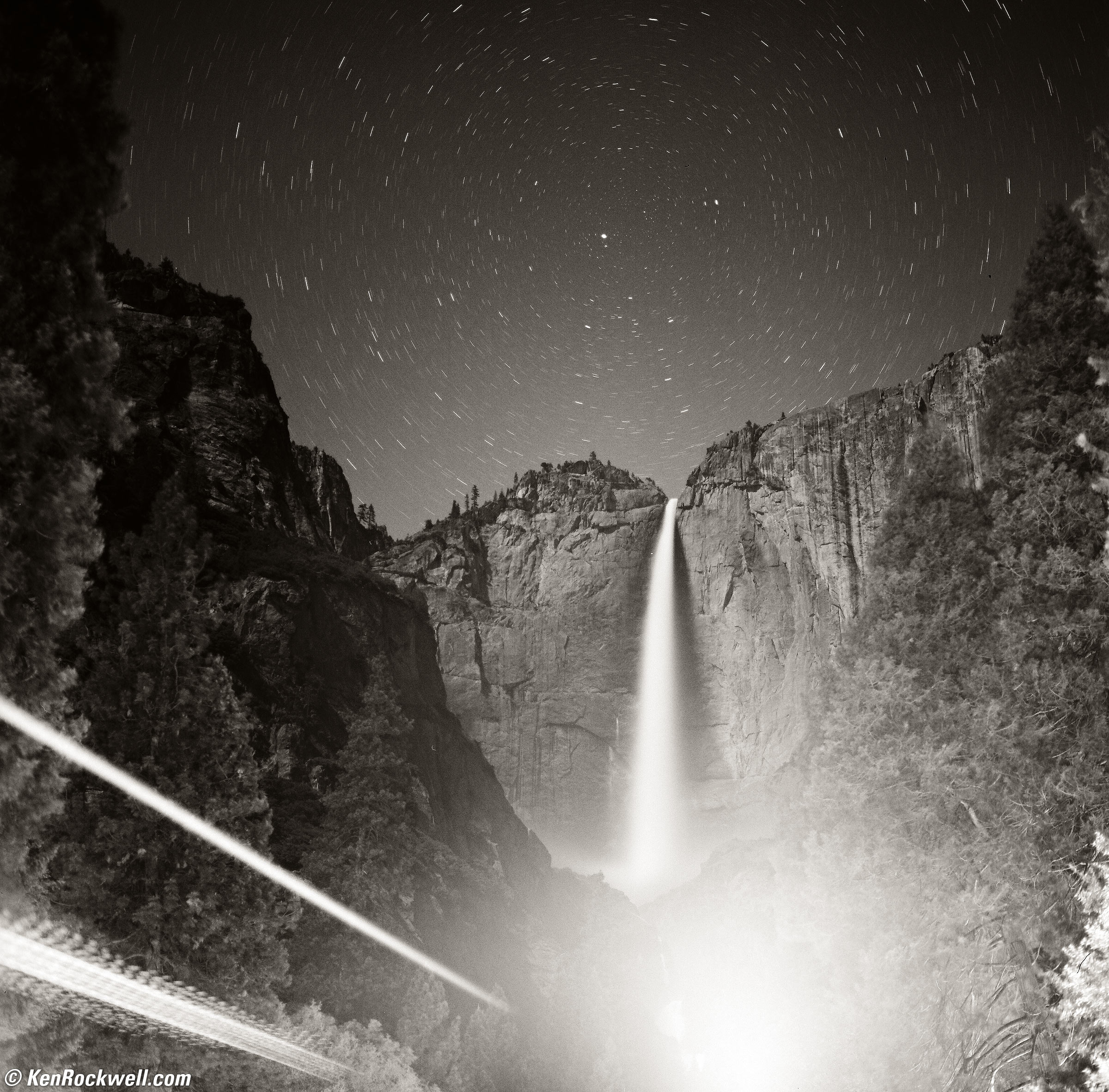
Yosemite Falls by Moonlight (first quarter) with Star Trails, Yosemite National Park, 9:32 ~ 9:40 PM, Friday, 13 May 2016. HASSELBLAD 500C/M, ZEISS PLANAR T✻ 80mm f/2.8 CF, no filter, f/2.8 for eight minutes on Fuji ACROS 100, Great American Photo Lab develop & scan, Radiant Photo software, split-toned print. Gossen Luna Pro SBC read LV -5 (minus five). Photo: Ken Rockwell. bigger.
What look like light leaks are passing busses on the bottom left and approaching cars at the bottom center.
While the trees are blowing in the wind (or growing) in the course of this 8-minute time exposure and therefore soft, look carefully at the star trails in the upper corners and you'll see how sharp they are, even wide-open at f/2.8.
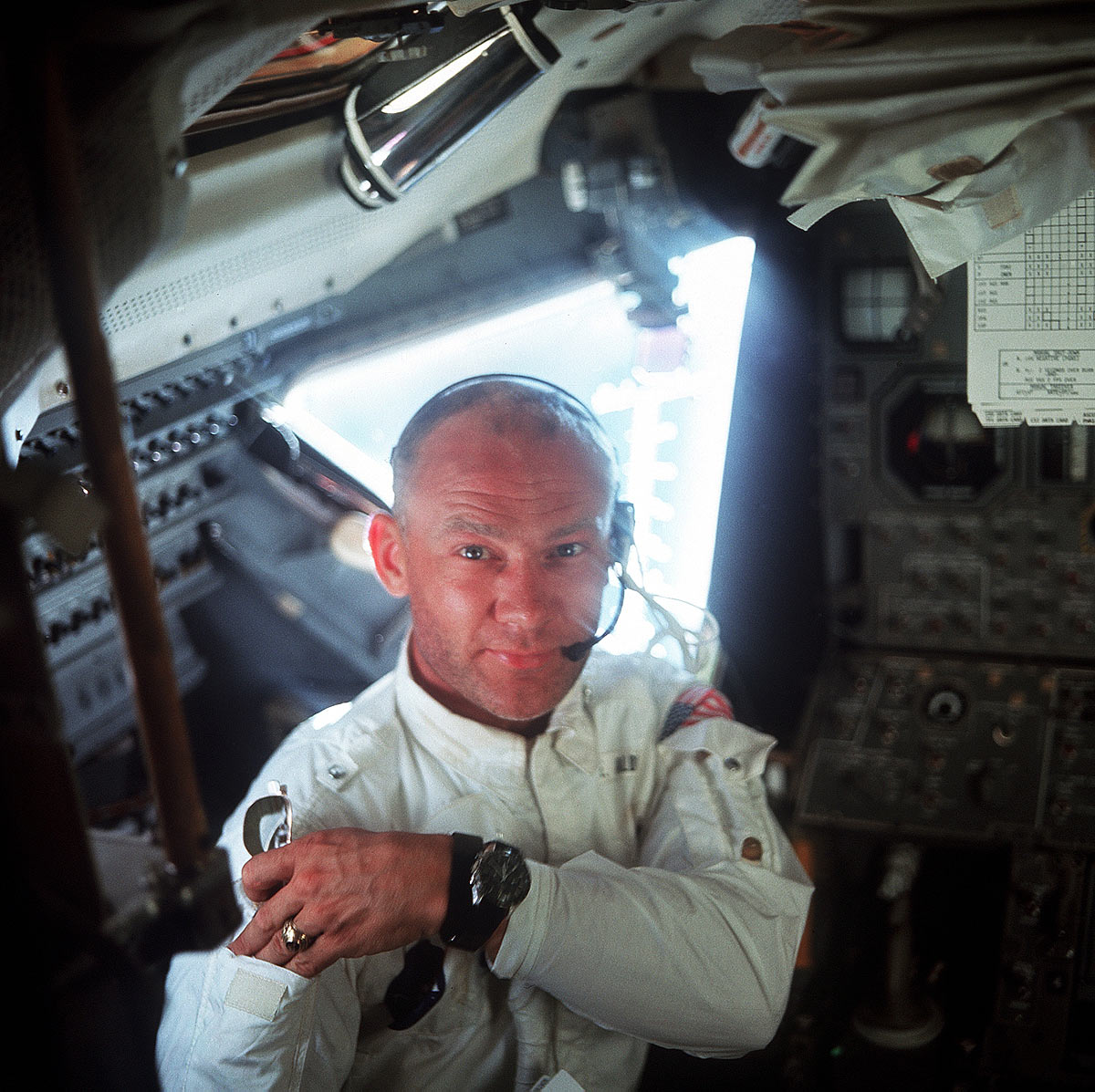
Buzz Aldrin inside the LEM during the lunar descent, 20 July 1969. bigger. HASSELBLAD 500 EL, 80mm f/2.8 Planar, Kodak SO-368 Ektachrome 70mm film. Photo: Neil Armstrong, commander, Apollo XI, NASA.

Introduction top
Sample Images Intro New Good Bad Missing
Compatibility Format Specifications

I buy only from these approved sources. I can't vouch for ads below. |



This ZEISS PLANAR 80mm f/2.8 is arguably the most important lens in photography.
Not only is this lens important in photography; its images are the most important in our history. The photographs brought back from our trips to the moon are the best documentation we have of Man's Greatest Achievement. No one has been outside of Earth's orbit, much less to the moon, for over 50 years. These are the most recent and important photos we have.
This lens is from an era when full-time career professional photographers were common. Pros bought and used the same lenses for decades and decades. This same optical design remained as state-of-the art for over 55 years! Pros would send out lenses for service as needed, but these lenses never needed to be replaced with "improved" versions. Rich hobbyists bought these too, often falling for marketing departments' cosmetic changes advertised as "upgrades," but with the many cosmetic variations from 1957 through 2013, its optics have never changed. What did change over the years is cosmetics, shutters and filter sizes — but never the optics.
This lens combines flawless optics in a superior all-metal and ergonomically perfect package. The only gotcha is that while this original C version offers a built-in depth-of-field computer and self-timer not found in the newer CF and CFE versions, these C lenses are all so old that they are much more likely to need an overhaul to bring them back to perfect operation.
This ZEISS PLANAR 80mm f/2.8 was the main lens for a quarter of a century in the leading professional camera system most used by artists like Ansel Adams, used by NASA for our moon missions and it was used in all of commercial photography for decades. Your favorite classic album cover was probably shot with this lens. I can't possibly describe just how important and excellent is this lens, which is why this review went unwritten for about nine years after I bought mine.
Pros often bought beat-up used HASSELBLAD items and sent them to HASSELBLAD for their fixed-price overhaul service. HASSELBLAD's skilled service always brought items back to like-new with all new parts as needed, for a fixed price. Pros bought gear in the worst, cheapest condition possible and had them rebuilt like new by HASSELBLAD. Those days are gone, so don't get any ideas.
T✻ multicoating was added in the 1970s. It was added just before black models became available, so while you can find the occasional silver version with T✻ multicoating, I've never seen a black one without T✻ multicoating. As a simple seven-element, five group optical formula, it delivers great images even single-coated, as all are. T✻ multicoating doesn't add any significant contrast or color boost; it's mostly marketing as far as this simple lens is concerned.
More important than multicoating, the lack of the T✻ multicoating mark means you have one of the oldest lenses, and it's more likely to need an overhaul.
The first C version, shown here, came in chrome, then black in later years. It's not marked "C" anyplace; you just have to know. It takes B50 bayonet filters.
The newer CF version changed to a rubber focus ring and takes larger B60 bayonet filters. They have a newer Prontor shutter that also works with the focal-plane shutter HASSELBLADs.
The newest CFE version added electronic contacts and replaced the metal filter ring with a crappy plastic one — and still uses the same optics!
All these versions use an in-lens mechanical leaf shutter, so flash sync works perfectly at every shutter speed, which is great for fill flash at 1/500.
HASSELBLAD stopped making this V system as of 29 April 2013, but that's no big deal because these last forever with proper service, and it's easy to get digital backs for it. That's right; for the same price as a typical DSLR it's easy to get a used medium format back today; you don't have to hock your Mercedes to buy a new one anymore.
These 80mm lenses flew numerous Apollo missions and shot on the moon. If you want HASSELBLAD Lunar, the lenses that shot almost everything on most missions were this 80mm and the 250mm; the other lenses rarely flew.
Planning an important, once-in-a-lifetime photo outing and need to be prepared for anything and everything and to make the most important photographs ever produced? All we brought on most flights to the moon were this 80mm, the 250mm, and that was it.
If you have good eyes and want to see a few of these lenses, just look up at the moon. We left left several of these on the lunar surface, still there today.
New since lenses for the old 1000 and 1600 cameras intro top
 HASSELBLAD's first lens for their new (in 1957) 500-series cameras.
Integral leaf shutter.
Good intro top
 Extremely sharp at every setting.
No significant distortion.
Analog depth-of-field computer.
Depth of field preview.
Long-time exposure calculator.
Hands-free bulb and time exposures.
Built to last a lifetime or more.
MADE IN WEST GERMANY.
Bad intro top
 Mechanical shutter needs occasional overhauls every decade or so; used ones may require service.
Missing intro top
 No Image Stabilization - but
No batteries, no problem!
|
|
ZEISS PLANAR 80mm f/2.8 C. bigger. |
ZEISS PLANAR T✻ 80mm f/2.8 C. bigger. |
Compatibility top
Sample Images Intro New Good Bad Missing
Compatibility Format Specifications
The HASSELBLAD ZEISS PLANAR 80mm f/2.8 works on all classic V system HASSELBLAD cameras, but not today's H system.
None of the modern HASSELBLAD system works with the ancient 1600 and 1000 focal plane cameras of 1948-1957.
All versions of the 80/2.8 all work on all the usual 500, 501 and 503 series of cameras.
Only the CF and CFE versions work on the focal-plane cameras like the 200 and 2000 series.
Format top
Sample Images Intro New Good Bad Missing
Compatibility Format Specifications
It covers 2¼" (56.5 mm) square, or a 3.15" (80mm) diagonal.
Specifications top
Sample Images Intro New Good Bad Missing
Compatibility Format Specifications
Name
HASSELBLAD calls this the ZEISS PLANAR 80mm f/2.8 C.
PLANAR: A ZEISS trademark used as they see fit, today usually for high-speed normal lenses.
T✻: Another clever ZEISS trademark, used for multicoating since the 1970s.
C: Central leaf shutter, distinguishing it from the shutterless lenses sold earlier for HASSELBLAD's focal-plane shuttered model 1000 and 1600 cameras.
These original all-metal versions are still referred to as "C" today, even though HASSELBLAD only used this designation in its literature through about 1967 to differentiate it from the older, shutterless lenses.
Newer versions are suffixed CF or CFE.
It's made by ZEISS for HASSELBLAD.
Optics specifications top
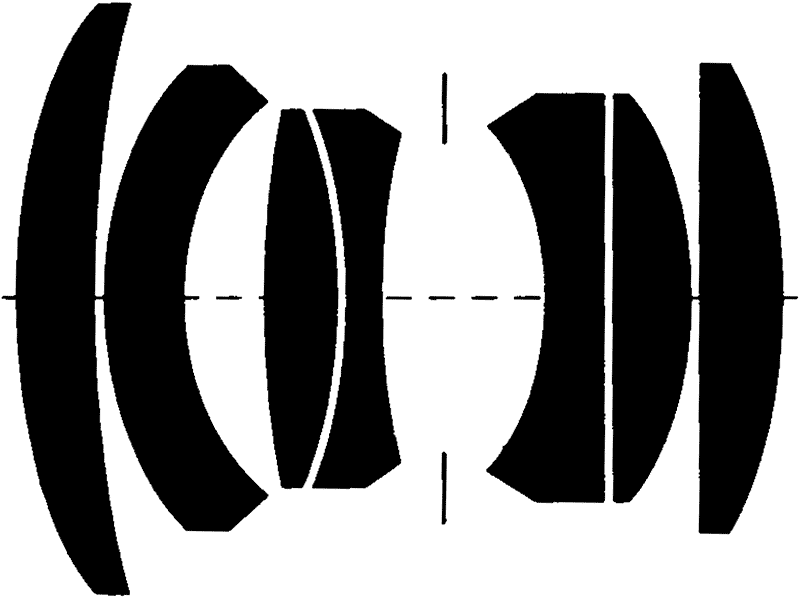
ZEISS PLANAR 80mm f/2.8 internal construction.
7 elements in 5 groups.
No aspherical, plastic or ED elements: just great, highly homogenous glass crafted into lenses with extraordinary precision and uniformity.
Dr. Ludwig Bertele's original, simpler PLANAR design dates to 1931 as a 50mm f/2. In 1932 a 50mm f/1.5 design came out, and it's still sold today by ZEISS. It was a very simple design with few air-to-glass surfaces which made high-speed lenses a reality back before anti-reflection coatings were invented in World War Two.
PLANAR is a trademark of ZEISS. It no longer refers to a particular optical design and instead is used to denote fast normal lenses.
This lens uses a completely different and more complex symmetrical double-GAUSS design from 1957, with more elements and air-glass surfaces than the 1931 PLANARs.
The first versions of this 1957 design are single coated mostly in blue, and most later versions are multicoated, which Zeiss brands as T*.
Actual focal length: 80.5 mm.
Flange focal distance (common to all lenses for this system): 74.90 mm.
Close Focus specifications top
3 feet (0.9 meters) from the image plane.
Maximum Reproduction Ratio specifications top
1:9 (0.11×).
Use a B50 PROXAR or extension tubes for closer closeups.
Minimum Field Size specifications top
517 mm (20.35") square.
Use a B50 PROXAR or extension tubes for closer closeups.
Diaphragm specifications top
|
|
ZEISS PLANAR 80mm f/2.8 C. bigger. |
ZEISS PLANAR T✻ 80mm f/2.8 C. bigger. |
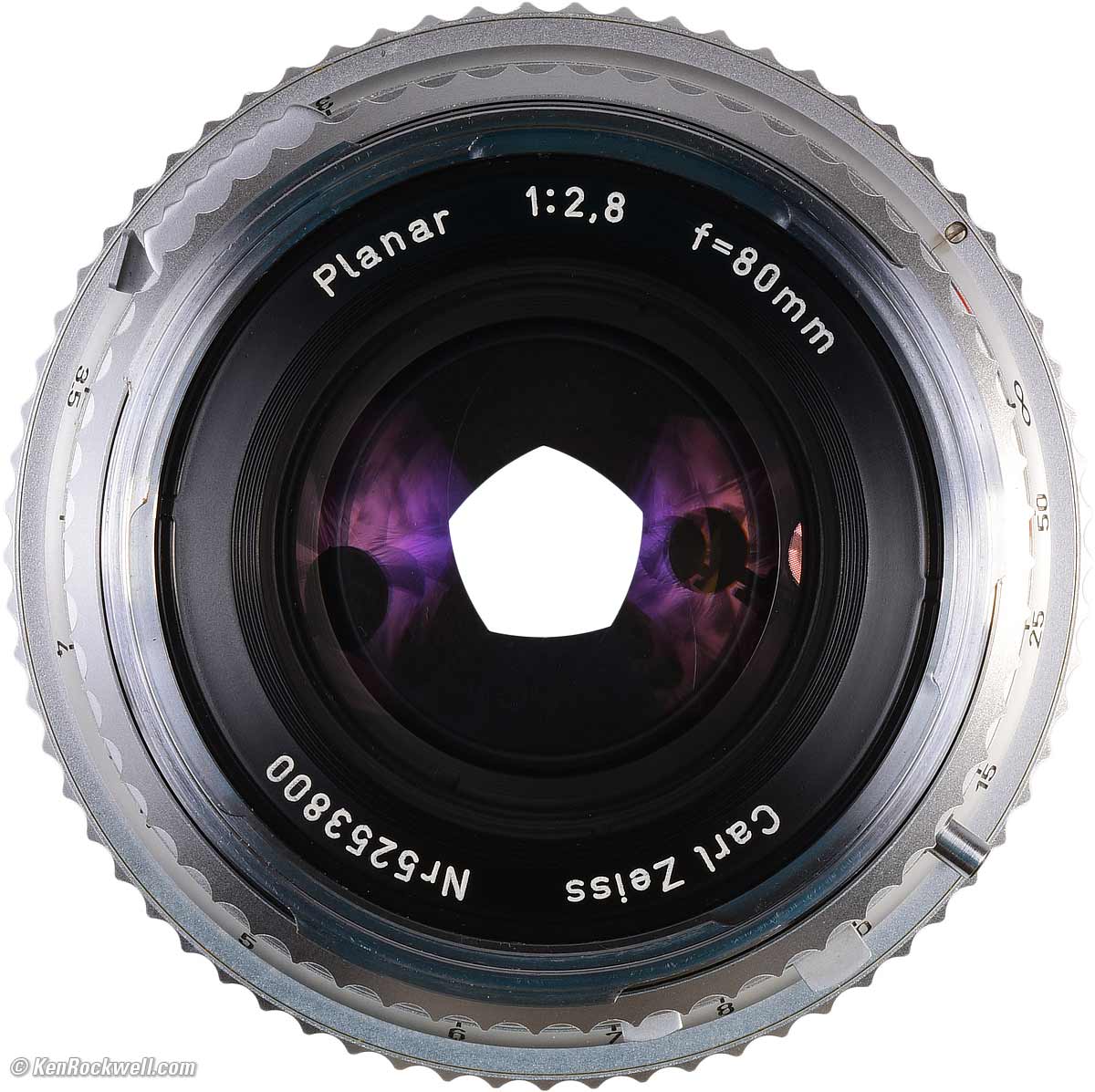
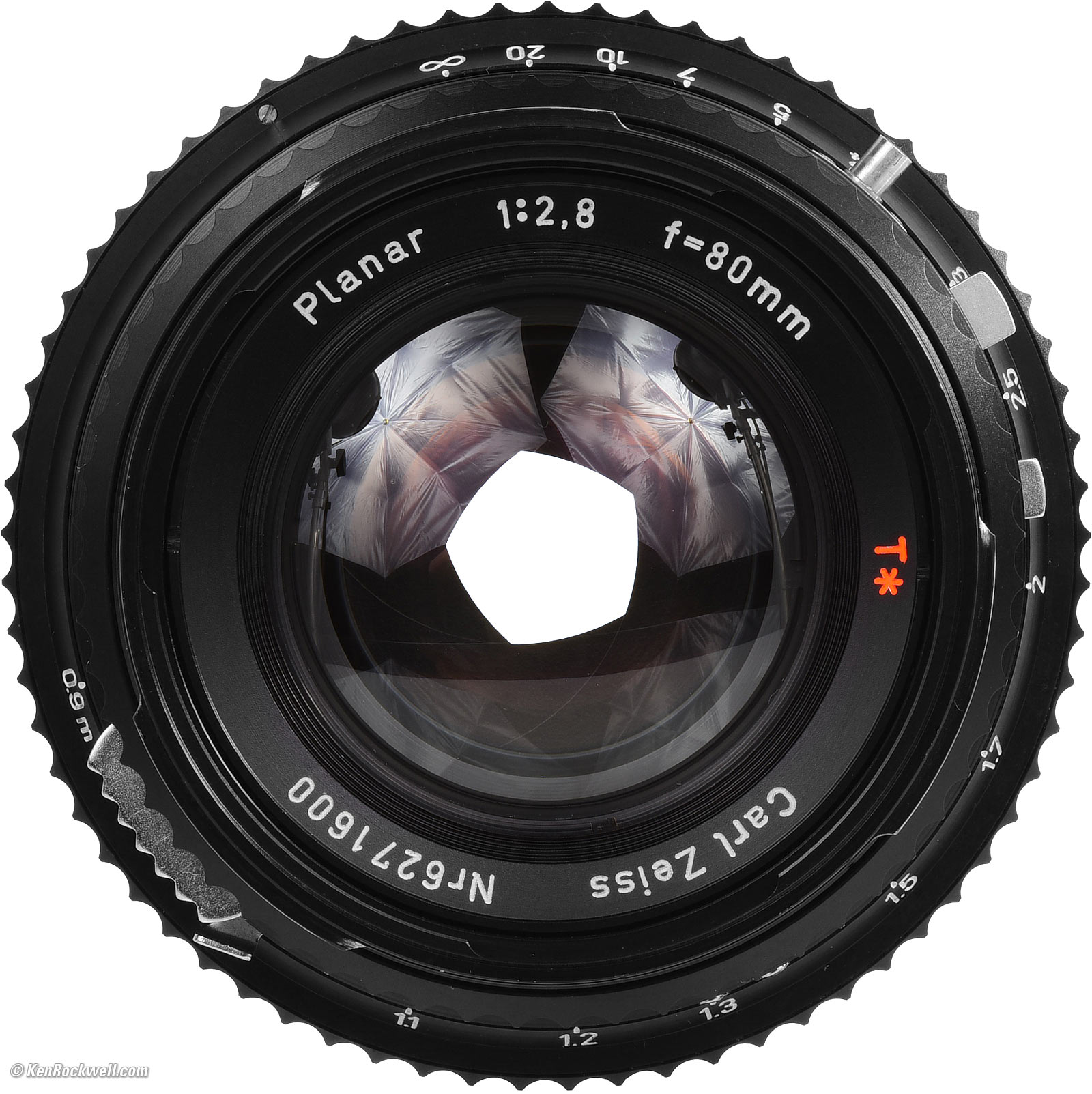
(The black sample is defective in that the front and rear coatings seem to have been rubbed off from overactive cleaning; I returned it.)
5 straight blades.
Stops down to f/22.
Image Stabilization specifications top
None. Real men don't wobble.
Focal Length specifications top
80mm.
When used with a HASSELBLAD A12 series 6×6 cm back, it sees an angle of view roughly similar to what a 42mm lens sees when used on a 35mm or "full frame" camera.
Angles of View specifications top
52° diagonal.
38° horizontal and vertical.
Hard Infinity Focus Stop? specifications top
Yes.
Just set it to the stop and you're all set for astronomical photography.
Focus Scale specifications top
Yes, very precise, with tick marks.
Depending on your country, it will read in meters or read in feet — but not both.
Depth-of-Field Scales specifications top
|
|
ZEISS PLANAR 80mm f/2.8 C. bigger. |
ZEISS PLANAR T✻ 80mm f/2.8 C. bigger. |
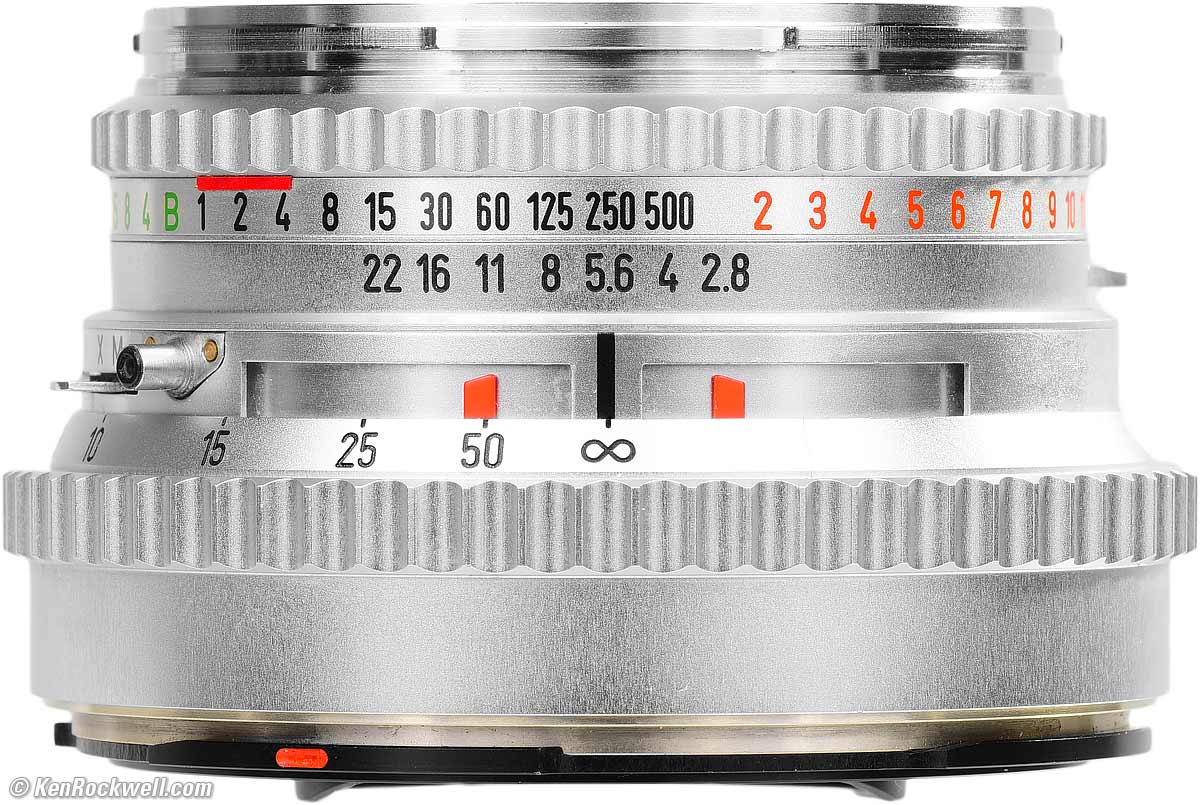
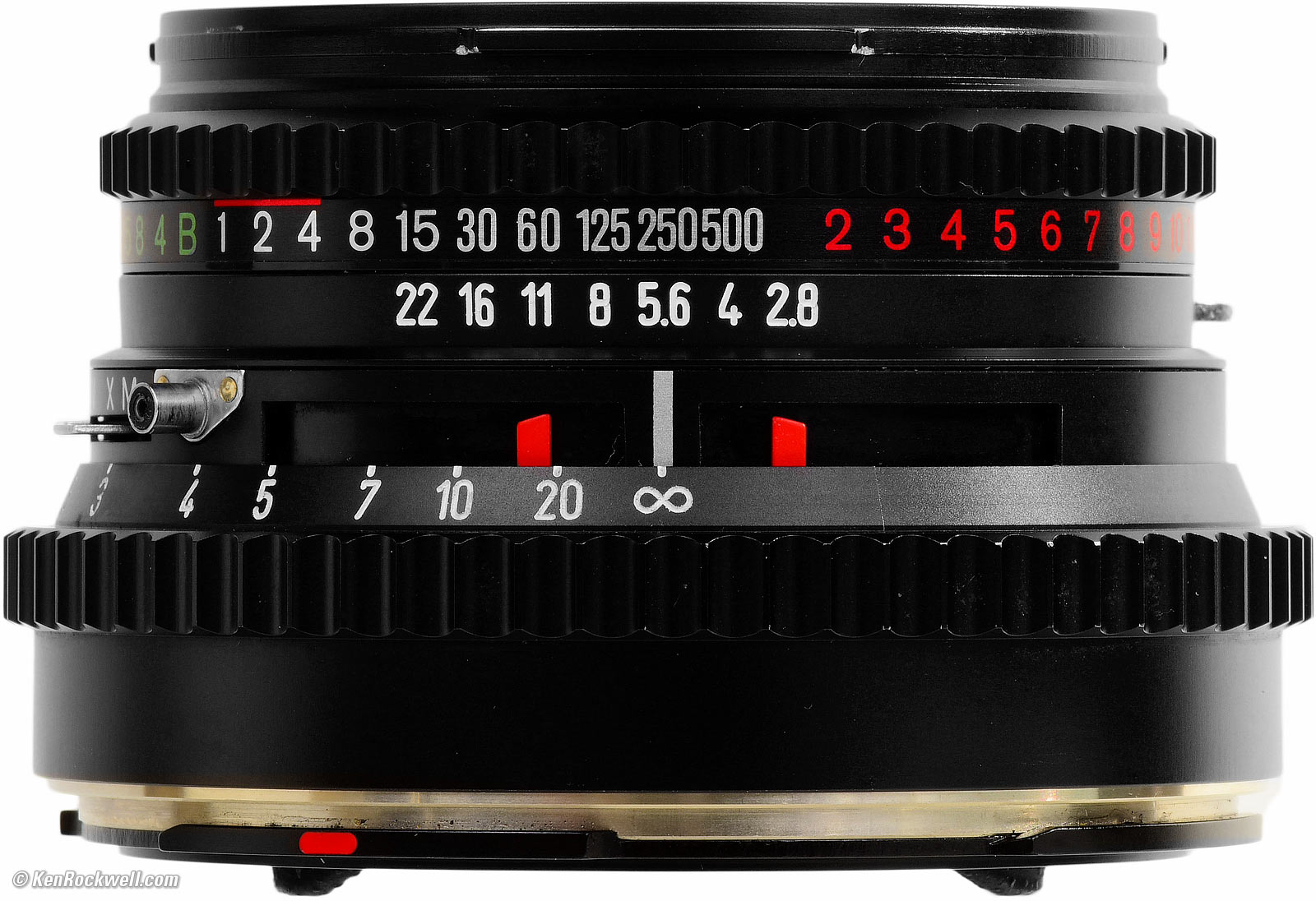
Yes; the red indicators above the focus scale on this C version move automatically as you change the aperture!
Depth of fields are indicated for a 60 micron circle-of-confusion, which is twice the size usually used for 35mm cameras.
Infra-Red Focus Index specifications top
Yes on the CF and CFE version, but not on this C version.
Hint: It's not marked on this C version, so imagine the infrared index as 5mm to the right of the regular index (about where the index goes at f/4) and you're good.
Aperture Ring specifications top
Yes.
Half stop clicks.
Filter Mount specifications top
C version: metal 50 mm Bayonet (Bay 50 or B50).
CF version: metal 60 mm Bayonet (Bay 60 or B60).
CFE version: plastic 60 mm Bayonet (Bay 60 or B60).
Shutter specifications top
All versions use an in-lens mechanical leaf shutter.
Speeds set in full stops from 1 second to 1/500, as well as Bulb.
Flash specifications top
Flash sync works perfectly at every shutter speed, which is great for fill flash at 1/500.
Caps specifications top
It uses either the HASSELBLAD 51640 B50 bayonet front cap or push-on plastic caps:
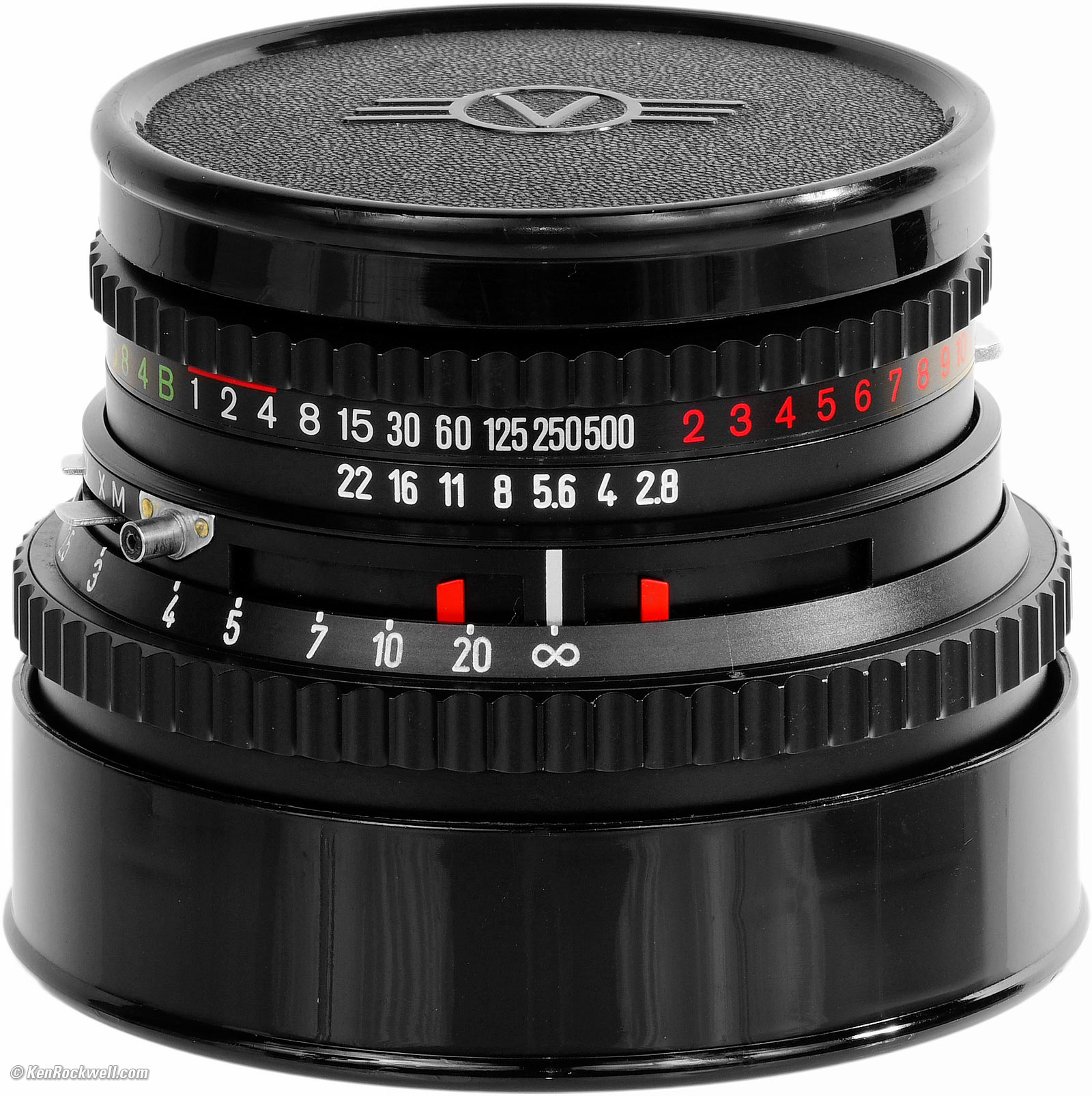
ZEISS PLANAR T✻ 80mm f/2.8 C. bigger.
A common 55mm snap-in cap works well if you don't have a real HASSELBLAD bayonet or slip-over cap.
Hood specifications top
Special square bayonet hood.
Size specifications top
C version: 3.07" (78 mm) diameter by 2.04" (51.7 mm) extension from flange, focussed at infinity.
CF version: 3.25" (82.5 mm) diameter by 2.59" (65 mm) extension from flange, focussed at infinity.
CFE version: 3.27" (83 mm) diameter by 2.32" (59 mm) extension from flange, focussed at infinity.
Weight specifications top
C version
Silver: 16.485 oz. (467.35 g) actual measured weight.
Black: 15.160 oz. (429.75 g) actual measured weight.
Rated 16.4 oz. (465 g).
CF version
17.320 oz. (491.05 g) actual measured weight.
Rated 18.0 oz. (510 g).
CFE version
Rated 18.0 oz. (510 g).
Quality
Made in WEST GERMANY.
Introduced specifications top
1957.
Discontinued specifications top
29 April 2013, with the end of the V system.
Prices, USA specifications top
June 2024
About $725 used if you know How to Win at eBay.
The range runs about $565 ~ $1,200, with most selling between $650 and $800.
January 2016
About $300 used if you know How to Win at eBay.
July 1981
$619 at Adorama ($2,125 in 2024 dollars considering inflation).
November 1969
$315 catalog list price ($2,700 in 2024 dollars considering inflation).
1965
$270 catalog list price ($2,700 in 2024 dollars considering inflation).
Performance top
Sample Images Intro New Good Bad Missing
Compatibility Format Specifications
Overall Focus Distortion Ergonomics Falloff
Filters Flare & Ghosts Macro Mechanics
Overall
The HASSELBLAD ZEISS PLANAR 80mm f/2.8 is arguably the most important lens in photography. It combines flawless optics into an ergonomically superb all-metal barrel.
It's all metal, all precision, and at least the C models travelled to the moon and are built to last more than a lifetime.
My silver sample was made in 1970, and still works perfectly with proper service.
Focus performance top
It's wonderfully precise; the ring turns about 270º from infinity to close-focus distance.
Distortion performance top
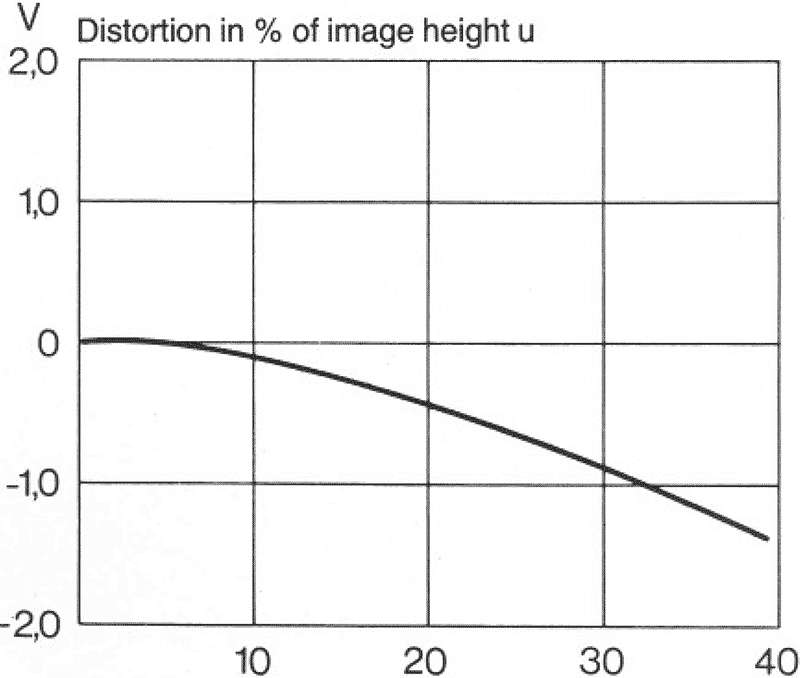
Hasselblad ZEISS PLANAR 80mm f/2.8 Distortion.
The ZEISS PLANAR 80mm has an invisible amount of barrel distortion.
I use a value of +1.3 at infinity in Photoshop's Lens Distortion tool to remove the distortion for more critical scientific use, but otherwise it's never visible.
Ergonomics performance top
|
|
ZEISS PLANAR 80mm f/2.8 C. bigger. |
ZEISS PLANAR T✻ 80mm f/2.8 C. bigger. |
This C version is built to last more than a lifetime.
The chrome C version is all matte, not shiny, so it's easy to read even in direct sunlight.
Unlike most cameras, the HASSELBLAD was designed by an active photographer rather than a marketing department, so it does everything we need with complete simplicity. The more you use it, the more you appreciate a lens actually designed by a photographer.
Falloff performance top
It does have a small amount of falloff wide open, going away as stopped down:
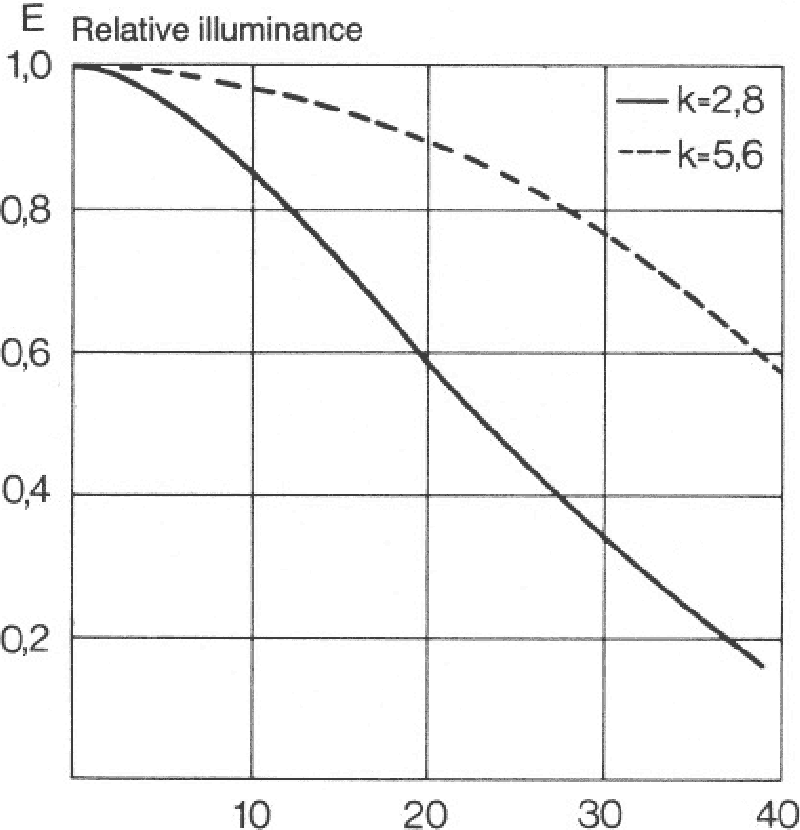
HASSELBLAD ZEISS PLANAR 80mm f/2.8 Illuminance.
Filters, use with performance top
Use 50 mm Bayonet (Bay 50 or B50) filters for fast on/off; or you can use an adapter ring from B50 to use conventional screw-in filters.
On the C version that wants B50 filters, an ordinary 52mm screw-in filter will sit inside in the front of the lens. Hold or tape it there and you're good in an emergency. 52mm filters just have enough glass to work without vignetting; don't use adapters to anything smaller.
Flare & Ghosts performance top
Just about none.
See an example at Sunstars.
Macro performance top
It only focuses to 3 feet (0.9 meters), which means that it only gets close enough to fit something 517 mm (20.35") square to fill the 2¼" frame.
Use a B50 PROXAR close-up lens (they come different strengths) or extension tubes for closer closeups.
Mechanics performance top
|
|
ZEISS PLANAR 80mm f/2.8 C. bigger. |
ZEISS PLANAR T✻ 80mm f/2.8 C. bigger. |
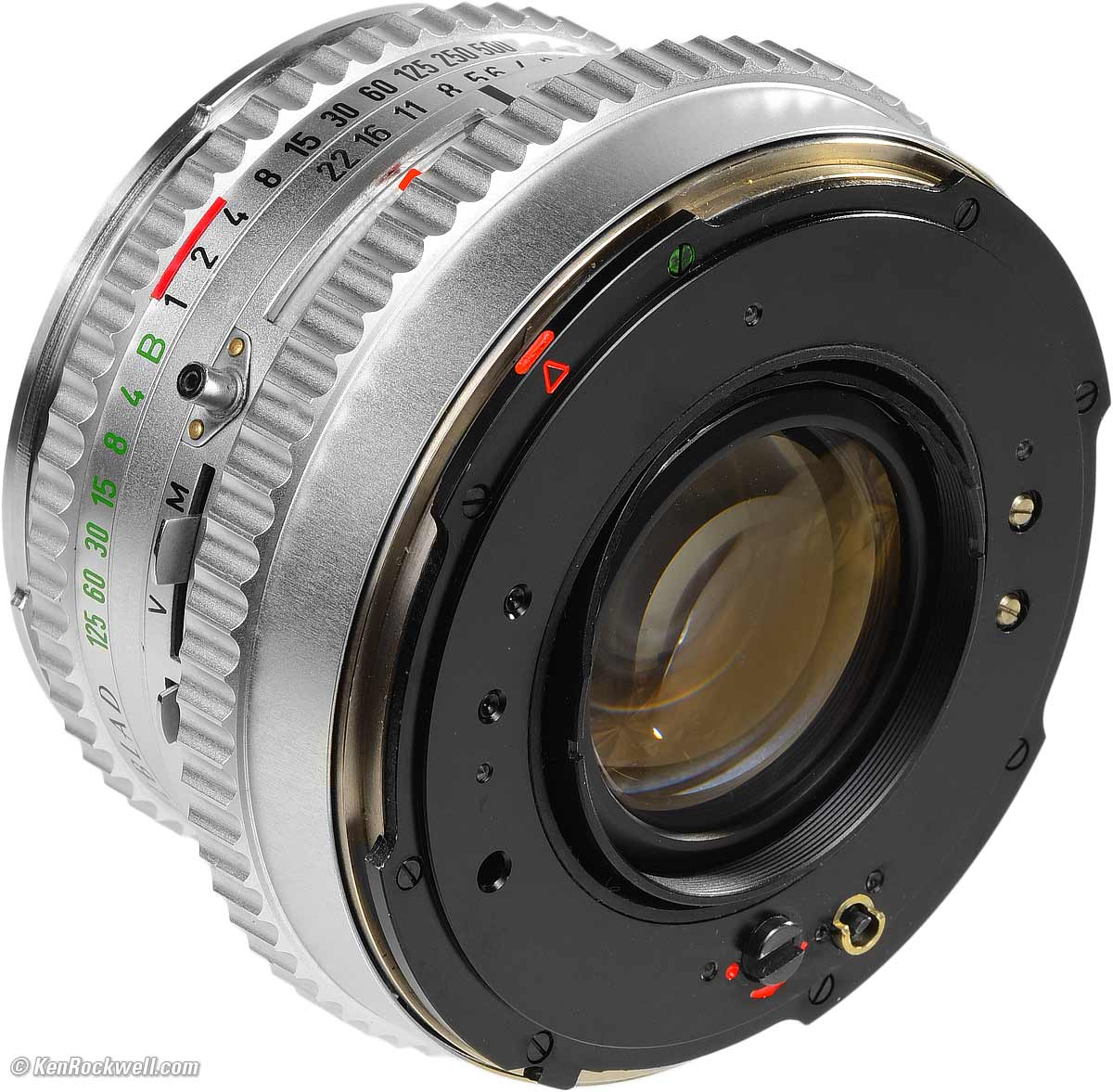
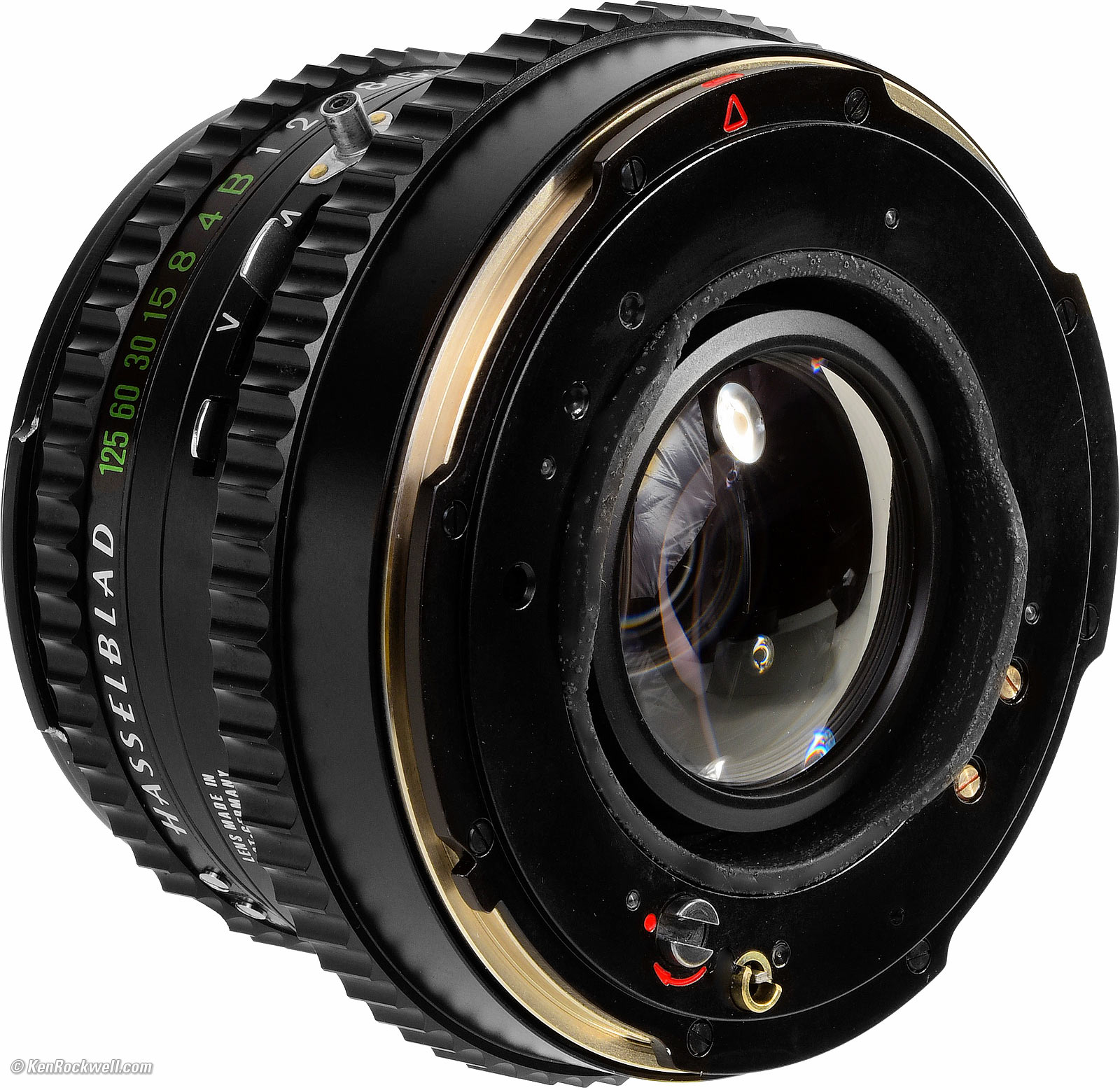
Lenses don't get any better than this. It's all metal, period.
Newer models add more plastic and skimp by painting some markings that should be engraved.
For the C version:
Filter Mount
Metal.
Hood Mount
Metal.
Barrel
Metal.
Focus Ring
Metal.
Internals
All Metal.
Identity
Engraved into the ring around the front element and filled with paint.
Mount
Metal.
Markings
Engraved and filled with paint, except for printed shutter speed and EVS scale and sync indications.
Everything else, even "LENS MADE IN WEST GERMANY," is all engraved to last for centuries.
Serial Number
Engraved into the ring around the front element and filled with paint.
Date Codes
Zeiss serial numbers have been sequential forever, so we use these to date Zeiss lenses.
There also may be a red date code stamped inside the rear barrel. If you have that number:
C version: The last two digits are the month, and the first one or two are the year. Add the year digits to 1957 to get the year. (HASSELBLAD started this series of lenses in 1957.) 501 is January 1962, and 1503 is March 1972, for example.
My silver one shown here is marked 1302, which is February 1970.
CF version: The letter is the month (A ~ L = January ~ December) and the two digits are the year, reversed. Thus F38 means June 83.
See also HASSELBLAD Date Codes.
Noises When Shaken
Mild clicking.
Made in
WEST GERMANY.
Sharpness performance top
Image sharpness depends more on you than your lens, and lens sharpness doesn't mean much to good photographers. It's the least skilled hobbyists who waste the most time blaming fuzzy pictures on their lenses, while real shooters know that few photos ever use all the sharpness of which their lenses are capable due to subject motion and the fact that real subjects are rarely perfectly flat.
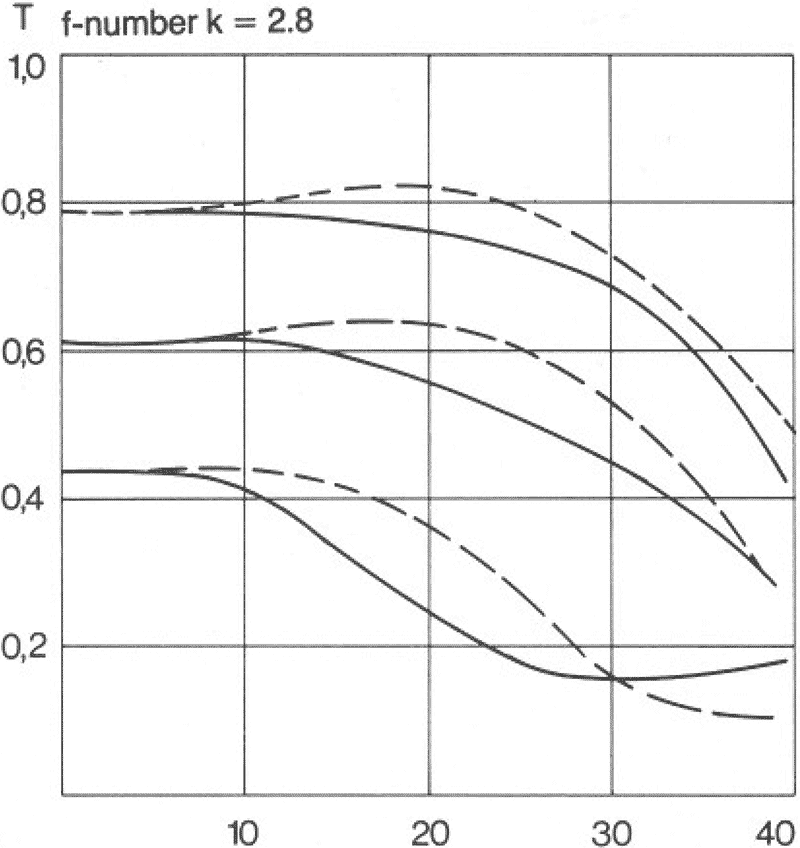
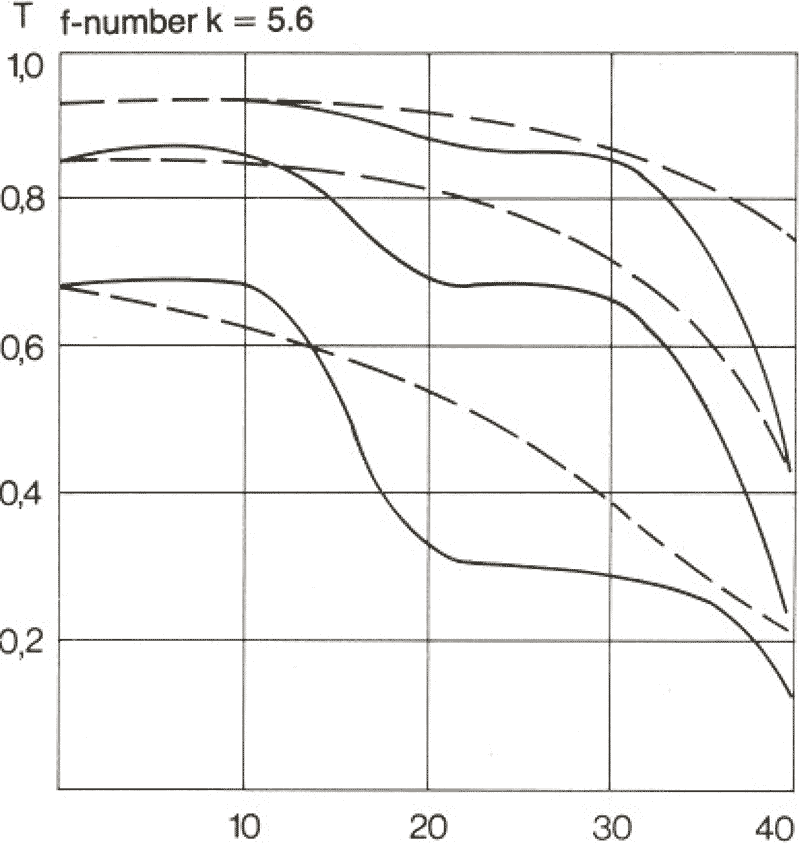
This HASSELBLAD ZEISS PLANAR 80mm f/2.8 is equally sharp all across the field at every aperture. Corners are as sharp as the center, presuming you're in perfect focus.
It doesn't get sharper as stopped down; go ahead and shoot wide-open if you like. What will improve stopped down is depth of field and evenness of illumination. Yes, these MTF curves look scary, while in actual on-film use it's always super sharp.
|
|
Shutter performance top
It's a leaf shutter: vibration free and flash syncs at every speed.
Yours, like mine, will most likely need an overhaul for accurate and consistent shutter speeds. This is as analog as it gets; every sample will be different and will be different every day and at different temperatures — and every shot will have a slightly different shutter speed due to shot-to-shot variation.
I present these results mostly for references; serious film shooters all need to know Zone-system film speed and meter calibration as well as own a shutter tester for superb results. Otherwise, most people wind up underexposing due to a lack of calibration, which leads to dull gray shadow areas. Most people would be well advised to shoot at half the rated ISO if they haven't run actual calibrations.
Not to worry: if you're shooting negative film, you can overexpose by several stops and not even notice a difference in final results so long as you don't underexpose much. Worrying about fractions of a stop only matters if you're shooting transparencies like Fuji Velvia.
Measured at f/2.8
Chrome one measured wide-open, 06 January 2016 before service.
My shutter is about a third of a stop slow, except 1/250 which is right-on and 1/30 where it's a third of a stop fast. This is perfectly usable and great for a 45-year-old lens that's probably never been serviced:
Marked |
Actual |
Actual |
Error |
1 |
1.18 s |
1/0.847 |
0.24 stops slow |
2 |
640 ms |
1/1.56 |
0.36 stops slow |
4 |
328 ms |
1/3.05 |
0.39 stops slow |
8 |
165 ms |
1/6.06 |
0.40 stops slow |
15 |
71 ms |
1/14.1 |
0.18 stops slow |
30 |
39 ms |
1/25.6 |
0.32 stops fast |
60 |
19 ms |
1/53 |
0.28 stops slow |
125 |
9.5 ms |
1/105 |
0.28 stops slow |
250 |
4.05 ms |
1/247 |
0.05 stops slow |
500 |
2.4 ms |
1/417 |
0.30 stops slow |
8.6s self timer
Black one measured wide-open, 20 December 2015
My shutter is within a fifth of a stop at every speed, except 1/500 with is slow three-tenths of a stop. This is excellent for a 35-year-old lens:
Marked |
Actual |
Actual |
Error |
1 |
1.118 s |
1/0.894 |
0.16 stops slow |
2 |
557 ms |
1/1.8 |
0.16 stops slow |
4 |
290 ms |
1/3.4 |
0.21 stops slow |
8 |
142 ms |
1/7 |
0.18 stops slow |
15 |
57 ms |
1/17.5 |
0.13 stops slow |
30 |
29.8 ms |
1/33.6 |
0.07 stops fast |
60 |
16.4 ms |
1/61 |
0.07 stops slow |
125 |
8.3 ms |
1/120 |
0.09 stops slow |
250 |
4.3 ms |
1/233 |
0.14 stops slow |
500 |
2.4 ms |
1/417 |
0.30 stops slow |
Measured at f/4.7
Chrome one measured at f/4.7, 14 October 2016, after service by Gus.
It's now within ±⅙ of a stop, except for 1/15 which is ⅓ stop slow, 1/125 which is ¼ stop slow, and 1/500 which is 0.4 stops slow:
Marked |
Actual |
Actual |
Error |
1 |
1.02 s |
1.02s |
OK |
2 |
506 ms |
1/2 |
OK |
4 |
260 ms |
1/3.85 |
OK |
8 |
136 ms |
1/7.36 |
0.17 stops slow |
15 |
80.00 ms |
1/12.5 |
0.36 stops slow |
30 |
27.75 ms |
1/36/0 |
0.17 stops fast |
60 |
15.87 ms |
1/63.0 |
OK |
125 |
9.20 ms |
1/108.7 |
0.24 stops slow |
250 |
4.40 ms |
1/227.3 |
0.17 stops slow |
500 |
2.63 ms |
1/380 |
0.43 stops slow |
Measured at f/11
Silver one measured at f/11, 14 October 2016, after service by Gus.
Marked |
Actual |
Actual |
Error |
1 |
|||
2 |
|||
4 |
|||
8 |
|||
15 |
80.00 ms |
1/12.5 |
0.32 stops slow |
30 |
28.00 ms |
1/35.7 |
0.16 stops fast |
60 |
16.20 ms |
1/61.7 |
OK |
125 |
9.65 ms |
1/103.6 |
0.30 stops slow |
250 |
4.83 ms |
1/207 |
0.30 stops slow |
500 |
3.00 ms |
1/333 |
0.62 stops slow |
Black one measured at f/11, 20 December 2015
My shutter is within a sixth of a stop at every speed stopped down, except the expected one-fifth stop slow at 1/125, one-third stop slow at 1/250 and 2/3 stops slow at 1/500. This is what al leaf shutter is expected to do due to the the way the shutter blades move out form the center and back in again:
Marked |
Actual |
Actual |
Error |
1 |
1.1121 |
1/0.9 |
0.15 stops slow |
2 |
555 ms |
1/1.8 |
0.15 stops slow |
4 |
281 ms |
1/3.6 |
0.17 stops slow |
8 |
133 ms |
1/7.5 |
0.09 stops slow |
15 |
58.6 ms |
1/17.6 |
0.14 stops fast |
30 |
30.3 ms |
1/33 |
0.04 stops fast |
60 |
17 ms |
1/58.9 |
0.12 stops slow |
125 |
9 ms |
1/111 |
0.20 stops slow |
250 |
4.95 ms |
1/202 |
0.34 stops slow |
500 |
3.12 ms |
1/320 |
0.68 stops slow |
Sunstars performance top
With a 5-bladed diaphragm, I get classic 10-point sunstars on brilliant points of light:
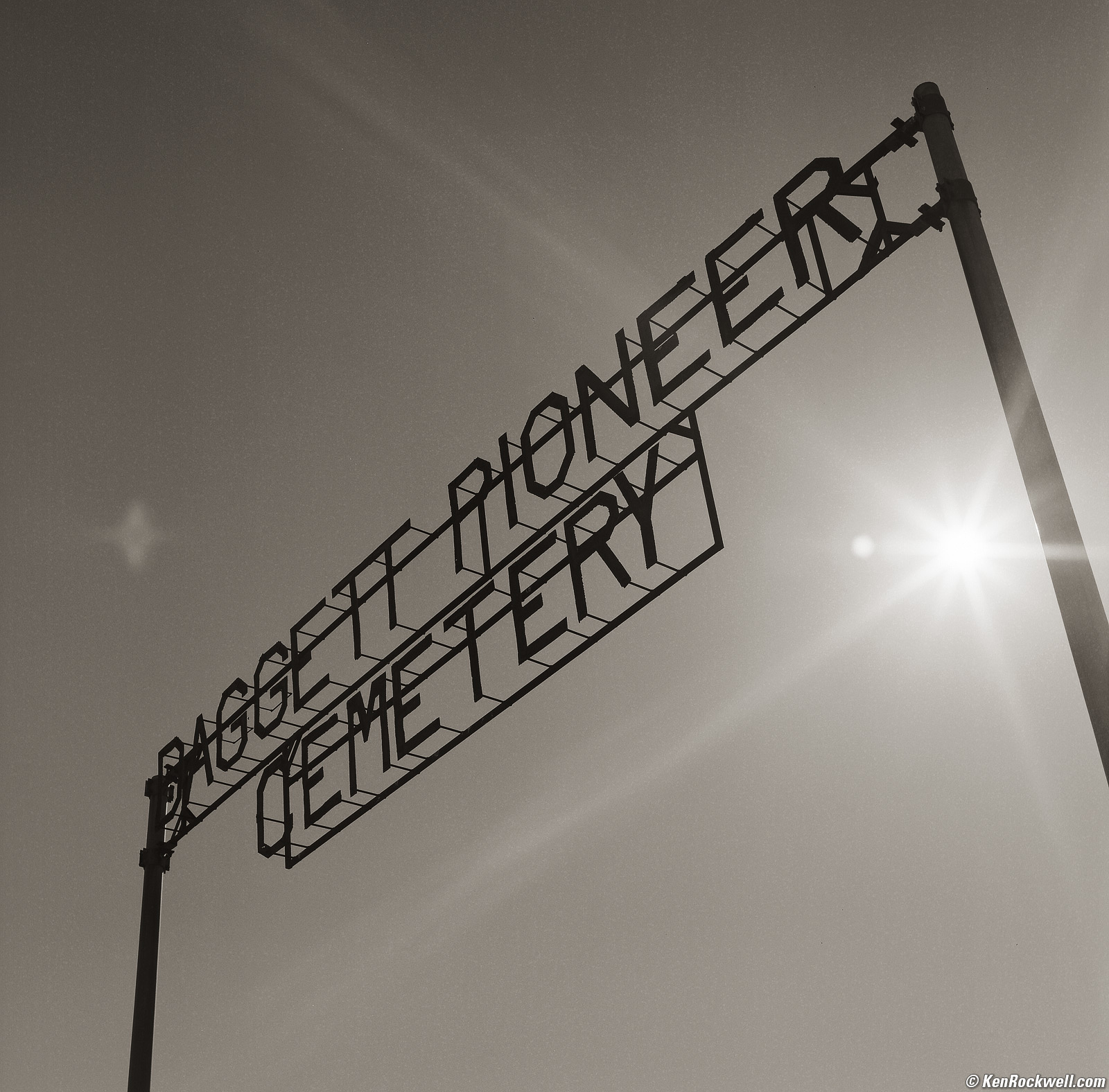
Daggett Pioneer Cemetery with Sun Star, 10:12 AM, Saturday, 06 February 2016. 1993 ZEISS PLANAR T✻ 80mm f/2.8 CF, no filter, 1992 Hasselblad 503 CX with 1985 PME metered prism, Kodak T-Max 100 in 1993 A12 magazine, f/22 at 1/60, 7 meters focus distance, Great American Photo Lab develop & scan, Radiant Photo software, split-toned print. More technical details. bigger.
Compared top
Sample Images Intro New Good Bad Missing
Compatibility Format Specifications
C, CF and CFE versions
I've compared the C, CF and CFE versions above.
They all use the same optics; the differences are your preference for cosmetics, weight, filter size and of course shutter design and camera compatibility.
The CF and CFE versions have slightly deeper fronts which provide a little extra free flare protection without a hood.
I prefer this C version, assuming it's in top operating condition. It weighs the least, is built the best, takes the smallest filters, has a built-in self-timer so I can skip the cable release and pre-release, costs the least, and has the same great optics as the newest versions.
If I'm bringing my 903 SWC or CF lenses which take 60 mm Bayonet (Bay 60 or B60) filters, then I'll bring my ZEISS PLANAR T✻ 80mm f/2.8 CF, which takes the same filters.
If I'm bringing my classic C lenses like my 150mm f/4 C and/or 250mm f/5.6 C which take 50 mm Bayonet (Bay 50 or B50) filters, then I'll take this C version which takes the same size.
See also Assembling a System.
I never liked the CFE version with its plastic filter mount and high price. I'd only get it if you needed it for compatibility with newer cameras.
Usage top
Sample Images Intro New Good Bad Missing
Compatibility Format Specifications
Infrared Focus
It's not marked, but turn the focus ring 5mm to right (closer) after you focus with visible light to focus for infrared film.
Imagine the infrared index as 5mm to the right of the regular index; it's where the red depth-of-field indicator goes when set to f/4.
On the CF and CFE versions it's marked on their static depth of field scales at f/4, while this lens' active computer lacks that red mark.
Exposure user's guide top
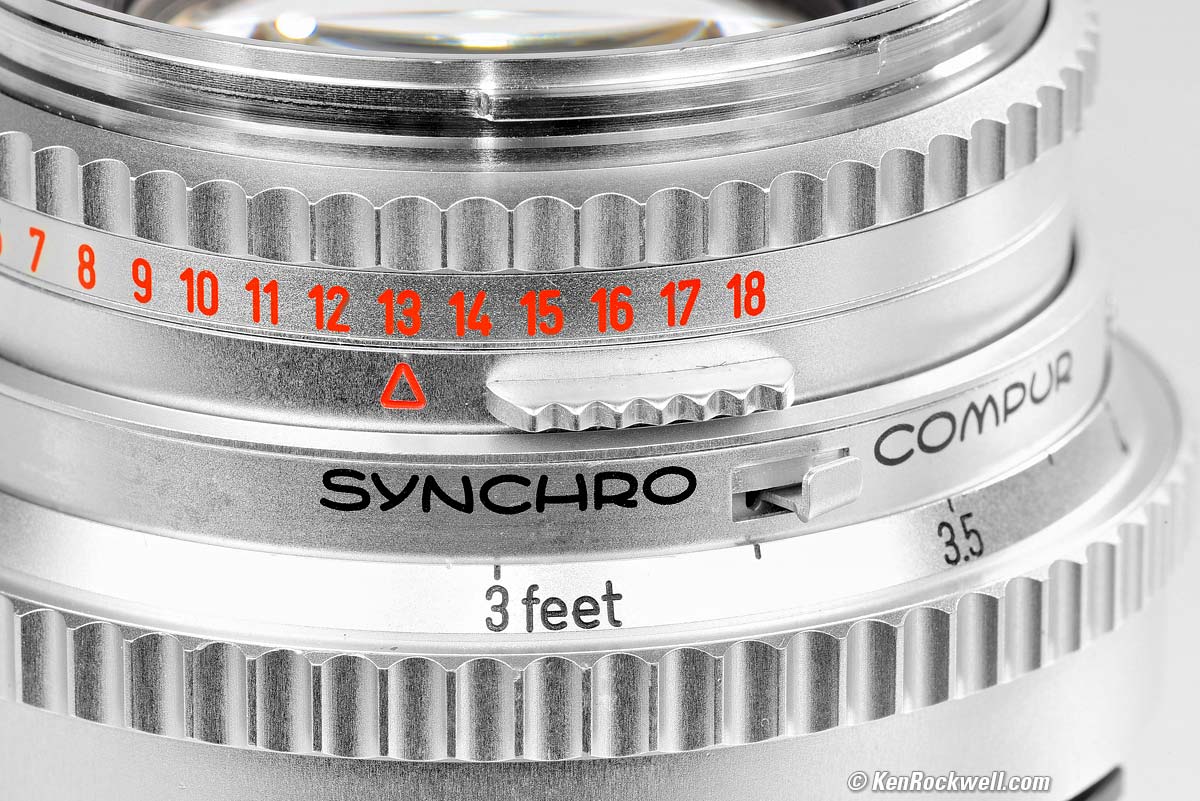
ZEISS PLANAR 80mm f/2.8 EVS & Depth-of-Field Controls. bigger.
To set an EV (exposure value) from a PME, a meter knob or any other meter that reads in EV (or a guess based on experience), press the ridged tab (seen here between 15 and 18) down towards the camera (it will move the entire aperture ring away from the shutter speed ring to unlock it), and move it until the ▲ (red triangle) points to the EV number you want.
EV sets in half-stops: shutter speeds set in full stops and apertures set in half-stops. I find it easier to more the shutter to its clicks and then fine-tune the aperture setting.
The aperture and shutter speed rings are usually locked together. This way you retain the same exposure (EV) regardless of how you rotate the ring. Once set, rotating the ring lets you choose different apertures or shutter speeds while retaining the same exposure. Clever, eh?
Depth of Field user's guide top
To preview the depth of field, press-in the little lever between SYNCHRO and COMPUR shown above.
If your lens is cocked, the diaphragm will stop down, and change as you set apertures.
To reset it to stay open, either take the picture, or set the lens to f/2.8, at which point the diaphragm will now stay locked wide-open as you set different apertures.
This C version has an automatic analog computer that calculates the depth of field for a 60 micron circle-of-confusion. This is always displayed by the red bars next to the focus scale. Newer models economized and removed the computer; they have the usual markings.
To calculate the aperture that will give optimum sharpness when you need depth-of-field and don't want diffraction to soften the image, put a new scale over the computer display and use these half distances (see here for details of how to use these):
focal length = 80.5 mm (actual design focal length)
f/ |
feet |
meters |
aperture on Zeiss' computer |
5.6 |
500 |
152.52 |
|
8 |
250 |
76 |
end of aluminum |
11 |
125 |
38.1 |
f/2.8 |
16 |
62.6 |
19.1 |
f/5.6 |
22 |
31.3 |
9.5 |
f/11 |
Self Timer, Flash & Digital Back Sync user's guide top
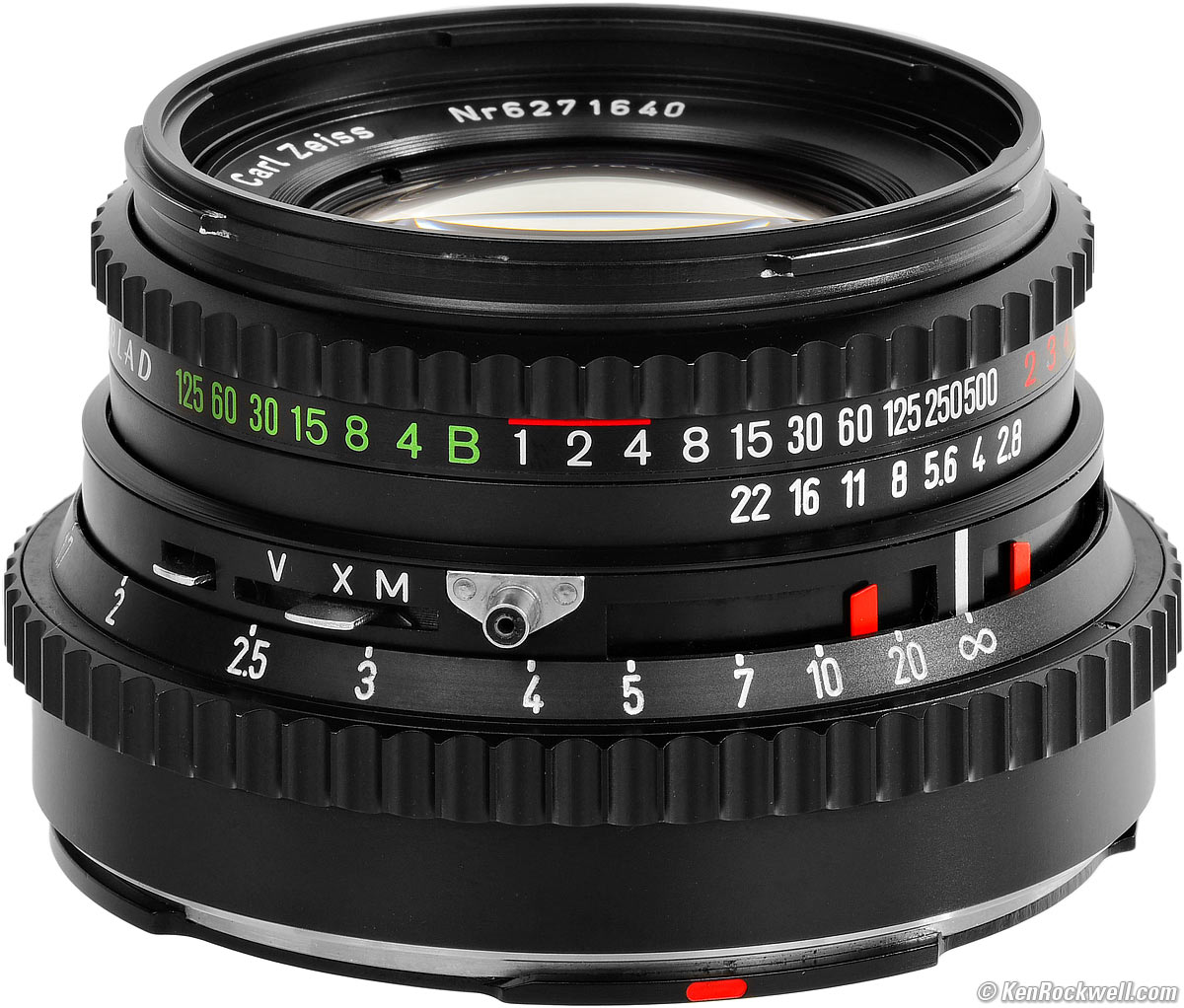
ZEISS PLANAR T✻ 80mm f/2.8 Flash Sync & Self-Timer Controls. bigger.
The V X M selector sets the flash synchronization and the self timer.
To unlock the V X M selector lever, move the little lock lever (left of the V) towards the front of the lens.
X is normal, for modern studio strobes, digital backs and ordinary electronic flash.
M is for M-type flashbulbs. You guys have no idea how tough it was in the old days; you needed different kinds of flashbulbs depending on what kind of shutter you had!
V is the self timer. Push the lever all the way towards V, and you'll get an 8 to 10 second mechanical delay after you press the camera's shutter. The self timer always uses X sync when it fires. Remember that you have to move the lock lever towards the front of the lens to unlock this lever.
The Red Bar Above 1, 1/2 and 1/4 Shutter Speeds user's guide top
This is a reminder to keep holding the shutter button until the exposure completes. If you don't, the blind in the camera body may close before the exposure completes. Don't worry in Bulb; the blind stays open until the shutter closes.
Time Exposures user's guide top
Read EV from either a PME, a meter knob or any other meter that reads in EV, or simply from prior experience.
Set the EV on the scale as shown above.
Below EV 9 the scale will show times longer than one second in green (B is two seconds):
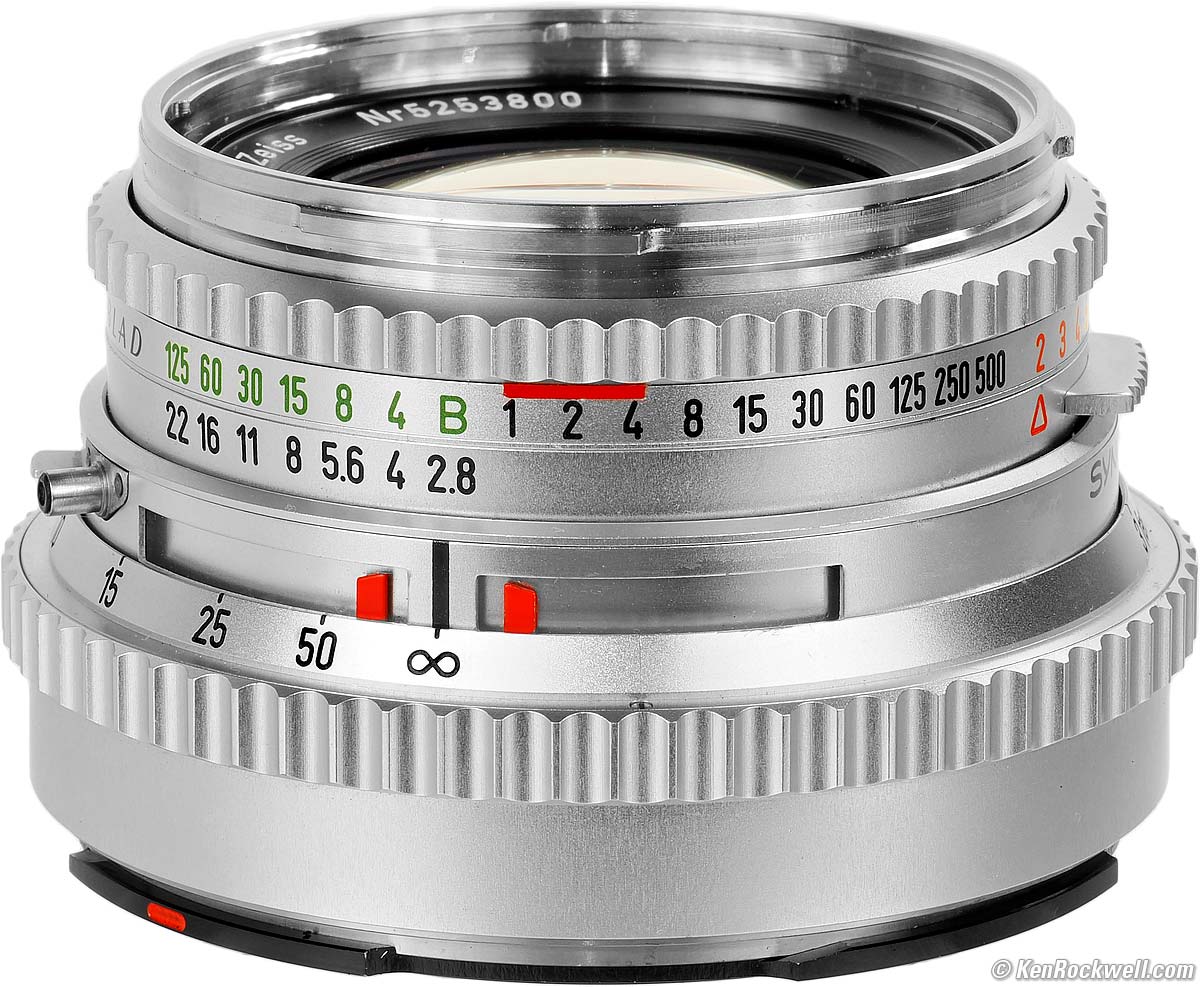
ZEISS PLANAR T✻ 80mm f/2.8 Long Exposure Scale. bigger.
The green numbers on the shutter speed scale are the calculated time exposures in full seconds to use with the apertures below them — but since the shutter's longest time is one second, we have to use Bulb and time the exposure manually.
In this example I've set EV 2, which now shows lots of combinations from 2 seconds at f/2.8, 4 seconds at f/4 all the way to a minute (60 seconds) at f/16 and two minutes (125 seconds) at f/22.
Select in your head the combination you want to use. Remember the time and leave the shutter set to B as shown above.
Pull the toothed aperture lever on the right towards the camera body to unlock it, then move it to set the aperture you want to use. Once you've moved this, ignore the indications since you've moved it away from the set EV.
Now you're at your selected aperture and Bulb. To make your exposure with no need for a cable release, of course be sure your camera is cocked and then:
Charge the self timer by pushing the unmarked lock lever to the left of the V X M selector towards the front of the lens, and then pushing the V X M selector gently towards V.
On most 500 series cameras, flip down the Time Exposure Catch (the lock lever around the shutter release). This will keep the shutter pressed without having to hold it for your time exposures!
Focus, compose and press the shutter. The self timer buzzes and opens shutter without camera shake some seconds later. Since you flipped down the Time Exposure Catch (the lock lever around the shutter release), the shutter button stays pressed and the shutter stays open.
When your watch, timer or simply counting seconds in your head tells you you're done, put a hat, your hand or a lens cap in front of the lens to stop the exposure, then flip up the shutter lock lever to close the shutter. Don't touch the camera until you've covered it to stop the exposure. Advance your film as always, and you're done: a perfect, vibration-free time exposure using nothing but your HASSELBLAD and your skilled, creative hands.
Filters user's guide top
See Filters.
Recommendations top
Sample Images Intro New Good Bad Missing
Compatibility Format Specifications
This is the perfect lens for just about everything shot with the HASSELBLAD. Add the 150mm for portraits, and you have almost everything covered.
Since the optics of all the versions are the same, you may as well save money and get the oldest and cheapest C model I've shown here, if you have a good way to get it serviced if needed. If not, a CF or CFE version has exactly the same optics, but they're much safer bets if you just want to go shoot without overhauling an ancient shutter.
T✻ multicoating is unnecessary with the simple optical formula of this lens, so don't worry about it; the real reason to be concerned about a non-T✻ lens is that it's so old you're more likely to need an overhaul.
I prefer the C model because it weighs about 2 oz. (57 g) less than the CF and CFE versions. The C version is also the only one with flashbulb (M) sync, and the only one with a built-in self timer to save me from needing a cable release.
Expect that whatever you get used at eBay may need an overhaul to get all the shutter speeds accurate again. (I got mine at eBay; see How to Win at eBay). I had Gus service mine, but he's very backed up. A newer CF version is more likely to work perfectly right out of the box.
Get this C version if your other lenses are C, taking B50, filters, and get a CF or CFE version if your other lenses take B60, as opposed to B50, filters. See Assembling a System.
Don't bother adapting this to smaller format cameras. A Nikon AI-s 85mm f/2 is a stop faster and smaller, lighter and less expensive for use on 35mm or "full frame" cameras. The PLANAR is the world standard for sharpness, but that's when you use the entire 6×6 cm film gate. Millimeter for millimeter on film it's no better than a Nikon manual-focus 85mm lens.
For a front cap, a common 55mm snap-in cap works well if you don't have a real HASSELBLAD bayonet or slip-over cap.
I got mine at this link directly to them at eBay. Never buy at a retail store or other dealers; you'll pay way too much and have very limited options if you don't like it.
This all-content, junk-free website's biggest source of support is when you use those or any of these links to my personally-approved sources when you get anything, regardless of the country in which you live. Use only the approved sources I use myself for the best prices, service, return policies and selection. Thanks for helping me help you! Ken.
More Information top
Sample Images Intro New Good Bad Missing
Compatibility Format Specifications
NASA's page about this lens and Apollo photography.
NASA's page showing on what Apollo flights this lens flew.
© Ken Rockwell. All rights reserved. Tous droits réservés. Alle Rechte vorbehalten. Alla rättigheter förbehållna. Toate drepturile rezervate. Omnia jura reservata. Ken Rockwell® is a registered trademark.
Help Me Help You top
I support my growing family through this website, as crazy as it might seem.
The biggest help is when you use any of these links when you get anything. It costs you nothing, and is this site's, and thus my family's, biggest source of support. These places always have the best prices and service, which is why I've used them since before this website existed. I recommend them all personally.
If you find this page as helpful as a book you might have had to buy or a workshop you may have had to take, feel free to help me continue helping everyone.
If you've gotten your gear through one of my links or helped otherwise, you're family. It's great people like you who allow me to keep adding to this site full-time. Thanks!
If you haven't helped yet, please do, and consider helping me with a gift of $5.00.
As this page is copyrighted and formally registered, it is unlawful to make copies, especially in the form of printouts for personal use. If you wish to make a printout for personal use, you are granted one-time permission only if you PayPal me $5.00 per printout or part thereof. Thank you!
Thanks for reading!
Ken.