Godox SK400II V
400 Ws 2.4 GHz, Optical & Wired Xenon Strobe, with Standard Bowens S Accessory Mount
Sample Images Intro New Good Bad Missing
Specs Accessories Measurements Compared
User's Guide Recommendations More
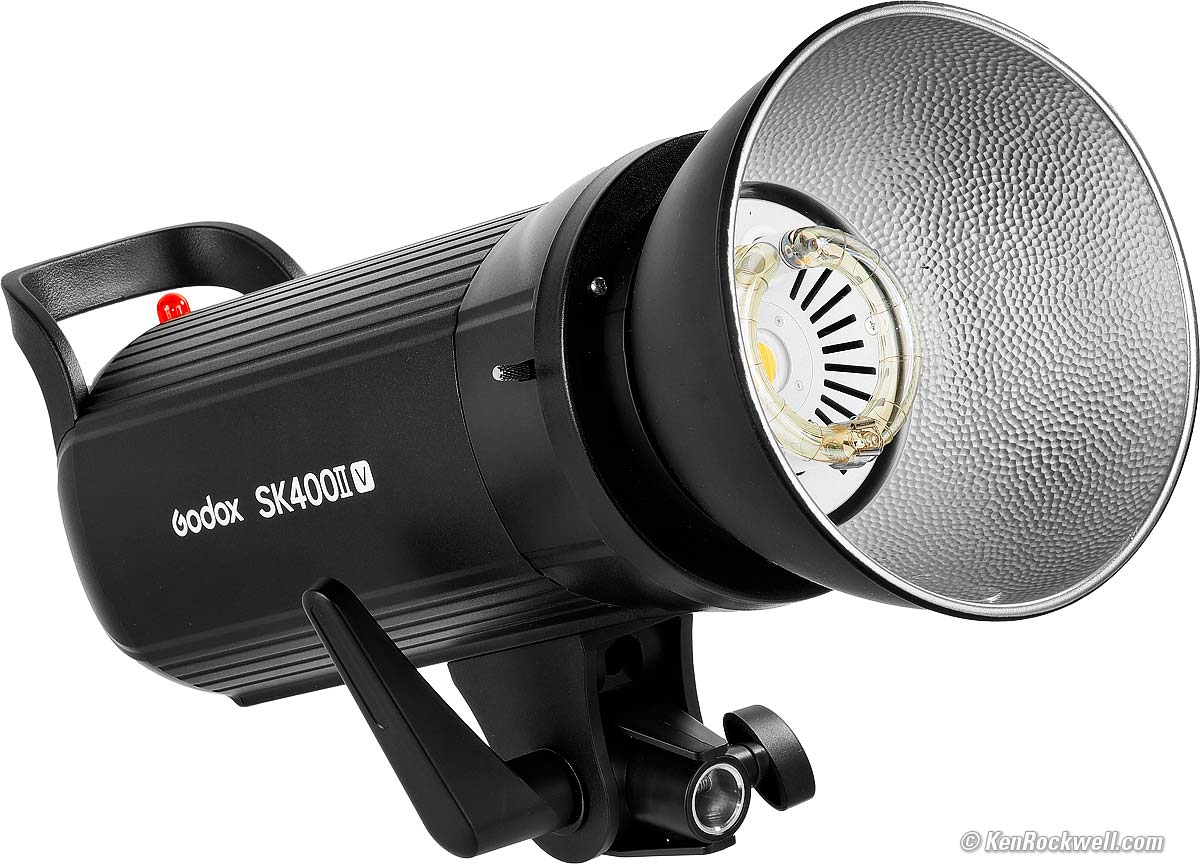
Godox SK400 II V Studio Strobe with included reflector (400 Watt-seconds maximum output with a 1.0 second measured recycling time, runs on AC power, manual [no TTL] 1 ~ 1/16 power settings in tenths of stops [equal to 400 Ws ~ 25 Ws], mounts on standard ⅝" light stands with enough set screw travel to work on ⅜" light stands as well, 4.63 lbs/74.1 oz./2,100g, $169). bigger.
I'd get mine at Amazon, which includes the reflector as shown. I'd also get it as part of a multi-light kit at B&H or at Adorama, or at eBay (How to Win at eBay). It also comes without the reflector at B&H and you can order the standard reflector separately, as well as loads of other reflectors, softboxes, snoots and more that all fit its standard Bowens S mount.
This all-content, junk-free website's biggest source of support is when you use those or any of these links to approved sources when you get anything, regardless of the country in which you live. Thanks for helping me help you! Ken.
July 2024 Better Pictures Godox Canon Nikon Sony Fuji OM SYSTEM LEICA Zeiss HASSELBLAD All Reviews
Canon Flash Nikon Flash Sony Flash
The Importance of Flash Sync Speed
DEAL: $499 for a complete three-light 600 Ws (3 × 200 Ws) kit.
DEAL: $529 for a complete three-light 900 Ws (3 × 300 Ws) kit.
DEAL: $699 for a complete three-light 1,200 Ws (3 of this 400 Ws unit) kit.
DEAL: $949 for a complete three-light 1,800 Ws (3 × 600 Ws) kit.
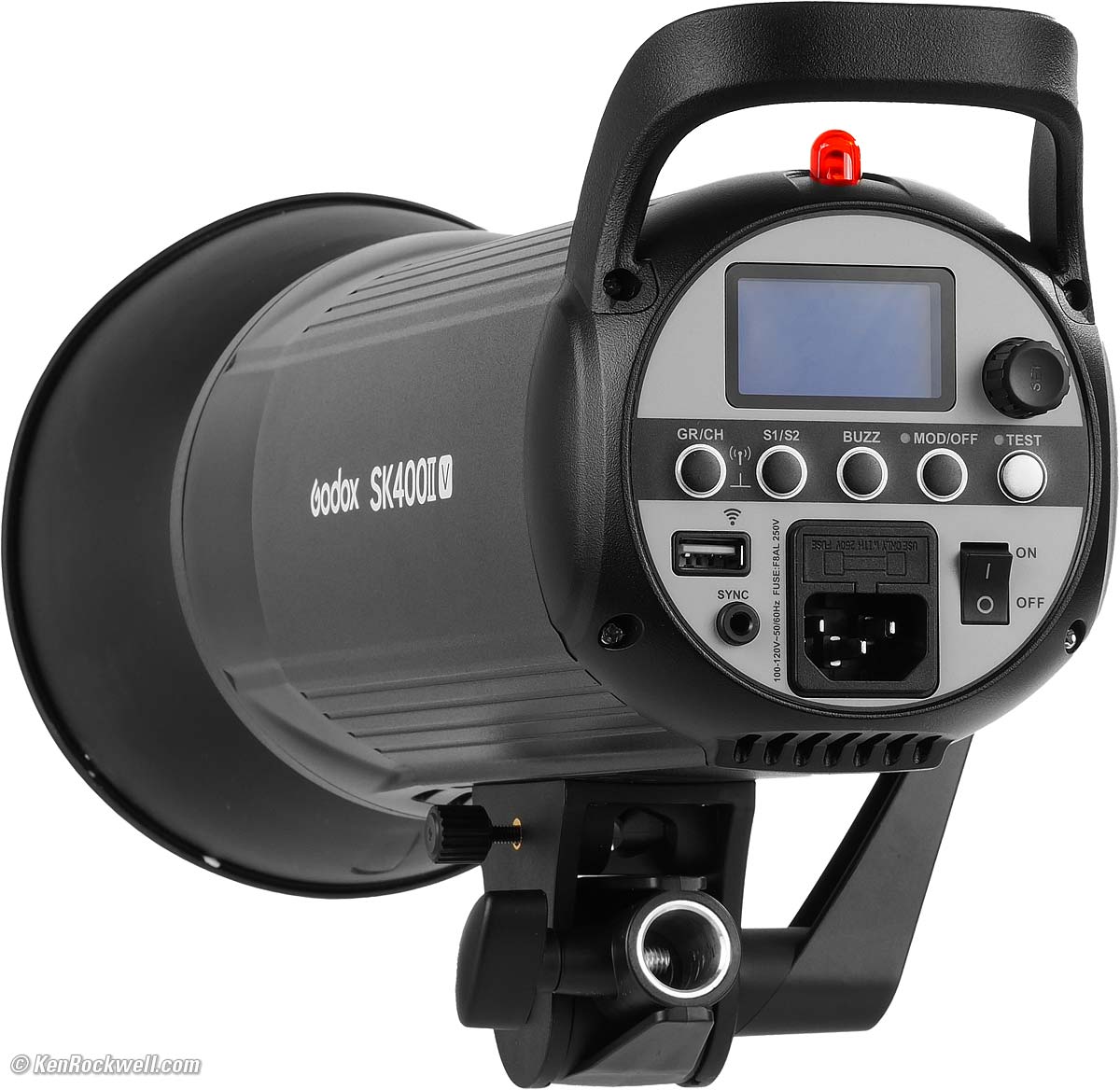
Godox SK400 II V Studio Strobe with included reflector. bigger. See the LCD lit at Usage.
Sample Images top
Sample Images Intro New Good Bad Missing
Specs Accessories Measurements Compared
User's Guide Recommendations More
These are just snapshots made using my usual three-light setup; my real work is in my Gallery.
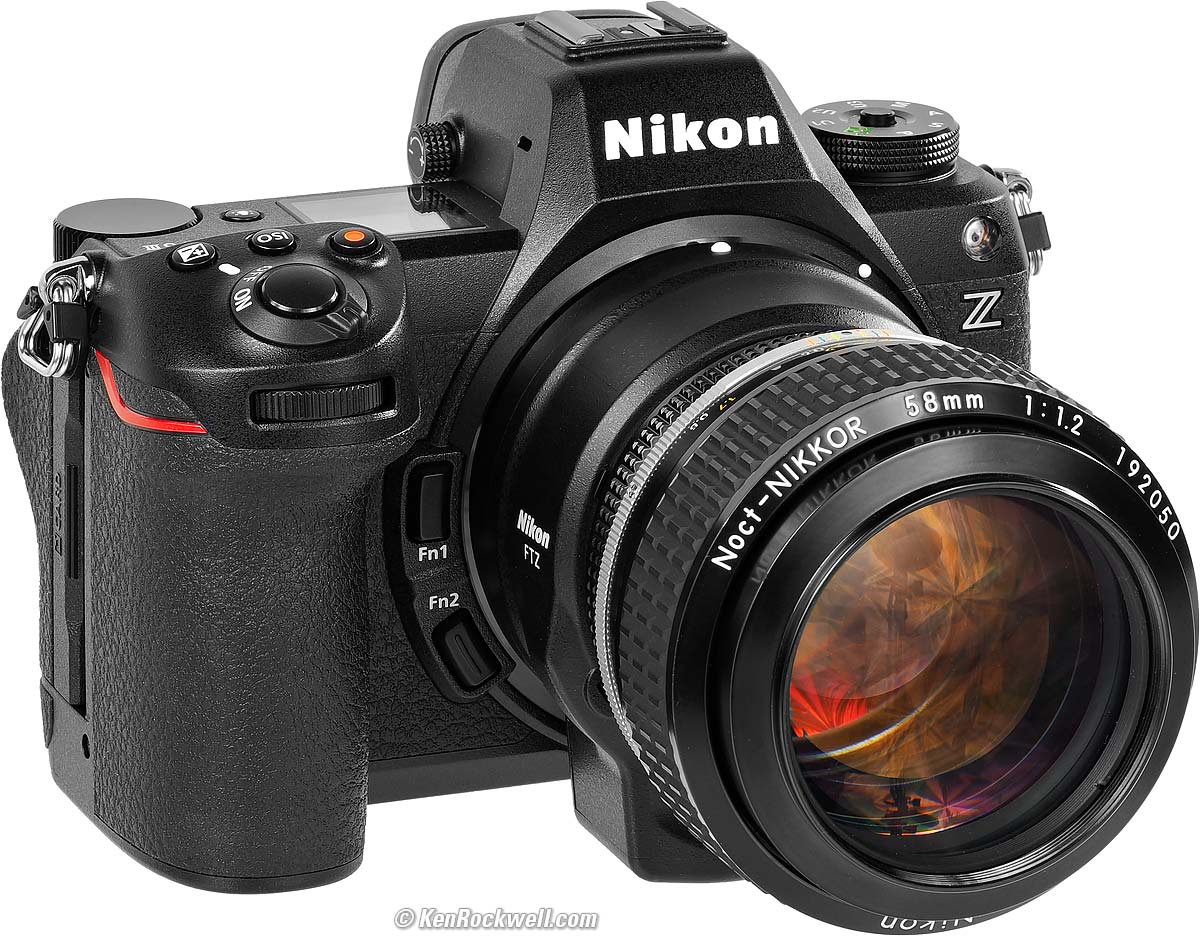
Studio Shot of Nikon Noct-NIKKOR 58mm f/1.2 on an FTZ on a Nikon Z6 III, 16 July 2024. Godox SK400 II V and Novatron 500 Ws system of Studio Strobes. OM SYSTEM OM-1, M.Zuiko ED 90mm f/3.5 IS at f/20 at 1/200 at ISO 100L, Radiant Photo software. bigger.

Studio Shot of Oben GH3W-15 Geared Head, 11 July 2024. Godox SK400 II V and Novatron 500 Ws system of Studio Strobes. OM SYSTEM OM-1, M.Zuiko ED 90mm f/3.5 IS at f/16 at 1/250 flash sync at ISO 100L, Radiant Photo software. bigger.

Studio Shot of Oben CQL-13 Carbon-Fiber Tripod & Head, 10 July 2024. Godox SK400 II V and Novatron 500 Ws system of Studio Strobes. OM SYSTEM OM-1, M.Zuiko ED 90mm f/3.5 IS at f/20 at 1/250 flash sync at ISO 100L, Radiant Photo software. bigger.

Introduction top
Sample Images Intro New Good Bad Missing
Specs Accessories Measurements Compared
User's Guide Recommendations More

I buy only from these approved sources. I can't vouch for ads below. |



This Godox SK400 II V Studio Strobe is a very solid, potent and easy-to-use studio strobe at a bargain price. I thought this must be a $350~$450 strobe until I looked at the price, just $169!
Xenon-gas Studio Strobes like this are the correct lights to use for studio and macro work. Strobes provide brilliant, instantaneous bursts of intense light to freeze action for still photography at small apertures and low ISOs to ensure ultra-sharp and clean results. Of course you can turn them down to use larger apertures or higher ISOs.
Strobes like this are not for video, which require continuous light. Continuous light is awful for still photography because it's nowhere near as bright as a strobe. Because continuous light is so much dimmer you'll have to use larger apertures and much longer exposure times and higher ISOs. Continuous light would have to be about ten times brighter than direct sunlight to let us shoot at similar exposures (f/22 for a 1/1,000 second flash burst at ISO 100, or LV 19), and no way would you want that much continuous light in your studio, even if you could get it.
I'm very impressed at how well this SK400II V strobe works and how easy it is to setup and use. Clearly it's designed by people who know what a strobe is supposed to do. The only reason I needed to glance at its short manual was to learn which icon referred to the optical slave (it's S1, or S2 if you need it to ignore a preflash), and I was good to go!
If you want to shoot film in the studio, this has loads of power to let you use light modifiers and still shoot ISO 50 or ISO 100 film at small apertures for ultrasharp results.
I'm also impressed by Godox including a useful 16-foot (5 meter) power cord and spare fuses. Thank goodness it's a long cord so we can find a power source; you won't believe how many things have only 6-foot (2m) cords which demand we go find extension cords.
It works great along with my ancient Novatron 500 Ws system of Studio Strobes. Assuming you know How to Use Studio Strobes, I was flabbergasted with how insanely fast, simple and intuitive it was to get it up and integrated into my Novatron system. Its rated for a 5700±200K color temperature, and it matches perfectly with my 1990s Novatrons, bravo! This is a huge advantage of Xenon-gas strobes over LED continuous lights: we don't have to worry about a green/magenta bias. So long as the color temperatures match, you're usually good to go.
It works with 2.4 GHz (wireless antenna icon), optical (S1 or S2 icon) or wired (3.5mm) sync. I trigger it in my studio optically (S1) from the tiny toy flash included with my OM SYSTEM OM-1 Mark II. This and my M.Zuiko ED 90mm f/3.5 IS is the current system with which I shoot all my product photos. Whichever system picks up my trigger (I set the camera's tiny flash to manual 1/32 power), it will trigger the other system, so the entire system always fires. Optical triggering from an on-camera flash is my preference over complex radio systems.
My Godox SK400 II V's optical slave is very sensitive, and far more sensitive than the plug-in slave trigger I use with my Novatrons. The Godox SK400 II V's optical slave is so sensitive that I set my tiny camera flash to just 1/32 power (same as a full-sized flash set down to 1/1,024 power!) and it fires every time! This saves my camera's battery, as it powers the little flash.
I'd get my Godox SK400II V at Amazon, which includes the reflector as shown. I'd also get it as part of a multi-light kit at B&H or at Adorama, or at eBay (How to Win at eBay). It also comes without the reflector at B&H and you can order the standard reflector separately, as well as loads of other reflectors, softboxes, snoots and more that all fit its standard Bowens S mount.
New Since the Older SK400II (not "V") intro top
 A fixed 10W, 5,700K LED modeling light replaces the previous household E26 socket and 150W, 3,200K halogen bulb.
This new "V" version's 5,700K LED modeling light matches the color of the flash itself, but I can't see any benefit in that. It's a cool daylight white; I prefer warmer, cozier 2,700-3,200K modeling lights while working indoors in my studio.
Good intro top
 Easy operation and setup.
Lots of power.
Fast recycling: only 1.0 second, actual measured time, at full power.
Built-in optical slave.
Built-in 2.4 GHz control.
USB-A port for other remotes.
3.5mm jack for wired sync or 3.5mm plug-in slaves.
Solid, mostly metal construction.
Internal memory ensures the strobe always wakes-up as you last set it.
Solid metal carrying handle works great.
ON/OFF rocker power switch can be left ON so it turns on whenever power is applied. Now all my strobes turn on when I flip a light switch on my studio wall. I don't have to hold a button down on each unit; just leave them flipped to ON and they come on when my wall outlet turns on. Easy.
Easy tilt lock requires little force to lock it, but it only adjusts in discrete steps.
No visible flickering from the modeling light as it's dimmed. (Any pulse-width modulator must be working at a high frequency.)
16-foot (5-meter) power cord.
Fan always runs, ensuring it stays cool.
Bad intro top
 Fan always runs, making noise similar to a small under-counter fridge: about 33 dBA at 1 meter.
Proportional modeling light isn't completely proportional; it changes less than the flash output changes. Its output only varies by ⅝ of a stop for every full stop change in flash output. Weird, but I never use this to preview lighting; I look at it in my camera as playback.
Optical trigger is very sensitive to infra-red light, so if there is halogen or incandescent light in your studio, it may blind the strobe from triggering optically from a regular electronic flash as I use.
Missing intro top
 No TTL or other automatic exposure control. As a studio light, we shoot with a strobe's precise manual settings for repeatable results under controlled studio conditions. Back in the days of film we'd use a flash meter to measure exposure, and today with digital we set manual flash intensity and camera exposure by experience or trial-and-error.
Runs only on 100 ~ 120 VAC 50~60 Hz. You need a different model to run on 220 ~ 240 VAC.
No High Speed Sync option. If you want to use large apertures, just turn down the power.
No case or bag included with single units; they expect you'll always use more than one at a time and will use a system case, which usually is included with multilight kits.
No easy phone app for remote control, which is needed if the strobe head is pointed towards you into an umbrella so the panel is facing away from you. I'd like to be able to pull out my phone to make strobe settings, but there is no such app that seems to be working well and out there. Luxli has a great app, for comparison.
The tilt lock lever handle can't be reversed to the other side.
Specifications top
Sample Images Intro New Good Bad Missing
Specs Accessories Measurements Compared
User's Guide Recommendations More
I'd get my Godox SK400II V at Amazon, which includes the reflector as shown. I'd also get it as part of a multi-light kit at B&H or at Adorama, or at eBay (How to Win at eBay). It also comes without the reflector at B&H and you can order the standard reflector separately, as well as loads of other reflectors, softboxes, snoots and more that all fit its standard Bowens S mount.
Power Output
Rated 400 Ws maximum; GN 213'/65m. (see also actual measured guide numbers.)
1 ~ 1/16 (400 Ws ~ 25 Ws) power settings in tenths of stops.
5,700 ± 200 K.
1/800 ~ 1/2,000 pulse width (flash duration).
Xenon flash tube.
Modeling Lamp
10 W 5,700±200K LED.
Variable 5% to 100%
Front Accessory Mount
Standard Bowens S mount for reflectors, softboxes, snoots and more.
Power Input specifications top
100 ~ 120 VAC.
50 ~ 60 Hz.
This is NOT a universal power supply; it does not run at 220~240VAC:
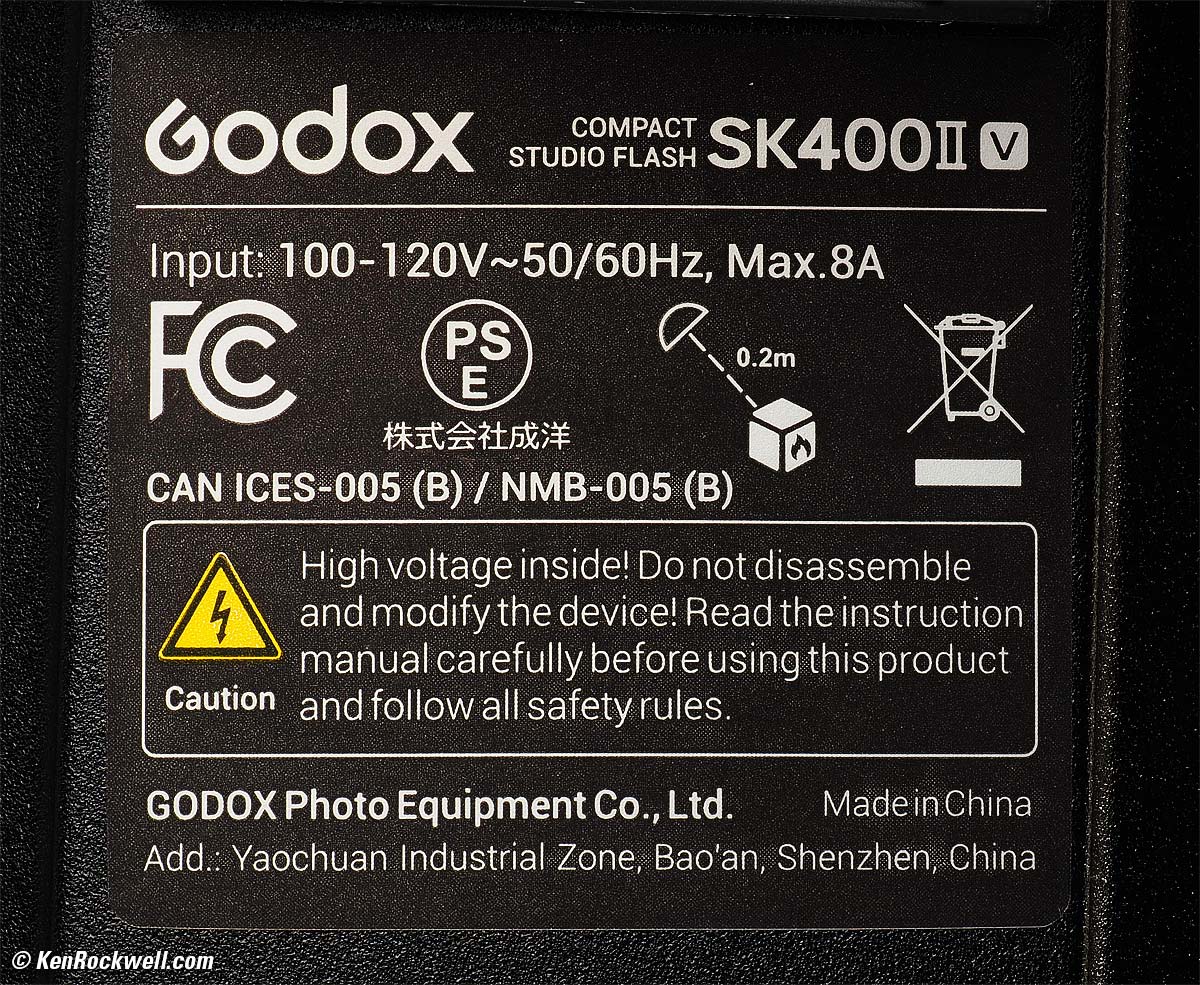
Godox SK400 II V Studio Strobe. bigger.
Size specifications top
5.4" ø diameter × 9.1" high (with handle) × 15.4" long (with safety cover).
137 mm ø diameter × 232 mm high (with handle) × 390 mm long (with safety cover).
Weight specifications top
4.63 lbs.
74.1 oz.
2,100g.
Quality specifications top
Made domestically in China.
Announced specifications top
1H 2024.
Included specifications top
Strobe with non-removable tilt mount and tube guard for shipping.
Possibly a reflector.
16-foot (5-meter) US standard computer-type power cord. Works with any standard cord.
Two spare 8A fuses.
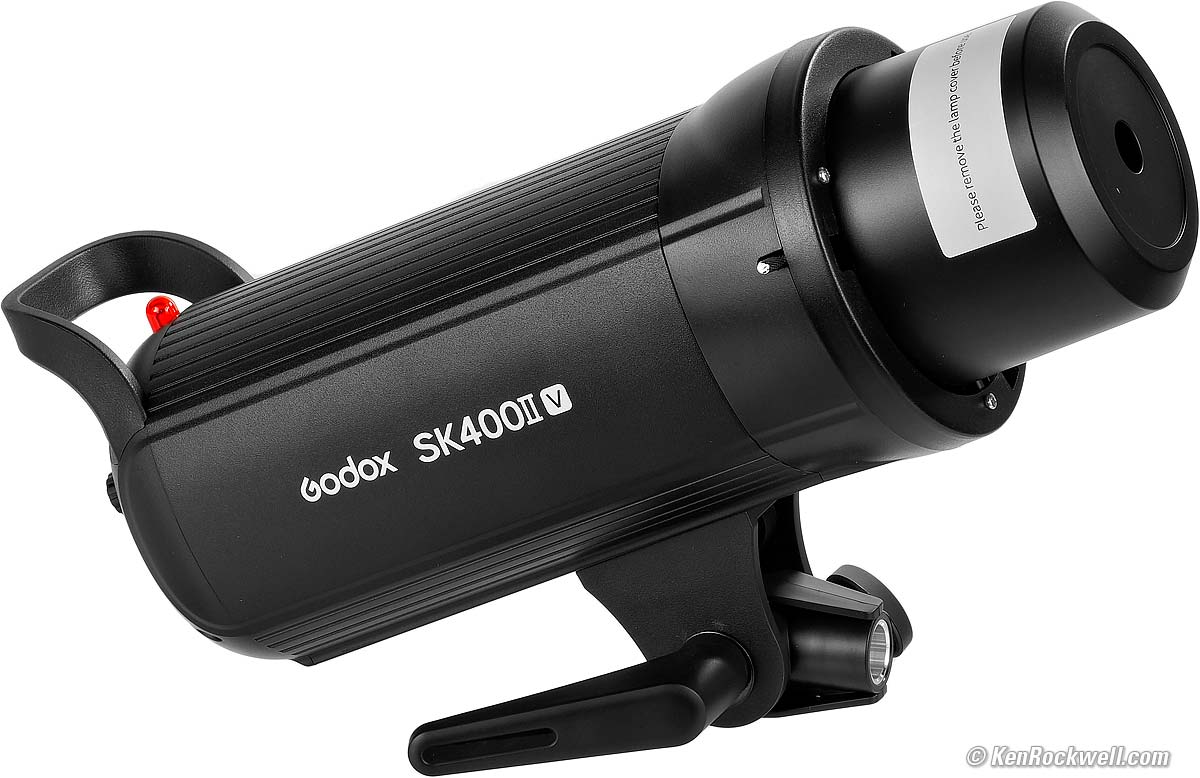
Godox SK400 II V Studio Strobe as Shipped with Included Tube Guard. bigger.
Price, U. S. A. specifications top
23 July 2024
$169 at Amazon with a reflector, or $152 at B&H without a reflector:
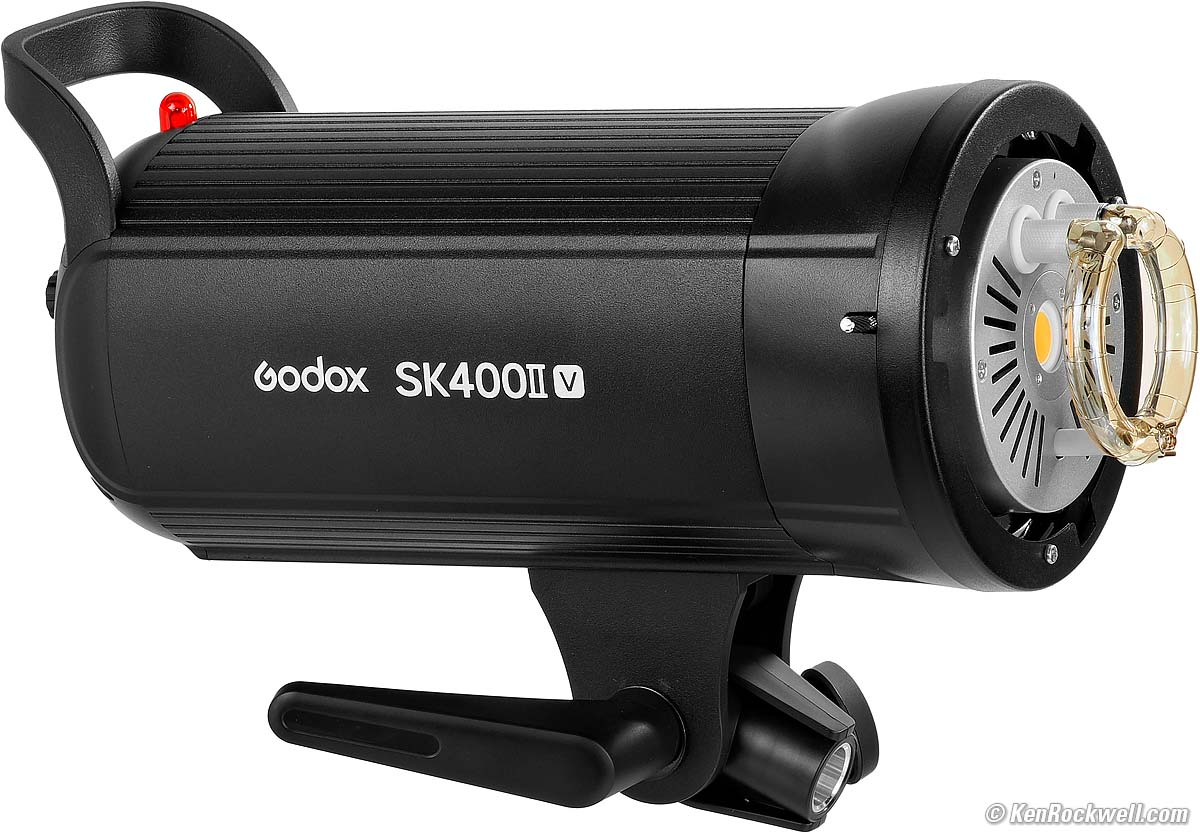
Godox SK400 II V Studio Strobe without Reflector (bare-bulb mode ready for use with S-Mount accessories). bigger.
16 July 2024
$152 at Amazon with a reflector, and at B&H without a reflector.
Packaging specifications top
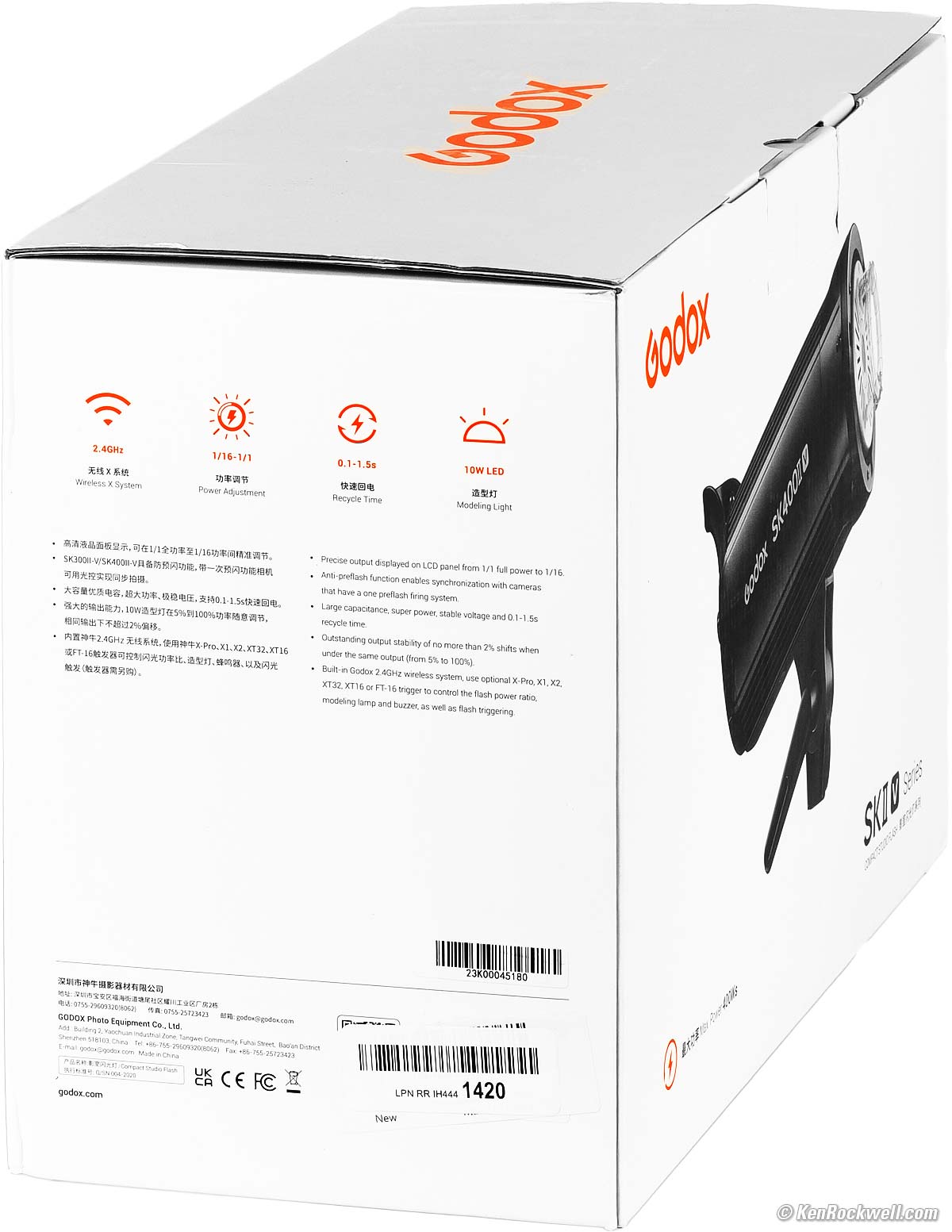
Molded closed-cell polystyrene foam holding the parts inside a corrugated cardboard box:
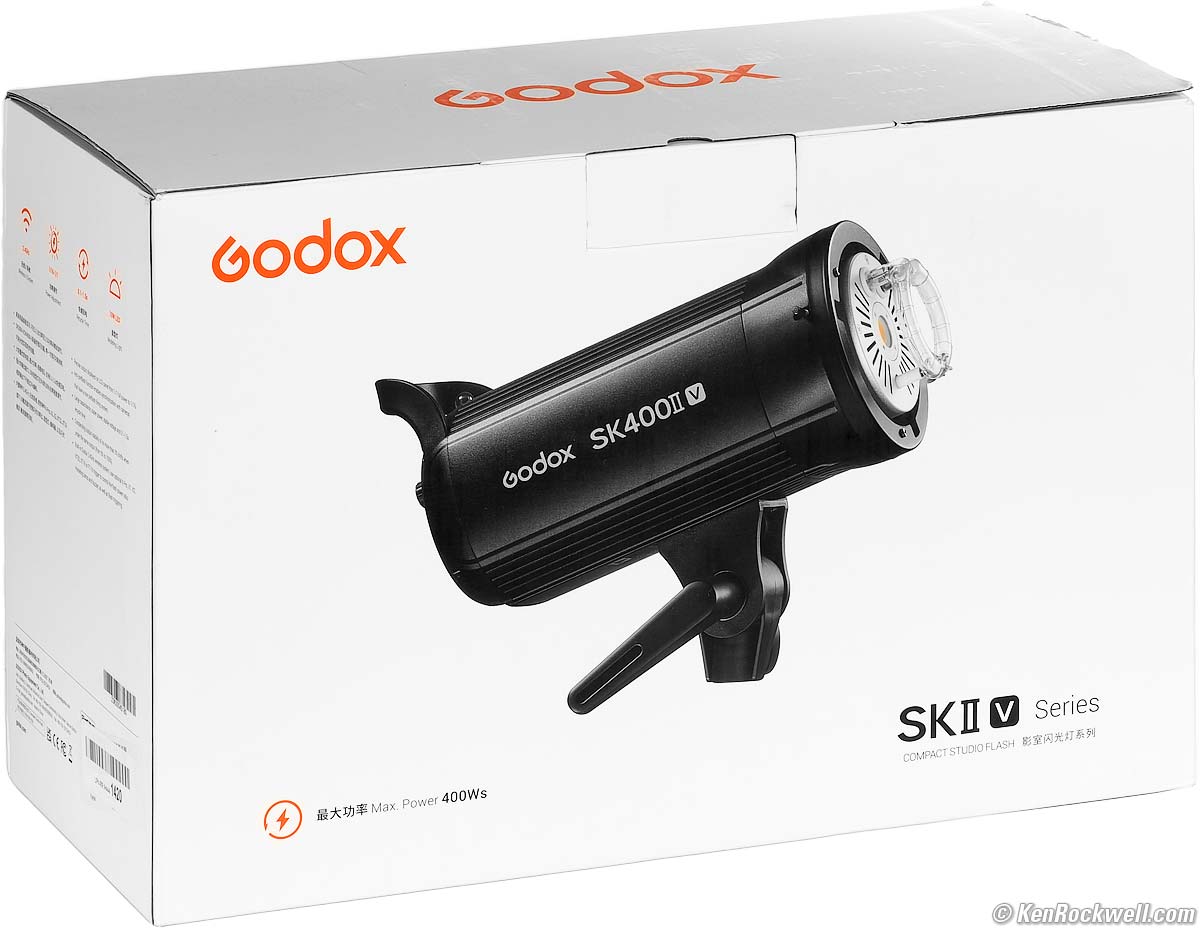
Box, Godox SK400 II V Studio Strobe. bigger.
Godox SK400 II V Studio Strobe. bigger.
Optional Accessories top
Sample Images Intro New Good Bad Missing
Specs Accessories Measurements Compared
User's Guide Recommendations More
I'd get my Godox SK400II V at Amazon, which includes the reflector as shown. I'd also get it as part of a multi-light kit at B&H or at Adorama, or at eBay (How to Win at eBay). It also comes without the reflector at B&H and you can order the standard reflector separately, as well as loads of other reflectors, softboxes, snoots and more that all fit its standard Bowens S mount.
Light Modifiers
It has a standard Bowens S mount for reflectors, softboxes, snoots and more.
Triggers, Receivers & Remote Controls
I don't use any of these. I simply make my settings at each flash and trigger everything optically using a regular (or built-in) flash on my camera.
X2 2.4 GHz Flash Receiver
Actually a camera-mounted 2.4 GHz transmitter to control multiple flashes. No idea why it's called a receiver.
X1 2.4 GHz Flash Receiver
Actually a camera-mounted 2.4 GHz transmitter to control multiple flashes. No idea why it's called a receiver.
XT-16 2.4 GHz Transmitter and Receiver Set
Hotshoe-mounted 2.4 GHz XT-16 transmitter for your camera and one USB-A mounted XTR-16 receiver to mount on a flash. You can get more XTR-16 receivers for other flashes you wish to fire together - but remember that this flash already has an internal 2.4 GHz receiver.
Be careful; this transmitter is big and tall and looks easy to break off the top of your camera if you're not always diligent in not banging it on anything.
FT-16 433 MHz transmitter
Older model hotshoe-mounted 433 MHz FT-16 transmitter for your camera and one USB-A mounted FT-16 receiver to mount on a flash.
Measurements top
Sample Images Intro New Good Bad Missing
Specs Accessories Measurements Compared
User's Guide Recommendations More
I'd get my SK400II V at Adorama, at Amazon, at B&H (kit options at B&H) or at eBay (How to Win at eBay). It also comes as a kit with the reflector if you don't want to order the reflector separately.
Beam Width (coverage)
Bare tube: 180+º
With standard reflector: about 90º, or about the angle of a 20mm lens on full-frame.
Measured Full-Power Guide Numbers at ISO 100 measurements top
Bare tube: 24 meters (80 feet).
With standard reflector: 34 meters (110 feet).
With my 25-year-old 36" Photogenic Eclipse silver-fabric ("white/black") umbrella: 21 meters (70 feet).
These guide numbers don't seem much different from an ordinary shoe-mounted flash, however one must realize that this much more powerful strobe is covering an ultra-wide angle with the same guide number as a shoe-mounted flash does when set to a much longer focal length.
In other words, this potent strobe has a fat guide number while covering a huge angle and/or bouncing off an umbrella, while a shoe-mounted flash is using reflectors and lenses to focus the smaller flash's limited power in only the direction you're shooting to get a similar guide number.
The whole point to these strobes is that we use them with large soft-light modifiers, with which shoe-mounted flash don't work well as their beam angles are too restricted, or if we set them to their "wide" settings, lack the power and recycling speed.
Measured Recycle Times measurements top
1.0 seconds at full power.
0.25 seconds at quarter power.
Bravo!
Strobe Proportional Output measurements top
The indicated power settings are accurate.
Modeling Light measurements top
Color
It looks to be about 5,700K as specified.
Brightness
Bare tube: 450 lux at 1 meter (3.3 feet) at 100%.
With standard reflector: 800 lux at 1 meter (3.3 feet) at 100%
Modeling Light Proportional Output
 It doesn't track the strobe's output accurately. It isn't completely proportional; it changes less than the flash's output changes.
Its output only varies by ⅝ of a stop for every full stop change in flash output.
In other words, when setting the flash down to 1/16 power (four stops reduction from full), the modeling light only dims by 2½ stops.
Fan Noise
The fan runs continuously. I've never heard it run any faster with use; I shoot every couple of seconds for several shots at a time and then regroup; I don't hit the flash enough to overheat it to see if the fan runs any faster.
The fan makes about as much noise as an under-counter fridge.
I measure the fan noise as about 33 dBA at 1 meter. The fan noise comes out the ventilation slots behind the flash tube, so with the reflector it's loudest in front (34 dBA at 1 meter) and a little more quiet (32 dBA at 1 meter) to the sides and rear.
Power Consumption measurements top
It seems to draw less than 1 VA idling.
With the modeling light ON FULL it draws 16 VA.
It can draw what I see as up to about 1,150 VA while recycling.
Power Station & Power Bank Compatibility measurements top
I tried it with various power banks for field use. Ideally a smarter idea is to use battery-powered studio strobes, but just for grins I tried it with the AC outputs of these power stations. Note that this studio strobe draws up to at least 1,200W peak while recycling, so let's see what happens with just one SK400II V.
These were quick tests. I made a few pops with each to see what would happen. I didn't shoot for any extended period of time, and more importantly, I did not try with multiple strobe heads, which is how I would shoot in the field and would be very likely to fry most of these power banks.
Bluetti AC2A (rated only 300W AC output)
This little 300W AC power station isn't happy driving this strobe at anything other than at 1/16 power.
Pass.
Bluetti AC70 (rated 1 kW AC output)
It runs fine at any power level with my Bluetti AC70.
The fan runs about two seconds after each full-power pop.
Its internal power meter reads up to 1,150 VA while recycling. While it's marked Watts, it's actually reading VA.
Bluetti AC180 (rated 1.8 kW AC output)
It runs fine at any power level with my Bluetti AC180.The fan didn't run after each full-power pop. I didn't use it that much; I imagine after a lot of shooting that it would run.
Its internal power meter reads up to 1,150 VA while recycling. While it's marked Watts, it's actually reading VA.
Jackery Explorer 300 (rated only 300W AC output)
The Jackery Explorer 300 seems to work OK with this strobe, but the catch is that it's straining this poor little power station, so a full-power pop requires about 2.3 seconds to recycle. I didn't measure it, but I'll bet that the Jackery Explorer 300 is lowering its output voltage during peak power draw.
The fan runs a few seconds after each full-power pop.
Jackery Explorer 1000 (rated 1kW AC output)
The Jackery Explorer 1000 drives this strobe just fine.
Its fan is the loudest of this bunch while the flash recycles.
Compared top
Sample Images Intro New Good Bad Missing
Specs Accessories Measurements Compared
User's Guide Recommendations More
I'd get my Godox SK400II V at Amazon, which includes the reflector as shown. I'd also get it as part of a multi-light kit at B&H or at Adorama, or at eBay (How to Win at eBay). It also comes without the reflector at B&H and you can order the standard reflector separately, as well as loads of other reflectors, softboxes, snoots and more that all fit its standard Bowens S mount.
Versus Shoe-Mounted Flash
Dedicated strobes like these work far better in the studio than shoe-mounted flash that camera makers want you to buy because strobes:
1.) Have far more power, which you need when using umbrellas, reflectors and other light modifiers,
2.) Run directly off wall power so they recycle super fast and never need to be recharged,
3.) These are far easier to set up and get to fire every single time than mucking around with little shoe-mount flashes and wireless settings,
4.) Are designed to mount on light stands and have things attached to them. Shoe mount flashes are never really happy on light stands or with things attached to them, and also importantly,
5.) Cost less than buying shoe-mount flashes. You can get a set of three of these with stands, umbrellas, triggers and a system case for just $699 complete — much less than a single Canon EL-1!!!
Versus the older SK400II (not "V")
The older SK400II (not "V") seems identical, but instead of an LED modeling light uses a hot 150W halogen bulb in a regular household E26 socket.
I haven't tried, and I imagine you probably could use a cool-running household LED in your choice of brightness and color temperature instead of the 150W halogen bulb. It's unlikely that an LED bulb in this socket would have the same response to proportional modeling light settings.
I use household LED bulbs as modeling lights in my ancient Novatrons, but I doubt this older model is worth the trouble unless you want to use a warmer-colored bulb than the 5,700K LED modeling light in this new V version.
User's Guide top
Sample Images Intro New Good Bad Missing
Specs Accessories Measurements Compared
User's Guide Recommendations More
I'd get my Godox SK400II V at Amazon, which includes the reflector as shown. I'd also get it as part of a multi-light kit at B&H or at Adorama, or at eBay (How to Win at eBay). It also comes without the reflector at B&H and you can order the standard reflector separately, as well as loads of other reflectors, softboxes, snoots and more that all fit its standard Bowens S mount.
SK400II V User's Manual.
Why Studio Strobes?
How to Use Studio Strobes.
Setup
It mounts on standard ⅝" light stands, and has enough setscrew travel to work on ⅜" light stands (from my Novatrons) as well.
You don't need to use much force to tighten the tilt lock. It's not a friction lock; it adjusts in discrete steps. A gentle touch of the lock lever will lock it down:
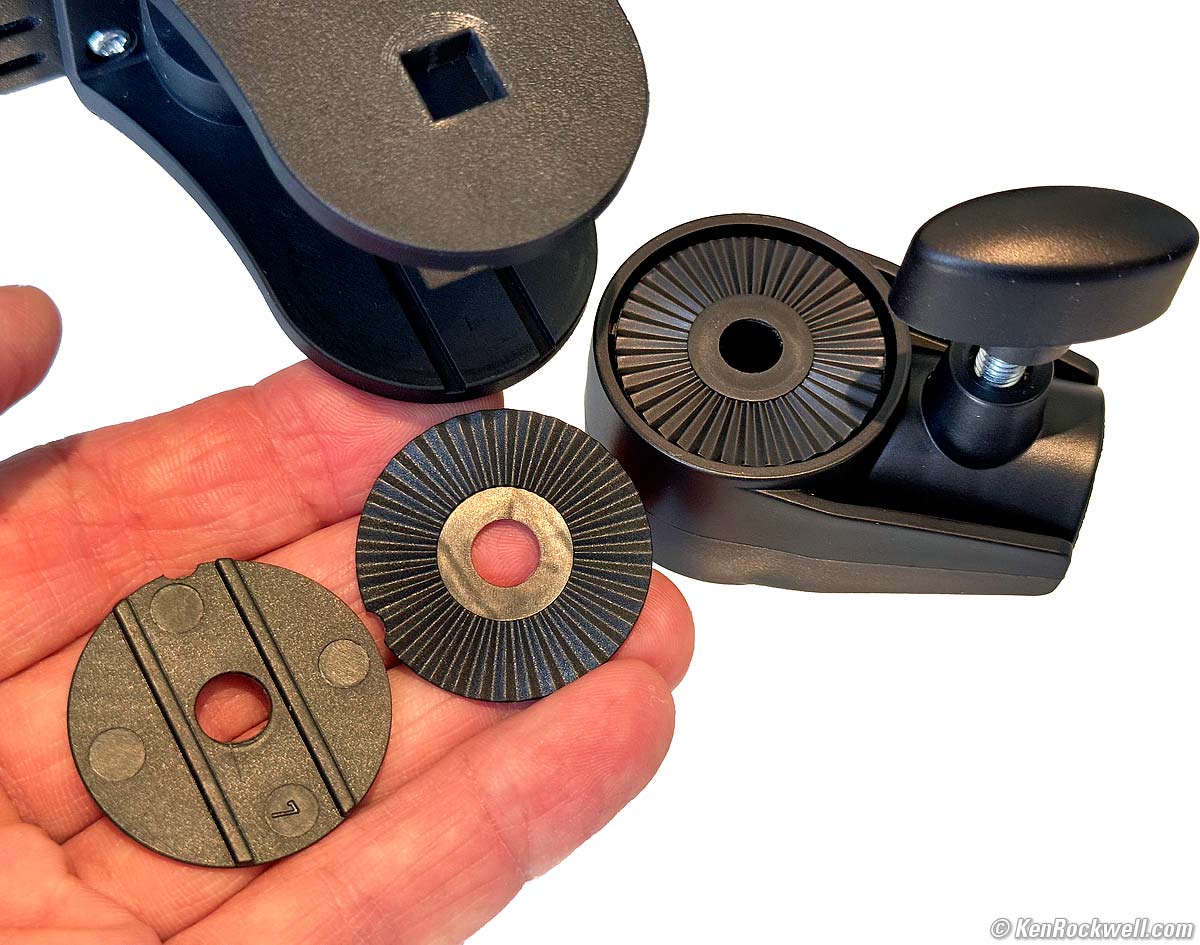
Dismantled Stepped Tilt Control, Godox SK400 II V Studio Strobe. bigger.
Settings
Power Level
Just turn the knob on the upper right. Easy!
If you set it to a lower power, the red LED ready light will blink until you hit TEST once to discharge the capacitor which will then fill to the lower power level. Otherwise the next time you make a shot, the capacitor would still be charged and the flash will fire (once) at the previous (higher) power level. Every studio strobe had been like this for decades, what's new is the blinking LED to remind you.
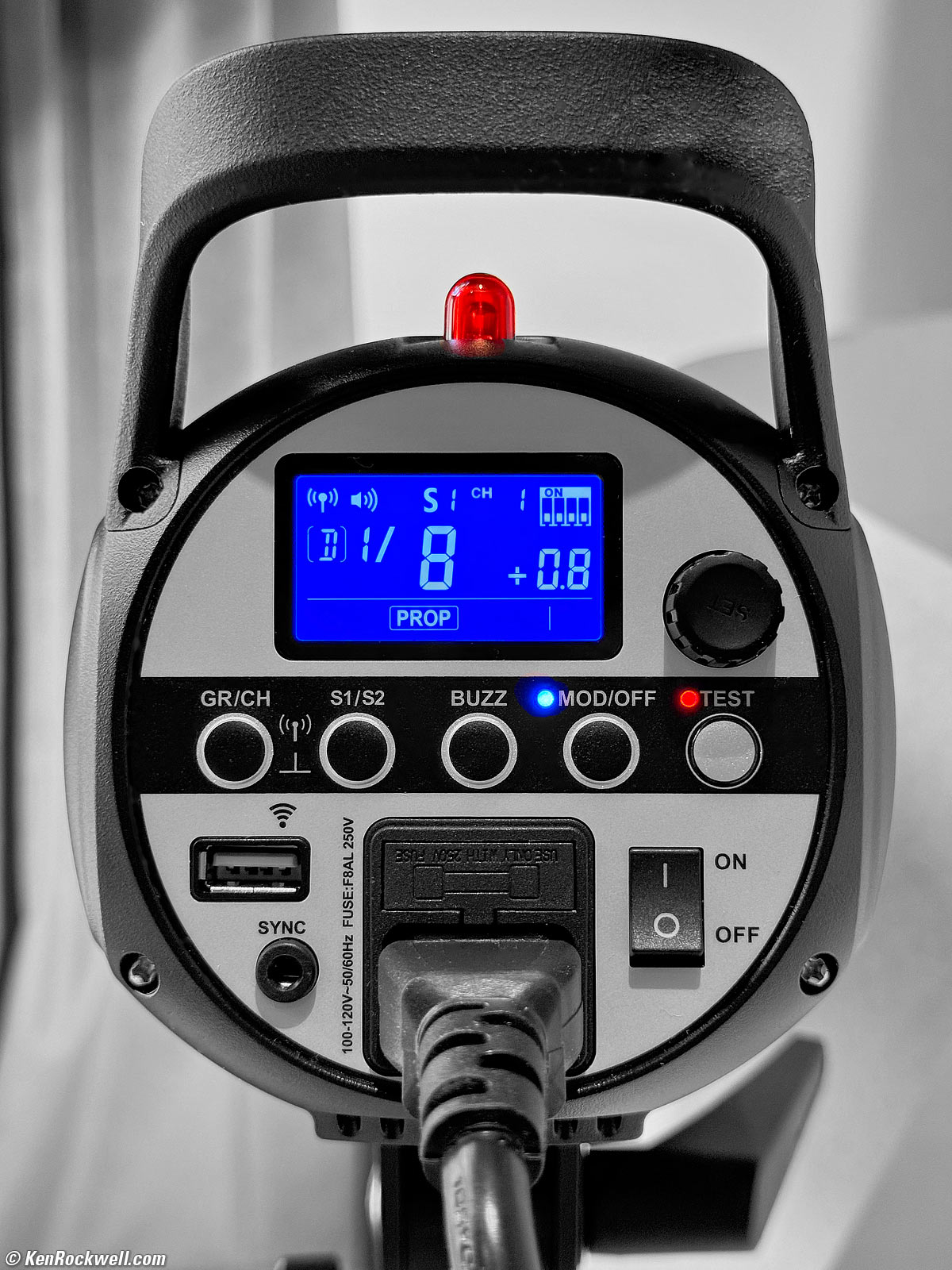
Godox SK400 II V Studio Strobe. bigger.
GR/CH
Tap and/or hold GRoup/CHannel to set radio options. What look like DIP switches at the top right of the blue LCD are simply a visual guide to help you make the same setting on your remote!
S1/S2
Tap this for S1 (regular optical slave) or S2 (optical slave for use with a camera's preflash system).
Tap again to make the S go away and disable optical triggering.
HINT: The optical sensor is the clear red nubbin at the top rear.
HINT: It's very sensitive to infrared light. If I have my halogen lights on in my studio, it can blind my SK400II V to the regular camera flashes I use to trigger it. No big deal, I open the shades and turn off the lights.
GR/CH & S1/S2 Together
Hold both of these to turn radio control on or off, shown by the antenna icon on the top left of the blue LCD.
BUZZ
This turns ON or OFF the beeper that beeps each time its ready after recycling. If it's active, you'll see the speaker icon on the top left of the LCD; if not, no speaker icon.
It should read BEEP, but in China I guess they call this BUZZ, for Buzz Aldrin in respect of America having put men on the moon 55 years before any other country has even dared to try.
MOD/OFF
Tap this to turn off the modeling light, or turn it on full-power or proportional modes.
The bottom of the LCD will show OFF, PROP (proportional to the strobe setting) or 100%. When it shows a percentage, press-in the knob at the top right to set a particular percentage value, or just leave it at 100%. Tap the knob again to lock-in the setting. Easy.
TEST
Tap this to test fire the strobe.
The red LED is the ready light.
It blinks if you've just changed the strobe to a lower power level and haven't "cleared" the higher-power charge by hitting the TEST button once to discharge it.
USB-A Port on Left
This is for various receivers.
I don't use these, this strobe has its own internal radio and optical slaves.
SYNC
This is a 3.5mm input for wired sync or plug-in slaves.
Exposure
There's no TTL or other automatic exposure.
As a studio light, we shoot with a strobe's precise manual settings for repeatable results under controlled studio conditions.
With digital we set exposure and flash intensity by experience or trial-and-error. In other words, make some settings, make a shot, and adjust to taste based on the playback images and trial-and-error.
Back in the days of film we'd use a flash meter to measure exposure.
Use with Umbrellas & Reflectors
I use a reflector with my umbrellas to throw the light into my umbrella rather than have it fly around the studio and pick up off-colors from my clothes or anything else if I just left the flash tube bare.
To poke the umbrella shaft into the screw-locked receptacle under the strobe (above the tilt adjustment), mount the reflector with its punched-out section towards the bottom as shown, and poke-out the punched-out section to allow the shaft to penetrate the reflector:
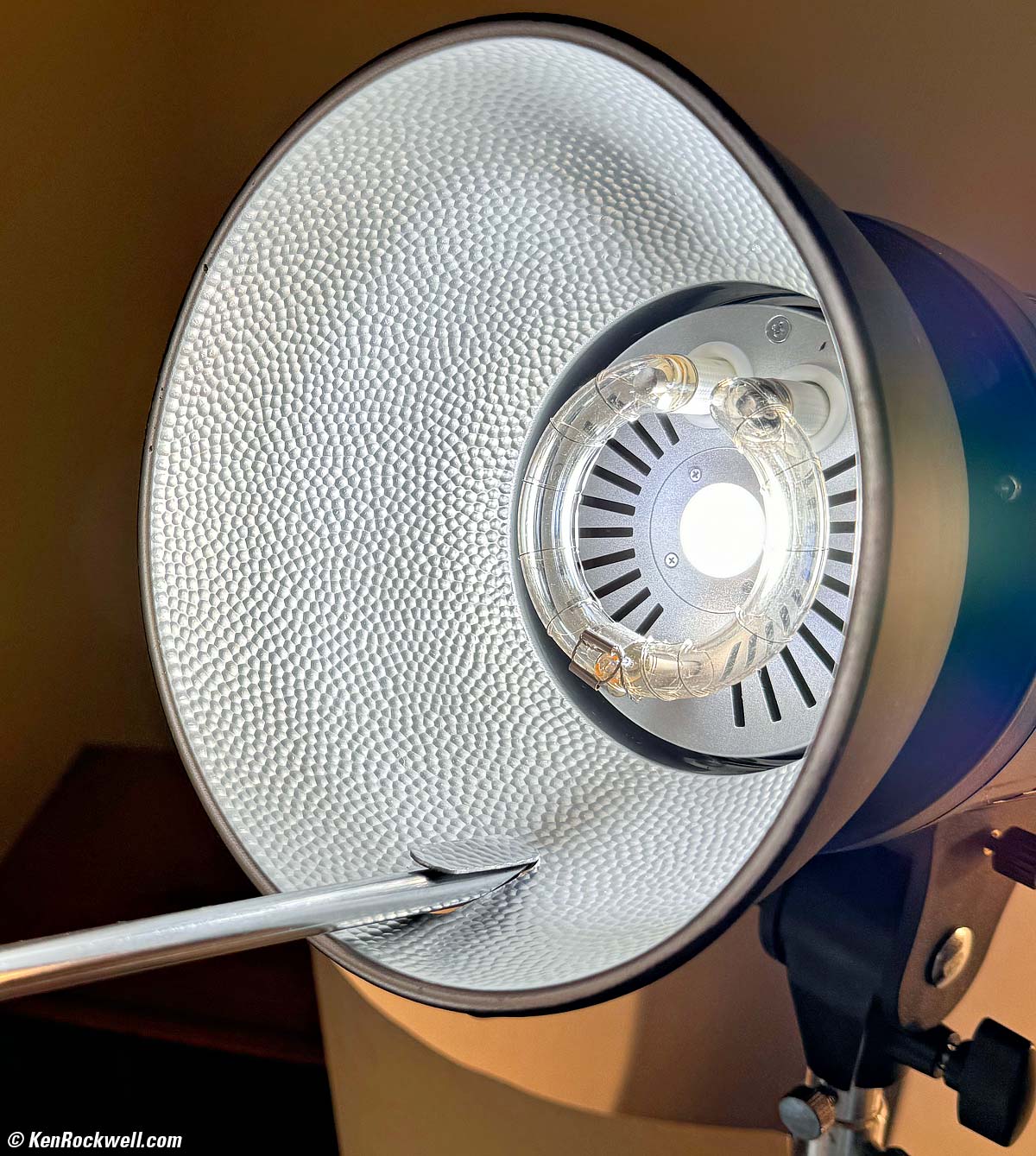
Punched-Out Slot for an Umbrella in the included Reflector. bigger.
Recommendations top
Sample Images Intro New Good Bad Missing
Specs Accessories Measurements Compared
User's Guide Recommendations More
I'd get my Godox SK400II V at Amazon, which includes the reflector as shown. I'd also get it as part of a multi-light kit at B&H or at Adorama, or at eBay (How to Win at eBay). It also comes without the reflector at B&H and you can order the standard reflector separately, as well as loads of other reflectors, softboxes, snoots and more that all fit its standard Bowens S mount.
You really want three of these for a proper studio setup. You can get a set of three of these with stands, umbrellas, triggers and a system case for just $699 complete, or look at loads of other kit options at different powers.
These 400 Ws units have loads of power for tabletop and headshot use with umbrellas at about f/22 at ISO 100 from a few feet away.
Lower power lights will also work great this close; for instance, three 200 Ws strobes would have you at about f/16 at ISO 100 a few feet away, not too shabby either.
These 400 Ws units are great for full-body portraits. I'd not worry about more power unless you're trying to light large spaces, or don't want to shoot at small apertures for ultimate studio sharpness.
Of course all the various models allow you to turn down the power if you like, so feel free to go hog-wild with more powerful strobes if you might need to light an entire team or class now and then. I find this 400 Ws unit always has all the power I need.
There's an almost identical SK300II V model with up to 300 Ws of power. It's the same as this SK400II V other than its slightly lower maximum power output, price and length, and it also comes in multi-light kits.
I'd get my Godox SK400II V at Amazon, which includes the reflector as shown. I'd also get it as part of a multi-light kit at B&H or at Adorama, or at eBay (How to Win at eBay). It also comes without the reflector at B&H and you can order the standard reflector separately, as well as loads of other reflectors, softboxes, snoots and more that all fit its standard Bowens S mount.
This all-content, junk-free website's biggest source of support is when you use those or any of these links to approved sources when you get anything, regardless of the country in which you live. Thanks for helping me help you! Ken.
Ken.
More Information top
Sample Images Intro New Good Bad Missing
Specs Accessories Measurements Compared
User's Guide Recommendations More
I'd get my Godox SK400II V at Amazon, which includes the reflector as shown. I'd also get it as part of a multi-light kit at B&H or at Adorama, or at eBay (How to Win at eBay). It also comes without the reflector at B&H and you can order the standard reflector separately, as well as loads of other reflectors, softboxes, snoots and more that all fit its standard Bowens S mount.
SK400II V User's Manual.
Why Studio Strobes?
How to Use Studio Strobes.
© Ken Rockwell. All rights reserved. Tous droits réservés. Alle Rechte vorbehalten. Alla rättigheter förbehållna. Toate drepturile rezervate. Omnia jura reservata. Ken Rockwell® is a registered trademark.
Help Me Help You top
I support my growing family through this website, as crazy as it might seem.
The biggest help is when you use any of these links when you get anything. It costs you nothing, and is this site's, and thus my family's, biggest source of support. These places always have the best prices and service, which is why I've used them since before this website existed. I recommend them all personally.
If you find this page as helpful as a book you might have had to buy or a workshop you may have had to take, feel free to help me continue helping everyone.
If you've gotten your gear through one of my links or helped otherwise, you're family. It's great people like you who allow me to keep adding to this site full-time. Thanks!
If you haven't helped yet, please do, and consider helping me with a gift of $5.00.
As this page is copyrighted and formally registered, it is unlawful to make copies, especially in the form of printouts for personal use. If you wish to make a printout for personal use, you are granted one-time permission only if you PayPal me $5.00 per printout or part thereof. Thank you!
Thanks for reading!
Ken.