TTArtisan AF 56mm f/1.8 ED: $129!
85mm (eq.) APS-C for Nikon Z, for Sony & for Fuji (2025 ~ today)
Sample Images Intro New Good Bad Missing
Specifications Performance Recommendations
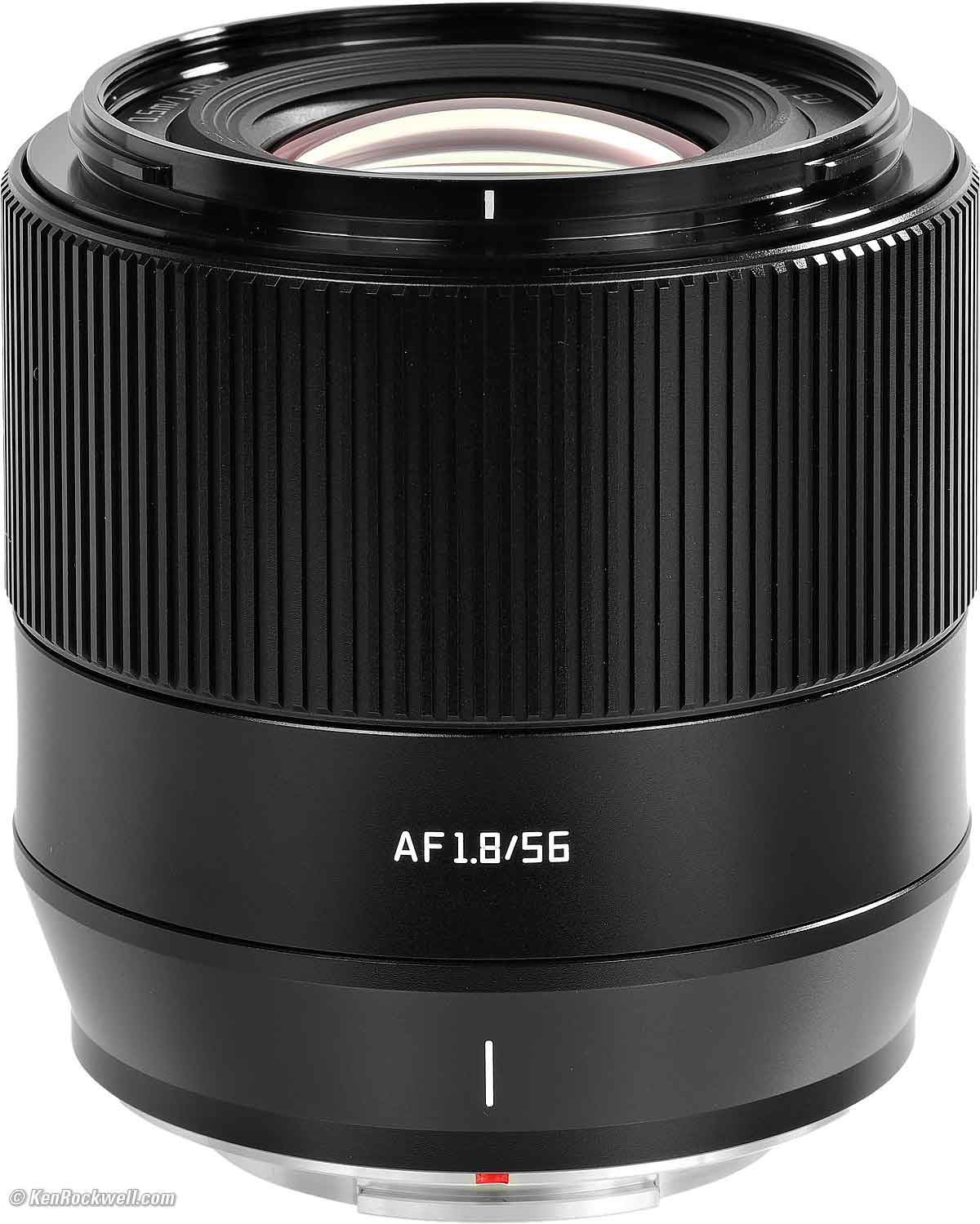
TTArtisan AF 56mm f/1.8 ED for Fuji (also comes for Nikon Z and for Sony and also comes in silver, metal 52mm filter thread, 8.6 oz./245 g, 1.6'/0.5m close focus, $129). bigger.
I'd get mine at B&H, at Adorama, at Amazon, or at eBay (How to Win at eBay), or get it used at KEH.
This all-content, junk-free website's biggest source of support is when you use those or any of these links to approved sources when you get anything, regardless of the country in which you live. Thanks for helping me help you! Ken.
August 2025 Better Pictures TTArtisan Canon Nikon Sony Fuji OM SYSTEM LEICA Zeiss HASSELBLAD All Reviews
AstrHori Full Frame AF 85mm f/1.8
Why Fixed Lenses Take Better Pictures
Sample Images top
Sample Images Intro New Good Bad Missing
Specifications Performance Recommendations
More samples throughout this review at Bokeh, Falloff, Macro, Sharpness, Spherochromatism and Sunstars.
These are just snapshots; my real work is in my Gallery.
These are all shot hand-held as NORMAL JPGs; no tripods, FINE JPGs or RAW files were used or needed.
It's sharp, with loads of room to crop:
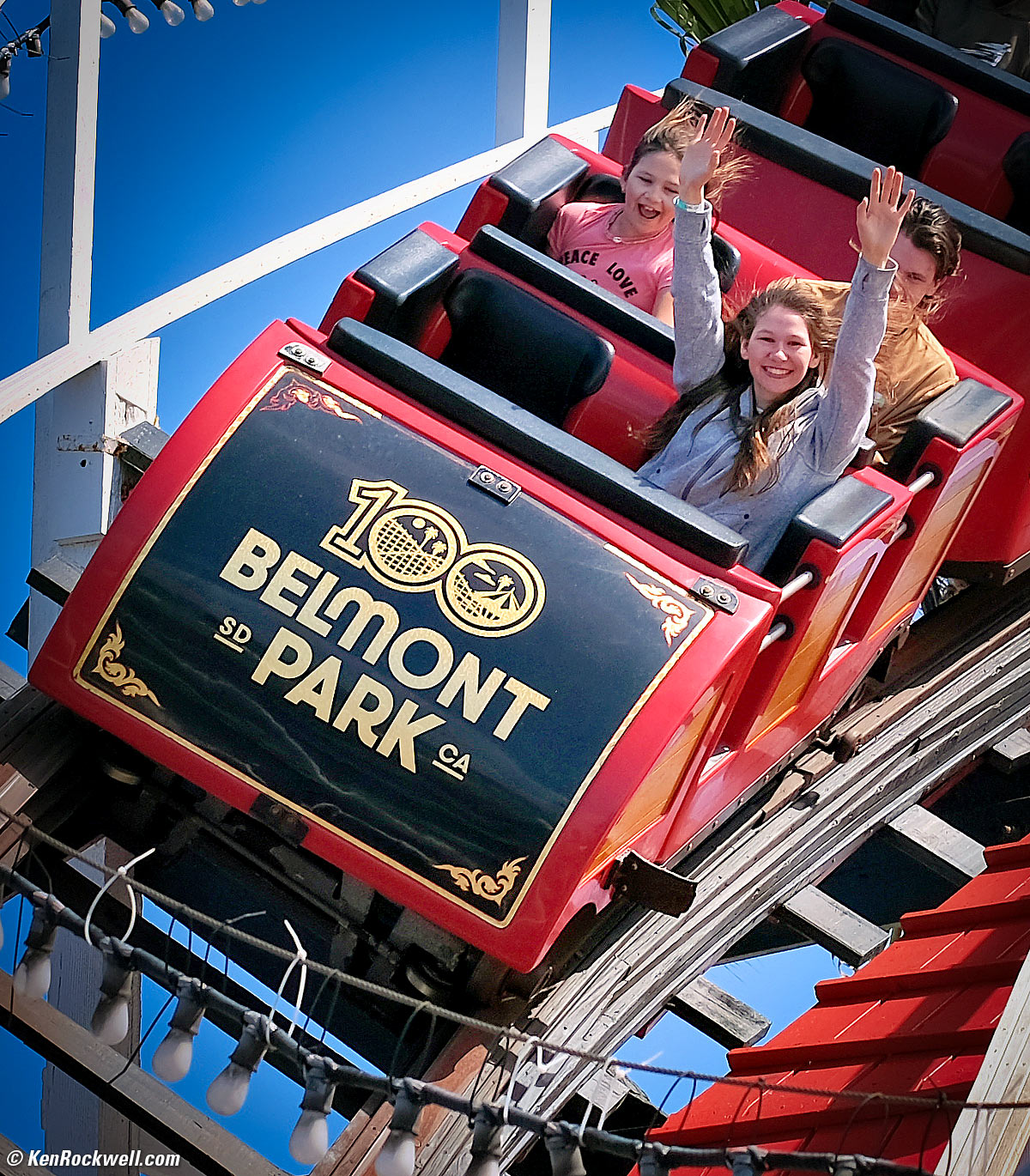
The Big Dipper, Belmont Park, Mission Beach, San Diego, California, 11:45 AM, Tuesday, 18 March 2025. Strongly cropped from Fuji X-T30 (which was in The Eastern Sierra with us in 2019) and TTArtisan 56mm f/1.8, f/5.6 at 1/680 at ISO 160, +0.7 stops compensation (LV 13¾), Dark faces lit with Radiant Photo software and deliberate vignetting added in Skylum Luminar Neo software. bigger.
It's nice that my Fuji X-T30 and TTArtisan 56mm f/1.8 have so much resolution (like every camera today) that it's trivial to crop so I don't need to carry any stinking long tele. Here's the as-shot image before cropping:
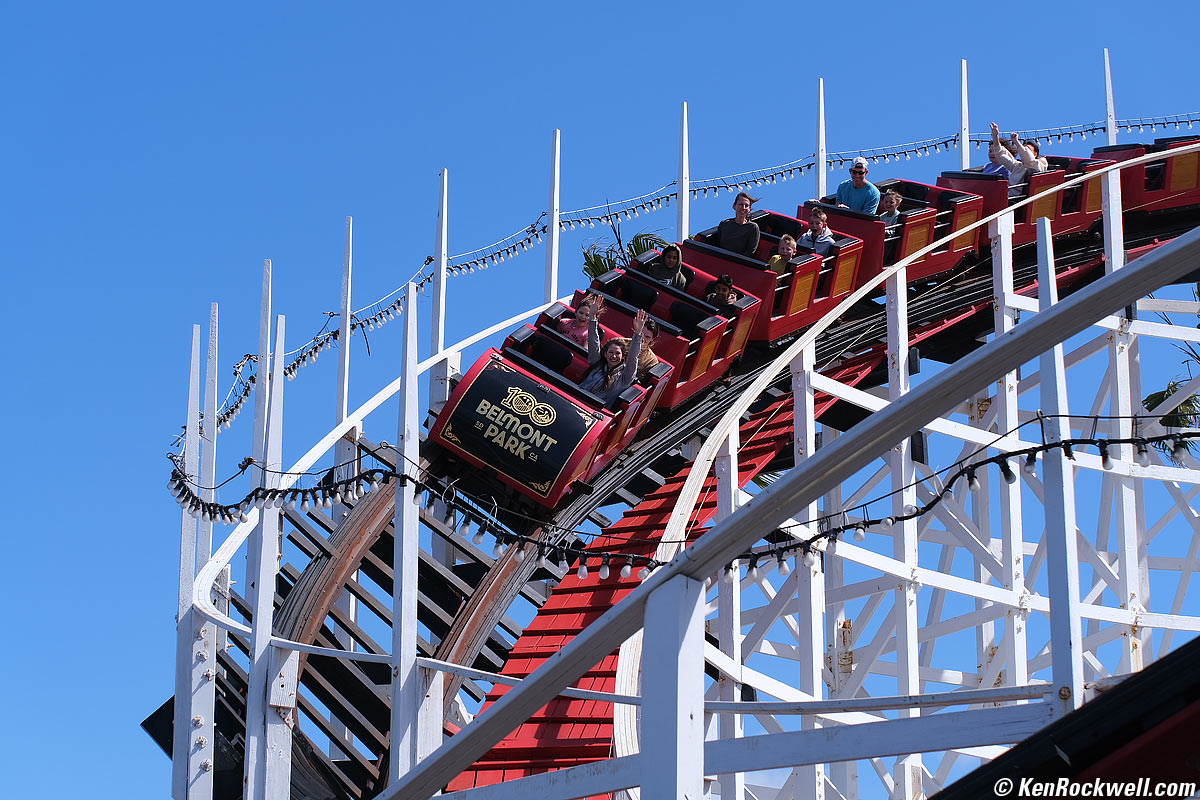
Complete as-shot image from which the above was cropped and edited. bigger.
Camera makers really play the FUD card trying to scare the innocent into thinking they need 45 megapixels to crop. This was shot on a 26 MP camera from glorious 2019 with a $129 lens. Ha! The above is a 5.2× crop from APS-C, making it equivalent to a 440mm lens on full-frame! Heck, if I had used a 400mm lens it's not likely it could have tracked focus, and even less likely I'd have it framed as I wanted it!
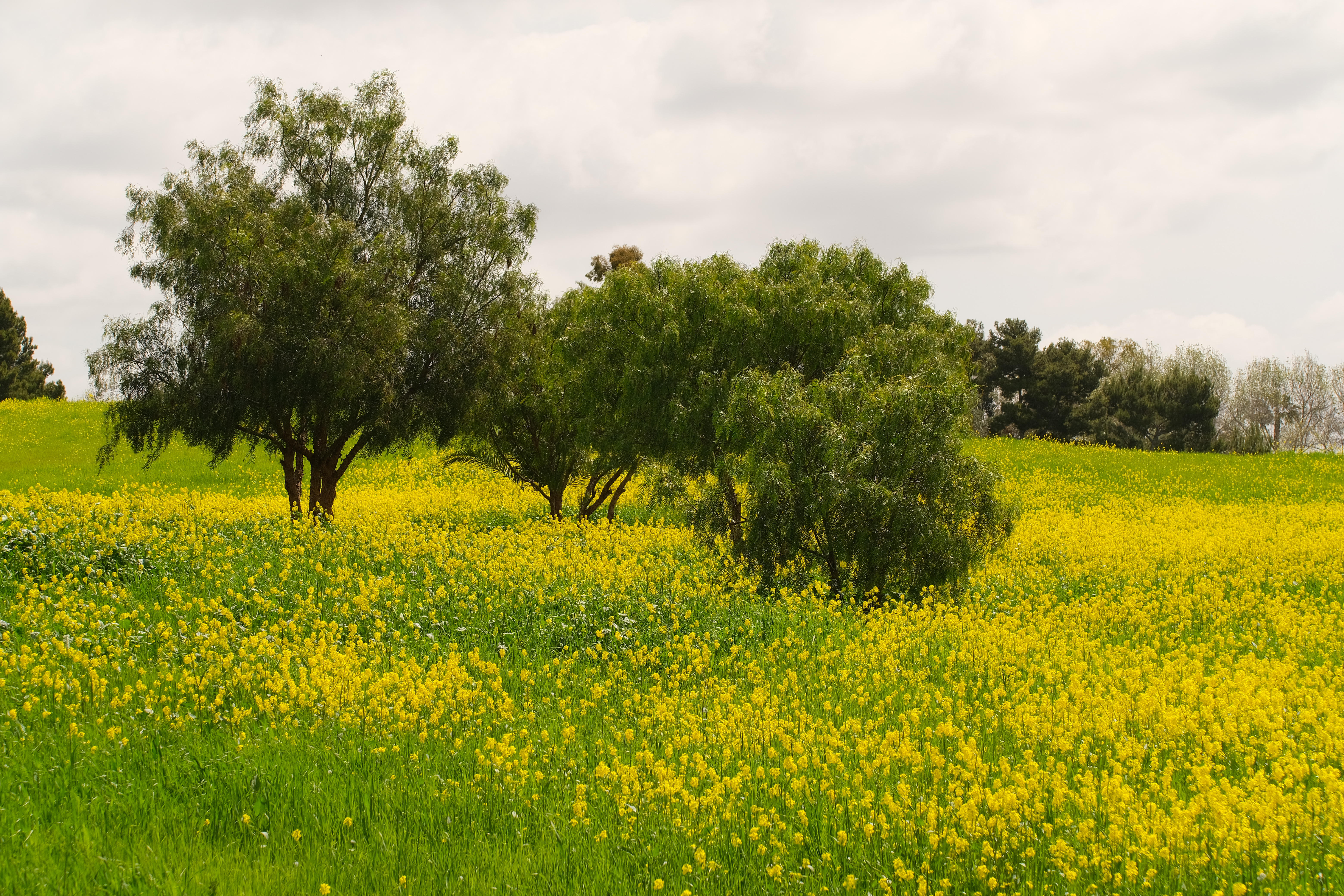
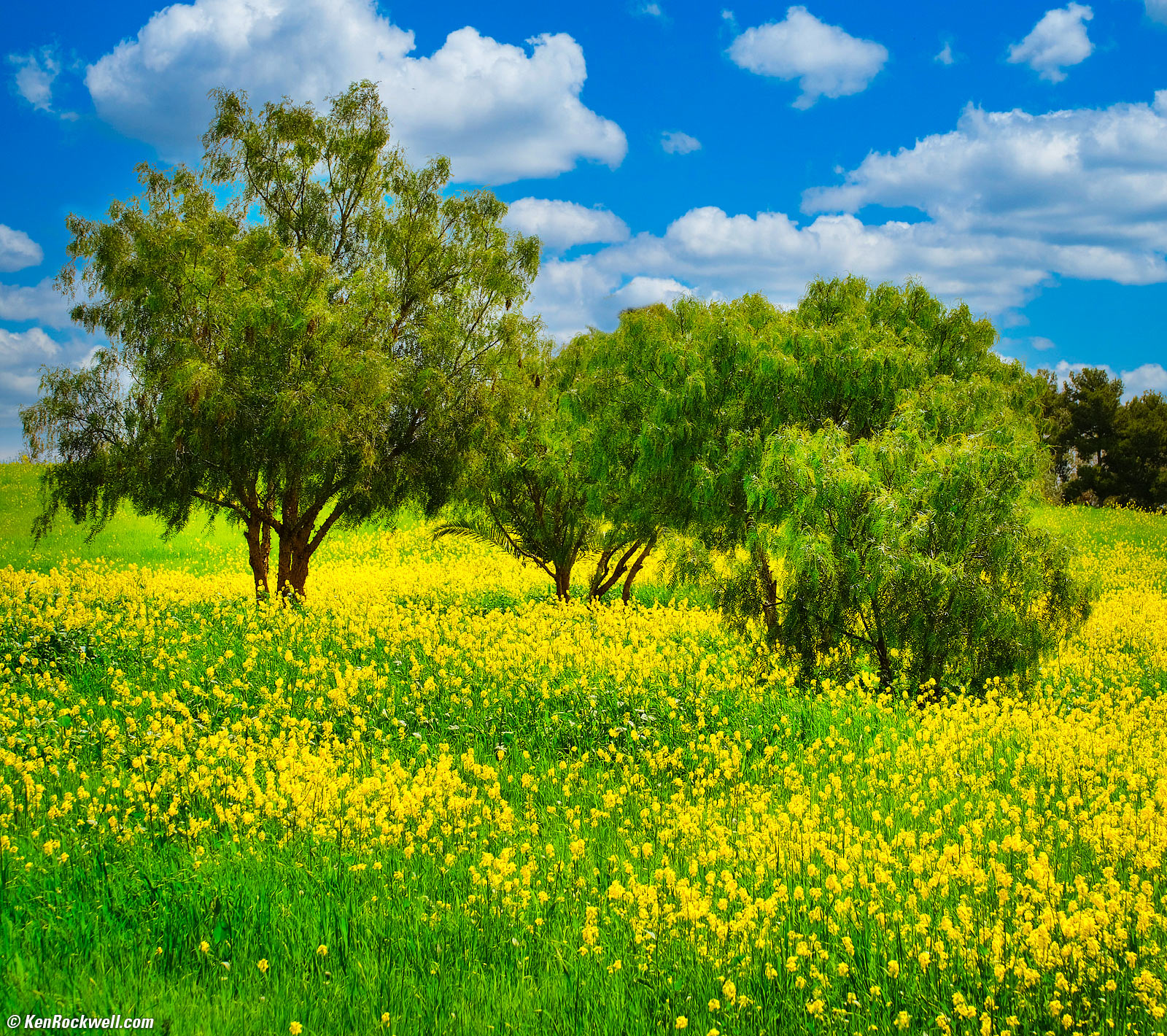
Springtime Mustard, Rancho Santa Fe, California, 11:57 AM, Saturday, 29 March 2025. Fuji X-T30 (which was in The Eastern Sierra with us in October, 2019), TTArtisan 56mm f/1.8 at f/8 at 1/800 at Auto ISO 160 (LV 14.0), Skylum Luminar Neo software to bump-up colors and add a fake sky. bigger or camera-original © JPG file.
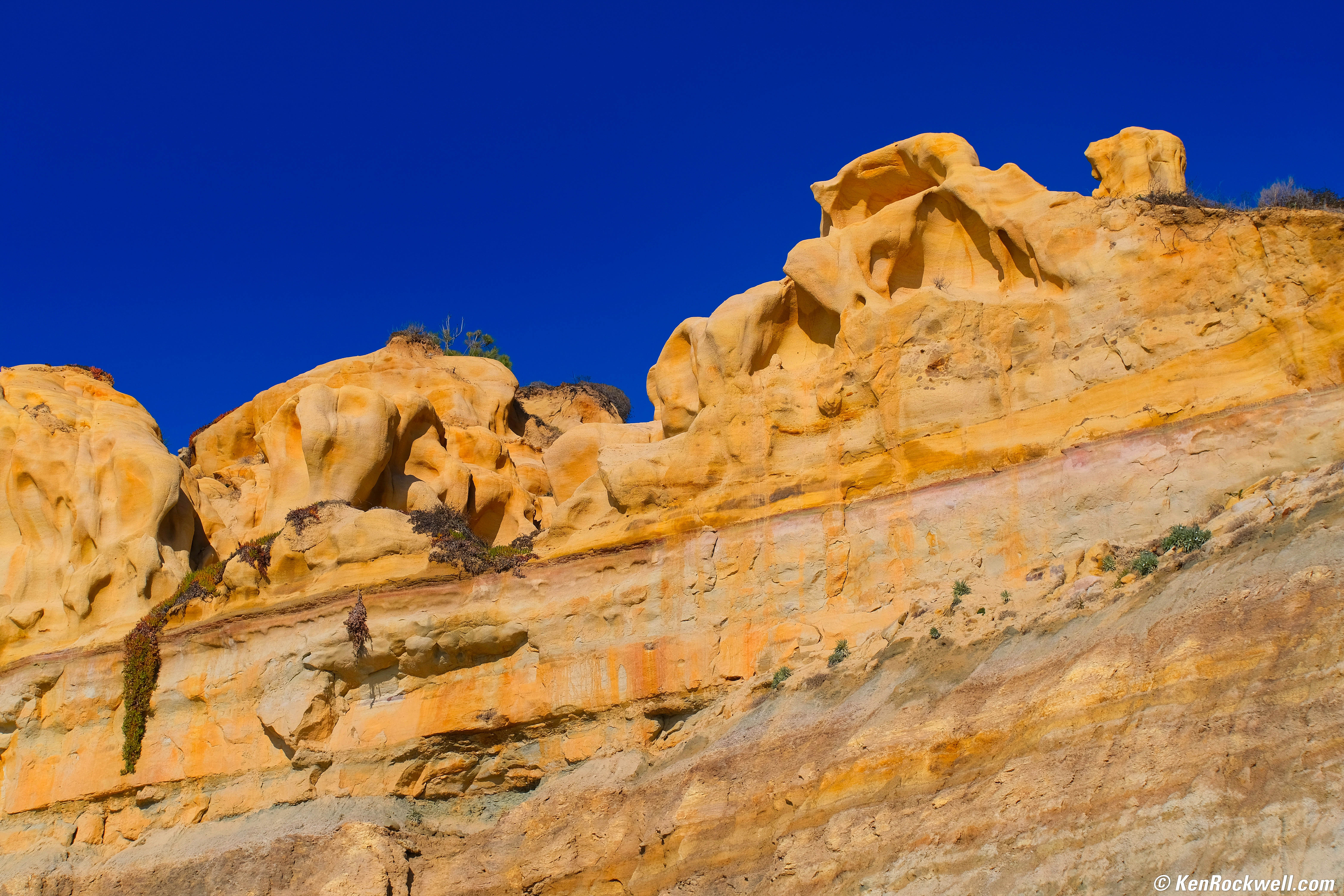
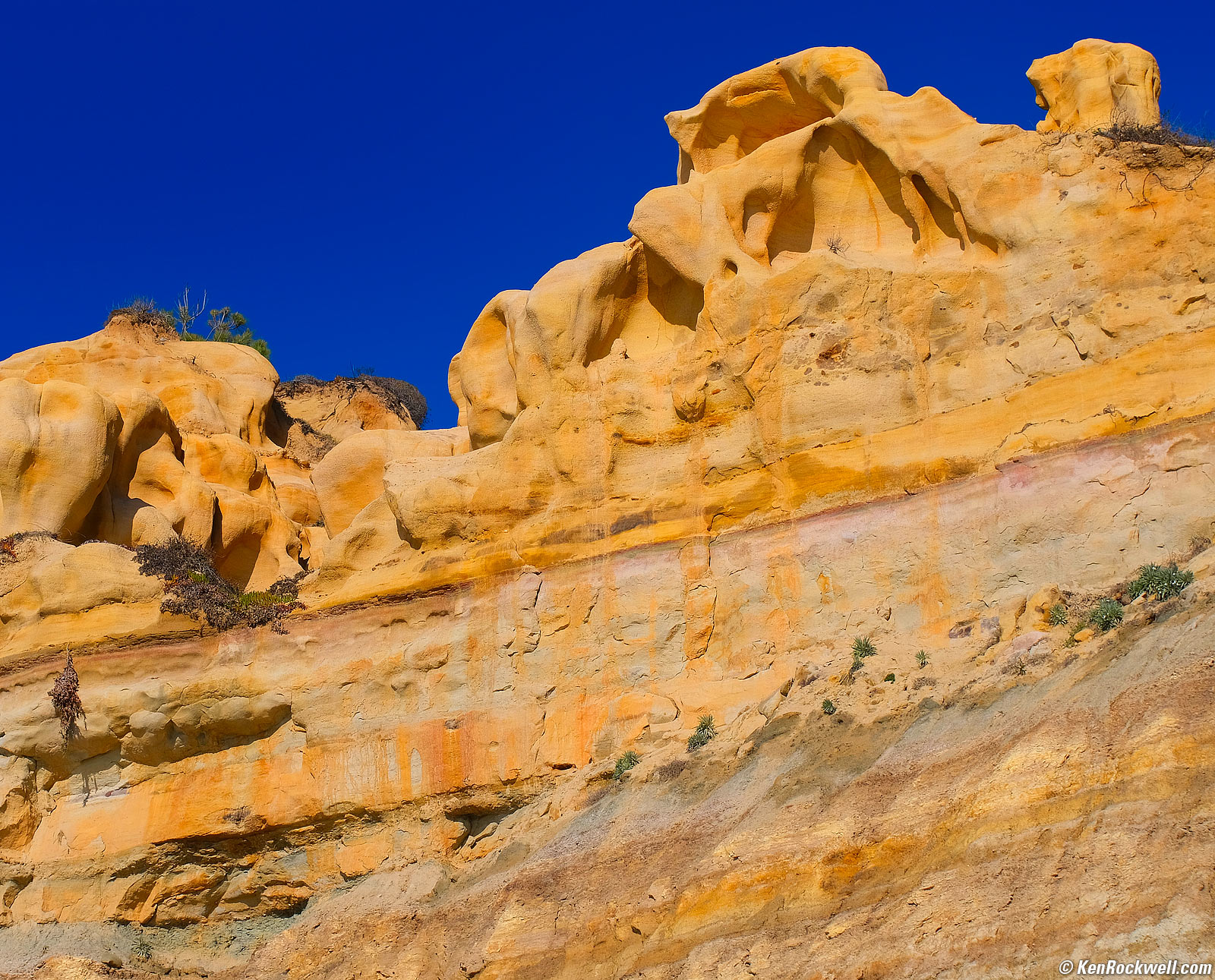
Torrey Pines State Reserve, 4:40 PM, Saturday, 15 March 2025. Fuji X-T30 (which was in The Eastern Sierra with us in 2019), TTArtisan 56mm f/1.8 at f/5.6 at 1/1,300 at Auto ISO 160 (LV 14.7), Skylum Luminar Neo software to amp-up the color. bigger or full-resolution.

Luigi's at the Beach, Mission Beach, California, 11:22 AM, Tuesday, 18 March 2025. Fuji X-T30 (which was in The Eastern Sierra with us in 2019), TTArtisan 56mm f/1.8 at f/5.6 at 1/2,200 at Auto ISO 320 (LV 14½), Radiant Photo software. bigger or camera-original © JPG file.

Graffiti, Mission Beach, California, 11:24 AM, Tuesday, 18 March 2025. Fuji X-T30 (which was in The Eastern Sierra with us in October, 2019), TTArtisan 56mm f/1.8 at f/5.6 at 1/680 at Auto ISO 160 (LV 13.8), exactly as shot. bigger or camera-original © JPG file.
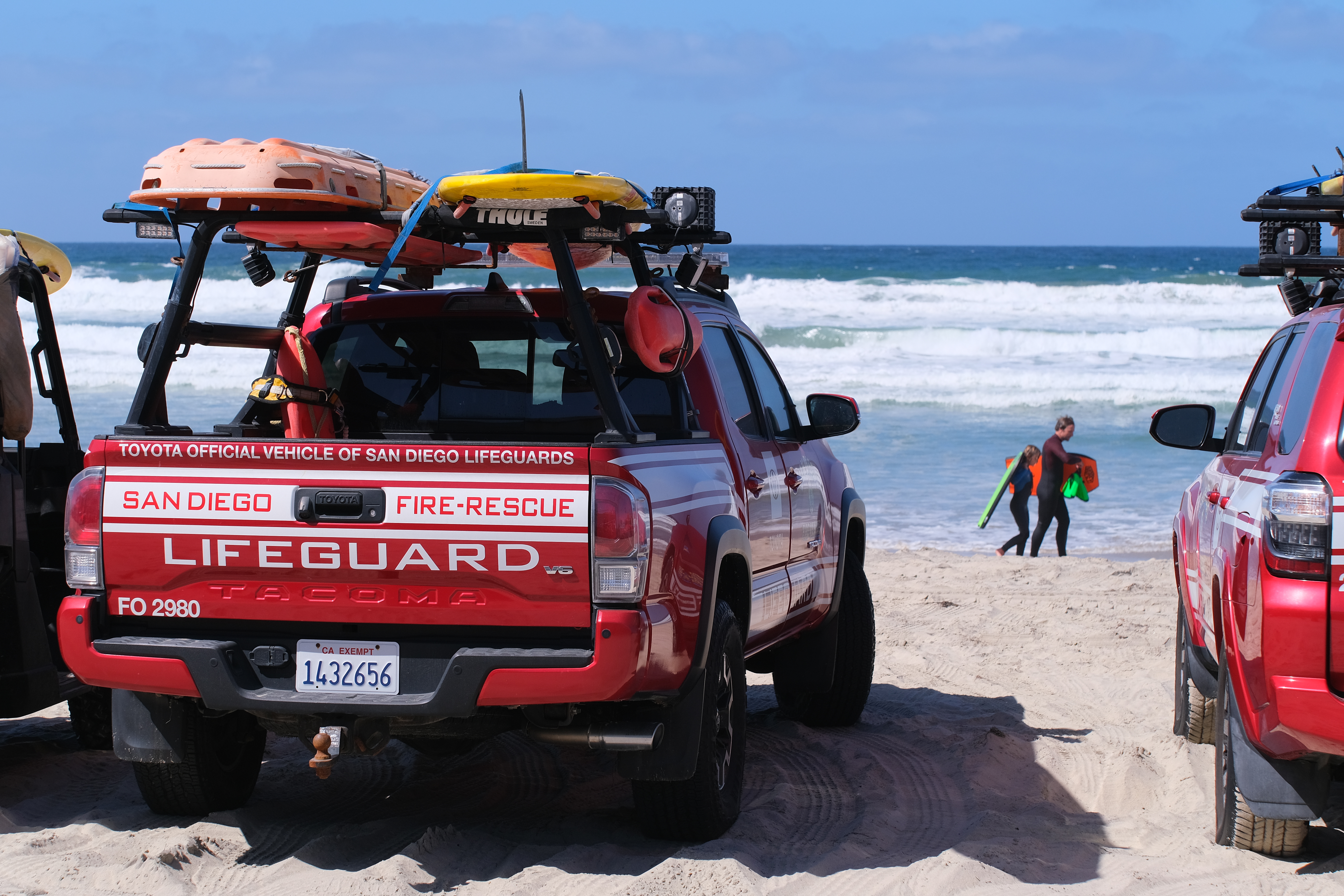
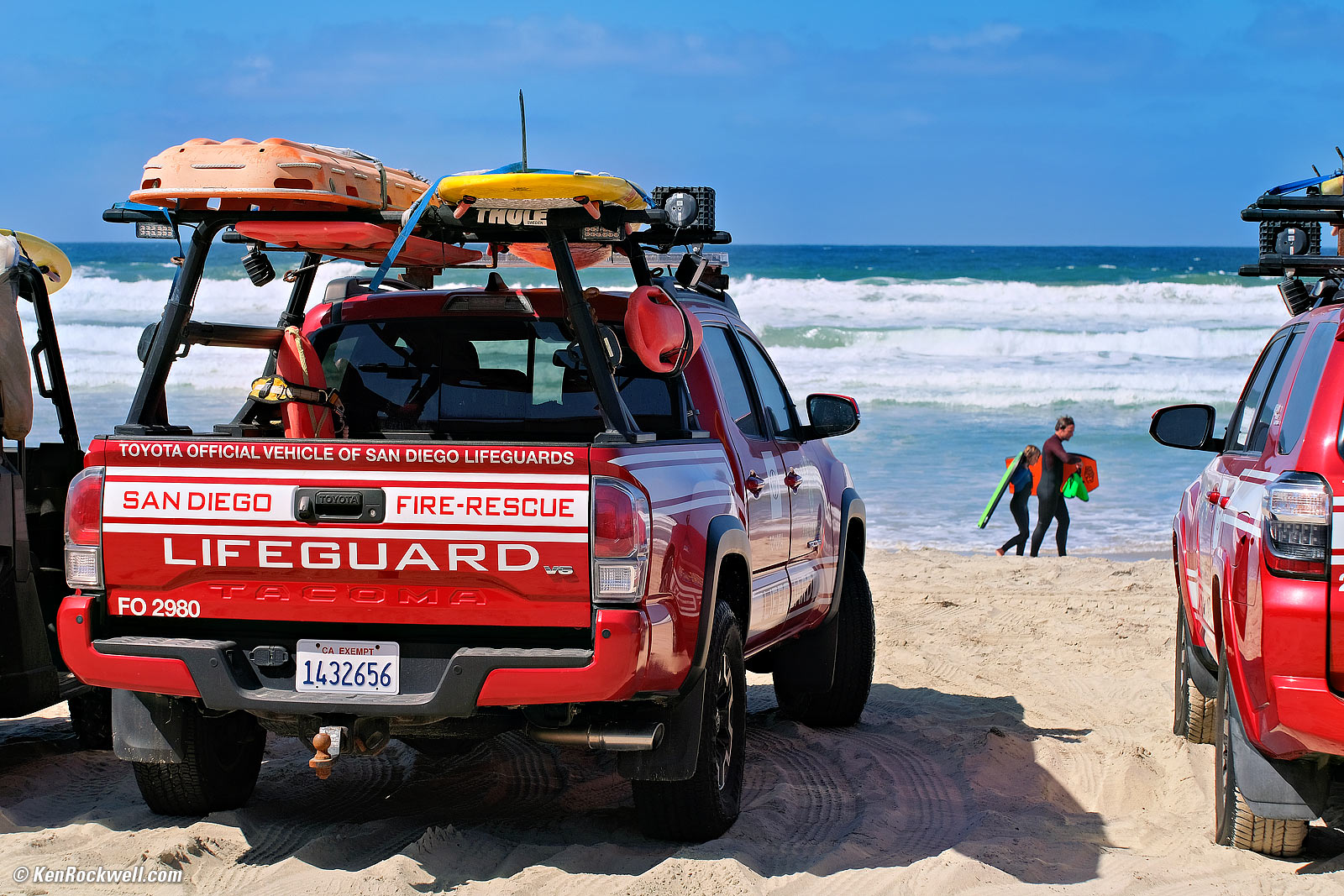
Lifeguards, Pacific Beach, California, 11:28 AM, Tuesday, 18 March 2025. Fuji X-T30 (which was in The Eastern Sierra with us in October, 2019), TTArtisan 56mm f/1.8 at f/5.6 at 1/1,500 at Auto ISO 320 (LV 13.9), Radiant Photo software. bigger or camera-original © JPG file.

Brenda's Burgers, Belmont Park, Mission Beach, California, 11:33 AM, Tuesday, 18 March 2025. Fuji X-T30 (which was in The Eastern Sierra with us in October, 2019), TTArtisan 56mm f/1.8 at f/5.6 at 1/1,600 at Auto ISO 160 (LV 14.9), Radiant Photo software. bigger or camera-original © JPG file.

Carousel, Belmont Park, Mission Beach, California, 11:38 AM, Tuesday, 18 March 2025. Fuji X-T30 (which was in The Eastern Sierra with us in October, 2019), TTArtisan 56mm f/1.8 at f/5.6 at 1/850 at Auto ISO 160 (LV 14.1), Radiant Photo and Skylum Luminar Neo software. bigger or camera-original © JPG file.
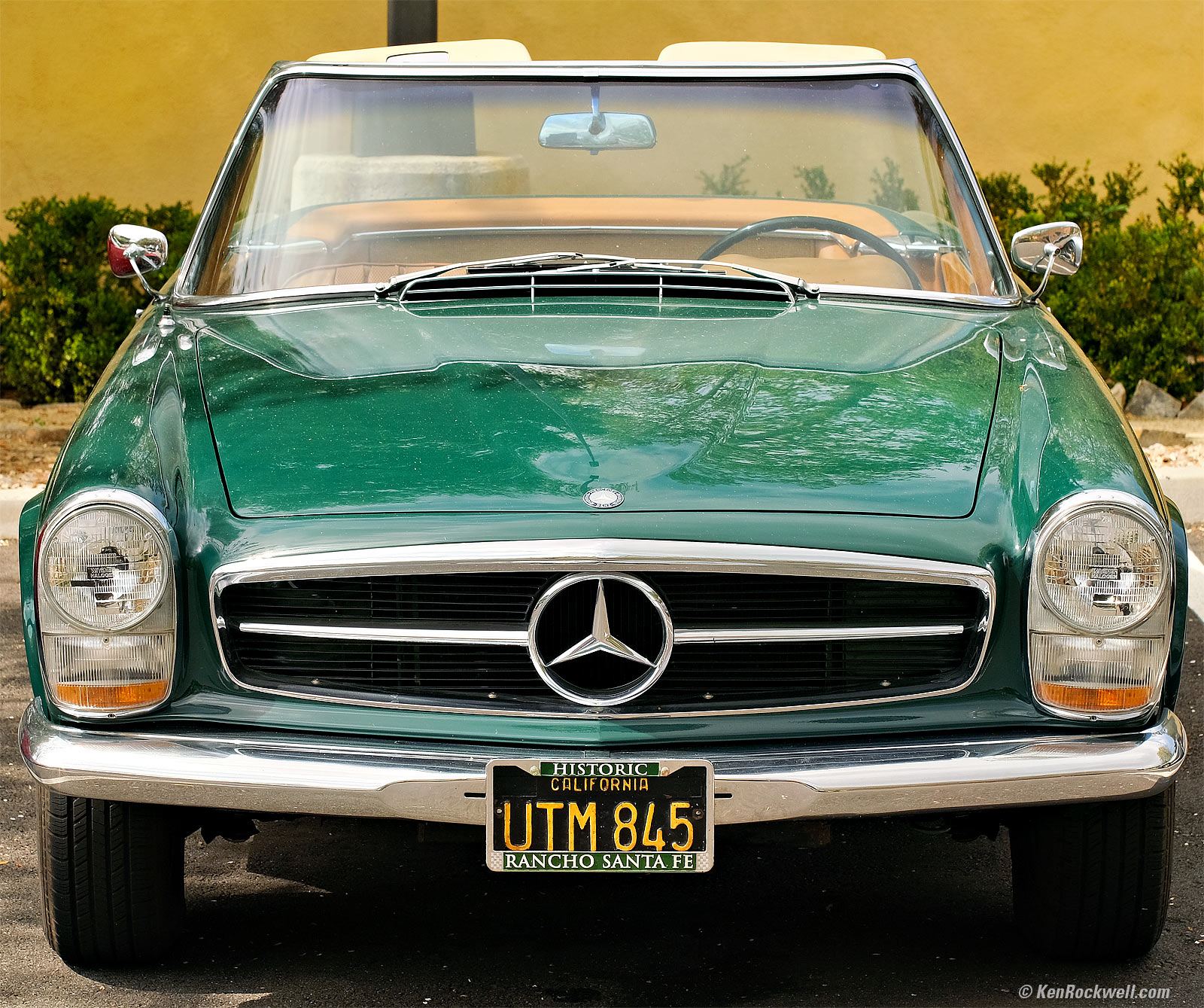
Green Mercedes 230 SL, Rancho Santa Fe, California, 11:02 AM, Saturday, 29 March 2025. Fuji X-T30 (which was in The Eastern Sierra with us in October, 2019), TTArtisan 56mm f/1.8 at f/5.6 at 1/850 at Auto ISO 320 (LV 13.1), Radiant Photo software. bigger.
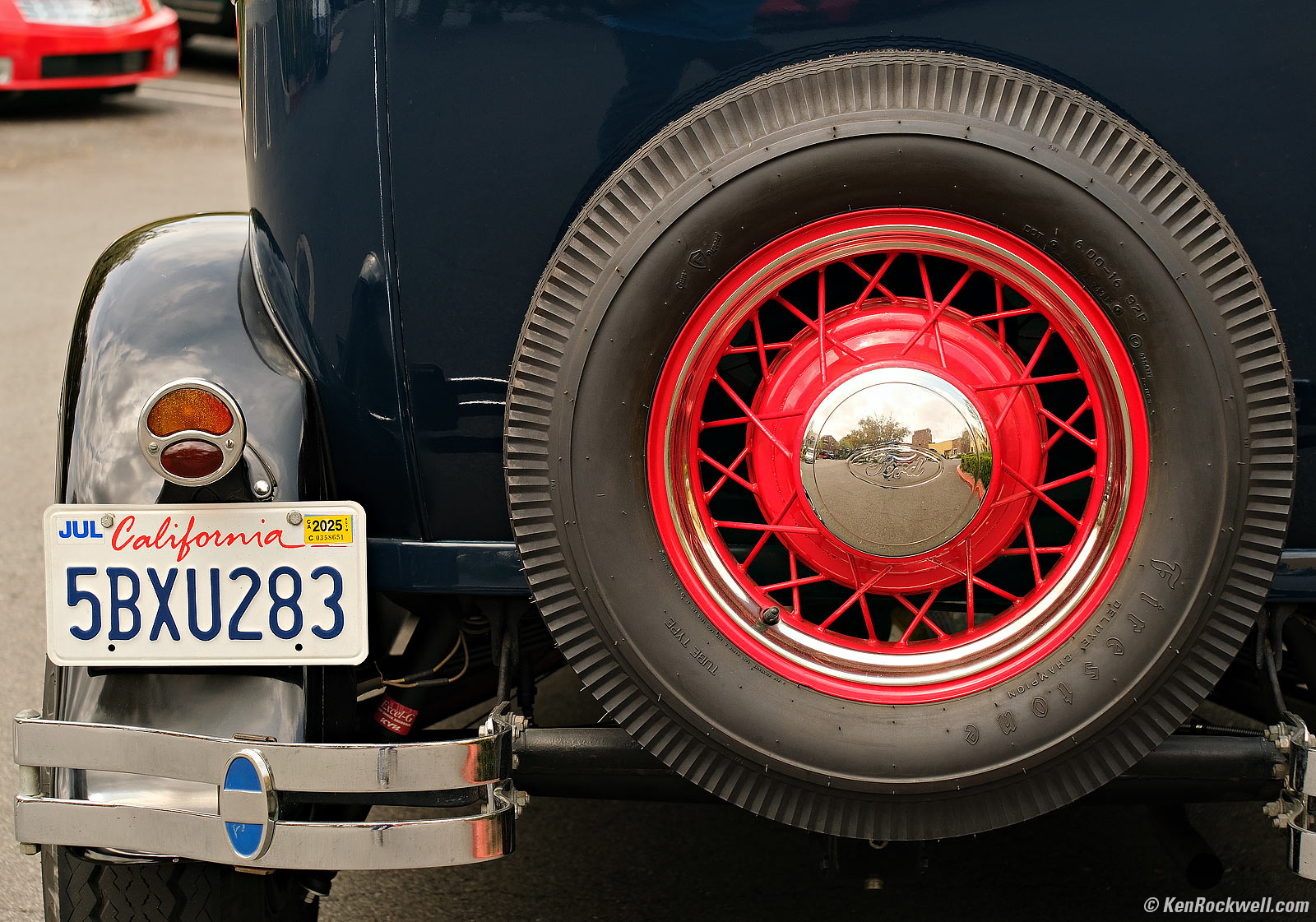
Red Wire Wheel (say it five times fast), Ford Model A, Rancho Santa Fe, California, 11:33 AM, Saturday, 29 March 2025. Fuji X-T30 (which was in The Eastern Sierra with us in October, 2019), TTArtisan 56mm f/1.8 at f/5 at 1/500 at Auto ISO 320, -1 stop exposure compensation (LV 12.0), Radiant Photo software. bigger.
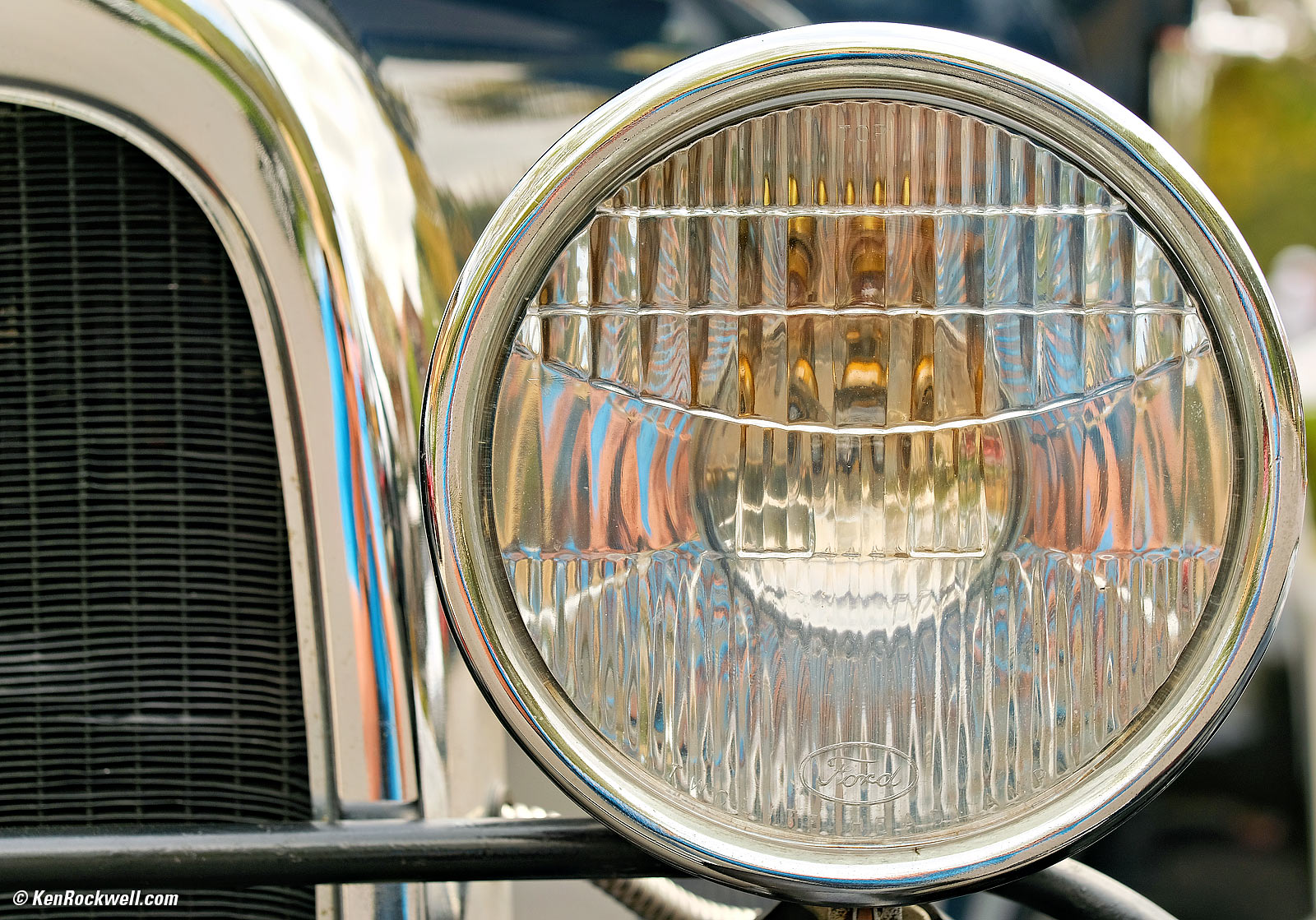
Headlight, Ford Model A, Rancho Santa Fe, California, 11:34 AM, Saturday, 29 March 2025. Fuji X-T30 (which was in The Eastern Sierra with us in October, 2019), TTArtisan 56mm f/1.8 at f/4.5 at 1/500 at Auto ISO 320 (LV 11.6), Radiant Photo software. bigger.

Introduction top
Sample Images Intro New Good Bad Missing
Specifications Performance Recommendations

I buy only from these approved sources. I can't vouch for ads below. |



This all-metal APS-C lens has surprisingly good optics and build quality for $129. If you want one for Nikon Z, for Sony or for Fuji, go for it!
It has no falloff, focuses well and focuses closely. It has no visible distortion and negligible spherochromatism.
It's plenty sharp as you've seen, but for $129 it's not quite as sharp as camera-brand lenses if you're ore interested in counting pixels than making great pictures. For portraits and sports and even product photography, we don't need extreme sharpness, and as you've seen, its images look great in actual use — and I prefer its all-metal construction over the plastic rubbish pushed by the camera brands today.
I'd get mine at B&H, at Adorama, at Amazon, or at eBay (How to Win at eBay), or get it used at KEH.
New intro top
 Tough, compact, fast long lens, and almost free.
Good intro top
 Sharp.
All-metal construction.
No falloff.
No visible distortion.
Little spherochromatism.
Close focusing.
Cool-looking (but not particularly effective) hood included:
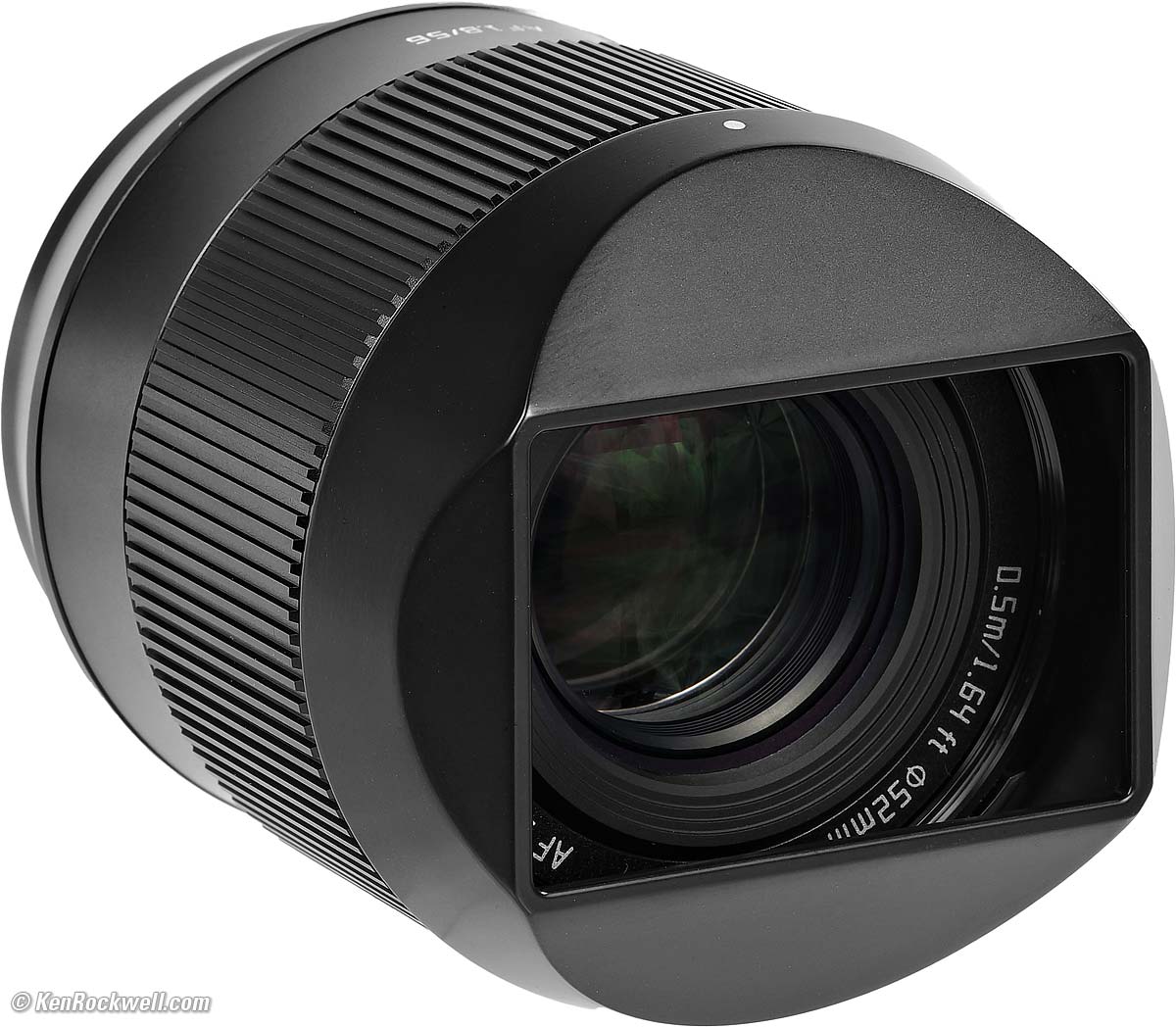
TTArtisan AF 56mm f/1.8 ED. bigger.
Bad intro top
 For the price, nothing!
Missing intro top
 Mounting index mark not raised so it can't be found by feel in the dark.
Mounting index mark on the barrel is the same white as everything else, so it doesn't stand out when you need to find it to mount your lens.
No Stabilizer switch for in-camera stabilization.
No aperture ring.
Only stops down to f/16, not f/22.
No case included.
No focus or depth-of-field scales.
No infra-red focus indices.
No focus lock buttons.
Will not work with any teleconverters.
So? No high price, either.
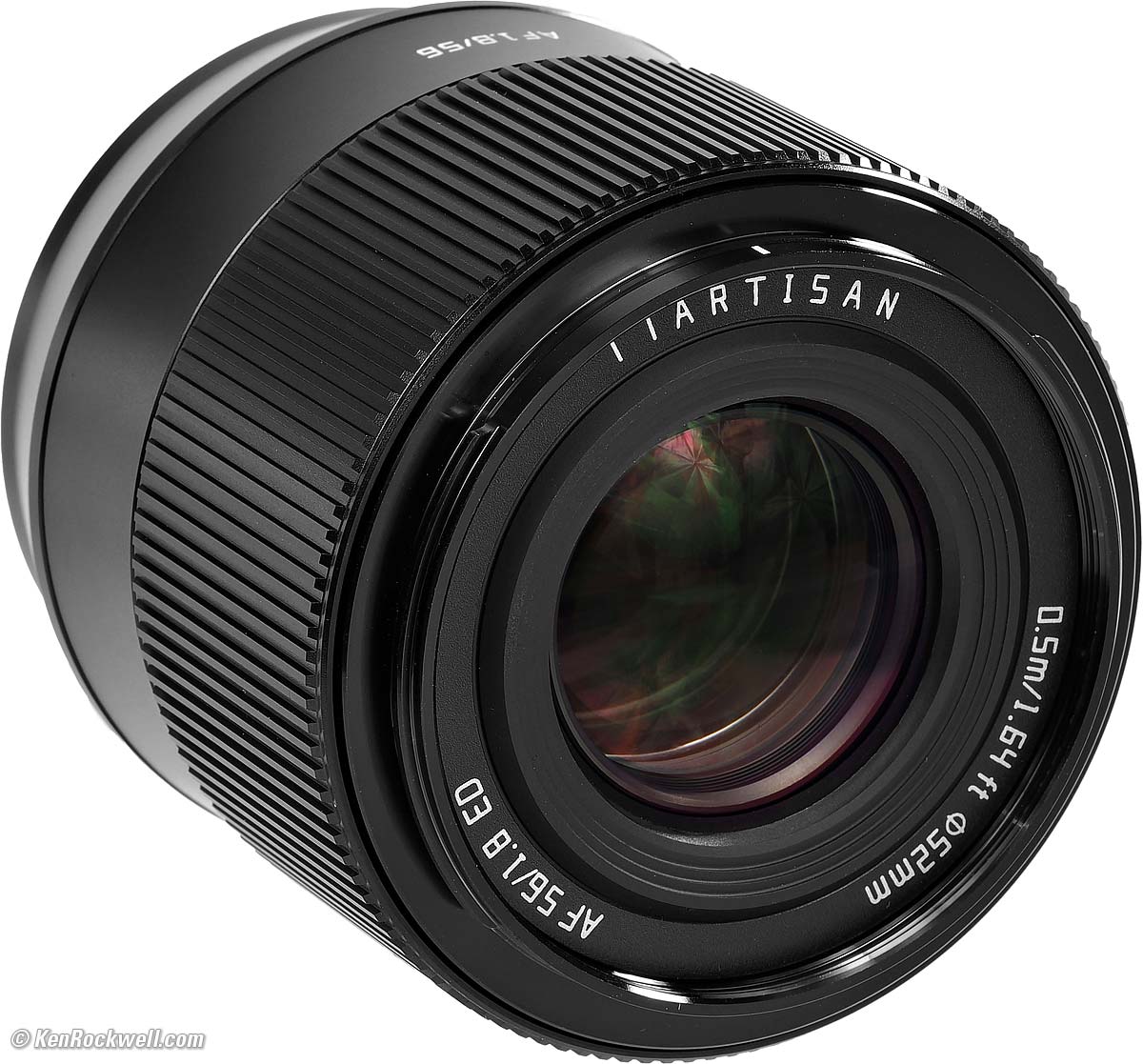
TTArtisan AF 56mm f/1.8 ED. bigger.
Specifications top
Sample Images Intro New Good Bad Missing
Specifications Performance Recommendations
I'd get mine at B&H, at Adorama, at Amazon, or at eBay (How to Win at eBay), or get it used at KEH.
Name specifications top
TTArtisan calls this the TTArtisan AF 56mm f/1.8 ED:
ED: Magic Extra-low Dispersion glass for reduced secondary chromatic aberration.
It also has:
AF-P: Stepper (Pulse) autofocus motor.
IF: Internal focusing; nothing moves externally as focused.
Ø52: 52mm filter thread.
Optics specifications top
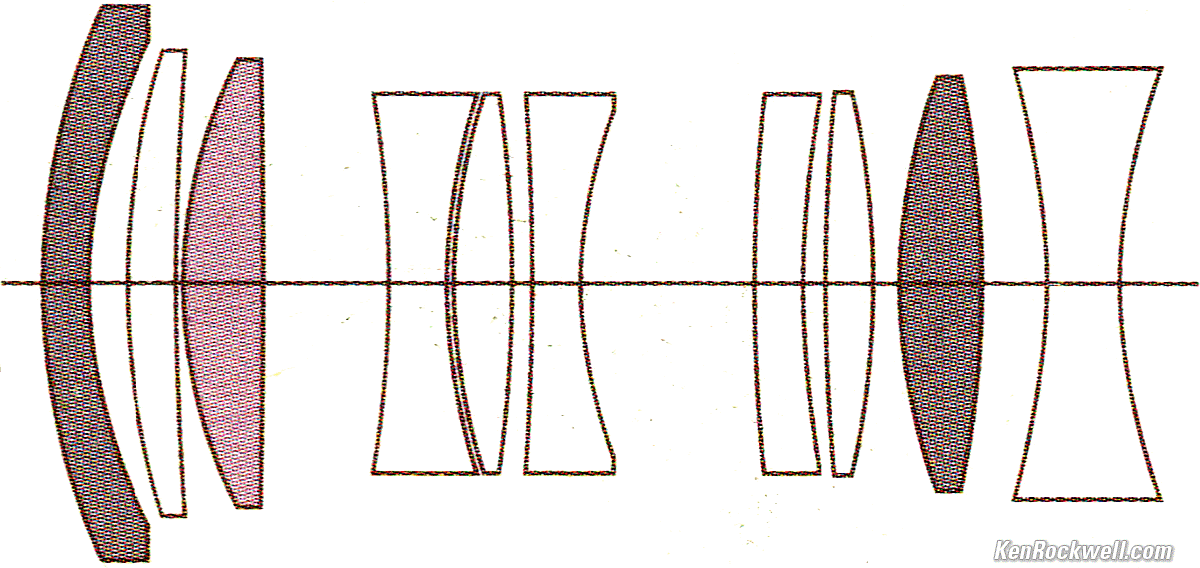
Internal Optical Construction: High index of refraction and ED glass. bigger.
10 elements in 9 groups.
2 High index of refraction elements.
1 ED element: magic Extra-low Dispersion glass for reduced axial secondary chromatic aberration.
Diaphragm specifications top
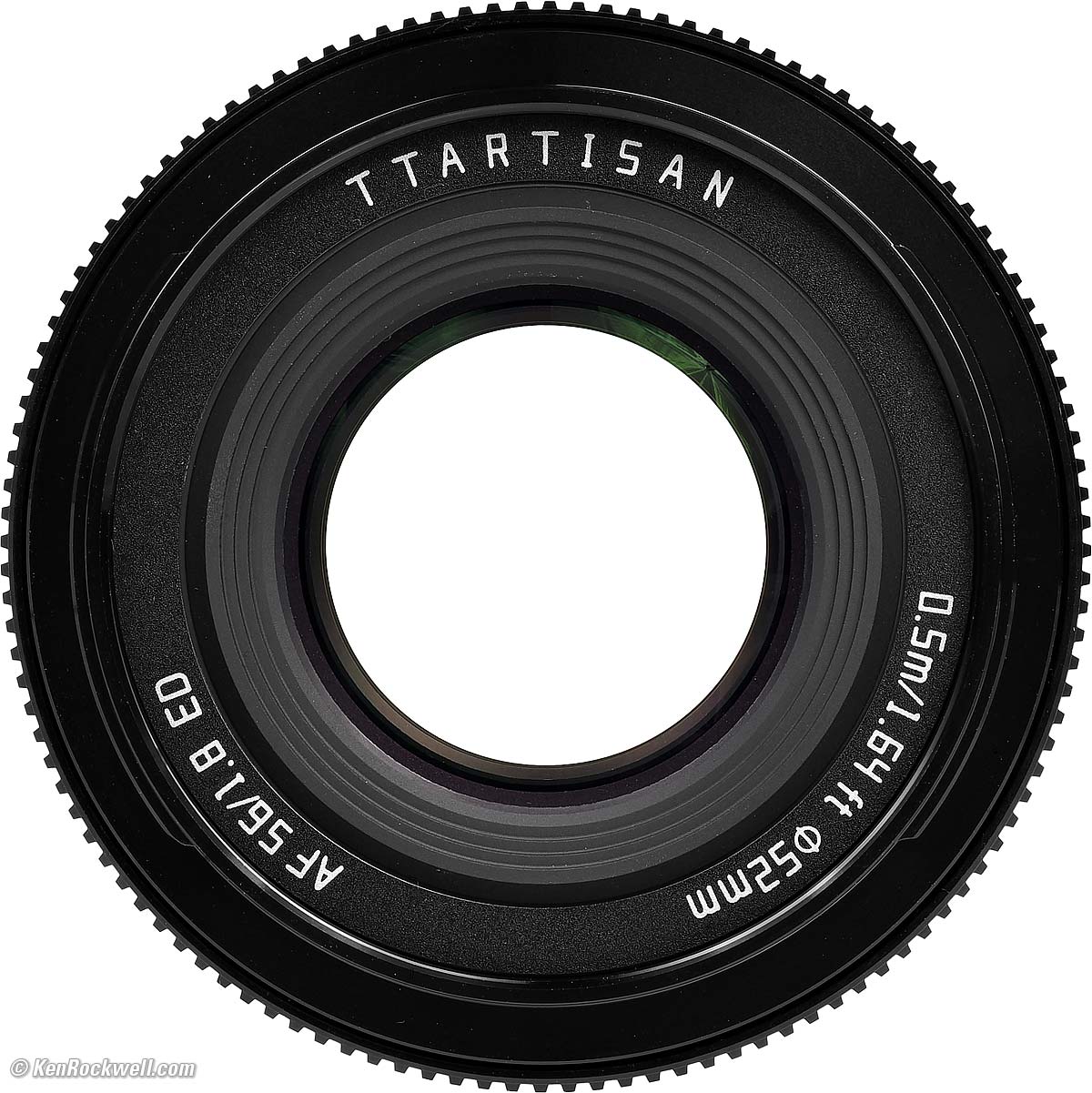
TTArtisan AF 56mm f/1.8 ED (Diaphragm not seen). bigger.
9 rounded blades.
Electronically actuated.
Stops down to f/16.
Filters specifications top
Metal 52mm filter thread.
Coverage specifications top
APS-C only.
Full-frame cameras will automatically use a 1.5× APS-C crop, so you might not realize you're missing most of your pixels unless you look at the image pixel dimensions.
Focal Length specifications top
56mm.
When used on an APS-C camera, it sees the same angle of view as an 85 mm lens sees when used on a full-frame or 35mm camera.
When used in the 1:1 square crop mode on APS-C it sees the same angle of view as a 200 mm lens sees when used on 6×6 cm HASSELBLAD.
See also Crop Factor.
Angle of View specifications top
28º diagonal on APS-C.
Autofocus specifications top
No external movement as focussed, so no air or dust is sucked in.
Focus Scale specifications top
No.
Not on lens, but may be displayed in-camera.
Infinity Focus Stop specifications top
No.
You have to focus somehow to get precise focus at infinity, just like at every other distance.
Depth of Field Scale specifications top
No.
Not on lens, but may be displayed in-camera.
Infrared Focus Index specifications top
No.
Close Focus (distance from subject to image plane) specifications top
1.6 feet (0.5 meters).
Image Stabilizer specifications top
None, but should work fine with in-camera stabilization.
Caps specifications top
The rear cap includes USB-C and terminals potentially for lens firmware updates:
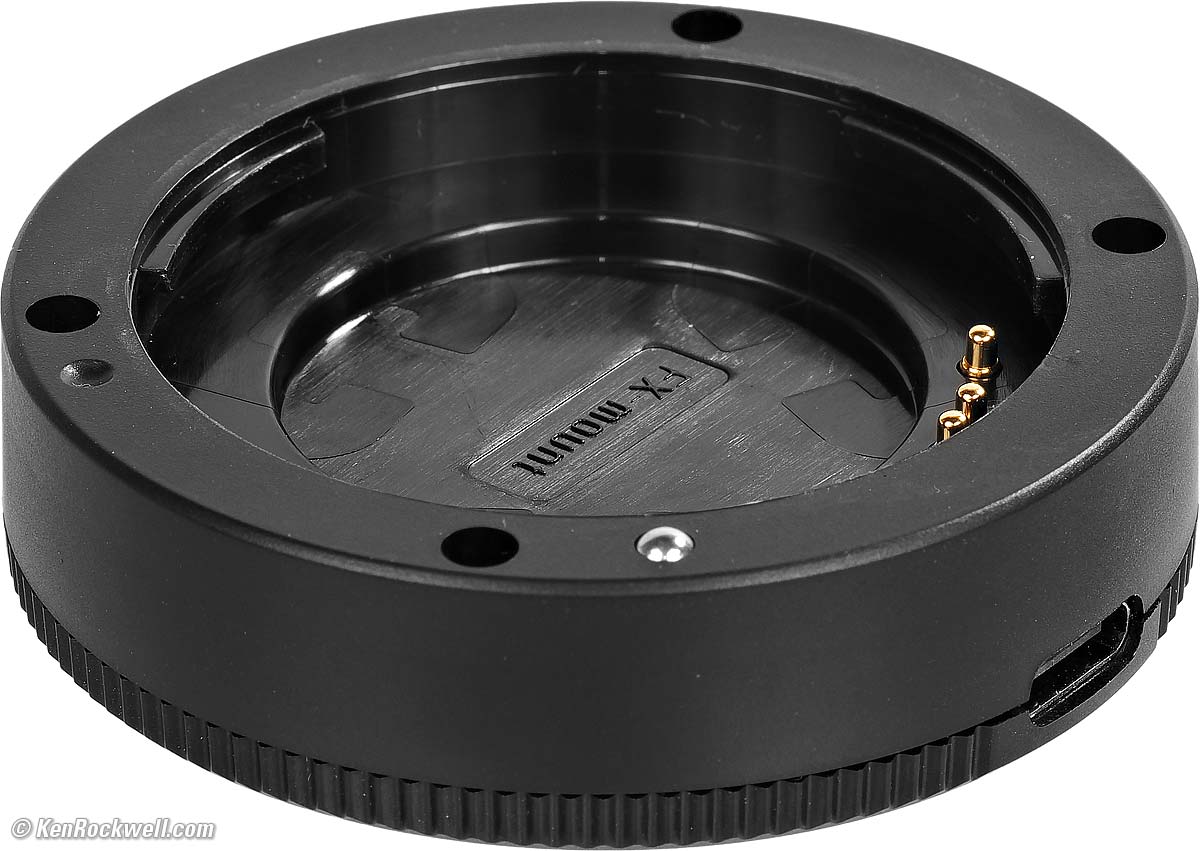
Included rear cap with USB-C Socket. bigger.
Hood specifications top
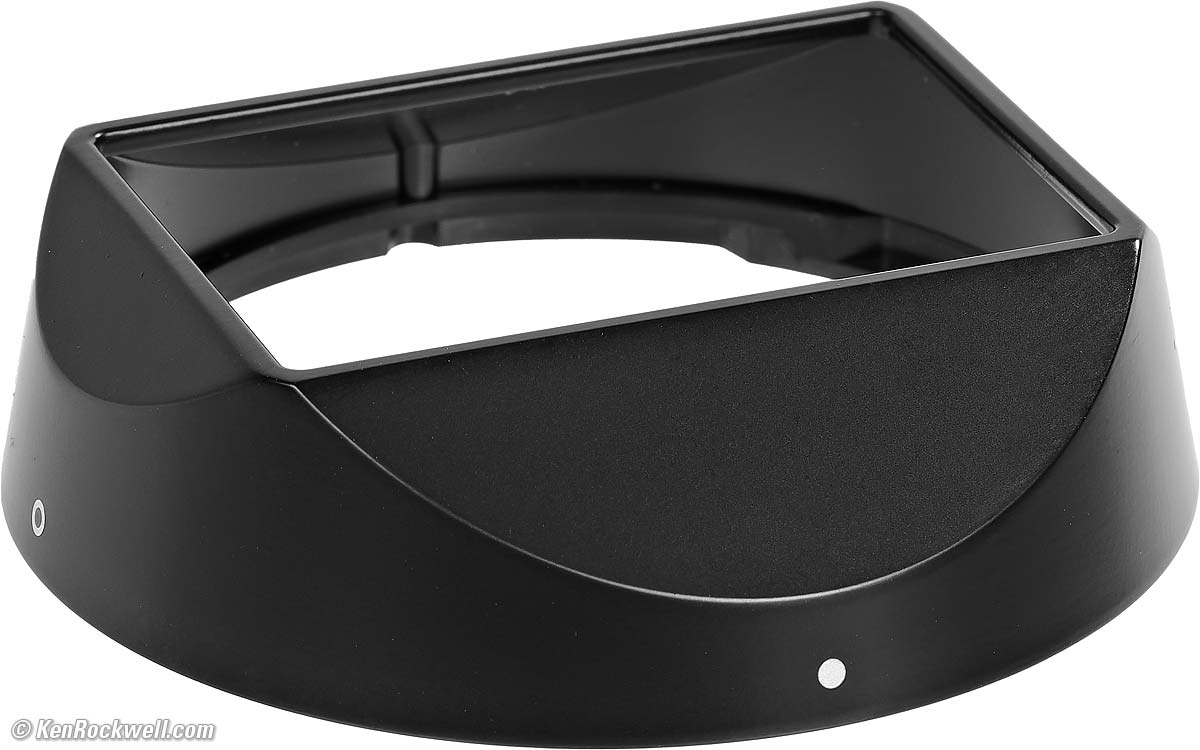
Included metal hood. bigger.
The hood body is metal, while the bayonet mount is plastic.
Case specifications top
None included.
So?
Weight specifications top
8.8 oz. (245 g).
Quality specifications top
Made domestically in China.
Announced specifications top
Early 2025.
Included specifications top
Lens.
Metal hood.
52mm front cap.
Rear cap with USB-C connector.
Packaging specifications top
Nesting cardboard box with closed-cell black foam inside:
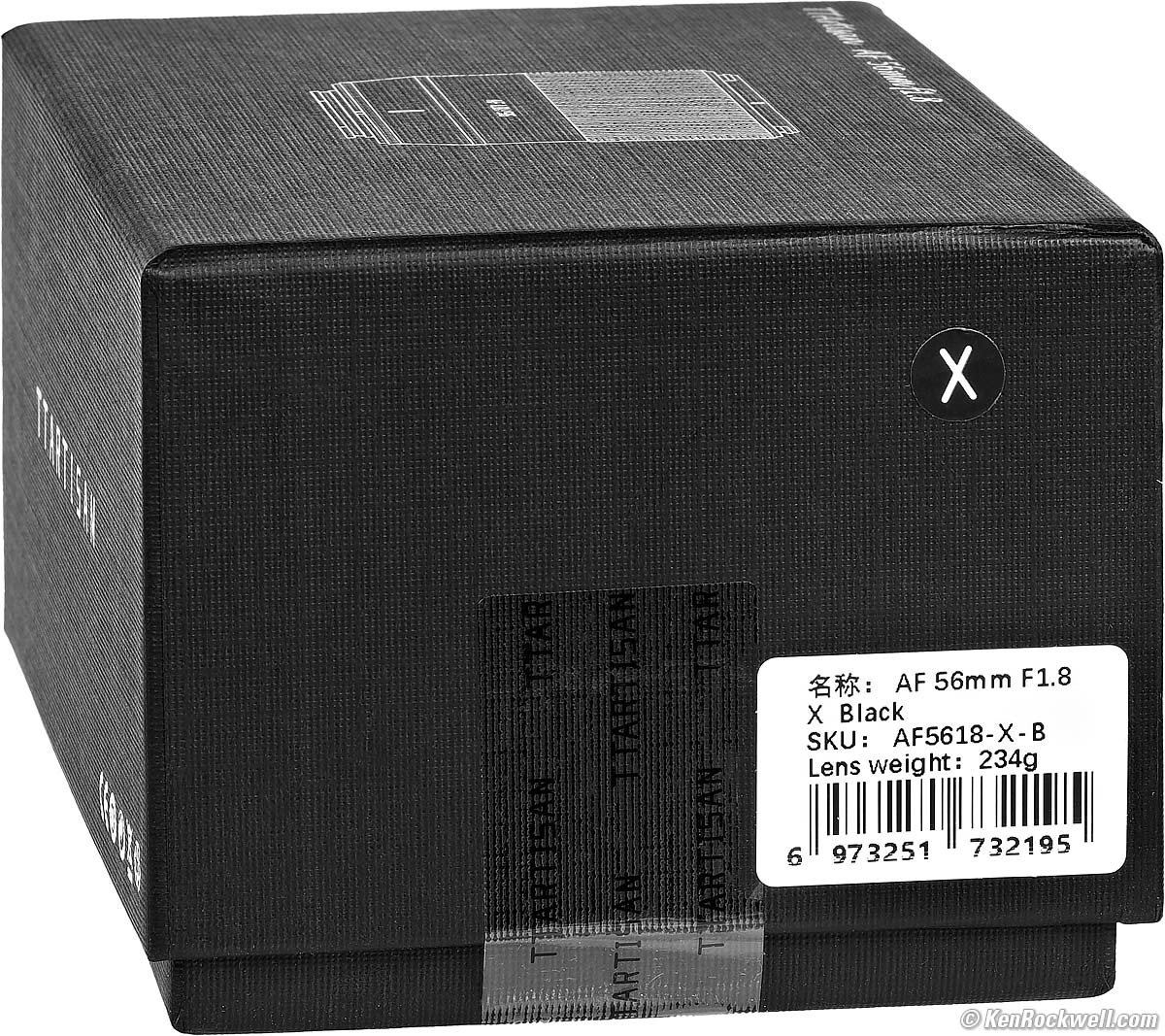
Box, TTArtisan AF 56mm f/1.8 ED. bigger.
It's sealed! None of Nikon, Canon, Sony or Fuji seal their boxes, while TTArtisan does. How about that?
Model Numbers specifications top
Nikon Z: AF5618-Z-B (black), AF5618-Z-S (silver).
Sony: AF5618-E-B (black).
Fuji: AF5618-X-B (black), AF5618-X-S (silver).
Price, U. S. A. specifications top
August 2025
$129 at B&H, at Adorama, at Amazon, and at eBay (How to Win at eBay).
Performance top
Sample Images Intro New Good Bad Missing
Specifications Performance Recommendations
Overall Autofocus Manual Focus Bokeh Data
Ergonomics Falloff Filters Hood Lateral Color
Lens Corrections Macro Mechanics
I'd get mine at B&H, at Adorama, at Amazon, or at eBay (How to Win at eBay), or get it used at KEH.
Overall performance top
This little lens works great. While it's not always as space-grade sharp as the camera maker's lenses, focus is always accurate and it's certainly sharp enough for anything I need, and it's better made and less expensive than the camera-brand lenses.
Autofocus performance top
Autofocus isn't instantaneous, but it is immediate and sure, with no hunting.
Works great!
Manual Focus performance top
Manual focus is precise, rather than fast.
As expected, the focus ring is connected to a digital encoder; there is no direct mechanical focus connection.
Bokeh performance top
Bokeh, the feel, character or quality of out-of-focus areas as opposed to how far out of focus they are, is pretty good!
Here are photos from headshot distance wide-open. I'm focused on the DAVIS logo. Click any for the © camera-original file:
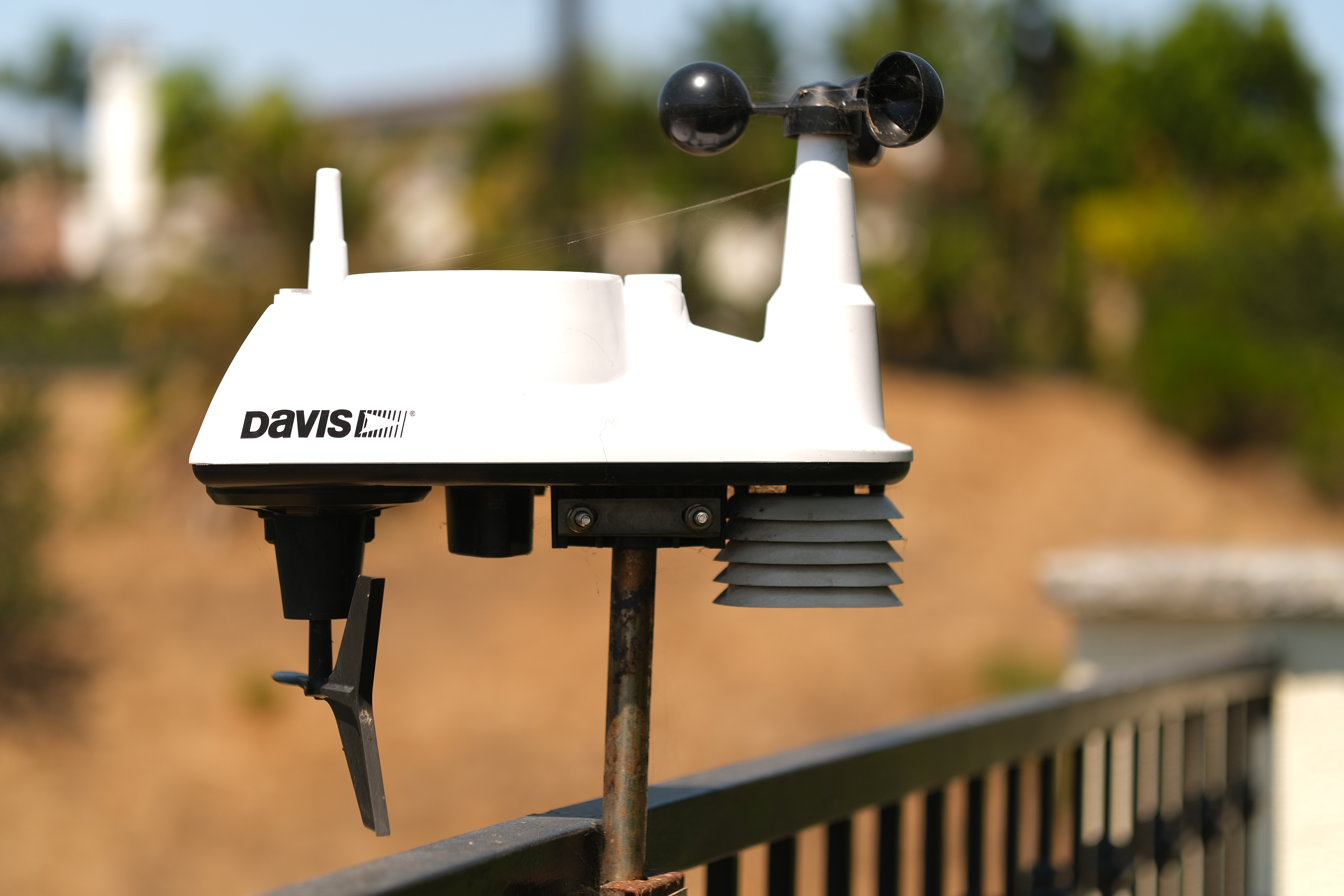
Made-in-U. S. A. Davis 6357 Vantage Vue Wireless Sensor Suite (use with WeatherLink console), 11:22 AM, Friday, 08 August 2025. Fuji X-T30 (which was in The Eastern Sierra with us in October, 2019), TTArtisan 56mm f/1.8 at 1/3,800, 1/3,200, 1/1,500 and 1/400 at ISO 80L, 160, 320 and 320 (LV 13.9, 14.1, 13.9 and 13.8).
I agree, the bokeh is very similar between f/1.8 and f/2.8. Look at the trunk of the big palm tree behind the weather station to see it softest at f/1.8.
Click any for the camera-original © file.
As always, if you want to throw the background as far out of focus as possible, shoot at f/1.8 and get as close as possible.
Data performance top
Its EXIF data reads "MJ56mm F1.8X DA DSM" in Photo Mechanic, at least as shot on my Fuji X-T30.
Distortion performance top
There's no visible distortion!
For more critical scientific use, use a correction factor of +0.80 in Photoshop's lens correction file for the slight barrel distortion. Oddly it's not quite symmetrical from left to right, but tough, if you want to hold rulers to greatly enlarged images from a $129 lens, you get what you get.
These aren't facts or specifications, they are the results of my research that requires hours of photography and calculations on the resulting data.
Ergonomics performance top
|
|
TTArtisan AF 56mm f/1.8 ED. bigger. |
TTArtisan AF 56mm f/1.8 ED. bigger. |
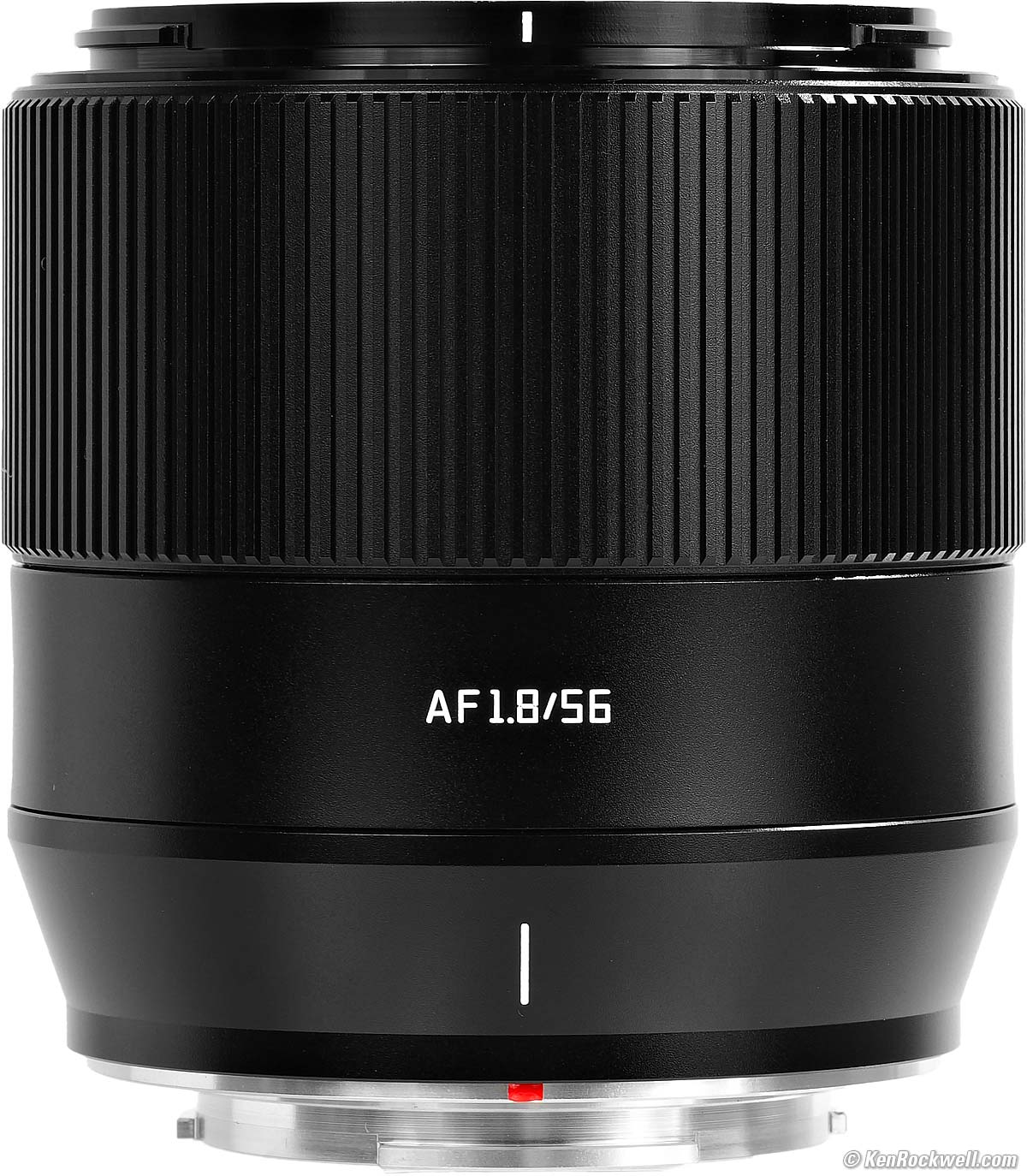
It's got one big manual focus ring, and that's it. Enjoy!
As an all-metal lens, it feels much better in-hand than the plastic toys from camera brands.
Falloff performance top
Falloff is completely invisible.
I've greatly exaggerated the falloff by shooting a gray field and placing these on a gray background; it will not look this bad in actual photos of real things:
Falloff on APS-C Fuji X-T30 at infinity, Lens Modulation Optimizer ON (looks the same OFF):
© 2025 KenRockwell.com. All rights reserved. |








Filters, use with performance top
There's no need for thin filters. I can stack several standard 52mm filters with no vignetting at any setting, however you may have a problem attaching the hood with more than one reasonably thin filter, like a classic Nikon 52mm L37c.
Go ahead and use your standard rotating polarizer and grad filters.
Flare & Ghosts performance top
It has a typical amount of flare and ghosts.
See examples at Sunstars.
Hood specifications top
TTArtisan AF 56mm f/1.8 ED. bigger.
While it looks cool, remember that this is a telephoto lens.
The hood is so short that it doesn't do much.
Lateral Color Fringes performance top
I see some minor cyan/red fringes, no big deal.
Macro Performance performance top
It gets pretty close, and it's sharp!
At f/1.8
It's sharp and free from Spherochromatism, but of course no lens has any depth of field this close at f/1.8:
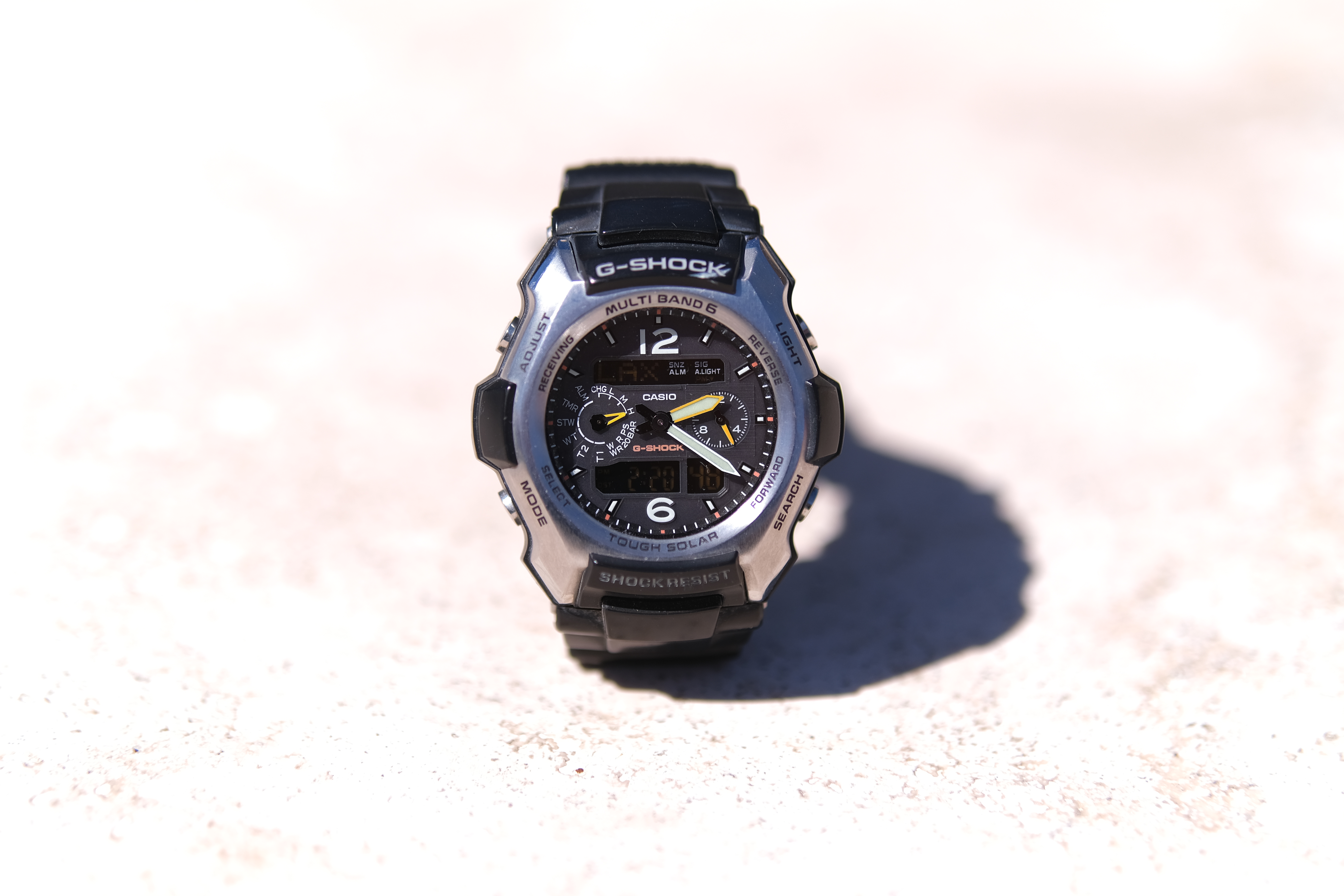
Casio G-Shock Solar Atomic Watch at close-focus distance, 15 March 2025. Fuji X-T30 (which was in The Eastern Sierra with us in October, 2019), TTArtisan 56mm f/1.8 at f/1.8 at 1/4,000 at ISO 80L (LV 14.0). bigger or camera-original © file.
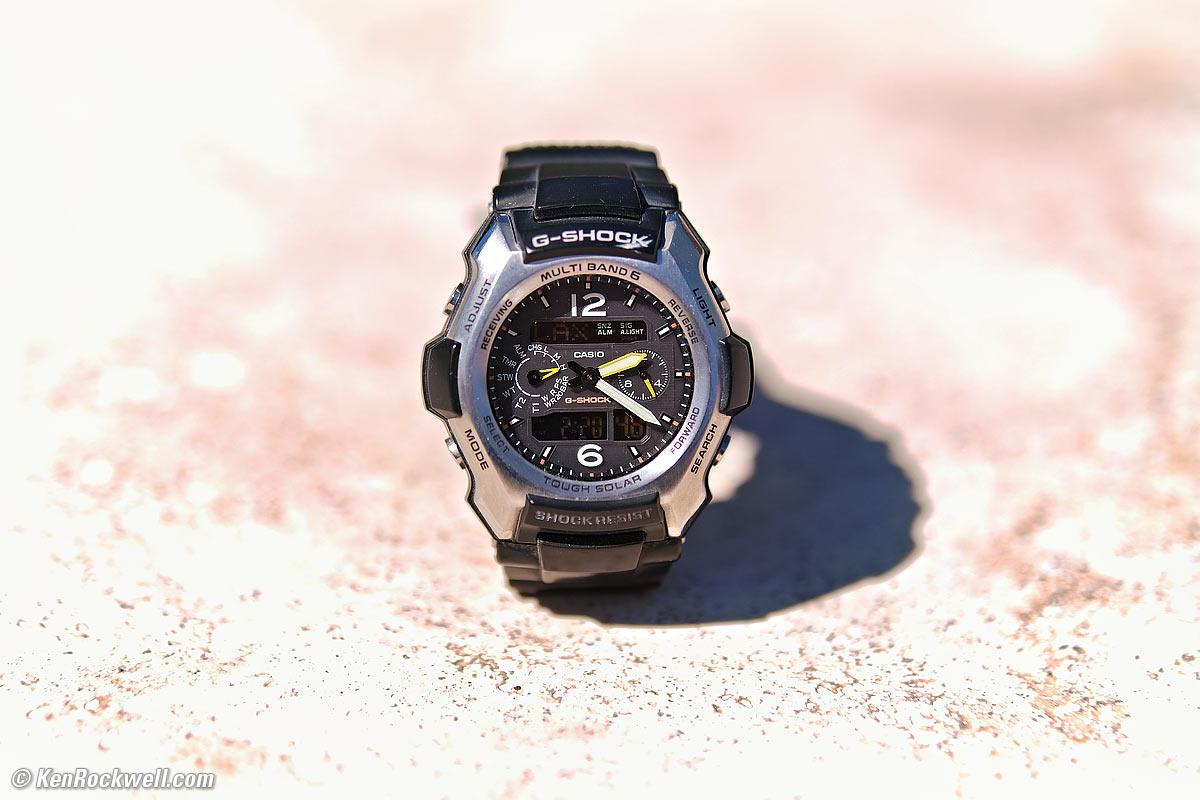
1,200 × 900 pixel (5.2× magnification) crop from above. bigger or camera-original © file.
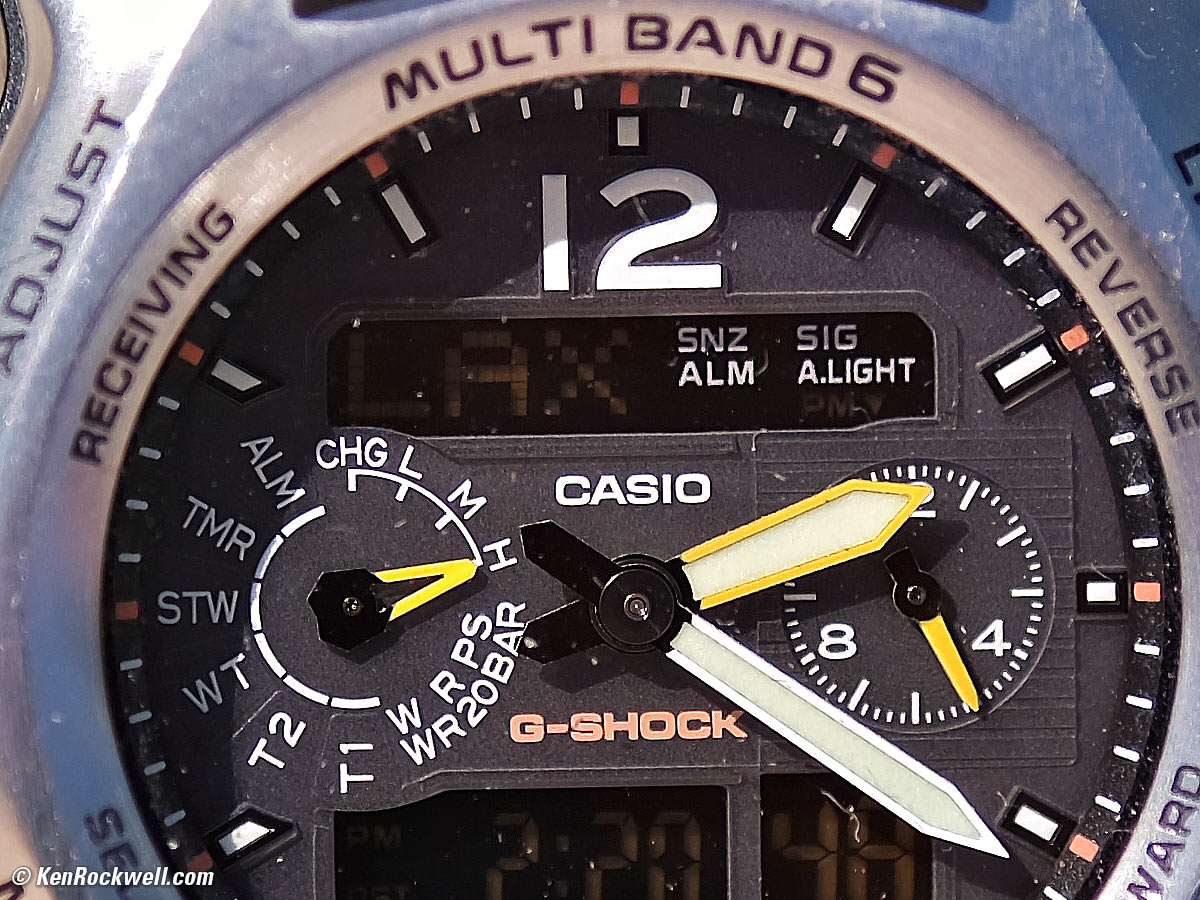
If this 1,200 × 900 pixel crop is about 3" (7.5cm) wide on your phone, then the complete image printed at this same extreme magnification would be about 11 × 16" (0.9 × 1.3 feet or 25 × 40 cm).
If this 1,200 × 900 pixel crop is about 6" (15cm) wide on your screen, then the complete image printed at this same extreme magnification would be about 21 × 31" (1.7 × 2.6 feet or 50 × 80 cm).
If this 1,200 × 900 pixel crop is about 12" (30cm) wide on your screen, then the complete image printed at this same extreme magnification would be about 42 × 62" (3.5 × 5.2 feet or 1.05 × 1.6 meters).
At f/8
Sharp and close!
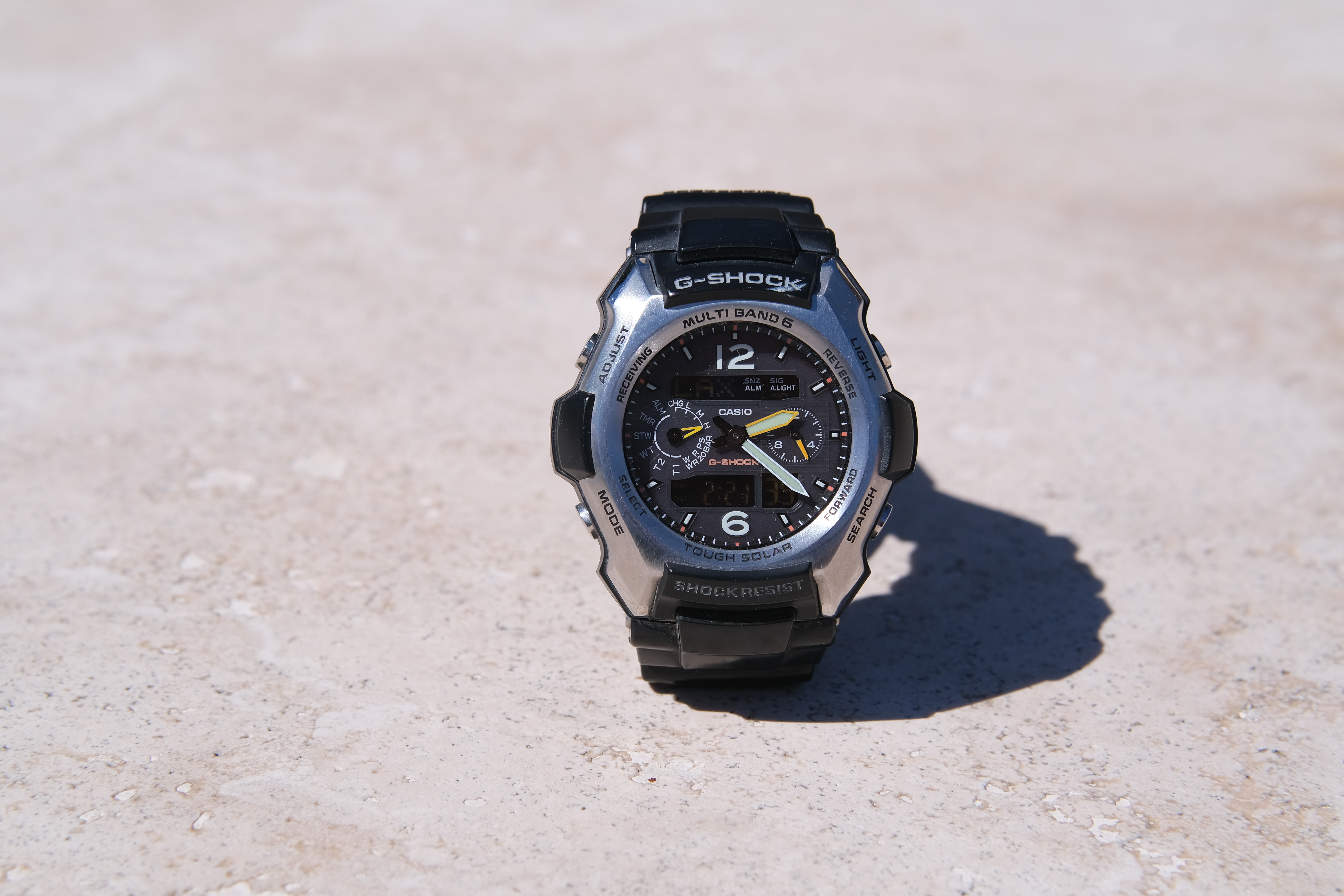
Casio G-Shock Solar Atomic Watch at close-focus distance, 15 March 2025. Fuji X-T30 (which was in The Eastern Sierra with us in October, 2019), TTArtisan 56mm f/1.8 at f/8 at 1/550 at ISO 160 (LV 14.5). bigger or camera-original © file.
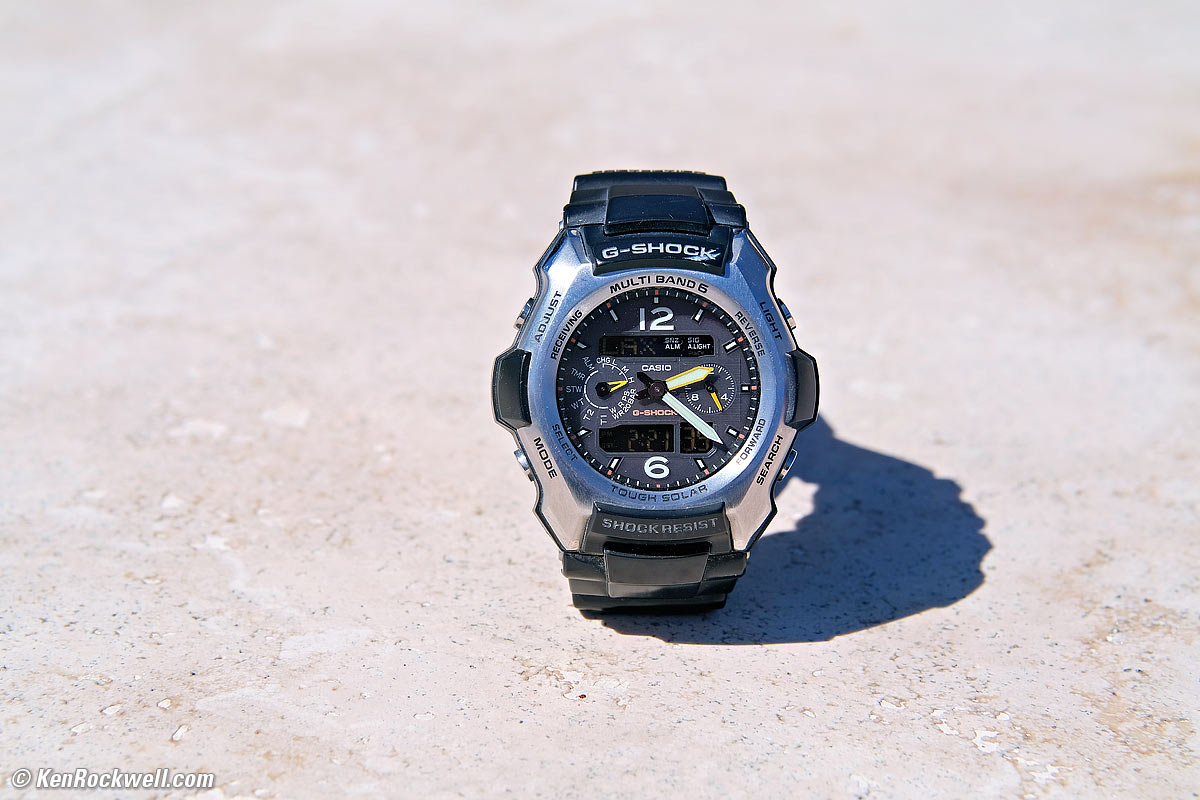
1,200 × 900 pixel (5.2× magnification) crop from above. bigger or camera-original © file.
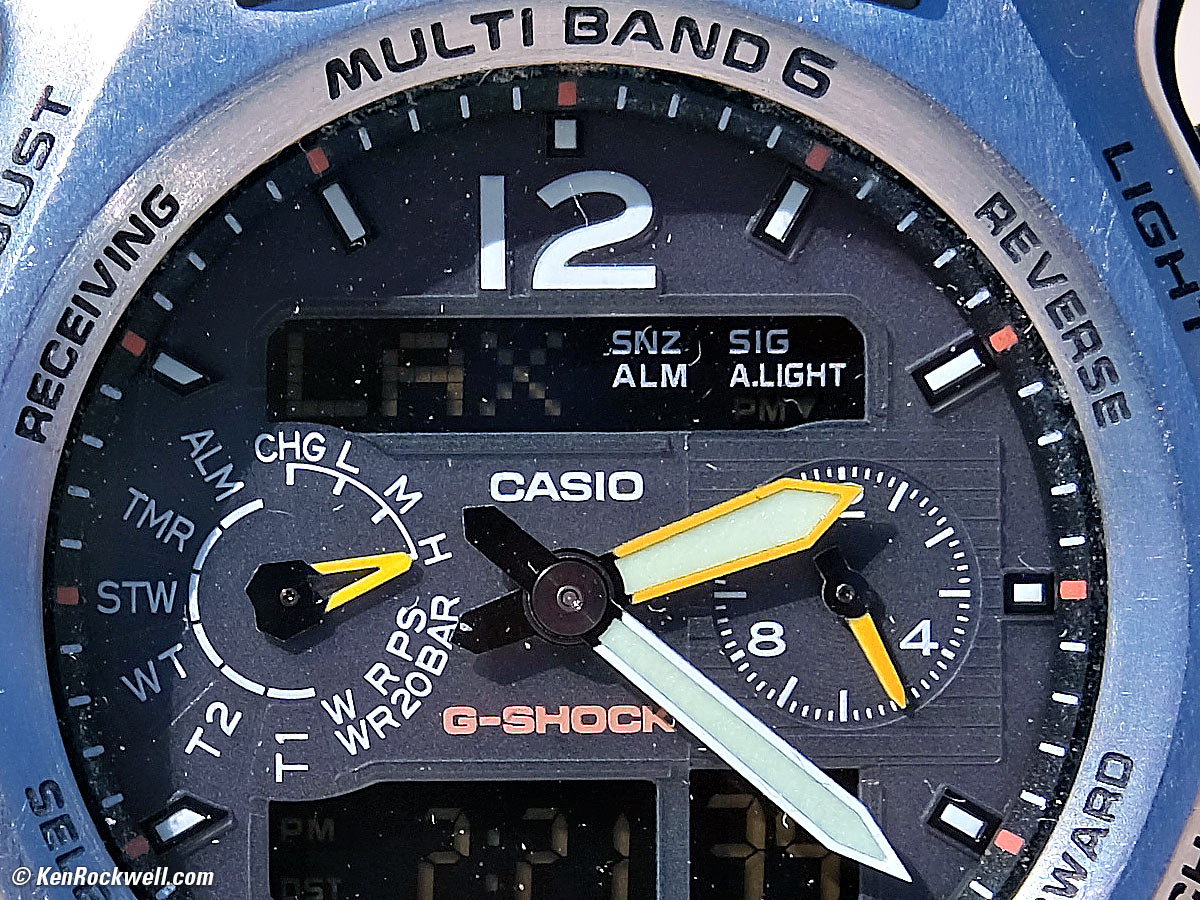
If this 1,200 × 900 pixel crop is about 3" (7.5cm) wide on your phone, then the complete image printed at this same extreme magnification would be about 11 × 16" (0.9 × 1.3 feet or 25 × 40 cm).
If this 1,200 × 900 pixel crop is about 6" (15cm) wide on your screen, then the complete image printed at this same extreme magnification would be about 21 × 31" (1.7 × 2.6 feet or 50 × 80 cm).
If this 1,200 × 900 pixel crop is about 12" (30cm) wide on your screen, then the complete image printed at this same extreme magnification would be about 42 × 62" (3.5 × 5.2 feet or 1.05 × 1.6 meters).
Mechanical Quality performance top
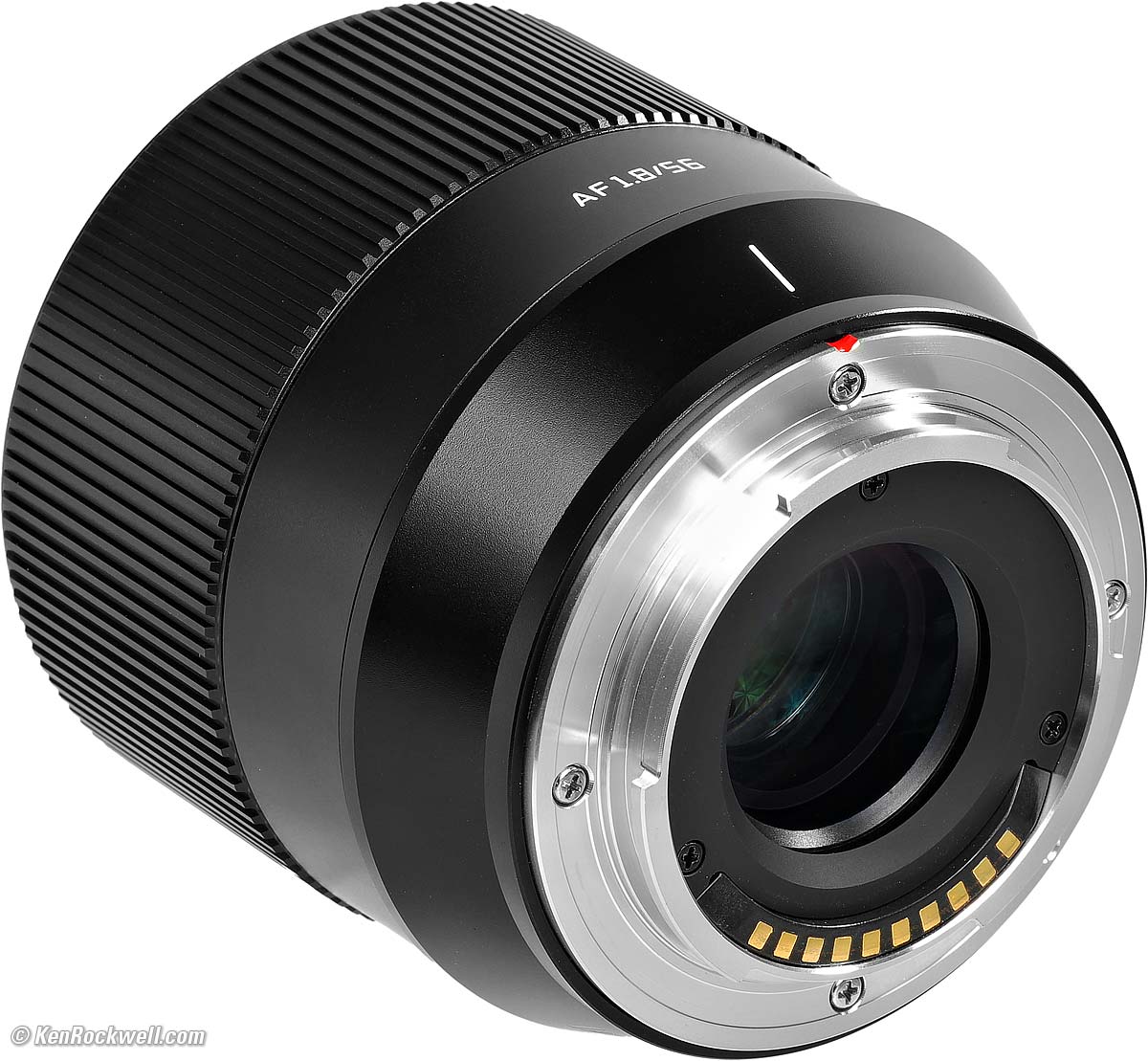
TTArtisan AF 56mm f/1.8 ED. bigger.
It's all metal.
Exterior Finish
Black anodized aluminum.
Hood
Solid alloy, with plastic bayonet.
Front Bumper
None.
Filter Threads
Metal!!!
Hood Bayonet Mount
Metal.
Focus Ring
Metal.
Barrel Exterior
All Metal!!!
Identity
Written on a ring around the outside of the front element.
I can't tell if it's shallow laser engravings on metal, or printed on a plastic insert.Also "AF 1.8/56" laser-engraved on top of barrel.
Internals
Seem like all metal!
Dust Gasket at Mount
No.
Mount
Chromed metal.
Serial Number
Laser engraved on the bottom of the barrel.
Date Code
None found.
Noises When Shaken
Very mild clicking, almost inaudible.
This is a solid lens.
Made in
Made in China.
Sharpness performance top
Lens sharpness has nothing to do with picture sharpness; every lens made in the past 100 years is more than sharp enough to make super-sharp pictures if you know what you're doing. The only limitation to picture sharpness is your skill as a photographer. It's the least talented who spend the most time worrying about lens sharpness and blame crummy pictures on their equipment rather than themselves. Skilled photographers make great images with whatever camera is in their hands; I've made some of my best images of all time with an irreparably broken camera! Most pixels are thrown away before you see them, but camera makers don't want you to know that.
If you're not getting ultra-sharp pictures with this, be sure not to shoot at f/11 or smaller where all lenses are softer due to diffraction, always shoot at ISO 100 or below because cameras become softer at ISO 200 and above, avoid shooting across long distances over land which can lead to atmospheric heat shimmer, be sure everything is in perfect focus, set your camera's sharpening as you want it (I set mine to the maximum) and be sure nothing is moving, either camera or subject. If you want to ensure a soft image with any lens, shoot at f/16 or smaller at ISO 1,600 or above at default sharpening in daylight of subjects at differing distances in the same image.
People worry waaaaay too much about lens sharpness. It's not 1968 anymore when lenses often weren't that sharp and there could be significant differences among them; ever since about 2010 all new lenses are all pretty much equally fantastic.
This lens is sharp, limited by your vision as an artist and of course by diffraction at the smallest apertures. No, it's not quite as sharp as camera-brand lenses, but it's the same throughout most of the image where it maters and I have no problem taking great pictures with it.
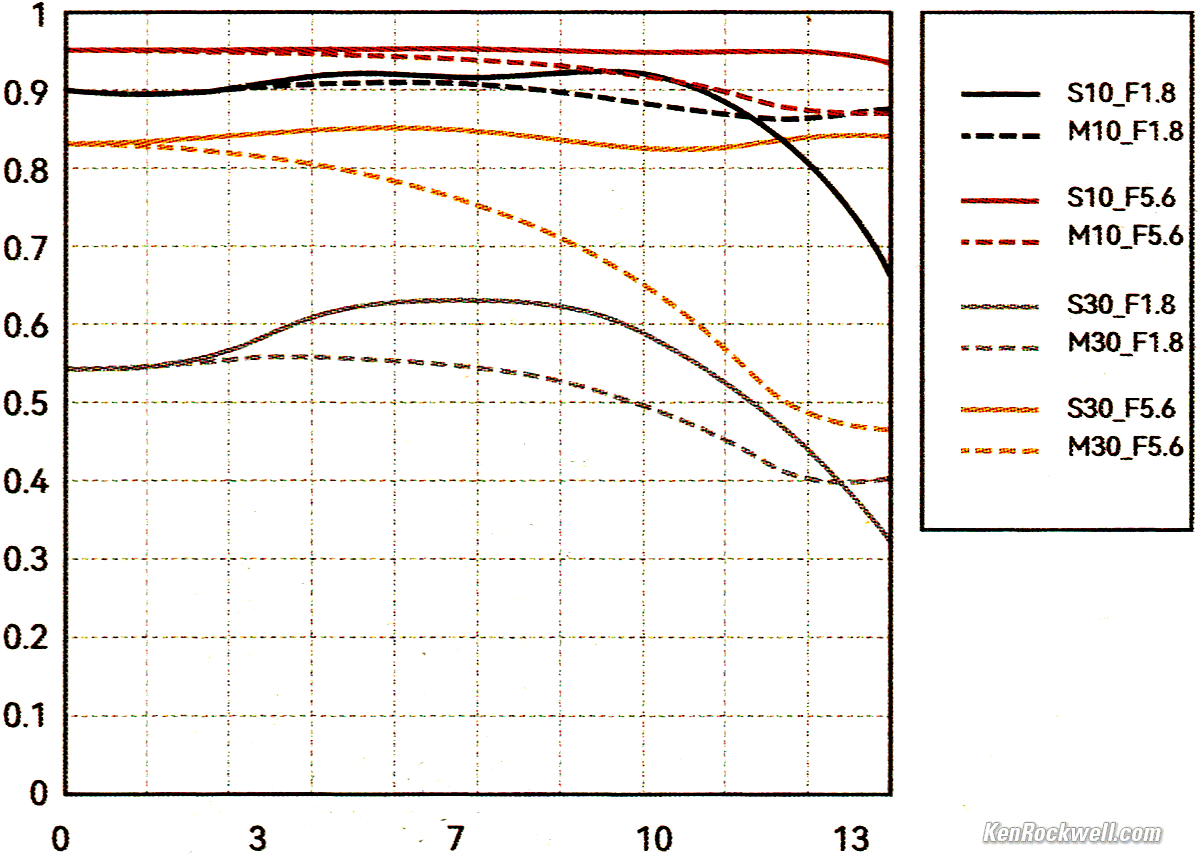
TTArtisan's MTF curves.
While it's usually valid to compare rated MTFs between different lenses of similar vintage from the same maker, every maker measures or simply calculates MTF very differently, and therefore one cannot compare these curves between brands. For instance, Sony seems to ignore diffraction and simply calculate overly optimistic MTFs that hug 100%, which no real lens can do at f/8, while other brands are more realistic and include diffraction. Only Canon offers any insight on how they arrive at their curves.
See also my article on MTF and Canon's article on MTFs.
Spherochromatism performance top
Spherochromatism, also called secondary spherical chromatic aberration or "color bokeh," is an advanced form of spherical and chromatic aberration in a different dimension than lateral chromatic aberration and therefore cannot be corrected with software or automatic corrections. It happens mostly in fast normal and tele lenses when spherical aberration at the ends of the color spectrum are corrected differently than in the middle of the spectrum. Spherochromatism can cause colored fringes on out-of-focus highlights, usually seen as green fringes on backgrounds and magenta fringes on foregrounds. Spherochromatism is common in fast lenses of moderate focal length when shooting contrasty items at full aperture. It goes away as stopped down.
It has a small amount of spherochromatism, with minor green fringes behind and minor magenta fringes ahead of the plane of perfect focus. This is pretty good performance:
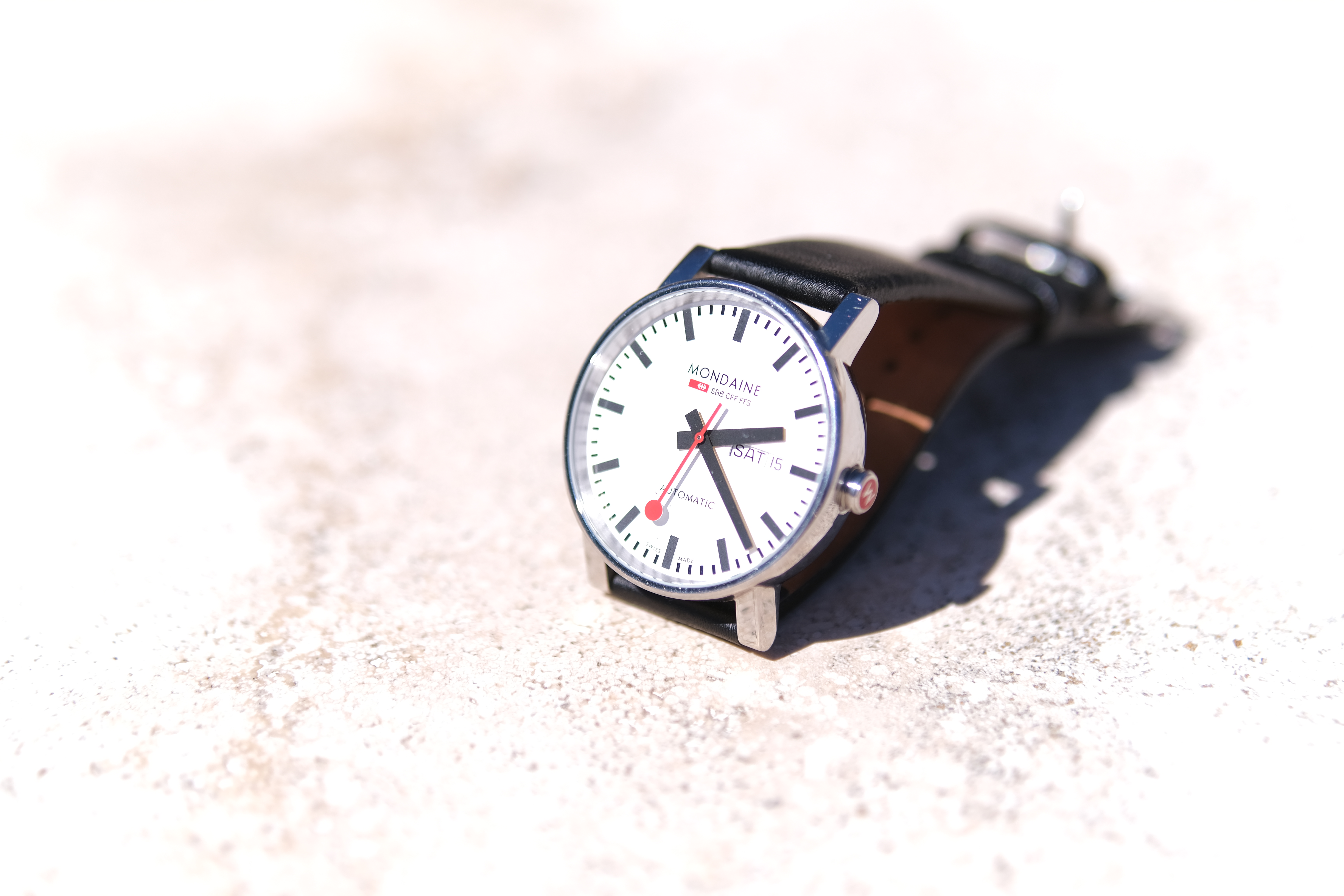
Mondaine A132.30348.11SBB at close-focus distance, 15 March 2025. Fuji X-T30 (which was in The Eastern Sierra with us in October, 2019), TTArtisan 56mm f/1.8 at f/1.8 at 1/4,000 at ISO 80L (LV 14.0). bigger or camera-original © file.
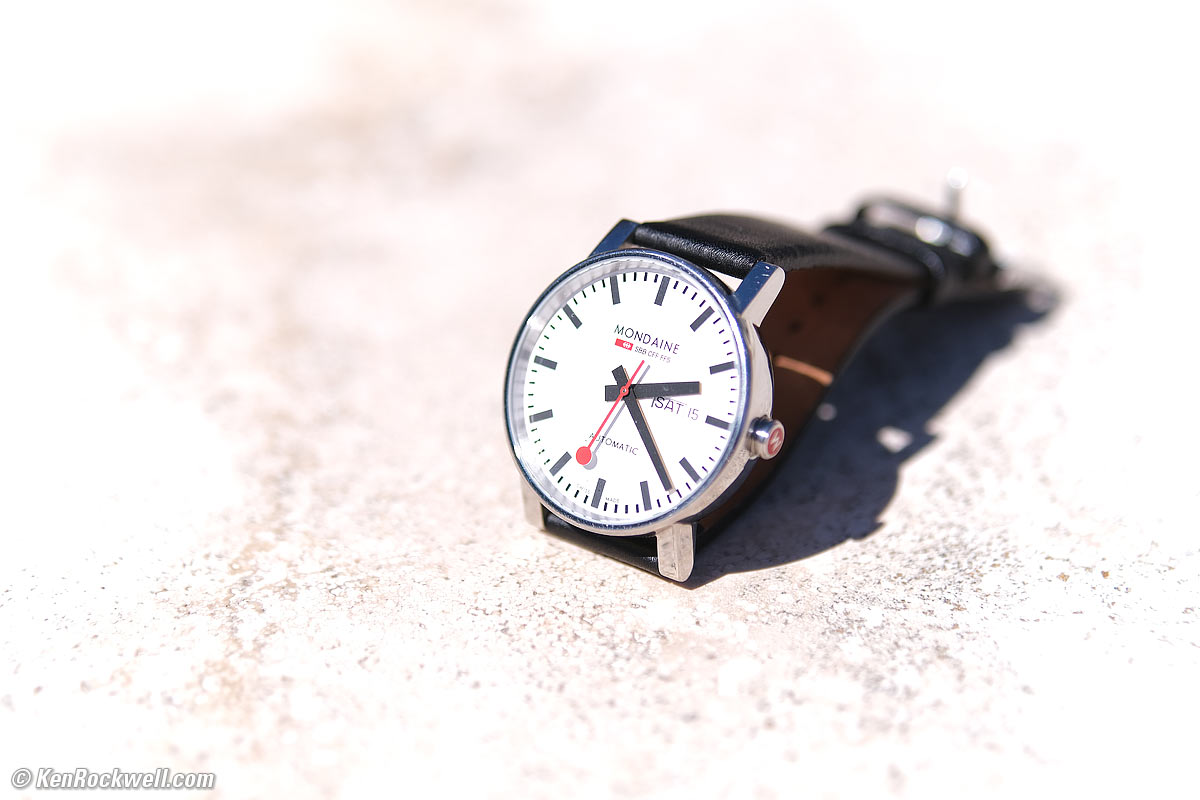
1,200 × 900 pixel (5.2× magnification) crop from above. bigger or camera-original © file.
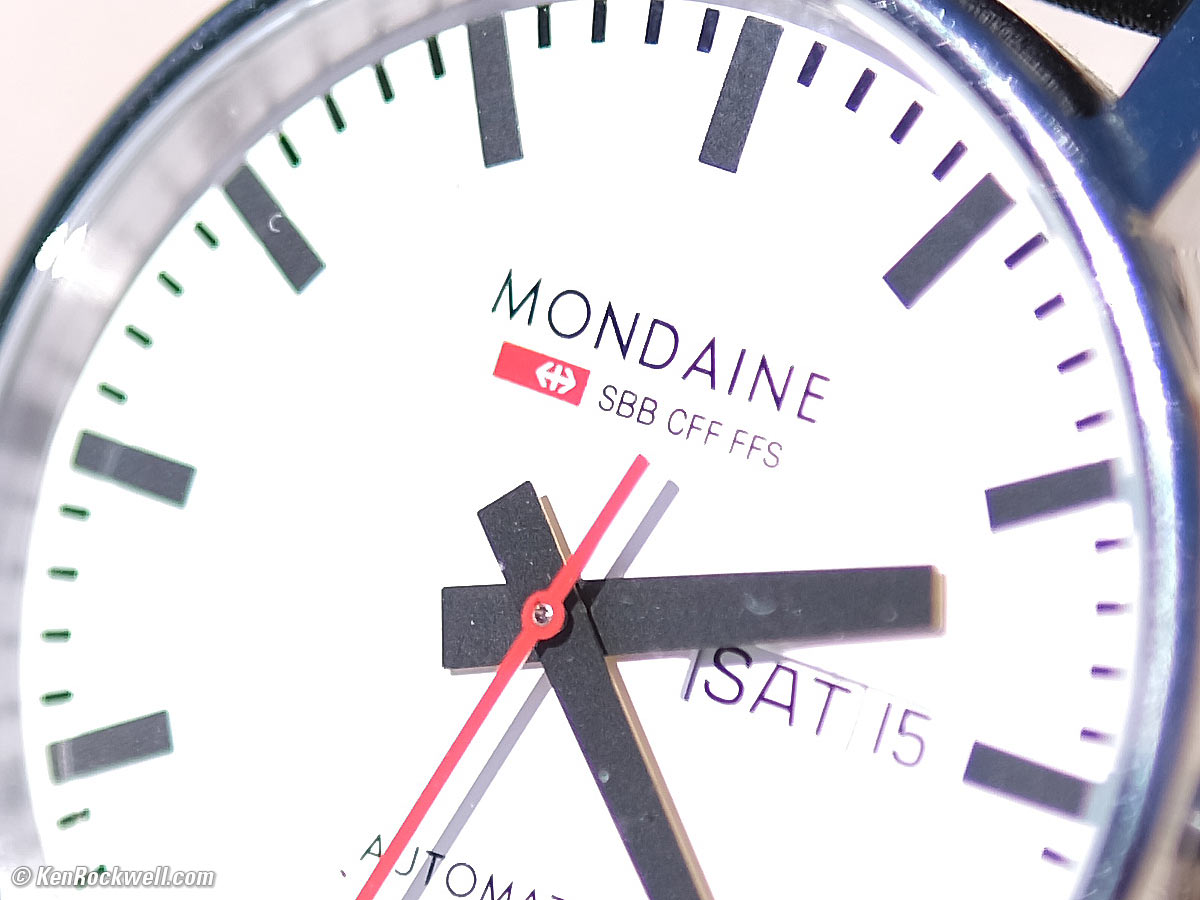
If this 1,200 × 900 pixel crop is about 3" (7.5cm) wide on your phone, then the complete image printed at this same extreme magnification would be about 11 × 16" (0.9 × 1.3 feet or 25 × 40 cm).
If this 1,200 × 900 pixel crop is about 6" (15cm) wide on your screen, then the complete image printed at this same extreme magnification would be about 21 × 31" (1.7 × 2.6 feet or 50 × 80 cm).
If this 1,200 × 900 pixel crop is about 12" (30cm) wide on your screen, then the complete image printed at this same extreme magnification would be about 42 × 62" (3.5 × 5.2 feet or 1.05 × 1.6 meters).
Sunstars performance top
With a 9-bladed rounded diaphragm, I get mild 18-point sunstars on brilliant points of light mostly at the smallest apertures.
Ignore the vertical smear at large apertures. This is a sensor artifact called interline transfer smear and is a camera, not a lens, defect.
Likewise ignore the insane rainbow dots at small apertures; these are sensor artifacts caused by interference among the divisions between pixels on the sensor. These are made visible because we're using enough exposure to show the dark underside of a huge palm tree, and then putting the blinding disk of the mid-day sun in it. Doing this will show everything due to the insane lighting range.
Click any to enlarge:
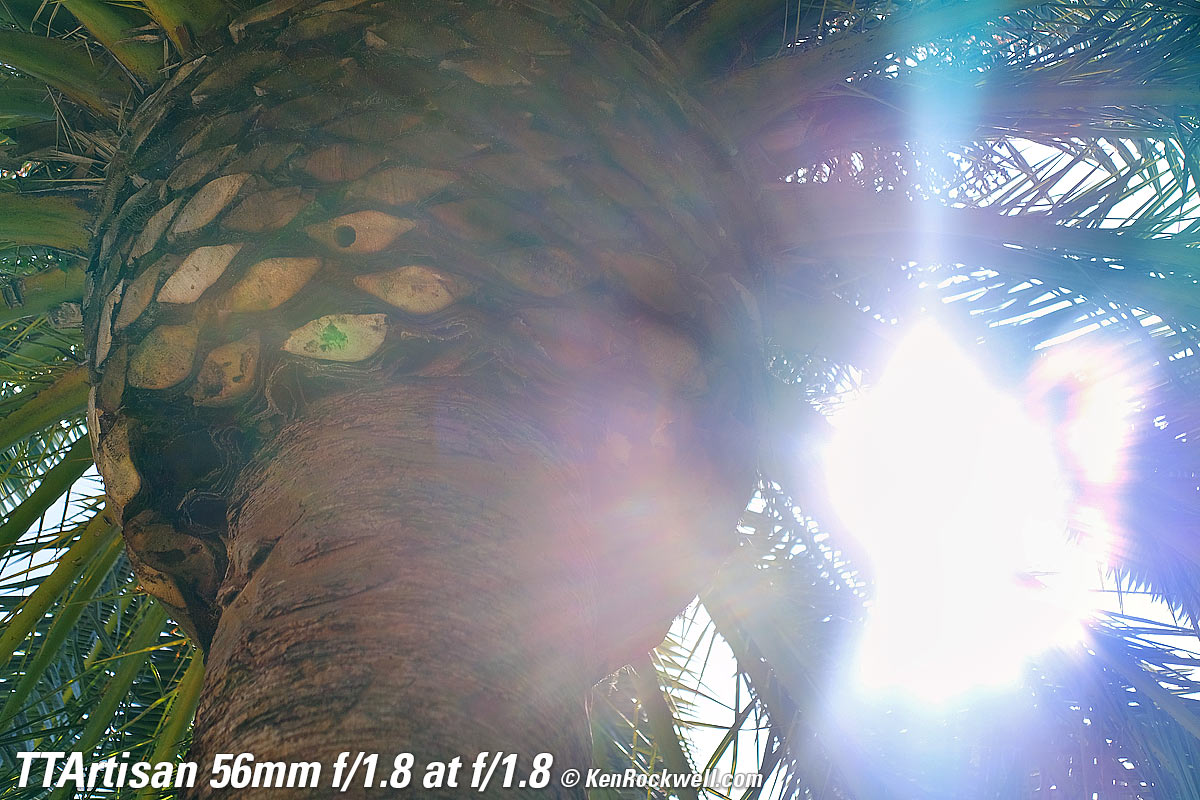
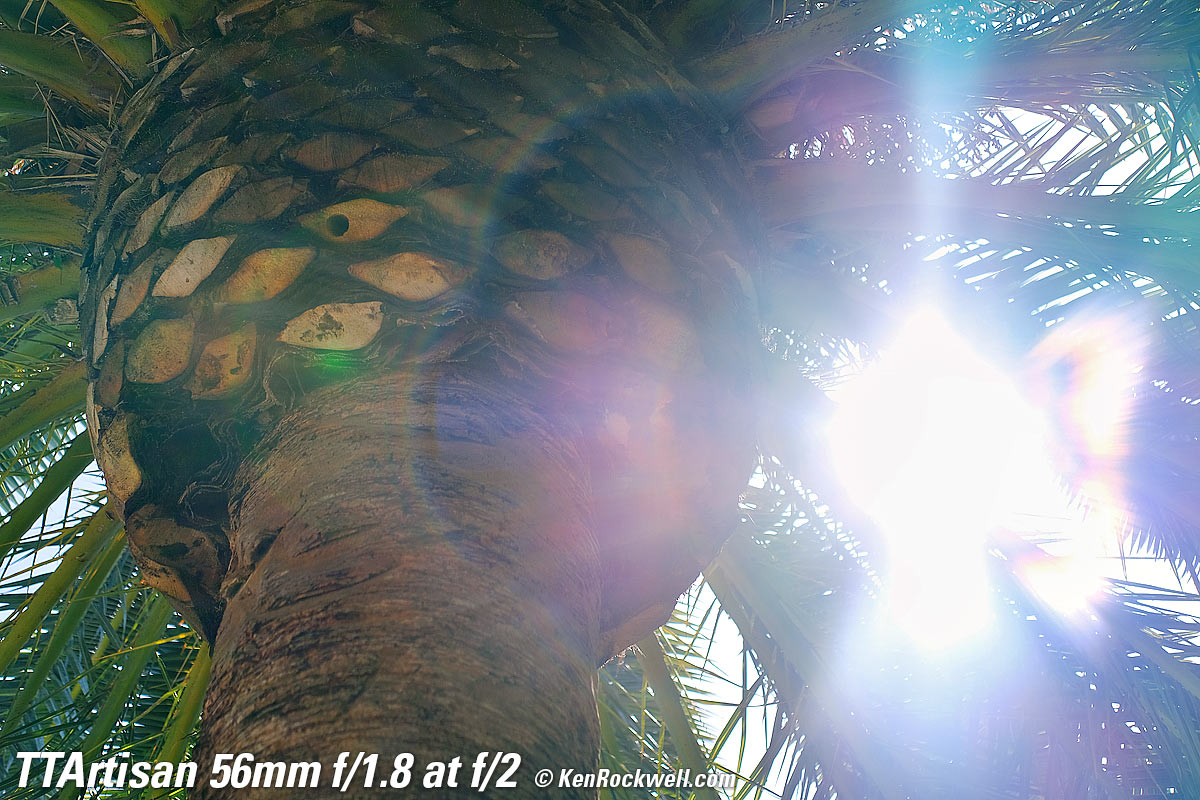
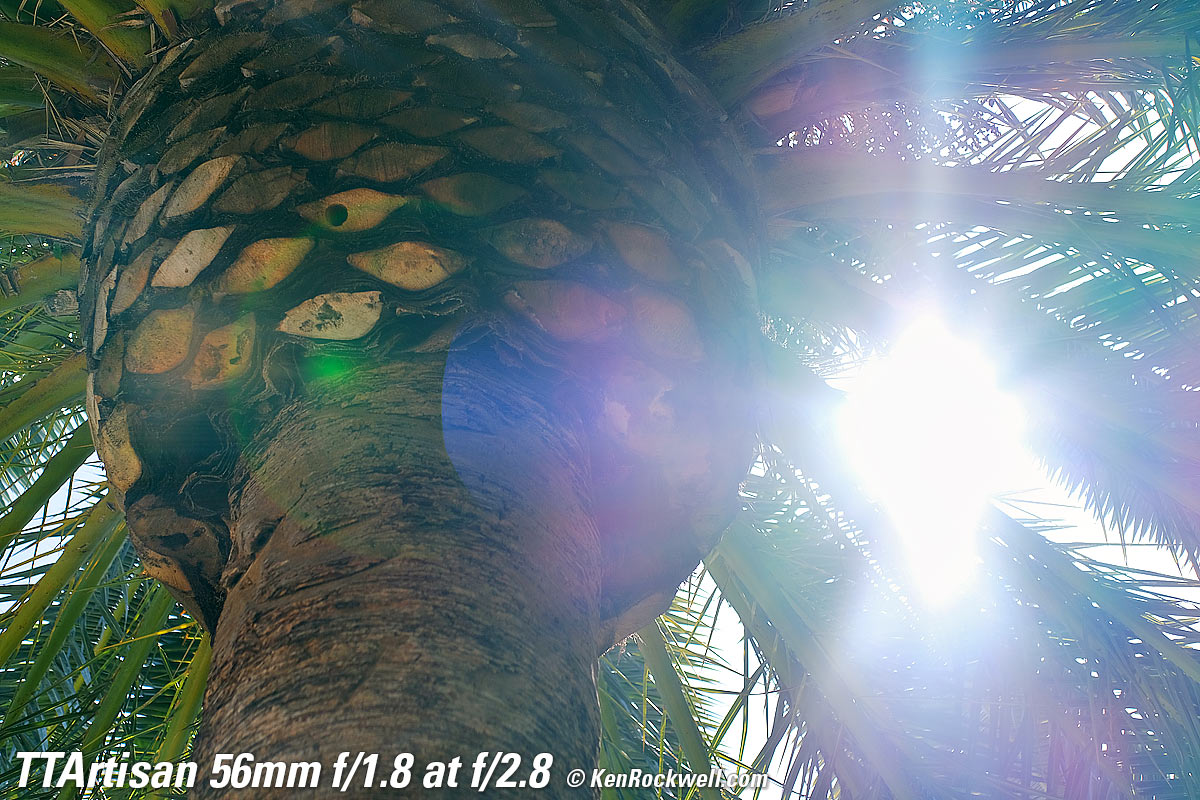
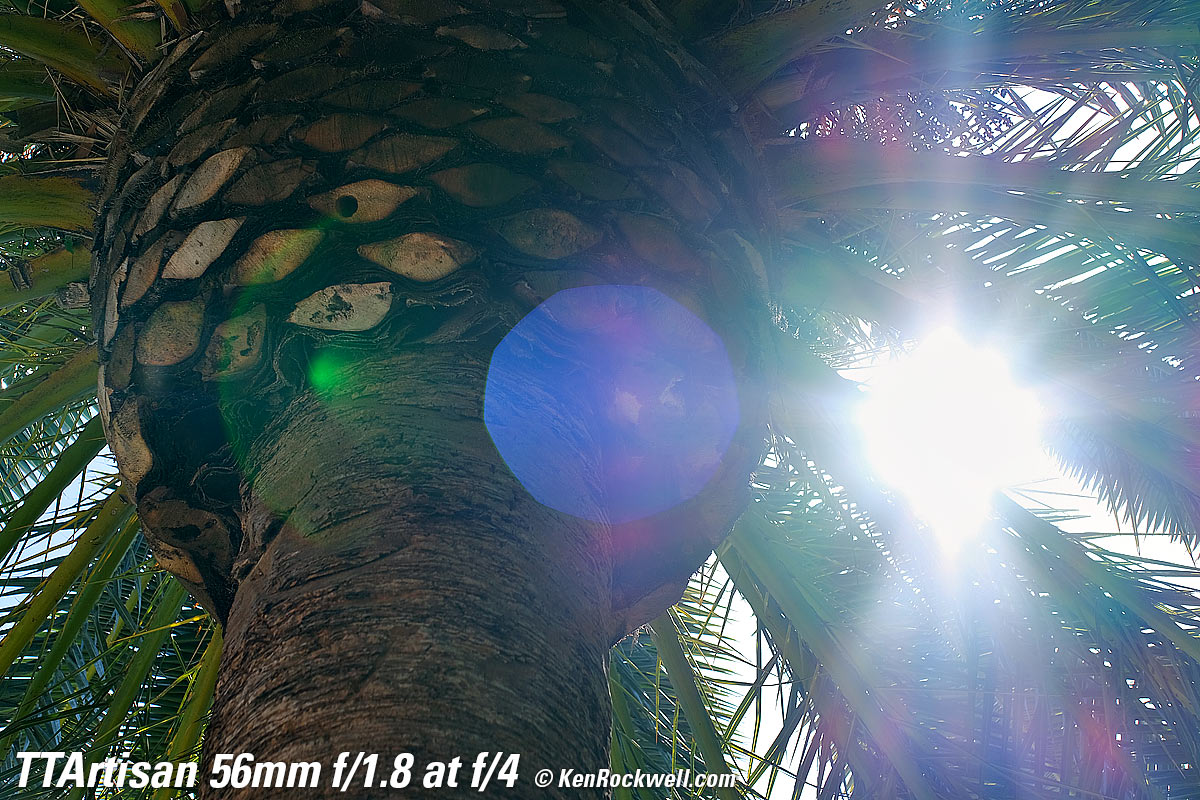
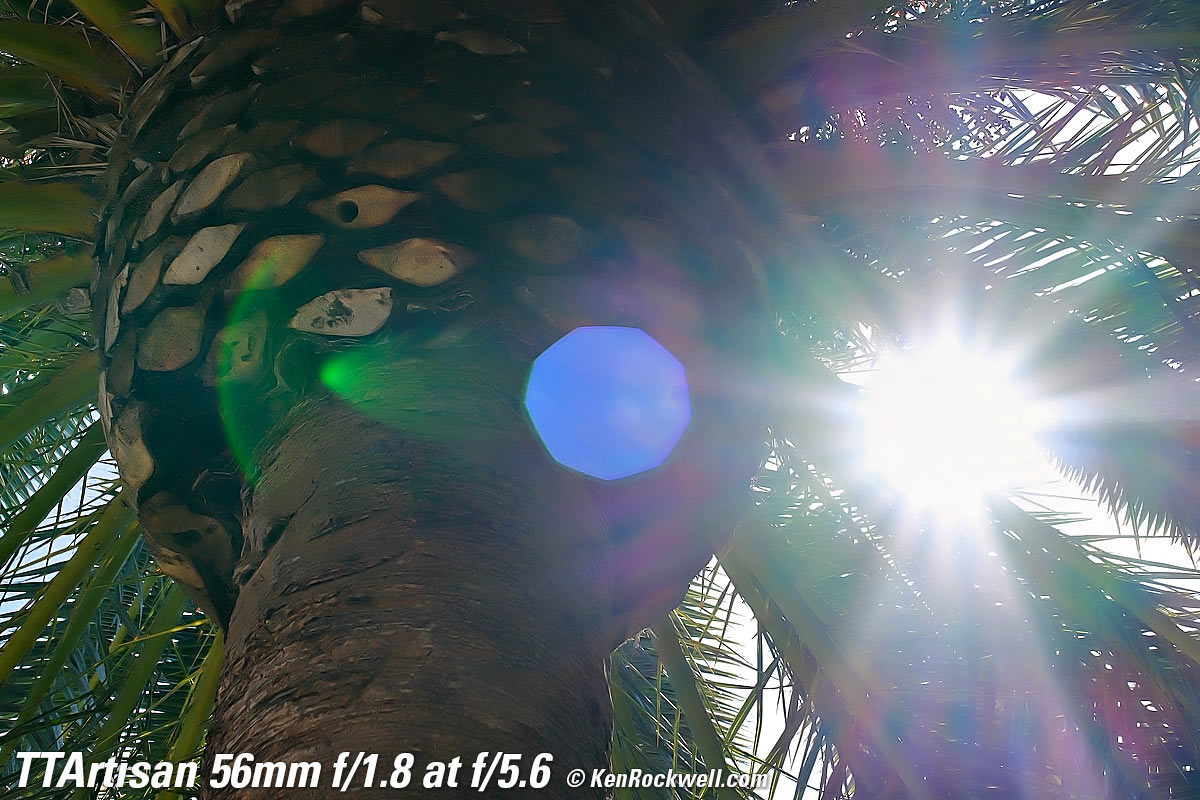
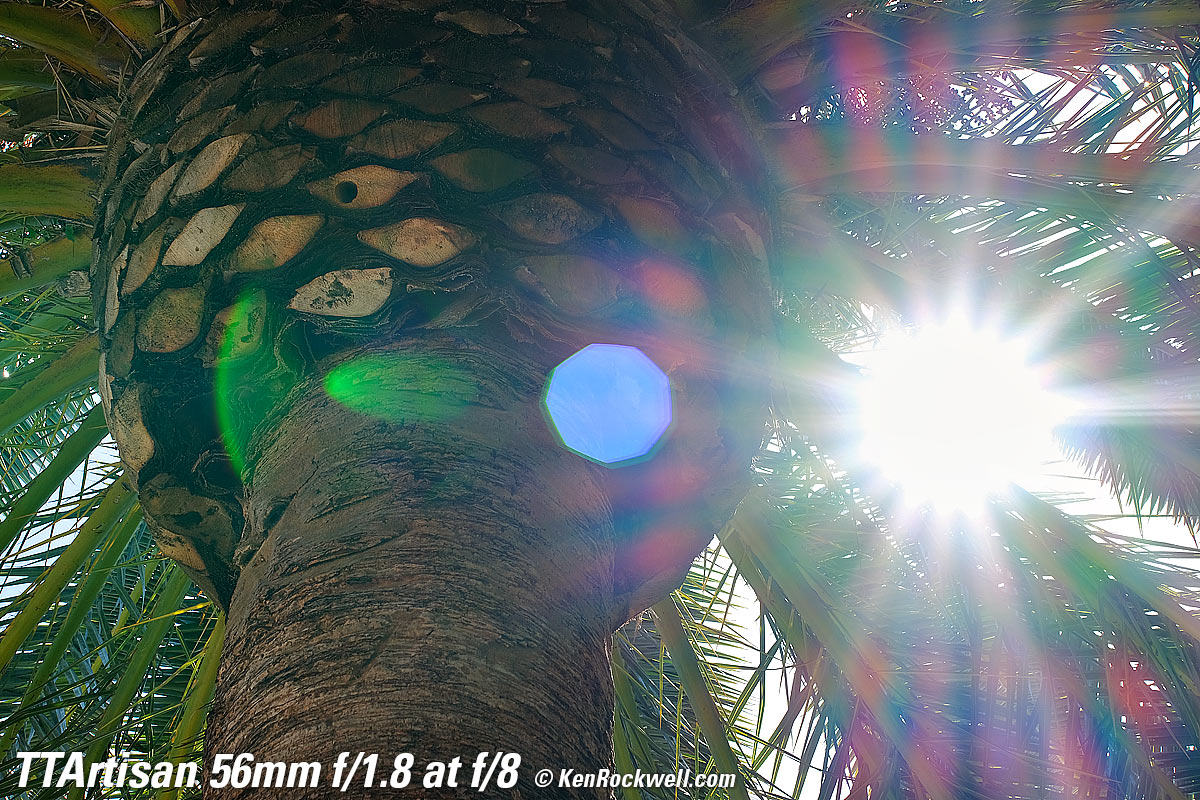
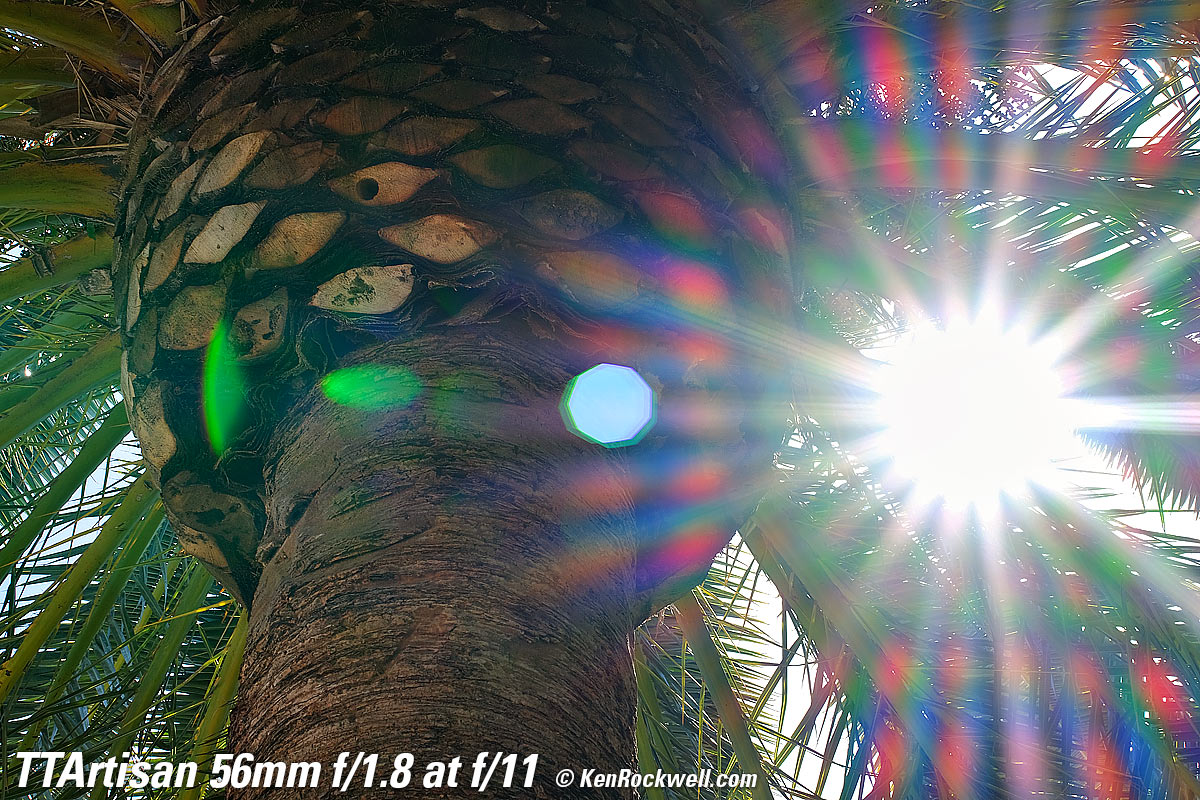
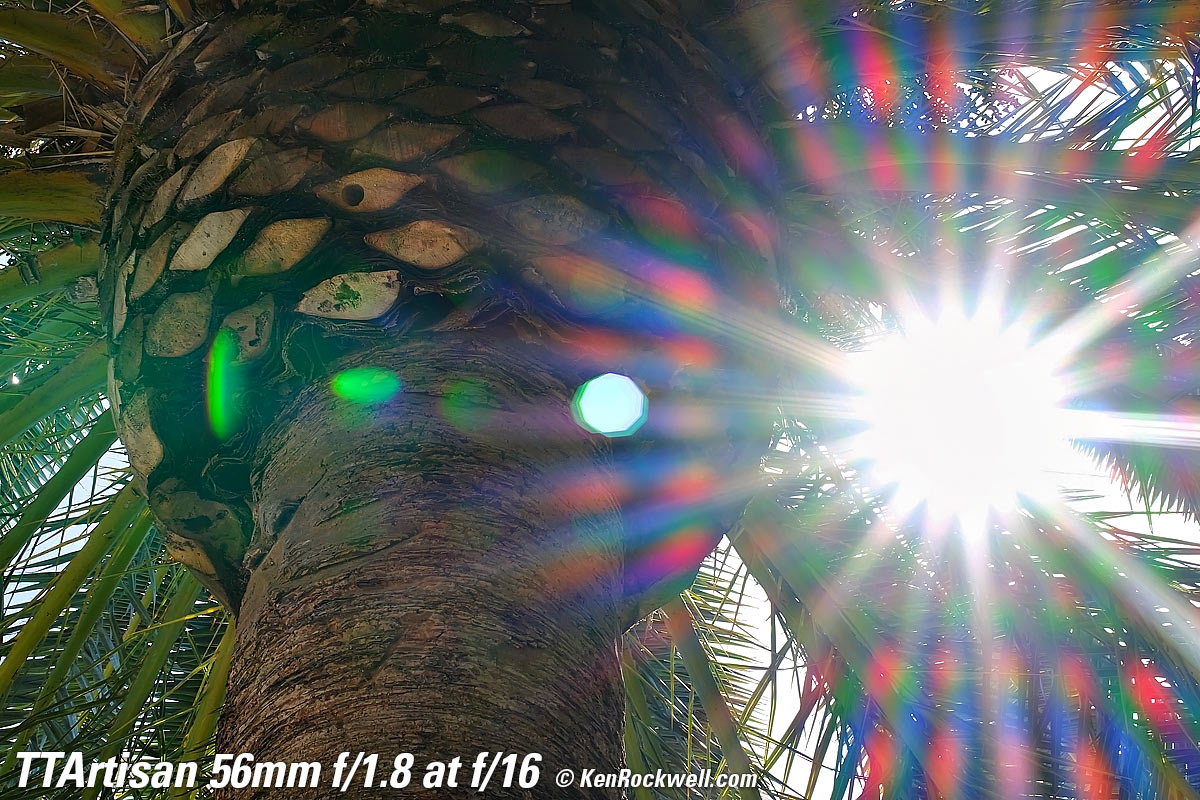
Click any to enlarge.
Recommendations top
Sample Images Intro New Good Bad Missing
Specifications Performance Recommendations
I'd get mine at B&H, at Adorama, at Amazon, or at eBay (How to Win at eBay), or get it used at KEH.
I use a clear (UV) protective filter instead of a cap (exactly like an iPhone) so I'm always ready to shoot instantly. I only use a cap when I throw this in a bag with other gear without padding — which is never. The UV filter never gets in the way, and never gets lost, either.
The very best protective filter is the Multicoated Hoya HD3 52mm UV which uses hardened glass and repels dirt and fingerprints. It's expensive, but it will last forever long after this lens is gone.
For less money, the classic Nikon 52mm NC is superb, as are the multicoated B+W 010 MRC and multicoated Hoya filters, but the Hoya HD3 is the toughest and the best.
Filters last a lifetime, so you may as well get the best. The Hoya HD3 stays cleaner than the others since it repels oil and dirt. I still use my classic Nikon 52mm L37c (multicoated 370 nanometer UV) filters because I bought them back in the 1980s when they were the best, and they never wear out. Putting a 1980s 52mm L37c on this new lens gives a tip of the hat to when Nikon ruled the photography world.
If I was working in nasty, dirty areas, I'd use an uncoated 52mm Tiffen UV filter instead. Uncoated filters are much easier to clean, but more prone to ghosting.
All these filters are just as sharp and take the same pictures, the difference is how much abuse they'll take and stay clean and stay in one piece. Since filters last a lifetime or more, there's no reason not to buy the best as it will last you for the next 50 years. Filters aren't throwaways like digital cameras which we replace every few years, like it or not. I'm still using filters I bought back in the 1970s!
I'd get mine at B&H, at Adorama, at Amazon, or at eBay (How to Win at eBay), or get it used at KEH.
This all-content, junk-free website's biggest source of support is when you use those or any of these links to approved sources when you get anything, regardless of the country in which you live. Thanks for helping me help you! Ken.
Thanks for helping me help you!
Ken.
© Ken Rockwell. All rights reserved. Tous droits réservés. Alle Rechte vorbehalten. Alla rättigheter förbehållna. Toate drepturile rezervate. Niciun vampir nu a fost implicat în crearea acestei lucrări. Omnia jura reservata. Ken Rockwell® is a registered trademark.
Help Me Help You top
I support my growing family through this website, as crazy as it might seem.
The biggest help is when you use any of these links when you get anything. It costs you nothing, and is this site's, and thus my family's, biggest source of support. These places always have the best prices and service, which is why I've used them since before this website existed. I recommend them all personally.
If you find this page as helpful as a book you might have had to buy or a workshop you may have had to take, feel free to help me continue helping everyone.
If you've gotten your gear through one of my links or helped otherwise, you're family. It's great people like you who allow me to keep adding to this site full-time. Thanks!
If you haven't helped yet, please do, and consider helping me with a gift of $5.00.
As this page is copyrighted and formally registered, it is unlawful to make copies, especially in the form of printouts for personal use. If you wish to make a printout for personal use, you are granted one-time permission only if you PayPal me $5.00 per printout or part thereof. Thank you!
Thanks for reading!
Ken.