Canon RF 10-20mm f/4L IS STM
World's Widest Non-Fisheye Zoom: 130½º (2024-today)
Sample Images Intro New Good Bad Missing
Specs USA Version Performance Compared
User's Guide Recommendations More
R1 R3 R5 II R5 R5C R6 III R6 II R6 R R8 RP R7 R10 R50 R50V R100
Bodies Compared RF Lenses EF Lenses Flash
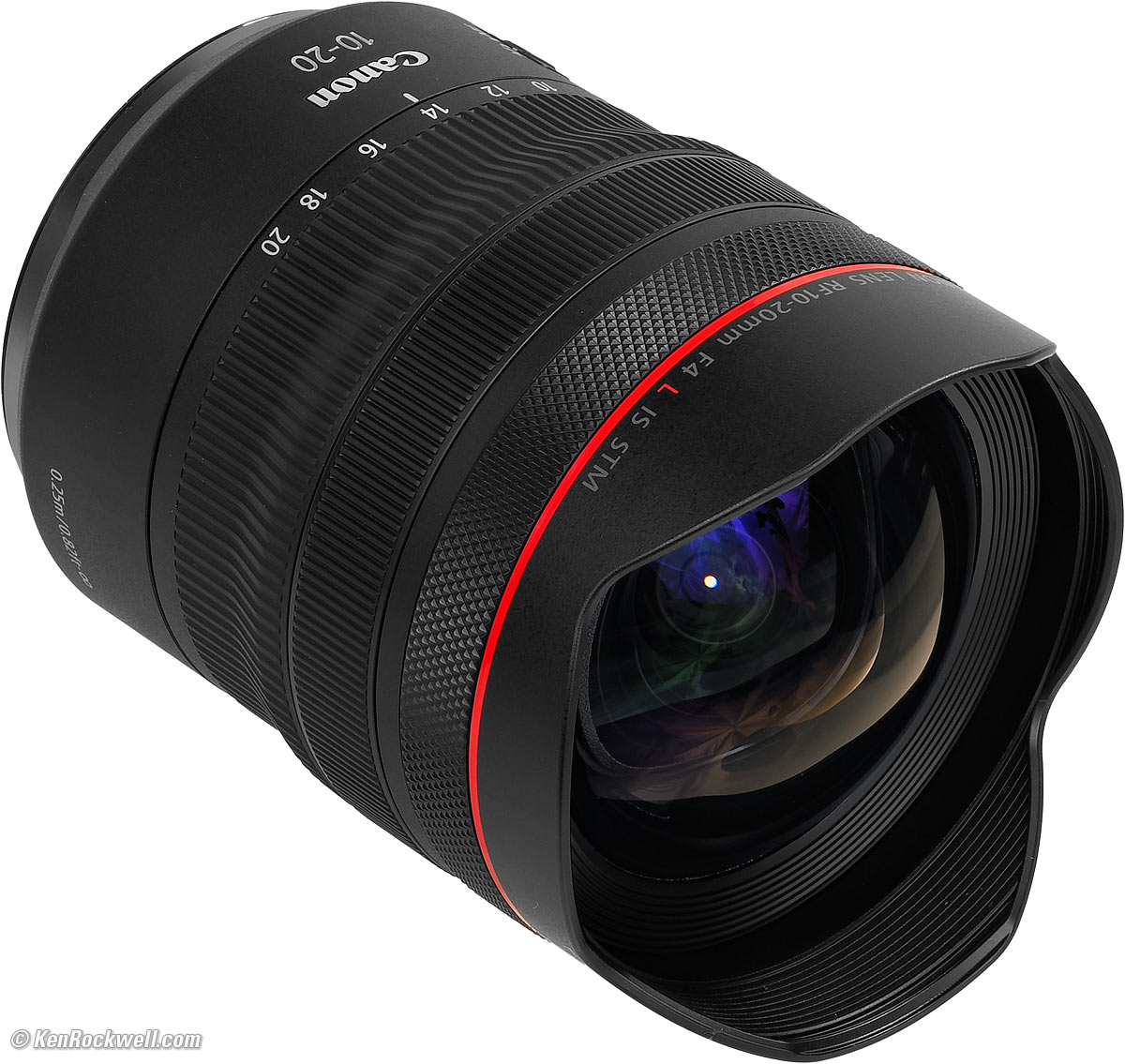
Canon RF 10-20mm f/4L IS STM (rear filters only, 20.0 oz./566g, 0.8'/0.25m close focus, 0.12× macro ratio, $2,499). bigger. I got mine at B&H. I'd also get mine at Adorama, at Crutchfield or at Amazon, or used at eBay if you know How to Win at eBay.
This 100% all-content, junk-free website's biggest source of support is when you use those or any of these links to my personally approved sources I've used myself for way over 100 combined years when you get anything, regardless of the country in which you live. Canon does not seal its boxes in any way, so never buy at retail or any other source not on my personally approved list since you'll have no way of knowing if you're missing accessories, getting a defective, damaged, returned, gray-market, store demo or used lens — and all of my personally approved sources allow for 100% cash-back returns for at least 30 days if you don't love your new lens. I've used many of these stores since the 1970s because I can try it in my own hands and return it if I don't love it, and because they ship from secure remote warehouses where no one gets to touch your new lens before you do. Buy only from the approved sources I've used myself for decades for the best prices, service, return policies and selection.
June 2025 Better Pictures Canon Reviews RF Lenses EF Lenses Flash All Canon Reviews All Reviews
EF 11-24mm f/4L IS USM (2015-today, use with adapter on mirrorless)
Nikon 13mm f/5.6 (1976-1998)
How to Use Ultra-Ultrawide Lenses
Sample Images top
Sample Images Intro New Good Bad Missing
Specs USA Version Performance Compared
User's Guide Recommendations More
More samples throughout this review at Bokeh, Falloff, Macro, Sharpness, Spherochromatism and Sunstars.
These are just snapshots; my real work is in my Gallery.
These are all shot hand-held as 45 MP Quality 1 (lowest quality, smallest file size) JPGs; no tripods, NORMAL (quality 4) or FINE JPGs or RAW CR3 files were used or needed.
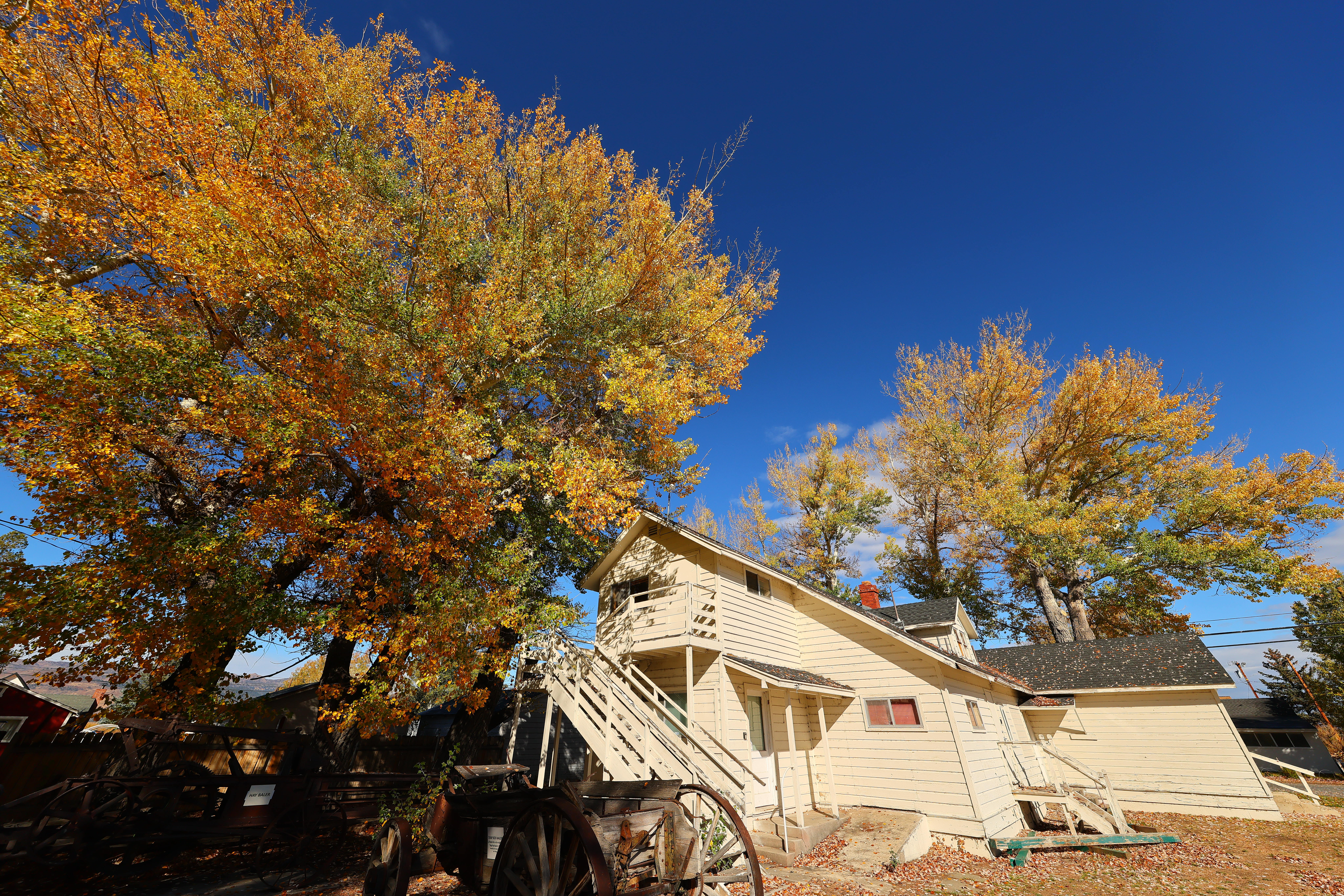
Mono County Museum, Bridgeport, California, 10:09 A.M., 17 October 2024. Canon R5 II, RF 10-20mm f/4 L IS USM at 12mm at f/10 at 1/400 at Auto ISO 100 (LV 15¼), Radiant Photo software. More tech details. bigger/fit-to-screen or camera-original 45 MP © JPG Quality 1 file.

Bodie Mercantile, Bodie, California, 2:45 P.M., 19 October 2024. Canon EOS R5 II and RF 10-20mm f/4 L IS STM at 17mm at f/16 handheld against a window for 0.8 seconds at Auto ISO 100, -0.7 stops exposure compensation (LV 8.4), perked up with Radiant Photo and Skylum Luminar Neo software, perspective correction in Photoshop CC. bigger or full-resolution 45 MP © 6.2 MB JPG file.
I used f/16 for depth of field, but if I had realized my new EOS R5 II easily can do focus stacking and compositing all in-camera automatically, even handheld, I would have used that mode at about f/8 for much sharper results with both deeper depth of field and less diffraction. Don't get too excited; this is shot through a dirty old ghost town window.
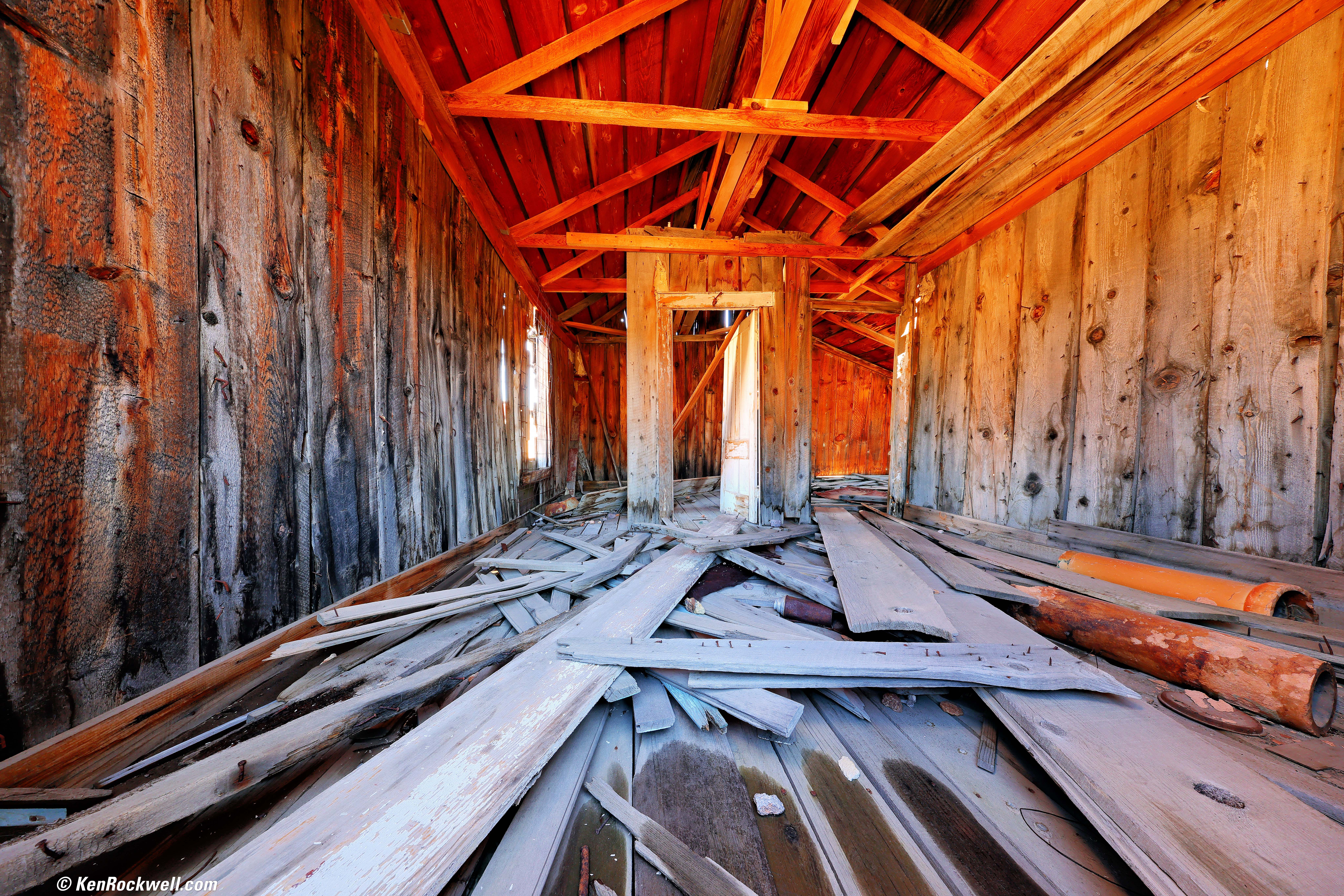
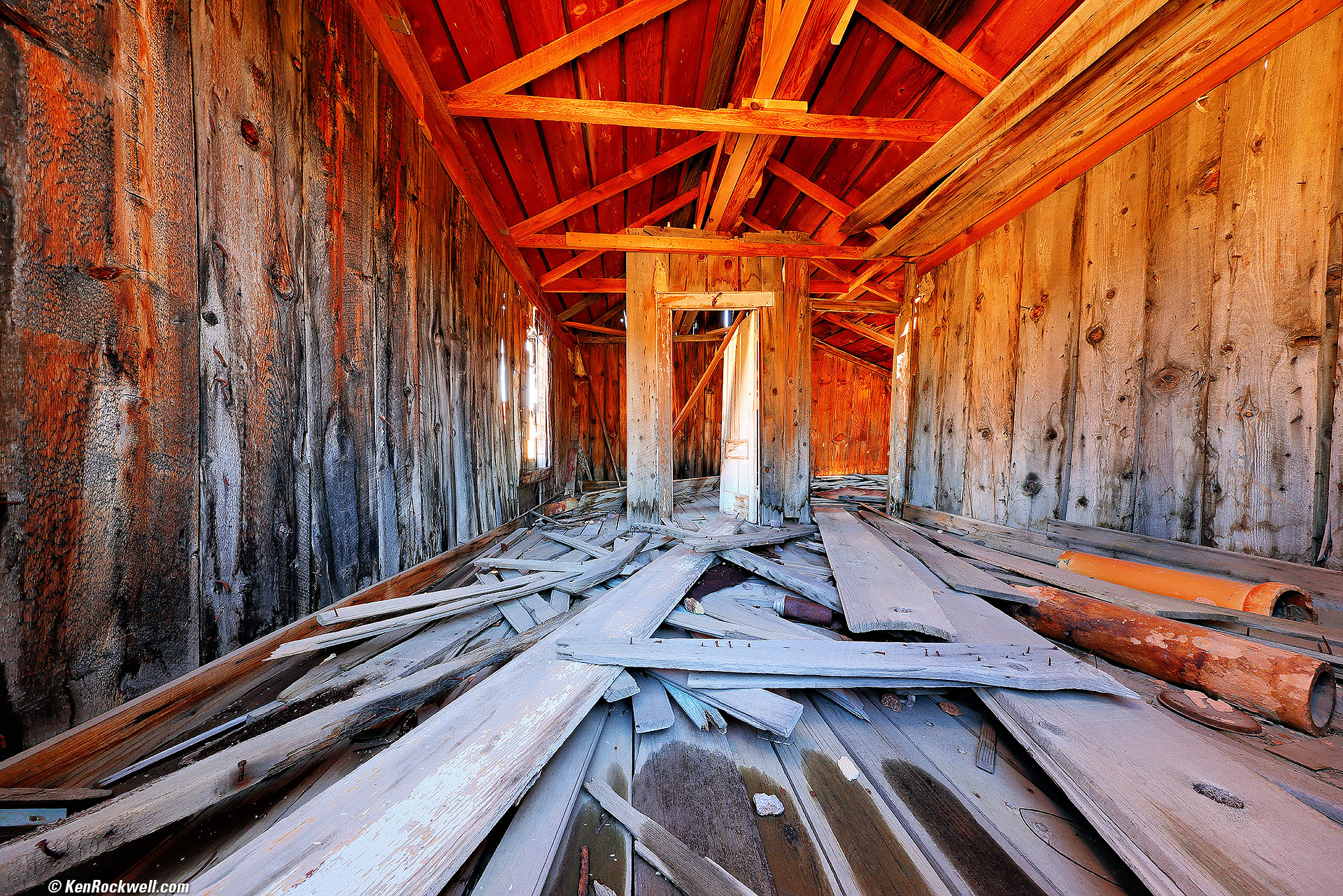
Interior of Orange House, Bodie, California, 2:59 P.M., 19 October 2024. Canon EOS R5 II and RF 10-20mm f/4 L IS STM at 10mm at f/11 handheld against a wobbly window frame for 0.8 seconds at Auto ISO 100, -0.7 stops exposure compensation (LV 7.4), perked up with Radiant Photo software. bigger or full-resolution 45 MP © 7.5 MB JPG file.
Again I used f/11 for depth of field, not realizing that my new EOS R5 II does focus stacking and compositing in-camera automatically, even handheld. I would have used about f/8 for sharper results with deeper depth of field.
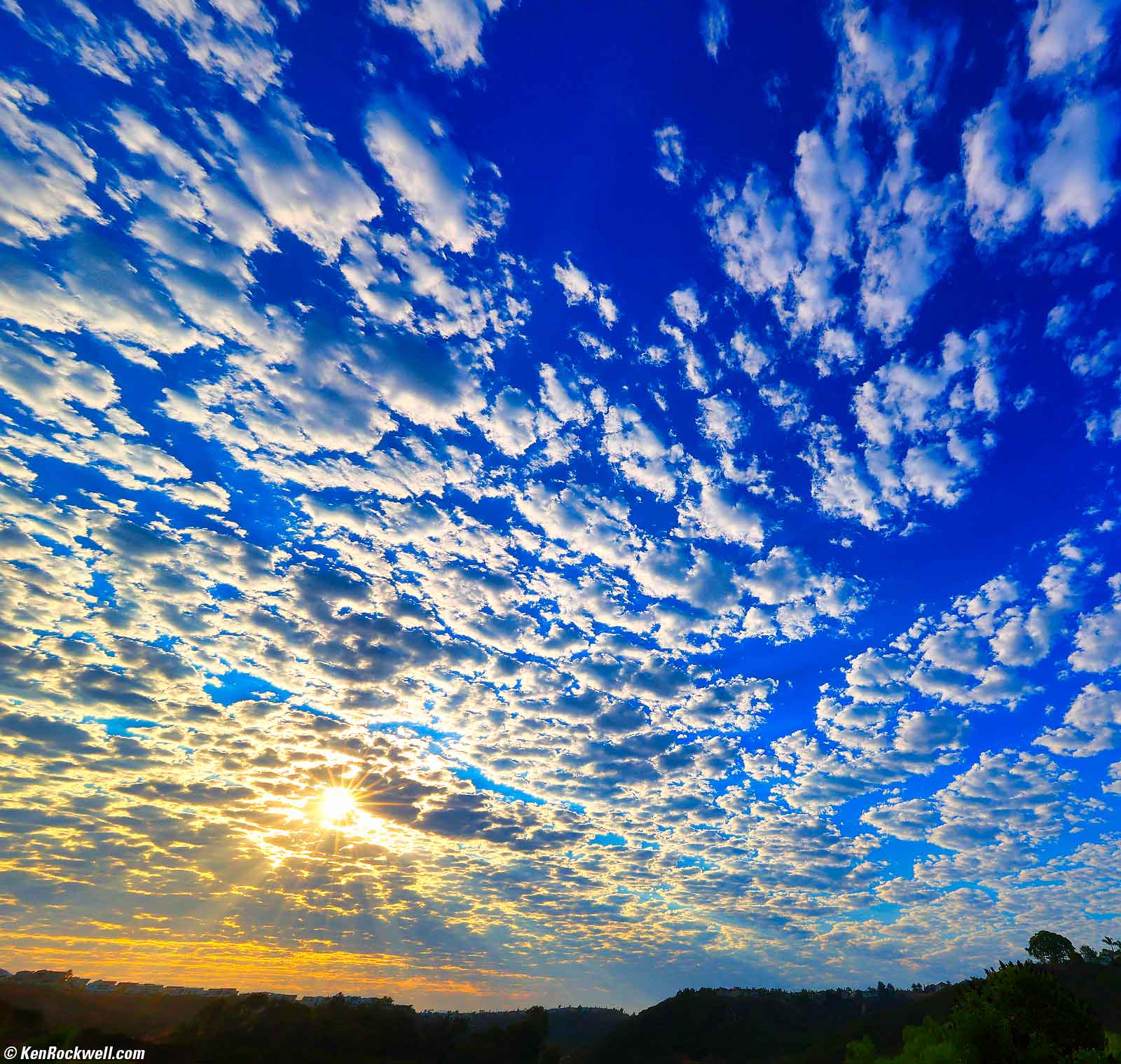
Dawn, Summer Heat, San Diego, California, 7:33 AM, Friday, 06 September 2024. Canon EOS R5 II and RF 10-20mm f/4 L IS STM at 10mm at f/22 (for the sunstar) at 1/60 at Auto ISO 100 (LV 15.0), color, highlights and shadows optimized with Skylum Luminar Neo software, cropped to taste in Photoshop CC. bigger.
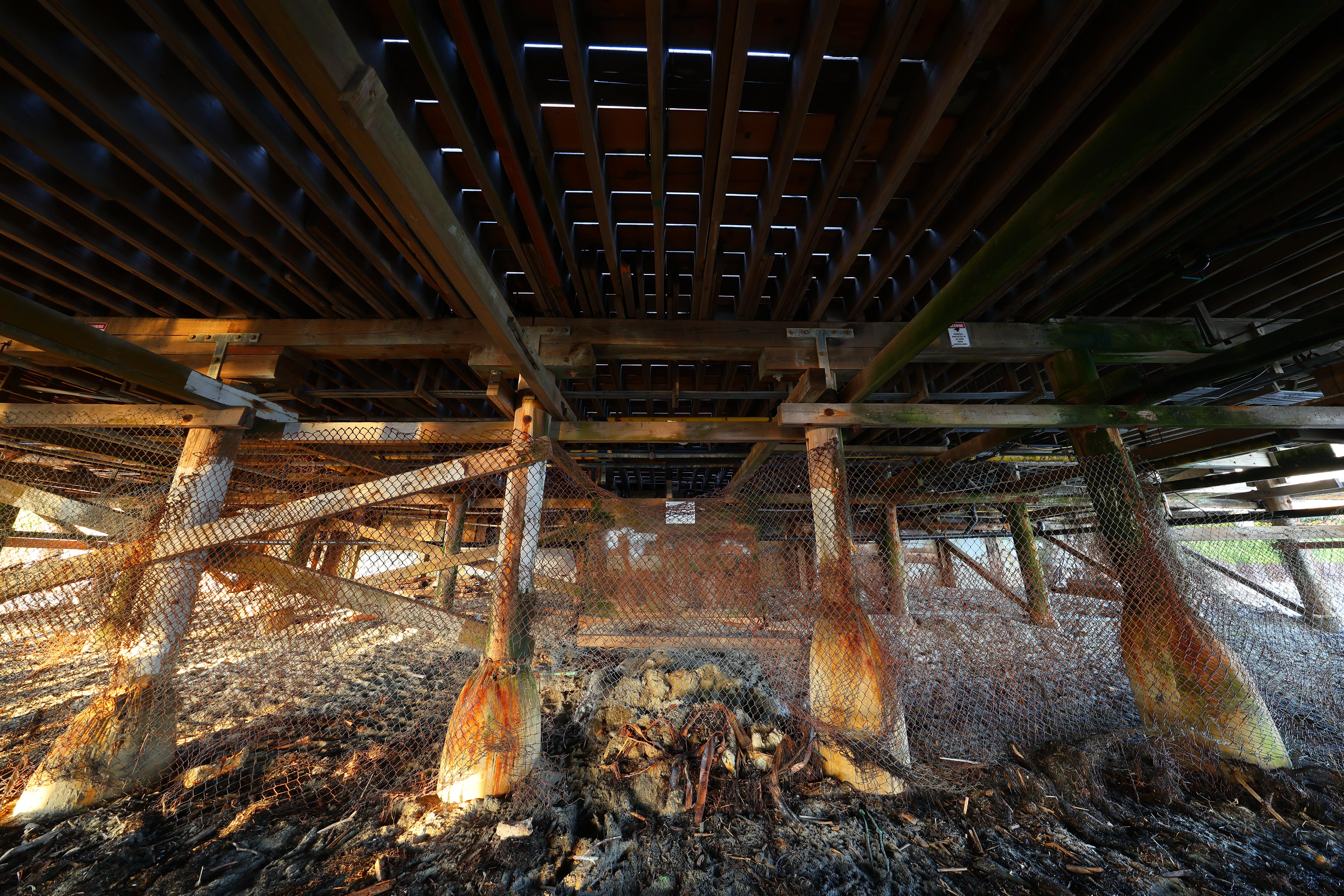
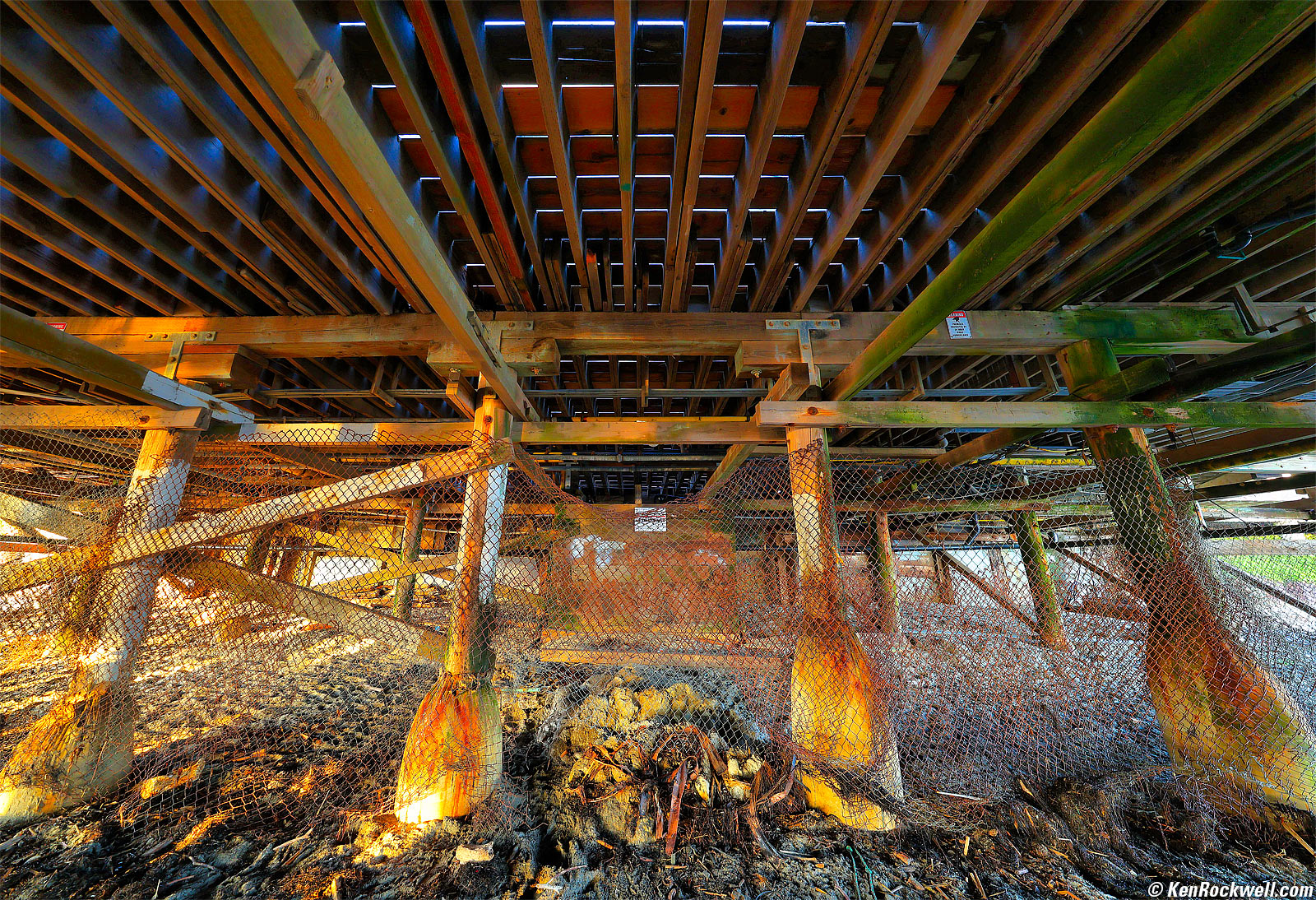
Under the Pacific Beach Pier, San Diego, California, 6:45 PM, Tuesday, 03 September 2024. Canon EOS R5 II and RF 10-20mm f/4 L IS STM at 10mm wide-open at f/4 hand-held at 1/10 of a second at Auto ISO 320 (LV 5.7), highlights and shadows optimized with Skylum Luminar Neo software, perspective correction in Photoshop CC. bigger or camera-original (unprocessed) 45 MP © 8 MB JPG Quality 1 file.
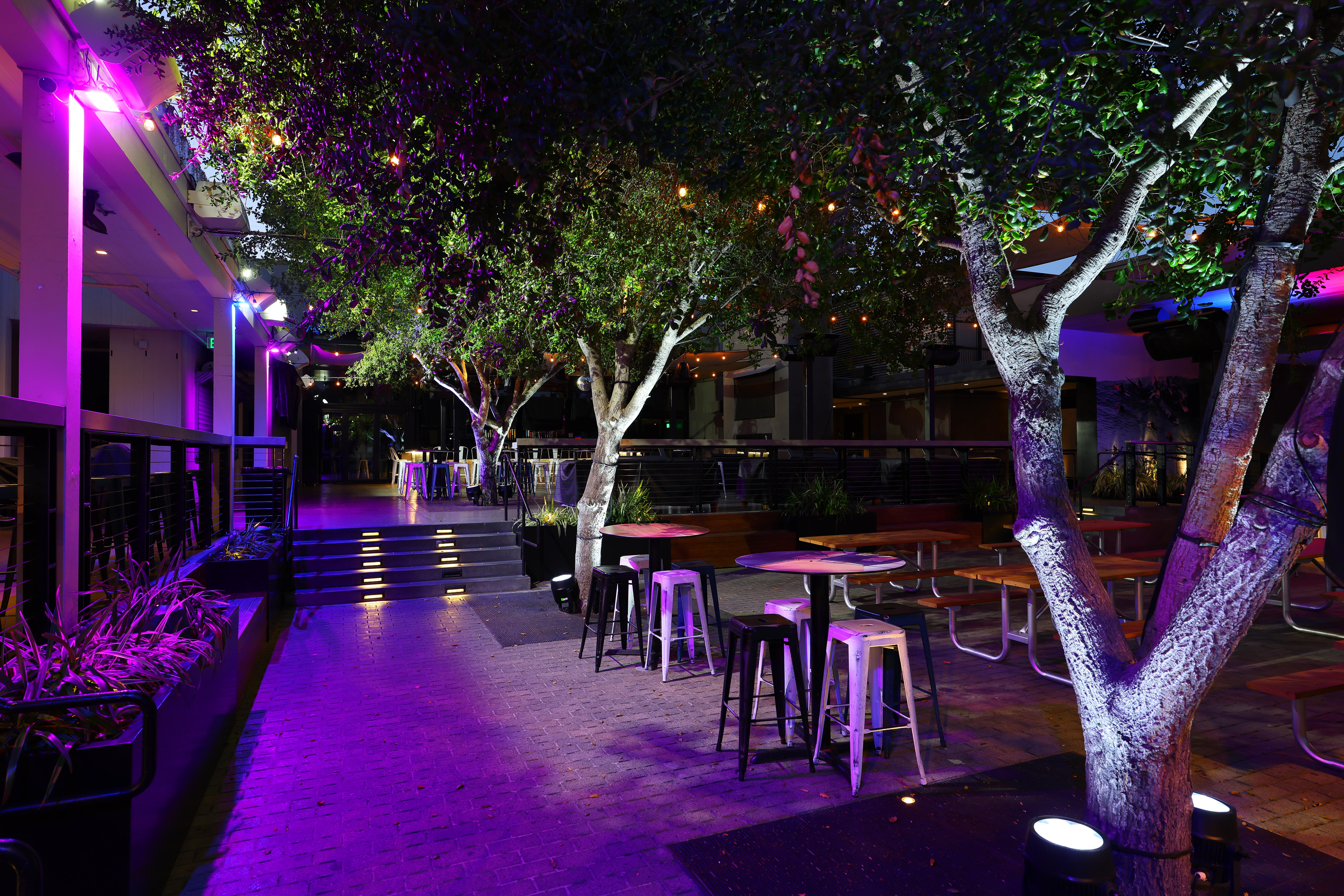
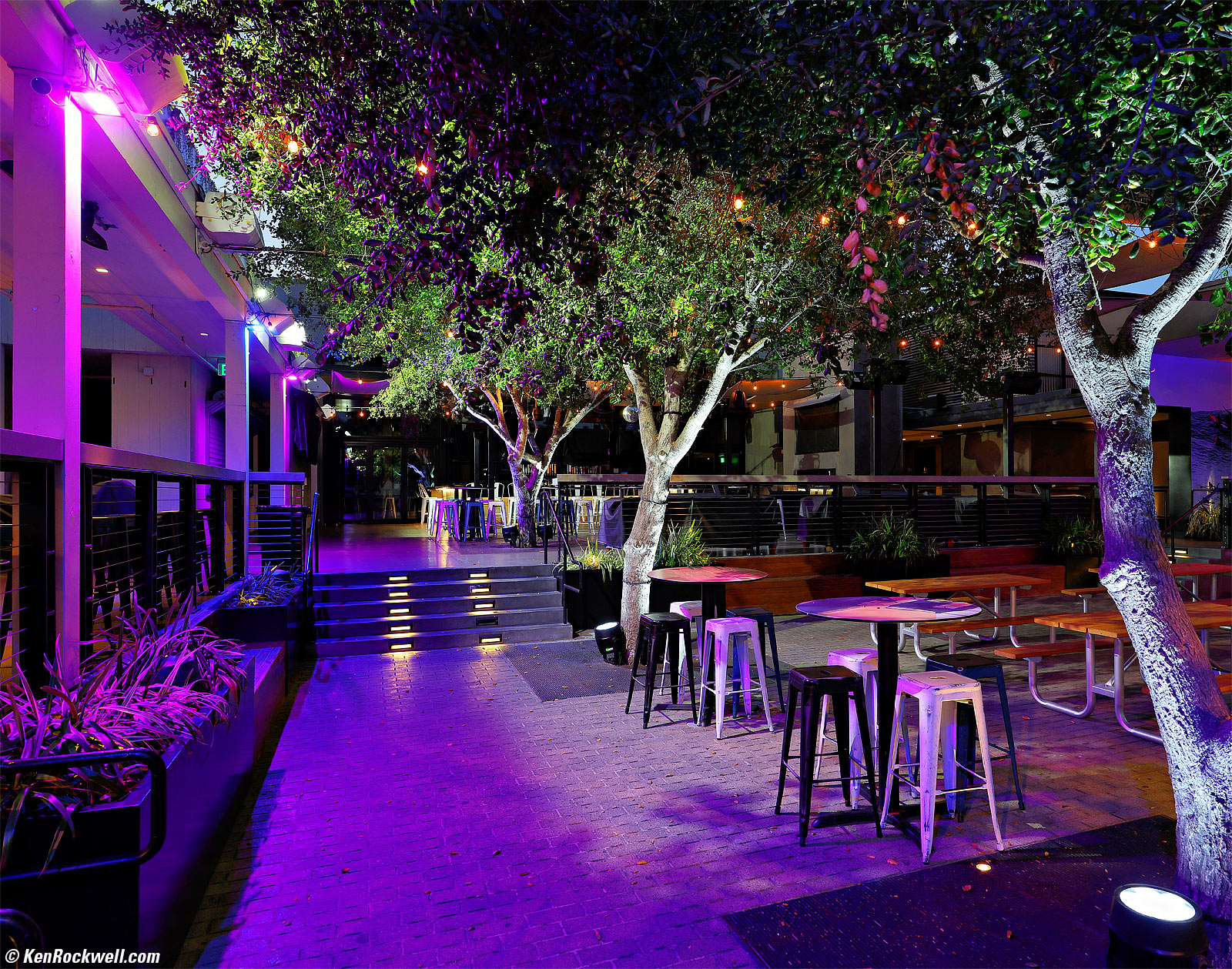
Swank Bar, Pacific Beach, California, 7:29 PM, Tuesday, 03 September 2024. Canon EOS R5 II and RF 10-20mm f/4 L IS STM at 20mm wide-open at f/4 hand-held at 1/8 of a second at Auto ISO 500, -0.7 stops exposure compensation (LV 4.7), details put back into the shadows without losing the highlights with Radiant Photo software, Photoshop CC. bigger or camera-original (unprocessed) 45 MP © 6.5 MB JPG Quality 1 file.
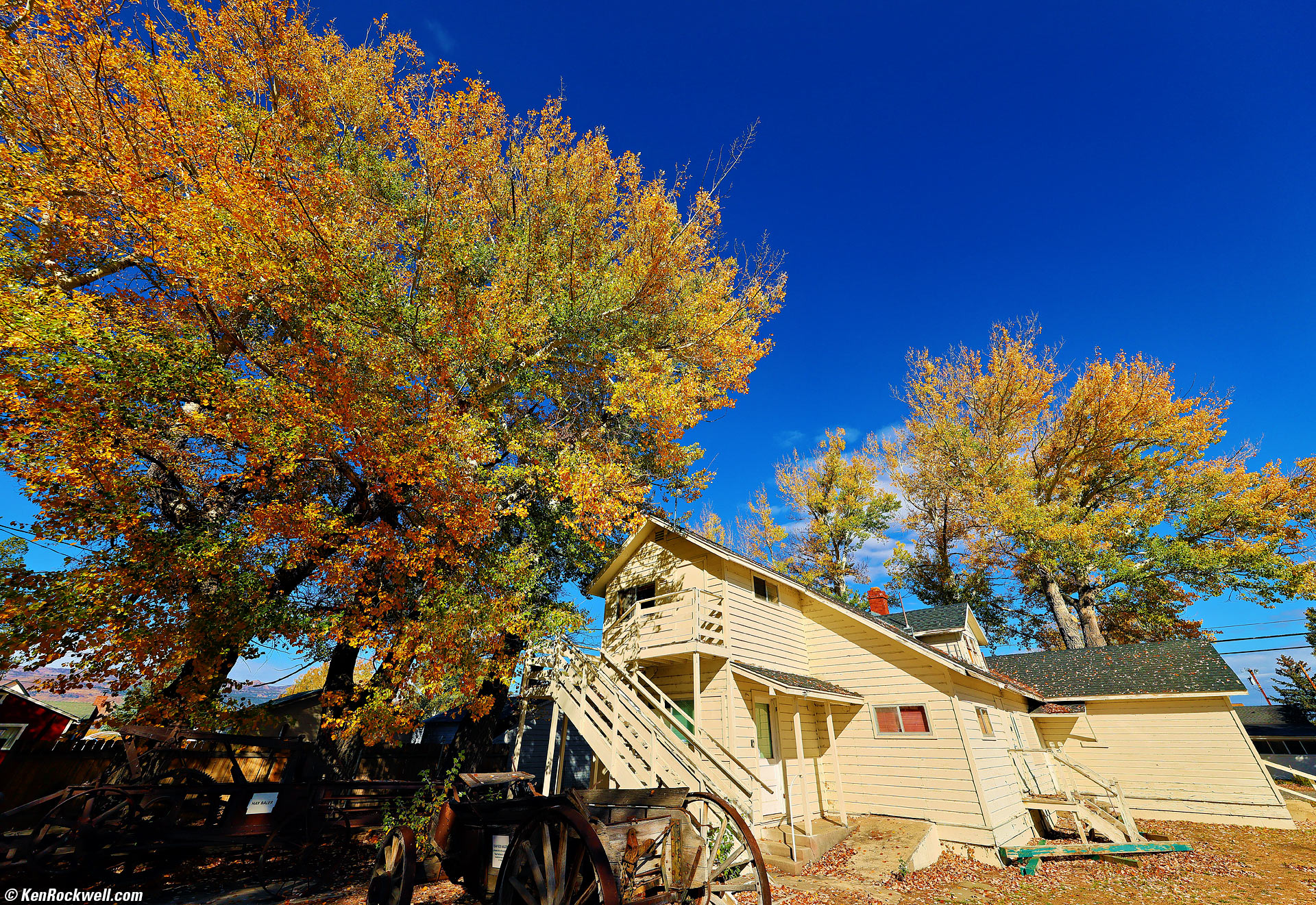
In this shot the right-side part of the tree seems softer, but it's simply close to the camera and out of focus. Look at the things behind it and you'll see they're sharp. In actual use, the RF 10-20mm f/4 L IS STM is ultrasharp, even at f/4, all the way out to the corners of my EOS R5 II. Bravo!
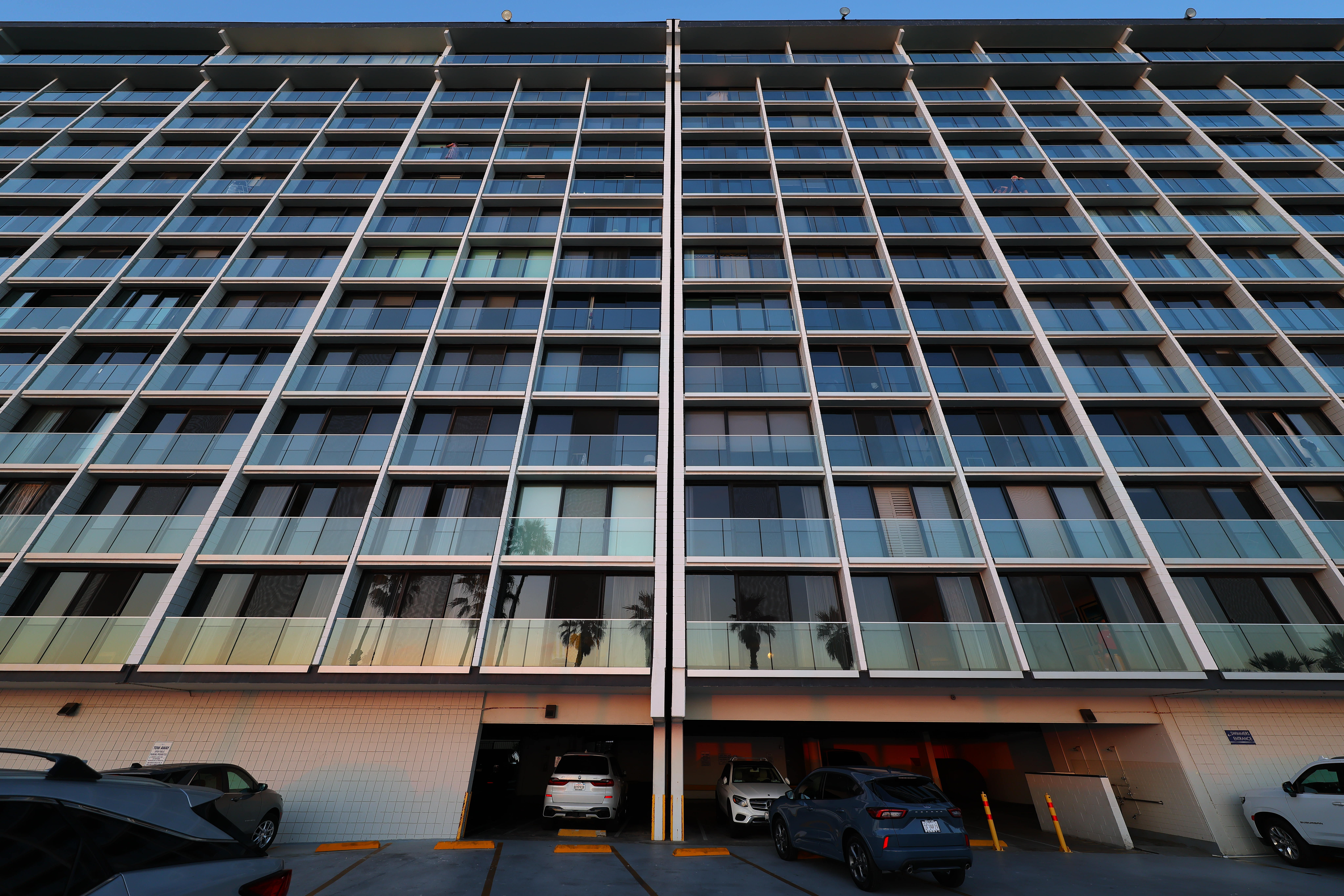
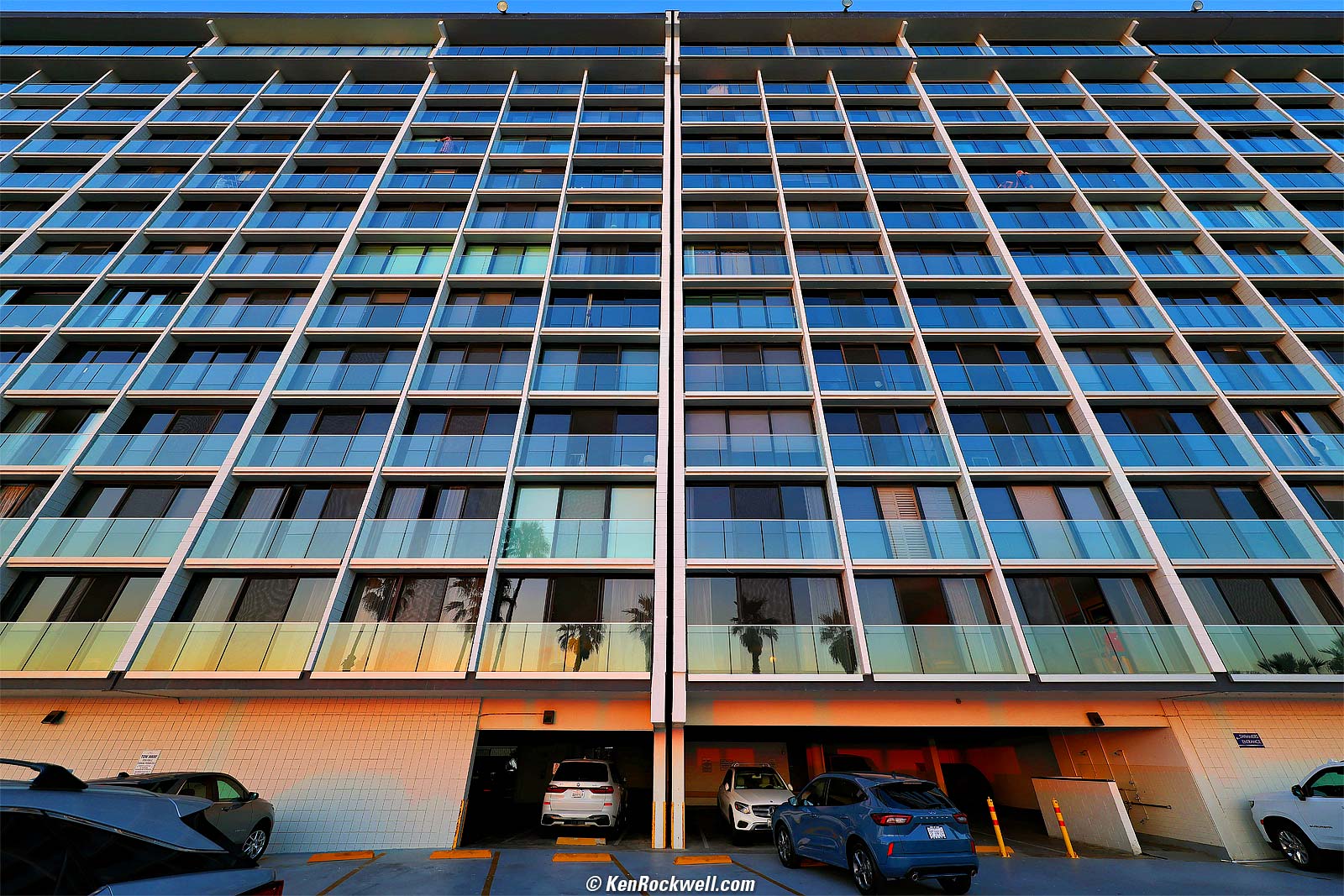
Capri by the Sea, Pacific Beach, California, 7:06 PM, Tuesday, 03 September 2024. Canon EOS R5 II and RF 10-20mm f/4 L IS STM at 13mm wide-open at f/4 at 1/60 at Auto ISO 100, -0.7 stops exposure compensation (LV 10.0), perked up in Radiant Photo and Photoshop CC. bigger or camera-original (unprocessed) 45 MP © 4.5 MB JPG Quality 1 file.

Introduction top
Sample Images Intro New Good Bad Missing
Specs USA Version Performance Compared
User's Guide Recommendations More

I buy only from these approved sources. I can't vouch for ads below. |



This Canon RF 10-20mm f/4L IS STM is an ultrasharp, ultra-ultrawide lens. Pleasant surprises are that it's also lightweight, reasonably practical, compact and inexpensive for what is otherwise an optically insane lens. It's half the weight of 2015's EF 11-24mm f/4L IS USM. It's about the same and weight as the small RF 14-35mm f/4 L IS USM and weighs only two-thirds as much as the RF 15-35mm f/2.8 L IS USM, and it's smaller, too!
This new RF 10-20mm f/4 L IS STM rocks. It's decades away from what we used to have to deal with for ultra-ultrawide lenses. As used on my EOS R5 II it has no distortion, no falloff, and no color shifts in the corners, all of which used to be common with lenses this wide.
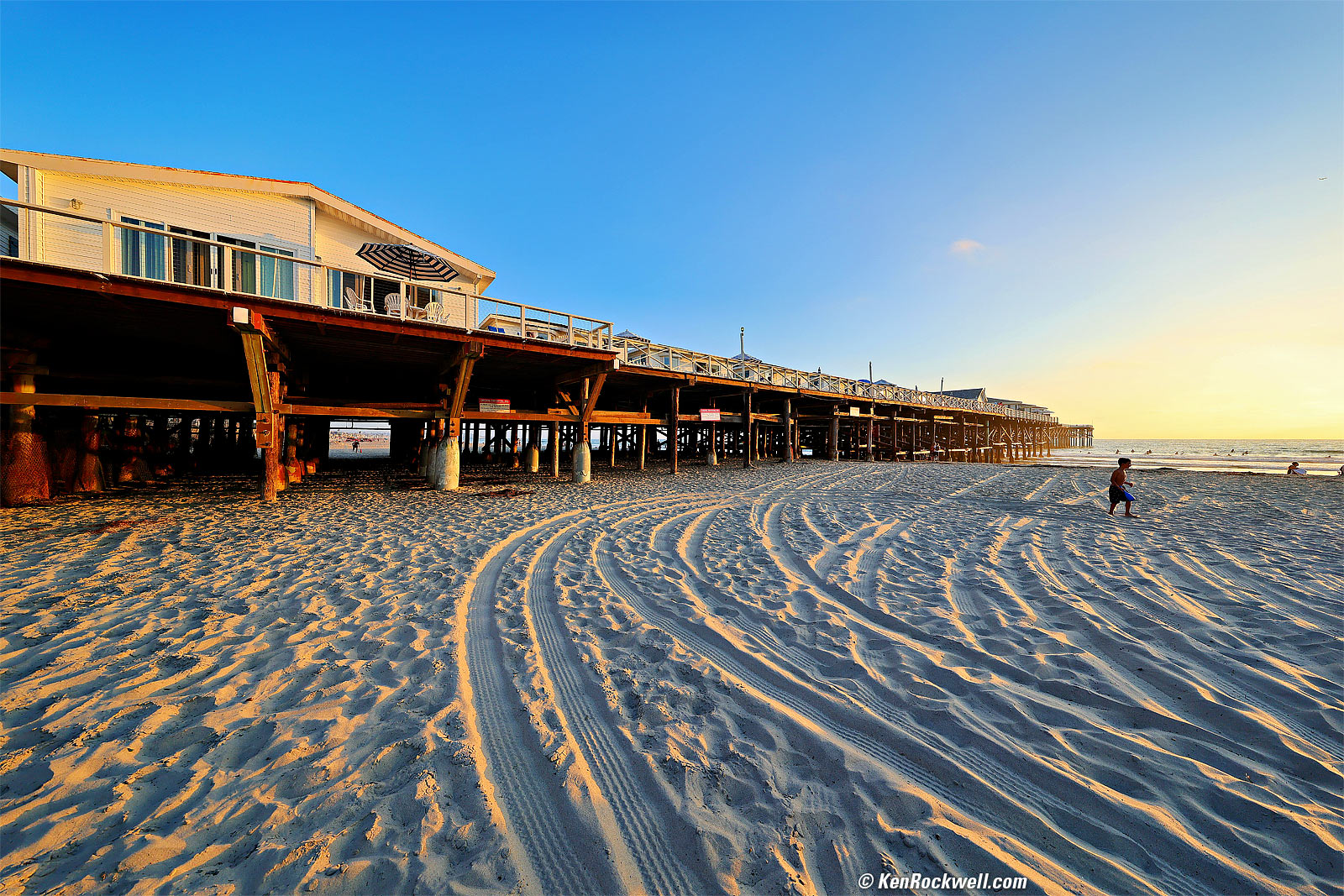
It's perfectly sharp and devoid of color fringes. You can count every grain of sand right out to the corners! At 10mm, everything is in focus:

Crystal Pier, Pacific Beach, California, 6:47 PM, Tuesday, 03 September 2024. Canon EOS R5 II and RF 10-20mm f/4 L IS STM at 10mm at f/6.3 at 1/160 at Auto ISO 100, (LV 12¾), perked up in Radiant Photo. bigger or camera-original (unprocessed) 45 MP © 6 MB JPG Quality 1 file.
Look at the camera-original JPG file; everywhere you look, it's flawless, and this is at the impossible 10mm ultra-ultra-ultrawide end of the zoom. Ultra-ultrawides were never this good! Did you notice the jetliner at the right edge?
Having owned the massive, impractical and optically pretty crummy-by-today's-standards Nikon 13mm f/5.6 (1976-1998), this new Canon lens is far superior optically and ergonomically, and sold at a bargain price for what it is: the world's widest non-fisheye zoom.
Its optics are free of the problems that used to plague Ultra-Ultrawide lenses: it's also free from distortion as-shot, and doesn't have any significant peripheral color shift, even uncorrected, which was always a problem in ultra-ultrawide lenses. Like any virtuoso, this lens performs incredibly difficult optical tricks and makes them all look easy.
While 10mm versus 11mm may seem like just one silly millimeter, it's significantly wider than the previous world wide leader, the EF 11-24mm f/4 L USM, and adds image stabilization.
This is insane! Ultra-ultra wides are extremely difficult to use, and if you know how, no other AF zoom goes this wide. There have been off-brand fixed or manual-focus lenses this wide, but nothing ever dedicated to a real camera system with this level of performance and modern electronic communication.
The only gotcha is this is not a lens for carrying around your neck all day because there is no way to use front protective filters. Its bulging unprotected front element is always susceptible to damage unless capped, and even minor dirt or damage will probably affect photos because the huge depth of field means things on the front element may quite visible. There's no way to mount a prophylactic filter on the front; it only can use gel filters on the rear. It always needs to be carried with the cap on when around your neck on a camera.
I got my RF 10-20mm f/4L IS STM at B&H. I'd also get mine at Adorama, at Crutchfield or at Amazon, or used at eBay if you know How to Win at eBay.
New intro top
 World's widest non-fisheye zoom.
Optical Image Stabilization! Rated 5 stops improvement without in-camera stabilization, 6 stops with in-camera stabilization. In actual use I get 3 to 4 stops of improvement on my stabilized R5 II. Lenses this wide have never been stabilized before, which is hugely important because geometry renders sensor-shift stabilization almost useless in the corners of an image.
Good intro top
 Ultrasharp.
No distortion as-shot.
Low flare and ghosts.
Great sunstars.
Surprisingly small.
Surprisingly light; half the weight of the EF 11-24mm f/4L.
Three control rings: mechanical zoom, electronic focus and a third programmable clicked control ring.
Programmable focus lock button.
AF/MF switch.
Stabilizer switch.
Case included.
Image Stabilization rated 5 stops by itself, and 6 stops when combined with in-camera stabilization. (actually gives about 3-4 stops real-world improvement).
Made in Japan.
100% U.S.A.-based high-quality technical support at (800) OK-CANON.
Bad intro top
 No way to protect the very delicate front element while shooting, unless you use the front cap.
Plastic exterior.
Crummy plastic front cap.
Missing intro top
 Mounting index dot not raised so it can't be found by feel in the dark.
No aperture ring.
No always-active manual-focus override, unless you set that in a menu.
No focus or depth-of-field scales.
No infra-red focus indices.
Won't work with any teleconverters — so?
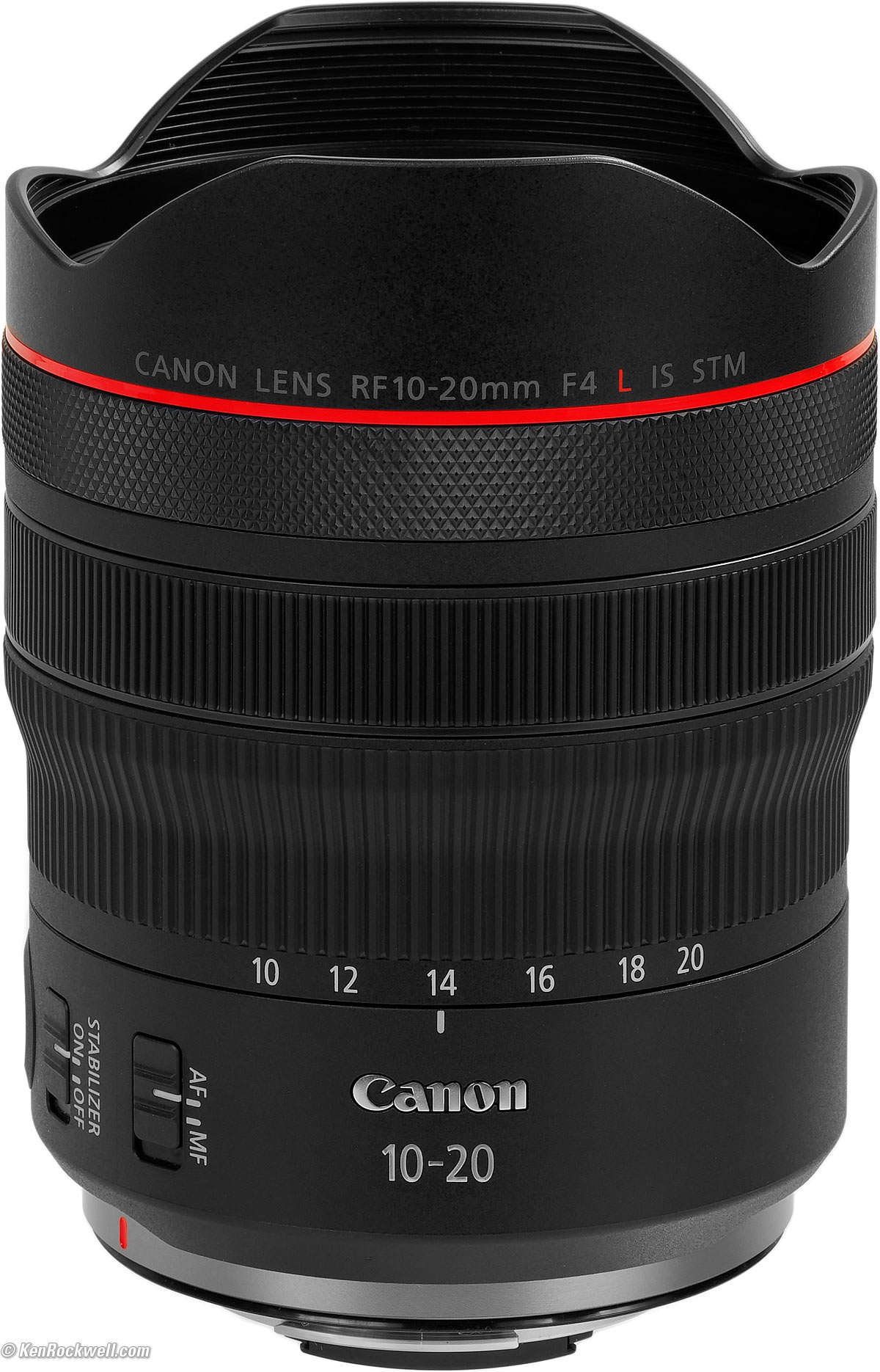
Canon RF 10-20mm f/4L IS STM. bigger.
Specifications top
Sample Images Intro New Good Bad Missing
Specs USA Version Performance Compared
User's Guide Recommendations More
I got my RF 10-20mm f/4L IS STM at B&H. I'd also get mine at Adorama, at Crutchfield or at Amazon, or used at eBay if you know How to Win at eBay.
See also Canon's own specifications (PDF).
Camera Compatibility
This lens only works on Canon's EOS-R series of mirrorless cameras.
It won't fit on, and cannot be adapted to, any DSLR because a DSLR has too much distance between its sensor and its lens mount flange.
This is a full frame lens and I'm reviewing it as such. Use this lens on full-frame cameras for the results I show here and that you deserve.
It won't work with any teleconverters.
While it works fine on APS-C cameras, you're paying an insanely premium price for the privilege of covering full frame, which APS-C cameras are not.
Using it on an APS-C camera throws away more than half of the image from this exotic lens. For APS-C cameras, use the RF-S 10-18mm IS STM instead for the same results from a far smaller and vastly less expensive lens.
Name specifications top
Canon calls this the RF 10-20mm f/4L IS STM:
RF: Works only on Canon's EOS-R Mirrorless cameras.
L: Expensive as L.
IS: Image Stabilization.
STM: STepper (autofocus) Motor.
Optics specifications top
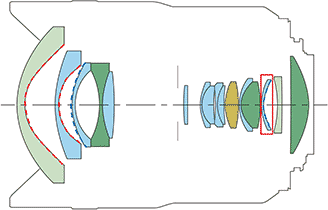
Canon RF 10-20mm f/4L IS STM Internal Optical Construction. Optical Glass, Aspherical, UD and UD Aspherical elements. Red box shows IS section. Red dashes show SWC Sub-Wavelength Coatings and dark blue dashes show ASC Air-Sphere coatings.
16 elements in 12 groups.
Canon writes that it has 1 super UD, 3 UD and 3 Aspherical elements, however Canon's diagram above (and the Japanese explanation along with it) shows me that it has 2 Aspherical, 3 UD and one UD Aspherical element. Potato, Potatoe; this is really only the business of Canon's lens designers.
Internal zooming and internal focusing; nothing moves externally. The front and rear sections move forwards and back inside the barrel, but the external barrel never moves.
Super Spectra multicoating, Air Sphere variable-refractive index coating (ASC) and sub-wavelength (SWC) coatings.
Fluorine coating to resist dirt and smudges.
Diaphragm specifications top
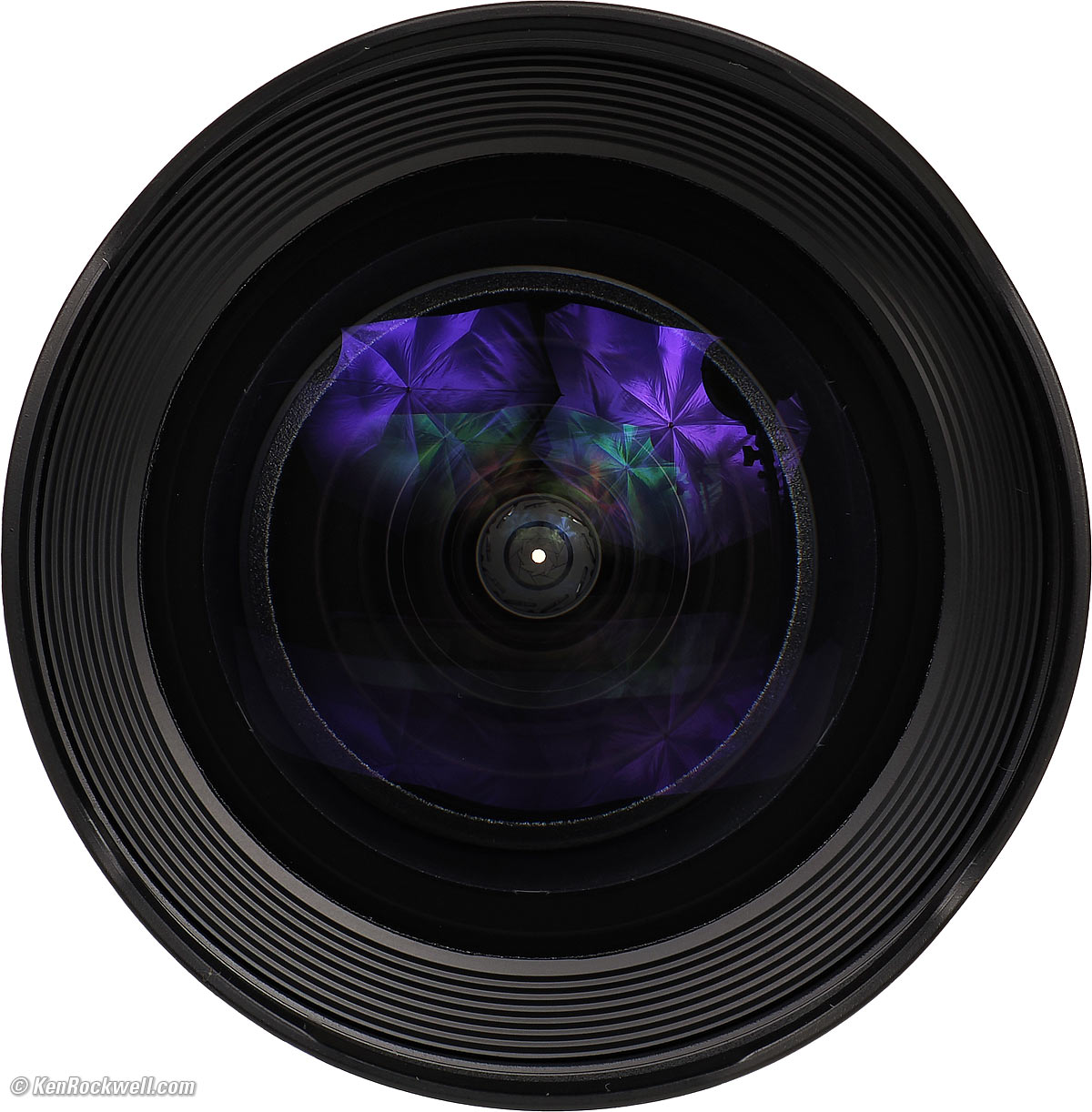
Canon RF 10-20mm f/4L IS STM. bigger.
9 rounded blades.
Electronically actuated.
Stops down to f/22.
Filters specifications top
Rear gel filters only.
Angle of View specifications top
130.42° ~ 94° diagonal.
121.92° ~ 84° horizontal.
100.42° ~ 62° vertical.
Focus Scale specifications top
No.
Not on lens, but may be displayed in-camera.
Infinity Focus Stop specifications top
No.
You have to focus somehow to get precise focus at infinity, just like at every other distance.
Depth of Field Scale specifications top
No.
Not on lens, but may be displayed in-camera.
Infrared Focus Index specifications top
No.
Close Focus (distance from subject to image plane) specifications top
0.8 feet (9.8" or 0.25 meters), which is almost up to the front of the lens.
Maximum Reproduction Ratio specifications top
1:8.3 (0.12×).
Minimum Subject Field specifications top
At 20mm
11.18 x 7.44 inches.
347 x 189 millimeters.
At 10mm
20.47 x 13.66 inches.
520 x 347 millimeters.
Reproduction Ratio Scale specifications top
No.
Not on lens, but may be displayed in-camera.
Image Stabilizer specifications top
Rated 5 stops improvement without in-camera stabilization, 6 stops with in-camera stabilization.
In actual use I get 3 to 4 stops of improvement on my stabilized R5 II.
Caps specifications top
Special front cap (p/n 6181C001).
Standard Rear Lens Dust Cap RF (p/n 2962C001).
Details at Caps.
Case specifications top
I love my Think Tank Retrospective bags for carrying this with my cameras.
I've never used the included LP1219 sack:
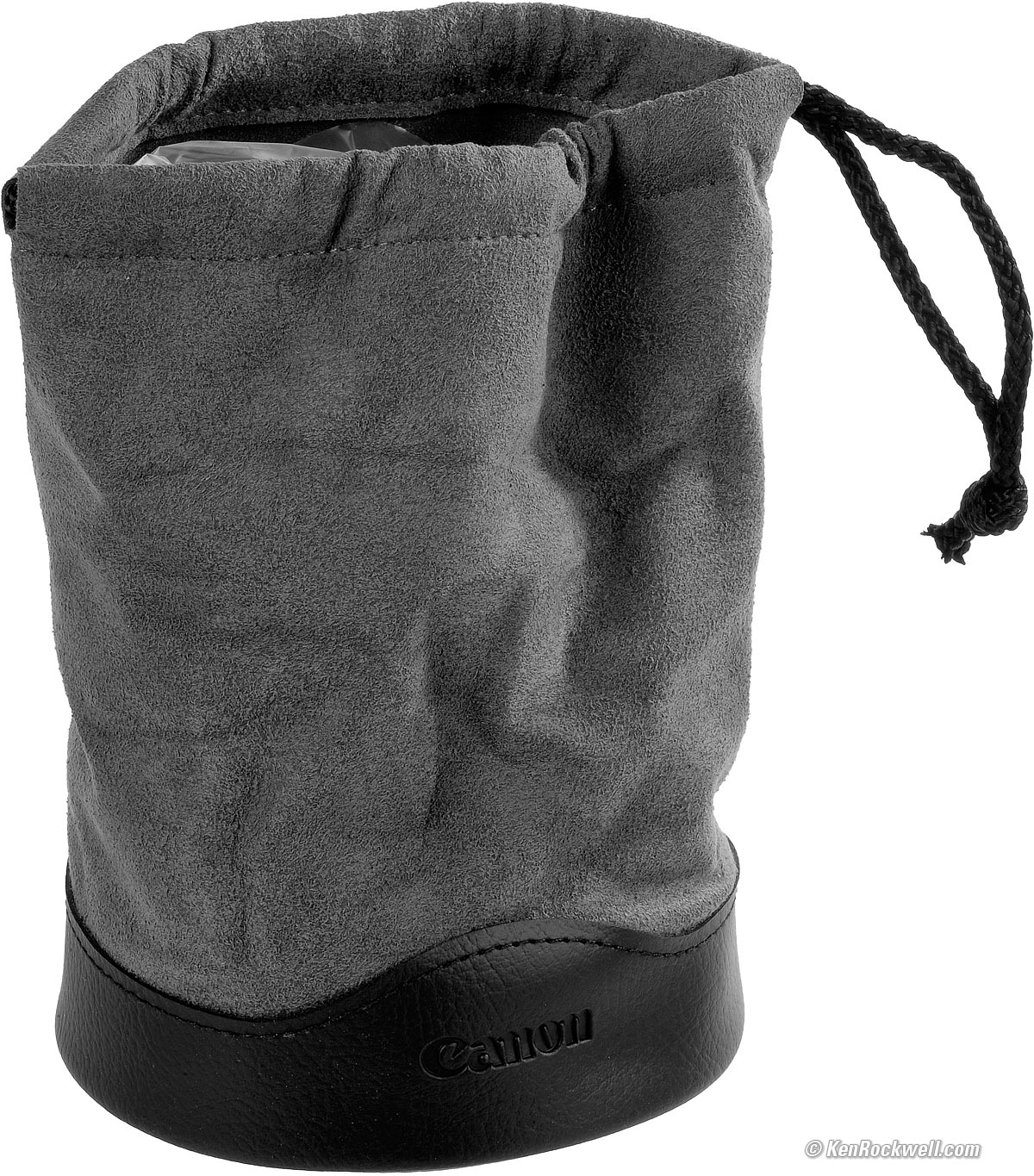
Canon LP1219 Lens Sack. bigger.
Size specifications top
3.30" ø maximum diameter × 4.41" extension from flange.
83.7 mm ø maximum diameter × 112 mm extension from flange. My calipers measure 82.80mm around the front of the lens.
Weight specifications top
19.965 oz. (565.9 g) actual measured weight.
Rated 20.11 oz. (570 g).
Quality specifications top
Canon RF 10-20mm f/4L IS STM. bigger.
Made in Japan.
Announced specifications top
12:01 AM, Wednesday, 11 October 2023.
Promised for specifications top
November 2023.
Included specifications top
Lens.
Special front cap (p/n 6181C001).
Rear Lens Dust Cap RF (p/n 2962C001).
LP1219 sack.
Packaging specifications top
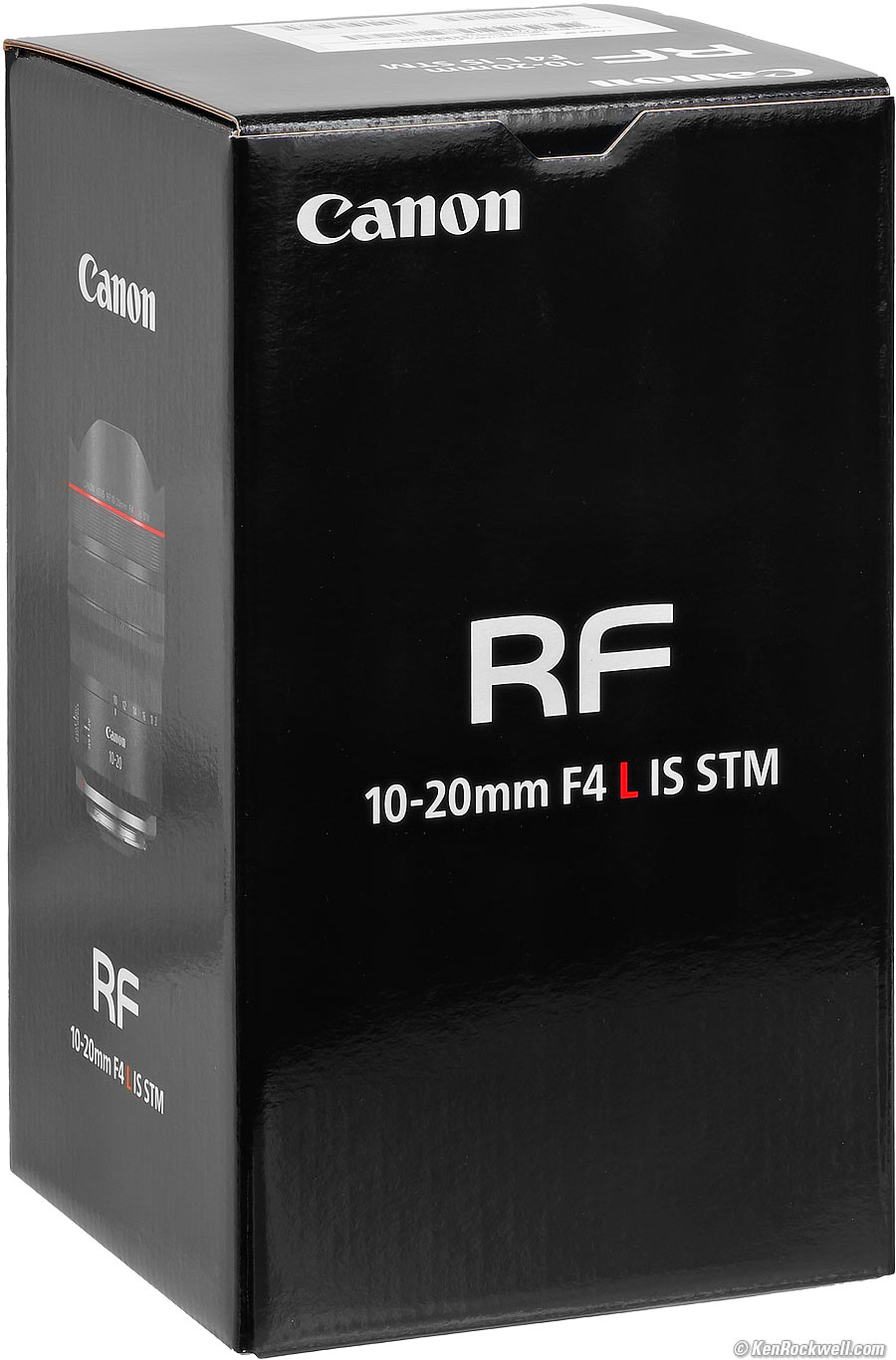
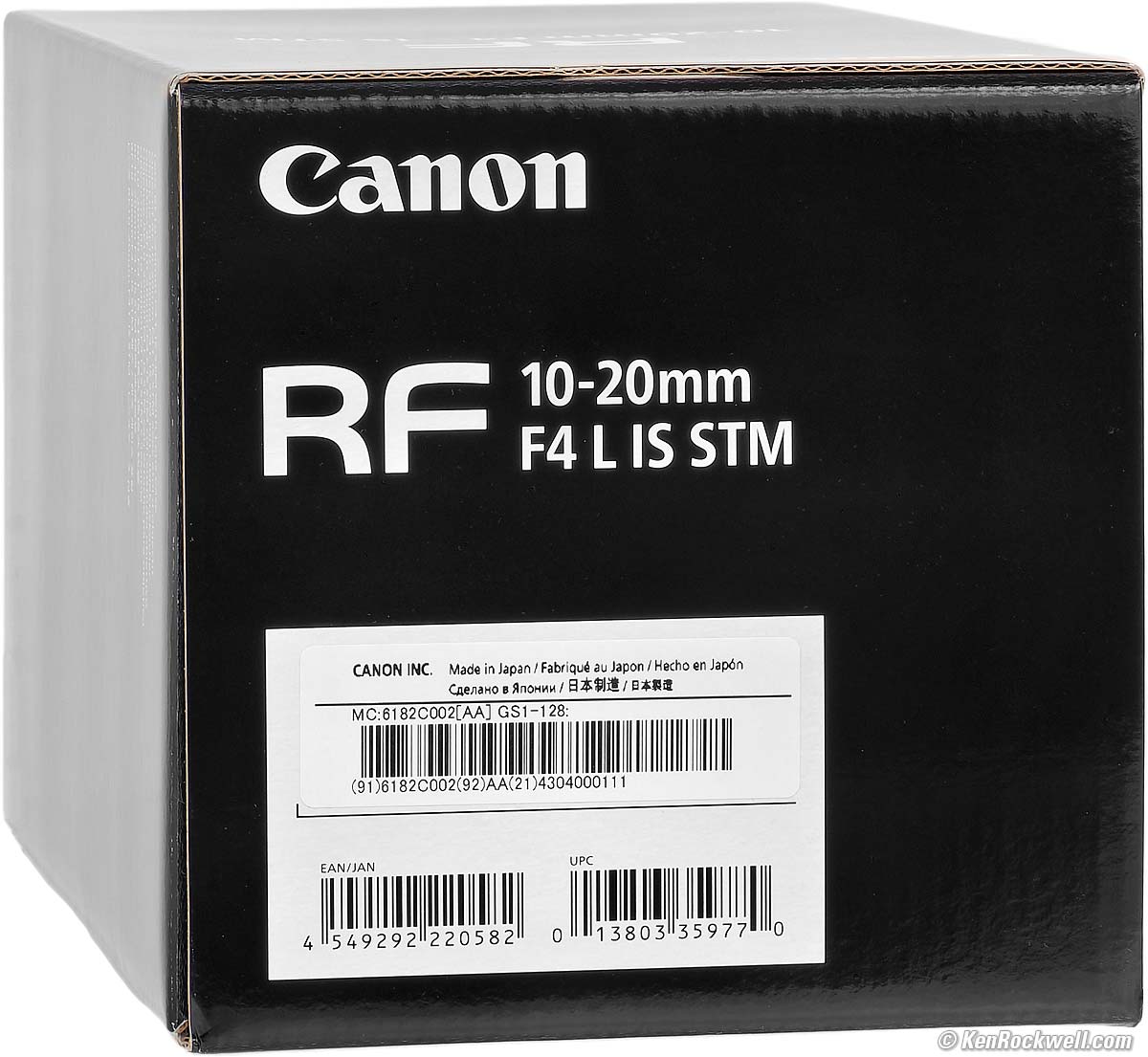
Microcorrugated cardboard box with polypropylene top and bottom lens holders:
Box. bigger. |
Box End. bigger. |
Model Numbers specifications top
Product code: 6182C002 (6182C001 in Japan).
Model number: RF10-20LIS.
JAN code: 4549292220582.
Price, U. S. A. specifications top
27 June 2025
$2,499 at B&H, at Adorama, at Crutchfield and at Amazon.
About $2,000 used if you know How to Win at eBay.
21 March 2025
$2,299 at B&H, at Adorama, at Crutchfield and at Amazon.
About $2,000 used if you know How to Win at eBay.
13 November 2024
$2,299 at B&H, at Adorama, at Crutchfield and at Amazon.
About $2,150 used if you know How to Win at eBay.
October 2024
$2,299 at B&H, at Adorama, at Crutchfield and at Amazon.
About $2,174 used if you know How to Win at eBay.
Getting a Legal U. S. A. Version top
Sample Images Intro New Good Bad Missing
Specs USA Version Performance Compared
User's Guide Recommendations More
I got my RF 10-20mm f/4L IS STM at B&H. I'd also get mine at Adorama, at Crutchfield or at Amazon, or used at eBay if you know How to Win at eBay.
This section applies in the U. S. A. only.
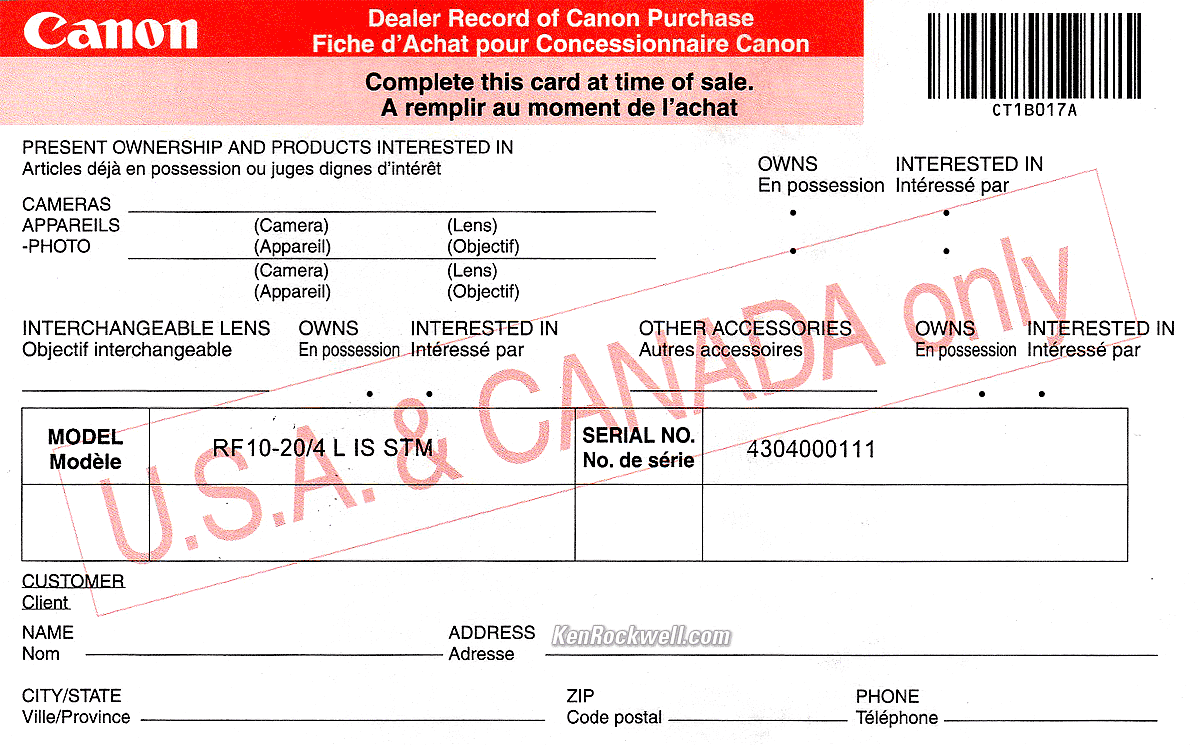
Canon RF 10-20mm f/4L IS STM. bigger.
Your lens must include a U. S. A. warranty card like the one shown above from Canon U.S.A., Inc. It should be on top inside your box as you open it. The serial number on the card must match the serial number on the bottom of your lens.
If you have no card or the serial number doesn't match, you got ripped off with a gray market version intended to be sold in another country. This is why I never buy from any place other than my personally approved sources. You just can't take the chance of buying elsewhere, especially at any retail store where strangers have probably opened your completely unsealed box and played with your camera, because non-U. S. A. versions have no warranty in the U. S. A., and you probably won't be able to get firmware or service for it — even if you're willing to pay out-of-pocket for it when you need it!
Shifty dealers may include color copies of a card from a legitimate U. S. A. product in a gray-market box, hoping you won't check serial numbers and catch their fraud. A card with the wrong serial number means nothing other than that you have no warranty coverage.
The serial number on the box doesn't have to match, but it should. It will be hidden someplace on the sticker with all the bar codes. If not, it means a shady dealer took things out of boxes and was too sloppy to put them back correctly — and it means you got a used lens if anyone other than you took it out of the box.
If a gray market version saves you $600 the risk might be worth it, but for $200 or less I wouldn't risk having no warranty or support.
Always be sure to check yours while you can still return it, or just don't buy from unapproved sources and never at retail so you'll be able to have your camera serviced and get free updated firmware as needed. Get yours from the same places I do and you won't have a problem.
Performance top
Sample Images Intro New Good Bad Missing
Specs USA Version Performance Compared
User's Guide Recommendations More
Overall Autofocus Manual Focus Breathing
Distance Recording Bokeh Caps Distortion
Ergonomics Falloff Filters Flare & Ghosts
Hood Lateral Color Fringes Lens Corrections
Macro Mechanics Peripheral Color Sharpness
Spherochromatism Stabilization Sunstars
I got my RF 10-20mm f/4L IS STM at B&H. I'd also get mine at Adorama, at Crutchfield or at Amazon, or used at eBay if you know How to Win at eBay.
Overall performance top
Great optics, handling and reasonable price? What's not to love? This unassuming little lens is a breakthrough in being the world's widest non-fisheye zoom, and what's awesome is that any serious photographer can afford it, unlike olden days when the Nikon 13mm f/5.6 (1976-1998) was made by Nikon mostly just to taunt us seeing it in catalogs, but priced more than most cars.
Autofocus performance top
Autofocus speed has never been a problem with ultrawide lenses, and this is no different. Autofocus is essentially silent, and more than fast enough.
Manual Focus performance top
Manual focusing is entirely electronic; the manual focus ring isn't connected to anything other than a digital encoder.
How to Get Manual-Focus Override.
Focus Breathing performance top
Focus breathing is the image changing size (growing and shrinking slightly) as focused in and out. It's important to cinematographers that the image not breathe as focus gets pulled back and forth between different actors as they speak. The image is said to breathe because it expands and contracts as the focus follows the dialog.
The image from this lens contracts as focused more closely.
Focus Distance Recording performance top
The focused distance is recorded in the EXIF data.
I read this in the lower left of my screen in Photoshop's lens correction filter.
Bokeh performance top
Bokeh, the feel, character or quality of out-of-focus areas as opposed to how far out of focus they are, is good, but it doesn't really matter as nothing ever gets that far out of focus with a lens this wide.
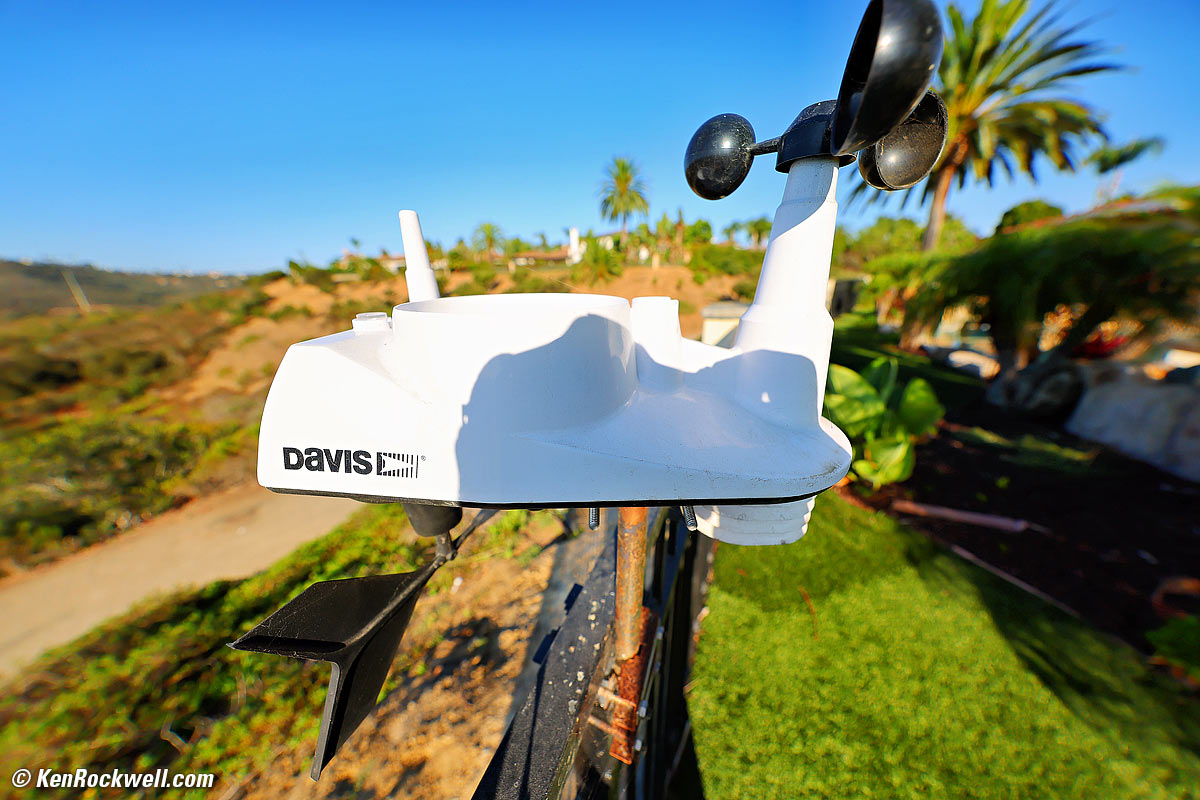
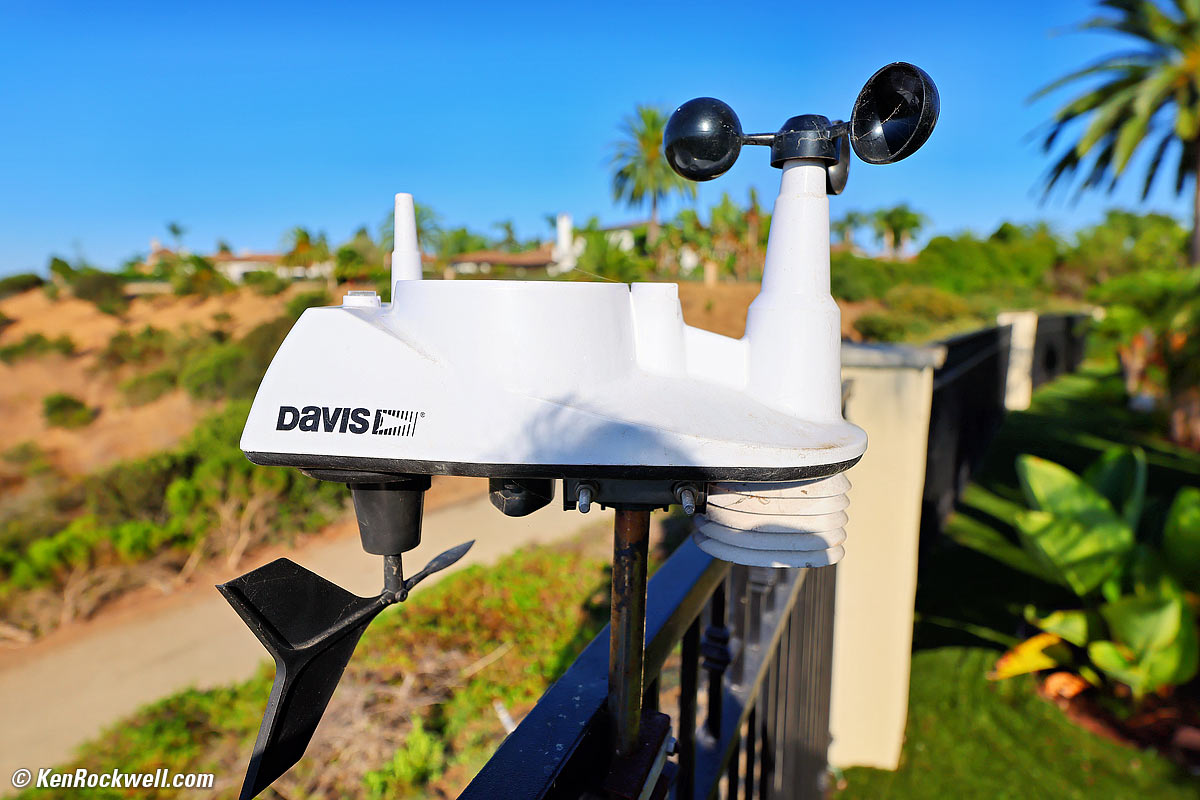
Here are photos from headshot distance wide-open. I'm focused on the DAVIS logo. Click any for the © camera-original file:
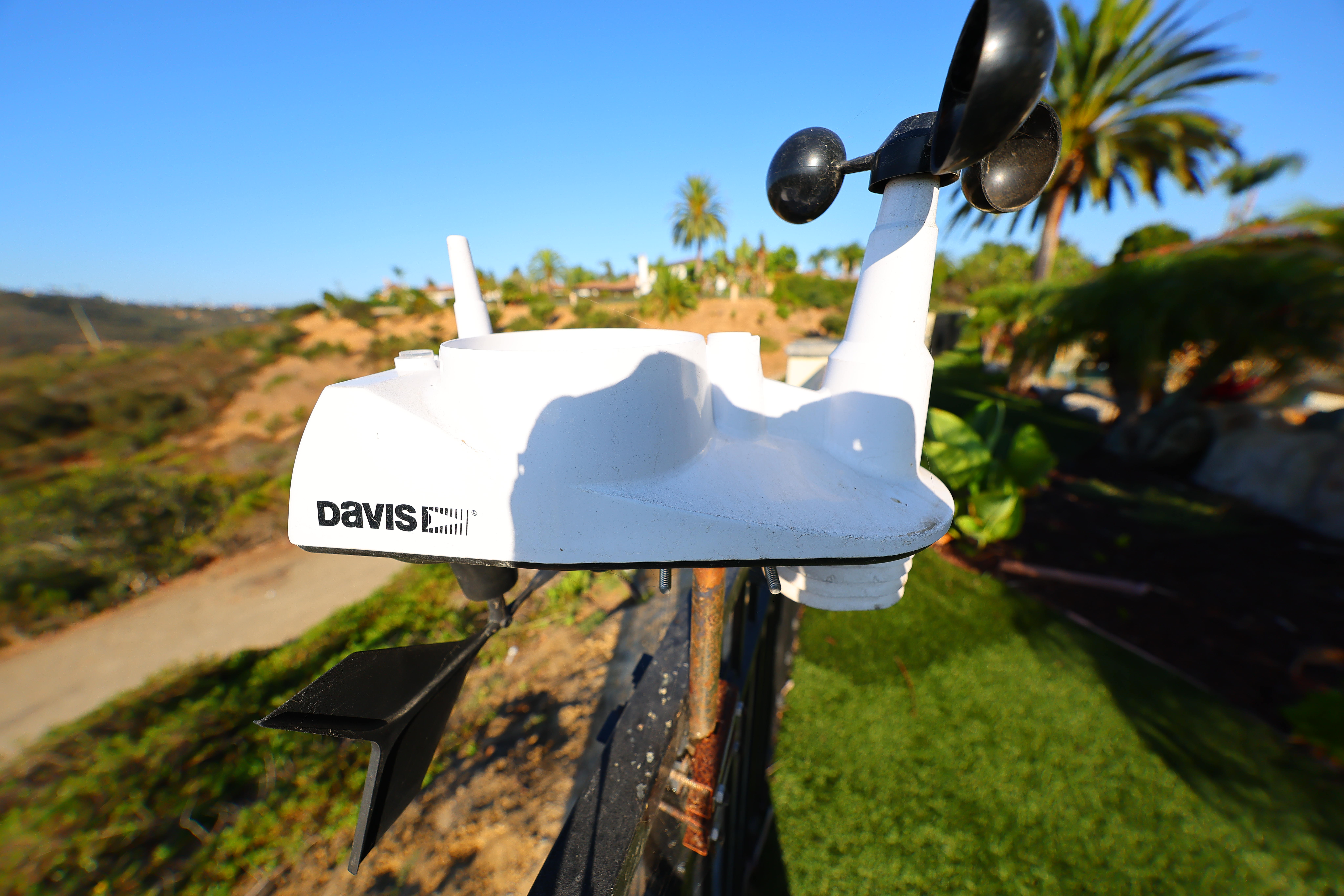
Made-in-U. S. A. Davis 6357 Wireless Sensor Suite (use with WeatherLink console), 8:27 AM, Thursday, 05 September 2024. Canon EOS R5 II, RF 10-20mm f/4 L IS STM at 10mm wide-open at f/4 at 1/800 at Auto ISO 100 (LV 13.6). bigger or camera-original © file.
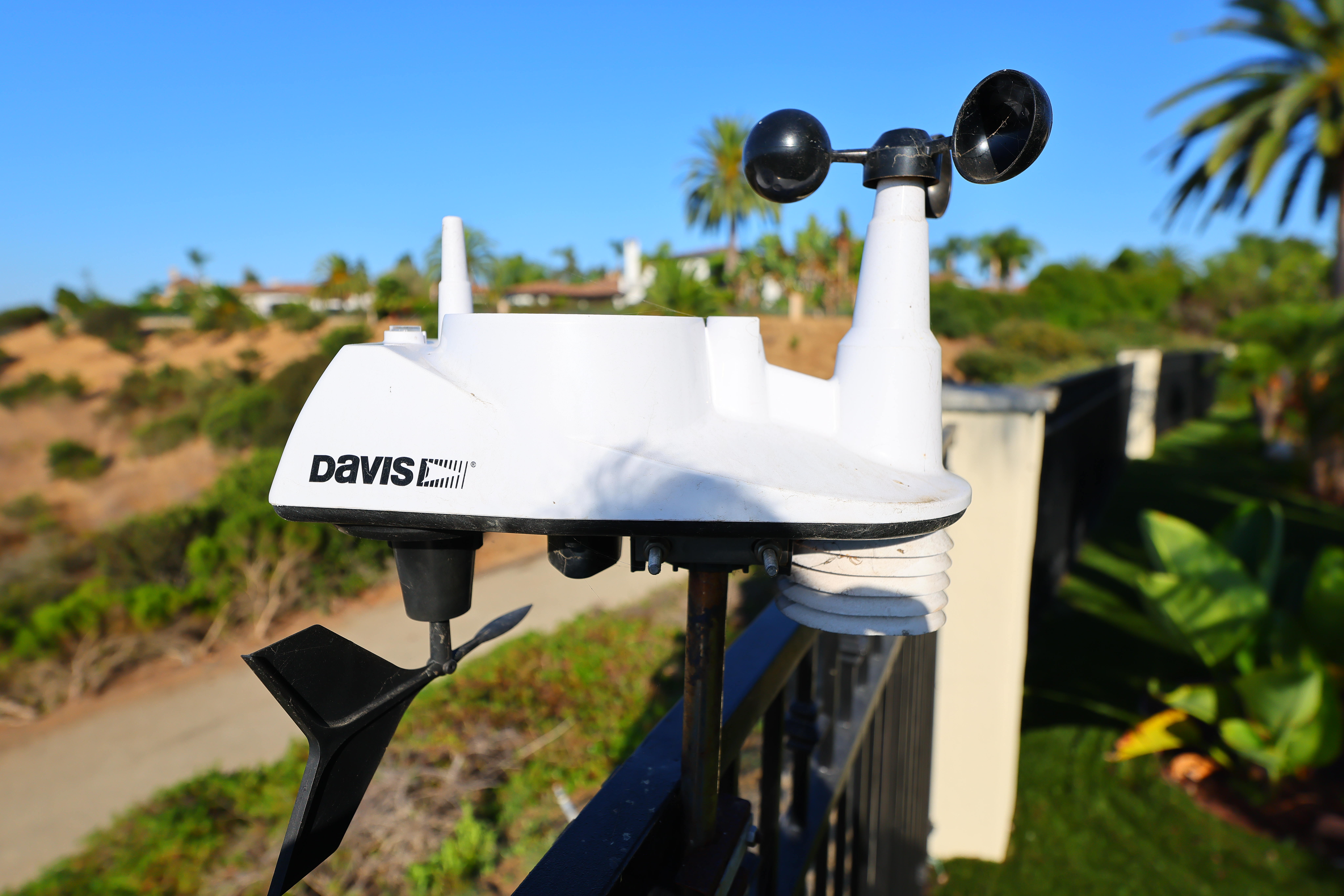
Made-in-U. S. A. Davis 6357 Wireless Sensor Suite (use with WeatherLink console), 8:26 AM, Thursday, 05 September 2024. Canon EOS R5 II, RF 10-20mm f/4 L IS STM at 20mm wide-open at f/4 at 1/1,250 at Auto ISO 100, +0.7 stops exposure compensation (LV 14.4). bigger or camera-original © file.
As always, if you want to throw the background as far out of focus as possible, shoot at f/4 at 20mm and get as close as possible.
Caps specifications top
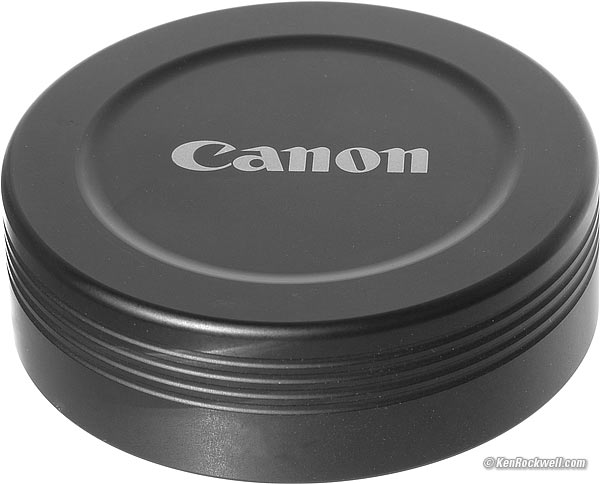
Unlike the solid billet aluminum felt-lined caps of the great lenses of old like the original EF 14mm f/2.8L, this cap is crappy plastic:
|
|
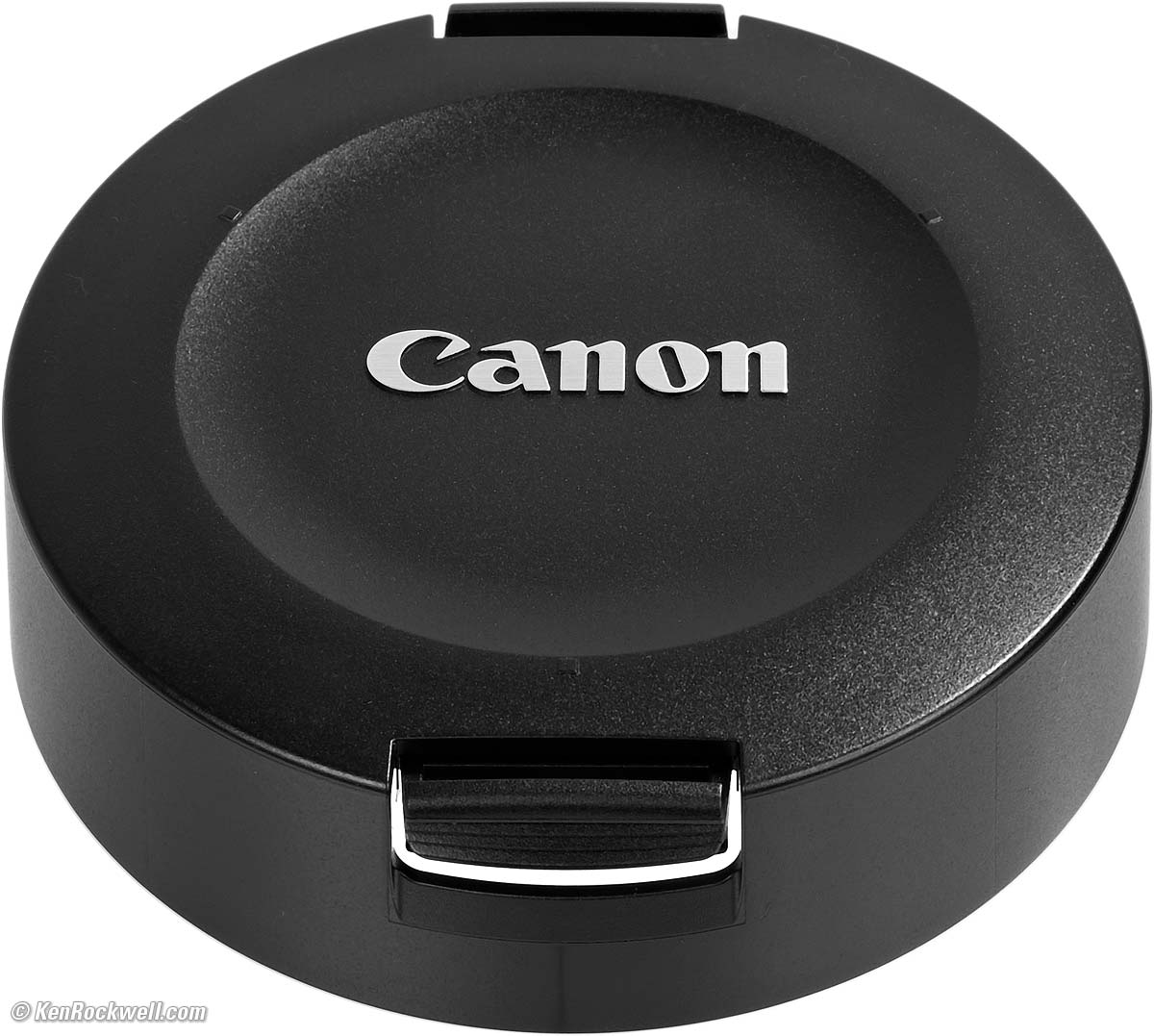
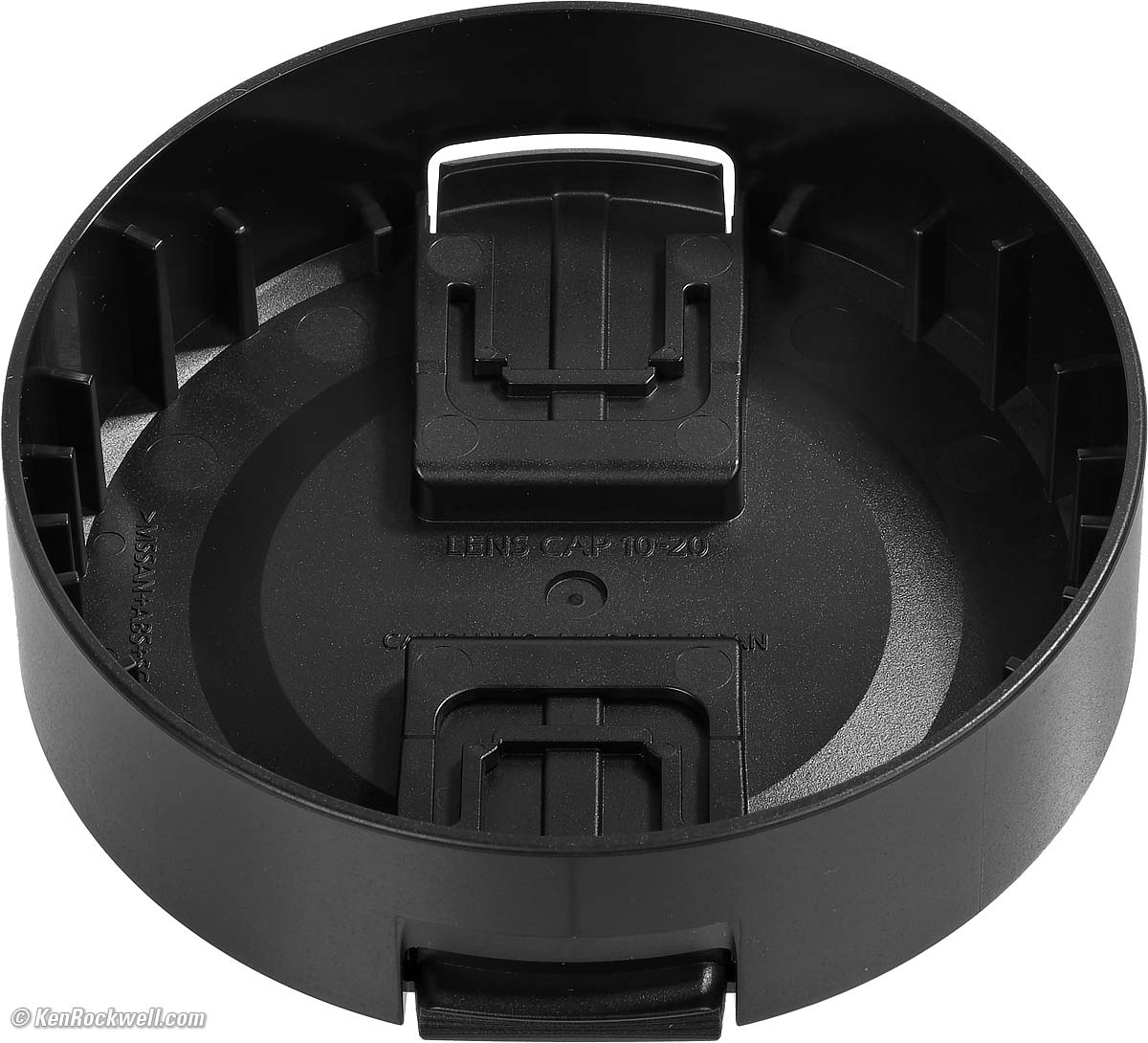
It clips on and around the front of the lens, but doesn't seal tightly as the felt-lined caps do. It has internal ribs that leave airspaces so it comes off and on easily, but likewise it's an open door to dust and dirt over time.
Look through the lens with the cap on, and you'll see light sneaking in around the sides of the cap 😁:
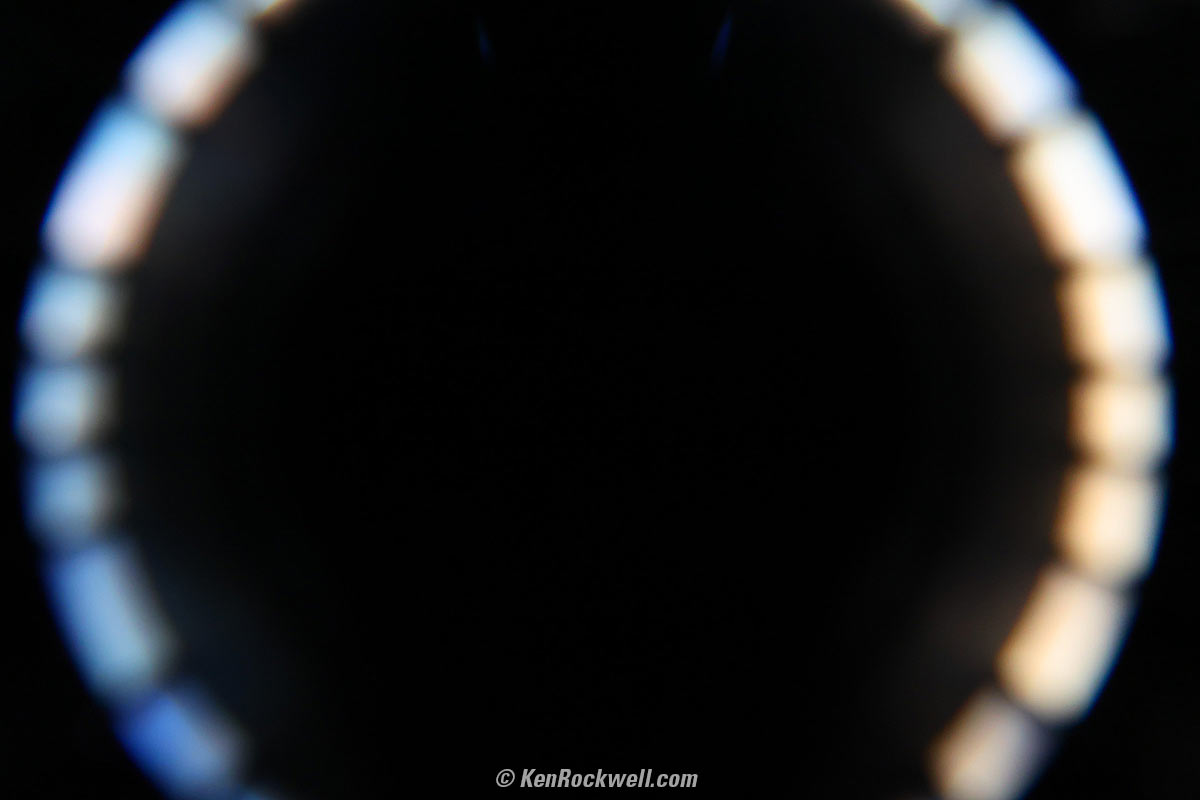
Shot at 15mm at f/4 on full-frame with the cap on. bigger.
Distortion performance top
The RF 10-20mm has no visible distortion as shot because electronic distortion control is an integral part of its design. In-camera distortion control is always active; you can't turn it off.
Capri by the Sea, Pacific Beach, California, 7:06 PM, Tuesday, 03 September 2024. Canon EOS R5 II and RF 10-20mm f/4 L IS STM at 13mm wide-open at f/4 at 1/60 at Auto ISO 100, -0.7 stops exposure compensation (LV 10.0), perked up in Radiant Photo and Photoshop CC. bigger or camera-original (unprocessed) 45 MP © 4.5 MB JPG Quality 1 file.
If you shoot raw data rather than JPG images, whatever software you use to create visible images from raw data may or may not correct the distortion as is done in-camera as JPGs. You're on your own there; I don't bother with raw data.
While Canon's own software probably also corrects this from RAW CR3 files, be warned that other brands of raw processing software probably won't correct the distortion, and Heaven only knows what distortion you may see then.
For more critical scientific use, use these corrections in Photoshop's lens correction filter to JPG images.
These aren't facts or specifications, they are the results of my research that requires hours of photography and calculations on the resulting data.
On Full-Frame at Infinity |
Correction factor to use with images made with correction ON in R5 II (other cameras should be the same) |
10mm |
+0.10 |
12mm |
-0.20 |
14mm |
-0.30 |
16mm |
-0.20 |
18mm |
-0.60 |
20mm |
-0.40 |
© 2024 KenRockwell.com. All rights reserved.
Ergonomics performance top
|
|
Canon RF 10-20mm f/4L IS STM. bigger. |
Canon RF 10-20mm f/4L IS STM. bigger. |
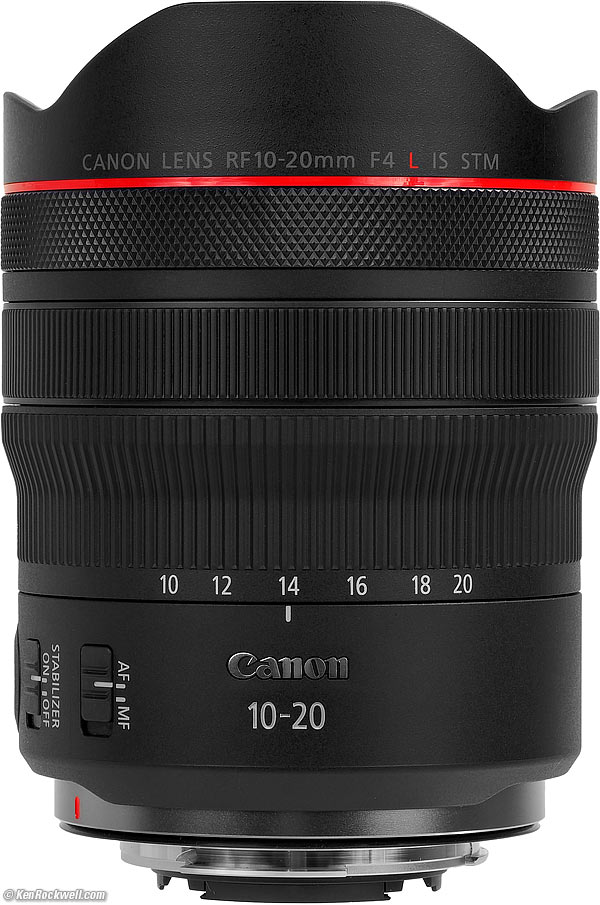
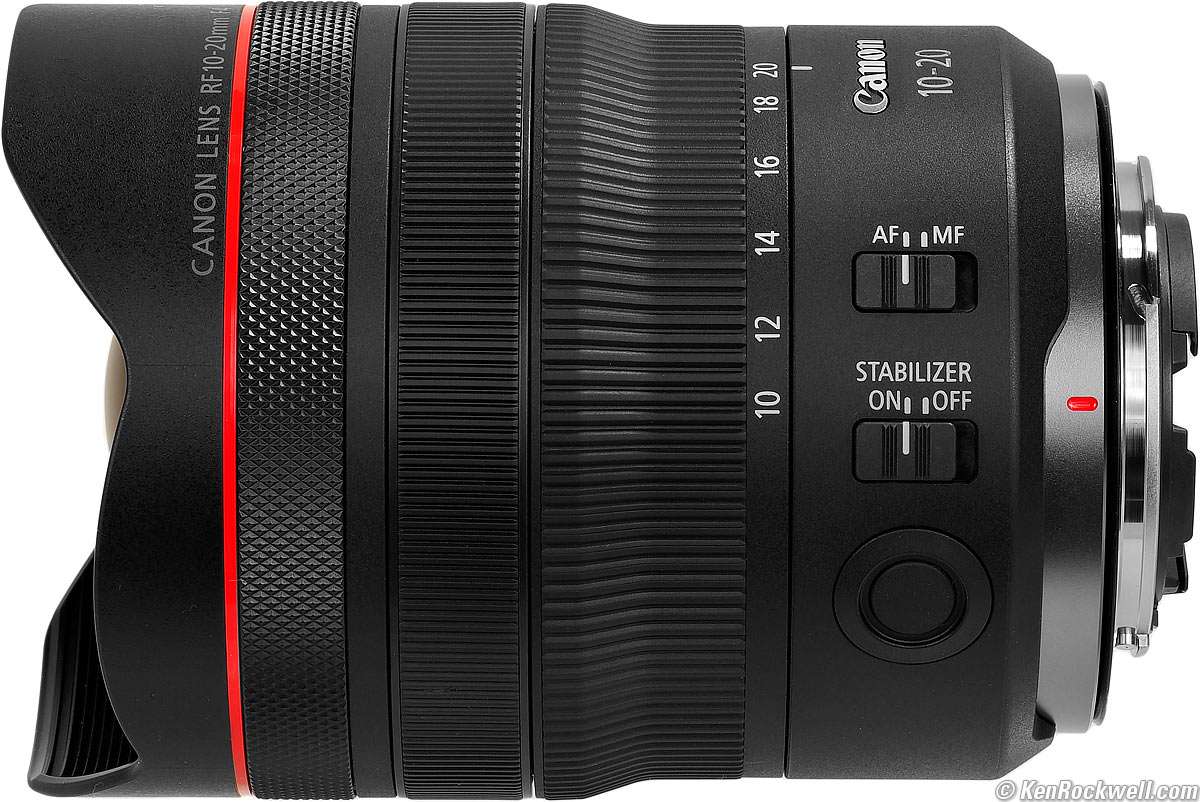
Canon RF 10-20mm f/4L IS STM. bigger.
This lens has lots of controls. There's an unmarked round programmable button, which is usually AF lock unless programmed otherwise in your camera.
There are three control rings: a mechanical zoom ring, an electronic focus ring and a third programmable clicked control ring.
Depending on camera model, manual-focus override may need to be activated in a menu. Even when set, Canon cameras aren't smart enough to stop trying to focus in SERVO AF mode; it will resume trying to autofocus as soon as you release the manual focus ring in SERVO AF mode.
Other than having no way to use a protective front filter so we have to carry it around with the front cap attached, this lens handles well.
Falloff performance top
Falloff isn't a problem at any lens setting.
I've greatly exaggerated the falloff by shooting a gray field and placing these on a gray background; it will not look this bad in actual photos of real things. As you've seen, falloff is invisible in actual photos even at 10mm at f/4. These torture tests it look much worse:
Falloff on full-frame at infinity, correction at its default of ON:
© 2024 KenRockwell.com. All rights reserved. |









If you save only raw data rather than create JPG images in-camera, whatever software you use to create visible images from that raw data later may or may not correct this as is done in-camera as JPGs. You're on your own there; I don't bother with raw data.
If you go out of your way to turn off the correction, or possibly in some raw software, this is what you get:
Falloff on full-frame at infinity, correction deliberately turned OFF:
© 2024 KenRockwell.com. All rights reserved. |











Filters, use with performance top
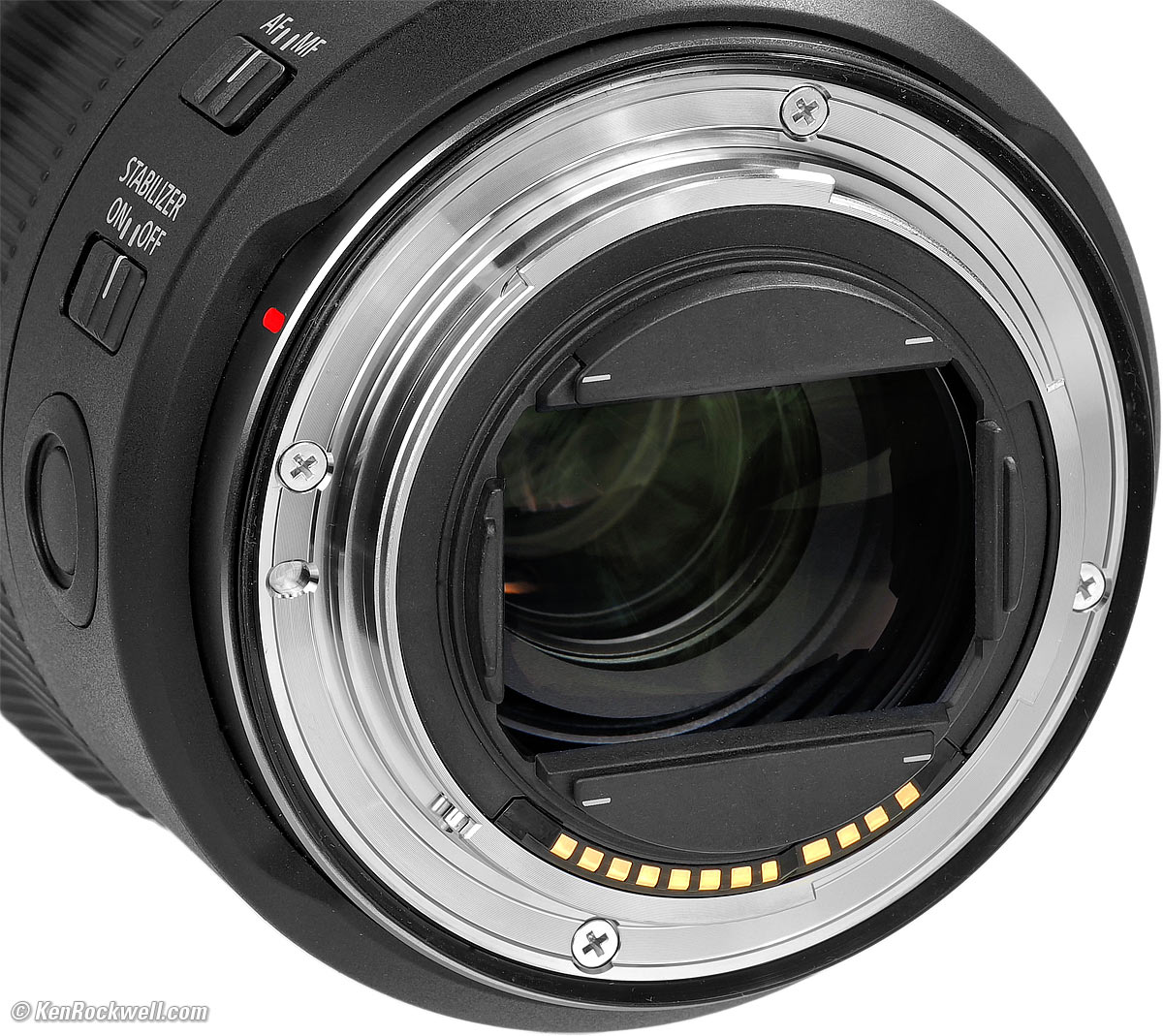
Gel Filter Slot, Canon RF 10-20mm f/4L IS STM. bigger.
Unless you create your own special rig or use a matte box, there are no front threads to which to attach a front filter.
The only way to use filters is to cut a gelatin filter to the right size (see the template in Canon's manual) and slide it in.
Genuine gelatin filters are very, very delicate and expensive. Resist using Rosco or Lee filters, which aren't optically flat and are designed for putting over lights — not in an imaging path.
Avoid polarizers with ultrawide lenses; the sky's natural polarization can appear as a dark band across the sky.
Flare & Ghosts performance top
Flare and ghosts are very well controlled, especially for such an insanely wide lens. Nikon's 15mm f/3.5 had horrendous flare and ghost problems by comparison.
See examples at Sunstars.
Hood specifications top
There is no hood. The petals are there to protect the front element from damage, not to protect your picture from stray light.
If the sun is shining on my lens, I use my left hand to block it. This works much better than any lens hood.
Lateral Color Fringes performance top
There are no color fringes when shot as JPG with the default Chromatic Aberration Correction left ON.
if you go out of your way to turn this OFF (or shoot raw and then use non-manufacturer software to process that data into images) then there is a tiny bit of red-cyan fringing at 10mm through 14mm, and none at 20mm. This is great performance, and even more so in light of the insane nature of this lens. For instance, the Nikon 13mm f/5.6 (1976-1998) has so much lateral color that Nikon's in-camera correction gives up half the time!
If you shoot raw data rather than JPG images you may — or may not — be responsible to correct this later on your own.
Lens Corrections performance top
Other cameras may vary as the years roll on, but my EOS R1, R3, R5 II, R5, R5C, R6 II, R6, R, R8, RP, R7, R10, R50 and R100 all have options to correct for falloff (Peripheral Illumination Correction), Distortion and a Digital Lens Optimizer which corrects for a suite of other aberrations.
Falloff and the Digital Lens Optimizer are ON by default, and you can turn any of them off if you like.
If you turn off the Digital Lens Optimizer, you are then offered à la carte ON/OFF options for Chromatic Aberration Correction and Diffraction Correction.
This lens integrates electronic distortion correction as part of its design, so Distortion correction is always ON. The Distortion setting is grayed-out because it can not be turned off.
If you shoot raw data rather than JPG images, whatever software you use to create visible images from raw data may or may not correct these as is done in-camera as JPGs. You're on your own there; I don't bother with raw data.
Macro Performance performance top
This lens is sharp close-up, but let's be honest: it's so wide it never seems very close.
Here's as close as it gets on full-frame:
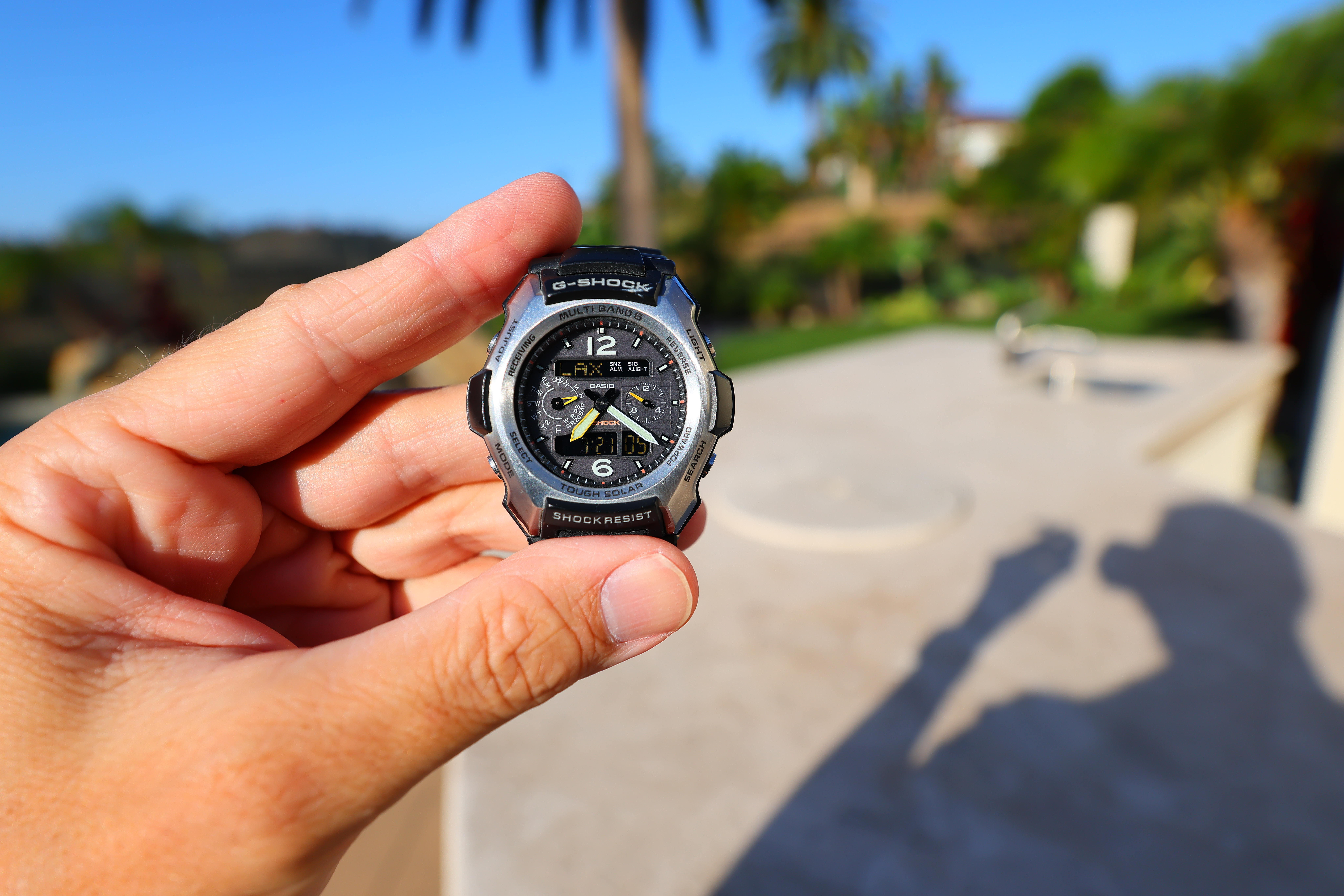
Casio G-Shock Solar Atomic Watch at close-focus distance, 8:20 AM, Thursday, 05 September 2024. Canon EOS R5 II and RF 10-20mm f/4 L IS STM at 20mm wide-open at f/4 at 1/1,250 at Auto ISO 100 (LV 14.4), Radiant Photo software. bigger or camera-original (unprocessed) 45 MP © 2.6 MB JPG Quality 1 file.
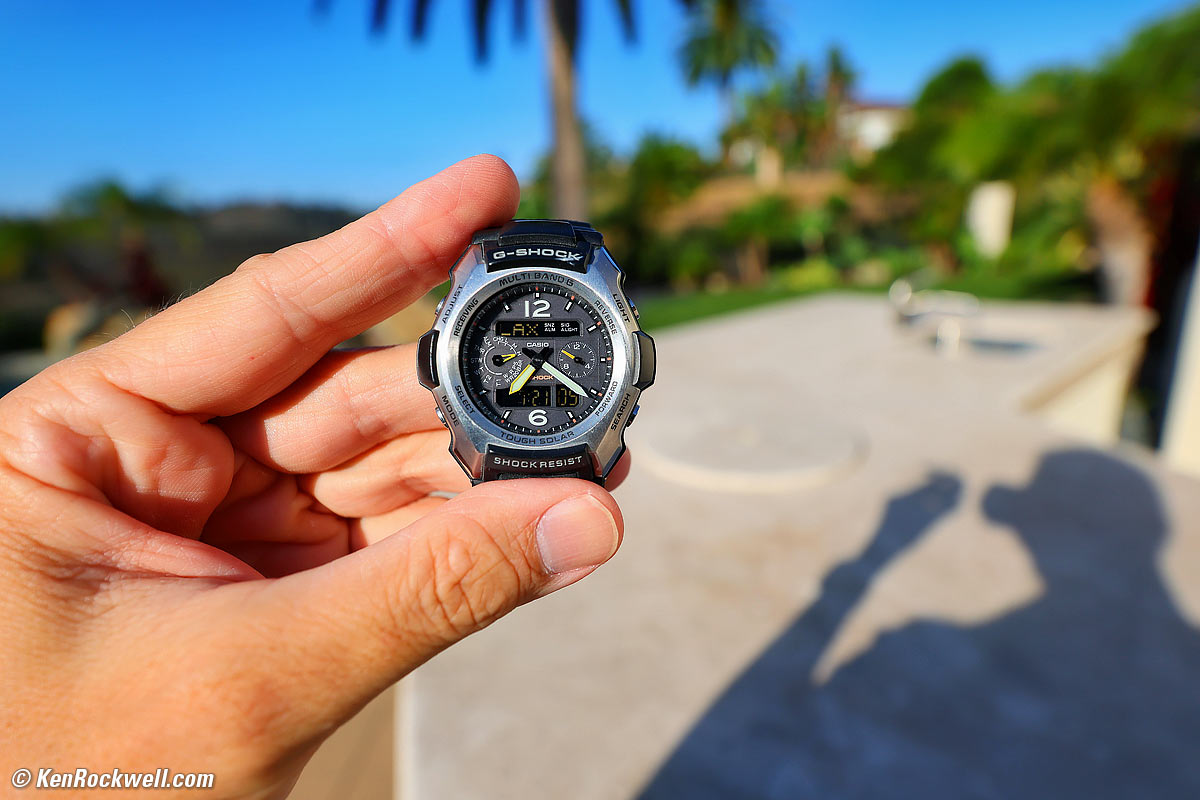
1,200 × 900 pixel (6.8× magnification) crop from above. bigger or camera-original (unprocessed) 45 MP © 2.6 MB JPG Quality 1 file.
The texture you're seeing is on the watch face.
If this 1,200 × 900 pixel crop is about 3" (7.5cm) wide on your screen, the complete image would print at a large 14 × 21″ (35 × 55 cm) at this same high magnification.
If this 1,200 × 900 pixel crop is about 6" (15cm) wide on your screen, the complete image would print at a huge 27½ × 41¼″ (70 × 105 cm) at this same high magnification.
If this 1,200 × 900 pixel crop is about 12" (30cm) wide on your screen, the complete image would print at a mammoth 55 × 82½″ (1.4 × 2.1 meters) at this same extremely high magnification!
Mechanical Quality performance top
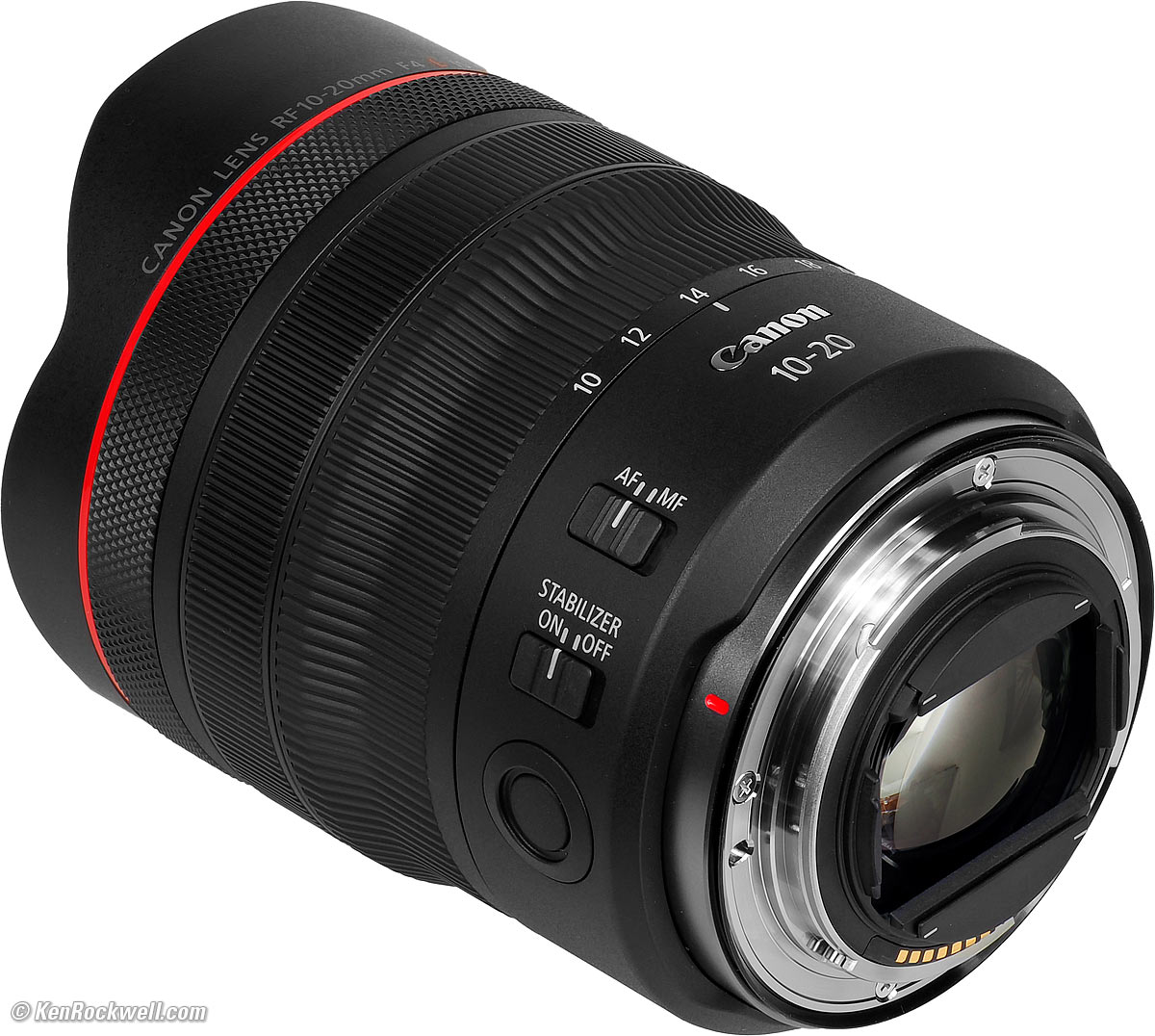
Canon RF 10-20mm f/4L IS STM. bigger.
It's a nicely made lens, but mostly plastic on the outside.
Finish
Black plastic.
Front Bumper
None.
"Hood"
Plastic petals, always attached.
Not really a hood to protect against ghosts; it's just enough to protect the front element if set down on a table.
Filter Threads
None.
Rear gel slot only.
Barrel Exterior
Plastic.
Front Clicked Control Ring
Hard plastic.
Focus Ring
Rubber-covered plastic.
Zoom Ring
Rubber-covered plastic.
Slide Switches
Plastic.
Identity
Printed in almost invisible dark grey on black plastic around the top front exterior of the lens just ahead of the Red L Band, also "10-20" engraved and filled with paint on top of barrel.
Internals
Hard to tell without disassembly; seems like a good mix of plastic and metal.
Dust Gasket at Mount
Yes.
Mount
Chromed metal.
Markings
Mostly paint; nothing's engraved except the serial number and "10-20" on the top of the barrel.
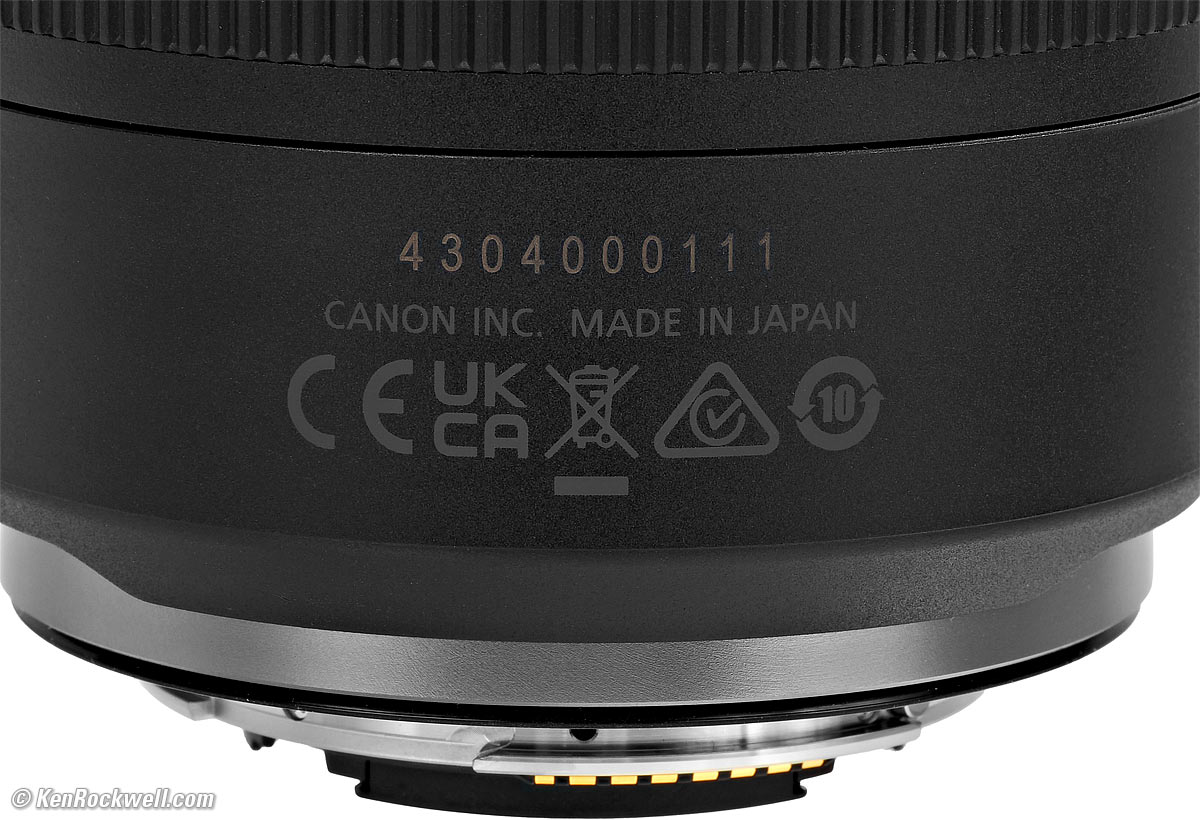
Serial Number
Canon RF 10-20mm f/4L IS STM. bigger.
Laser engraved in black-on-black on bottom of barrel.
It's almost completely invisible in actual use; it's visible above because this photo is enlarged and lit by lots of light in my studio.
Date Code
None found.
Noises When Shaken
Mild clicking from what sounds like mostly the diaphragm and IS group.
Made in
Made in Japan.
Peripheral Color Shifts performance top
I can't see any significant color shifts, even uncorrected, which is extraordinary for a lens so wide.
The problem is that lens coatings shift their color transmission away from the center of the image because their effective thickness changes as light hits the glass at different angles.
It's taken lens makers over 50 years to figure out how to conquer this effect, and Canon's done it. Bravo!
Sharpness performance top
You can count every grain of sand right out to the corners. At 10mm, everything is in focus:
Crystal Pier, Pacific Beach, California, 6:47 PM, Tuesday, 03 September 2024. Canon EOS R5 II and RF 10-20mm f/4 L IS STM at 10mm at f/6.3 at 1/160 at Auto ISO 100, (LV 12¾), perked up in Radiant Photo. bigger or camera-original (unprocessed) 45 MP © 6 MB JPG Quality 1 file.
Look at the camera-original JPG file; everywhere you look, it's perfectly sharp and devoid of color fringes. Ultra-ultrawides were never this good! Did you notice the jetliner at the right edge?
Lens sharpness has nothing to do with picture sharpness; every lens made in the past 100 years is more than sharp enough to make super-sharp pictures if you know what you're doing. The only limitation to picture sharpness is your skill as a photographer. It's the least talented who spend the most time worrying about lens sharpness and blame crummy pictures on their equipment rather than themselves. Skilled photographers make great images with whatever camera is in their hands; I've made some of my best images of all time with an irreparably broken camera! Most pixels are thrown away before you see them, but camera makers don't want you to know that.
If you're not getting ultra-sharp pictures with this, be sure not to shoot at f/11 or smaller where all lenses are softer due to diffraction, always shoot at ISO 100 or below because cameras become softer at ISO 200 and above, be sure everything is in perfect focus, set your camera's sharpening as you want it (I set mine to the maximum 7,1,1) and be sure nothing is moving, either camera or subject. If you want to ensure a soft image with any lens, shoot at f/16 or smaller at ISO 1,600 or above at default sharpening in daylight of subjects at differing distances in the same image.
People worry waaaaay too much about lens sharpness. It's not 1968 anymore when lenses often weren't that sharp and there could be significant differences among them; ever since about 2010 all new lenses are all pretty much equally fantastic.
This lens is super sharp corner-to corner at every aperture, limited by your vision as an artist and of course by diffraction at the smallest apertures. Avoid f/11 and smaller unless you really need them for extreme depth of field because diffraction takes its toll. See also How to Calculate the Sharpest Aperture.
It's super sharp all the way out to the corners wide-open at every focal length. Its astonishing how it's so sharp; ultra-ultrawides used to have huge difficulties trying to stay sharp out in the corners.
It's sharpest at f/5.6, with f/8 being as sharp as f/4, and then f/11, f/16 and f/22 each progressively softer due to diffraction, which are simply laws of nature that cannot be broken.
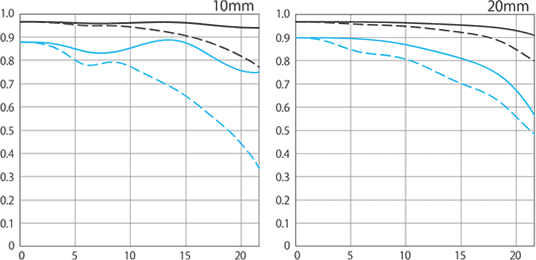
MTF wide-open at f/4 at 10 cyc/mm (black) and 30 cyc/mm (blue). Sagittal (solid) and meridional (dashed).
Spherochromatism performance top
Spherochromatism, also called secondary spherical chromatic aberration or "color bokeh," is an advanced form of spherical and chromatic aberration in a different dimension than lateral chromatic aberration. It happens mostly in fast normal and tele lenses when spherical aberration at the ends of the color spectrum are corrected differently than in the middle of the spectrum. Spherochromatism can cause colored fringes on out-of-focus highlights, usually seen as green fringes on backgrounds and magenta fringes on foregrounds. Spherochromatism is common in fast lenses of moderate focal length when shooting contrasty items at full aperture. It goes away as stopped down.
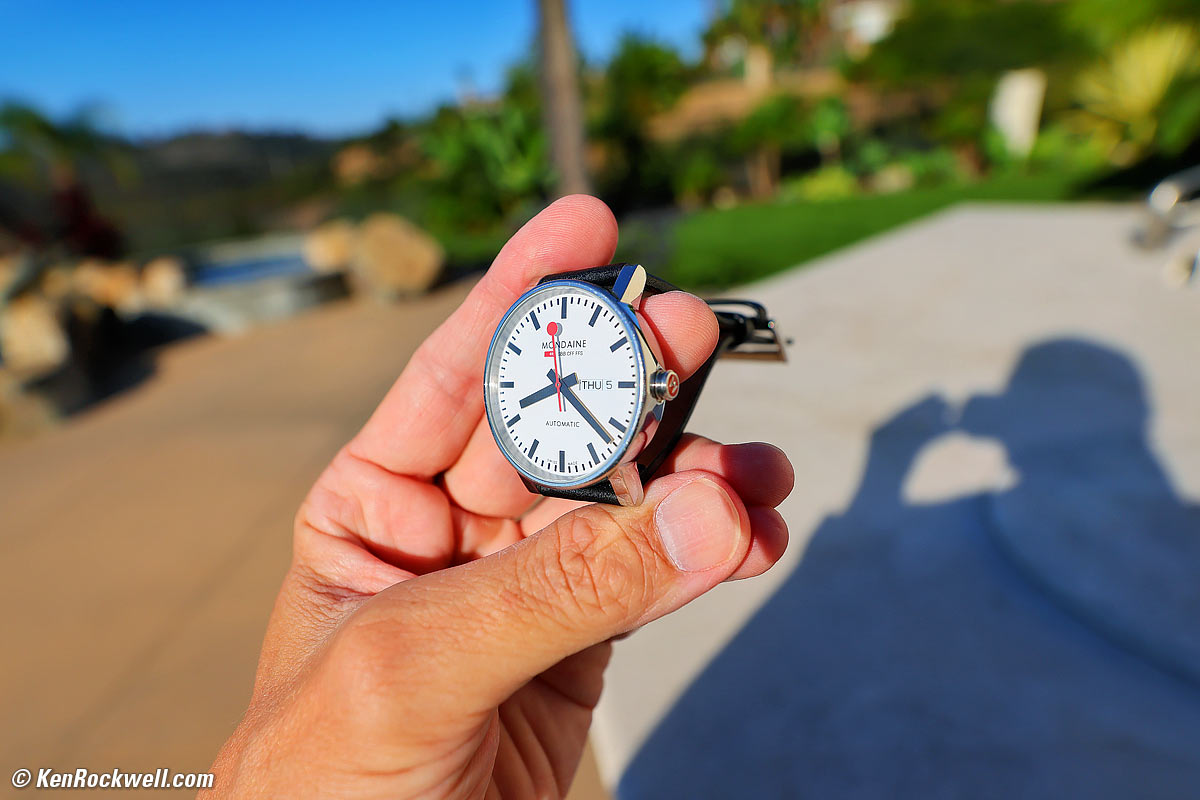
I cant' see any spherochromatism, which is as expected for a lens this good, short and slow:
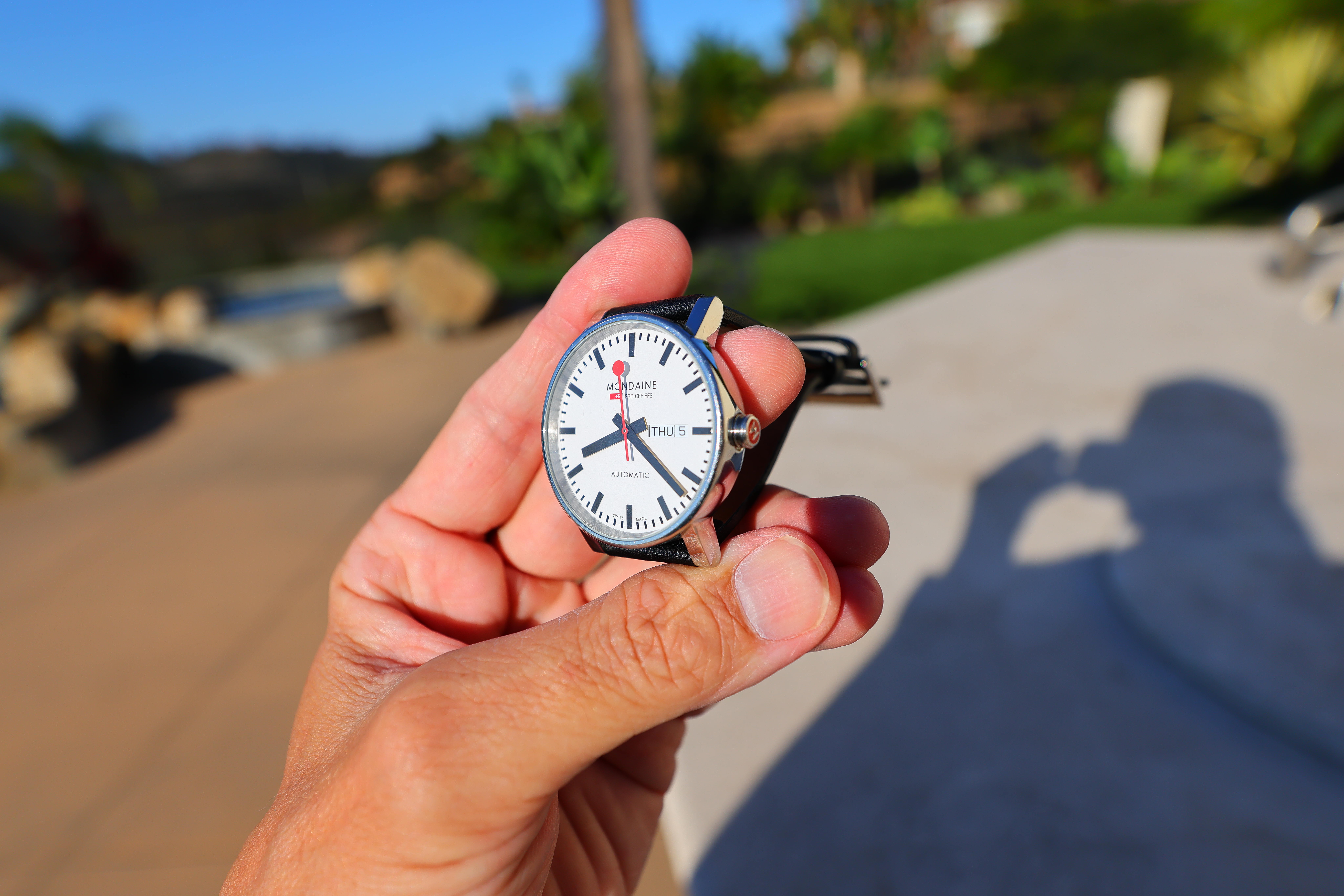
Mondaine A132.30348.11SBB at close-focus distance, 8:22 AM, Thursday, 05 September 2024. Canon EOS R5 II and RF 10-20mm f/4 L IS STM at 20mm wide-open at f/4 at 1/2,000 at Auto ISO 100 (LV 15.0), Radiant Photo software. bigger or camera-original (unprocessed) 45 MP © 2.3 MB JPG Quality 1 file.
1,200 × 900 pixel (6.8× magnification) crop from above. bigger or camera-original (unprocessed) 45 MP © 2.3 MB JPG Quality 1 file.
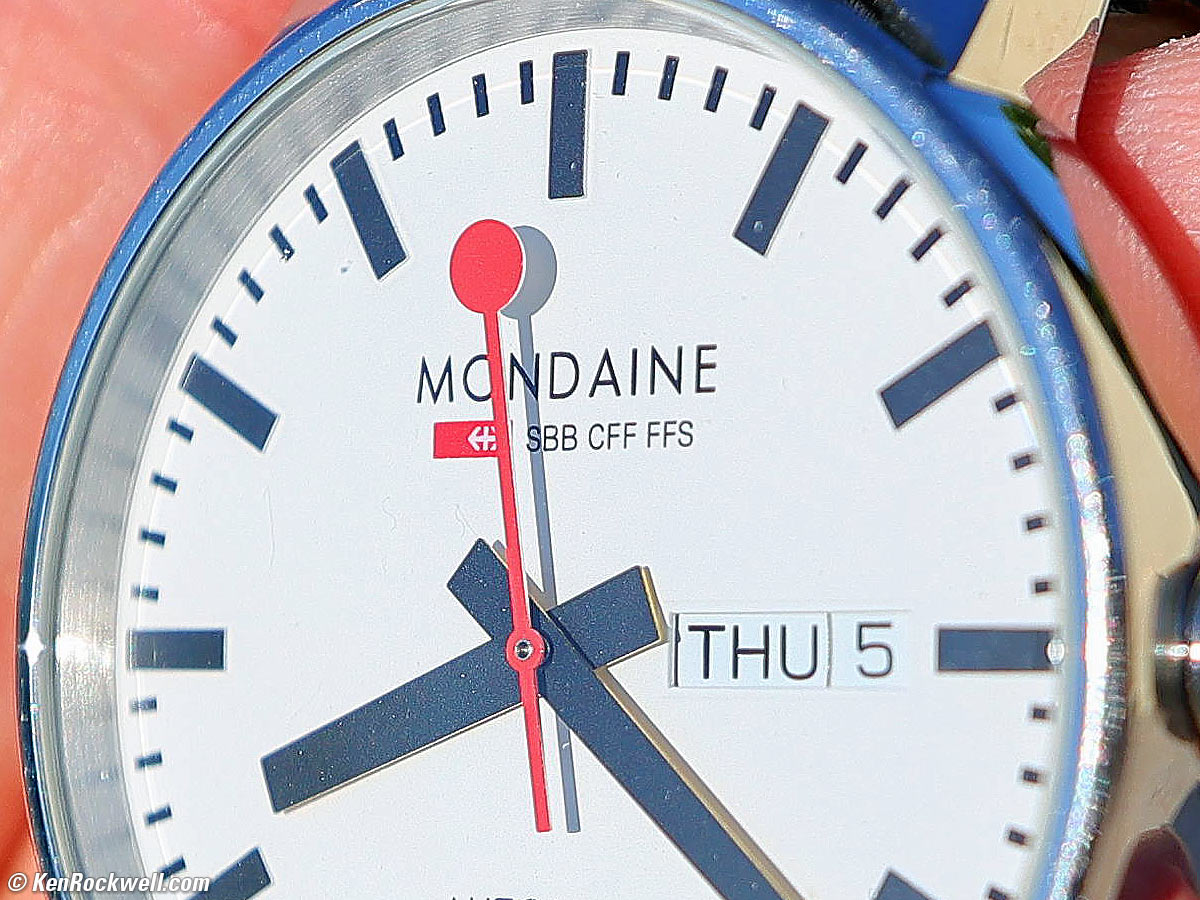
If this 1,200 × 900 pixel crop is about 3" (7.5cm) wide on your screen, the complete image would print at a large 14 × 21″ (35 × 55 cm) at this same high magnification.
If this 1,200 × 900 pixel crop is about 6" (15cm) wide on your screen, the complete image would print at a huge 27½ × 41¼″ (70 × 105 cm) at this same high magnification.
If this 1,200 × 900 pixel crop is about 12" (30cm) wide on your screen, the complete image would print at a mammoth 55 × 82½″ (1.4 × 2.1 meters) at this same extremely high magnification!
Image Stabilization (VR) performance top
Optical Image Stabilization (OIS, IS or VR (Vibration Reduction)) works great, and this is one of the very few lenses this wide that are optically stabilized.
This is critical because a sensor-shift system would need a rubber sensor to shift more than twice as much in the corners at 10mm due to the way geometry stretches ultrawide images. Here's how badly this affects the unstabilized Sony FE 12-24mm f/2.8 GM, and thankfully this isn't a problem with this optically stabilized Canon 10-20mm.
"Percent Perfectly Sharp Shots" are the percentage of hand-held, free-standing with no support or bracing, frames with 100% perfect tripod-equivalent sharpness as viewed at 300%. Hand tremor is a random occurrence, so at marginal speeds some frames will be perfectly sharp while others will be in various stages of blur — all at the same shutter speed.
This rates what percentage of shots are perfectly sharp, not how sharp are all the frames:
10mm
| % Perfectly Sharp Shots on stabilized R5 II | 4s |
2s |
1s |
1/2 |
1/4 |
1/8 |
1/15 |
1/30 |
1/60 |
| Stabilization ON | 0 |
18 |
27 |
80 |
90 |
100 |
100 |
100 |
100 |
| Stabilization OFF | 0 |
0 |
0 |
0 |
0 |
40 |
60 |
80 |
100 |
I see about a 3-stop real-world improvement.
20mm
| % Perfectly Sharp Shots on stabilized R5 II | 2s |
1s |
1/2 |
1/4 |
1/8 |
1/15 |
1/30 |
1/60 |
1/125 |
| Stabilization ON | 0 |
30 |
90 |
100 |
100 |
100 |
100 |
100 |
100 |
| Stabilization OFF | 0 |
0 |
0 |
0 |
0 |
0 |
90 |
85 |
100 |
I see about a 4-stop real-world improvement.
Sunstars performance top
With a 9-bladed rounded diaphragm, I get excellent 18-point sunstars on brilliant points of light at the smallest apertures.
Click any to enlarge:
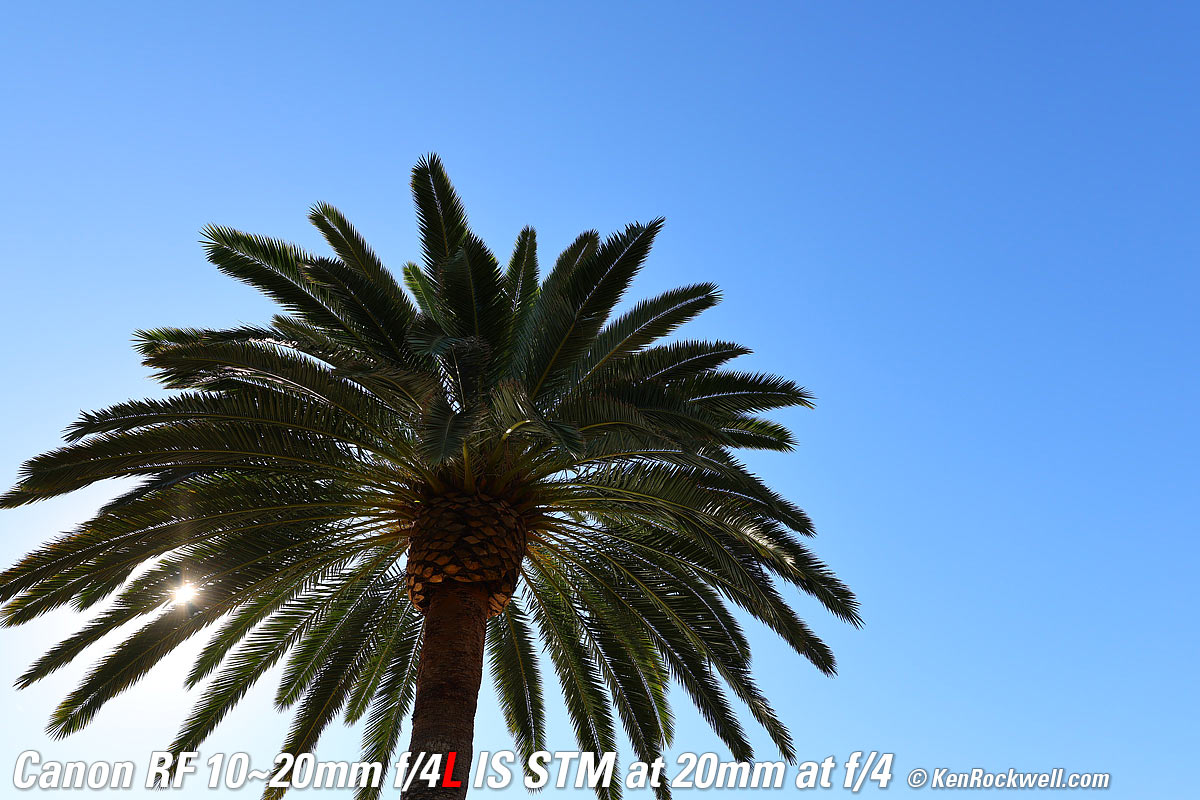
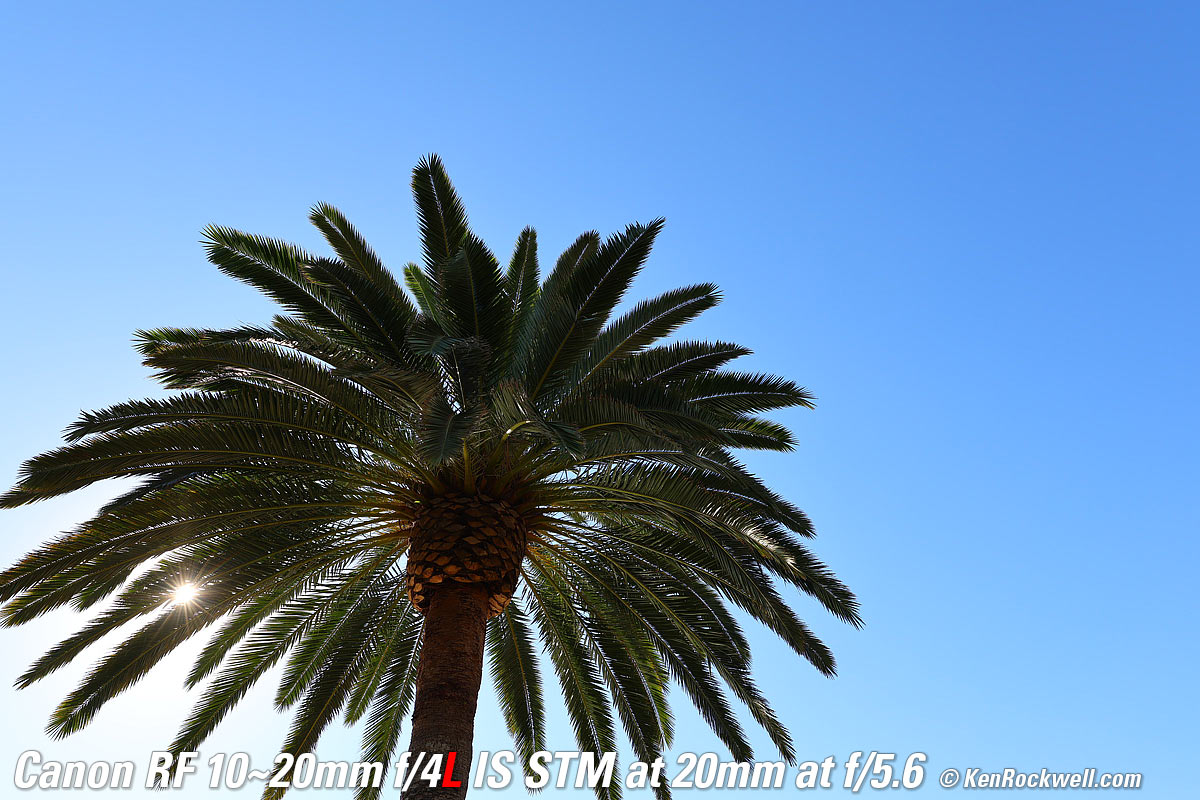
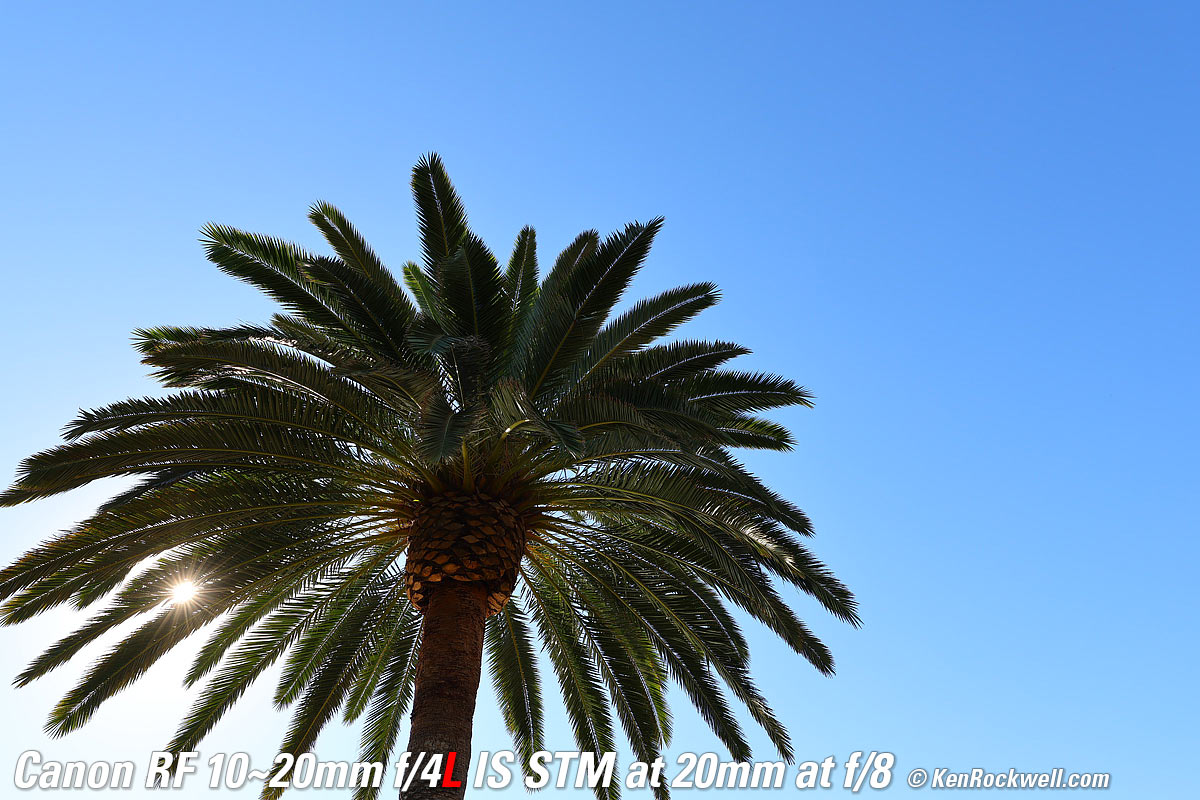
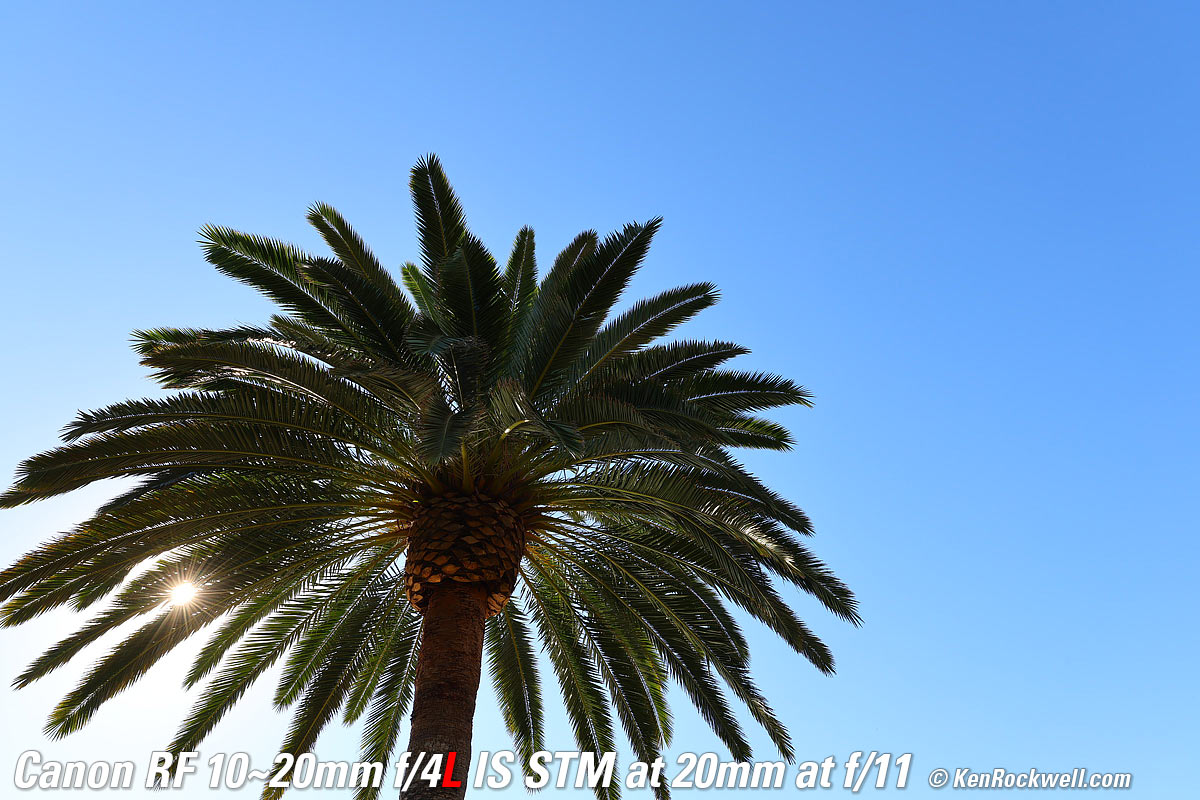
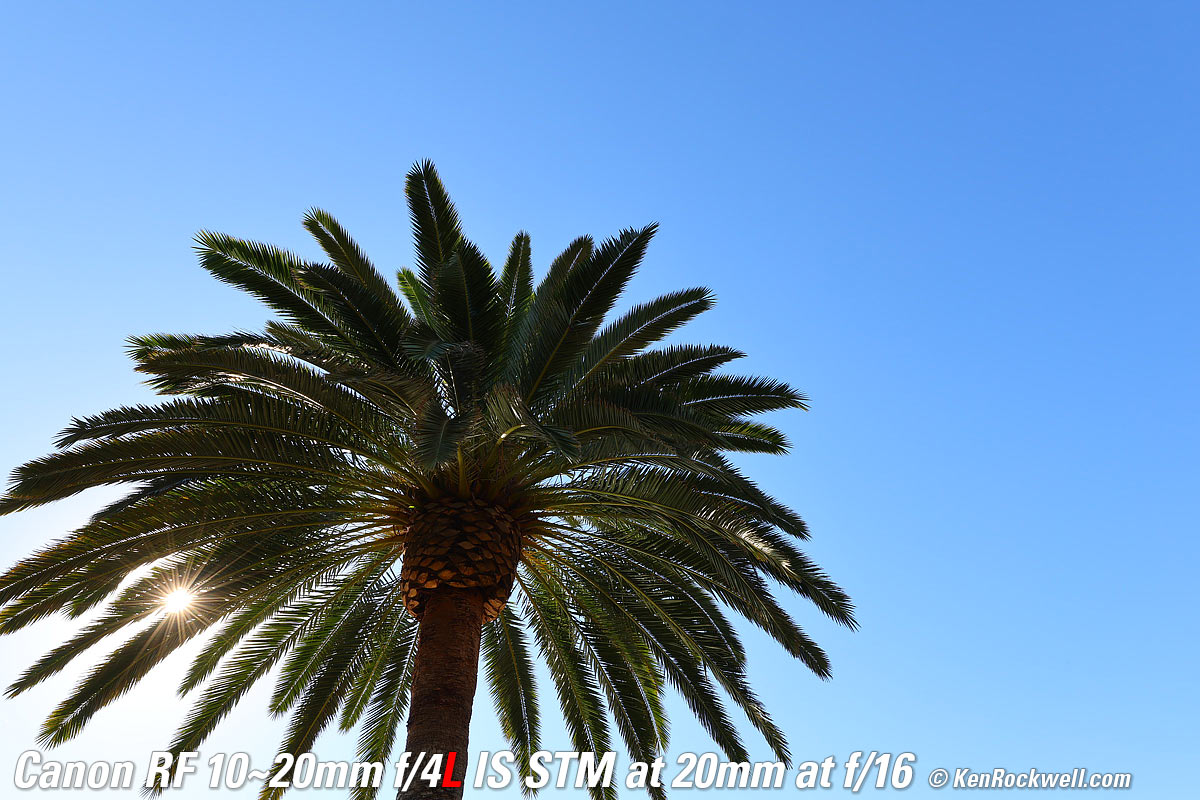
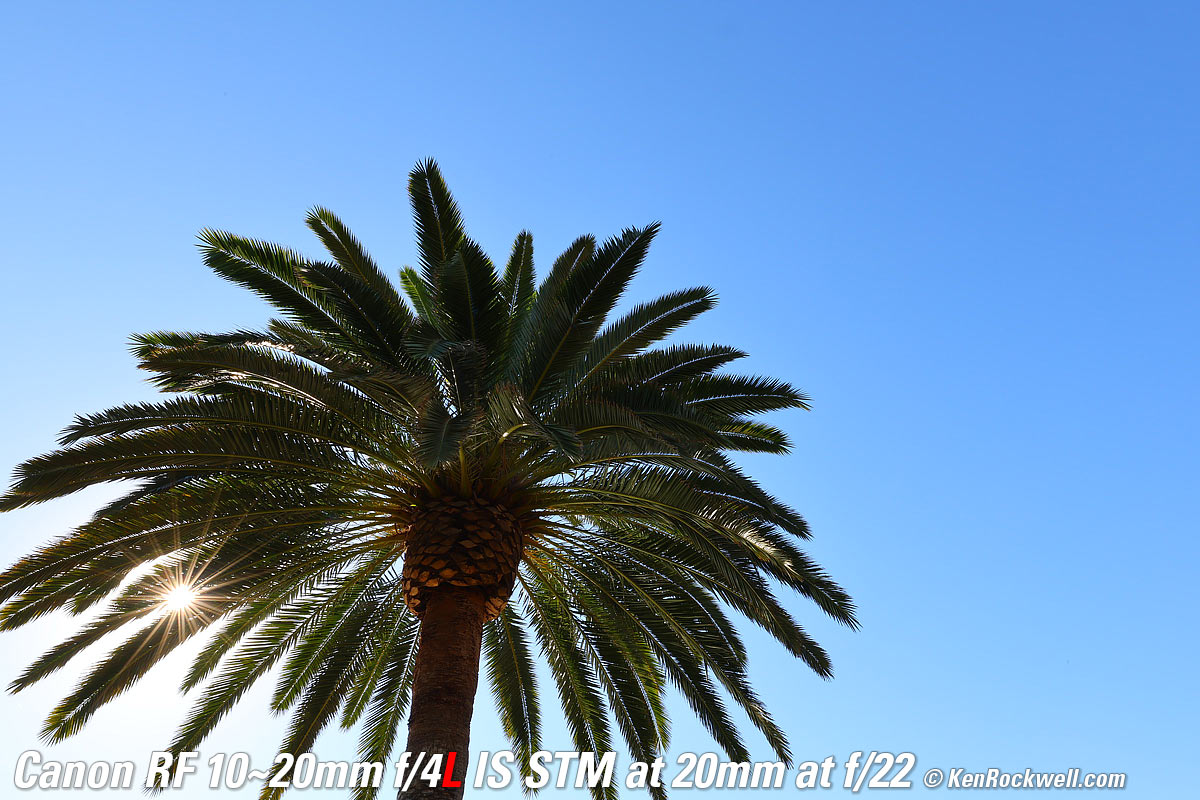
Click any to enlarge.
Teleconverters performance top
It's not compatible with either of the RF 2× Extender or RF 1.4× Extender or any other teleconverters.
So? Why would anyone pay top dollar for an exotic ultrawide 10-20mm f/4 and want to turn it into a foolish 20-40mm f/8?
Compared top
Sample Images Intro New Good Bad Missing
Specs USA Version Performance Compared
User's Guide Recommendations More
I got my RF 10-20mm f/4L IS STM at B&H. I'd also get mine at Adorama, at Crutchfield or at Amazon, or used at eBay if you know How to Win at eBay.
Versus Canon
NEW: All Canon Mirrorless Ultrawide Lenses Compared.
This lens is less practical than any other Canon RF ultrawide like the RF 14-35mm f/4L IS USM (my favorite), RF 15-35mm f/2.8L IS USM, 15-30mm IS STM or RF 16mm f/2.8 STM because this 10-20mm lens can't use a protective front filter as can all the others. Therefore we can't run around all day uncapped and ready shoot. Instead I'm always carrying this 10-20mm lens with its cap attached, and even with the cap, dust gets in.
This 10-20mm lens is for the truly insane who need the widest lens available. Seeing how few people know How to Use Ultra-Ultrawide Lenses and how we have to be very diligent about how we carry this lens, even though it's affordable, this RF 10-20mm should be reserved for special purposes rather than in your bag or pocket for every day use. In fact, the front element will get dusty carried in a pocket since the cap doesn't seal.
This new RF 10-20mm f/4L IS STM is half the weight of the EF 11-24mm f/4L IS USM (2015-today), and adds optical stabilization and costs less, but has more plastic rather than the metal parts of the EF 11-24mm f/4L IS USM. The EF 11-24mm f/4L IS USM likewise has an unprotectable front element.
Versus Nikon
This doesn't matter because Nikon lenses don't work on Canon cameras.
Nikon doesn't make anything this wide, and it's sad that Nikon's widest lens was in their past. Nikon has gone backwards!
The Nikon 13mm f/5.6 (1976-1998) was more of a showpiece for Nikon, who priced it out of sight, so only a few hundred were ever sold. It was slow, very difficult to use, and its optics are inferior in every way to this new RF 10-20mm.
Today Nikon's widest lenses are 14mm, and none of them are stabilized. Sensor-shift stabilization doesn't work in the sides and corners of ultrawide images. Sayonara, Nikon.
Versus Sony
This doesn't matter as Sony lenses don't work on Canon cameras.
Sony doesn't make anything this wide.
Sony makes some innovative and unique ultrawides, sadly none of them are stabilized and sensor-shift stabilization doesn't work well on the sides and corners of ultrawide images.
User's Guide top
Sample Images Intro New Good Bad Missing
Specs USA Version Performance Compared
User's Guide Recommendations More
I got my RF 10-20mm f/4L IS STM at B&H. I'd also get mine at Adorama, at Crutchfield or at Amazon, or used at eBay if you know How to Win at eBay.
How to Use Ultra-Ultrawide Lenses
See also Canon's RF 10-20mm f/4L IS STM User's Manual.
Canon RF 10-20mm f/4L IS STM. bigger.
Manual-Focus Override user's guide top
Older EOS R cameras need a menu setting changed for manual-focus override, otherwise the focus ring is always ignored in AF.
Find the "Lens electronic AF" or "Electronic full-time MF" option in your AF menu (AF 6 in R5 II, R6 II, R7, R8 and R10, AF 4 in EOS R5 and EOS R6 or CAMERA 8 in EOS RP), and set it to either "One‑Shot‑> enabled," "One‑Shot‑> enabled (magnify)" or ON.
Canon should have it set this way by default, but they don't. No big deal now that I figured it out, and it usually works by default in newer cameras.
In ONE SHOT mode manual focus now takes over and stays wherever you set the focus manually, however in SERVO mode this setting lets the lens focus manually as you turn the ring, but as soon as you stop turning the ring the AF system takes back over and keeps tracking focus! Oh well, this is still a defect in all Canon cameras. (This works properly in the Nikon Z system, Nikon's ahead here.)
AF - MF Switch user's guide top
AF: Auto Focus, with instant manual focus override in ONE SHOT AF if set. Even though it will usually focus manually in SERVO AF, the AF system takes over the moment you stop moving the manual focus ring.
MF: Manual Focus only.
Recommendations top
Sample Images Intro New Good Bad Missing
Specs USA Version Performance Compared
User's Guide Recommendations More
I got my RF 10-20mm f/4L IS STM at B&H. I'd also get mine at Adorama, at Crutchfield or at Amazon, or used at eBay if you know How to Win at eBay.
This is a special purpose lens, mostly because its so wide that it's unusual that one will ever need anything this wide other than for special effects, and because one always has to be vigilant about protecting the delicate and open front element.
For most people, myself included, any of the the RF 14-35mm f/4L IS USM (my favorite), RF 15-35mm f/2.8L IS USM, 15-30mm IS STM or RF 16mm f/2.8 STM are better choices for general photography as they can be carried all day with a protective filter, and cover a more useful focal length range.
You constantly have to be vigilant in protecting the front element against everything. Not only is it unprotected, but due to the extremely deep depth of field of ultrawide lenses, any damage to the front element will be seen in your pictures. You can scratch or have dirt or fingerprints on a tele and no one will notice, but you will see what's on your front element in your pictures with lenses this wide. I'm serious; a small fingerprint smudge will show up as a slightly darker region in the sky and its a bear to try to fix later. Be careful and be clean.
I got my RF 10-20mm f/4L IS STM at B&H. I'd also get mine at Adorama, at Crutchfield or at Amazon, or used at eBay if you know How to Win at eBay.
This 100% all-content, junk-free website's biggest source of support is when you use those or any of these links to my personally approved sources I've used myself for way over 100 combined years when you get anything, regardless of the country in which you live. Canon does not seal its boxes in any way, so never buy at retail or any other source not on my personally approved list since you'll have no way of knowing if you're missing accessories, getting a defective, damaged, returned, gray-market, store demo or used lens — and all of my personally approved sources allow for 100% cash-back returns for at least 30 days if you don't love your new lens. I've used many of these stores since the 1970s because I can try it in my own hands and return it if I don't love it, and because they ship from secure remote warehouses where no one gets to touch your new lens before you do. Buy only from the approved sources I've used myself for decades for the best prices, service, return policies and selection.
Thanks for helping me help you!
Ken.
More Information top
Sample Images Intro New Good Bad Missing
Specs USA Version Performance Compared
User's Guide Recommendations More
I got my RF 10-20mm f/4L IS STM at B&H. I'd also get mine at Adorama, at Crutchfield or at Amazon, or used at eBay if you know How to Win at eBay.
Canon's RF 10-20mm f/4L IS STM User's Manual.
© Ken Rockwell. All rights reserved. Tous droits réservés. Alle Rechte vorbehalten. Alla rättigheter förbehållna. Toate drepturile rezervate. Omnia jura reservata. Ken Rockwell® is a registered trademark.
Help Me Help You top
I support my growing family through this website, as crazy as it might seem.
The biggest help is when you use any of these links when you get anything. It costs you nothing, and is this site's, and thus my family's, biggest source of support. These places always have the best prices and service, which is why I've used them since before this website existed. I recommend them all personally.
If you find this page as helpful as a book you might have had to buy or a workshop you may have had to take, feel free to help me continue helping everyone.
If you've gotten your gear through one of my links or helped otherwise, you're family. It's great people like you who allow me to keep adding to this site full-time. Thanks!
If you haven't helped yet, please do, and consider helping me with a gift of $5.00.
As this page is copyrighted and formally registered, it is unlawful to make copies, especially in the form of printouts for personal use. If you wish to make a printout for personal use, you are granted one-time permission only if you PayPal me $5.00 per printout or part thereof. Thank you!
Thanks for reading!
Ken.