Canon RF 200-800mm IS USM
(2024 ~ today)
Sample Images Intro New Good Bad Missing
Specifications Accessories USA Version
Performance Compared User's Guide
R1 R3 R5 II R5 R5C R6 III R6 II R6 R R8 RP R7 R10 R50 R50V R100
Bodies Compared RF Lenses EF Lenses Flash
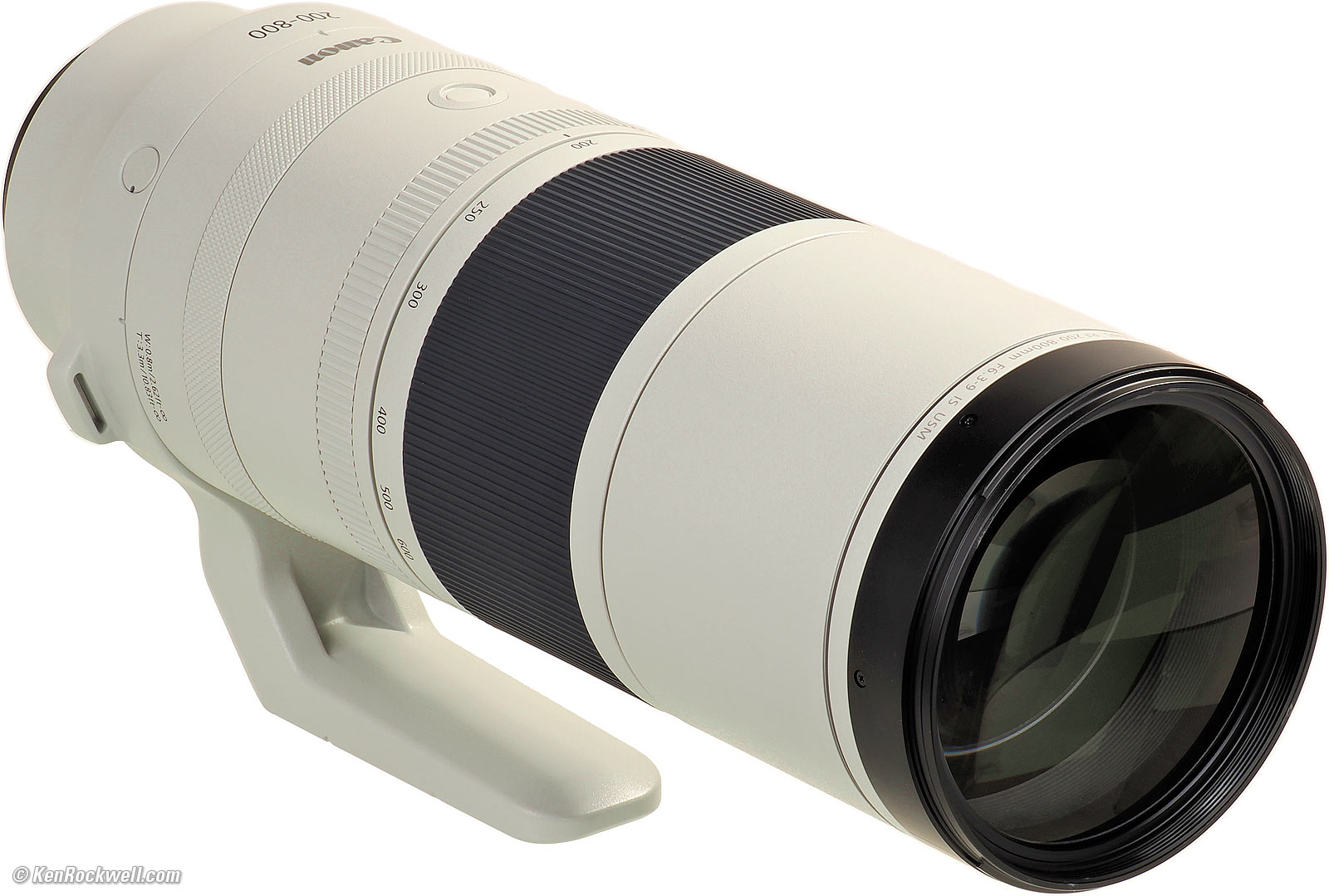
Canon RF 200-800mm IS USM f/6.3-9 (95mm filters, 72.3 oz./2,050g, 2.6~11'/0.8~3.3m close focus, 0.25× macro ratio, $1,899). bigger. I got mine at B&H. I'd also get it at Adorama, at Amazon or at Crutchfield, or get it used if you know How to Win at eBay, or get it used at KEH.
This all-content, junk-free website's biggest source of support is when you use those or any of these links to approved sources when you get anything, regardless of the country in which you live. Thanks for helping me help you! Ken.
June 2025 Better Pictures Canon Reviews Mirrorless RF Lenses EF Lenses Flash All Reviews
Sample Images top
Sample Images Intro New Good Bad Missing
Specifications Accessories USA Version
Performance Compared User's Guide
More samples throughout this review at Bokeh, Falloff, Macro, Spherochromatism and Sunstars.
These are just snapshots; my real work is in my Gallery.
These are all shot hand-held at the lowest JPG quality setting of 1 at 45 MP on my EOS R5 II. No tripods, no FINE JPGs or RAW CR3 files were used or needed.
To say again, these are all shot hand-held:

Family at the Beach With a Huge Sunset Behind Them, Solana Beach, California, 5:49 P.M., Thursday, 07 November 2024. Cropped to a square from Canon EOS R5 II, RF 200-800mm IS USM at 800mm at f/14 at 1/6400 at Auto ISO 100 (LV 17.0), as shot. bigger or camera-original 45 MP © 1.5 MB JPG quality 1 file.
I shot this from about 200 feet away, knowing that the disc of the sun would become huge as I zoomed-in. I love this shot, but oddly they weren't that excited about it.
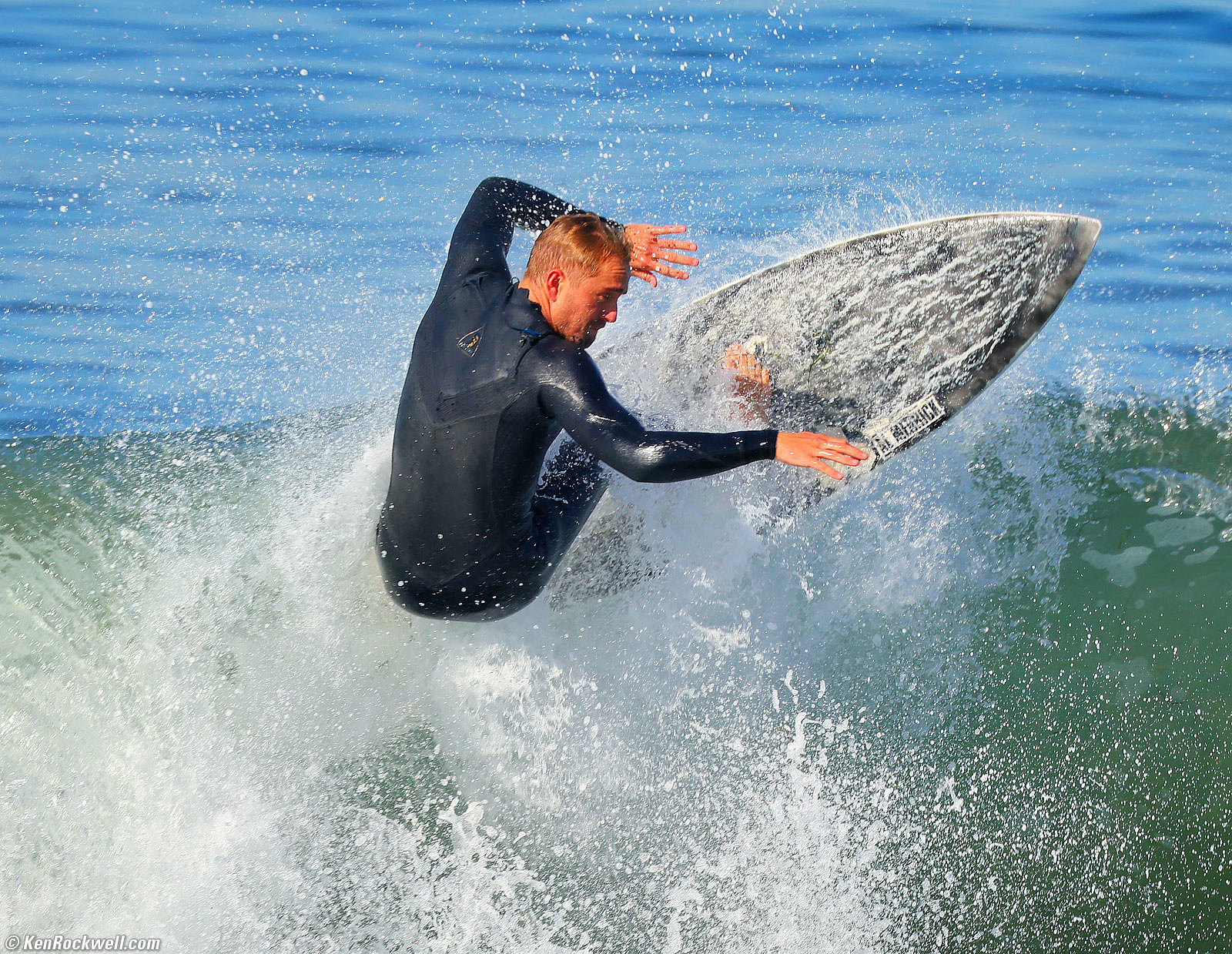
Surfer, Pacific Beach, California, 10:49 A.M., Sunday, 10 November 2024. Cropped a bit from Canon EOS R5 II, RF 200-800mm IS USM at 672mm at f/9 at 1/1,000 at Auto ISO 320 (LV 14.7), Radiant Photo software to make it a bit more brilliant. bigger.
This dude is about 400 feet (120 meters) away as I shot from the pier. This lens covers an ideal range of focal lens for distant sports.
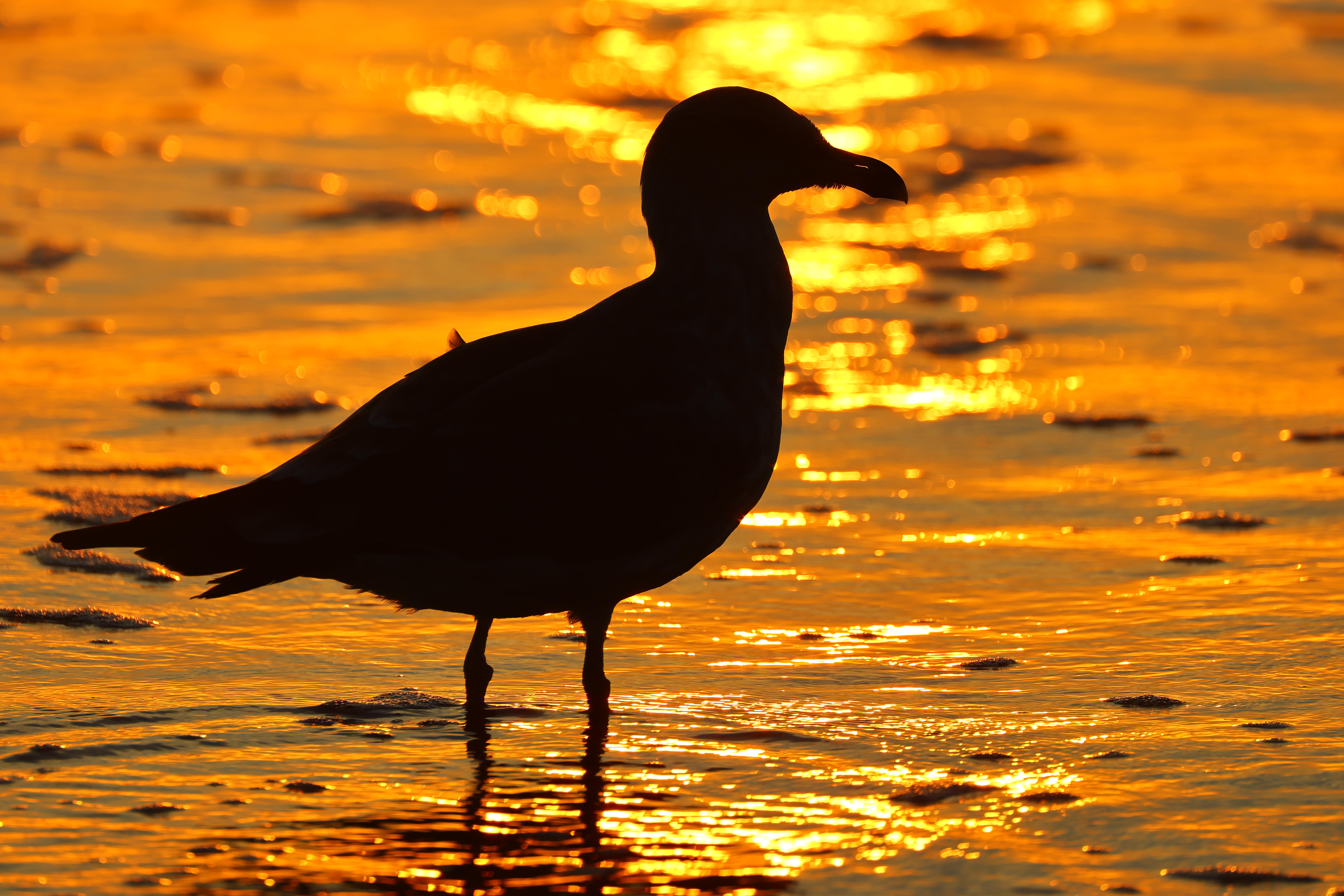
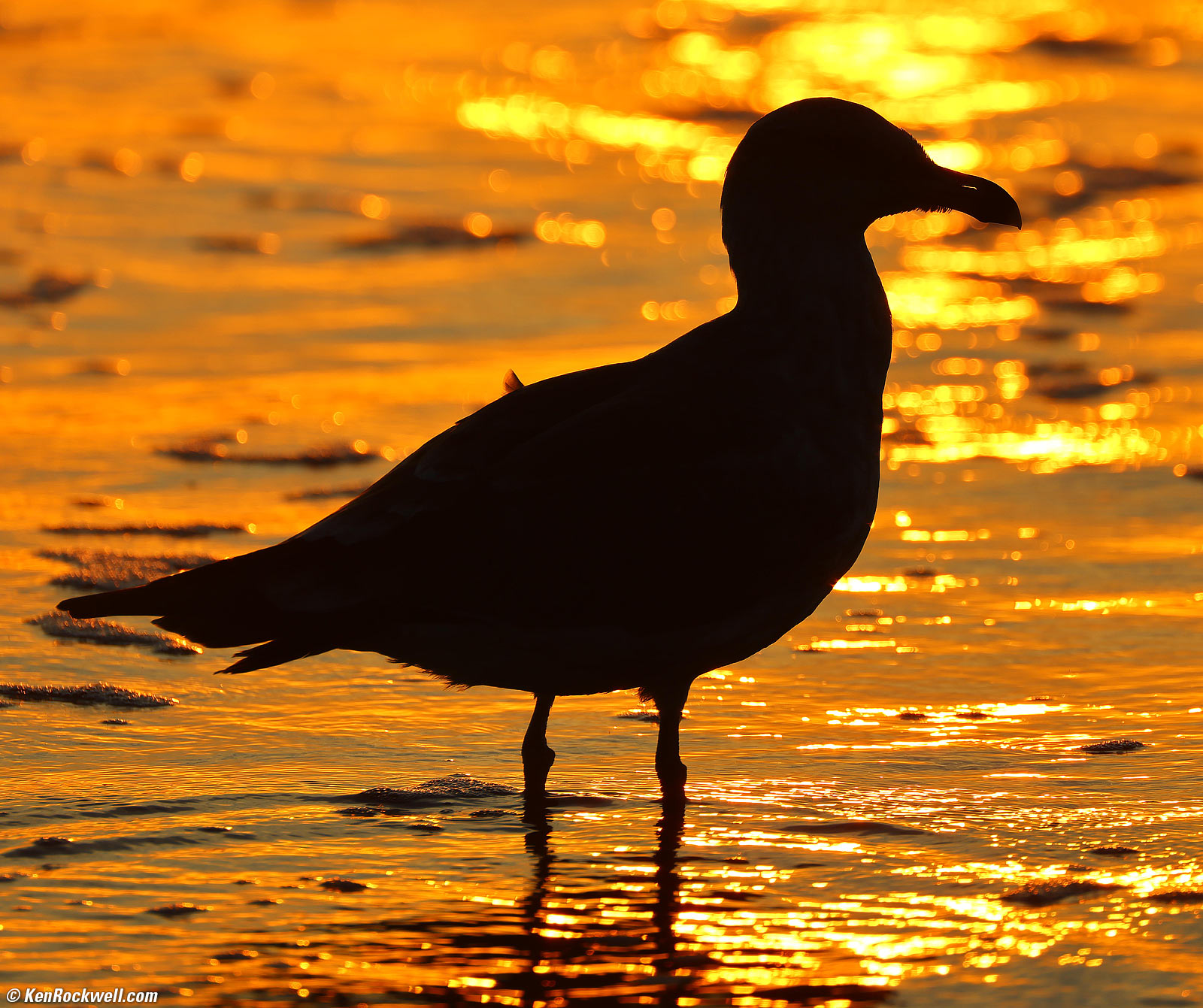
Gull at Sunset, Solana Beach, California, 6:01 P.M., Tuesday, 22 October 2024. Slight crop from Canon EOS R5 II, RF 200-800mm IS USM at 800mm at f/10 handheld at 1/320 at Auto ISO 100 (LV 15.0), as shot. bigger or camera-original 45 MP © 3.5 MB JPG quality 1 file.
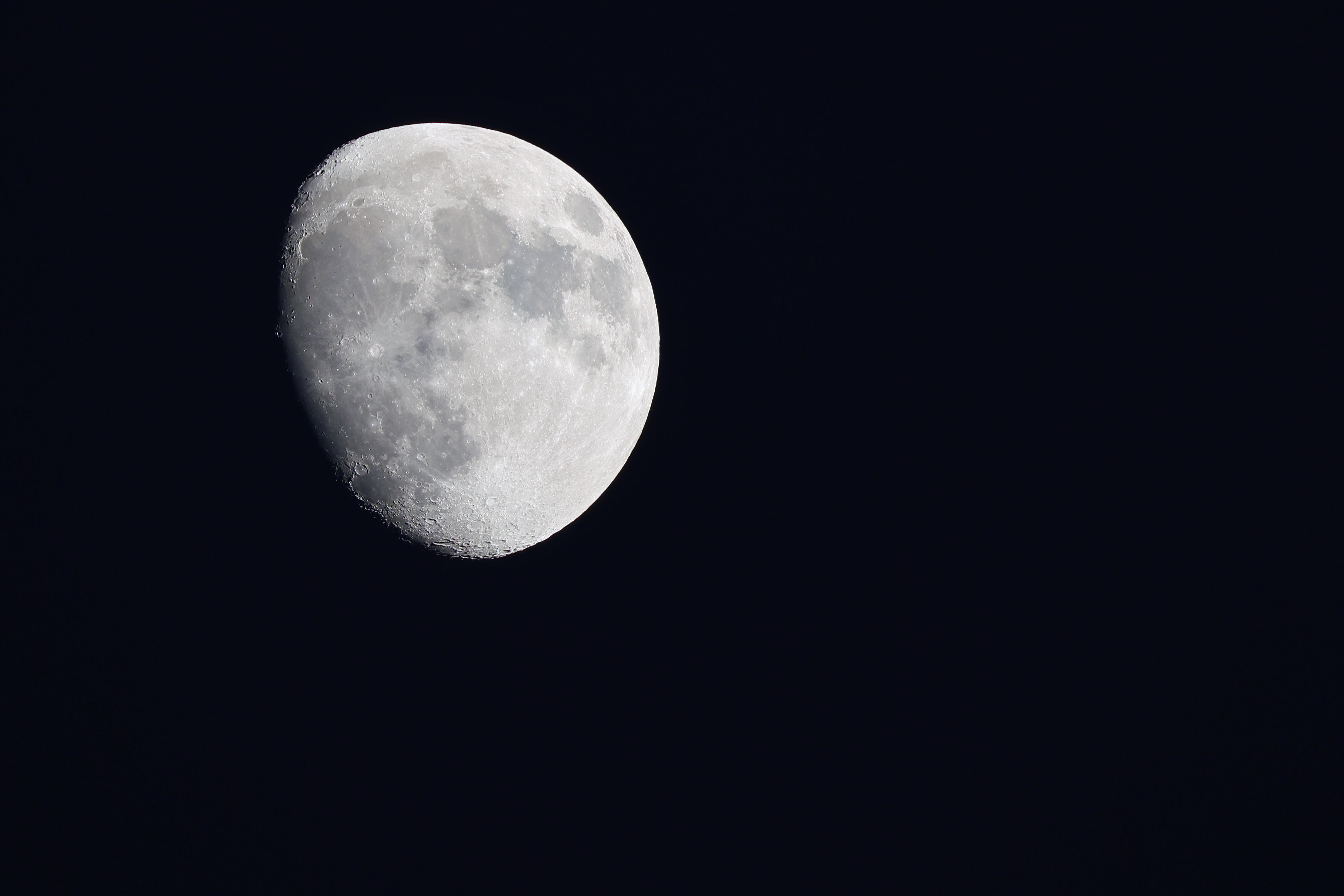
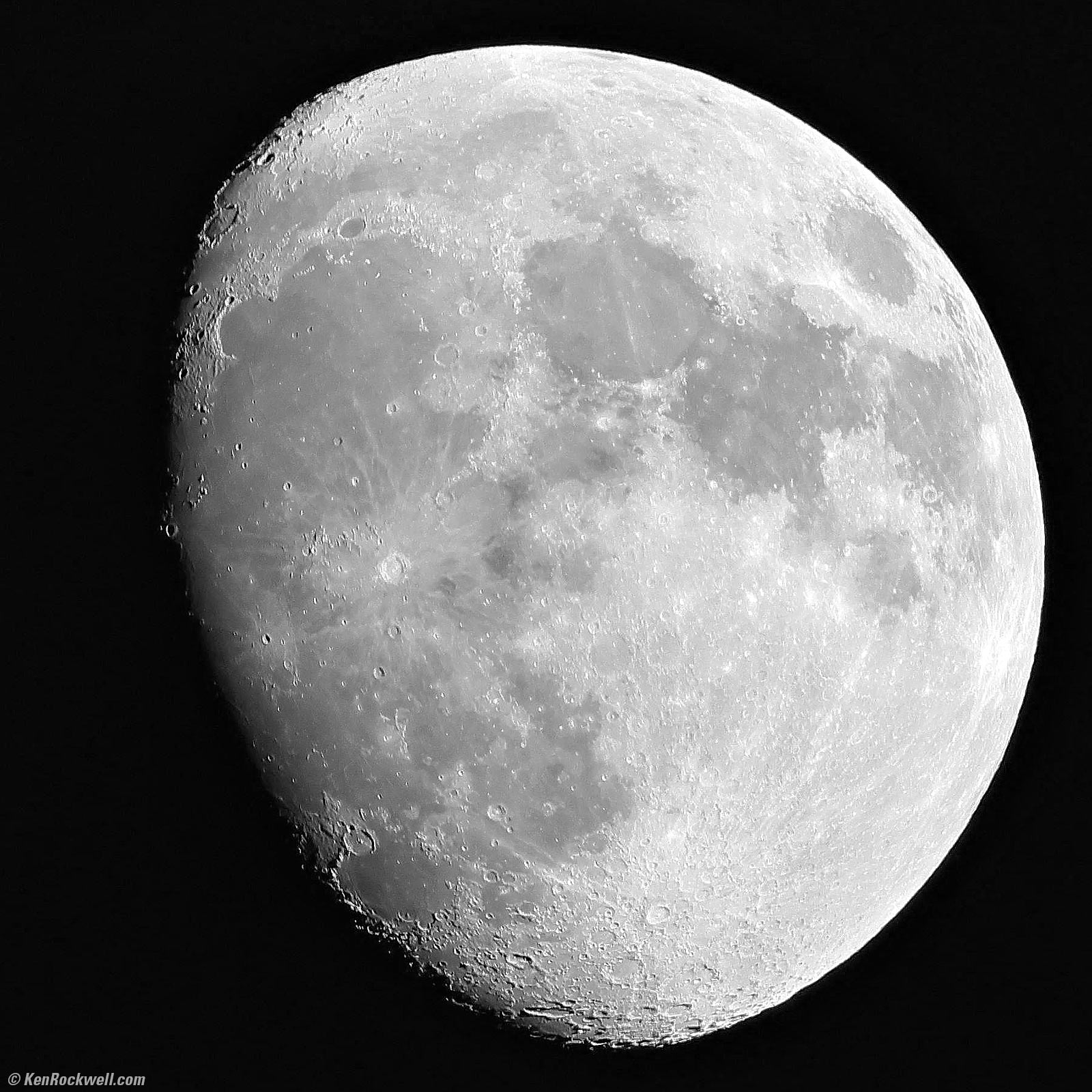
Waxing Gibbous Moon as seen over Christ Lutheran Church, Pacific Beach, California, 6:31 P.M., Sunday, 13 October 2024. Cropped from Canon EOS R5 II in APS-C crop mode (I didn't need any more black sky around this), RF 200-800mm IS USM at 800mm wide-open at f/9 hand-held at 1/250 at Auto ISO 500, -1 stop exposure compensation (LV 12.0), Radiant Photo software. bigger or camera-original 17 MP APS-C © 700 kB JPG quality 1 file.
I remember the bad old days trying to photograph the moon as a kid with my 700mm focal length f/11 (60mm diameter objective) Tasco telescope on an alt-azimuth slow-motion mount with my Minolta SRT-102 and a telescope adapter on Kodachrome 64. I got rubbish, even after half an hour setting up, while today, it's simply point-and-shoot as I'm walking down the street. Doing the math from LV 12.0 means I'd be at 1/15 with that film rig, which is asking for motion blur. Arrrgh, things are so much better today. The RF 200-800mm IS USM is super sharp and works great.

Sunset with God Beams, Solana Beach, California, 6:21 P.M., Friday, 27 September 2024. Square crop from Canon EOS R5 II, RF 200-800mm IS USM at 300mm at f/13 at 1/800 at Auto ISO 100 (LV 17.0), Radiant Photo and Skylum Luminar Neo software to perk it up. bigger.
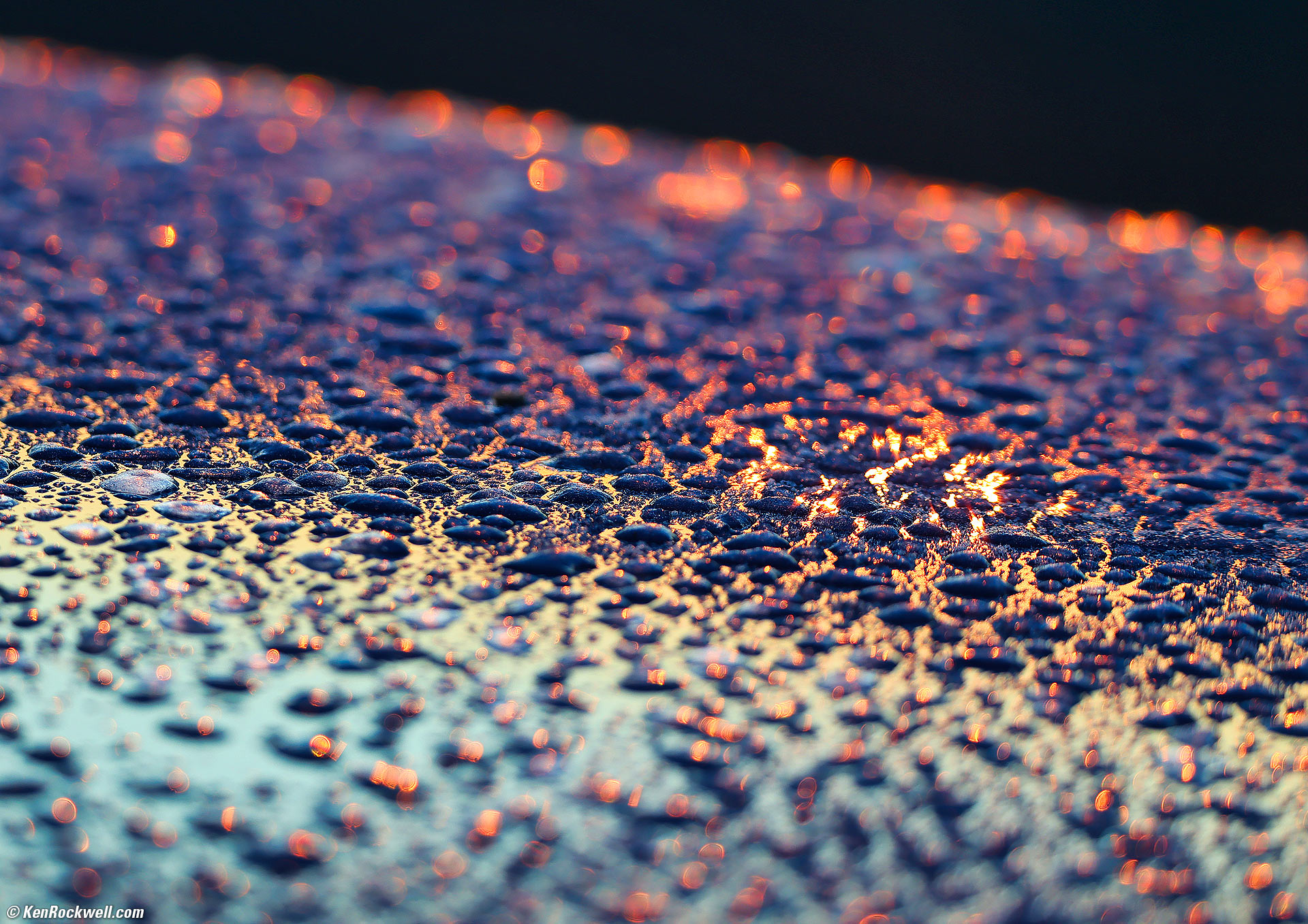
Morning Dew on Blue Car at Dawn, Conway Summit, Lee Vining, California, 7:10 A.M., 18 October 2024. Canon R5 II, RF 200-800mm IS USM at 288mm at f/7.1 hand-held at 1/80 at Auto ISO 100 LV 12). More tech details. bigger or fit-to-screen.
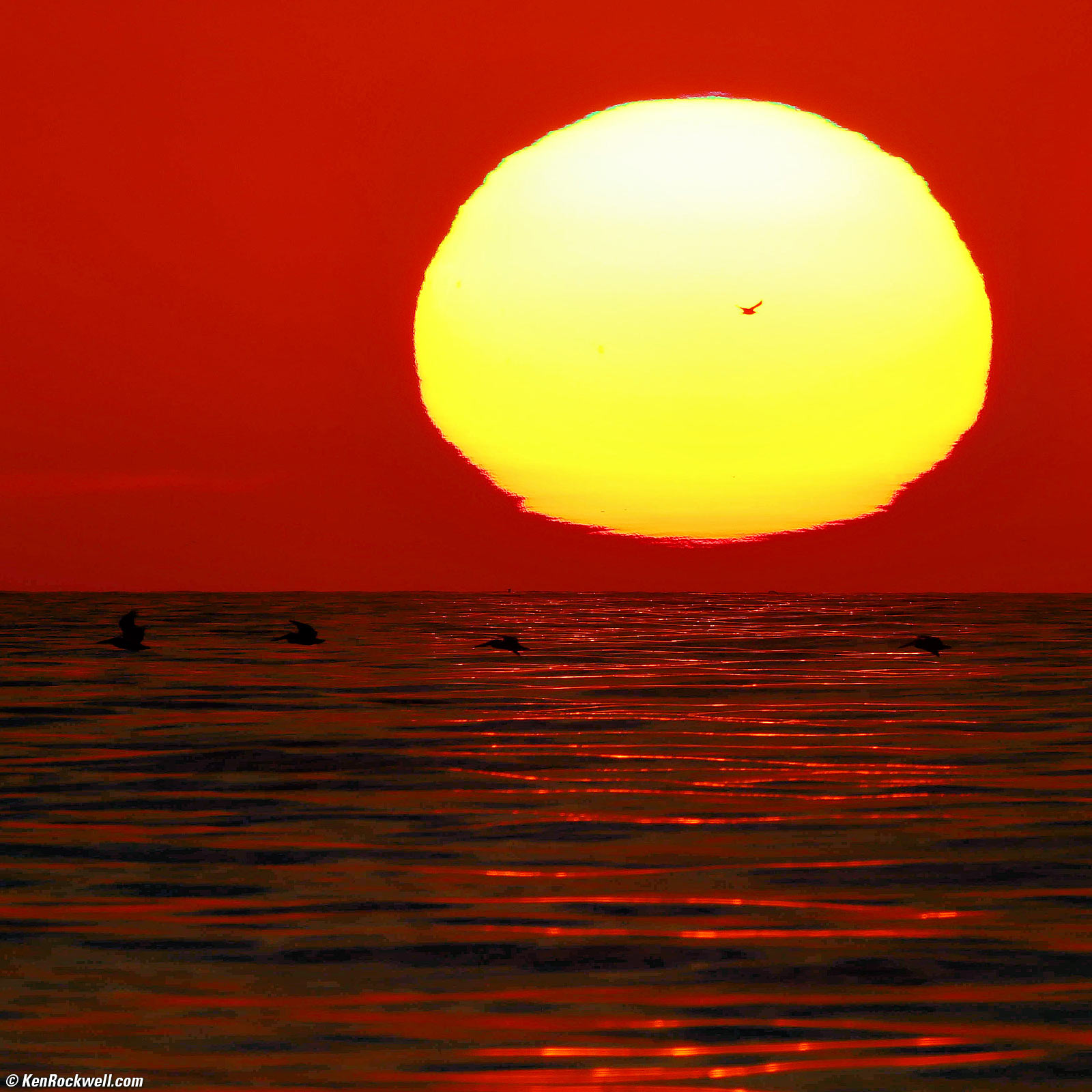
Sunset with Birds, Solana Beach, California, 6:04:38 P.M., Tuesday, 22 October 2024. Cropped from Canon EOS R5 II, RF 200-800mm IS USM at 800mm in Program exposure mode at f/16 hand-held at 1/1,250 at ISO 100, -1.3 stops exposure compensation (LV 18.4), Radiant Photo software to keep the detail in the sun and brighten everything else automatically. bigger.
You can see green along the top of the sun above, which is a hint of the little green flash to come three minutes later. It was only barely visible to the naked eye, and zoomed in all the way I got this much:

The Green Flash, Solana Beach, California, 6:07:33 P.M., Tuesday, 22 October 2024. Cropped from Canon EOS R5 II, RF 200-800mm IS USM in manual exposure mode at f/11 at 1/2,000 at ISO 100 (LV 18.0), Radiant Photo software to keep the detail and color in the Green Flash and put some detail in everything else automatically. bigger.
These shots are looking straight into sun, so both of these images are made with much less exposure than normal shots to ensure the retention of color in the disk of the sun or Green Flash. This makes everything else much darker than usual, and Radiant Photo then will lighten the surroundings to look more normal, while retaining color in the sun. Yes, these are all from JPG Quality 1 images, which store the same dynamic range as RAW files (8-bit log versus 14-bit linear). If I was paying attention I would have used a higher JPG quality setting, knowing that JPG artifacts would become much more visible after I lightened the dark areas. The artifacts you see are my fault, not the camera's.
Regardless of your chosen data format, you have to be careful to protect the highlights to retain color in the sun. In Zone System terms we place the disc of the sun at about Zone VII, and let everything else fall where it may. I then use Radiant Photo software to force everything else to be as light or dark as I want it, while Radiant Photo leaves the disc of the sun untouched, all automatically.
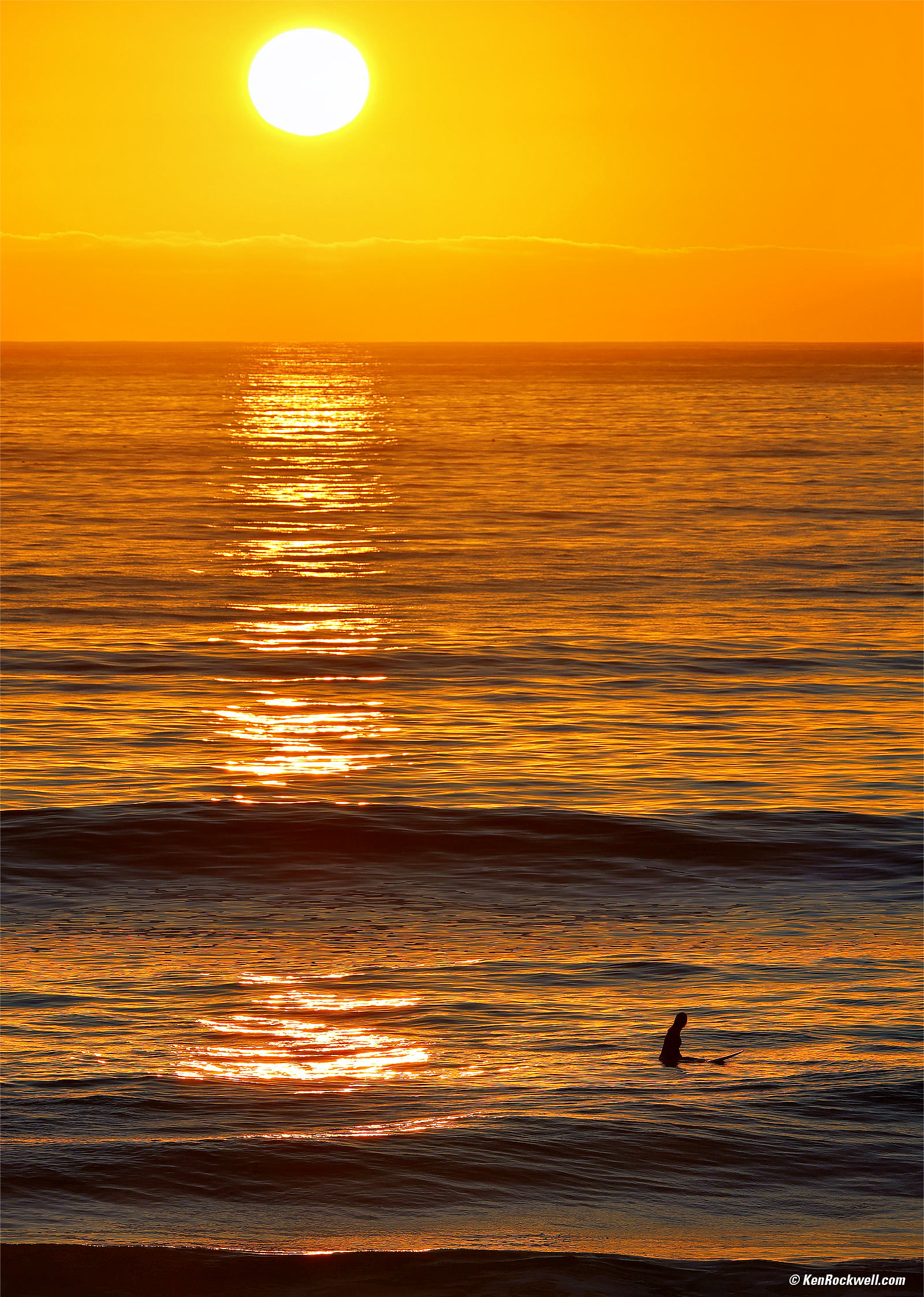
Sunset with Surfer, Pacific Beach, California, 6:10:22 P.M., Sunday, 13 October 2024. Canon EOS R5 II, RF 200-800mm IS USM at 300mm at f/11 at 1/640 at Auto ISO 100 (LV 16.4), Radiant Photo software. bigger.

Introduction top
Sample Images Intro New Good Bad Missing
Specifications Accessories USA Version
Performance Compared User's Guide

I buy only from these approved sources. I can't vouch for ads below. |



The Canon RF 200-800mm is a superbly sharp ultratelephoto. It has great image stabilization so it's trivial to shoot hand-held with no need for a tripod as I did for this moon shot. It weighs less than you'd expect, so it's easy to carry it all over and grab ultratele shots in ways we never have before.
It's very affordable for such a long lens, and therefore it's so popular that most of us have to wait months for ours to arrive as I did, or pay a $500 premium to get it sooner. Order yours now and be patient; order from B&H, from Adorama or from Crutchfield and you'll pay less, you'll get a brand-new lens, and if you don't love it to death as I do, you can simply send it back for a full cash refund (or resell it on eBay for a fat profit). You have nothing to lose. Don't wait and expect to find this in stock anywhere; when they come in they ship right out to people like me who had them on order in advance, without ever showing as "in stock," so order yours today and be patient for it to arrive. This is a super lens at a super-low price, which is why it's so hard to get.
It works with either the 2× Extender or 1.4× Extender, but only one at a time.
I got my 200-800mm IS USM at B&H. I'd also get it at Adorama, at Amazon or at Crutchfield, or get it used if you know How to Win at eBay, or get it used at KEH.
New intro top
 World's first 200-800mm zoom.
Unusual in being a big, white Canon ultra-tele, but not being marked "L" or having a red band around it.
Good intro top
 Ultrasharp.
Very close focussing for a lens so long.
I've had no problems with ghost images shot into the setting sun.
Extraordinarily affordable for such a long lens. For comparison, the RF 800mm f/5.6 L IS USM costs ten times as much and can't zoom.
AF/MF switch.
Image Stabilizer rated 7.5 stops at 200mm and 5.5 stops at 800mm. Actually gives about 4 stops of real-world improvement.
Stabilizer switch.
No need for a Stabilizer Mode switch because it figures out if you're panning and adjusts itself accordingly.
Zoom friction adjustment ring doubles as a zoom lock. It's marked SMOOTH <—> TIGHT.
Focus ring can be reprogrammed to do other things (the CONTROL position of the AF/MF stitch).
Two programmable focus lock buttons.
Strap lugs on the lens itself for use with the included strap.
Claimed dust- and drip-proofing:
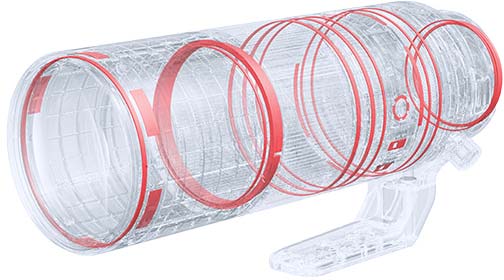
Gaskets.
Hood included.
100% U.S.A.-based high-quality technical support at (800) OK-CANON.
Bad intro top
 It's so good and so affordable that it takes a very long wait to get one at the official $1,899 price.
 Tripod collar can't be removed.
Missing intro top
 The LZ1438 Case is not included, which is too bad because this lens is so long it won't fit in any of my favorite shoulder bags; I have to put it in my Think Tank Airport Commuter.
Mounting index dot isn't raised, so it can't be found by feel in the dark.
No aperture ring.
No always-active manual-focus override, unless you set that in a menu.
No focus or depth-of-field scale, but may be shown in-camera.
No infra-red focus indices.
Specifications top
Sample Images Intro New Good Bad Missing
Specifications Accessories USA Version
Performance Compared User's Guide
I got my 200-800mm IS USM at B&H. I'd also get it at Adorama, at Amazon or at Crutchfield, or get it used if you know How to Win at eBay.
See also Canon's own specifications.
Name specifications top
Canon calls this the RF200-800mm F6.3-9 IS USM:
RF: Works only on Canon's EOS-R Mirrorless cameras.
IS: Image Stabilization.
USM: nano UltraSonic (autofocus) Motor.
Optics specifications top
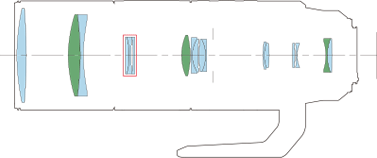
Canon RF Internal Optical Construction. UD elements and IS section outlined in red.
17 elements in 11 groups.
3 UD extra-low dispersion elements, which help reduce secondary axial chromatic aberration.
"Pumper" zoom; gets longer as zoomed to longer focal lengths.
Super Spectra multicoating.
Diaphragm specifications top
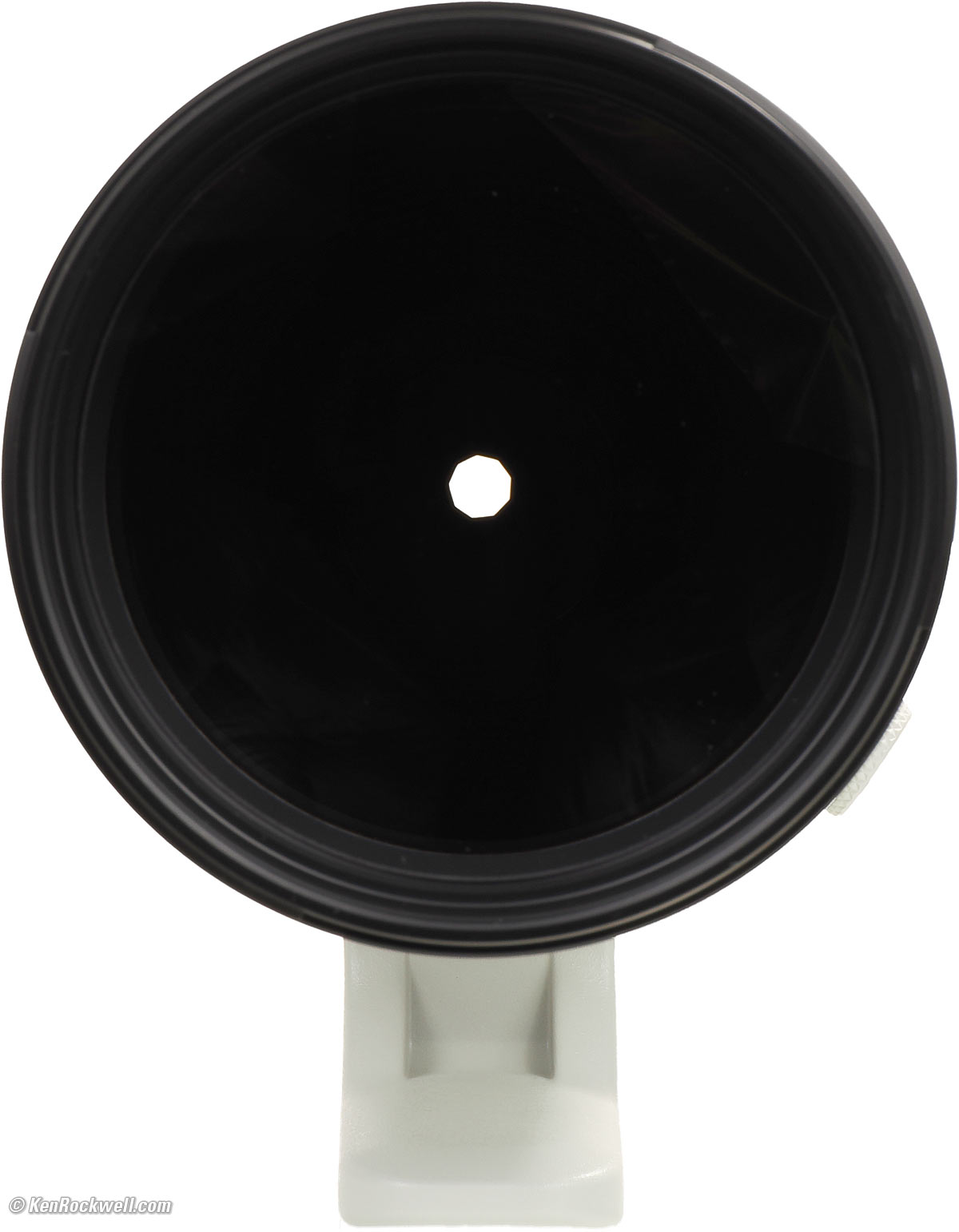
Canon RF 200-800mm IS USM. bigger.
9 rounded blades.
Electronically actuated.
Stops down to f/32 - f/51.
Filters specifications top
Plastic 95mm filter thread.
Focal Length specifications top
200 ~ 800mm.
When used on Canon's APS-C cameras, it sees the same angle of view as a 320 ~ 1,280mm lens sees when used on a full-frame or 35mm camera.
See also Crop Factor.
Angle of View, Full Frame specifications top
12º ~ 3º 05' diagonal.
10º ~ 2º 35' horizontal.
7º ~ 1º 40' vertical.
Autofocus specifications top
Nano USM.
No external movement as focussed, so no air or dust is sucked in.
Focus Scale specifications top
No.
Not on lens, but may be displayed in-camera.
Infinity Focus Stop specifications top
No.
You have to focus somehow to get precise focus at infinity, just like at every other distance.
Depth of Field Scale specifications top
No.
Not on lens, but may be displayed in-camera.
Infrared Focus Index specifications top
No.
Close Focus (distance from subject to image plane) specifications top
At 200mm: 2.6 feet (0.8 meters).
At 400mm: 5.9 feet (1.8 meters).
At 600mm: 9.2 feet (2.8 meters).
At 800mm: 11 feet (3.3 meters).
Maximum Reproduction Ratio specifications top
At 200mm: 1:4.0 (0.25×).
At 400mm: 1:5.3 (0.19×).
At 550mm: 1:5.3 (0.19×).
At 600mm: 1:5.6 (0.18×).
At 800mm: 1:5.0 (0.20×).
Minimum Subject Fields specifications top
At 200mm: 135 × 90mm (0.25×).
At 550mm: 192 × 128 mm (0.19×).
At 800mm: 173 × 115mm (0.20×).
Image Stabilizer specifications top
Rated 7.5 stops improvement at 200mm and 5.5 stops at 800mm.
Actually gives about 4 stops improvement in real-world shooting.
Caps specifications top
RF Rear Cap (p/n 2962C001).
Hood specifications top

Canon ET-101 Hood, included.
Case specifications top
Optional Canon LZ1438 Case, also at Adorama.
Tripod Collar specifications top
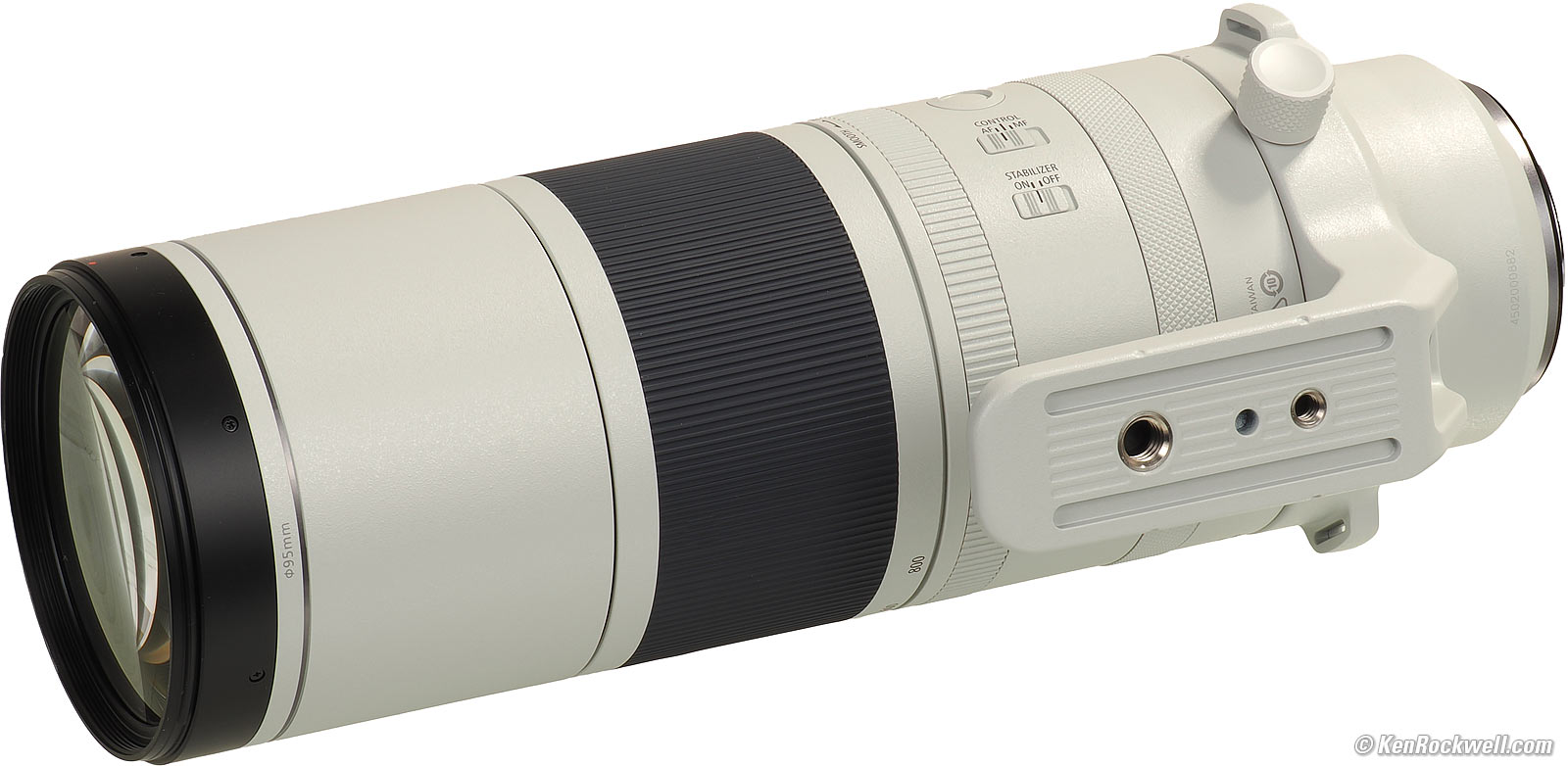
Canon RF 200-800mm IS USM. bigger.
The tripod collar has both ¼″ × 20" TPI and ⅜″ × 16" TPI sockets.
It has no 90º click stops.
It cannot be removed.
It does have a friction lock.
The tripod foot doubles as a handle, although it lacks the padding of some other more expensive lenses:
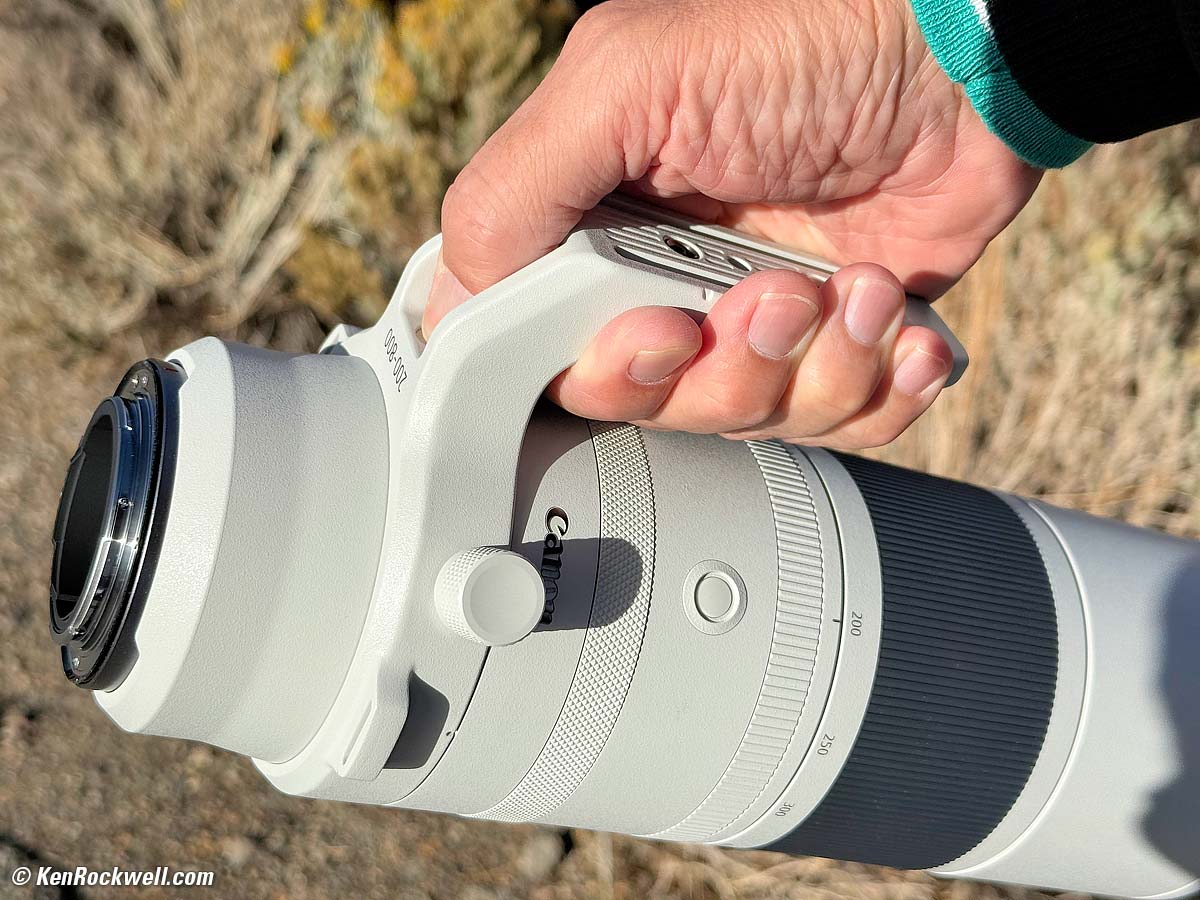
Canon RF 200-800mm IS USM. bigger.
Size specifications top
4.03" ø maximum diameter × 12.37" extension from flange at 200mm (gets longer at longer focal lengths).
102.3 mm ø maximum diameter × 314.1 mm extension from flange at 200mm (gets longer at longer focal lengths).
Weight specifications top
72.3 oz. (2,050g) rated and actual measured weight.
Quality specifications top
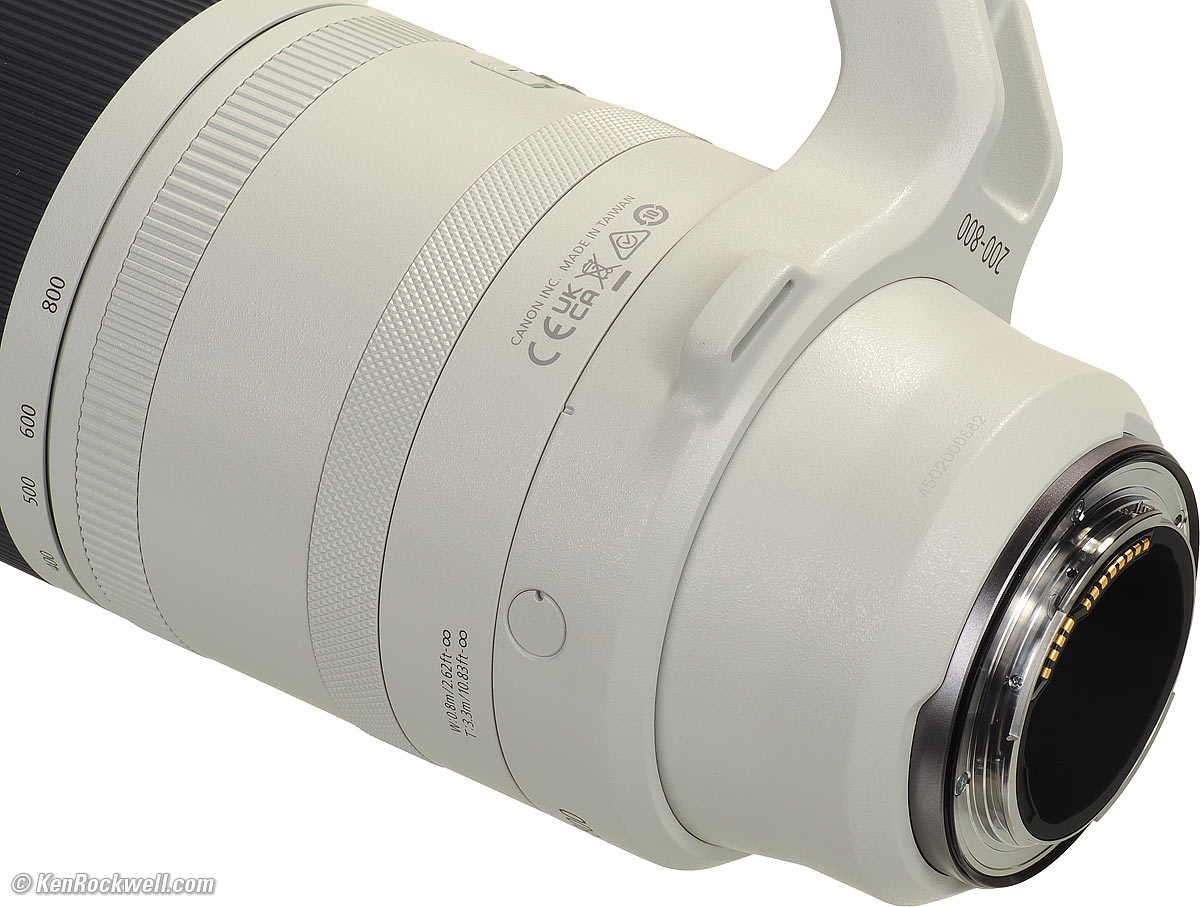
Canon RF 200-800mm IS USM. bigger.
Made in Taiwan, which is a huge step up ethically from Thailand or China in my opinion.
Announced specifications top
Thursday, 02 November 2023.
Promised for specifications top
December 2023, but as of November 2024 it's still very hard to get unless you order it and wait for it to arrive, or are prepared to pay more to scalpers to get it sooner.
Included specifications top
RF Rear Cap (p/n 2962C001).
Lens strap, which attaches to lugs on the tripod collar.
Packaging specifications top
These pictures don't show it, but this is a big lens which arrives in a big box. The outer box measures 8¼" (210mm) square by 16.4" (418mm) tall:
|
|
Outer Box. bigger. |
Box end. bigger. |
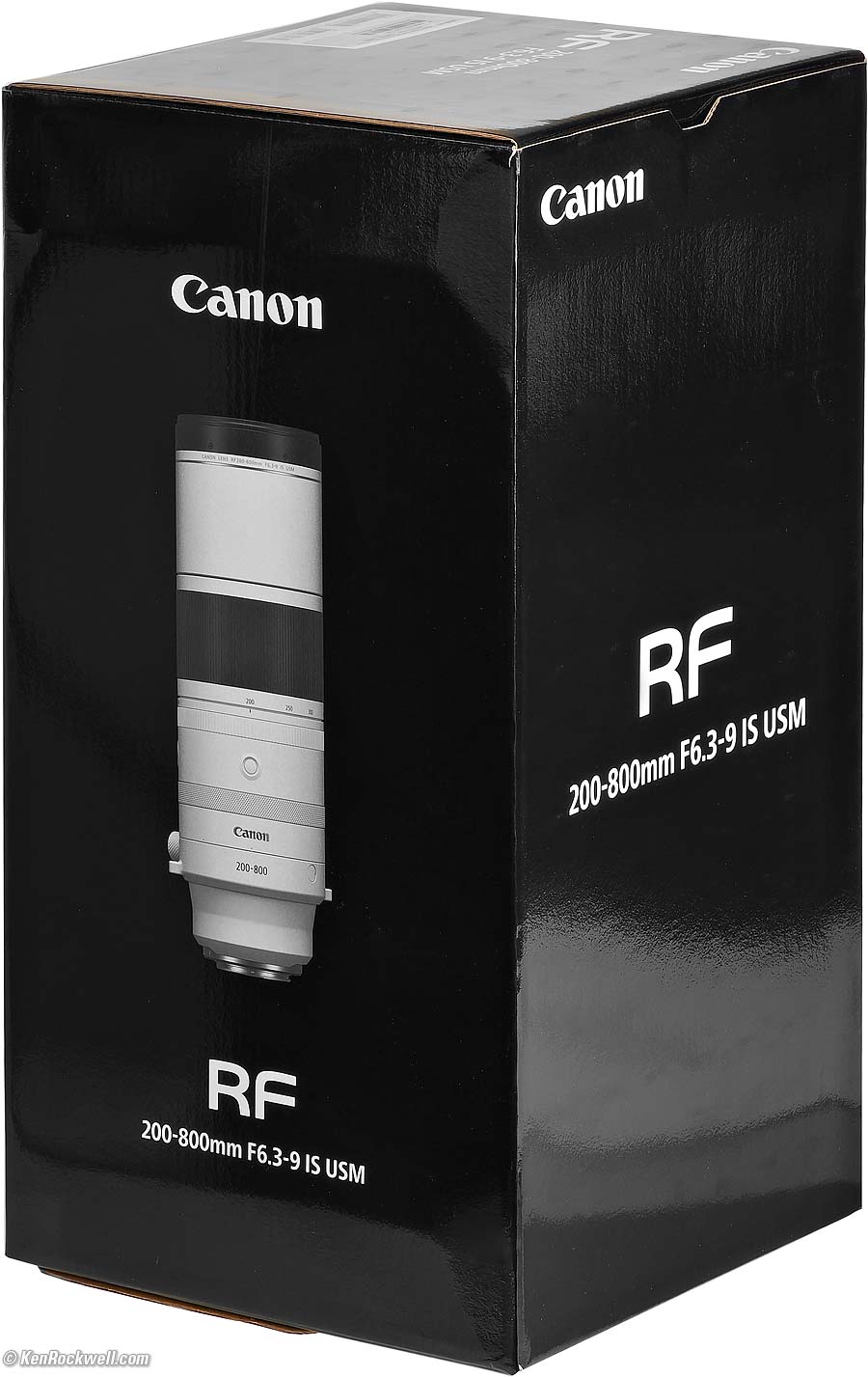
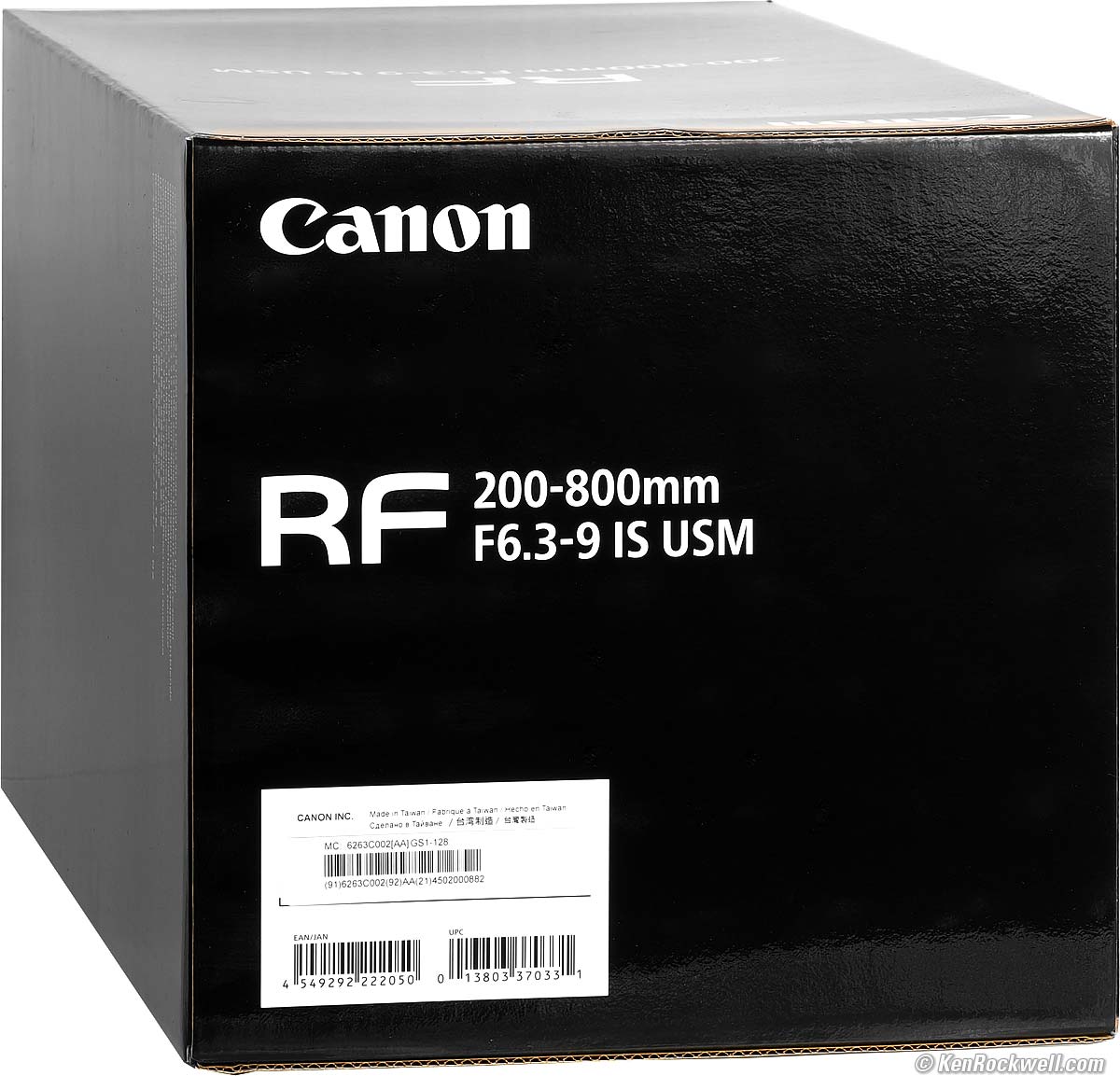
The lens sits in a plastic bag inside this plain cardboard inner box which is held inside inside the flashy black microcorrugated box with polypropylene formers:

Inner Box. bigger.
Model Numbers specifications top
Product code: 6263C002 (6263C001 in Japan).
Model number: RF200-800ISUSM.
JAN code: 4549292-222050.
Price, U. S. A. specifications top
30 June 2025
$2,099 new at B&H, at Adorama, at Amazon and at Crutchfield.
About $1,685 used at eBay (How to Win at eBay). Here are recently sold items on eBay so you can see the actual selling prices.
29 January 2025
$1,899 new at B&H, at Adorama, at Amazon and at Crutchfield.
About $1,750 used at eBay (How to Win at eBay). Here are recently sold items on eBay so you can see the actual selling prices.
15 November 2024
$1,899 new at B&H, at Adorama, at Amazon and at Crutchfield.
About $2,400 from third parties new at Amazon, or $2,400 used ("renewed") at Amazon.
About $2,400 used at Amazon or about $1,900 used at eBay (How to Win at eBay).
04 November 2024
$1,899 new at B&H, at Adorama, at Amazon and at Crutchfield.
About $2,400 from third parties new at Amazon, or $2,400 used ("renewed") at Amazon.
About $2,400 used at Amazon or about $2,000 used at eBay (How to Win at eBay).
27 September 2024
$1,899 new at B&H, at Adorama and at Crutchfield.
22 June 2024
$1,899 new at B&H, at Adorama and at Crutchfield.
25 May 2024
$1,899 new at B&H, at Adorama and at Crutchfield.
Optional Accessories top
Sample Images Intro New Good Bad Missing
Specifications Accessories USA Version
Performance Compared User's Guide
I got my 200-800mm IS USM at B&H. I'd also get it at Adorama, at Amazon or at Crutchfield, or get it used if you know How to Win at eBay.
Canon LZ1438 Case, also at Adorama.
95mm filters.
Canon ET-101 Hood (included).
Getting a Legal U. S. A. Version top
Sample Images Intro New Good Bad Missing
Specifications Accessories USA Version
Performance Compared User's Guide
I got my 200-800mm IS USM at B&H. I'd also get it at Adorama, at Amazon or at Crutchfield, or get it used if you know How to Win at eBay.
This section applies in the U. S. A. only.

Canon RF 200-800mm IS USM U. S. A. Warranty Card. bigger.
Your lens must include a printed U. S. A. warranty card like the one shown above from Canon U.S.A., Inc. It should be on top inside your box as you open it. The serial number on the card must match the serial number on the bottom of your lens, which is almost invisibly engraved on the bottom near the mount.
If you have no card or the serial number doesn't match, you got ripped off with a gray market version intended to be sold in another country. This is why I never buy from any place other than my personally approved sources. You just can't take the chance of buying elsewhere, especially at any retail store where strangers have probably opened your completely unsealed box and played with your fancy lens, because non-U. S. A. versions have no warranty in the U. S. A., and you probably won't be able to get firmware or service for it — even if you're willing to pay out-of-pocket for it when you need it!
Shifty dealers may include color copies of a card from a legitimate U. S. A. product in a gray-market box, hoping you won't check serial numbers and catch their fraud. A card with the wrong serial number means nothing other than that you have no warranty coverage.
The serial number on the box doesn't have to match, but it should. It will be hidden someplace on the sticker with all the bar codes. If not, it means a shady dealer took things out of boxes and was too sloppy to put them back correctly — and it means you got a used lens if anyone other than you took it out of the box.
If a gray market version saves you $600 the risk might be worth it, but for $200 or less savings I wouldn't risk having no warranty or support.
Always be sure to check yours while you can still return it, or just don't buy from unapproved sources and never at retail so you'll be able to have your camera serviced and get free updated firmware as needed. Get yours from the same places I do and you won't have a problem.
Performance top
Sample Images Intro New Good Bad Missing
Specifications Accessories USA Version
Performance Compared User's Guide
Overall Autofocus Manual Focus Breathing
Distance Recording Bokeh Distortion Ergonomics
Falloff Filters Flare & Ghosts Lateral Color Fringes
Lens Corrections Macro Max & Min Apertures
Mechanics Sharpness Spherochromatism
Stabilization Sunstars Teleconverters
I got my 200-800mm IS USM at B&H. I'd also get it at Adorama, at Amazon or at Crutchfield, or get it used if you know How to Win at eBay.
Overall performance top
This lens is so good and affordable that very few people have been able to get one, even a year after its introduction. Look at the pictures; what more is there to say?
Autofocus performance top
Autofocus is fast and sure. I have no problems shooting into the setting sun or tracking surfers from the pier.
Manual Focus performance top
Manual focusing is entirely electronic; the manual focus ring isn't connected to anything other than a digital encoder.
You may need to set some menus in some cameras to get manual-focus override, and no matter what you do, in SERVO AF mode all Canon EOS-R cameras, at least as of November 2024, will continue to autofocus as soon as you stop turning the manual focus ring. Sadly only Nikon has this all figured out today.
Focus Breathing performance top
Focus breathing is the image changing size (growing and shrinking slightly) as focused in and out. It's important to cinematographers that the image not breathe (change size) as focus gets pulled back and forth between different actors as they speak. The image is said to breathe because it expands and contracts as the focus follows the dialog back and forth.
The image from this 200-800mm gets slightly smaller as focussed more closely, however it's so slight and the image becomes so wildly out of focus so fast as you change focus I doubt anyone would every notice it outside of a laboratory.
Focus Distance Recording performance top
The focused distance is recorded in the EXIF data.
I can read this in the lower left of my screen in Photoshop's lens correction filter.
Bokeh performance top
Bokeh, the feel, character or quality of out-of-focus areas as opposed to how far out of focus they are, is very neutral, which is good. Blur circles stay as plain circles without calling attention to backgrounds. Of course with a lens this long backgrounds are usually very far out of focus.
Here are photos from headshot distance wide-open. I'm focused on the DAVIS logo. Click any for the © camera-original file:
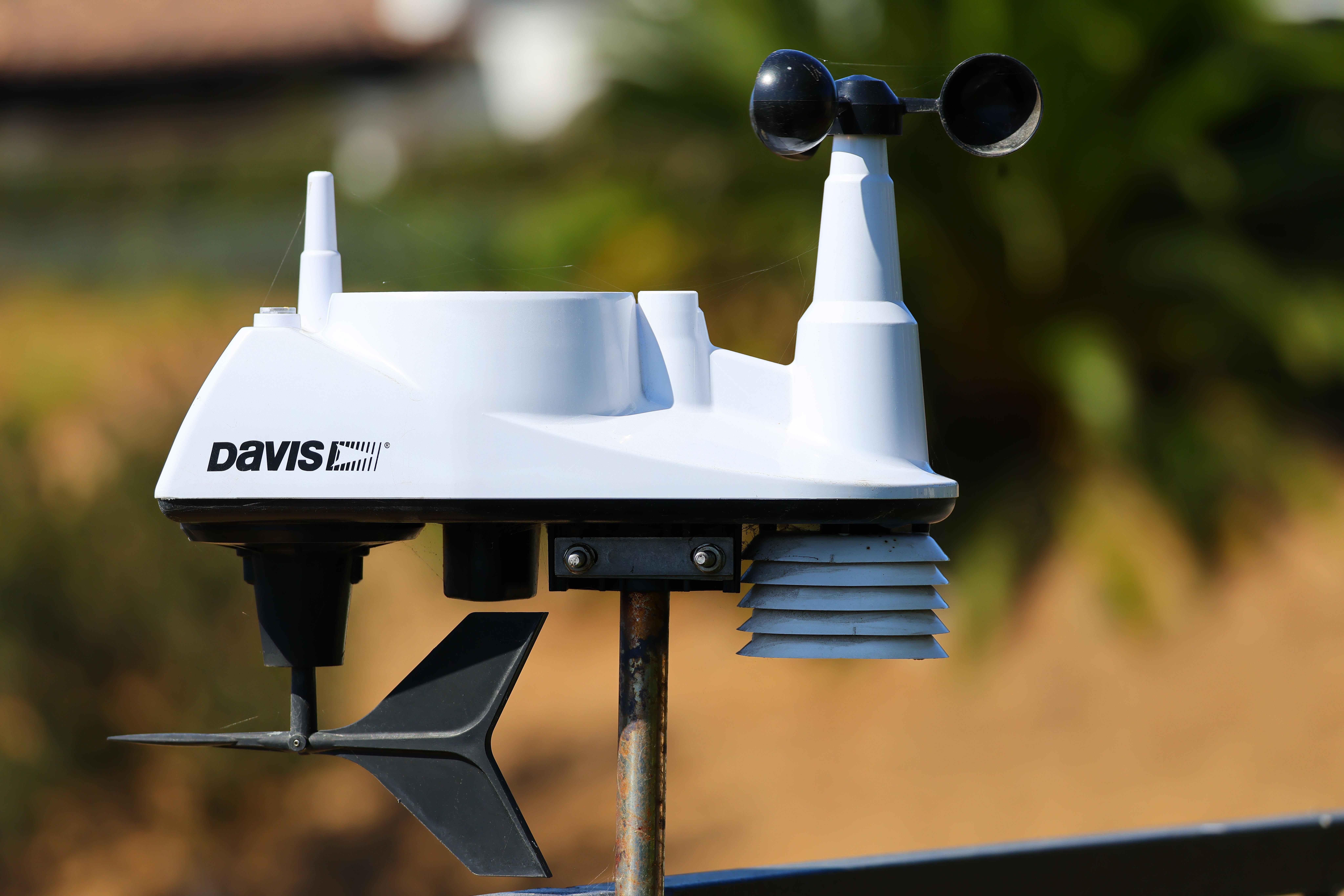
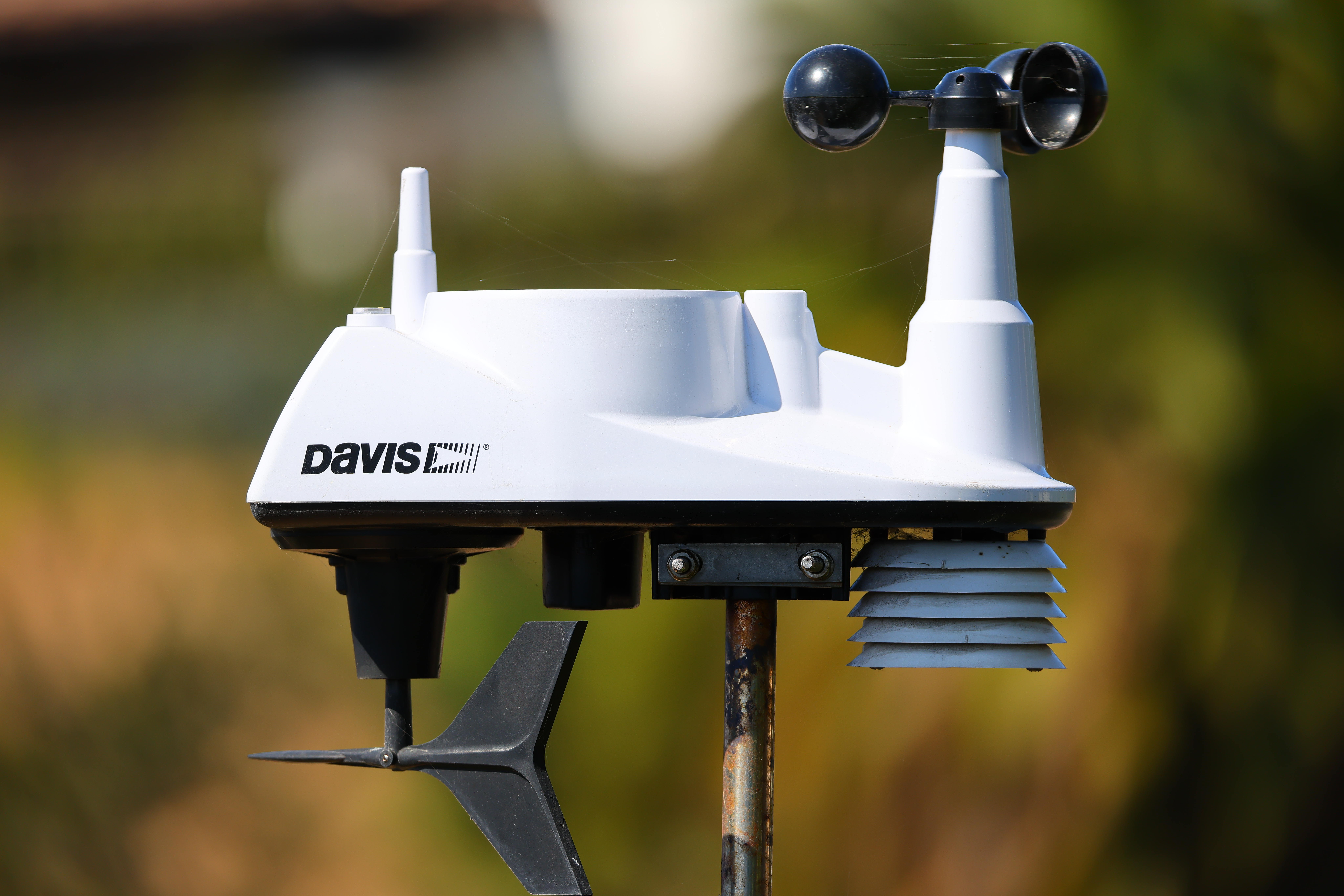
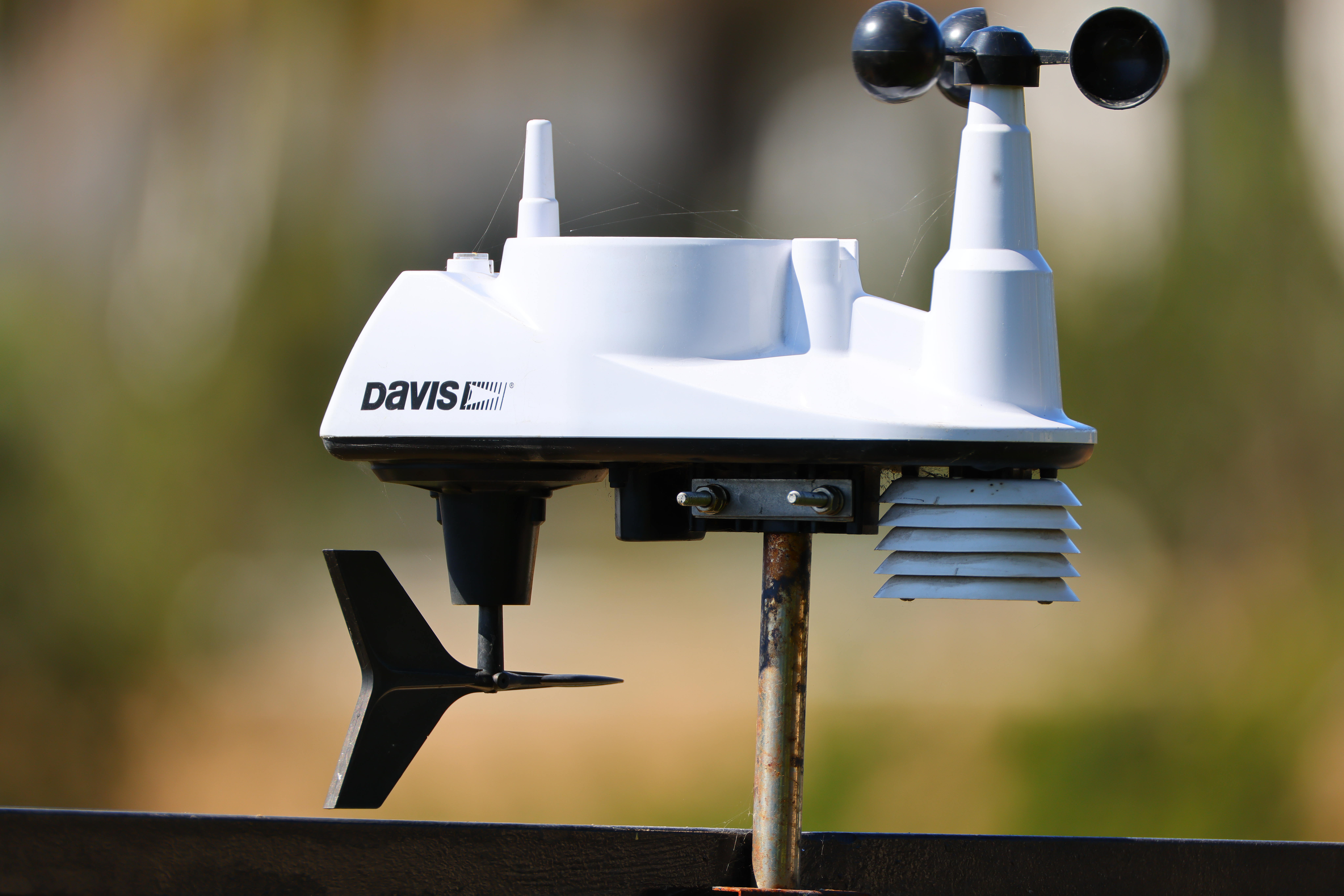
Made-in-U. S. A. Davis 6357 Vantage Vue Wireless Sensor Suite (use with WeatherLink console), 08 October 2024. Canon EOS R5 II, RF 200-800mm IS USM at 1/640, 1/500 and 1/250 at Auto ISO 100 (LV 14¾, 14.6 and 14.4). click any for the camera-original 45 MP © 2.2 MB file.
As always, if you want to throw the background as far out of focus as possible, shoot at 800mm and f/9 and get as close as possible.
Distortion performance top
The Canon RF 200-800mm has no visible or measureable distortion with Distortion Correction ON.
Even with distortion correction turned off, it has only moderate pincushion distortion from 200mm to 400mm, and only minor pincushion distortion from 500mm to 800mm.
If you shoot raw data rather than JPG images, whatever software you use to create visible images from raw data may or may not correct the distortion as is done in-camera as JPGs. You're on your own there; I don't bother with raw data.
For more critical scientific use, use these corrections in Photoshop's lens correction filter to JPG images.
These aren't facts or specifications, they are the results of my research that requires hours of photography and calculations on the resulting data.
On Full-Frame at Infinity |
Correction factor to use with images made with correction ON in EOS R5 II |
Correction factor with uncorrected images |
200mm |
±0.00 | -2.50 |
250mm |
±0.00 | -2.50 |
300mm |
±0.00 | -2.40 |
400mm |
±0.00 | -2.20 |
500mm |
±0.00 | -1.60 |
600mm |
±0.00 | -1.70 |
800mm |
±0.00 | -1.10 |
© 2024 KenRockwell.com. All rights reserved.
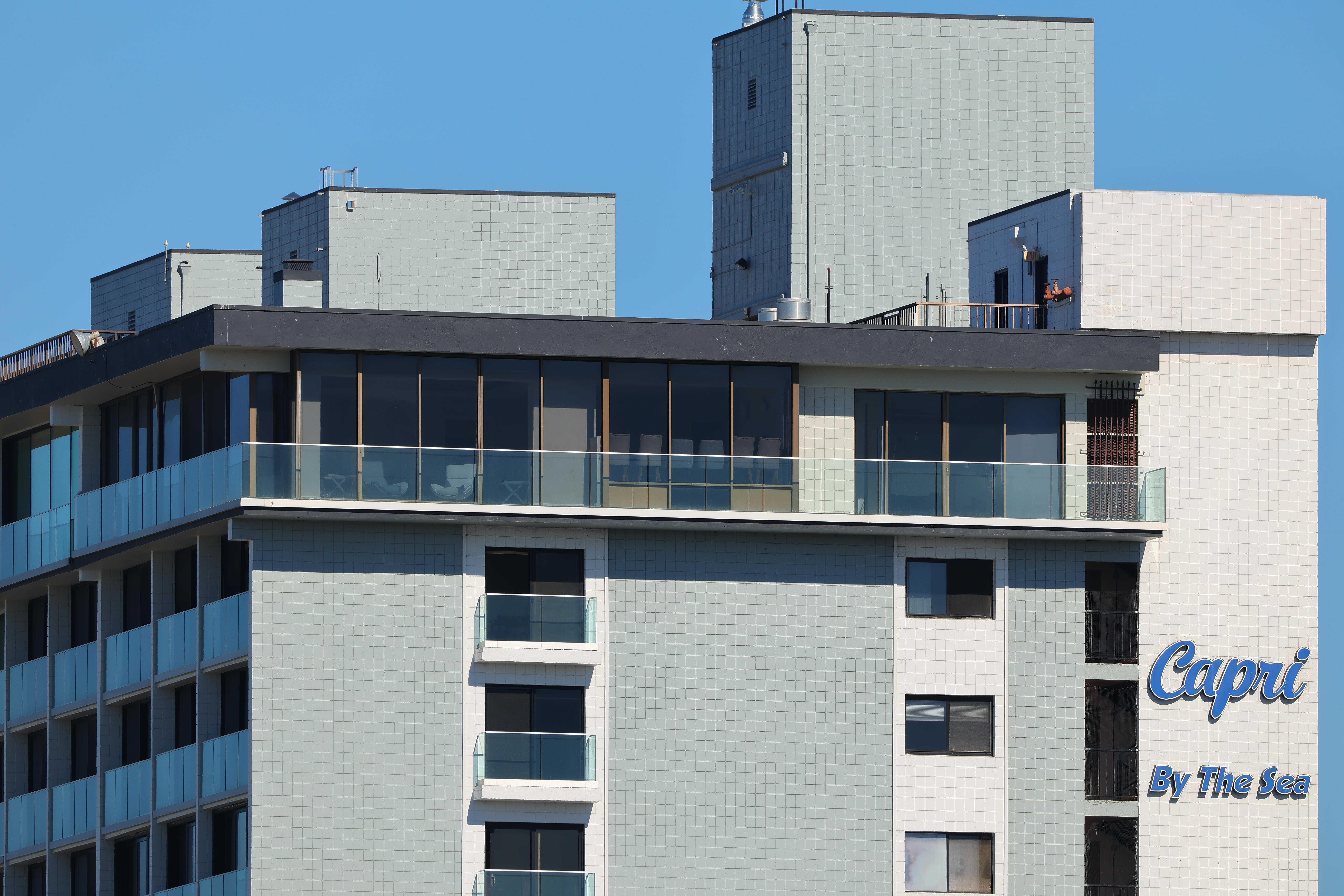
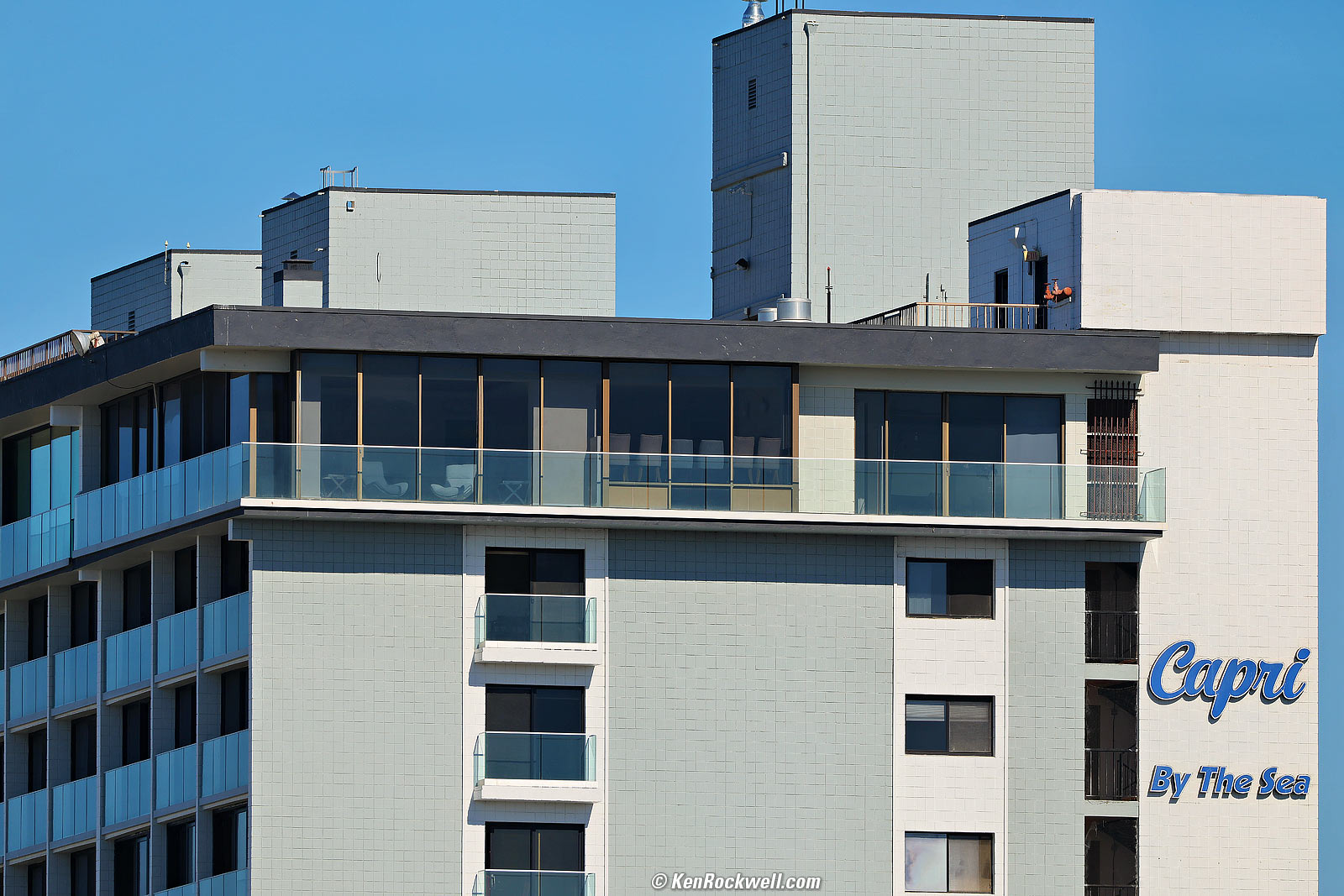
Capri by the Sea, Pacific Beach, California, 11:08 A.M., Saturday, 09 November 2024. Canon EOS R5 II with Distortion Correction ON, RF 200-800mm IS USM at 637mm at f/10 handheld at 1/400 at Auto ISO 100 (LV 15¼), exactly as shot. bigger or camera-original 45 MP © 3.4 MB JPG quality 1 file.
Ergonomics performance top
This is a big lens, but feels light and handles very well other than being clunky to zoom.
There is a lot moving around as you zoom. It takes at least two firm fingers. It takes more effort to zoom longer when pointed up, but not by much. This is a pretty clumsy lens to zoom; you're moving a lot around — the zoom ring doesn't flick back and forth with one finger as is does on the RF 70-200mm f/2.8L IS USM Z.
I always shoot it hand-held; with its excellent stabilization I never need a tripod and it's easy for 6-foot (183 cm) me to carry it around all day attached to the camera around my neck. I hold it between my arm and my body, cradling the front of the lens in my hand and all's good. If anything, people think I'm carrying a Thermos rather than a camera! Otherwise it's a big, white lens so you obviously look like a photographer while using it.
I wouldn't recommend doing this, but with my big, strong hands I can shoot this one-handed, supporting the whole rig with only my right hand on my EOS R5 II's grip.
The tripod foot cannot be removed, and it does work well as a handle for the whole rig. It would be comfier if it were padded, but too bad.
It's a "pumper" zoom that gets longer as zoomed longer:
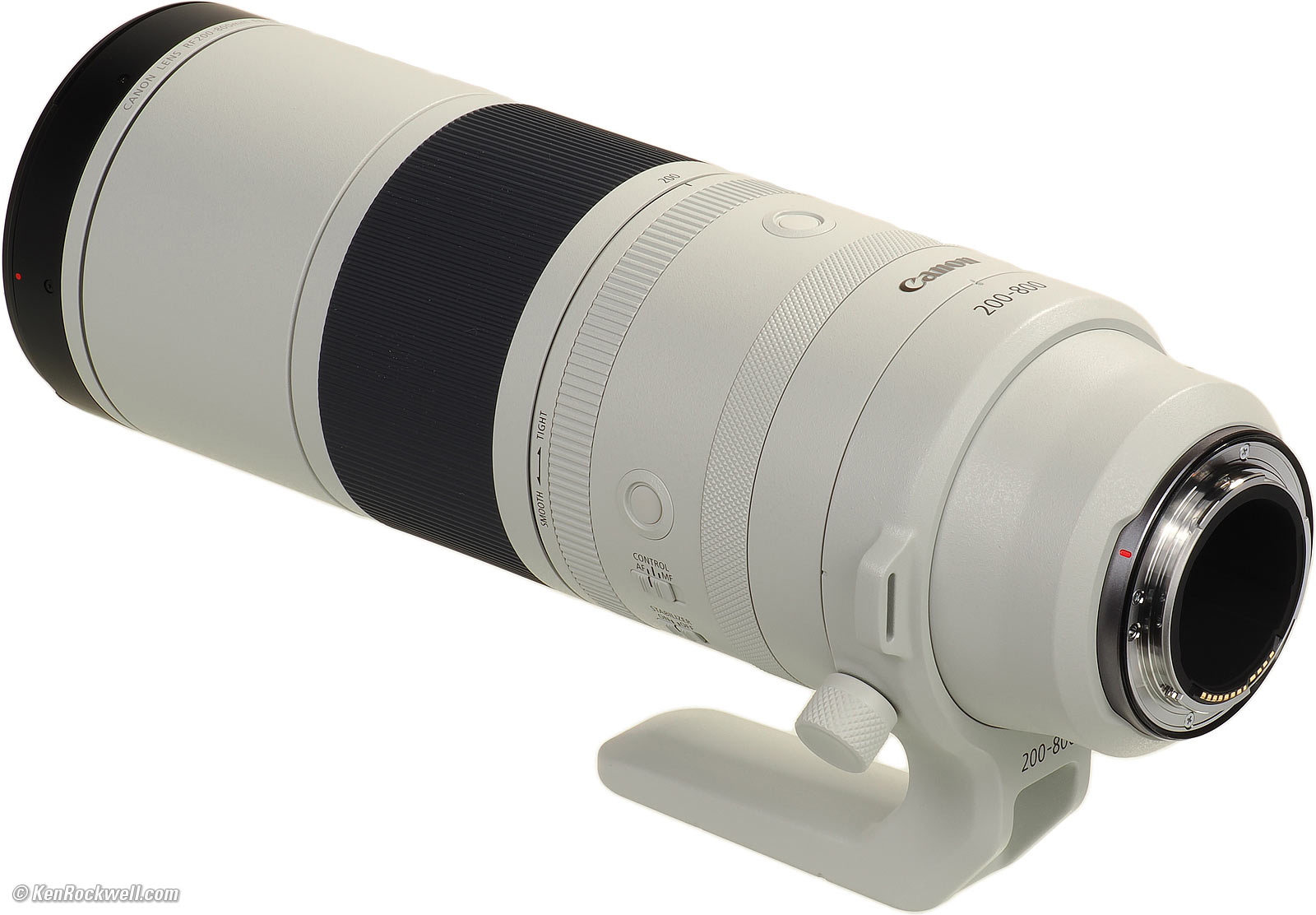
At 200mm. bigger.
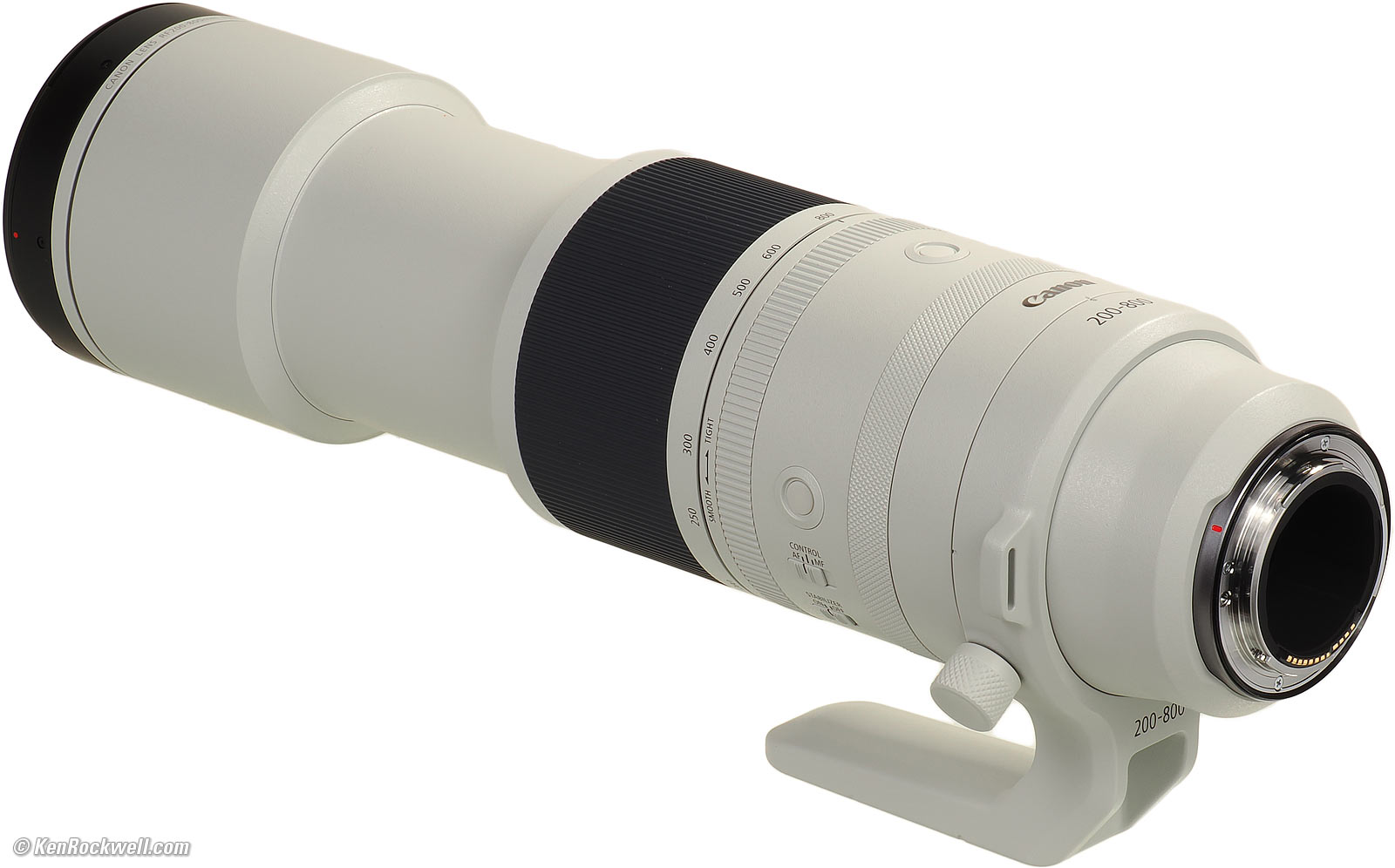
At 800mm. bigger.
|
|
|
|
At 200mm. bigger. |
At 800mm. bigger. |
At 200mm. bigger. |
At 800mm. bigger. |
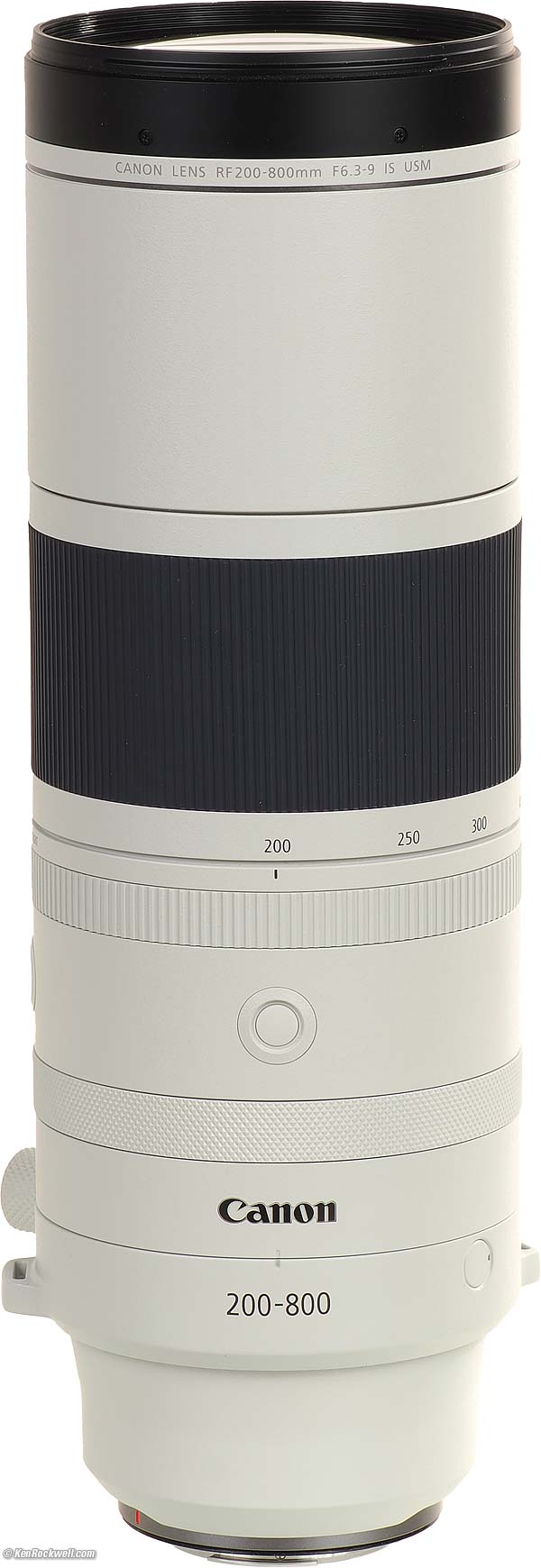
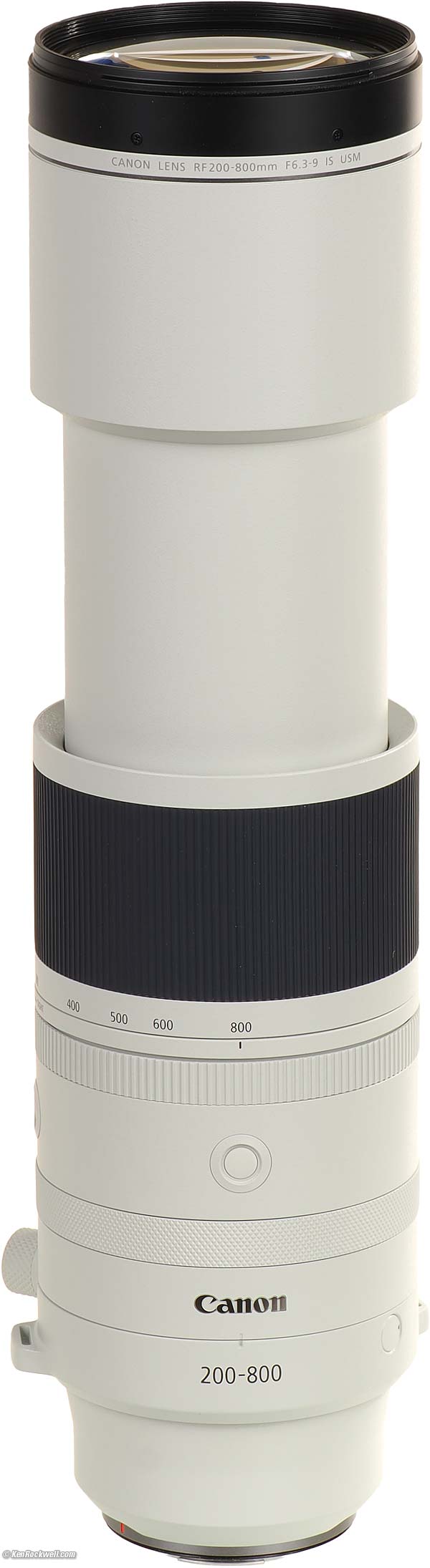
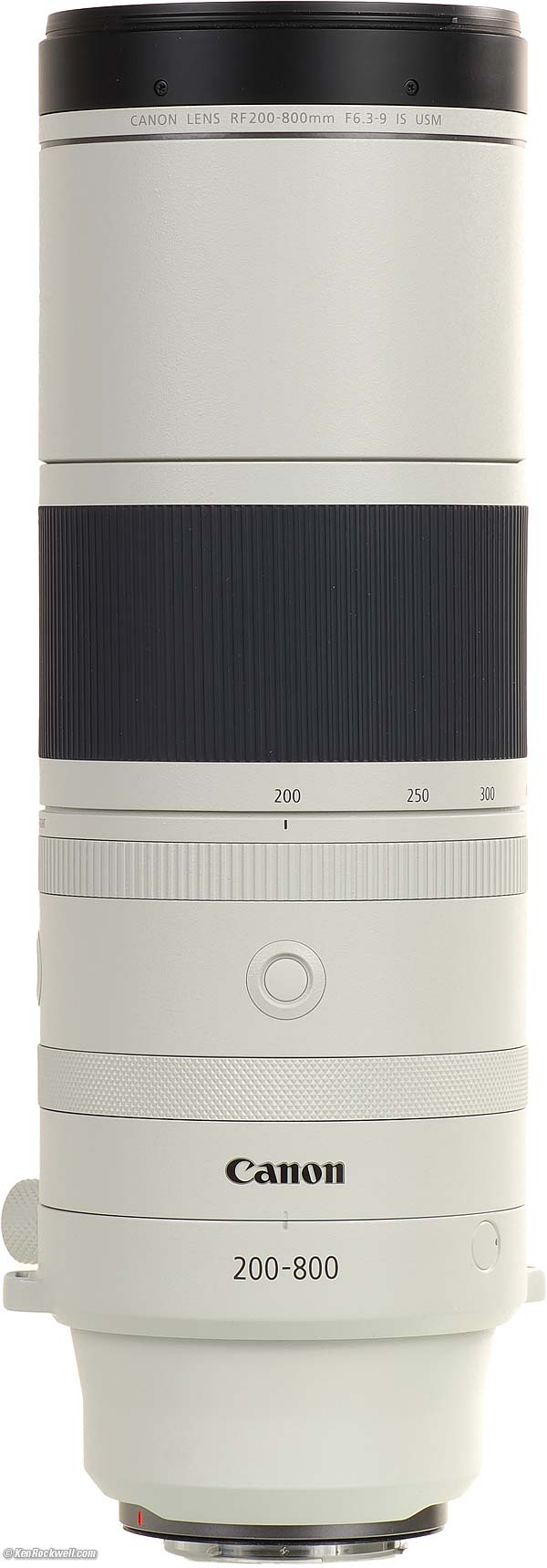
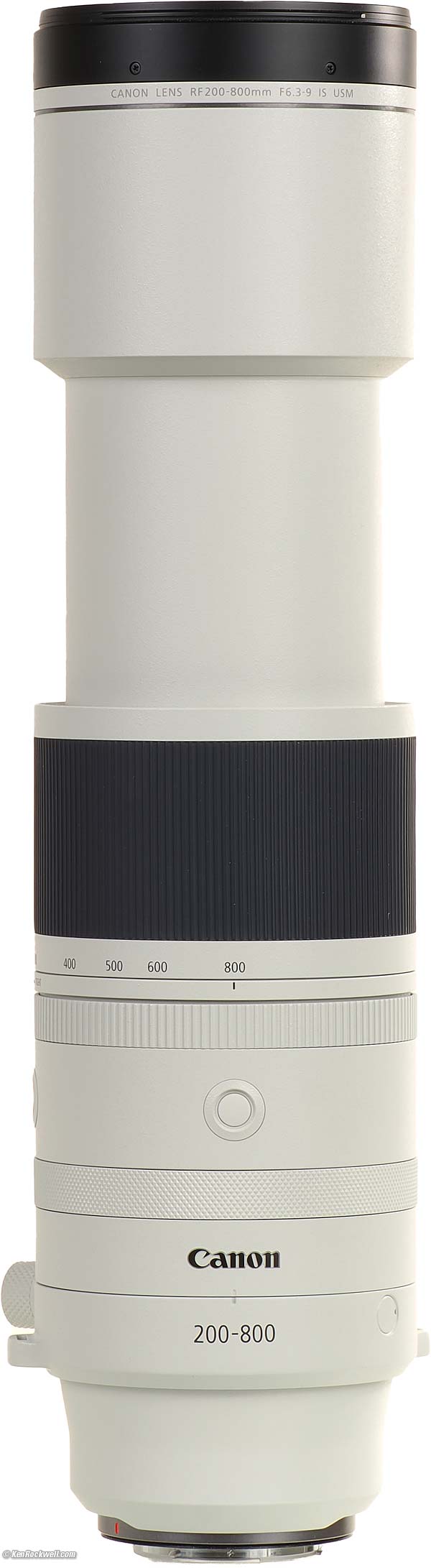
It has a ring marked SMOOTH <—> TIGHT just behind the zoom ring which lets us add drag to the zoom to prevent drift.
Even at 200mm the balance, with an R5 II, is still forward of the tripod sockets, and goes even more forward as zoomed to 800mm.
The focus ring is thin and hard white knurled plastic just ahead of the Canon logo ahead of the tripod collar. I'd rather it was covered in black rubber to make it more visible and more grippy. This ring can be programmed to do other things in your camera's menu system.
There may not be an always-responsive instant manual-focus override unless you enable this in a menu. Manual focus override never works in SERVO AF; while the lens will focus manually as you turn the ring, as soon as you stop the AF system takes over again.
Falloff performance top
Falloff is invisible with falloff (peripheral illumination) correction left at its default of ON.
I've greatly exaggerated the falloff by shooting a gray field and placing these on a gray background; it will not look this bad in actual photos of real things:
Falloff on full-frame at infinity, correction at its default of ON:
© 2024 KenRockwell.com. All rights reserved. |








If you save only raw data rather than create JPG images in-camera, whatever software you use to create visible images from that raw data later may or may not correct this as is done in-camera as JPGs. You're on your own there; I don't bother with raw data.
If you go out of your way to turn off the correction, or possibly in some raw software, this is what you get:
Falloff on full-frame at infinity, correction deliberately turned OFF:
© 2024 KenRockwell.com. All rights reserved. |









I'd leave correction ON, as we usually shoot this lens wide-open and often have sky as our background, so with correction OFF one may have visible vignetting. I often add vignetting to my images for artistic effect, however I add it with the vignetting centered on my intended subject, while shooting to emphasize this lens' own natural falloff only works well if your subject just happens to be in the center of the frame.
Filters, use with performance top
There's no need for thin filters. I can stack several standard 95mm filters with no vignetting at any setting on full-frame.
Go ahead and use your standard rotating polarizer and grad filters, although I doubt grads will have much effect so close to a lens this long.
Be careful; a lens this long will be sensitive to poorly made filters. Check any filter your hope to use with this lens for flatness. Take photos with and without the filter, or even better, just hold it over the front of one side of a pair of binoculars or a small telescope. The image should be perfectly clear with or without the filter. If the filter is even slightly unflat, the image seen through the telescope will look awful! So long as it looks good when held in front of your scope, it will be perfect for pictures. This test instantly makes even slightly bad filters look absolutely awful, so if it looks OK through your scope, you're good.
Personally I use an old 95mm Nikon L39 filter from the 1970s, which as you can see works great.
Flare & Ghosts performance top
Flare and ghosts are very well controlled:
Sunset with Surfer, Pacific Beach, California, 6:10:22 P.M., Sunday, 13 October 2024. Canon EOS R5 II, RF 200-800mm IS USM at 300mm at f/11 at 1/640 at Auto ISO 100 (LV 16.4), Radiant Photo software. bigger.
See more examples at Sunstars.
Lateral Color Fringes performance top
There are no color fringes shot as JPG with the default Chromatic Aberration Correction left ON.
If you go out of your way to turn this OFF (or shoot raw and then use non-manufacturer software to process that data into images) then there is very minor green-magenta fringing at 200mm, none at 400mm, and very minor red-cyan fringing at 800mm.
If you shoot raw data rather than JPG images you may — or may not — be responsible to correct this on your own.
Lens Corrections performance top
Other cameras may vary as the years roll on, but my EOS R1, R3, R5 II, R5, R5C, R6 II, R6, R, R8, RP, R7, R10, R50 and R100 all have options to correct for falloff (Peripheral Illumination Correction), Distortion and a Digital Lens Optimizer which corrects for a suite of other aberrations.
You can turn any of these ON or OFF as you like.
If you turn off the Digital Lens Optimizer, you are then offered à la carte ON/OFF options for Chromatic Aberration Correction and Diffraction Correction.
If you shoot raw data rather than JPG images, whatever software you use to create visible images from raw data may or may not correct these as is done in-camera as JPGs. You're on your own there; I don't bother with raw data.
Macro Performance performance top
It makes great close-ups and is super sharp.
While it doesn't focus very close, it's so long that it looks very close.
It focuses much closer at 200mm rather than 800mm, and thus the largest macro ratio is at 200mm:
At 200mm
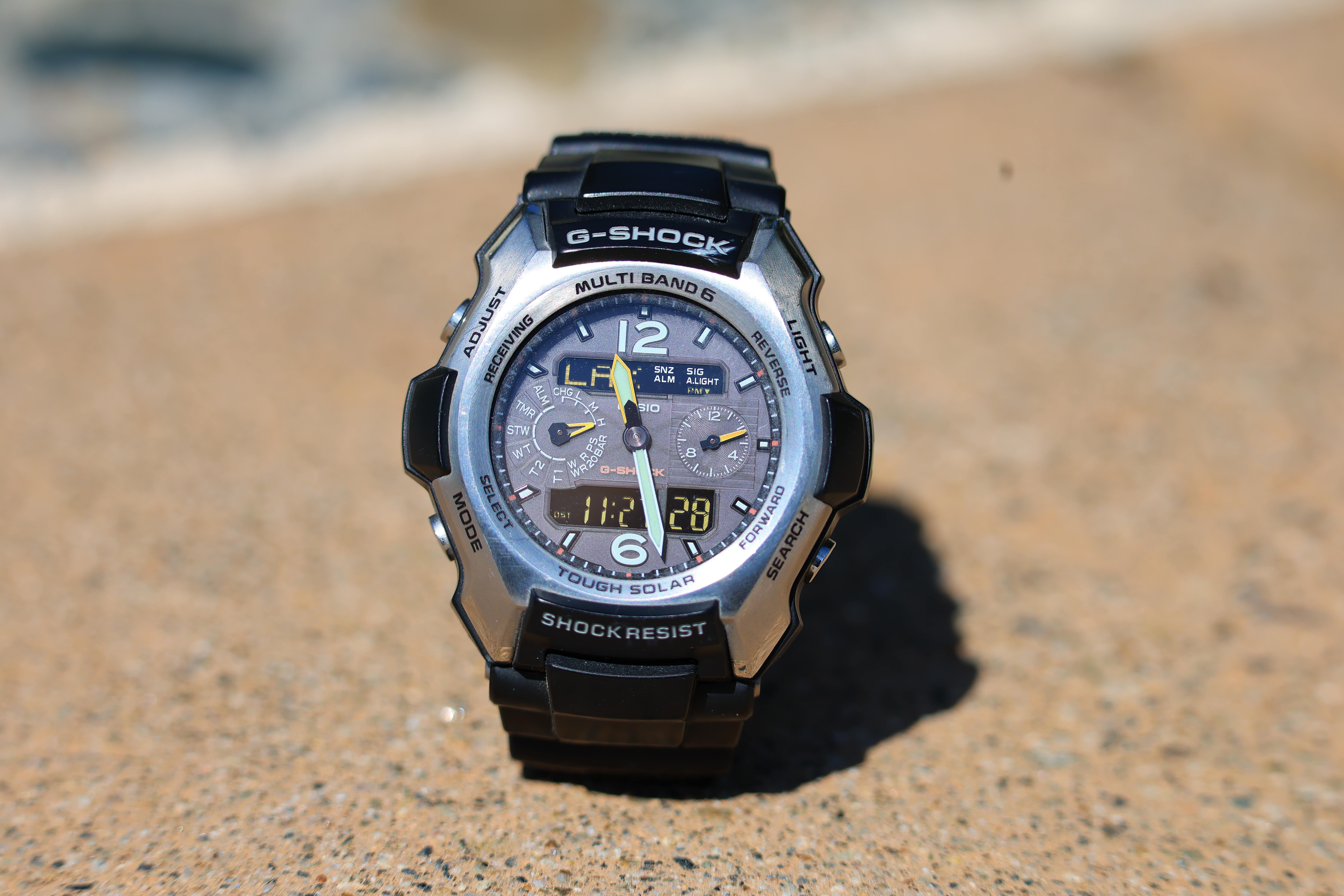
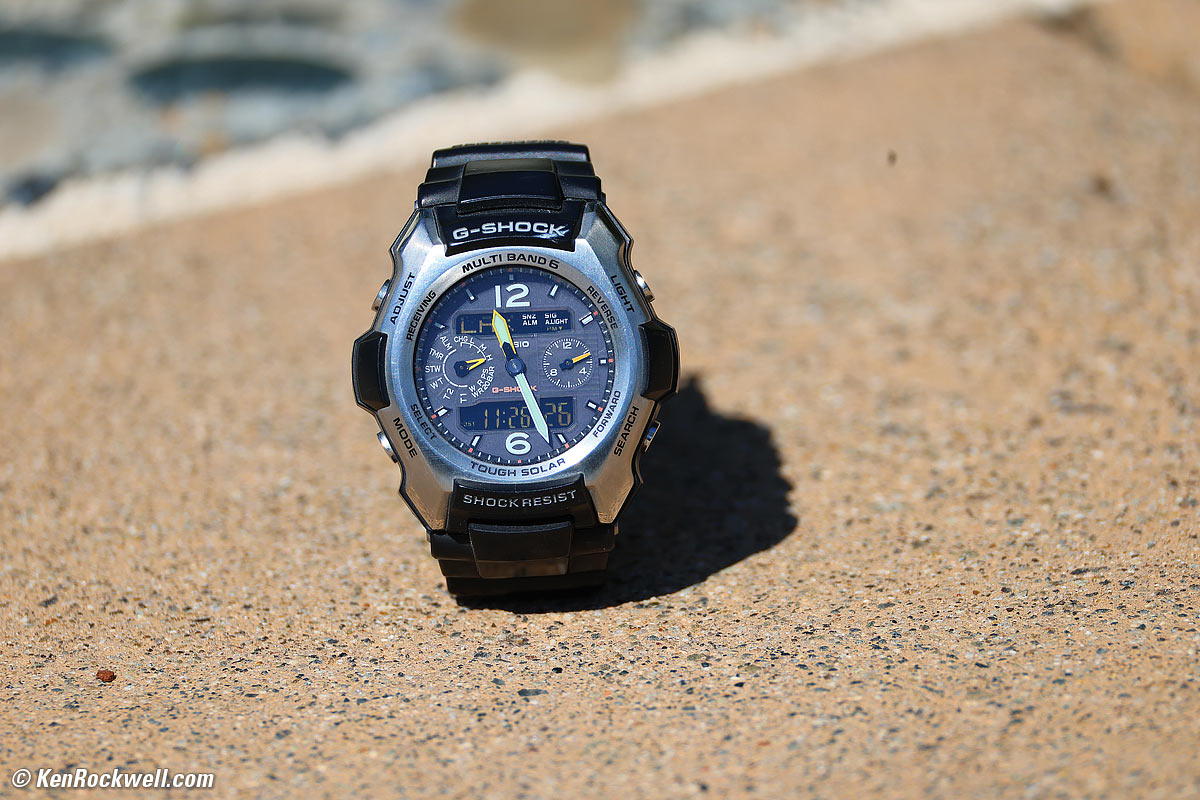
Casio G-Shock Solar Atomic Watch at close-focus distance, 08 October 2024. Canon EOS R5 II, RF 200-800mm IS USM at 200mm wide-open at f/6.3 at 1/800 at Auto ISO 100 (LV 15.0), exactly as shot. bigger or camera-original © file.
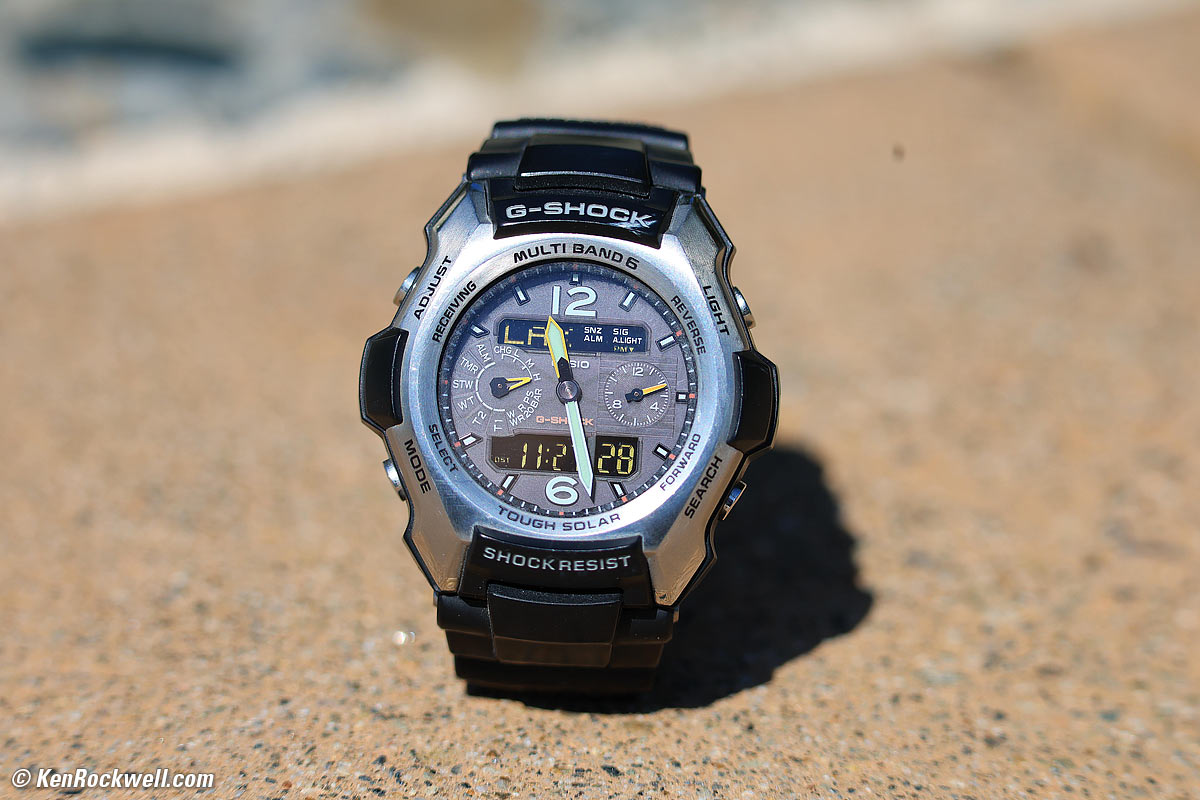
1,200 × 900 pixel (6.8× magnification) crop from above. bigger or camera-original © file.
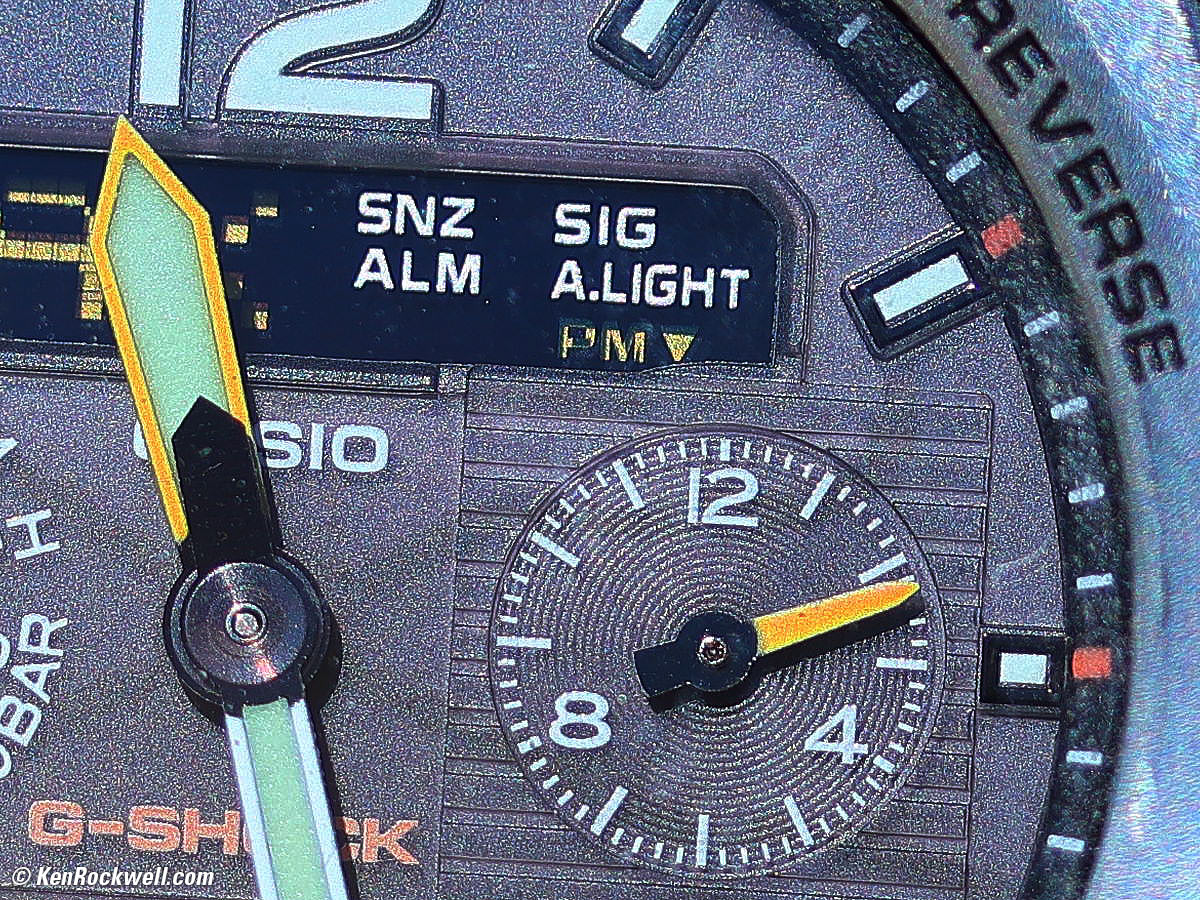
If this 1,200 × 900 pixel crop is about 3" (7.5cm) wide on your screen, the complete image would print at a large 14 × 21″ (35 × 55 cm) at this same high magnification.
If this 1,200 × 900 pixel crop is about 6" (15cm) wide on your screen, the complete image would print at a huge 27½ × 41¼″ (70 × 105 cm) at this same high magnification.
If this 1,200 × 900 pixel crop is about 12" (30cm) wide on your screen, the complete image would print at a mammoth 55 × 82½″ (1.4 × 2.1 meters) at this same extremely high magnification!
At 800mm
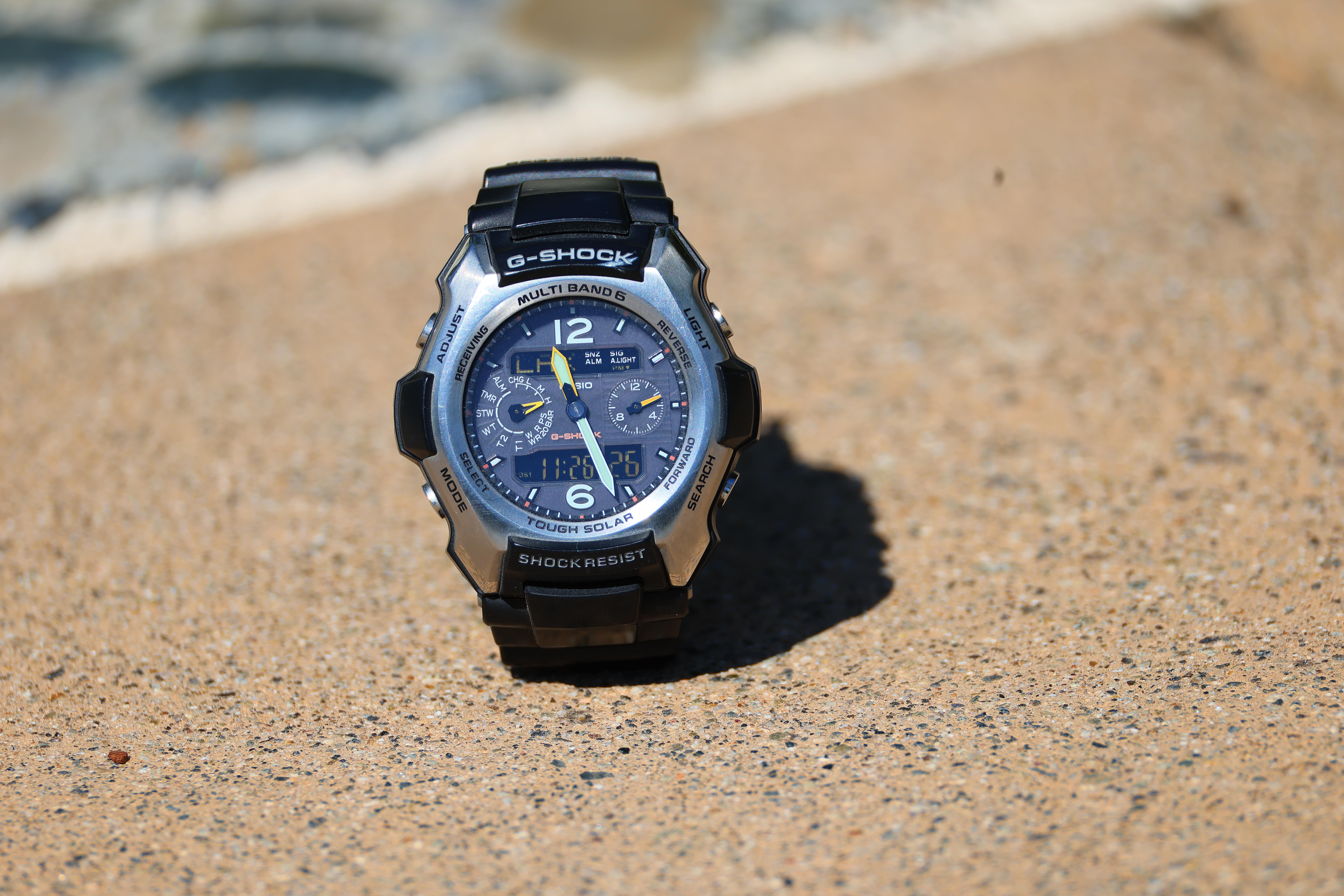
Casio G-Shock Solar Atomic Watch at close-focus distance, 08 October 2024. Canon EOS R5 II, RF 200-800mm IS USM at 800mm wide-open at f/9 at 1/400 at Auto ISO 100 (LV 15.0), exactly as shot. bigger or camera-original © file.
1,200 × 900 pixel (6.8× magnification) crop from above. bigger or camera-original © file.
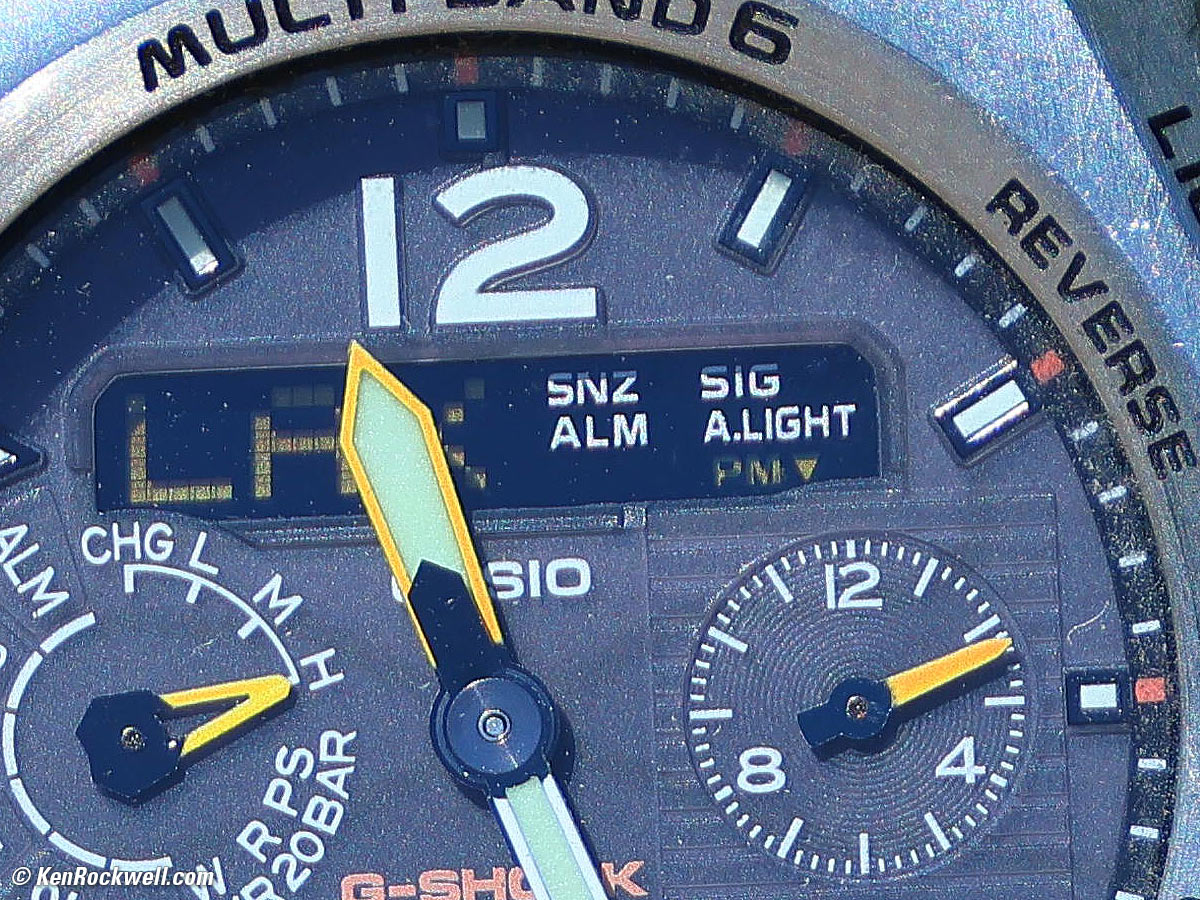
If this 1,200 × 900 pixel crop is about 3" (7.5cm) wide on your screen, the complete image would print at a large 14 × 21″ (35 × 55 cm) at this same high magnification.
If this 1,200 × 900 pixel crop is about 6" (15cm) wide on your screen, the complete image would print at a huge 27½ × 41¼″ (70 × 105 cm) at this same high magnification.
If this 1,200 × 900 pixel crop is about 12" (30cm) wide on your screen, the complete image would print at a mammoth 55 × 82½″ (1.4 × 2.1 meters) at this same extremely high magnification!
Maximum & Minimum Apertures performance top
Maximum Aperture |
Minimum Aperture |
|
| 200mm | f/6.3 |
f/32 |
| 250mm | f/6.3 |
f/32 |
| 300mm | f/7.1 |
f/36 |
| 400mm | f/7.1 |
f/40 |
| 500mm | f/8 |
f/40 |
| 600mm | f/8 |
f/45 |
| 800mm | f/9 |
f/51 |
Mechanical Quality performance top
RF 200~800mm f/6.3~9 IS USM at 200mm. bigger.
This is a very precisely and well made lens with a good blend of metal and plastic to have both durability and light-enough weight so we'll want to take this with us. Other than always wishing it had a metal rather than a plastic filter thread, two thumbs up 👍🏻👍🏻.
Exterior Finish
White paint.
Hood
Plastic bayonet.
Front Bumper
None.
Filter Threads
Plastic.
Hood Bayonet Mount
Plastic.
All Barrel Exterior Sections
Plastic.
Zoom Ring
Rubber-covered plastic.
Focus Ring (just ahead of the Canon logo near the tripod collar)
Hard white knurled plastic.
Slide Switches
Plastic.
Tripod Collar
Canon RF 200-800mm IS USM. bigger.
All metal.
The collar doesn't come off the lens, and the foot is a permanent part of the collar. Nothing comes off.
¼″ × 20 TPI and ⅜″ × 16 TPI threads.
Identity
Printed around front of lens, also "200-800" printed on top of tripod collar.
Internals
Seem like plastic barrels and light shields and baffles and optical carriers with metal zoom cams and collars, just like modern L lenses.
Dust Gasket at Mount
Yes.
Mount
Metal.
Markings
Just paint; nothing's engraved.
Serial Number
Almost invisible white-on-white laser engraved on the bottom of the barrel near the mount:
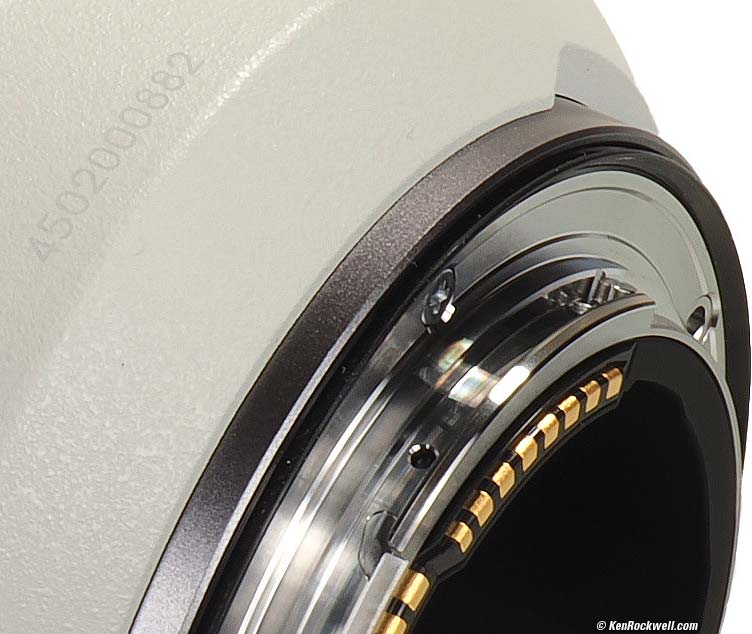
Canon RF 200-800mm IS USM. bigger.
Date Code
The serial number contains a date code.
My serial number starts with 45, which means it was made in September 2024.
Noises When Shaken
Just some mild clunking while shaking this beast.
Made in
Made in Taiwan, a leading first-world democracy and technological powerhouse with a highly advanced economy, a huge step up from the developing economies of the second- and third-world countries to which lesser brands like Sony and Nikon dump their manufacturing. If it's not made domestically in Japan, I'll take made-in-Taiwan any day.
Sharpness performance top
Lens sharpness has nothing to do with picture sharpness; every lens made in the past 100 years is more than sharp enough to make super-sharp pictures if you know what you're doing. The only limitation to picture sharpness is your skill as a photographer. It's the least talented who spend the most time worrying about lens sharpness and blame crummy pictures on their equipment rather than themselves. Skilled photographers make great images with whatever camera is in their hands; I've made some of my best images of all time with an irreparably broken camera! Most pixels are thrown away before you see them, but camera makers don't want you to know that.
If you're not getting ultra-sharp pictures with this, be sure not to shoot at f/16 or smaller where all lenses are softer due to diffraction, always shoot at ISO 100 or below because cameras become softer at ISO 200 and above, avoid shooting across long distances over land which can lead to atmospheric heat shimmer, be sure everything is in perfect focus, set your camera's sharpening as you want it (I set mine to the maximum) and be sure nothing is moving, either camera or subject. If you want to ensure a soft image with any lens, shoot at f/16 or smaller at ISO 1,600 or above at default sharpening in daylight across a hot lake bed of subjects at differing distances in the same image.
People worry waaaaay too much about lens sharpness. It's not 1968 anymore when lenses often weren't that sharp and there could be significant differences among them; ever since about 2010 all new lenses are all pretty much equally fantastic.
This lens is extremely sharp corner-to corner at every aperture, limited by your vision as an artist and of course by diffraction at the smallest apertures. Avoid f/16 and smaller unless you really need them for depth-of-field because diffraction takes its toll. See also How to Calculate the Sharpest Aperture.
This lens is limited more by the laws of physics, especially diffraction and atmospheric heat shimmer, than its own optics. Atmospheric heat shimmer is usually the limiting factor for image sharpness with this lens; this lens is optically superb.
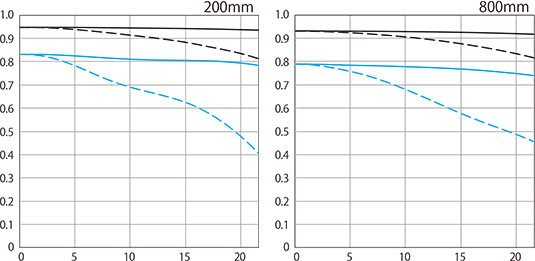
Canon MTF wide-open at 10 cyc/mm (black) and 30 cyc/mm (blue). Sagittal (solid) and meridional (dashed).
Spherochromatism performance top
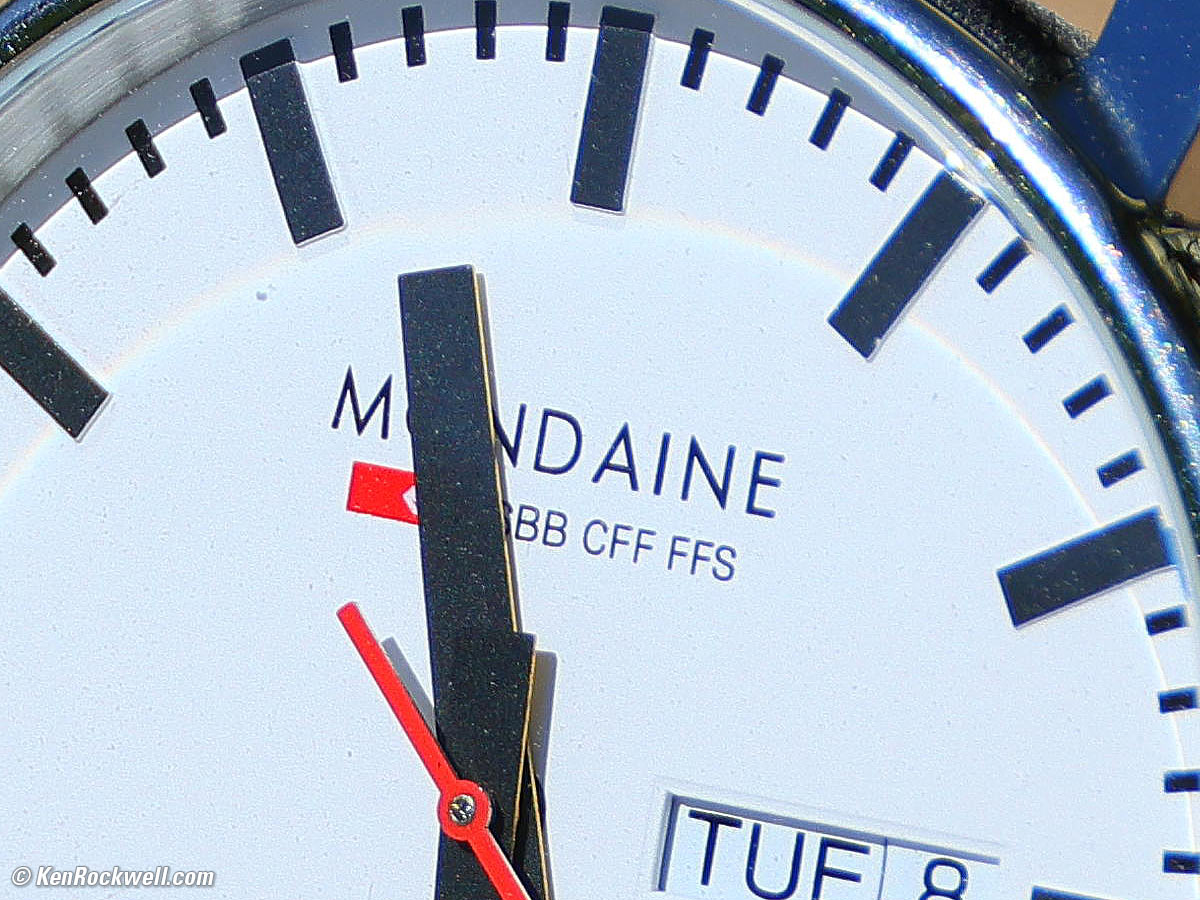
Spherochromatism, also called secondary spherical chromatic aberration or "color bokeh," is an advanced form of spherical and chromatic aberration in a different dimension than lateral chromatic aberration. It happens mostly in fast normal and tele lenses when spherical aberration at the ends of the color spectrum are corrected differently than in the middle of the spectrum. Spherochromatism can cause colored fringes on out-of-focus highlights, usually seen as green fringes on backgrounds and magenta fringes on foregrounds. Spherochromatism is common in fast lenses of moderate focal length when shooting contrasty items at full aperture. It goes away as stopped down.
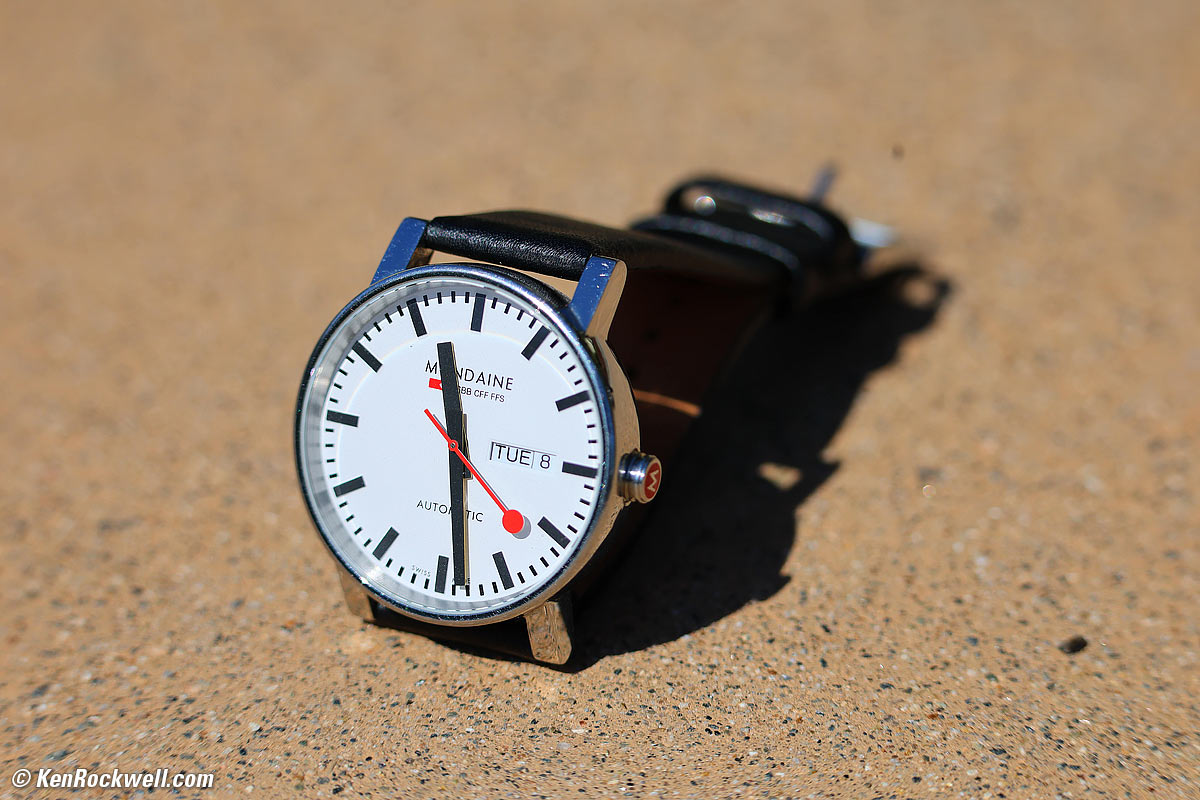
It has no significant spherochromatism, which is excellent and helped by its relatively slow speeds:
At 200mm
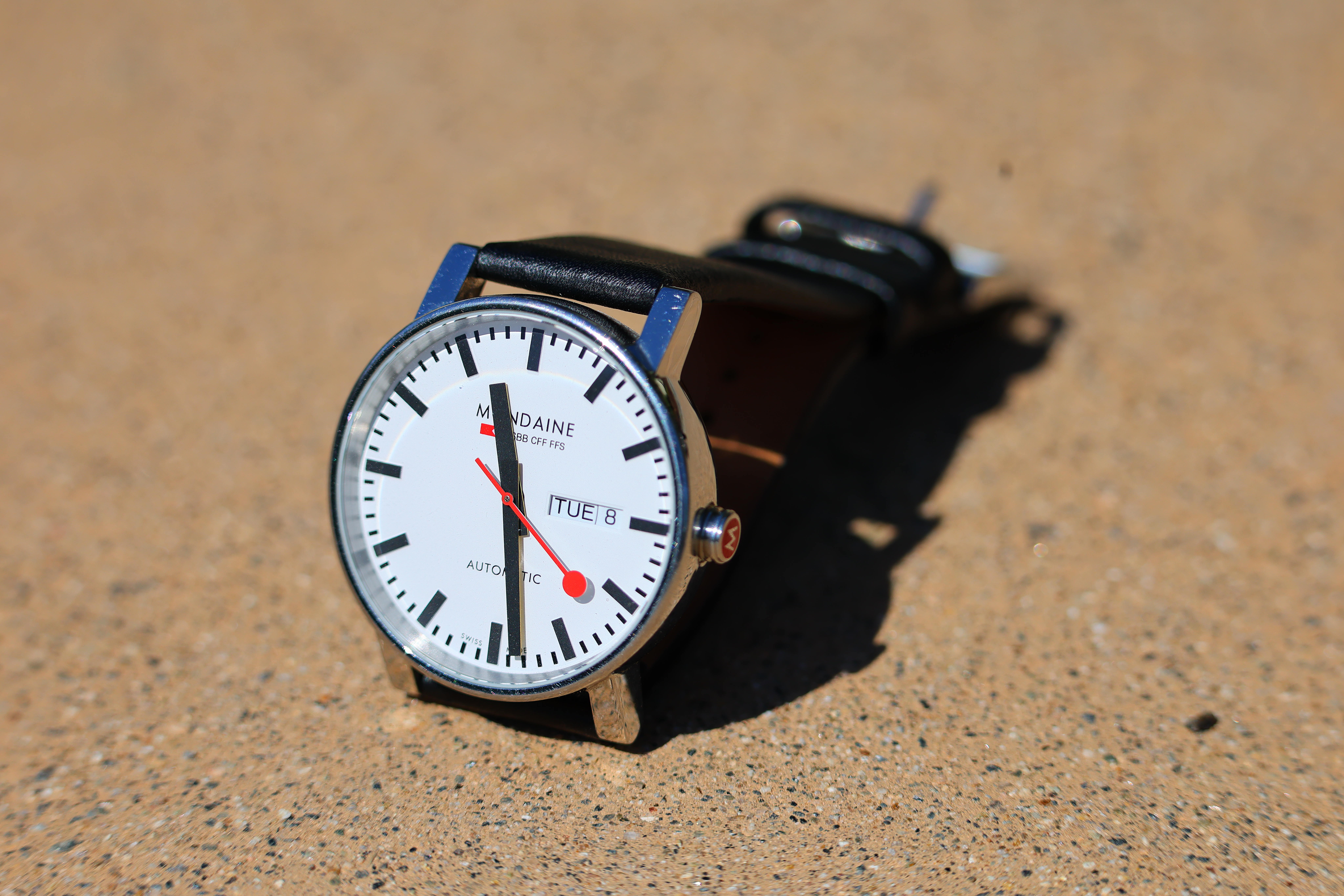
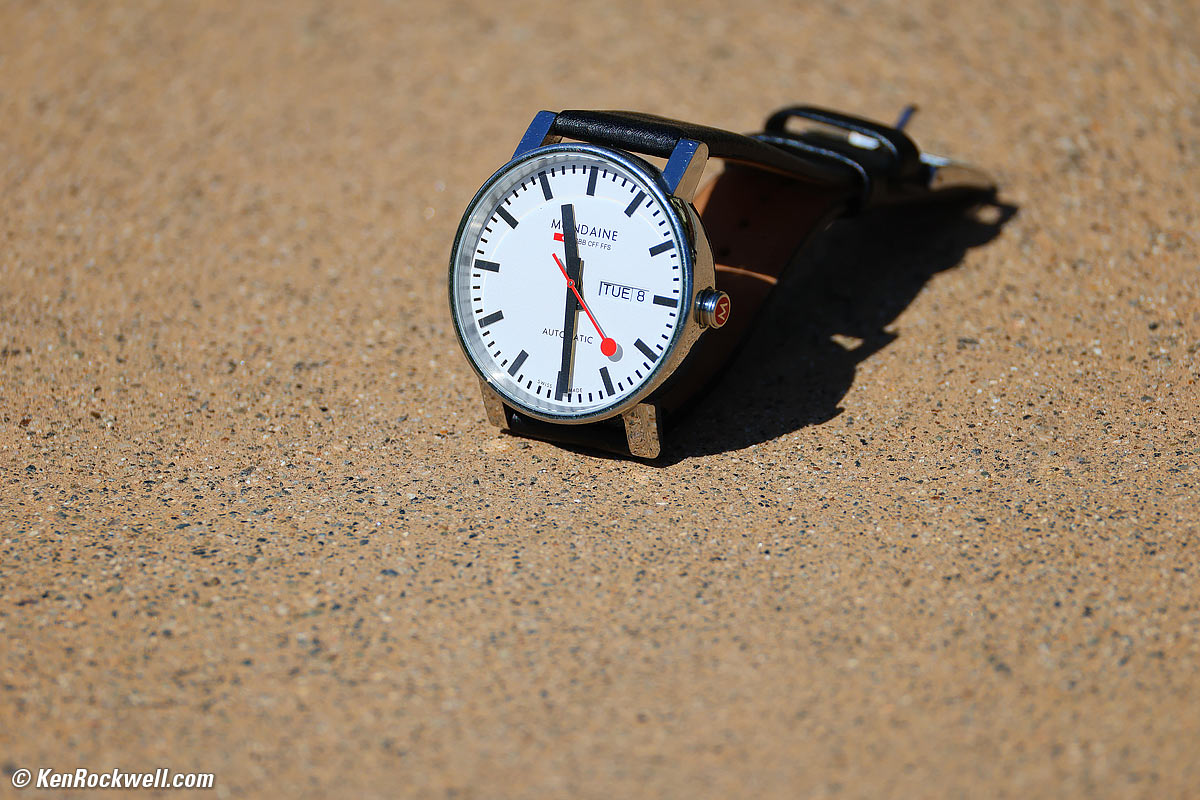
Mondaine A132.30348.11SBB at close-focus distance at 200mm, 08 October 2024. Canon EOS R5 II, RF 200-800mm IS USM at 200mm wide-open at f/6.3 at 1/1,000 at Auto ISO 100 (LV 15.4), exactly as shot. bigger or camera-original © file.
1,200 × 900 pixel (6.8× magnification) crop from above. bigger or camera-original © file.
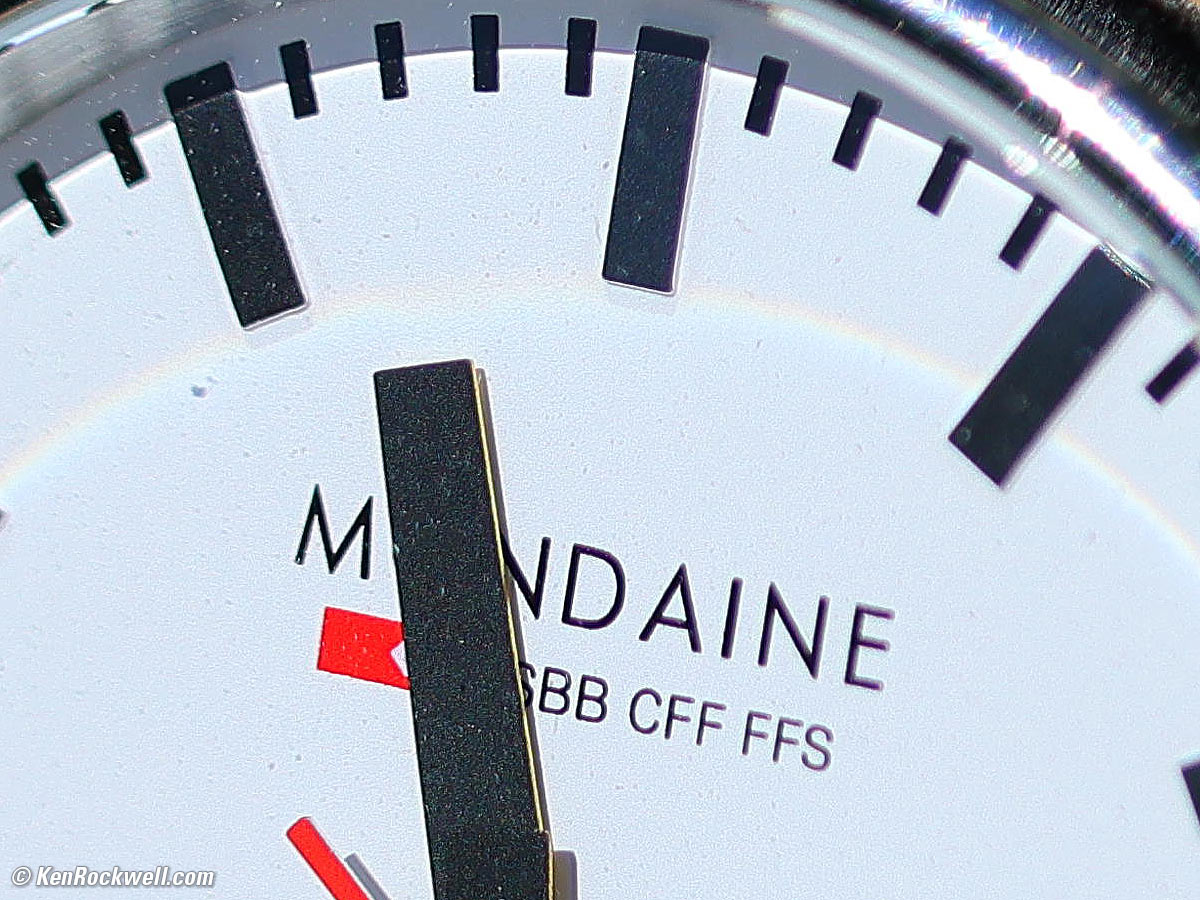
If this 1,200 × 900 pixel crop is about 3" (7.5cm) wide on your screen, the complete image would print at a large 14 × 21″ (35 × 55 cm) at this same high magnification.
If this 1,200 × 900 pixel crop is about 6" (15cm) wide on your screen, the complete image would print at a huge 27½ × 41¼″ (70 × 105 cm) at this same high magnification.
If this 1,200 × 900 pixel crop is about 12" (30cm) wide on your screen, the complete image would print at a mammoth 55 × 82½″ (1.4 × 2.1 meters) at this same extremely high magnification!
At 800mm
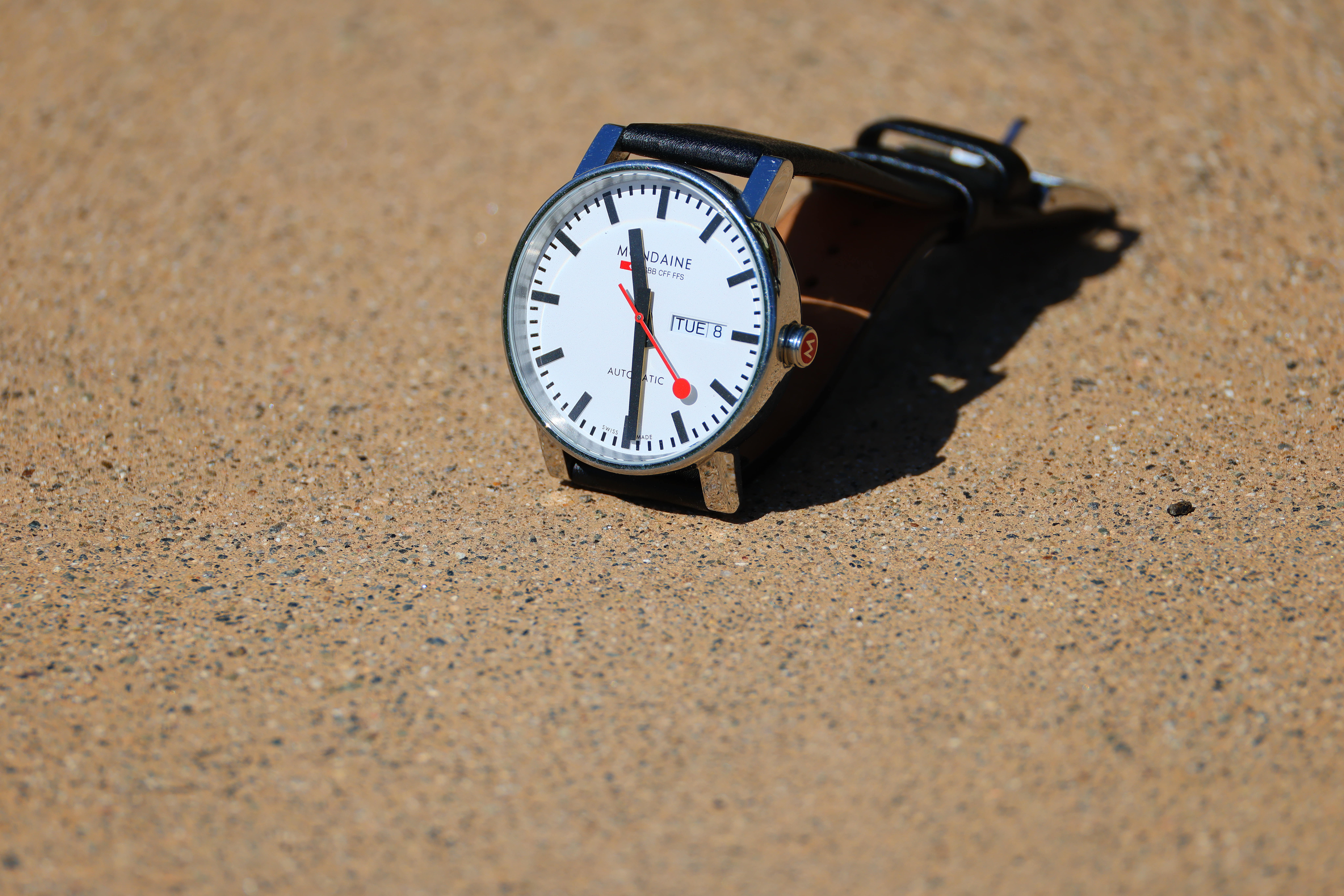
Mondaine A132.30348.11SBB at close-focus distance at 200mm, 08 October 2024. Canon EOS R5 II, RF 200-800mm IS USM at 800mm wide-open at f/9 at 1/640 at Auto ISO 100 (LV 15¾), as shot. bigger or camera-original © file.
1,200 × 900 pixel (6.8× magnification) crop from above. bigger or camera-original © file.
If this 1,200 × 900 pixel crop is about 3" (7.5cm) wide on your screen, the complete image would print at a large 14 × 21″ (35 × 55 cm) at this same high magnification.
If this 1,200 × 900 pixel crop is about 6" (15cm) wide on your screen, the complete image would print at a huge 27½ × 41¼″ (70 × 105 cm) at this same high magnification.
If this 1,200 × 900 pixel crop is about 12" (30cm) wide on your screen, the complete image would print at a mammoth 55 × 82½″ (1.4 × 2.1 meters) at this same extremely high magnification!
Image Stabilization performance top
Optical Image Stabilization (OIS, IS or VR (Vibration Reduction)) works great!
As you've seen, I have no problem shooting this lens hand-held at every focal length, especially 800mm. I've never even bothered to put this lens on a tripod. Almost every shot I make from 200 ~ 400mm has perfect tripod-equivalent sharpness on my 45-megapixel R5 II at 1/30. Remember olden days of film when 1/30 was iffy hand-held even with a 50mm lens? At 800mm almost all of my handheld shots have perfect sharpness at 1/125, and even at 1/60 and down to 1/15 it's not unusual to get a perfectly sharp shot (I'll fire several frames and pick the sharp one) at 800mm.
"Percent Perfectly Sharp Shots" are the percentage of hand-held, free-standing with no support or bracing, frames with 100% perfect tripod-equivalent sharpness as viewed at 300%. Hand tremor is a random occurrence, so at marginal speeds some frames will be perfectly sharp while others will be in various stages of blur — all at the same shutter speed.
This rates what percentage of shots are perfectly sharp, not how sharp are all the frames:
At 200mm
| % Perfectly Sharp Shots on Stabilized R5 II | 1s |
1/2 |
1/4 |
1/8 |
1/15 |
1/30 |
1/60 |
1/125 |
1/250 |
1/500 |
| Stabilization ON | 0 |
10 |
0 |
30 |
60 |
100 |
100 |
100 |
100 |
100 |
| Stabilization OFF | 0 |
0 |
0 |
0 |
0 |
0 |
0 |
0 |
0 |
100 |
I see a 4⅔ stop real-world improvement.
At 400mm
| % Perfectly Sharp Shots on Stabilized R5 II | 1/8 |
1/15 |
1/30 |
1/60 |
1/125 |
1/250 |
1/500 |
1/1,000 |
1/2,000 |
| Stabilization ON | 0 |
30 |
100 |
100 |
100 |
100 |
100 |
100 |
100 |
| Stabilization OFF | 0 |
0 |
0 |
10 |
0 |
50 |
80 |
100 |
100 |
I see a 3⅓ stop real-world improvement.
At 800mm
| % Perfectly Sharp Shots on Stabilized R5 II | 1/8 |
1/15 |
1/30 |
1/60 |
1/125 |
1/250 |
1/500 |
1/1,000 |
1/2,000 |
| Stabilization ON | 0 |
20 |
30 |
50 |
90 |
90 |
100 |
90 |
100 |
| Stabilization OFF | 0 |
0 |
0 |
0 |
20 |
0 |
50 |
90 |
100 |
I see a 3 stop real-world improvement.
Sunstars performance top
With a 9-bladed rounded diaphragm, I get excellent 18-point sunstars on brilliant points of light, mostly at the smallest apertures.
Ignore the vertical smear at large apertures. This is a sensor artifact called interline transfer smear and is a camera, not a lens, defect.
Likewise ignore the crazy rainbow dots at small apertures; these are sensor artifacts caused by taking a picture directly of the sun and exposing for the dark underside of a huge palm tree, and using that same palm tree to hide the sky to accentuate the stars.
Click any to enlarge:
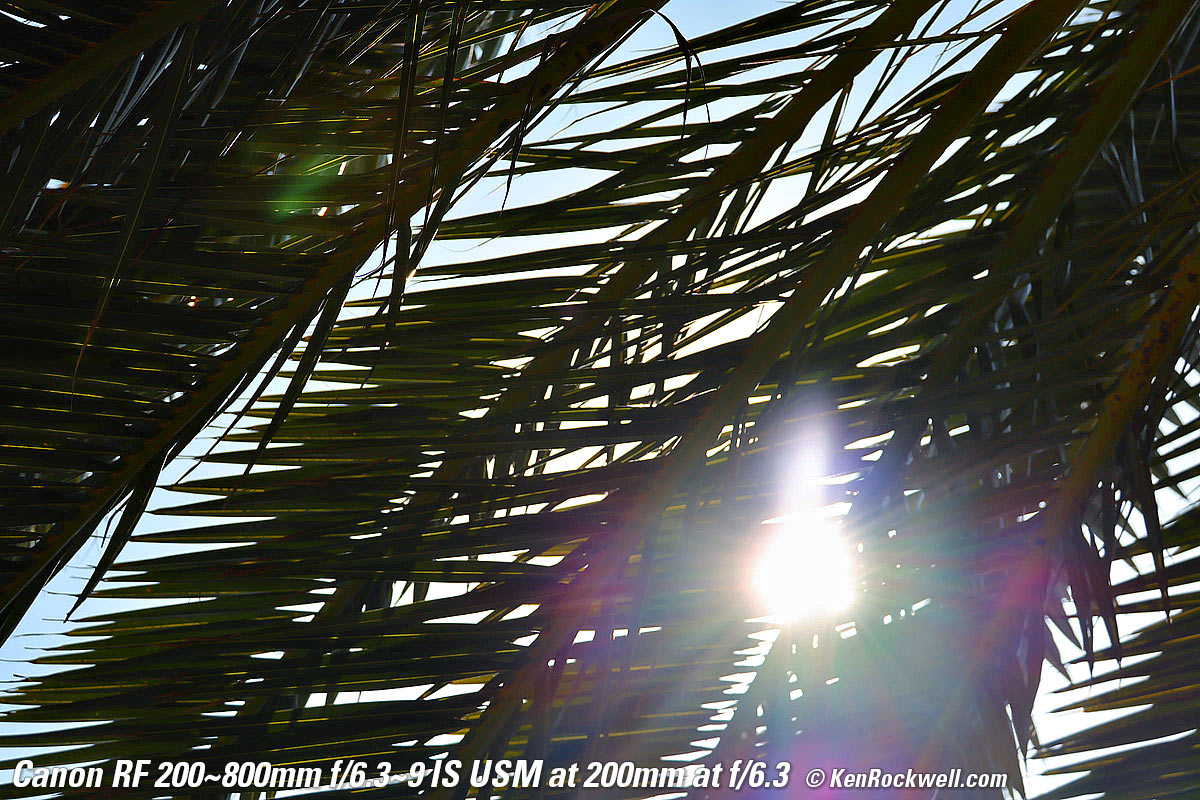
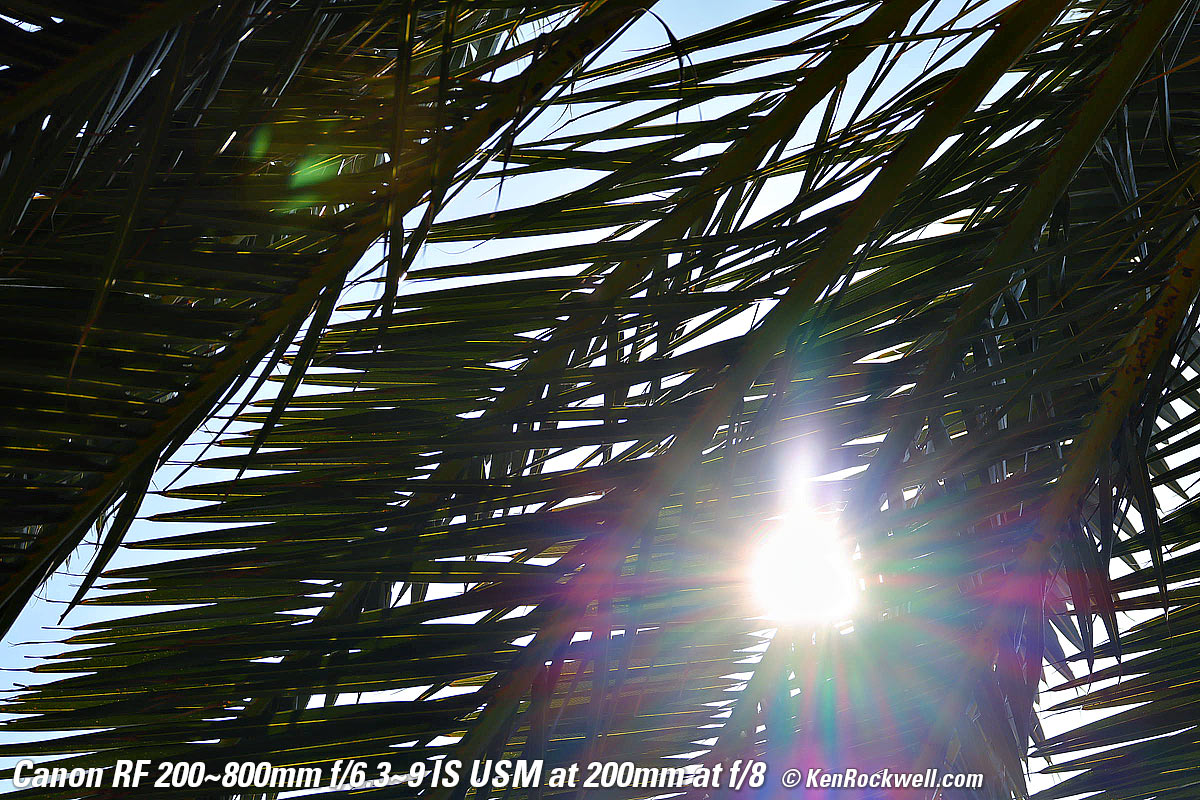
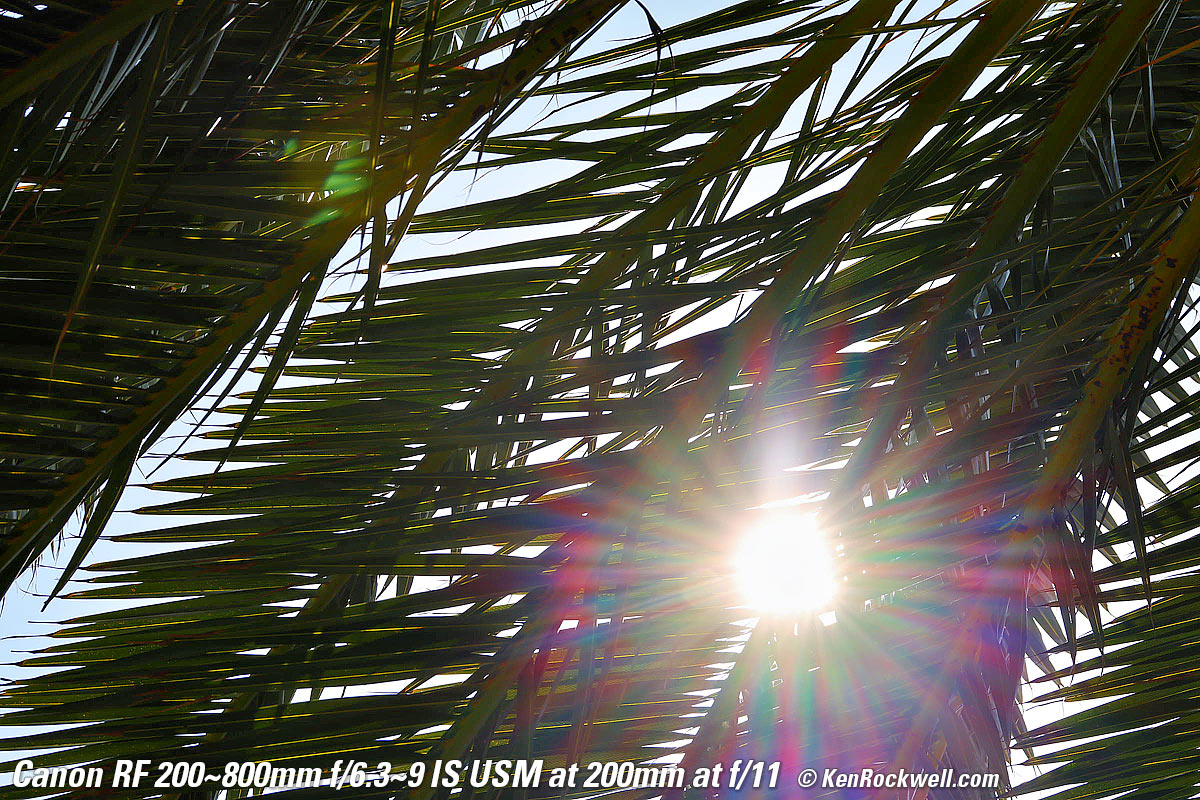
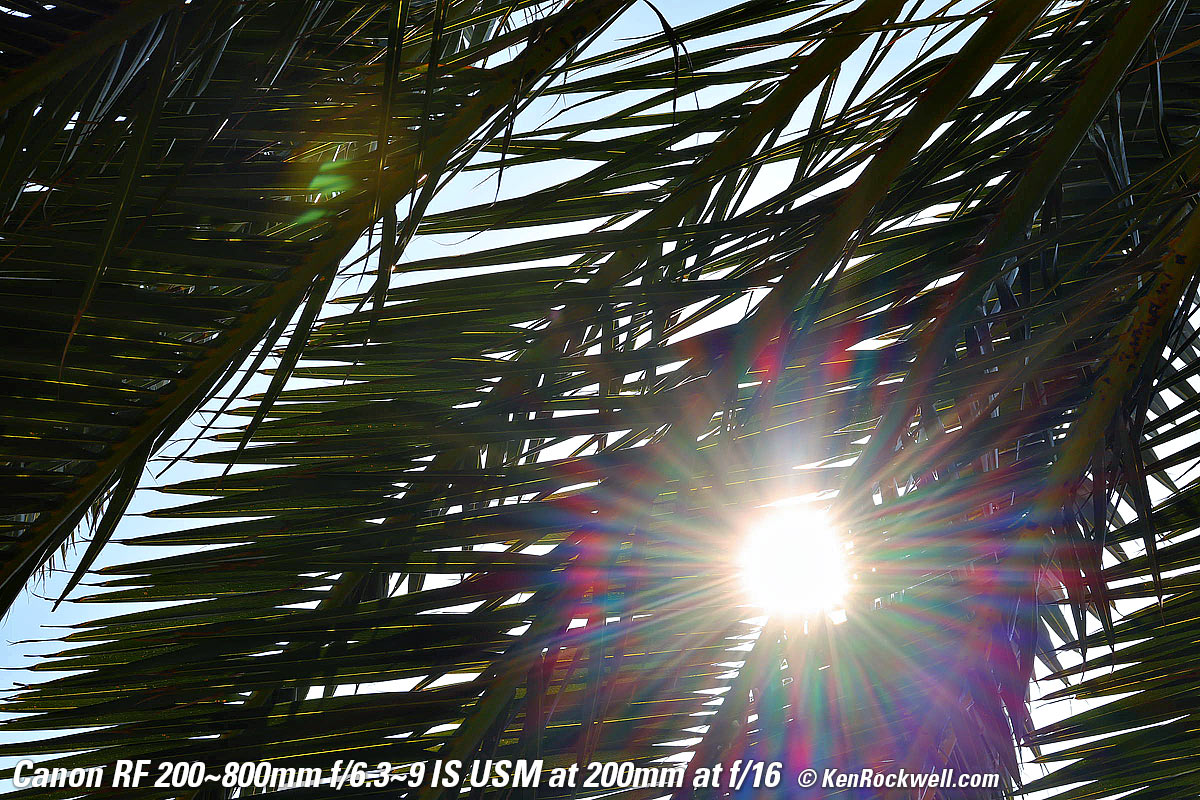
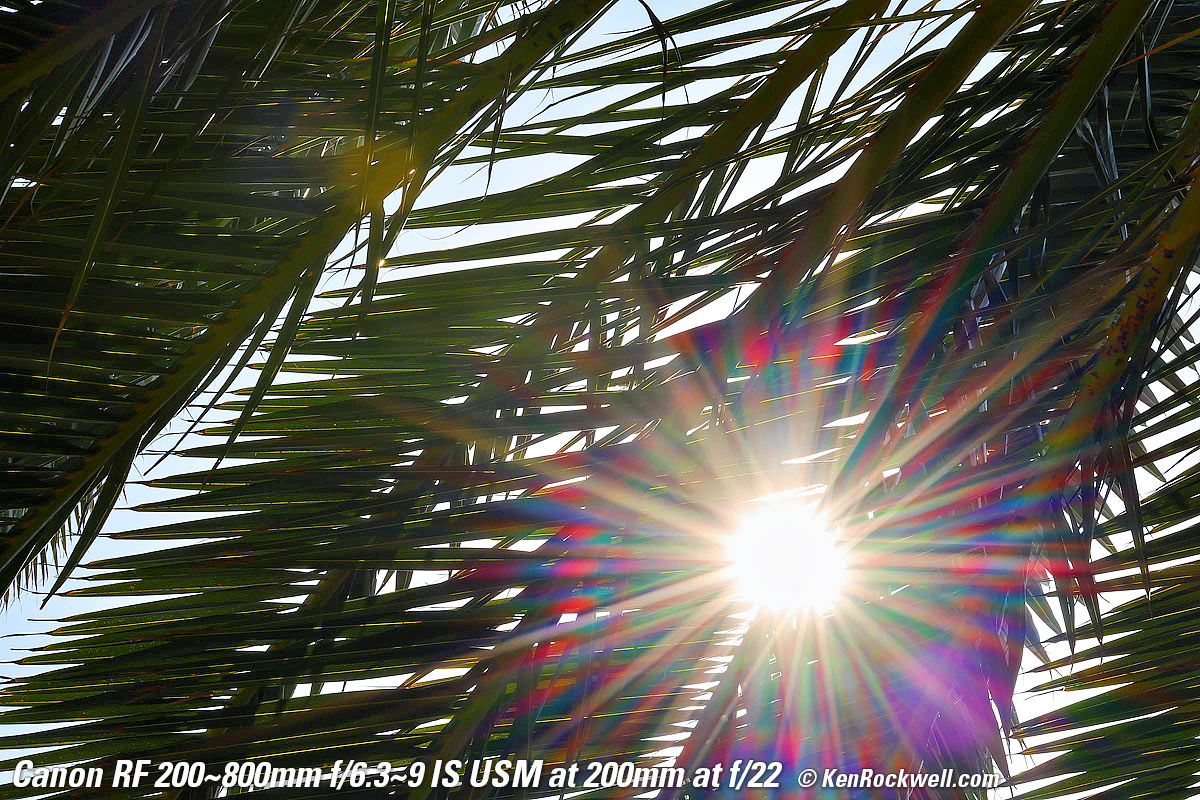
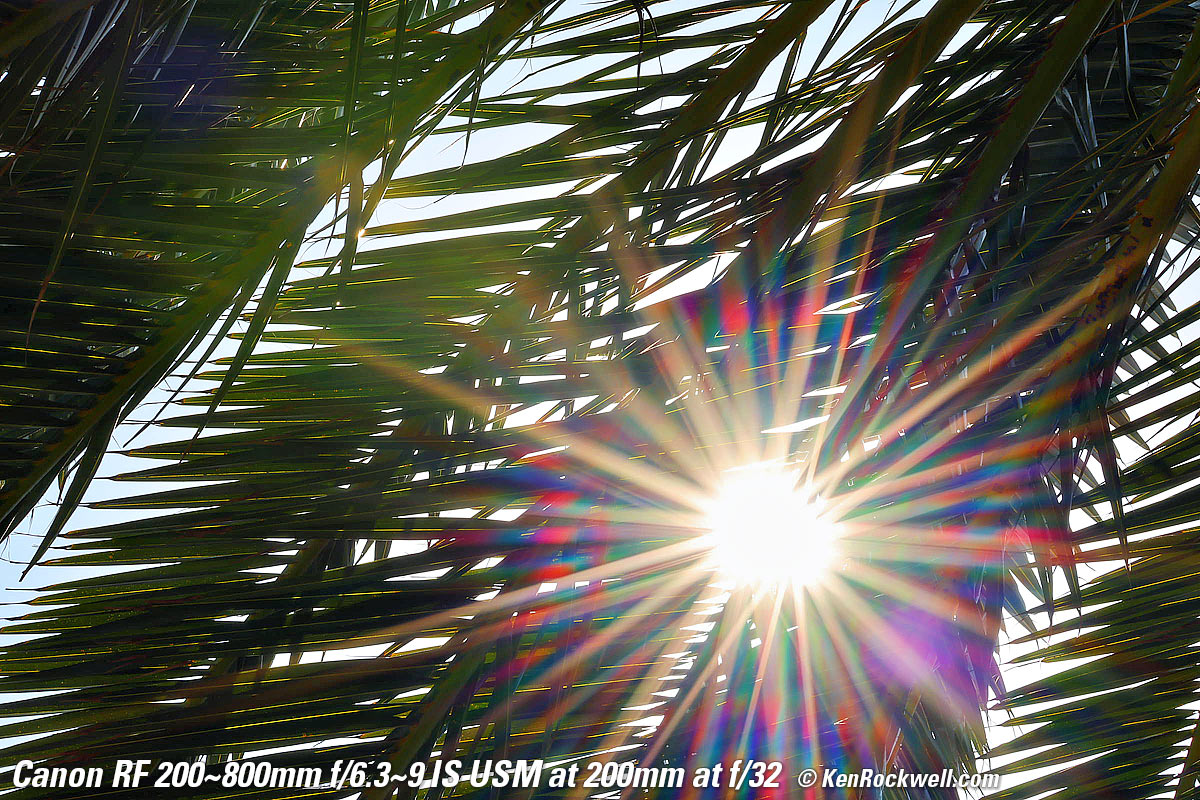
Click any to enlarge.
Teleconverters performance top
It works with either the RF 2× Extender or RF 1.4× Extender teleconverters, but only one at a time.
While the optics work great, the practical limitation with the teleconverters is that you're losing a stop or two of light, and at the same time needing faster shutter speeds to combat camera motion. This means that in actual shooting you're much more likely to be needing higher ISOs to accomplish this, which in and of themselves will lead to softer, grainier images — no fault of the lens or its optics.
I haven't shot my 200-800mm with teleconverters yet, but I have shot with my EF 100-400mm L IS II with stacked teleconverters, and had great results. If you need longer than 800mm, by all means try it out.
Compared top
Sample Images Intro New Good Bad Missing
Specifications Accessories USA Version
Performance Compared User's Guide
I got my 200-800mm IS USM at B&H. I'd also get it at Adorama, at Amazon or at Crutchfield, or get it used if you know How to Win at eBay.
There really is no comparison, as no one else makes a zoom today that goes to 800mm. Even if someone does, I can't imagine anything that would handle better, be sharper or have better stabilization that makes it trivially easy to shoot hand-held at 800mm.
The best comparison is to a 100-400mm lens with a 2x teleconverter:
RF 200-800mm |
||||
| Effective Focal Lengths | 200 ~ 800mm |
200 ~ 800mm |
200 ~ 800mm |
420 ~ 700mm |
| Effective Speed | f/11 ~ 16 |
f/6.3 ~ 9 |
f/9 ~ 11 |
f/8 ~ 10 |
| Filter Size | ||||
| Max. Macro Ratio | 0.82× |
0.25× |
0.62× |
0.46× |
| Build quality | Consumer |
Consumer |
Pro - all metal |
Consumer |
| Total Weight | 22.4 oz. + 11.8 oz. = 34.2 oz. |
72.3 oz. |
57.0 oz. + 9.4 oz. + 3.9 oz. = 70.2 oz. |
54.0 oz. + 7.9 oz. = 61.9 oz. |
| Total Weight | 635g + 334g = 969g |
2,050g |
1,616g + 265g + 110g = 1,991g |
1,530g + 223g = 1,753g |
| Total Price, 12/2024 |
Versus the RF 100-400mm + RF TC 2×
This solution is half the weight of the RF 200-800mm and much less expensive even after including the RF TC 2× (which costs as much as the lens itself), however it's 1⅔ stops slower, which will push you to much higher ISOs and/or slower shutter speeds, so I'd pass on this solution except for working in good light and with things that hold still. The slow effective apertures will lead to softer, grainier images in practical use not due to the lens, but due to how you'll have to set your camera to compensate for the lack of light.
Versus the EF 100-400mm II + EF TC 2× + Adapter
Seeing how I already own all this EF equipment, it's actually a good contender as it does work very well and offers similar performance with similar weight.
It is ⅔ of a stop slower, which isn't good, but if you already own the gear, it's not bad either.
On the other hand, if you don't already own this, it is much more expensive to buy new. It's better built of all-metal and of course you have a superb regular telephoto zoom when you pull off the teleconverter, which you can't do with the 200-800mm.
Also one can stack the original EF and Mark II EF teleconverters, but you cant' stack the RF or EF Mark III converters. I often stack my EF teleconverters with this lens, and it works great on mirrorless.
I'd much rather get the RF 200-800mm if I was starting from scratch, but if you already own the EF 100-400mm II, it's an idea for ultra-tele use.
Versus the RF 100-500mm + RF TC 1.4×
Sadly the RF 100-500mm IS USM works poorly with telconverters because it only works from its 300mm to 500mm settings. It can't be used with any teleconverters set to shorter than 300mm.
Thus the zoom range is quite restricted, it's not as fast as the 200-800mm and it's the most expensive option here.
If you already own the RF 100-500mm then by all means try an RF teleconverter, but don't get it if what you really want are ultra-tele focal lengths
Versus Manning-Up to the 800mm f/5.6L IS
The $17,000 800mm f/5.6L IS is 1⅓ stops faster than this 200-800mm, which lets us get sharper pictures because we can use slower ISOs and faster shutter speeds. That's why you see the pros on the sidelines of major games all using these huge lenses.
On the other hand, I never use my dedicated ultra teles because I rarely shoot action, and they're too big and heavy (50% more than any of the items above) to want to haul around all day for the fun things I shoot.
User's Guide top
Sample Images Intro New Good Bad Missing
Specifications Accessories USA Version
Performance Compared User's Guide
I got my 200-800mm IS USM at B&H. I'd also get it at Adorama, at Amazon or at Crutchfield, or get it used if you know How to Win at eBay.
See also Canon's RF 200-800mm IS USM User's Manual.
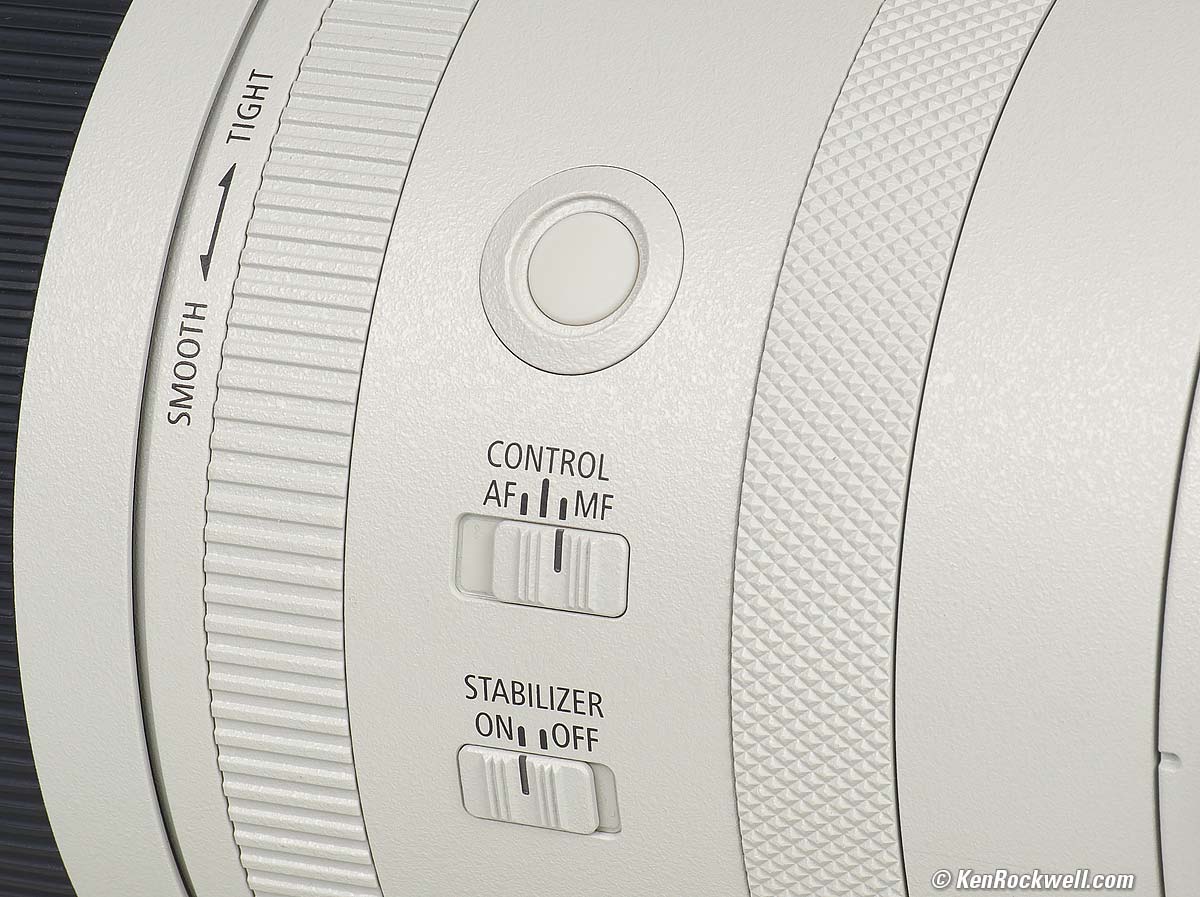
Canon RF 200-800mm IS USM. bigger.
AF - CONTROL - MF Switch user's guide top
This sets the function of the knurled focus ring just to the left of the switch in the photo above.
In the CONTROL position it does whatever you've assigned it in your camera's menu system, like aperture or exposure compensation.
Manual-Focus Override user's guide top
By default, there may not be always-responsive instant manual-focus override as we take for granted in our DSLRs.
EOS R cameras may need a menu setting changed for manual-focus override, otherwise the focus ring is may be ignored in AF.
Find the "Lens electronic AF" or "Electronic full-time MF" option in your AF menu (AF 6 in R5 II, R6 II, R7, R8 and R10, AF 4 in EOS R5 and EOS R6 or CAMERA 8 in EOS RP), and set it to either "One‑Shot‑> enabled," "One‑Shot‑> enabled (magnify)" or ON.
Canon should have it set this way by default, but they didn't in older models. No big deal now that I figured it out, and it usually works by default in newer cameras.
In ONE SHOT AF mode manual focus now takes over and stays wherever you set the focus manually, however in SERVO AF mode this setting lets the lens focus manually as you turn the ring, but as soon as you stop, the AF system takes over again and keeps tracking focus! Oh well, this is still a defect in all Canon mirrorless cameras. (This works properly in the Nikon Z system, Nikon's ahead here.)
Recommendations top
Sample Images Intro New Good Bad Missing
Specifications Accessories USA Version
Performance Compared User's Guide
I got my 200-800mm IS USM at B&H. I'd also get it at Adorama, at Amazon or at Crutchfield, or get it used if you know How to Win at eBay.
Get one! It's a superb lens that expands the reach of our creative abilities. It's so good and so low-priced that you can see why even a year after introduction it's difficult to get. Just look at the pictures; geeze, I can't believe you actually read this to the end, kudos to you!
I use a clear (UV) protective filter instead of a cap (exactly like an iPhone) so I'm always ready to shoot instantly. I only use a cap when I throw this in a bag with other gear without padding — which is never. The UV filter never gets in the way, and never gets lost, either.
I'd use a German brass 95mm B+W 010 UV MRC filter or Japanese aluminum 95mm Hoya EVO UV to protect this lens. Both have special dirt, dust and smudge resistant multicoatings to stay cleaner longer, so it's your choice of brass or aluminum. The basic multicoated 95mm Hoya HMC and Nikon's 95mm NC filter are also excellent filters, but lack the fancy crud-resistant coatings of the 95mm Hoya EVO UV and 95mm B+W 010 UV MRC.
All these UV filters are just as sharp and take the same pictures, the difference is how much abuse they'll take and stay clean and stay in one piece. Since filters last a lifetime or more, there's no reason not to buy the best as it will last you for the next 40 years. Filters aren't throwaways like digital cameras which we replace every few years, like it or not. I'm still using filters I bought back in the 1970s!
For a polarizer, I'd get Nikon's superb 95mm Circular Polarizer II.
I got my 200-800mm IS USM at B&H. I'd also get it at Adorama, at Amazon or at Crutchfield, or get it used if you know How to Win at eBay.
More Information top
Sample Images Intro New Good Bad Missing
Specifications Accessories USA Version
Performance Compared User's Guide
I got my 200-800mm IS USM at B&H. I'd also get it at Adorama, at Amazon or at Crutchfield, or get it used if you know How to Win at eBay.
Canon's own specifications.
Canon's RF 200-800mm IS USM User's Manual.
© Ken Rockwell. All rights reserved. Tous droits réservés. Alle Rechte vorbehalten. Alla rättigheter förbehållna. Toate drepturile rezervate. Omnia jura reservata. Ken Rockwell® is a registered trademark.
Help Me Help You top
I support my growing family through this website, as crazy as it might seem.
The biggest help is when you use any of these links when you get anything. It costs you nothing, and is this site's, and thus my family's, biggest source of support. These places always have the best prices and service, which is why I've used them since before this website existed. I recommend them all personally.
If you find this page as helpful as a book you might have had to buy or a workshop you may have had to take, feel free to help me continue helping everyone.
If you've gotten your gear through one of my links or helped otherwise, you're family. It's great people like you who allow me to keep adding to this site full-time. Thanks!
If you haven't helped yet, please do, and consider helping me with a gift of $5.00.
As this page is copyrighted and formally registered, it is unlawful to make copies, especially in the form of printouts for personal use. If you wish to make a printout for personal use, you are granted one-time permission only if you PayPal me $5.00 per printout or part thereof. Thank you!
Thanks for reading!
Ken.