Nikon Z 26mm f/2.8Full Frame (2023-)Sample Images Intro New Good Bad Missing Compatibility Specifications Performance User's Guide Recommendations & Comparisons Z9 Z8 Z7 II Z6 III Z6 II Z5 II Zƒ Z7 Z6 Z5 DX (APS-C): Zƒc Z50 II Z50 Z30 Z System Z Lenses All Nikon Lenses Flash
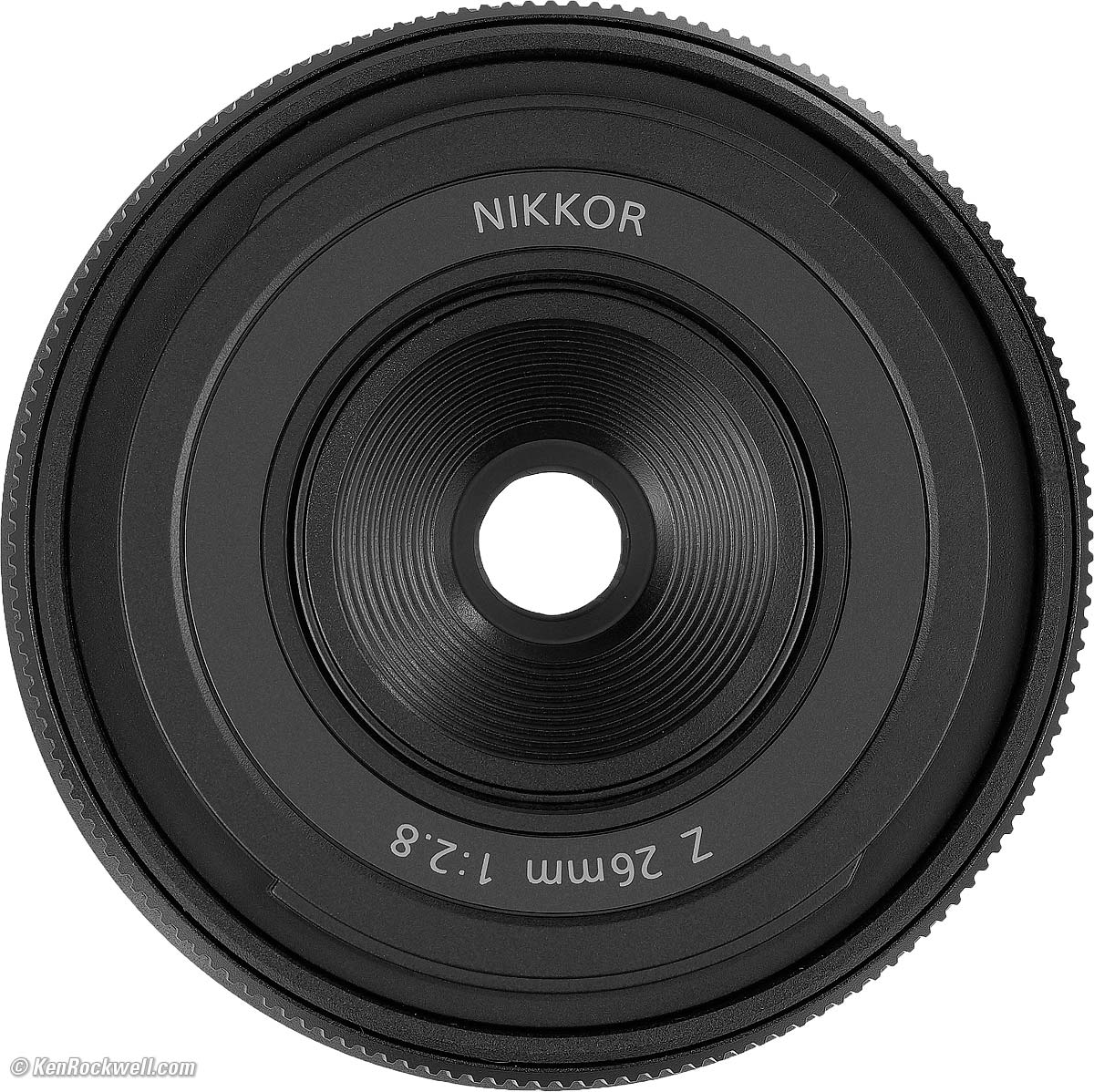
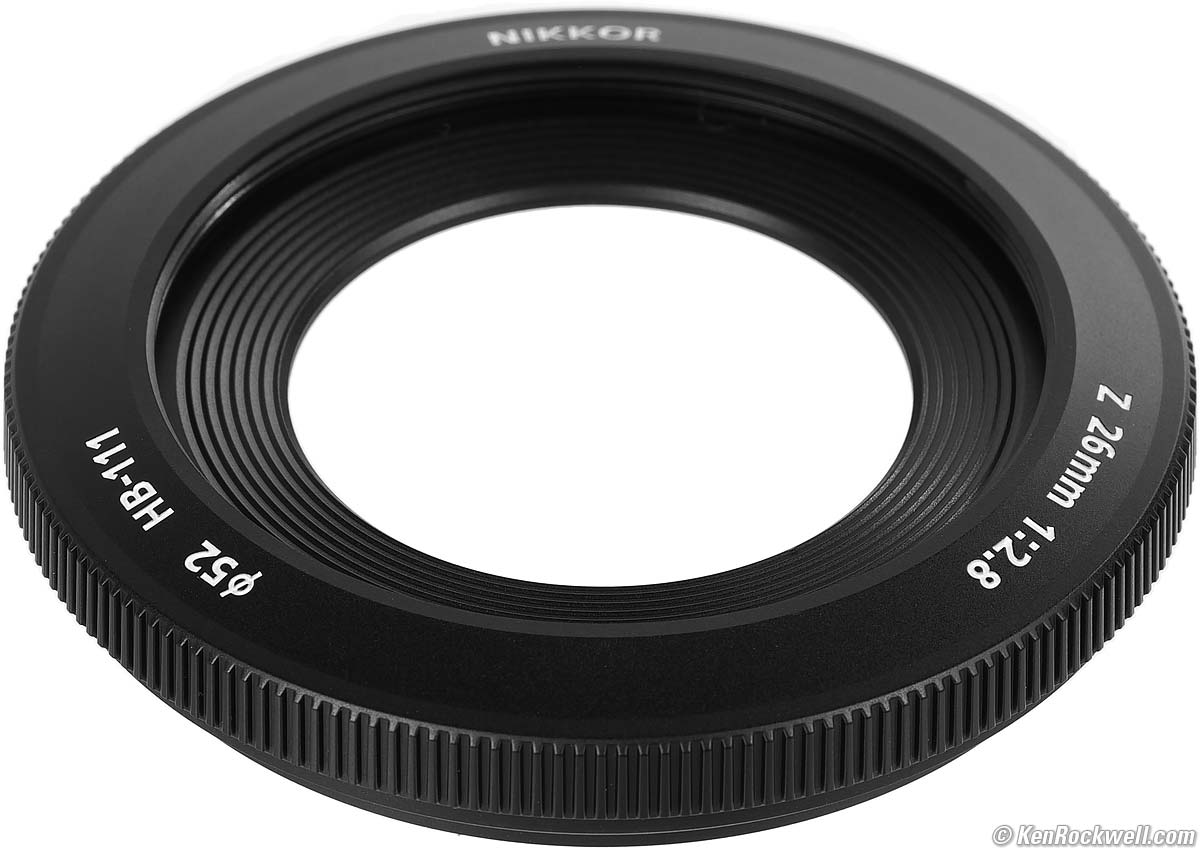
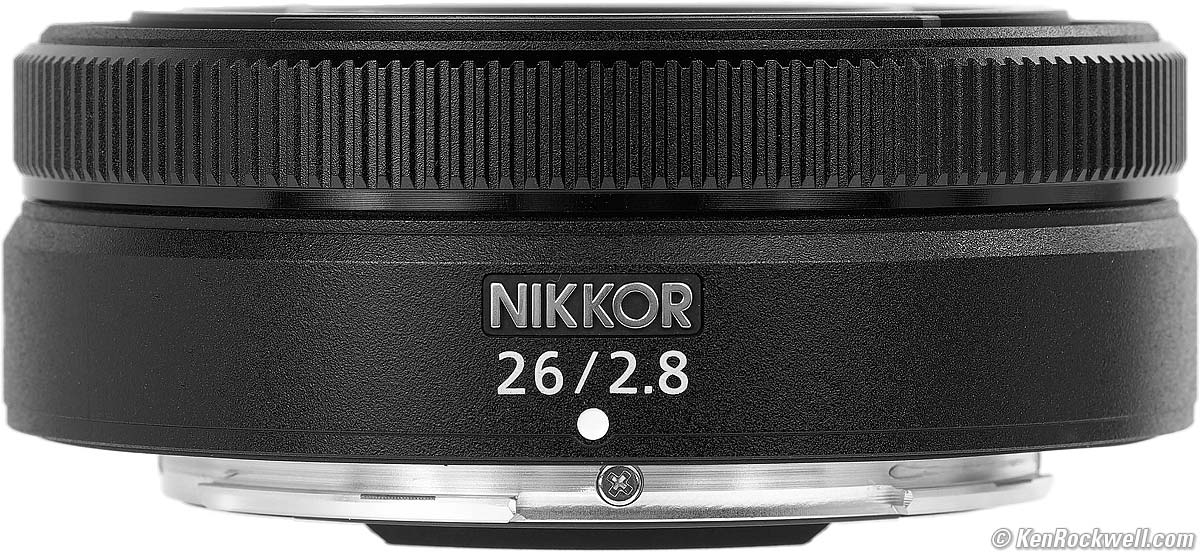
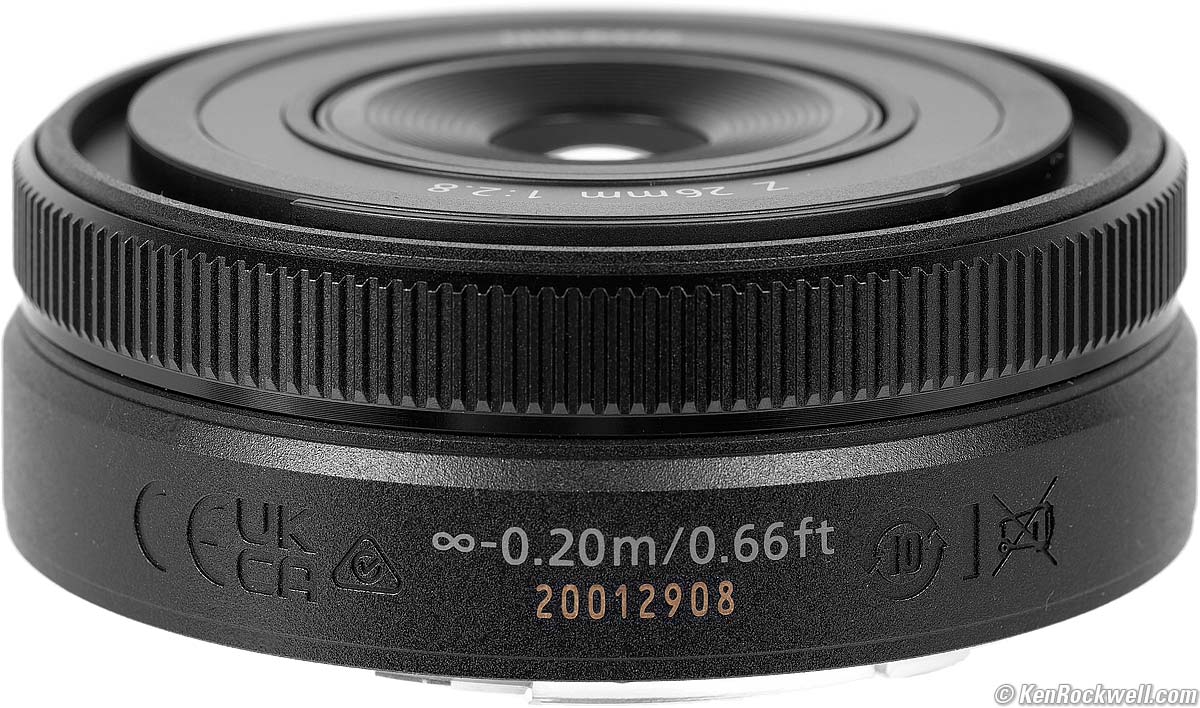
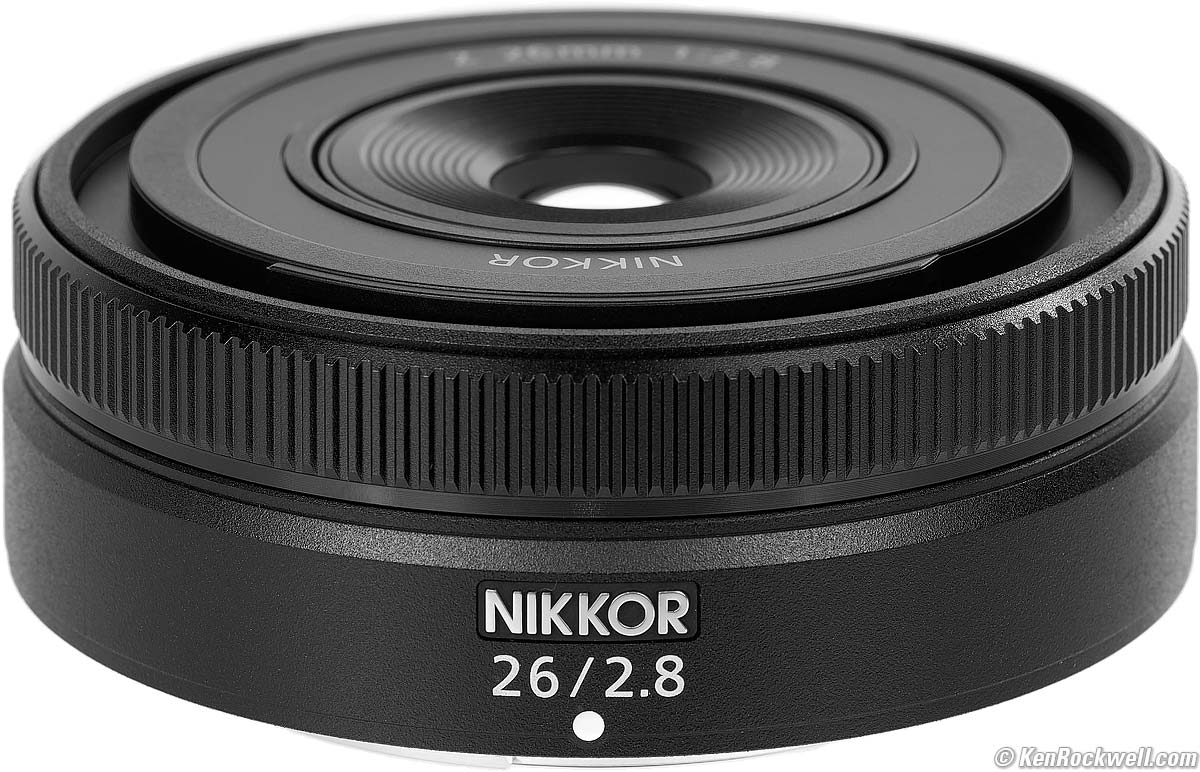
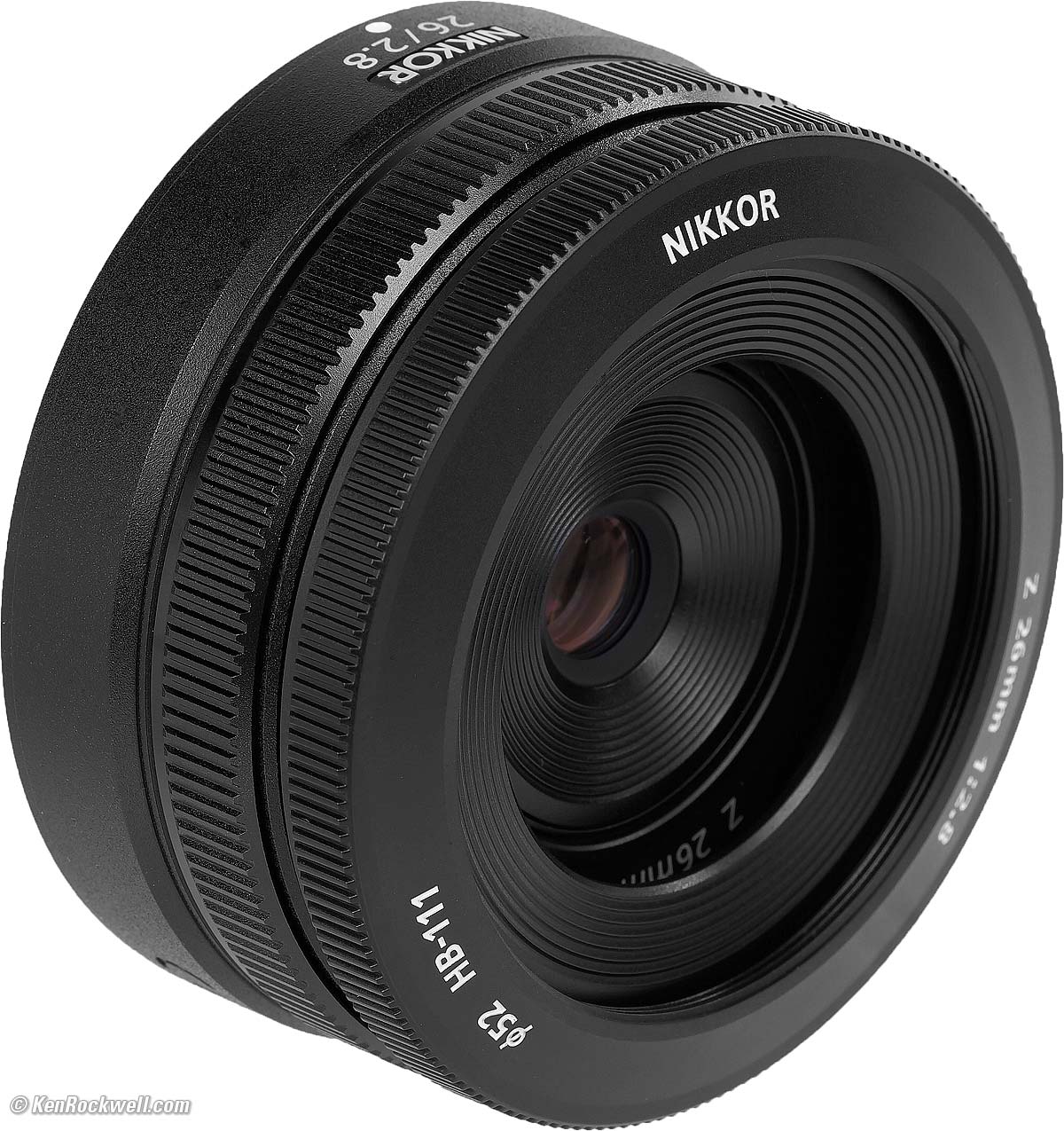
Nikon Z 26mm f/2.8 with HB-111 removed (takes 52mm filters only when used with HB-111 hood, 4.8 oz./136g with hood; 4.3 oz./122g without hood as shown, 0.66'/0.2m close focus, 0.19× macro ratio, $497). bigger. I got mine at B&H. I'd also get mine at Adorama, at Amazon or at Crutchfield, or used at eBay if you know How to Win at eBay. This 100% all-content, junk-free website's biggest source of support is when you use those or any of these links to my personally approved sources I've used myself for way over 100 combined years when you get anything, regardless of the country in which you live — but I receive nothing for my efforts if you get it elsewhere. Nikon does not seal its boxes in any way, so never buy at retail or any other source not on my personally approved list since you'll have no way of knowing if you're missing accessories, getting a defective, damaged, returned, dropped, incomplete, gray-market, store demo or used lens — and all of my personally approved sources allow for 100% cash-back returns for at least 30 days if you don't love your new lens. I've used many of these sources since the 1970s because I can try it in my own hands and return it if I don't love it, and because they ship from secure remote warehouses where no one gets to touch your new lens before you do. Buy only from the approved sources I've used myself for decades for the best prices, service, return policies and selection.
July 2023 Better Pictures Nikon Mirrorless Mirrorless Lenses All Nikon Lenses Nikon Flash All Reviews
Sample Images topSample Images Intro New Good Bad Missing Compatibility Specifications Performance User's Guide Recommendations & Comparisons More samples throughout this review at Bokeh, Falloff, Macro, Spherochromatism and Sunstars. These are just snapshots; my real work is in my Gallery. These are all shot hand-held as 25 MP MEDIUM BASIC ★ JPGs; no tripods, LARGE, NORMAL or FINE JPGs or RAW files were used or needed.
Under the Bridge, 4:38 PM, Sunday, 23 July 2023. Nikon Z8, Z 26mm f/2.8 at f/5.6 hand-held at 1/15 at Auto ISO 500 (LV 6.6), Perfectly Clear (now sold as Radiant Photo), split-toned print. bigger. This is cropped from a larger image.
Lagoon under Stormy Sky, 5:19 PM, Sunday, 23 July 2023. Nikon Z8, Z 26mm f/2.8 at f/9 hand-held at 1/25 at Auto ISO 64, +0.7 stops exposure compensation (LV 11.6), HDR Merge (now in Luminar Neo) from one JPG shot. bigger. This is cropped from a larger image.
Introduction topSample Images Intro New Good Bad Missing Compatibility Specifications Performance User's Guide Recommendations & Comparisons
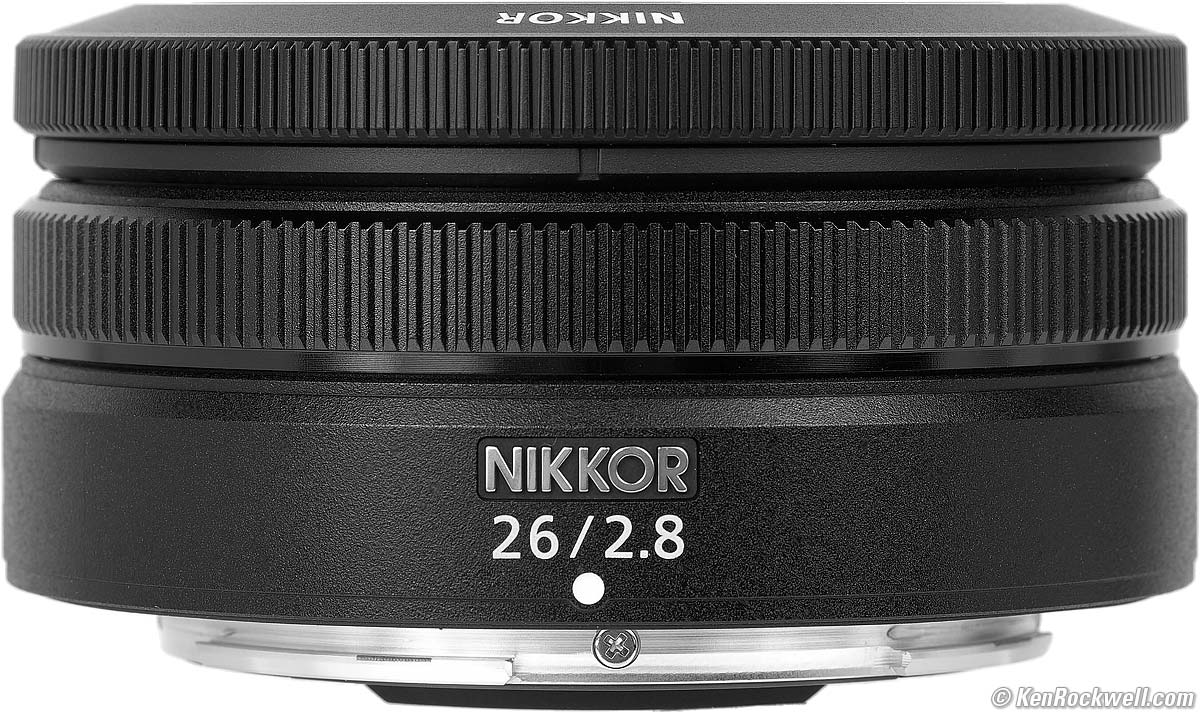
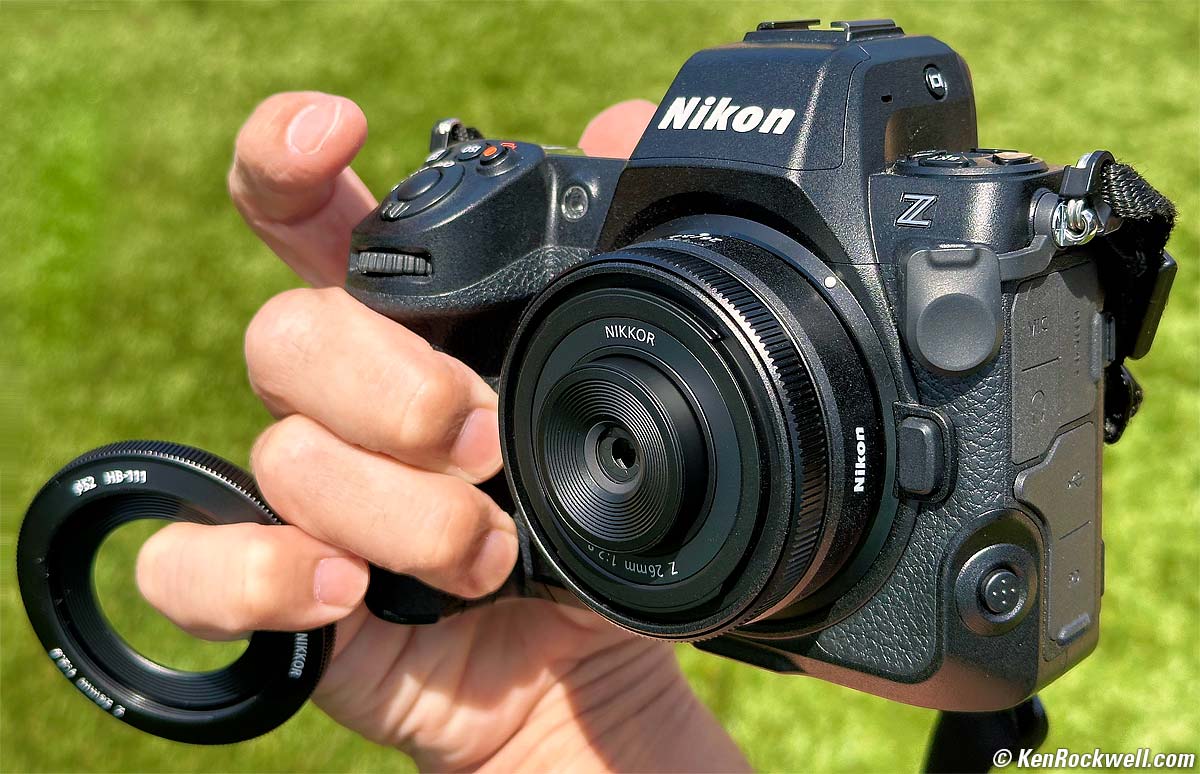
This Nikon Z 26mm f/2.8 is a tiny little lens not much bigger than a lens cap. While 26mm seems wide for full frame, remember that today's iPhones use a 26mm equivalent lens as their normal lens. It's sharp and works great once you get over the price and noisy focus motor. It comes with a tiny filter-holding "hood." You should use it all the time because without it there's no way to use a protective filter and the optics poke out of the lens without protection from knocks as focused closely, subjecting the focus mechanism to potential damage:
Nikon Z 26mm f/2.8 with HB-111 removed. Note how the central optical tube is poking out from the lens body. bigger. Sadly when you use the HB-111 you now have an additional do-nothing feel-alike ring in front of the actual focus ring, so half the time you'll grab the wrong one:
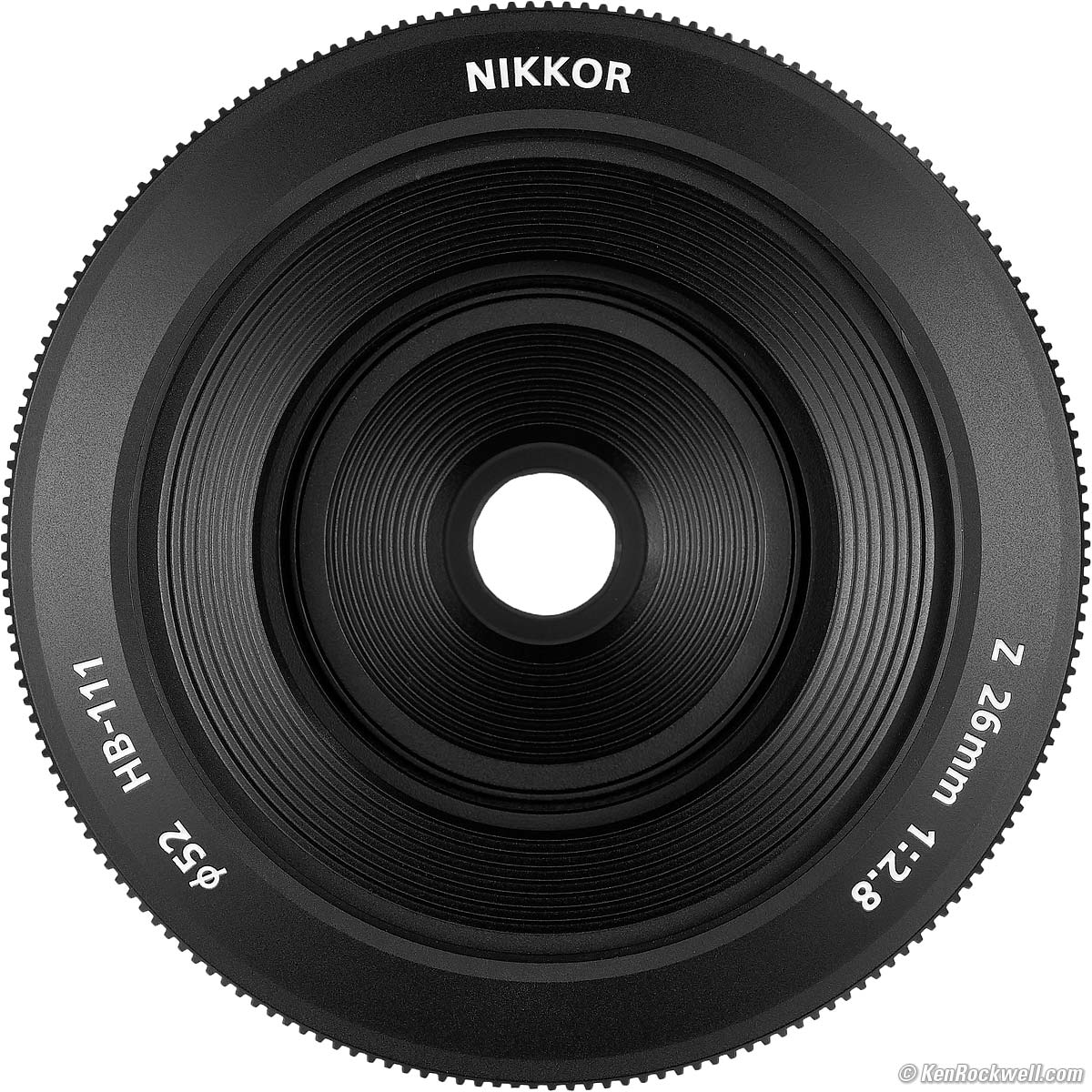
Nikon Z 26mm f/2.8 with HB-111. Note how the optics are now mechanically protected. bigger. Just turn the (working) focus ring at any time for instant manual-focus override. I got my Z 26mm f/2.8 at B&H. I'd also get mine at Adorama, at Amazon or at Crutchfield, or used at eBay if you know How to Win at eBay.
New intro top
Good intro top
Bad intro top
Missing intro top
Compatibility topSample Images Intro New Good Bad Missing Compatibility Specifications Performance User's Guide Recommendations & Comparisons
I got my Z 26mm f/2.8 at B&H. I'd also get mine at Adorama, at Amazon or at Crutchfield, or used at eBay if you know How to Win at eBay.
This lens works only on Nikon's Z-series mirrorless cameras. It does not so much as even mount on any other camera.
Specifications topSample Images Intro New Good Bad Missing Compatibility Specifications Performance User's Guide Recommendations & Comparisons
I got my Z 26mm f/2.8 at B&H. I'd also get mine at Adorama, at Amazon or at Crutchfield, or used at eBay if you know How to Win at eBay.
Name specifications topNikon calls this the NIKKOR Z 26mm f/2.8:NIKKOR: Nikon's brand name for all their lenses. Z: Fits Nikon's mirrorless cameras.
It also has: ∅52: 52mm filter thread. Aspherical: Specially curved glass elements for sharper pictures. D: Couples distance information to the 3D Matrix Meter.
Optics specifications top
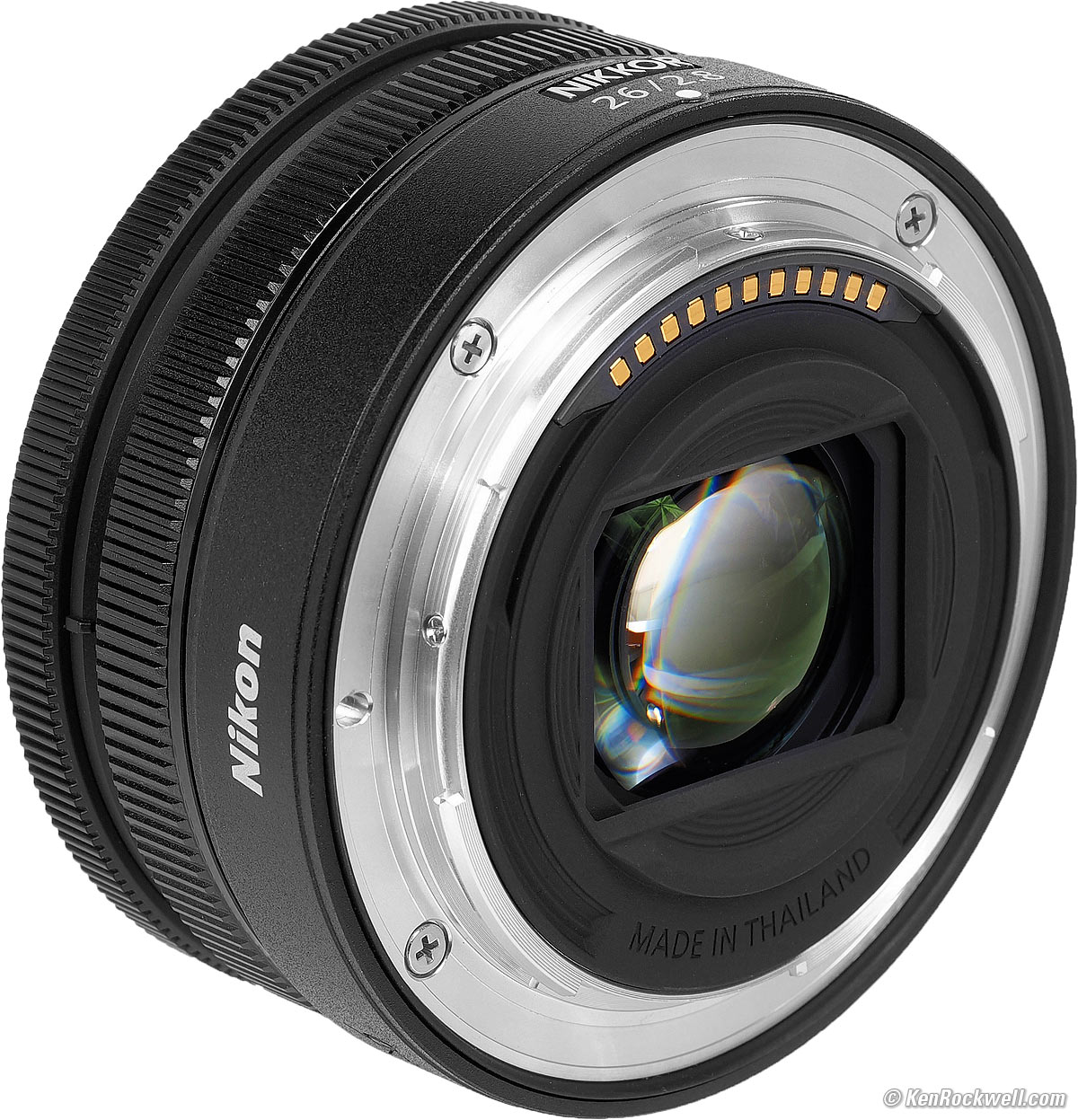
Nikon Z 26mm f/2.8 internal optical construction. Aspherical elements bigger. 8 elements in 6 groups. 3 aspherical elements. Traditional unit focussing: the entire central optical tube moves in and out as focused. Nikon Super Integrated multicoating (SIC).
Diaphragm specifications top
7 rounded blades. Electronically actuated. Stops down to f/16.
Filters specifications topPlastic 52mm filter thread, but only in the HB-111 hood.
Angles of View specifications topOn Full Frame FX79º diagonal.
On APS-C DX57º diagonal. See also Crop Factor.
Focus Scale specifications topNo. Not on lens, but may be displayed in-camera.
Infinity Focus Stop specifications topNo. You have to focus somehow to get precise focus at infinity, just like at every other distance.
Depth of Field Scale specifications topNo. Not on lens, but may be displayed in-camera.
Infrared Focus Index specifications topNo.
Close Focus (distance from subject to image plane) specifications top0.66'' (8" or 0.2 meters).
Maximum Reproduction Ratio specifications top1:5.3 (0.19 ×).
Reproduction Ratio Scale specifications topNo.
Image Stabilizer specifications topNONE, but works with in-camera stabilization if you have it.
Caps specifications topSpecial LC-K108 push-on front cap (Nikon part number 4279) included:
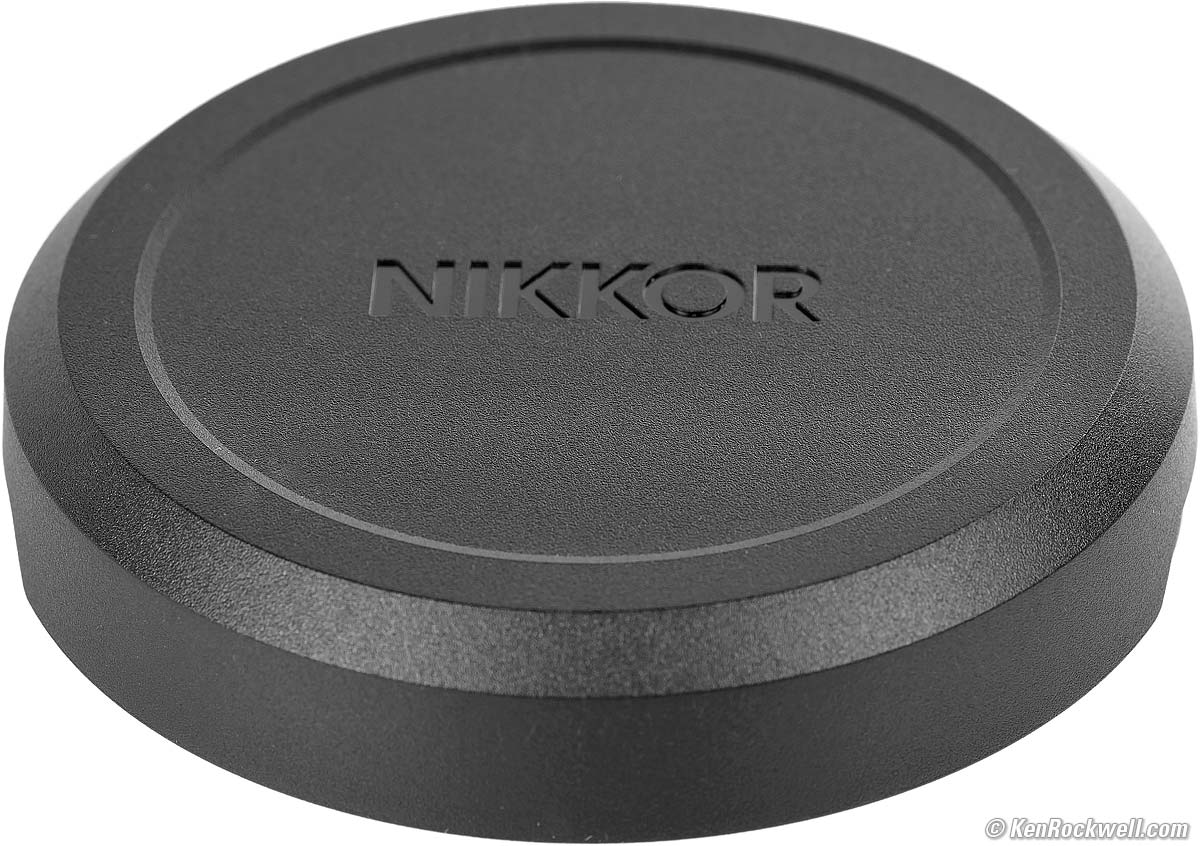
LC-K108 push-on front cap. bigger. It's all plastic, and it's felt-lined so it pushes-on and pulls straight-off like a real cap. It pushes-on to the lens alone which has no filter (or conventional cap) threads:
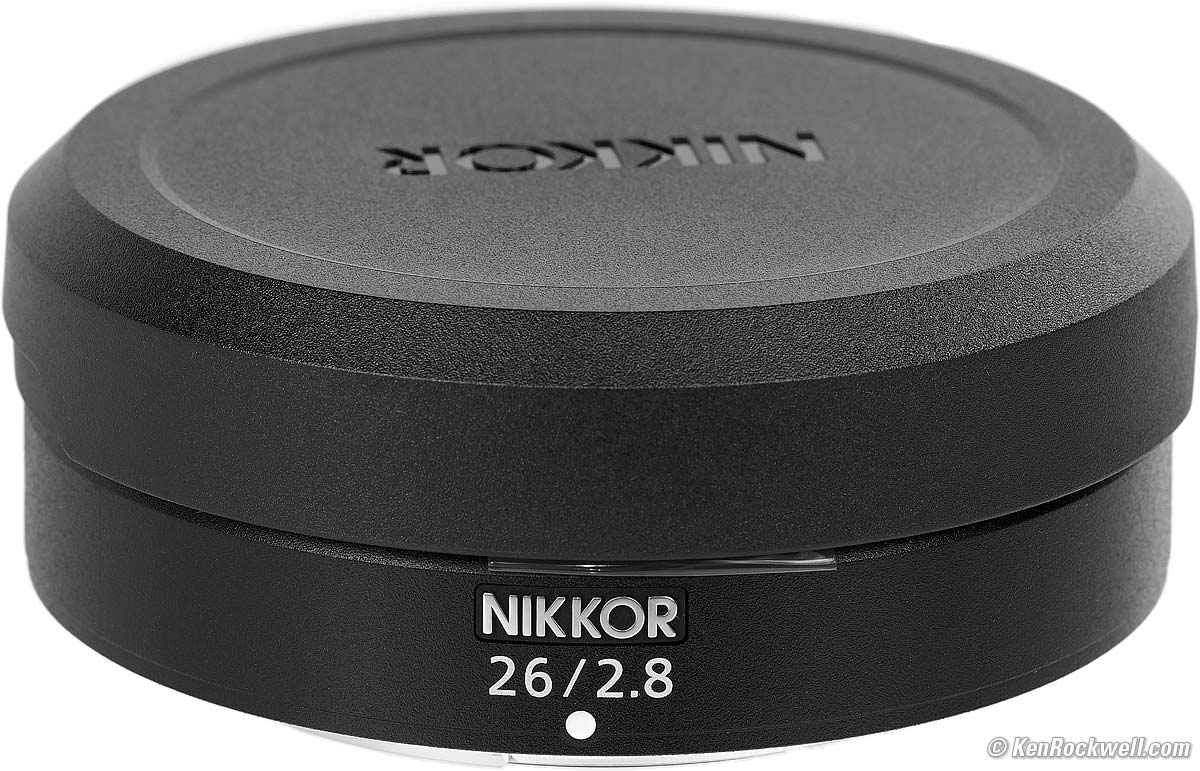
Nikon Z 26mm f/2.8 with LC-K108 but no HB-111 hood. bigger. The LC-K108 also pushes-over the HB-111 hood, so there's no need for a 52mm cap and thus no 52mm cap included.
Standard LF-N1 Z-mount rear cap included.
Hood specifications top
Nikon HB-111 hood, included.
Size specifications top2.756" ø maximum diameter × 0.925" extension from flange. 70 mm ø maximum diameter × 23.5 mm extension from flange.
Weight specifications top4.315 oz. (122.4 g) actual measured weight without hood, rated 4.5 oz. (125 g). 4.795 oz. (135.8 g) actual measured weight with HB-111 hood. HB-111 hood alone: 0.485 oz. (13.8 g) actual measured weight.
Quality specifications top
"MADE IN THAILAND" is shamefully hidden in black-on-black on the back of the light shield where it can only be seen while off the camera and without a rear cap.
Announced specifications topMonday, 06 February 2023 at 11:13 PM NYC time.
Promised for specifications topEarly March 2023.
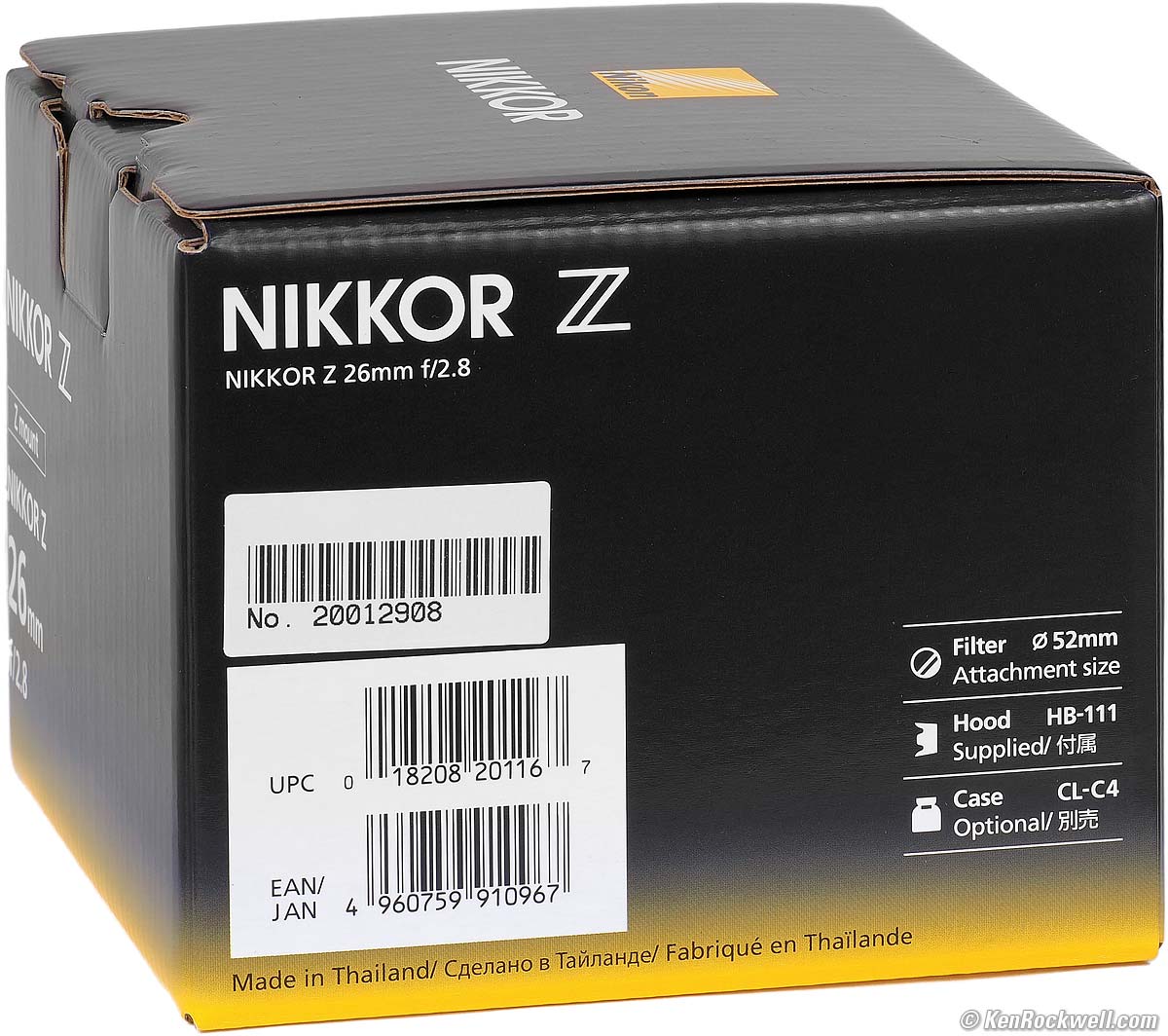
Included specifications topLens. HB-111 hood. LC-K108 push-on front cap (Nikon part number 4279) LF-N1 Z-mount rear cap.
Nikon's Model Number specifications top20116.
Price, U. S. A. specifications topJuly 2023$497 at B&H, at Adorama, at Amazon and at Crutchfield. About $425 used if you know How to Win at eBay.
Performance topSample Images Intro New Good Bad Missing Compatibility Specifications Performance User's Guide Recommendations & Comparisons
Overall Autofocus Manual Focus Breathing Bokeh Distortion Ergonomics Falloff Filters Flare & Ghosts Lens Corrections Macro Mechanics Sharpness Spherochromatism Sunstars
I got my Z 26mm f/2.8 at B&H. I'd also get mine at Adorama, at Amazon or at Crutchfield, or used at eBay if you know How to Win at eBay.
Overall performance topThe Z 26mm f/2.8 is a swell little lens if you don't mind paying for tiny; the Z 28mm f/2.8 is just about the same thing (see its review) a little larger for a lot less money. Honestly I prefer a basic zoom like the RF 24-50mm which does much more at about the same size. It's great that Nikon makes so many lenses so we can all find our favorites. À chacun son goût. It has a ratty-sounding focus motor, it's fast, sharp, has little to no distortion as shot and has decent sunstars. Autofocus performance top
Manual Focus performance topManual focusing is entirely electronic; the manual focus ring isn't connected to anything other than a digital encoder. The motor has to run to focus manually, and it's not silent. It will be audible from a few feet away in a quiet area. Just grab the electronic focus ring at any time for instant manual-focus override anytime the camera is awake. Better than any other brand, even if you're in AF-C and grab the manual-focus ring, it just swaps to manual focus instantly and stays in manual focus. Other brands will try to fight you for focus if you're in continuous AF, while this lens just does what you tell it to do. Bravo!
Focus Breathing performance topFocus breathing is the image changing size as focused in and out. It's important to cinematographers that the image not breathe because it looks funny if the image changes size as focus gets pulled back and forth between actors. If the lens does this, the image "breathes" by growing and contracting slightly as the dialog goes back and forth. As expected from a traditional unit-focus lens, the image from the Z 26/2.8 grows as focussed more closely.
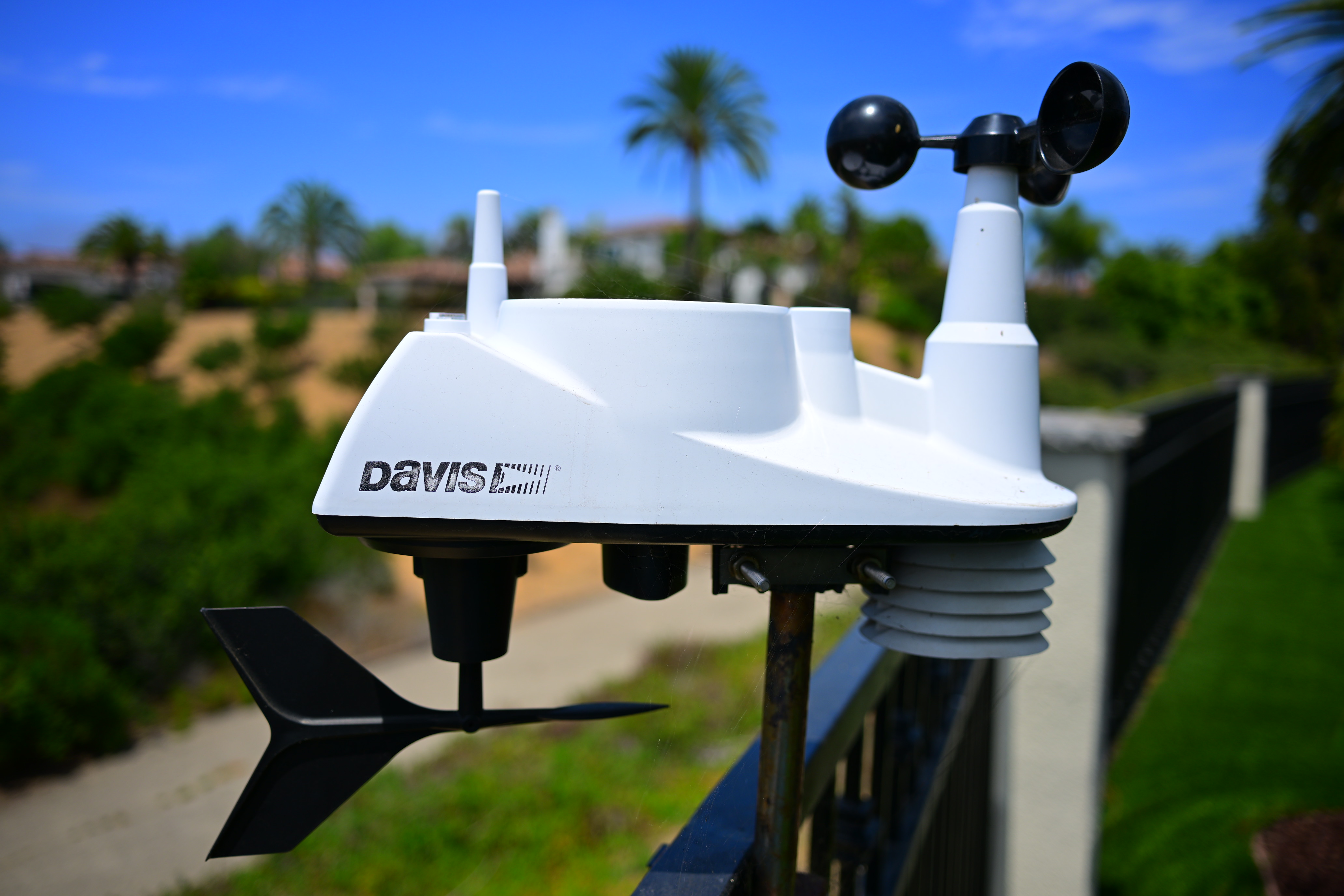
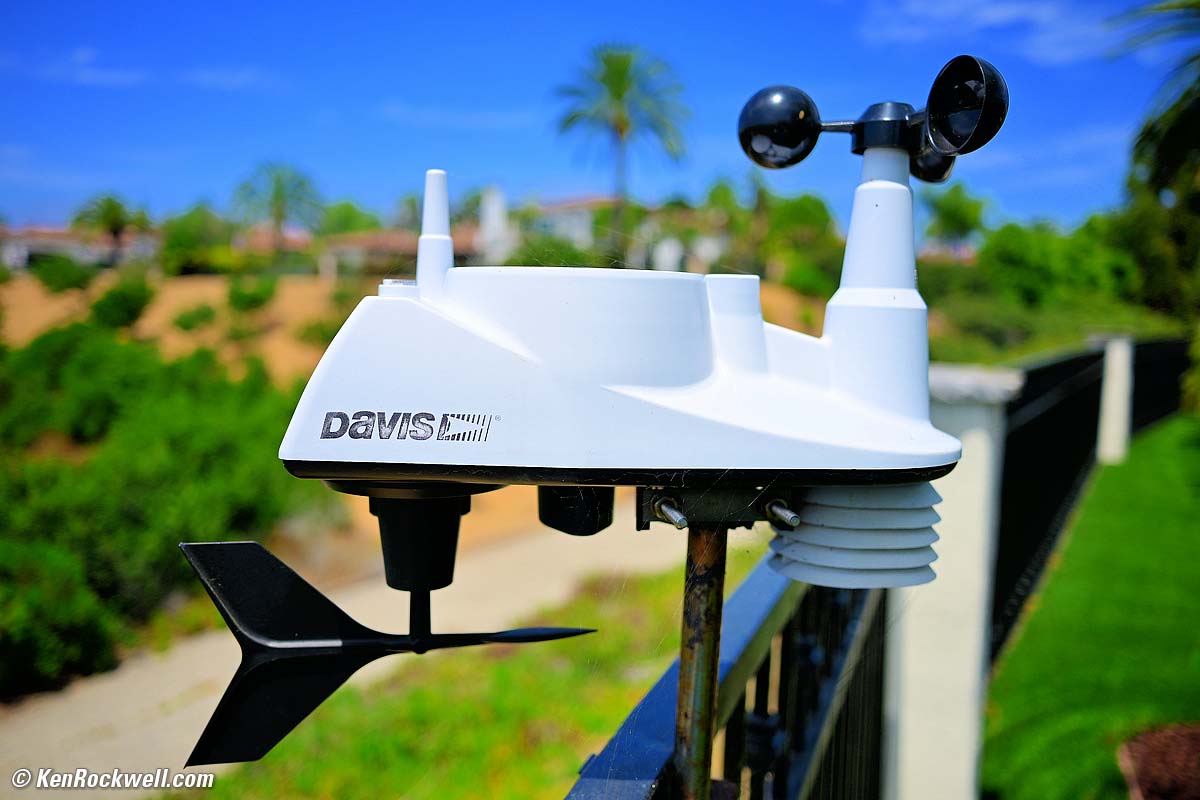
Bokeh performance topBokeh, the feel, character or quality of out-of-focus areas as opposed to how far out of focus they are, is pretty good — but since things are rarely out of focus with a lens like this it's not that important. Here's a photo from headshot distance wide-open. I'm focused on the DAVIS logo. Click for the © camera-original file:
Made-in-U. S. A. Davis 6250 weather station, 11:54 AM, 20 July 2023. Nikon Z8, Z 26mm f/2.8 at f/2.8 at 1/1,600 at Auto ISO 64, +0.7 stops exposure compensation (LV 14¼). bigger or camera-original © file. As always, if you want to throw the background as far out of focus as possible, shoot at f/2.8 and get as close as possible.
Distortion performance topThe Nikon Z 26mm f/2.8 has no visible distortion as shot with Distortion Correction ON, which is the only way it can be shot. At 30 feet (10 meters) I measure a correction factor of +0.8 (minor barrel distortion) to use in Photoshop's lens correction filter to JPG images with Distortion Correction ON. If you shoot raw data rather than JPG images, whatever software you use to create visible images from raw data may or may not correct the distortion as is done in-camera with JPGs. Canon's own software probably also corrects this from RAW CR3 files, but be warned that other brands of raw processing software probably won't correct the distortion, and Heaven only knows what distortion you may see then.
Ergonomics performance
This is a tiny lens with but one control ring. It's easy to grab its rear for mounting. By default the one ring is focus, which may be programmed in your camera to control aperture, ISO or exposure compensation if you prefer. If you use the HB-111 hood as I do, then what feels like the focus ring on the front no longer is; it's just a dead grip for the hood. There is no switch for Auto or Manual focus. There's no switch for in-camera Image Stabilization; you have to set this in a menu if your camera has this.
Falloff performance topFalloff is invisible with correction at its default of NORMAL. If you shoot raw data rather than JPG images, whatever software you use to create visible images from raw data may or may not correct the distortion as is done in-camera as JPGs. You're on your own there; I don't bother with raw data. I've greatly exaggerated the falloff by shooting a gray field and placing these on a gray background; it will not look this bad in actual photos of real things:
If you deliberately go our of your way to turn Correction OFF and then go looking for it, this is what you'll see. Again, I've greatly exaggerated the falloff by shooting a gray field and placing these on a gray background; it will not look this bad in actual photos of real things:
Filters, use with performance topThis 26mm lens has no filter threads. To use 52mm filters, use the HB-111 hood which has a 52mm thread. There's no need for thin filters. I can use a few standard 52mm filters with no vignetting at any setting on full-frame. Go ahead and use your standard rotating polarizer and grad filters.
Flare & Ghosts performance top
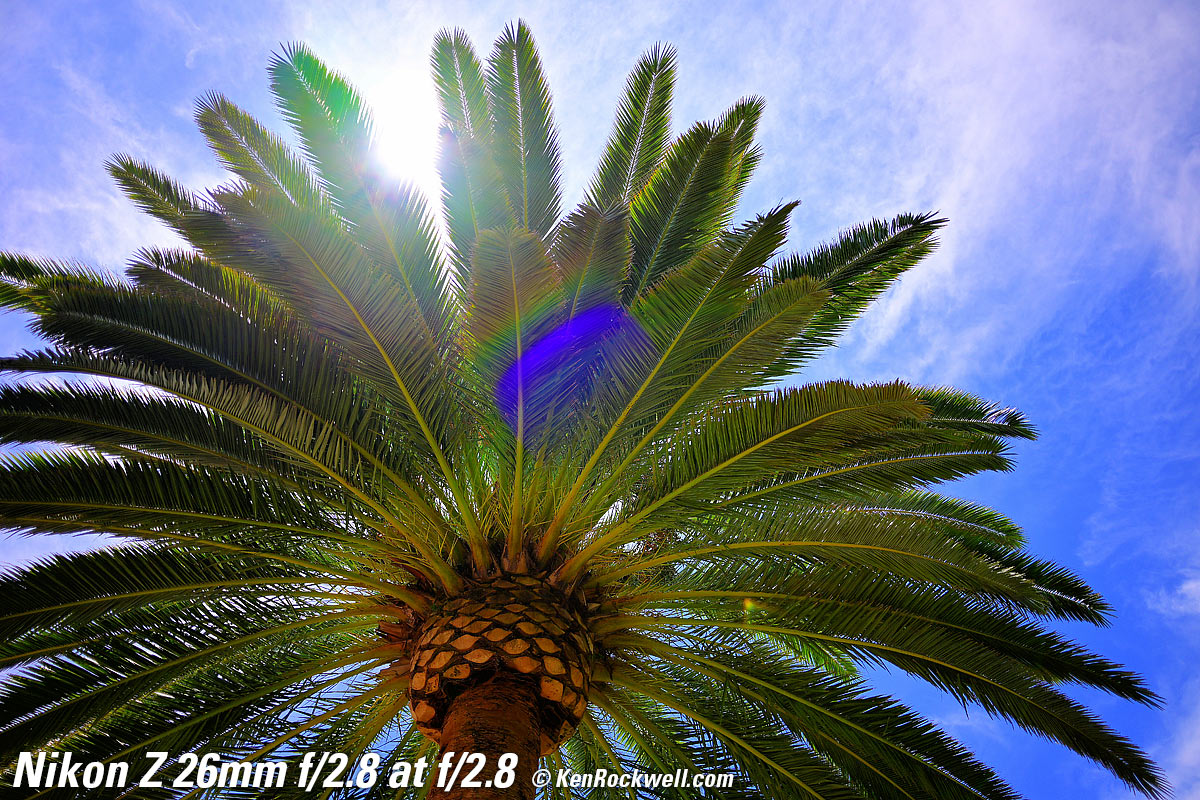
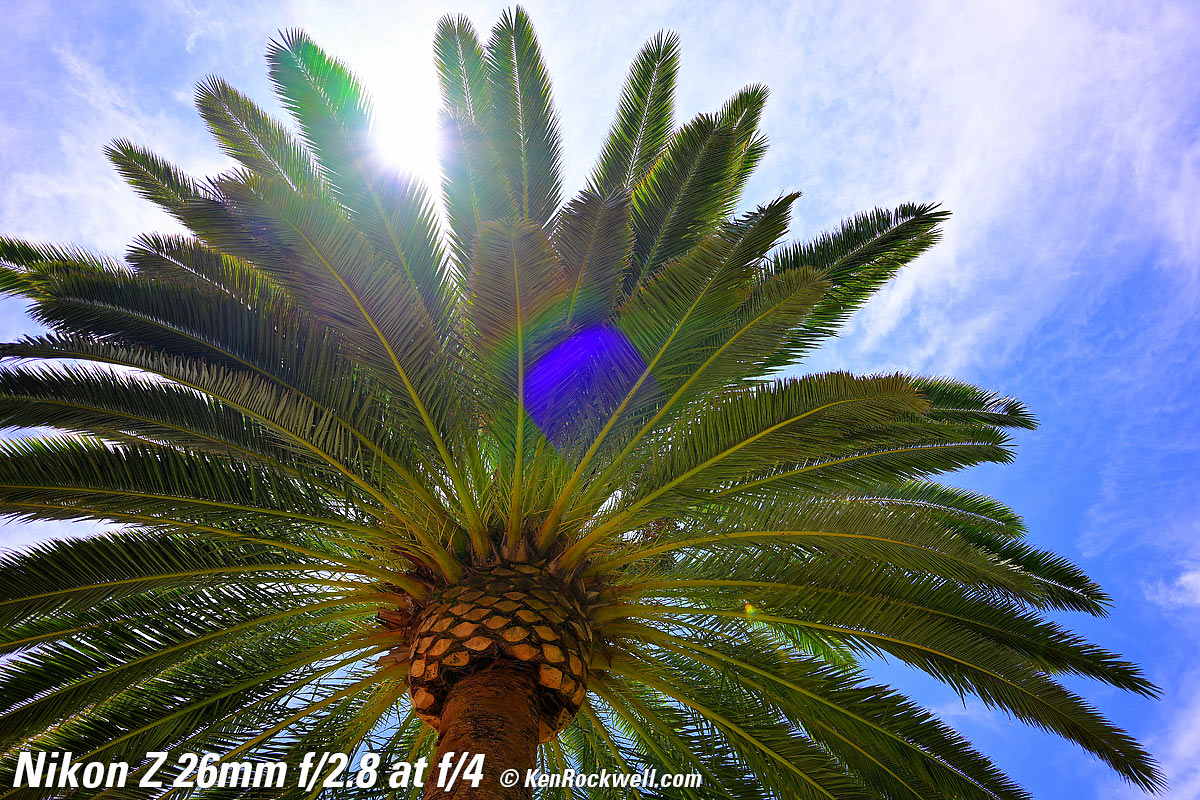
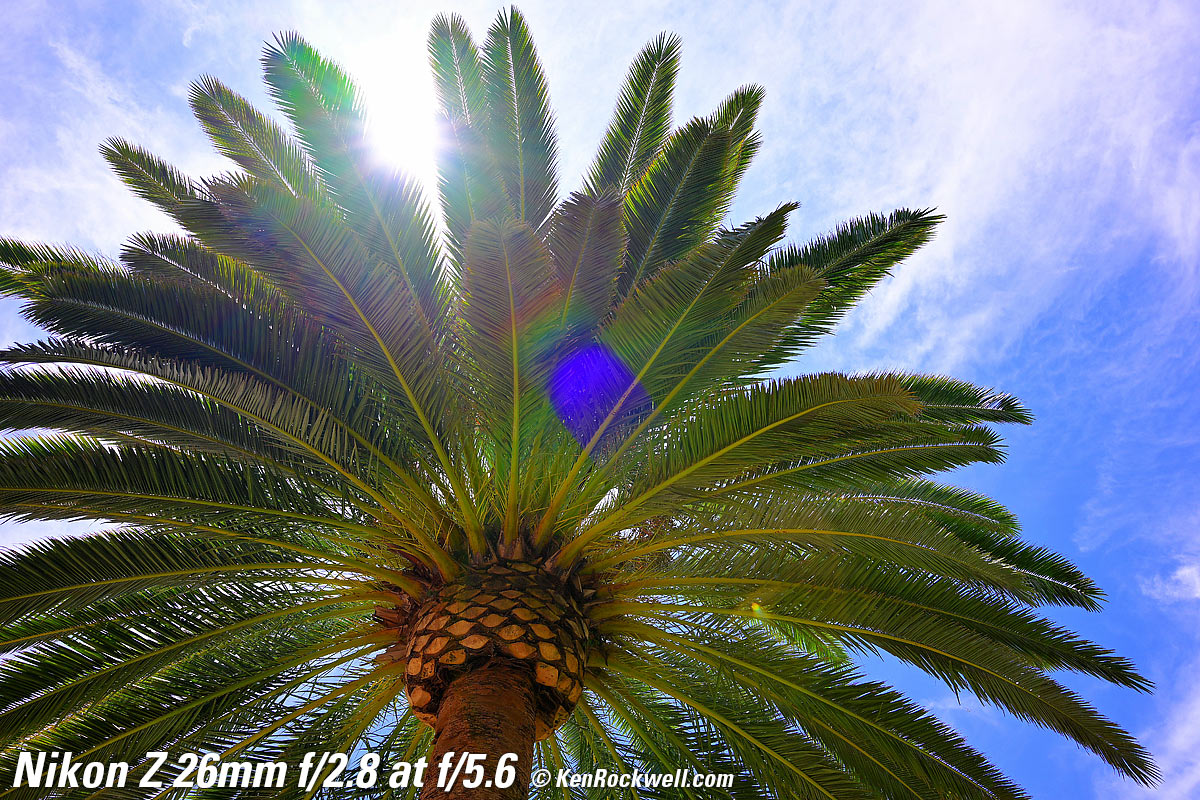
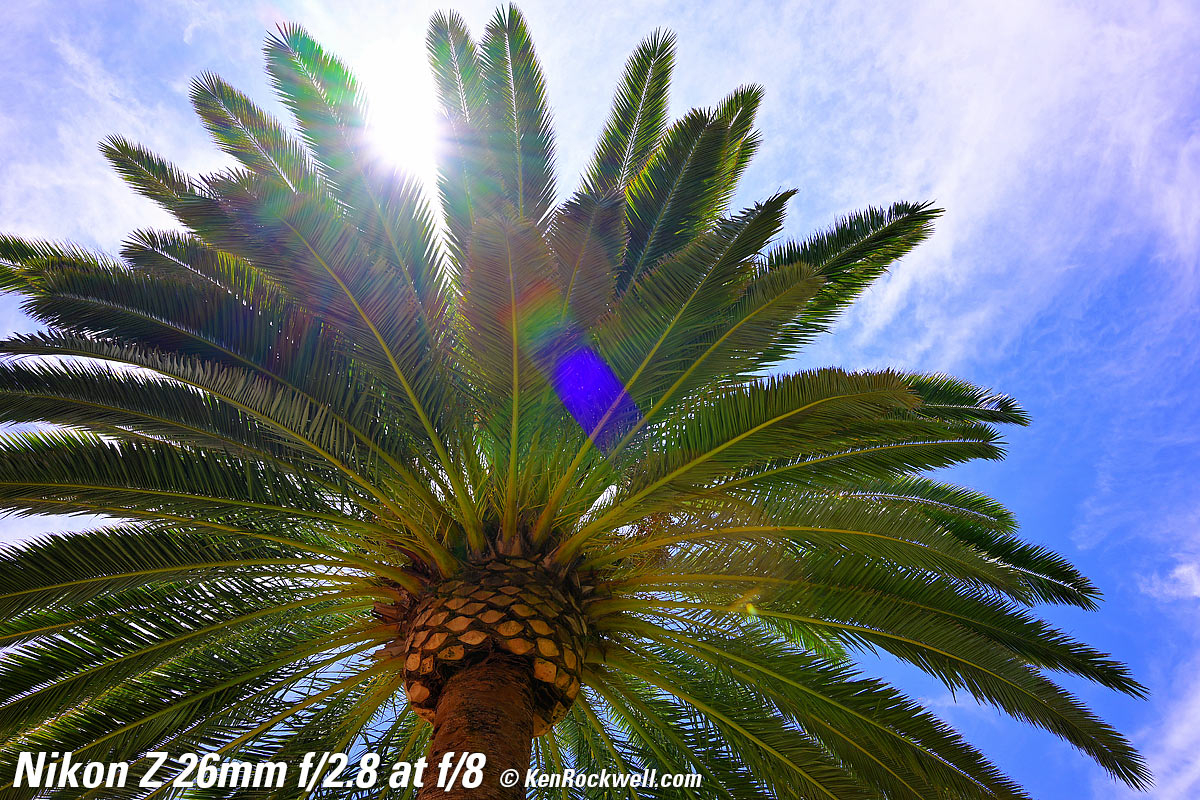
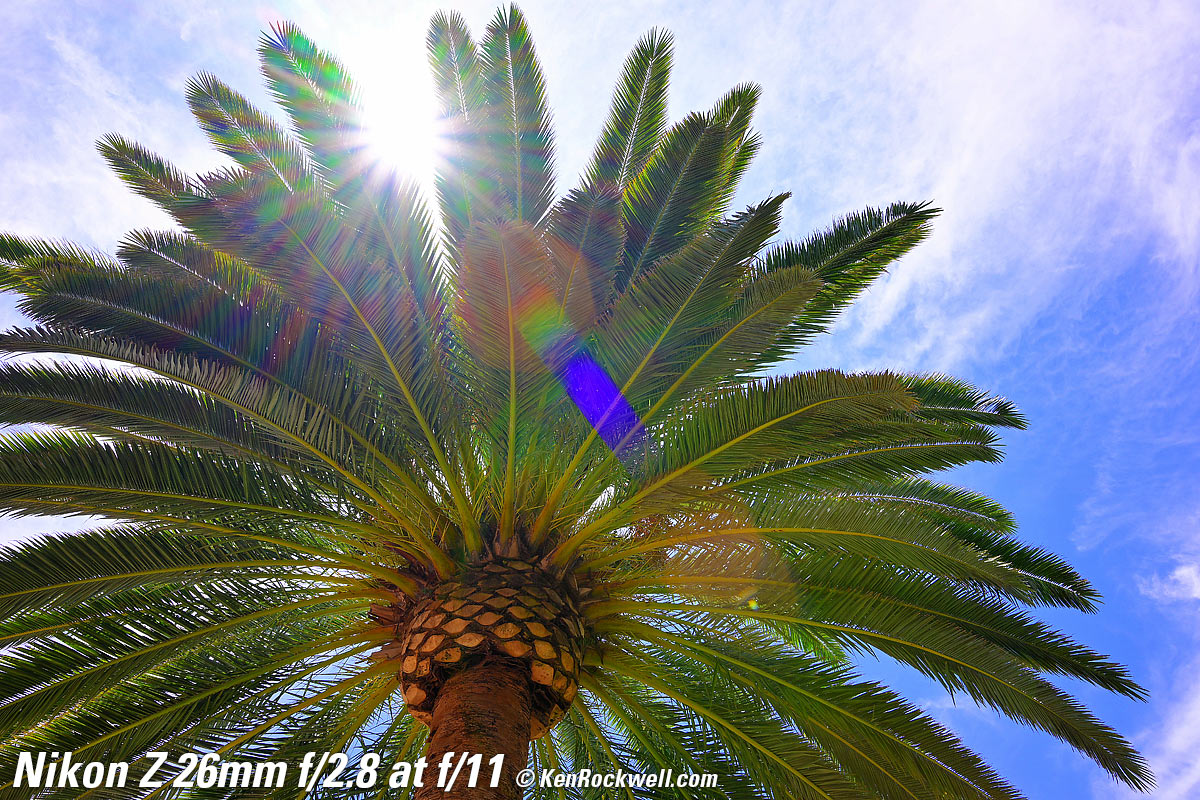
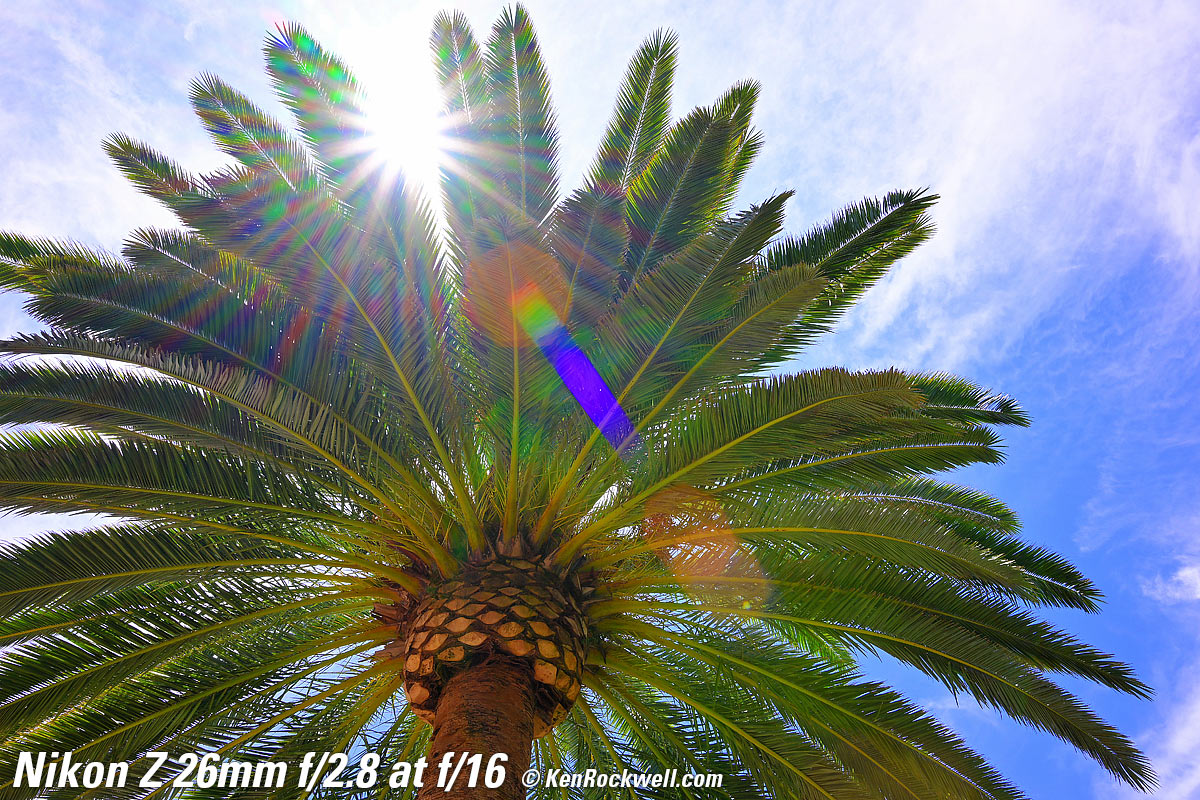
See examples at Sunstars.
Lens Corrections performance topIf you shoot raw data rather than JPG images, whatever software you use to create visible images from raw data may or may not correct aberrations as is done in-camera as JPGs. You're on your own there; I don't bother with raw data. Nikon Z cameras correct for any or all of distortion, diffraction and falloff (vignette control). Diffraction and falloff (vignette control) can be set on or off, while distortion correction can't be turned off.
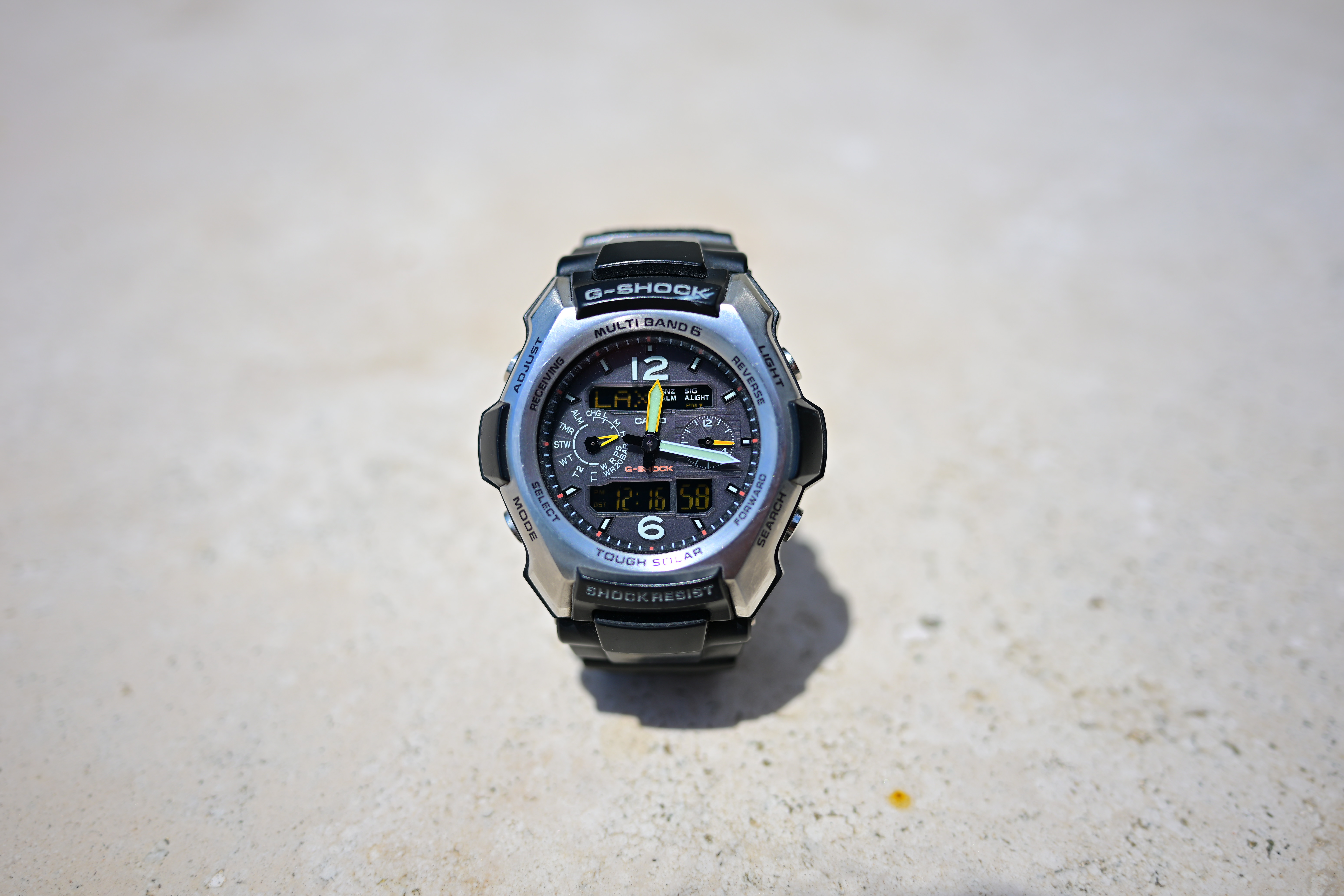
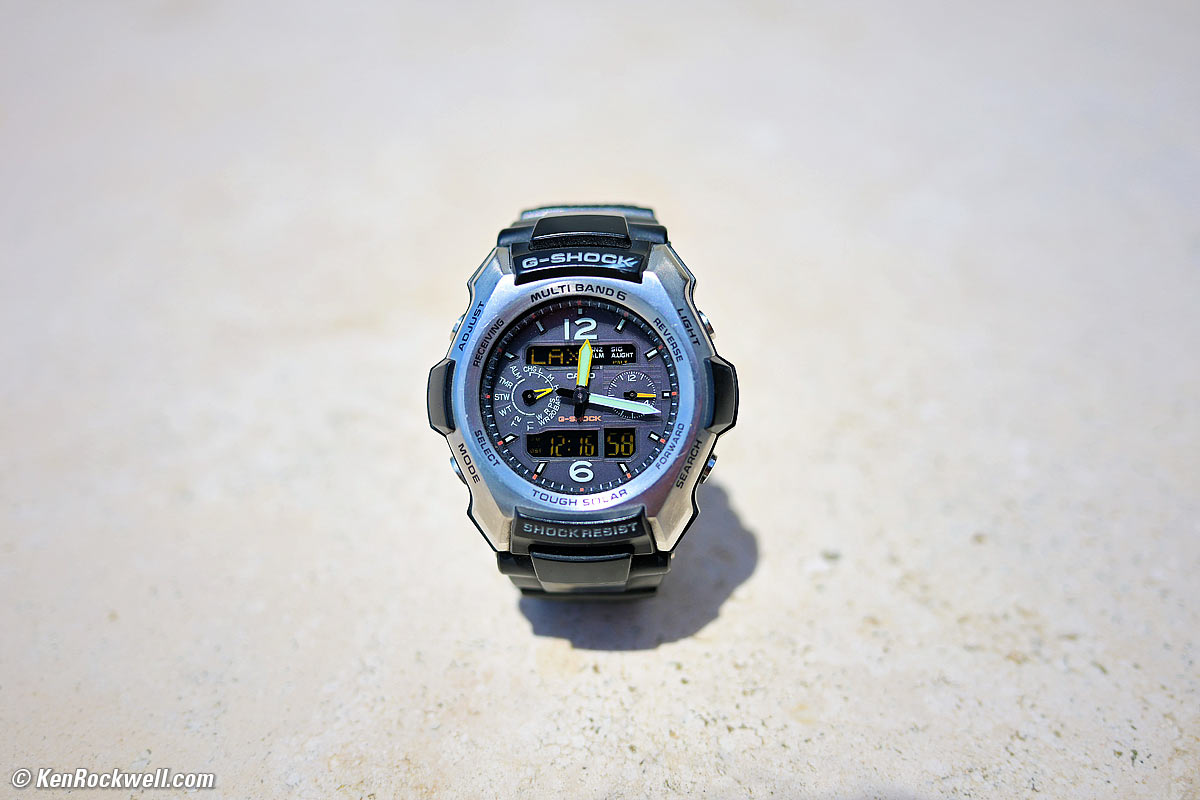
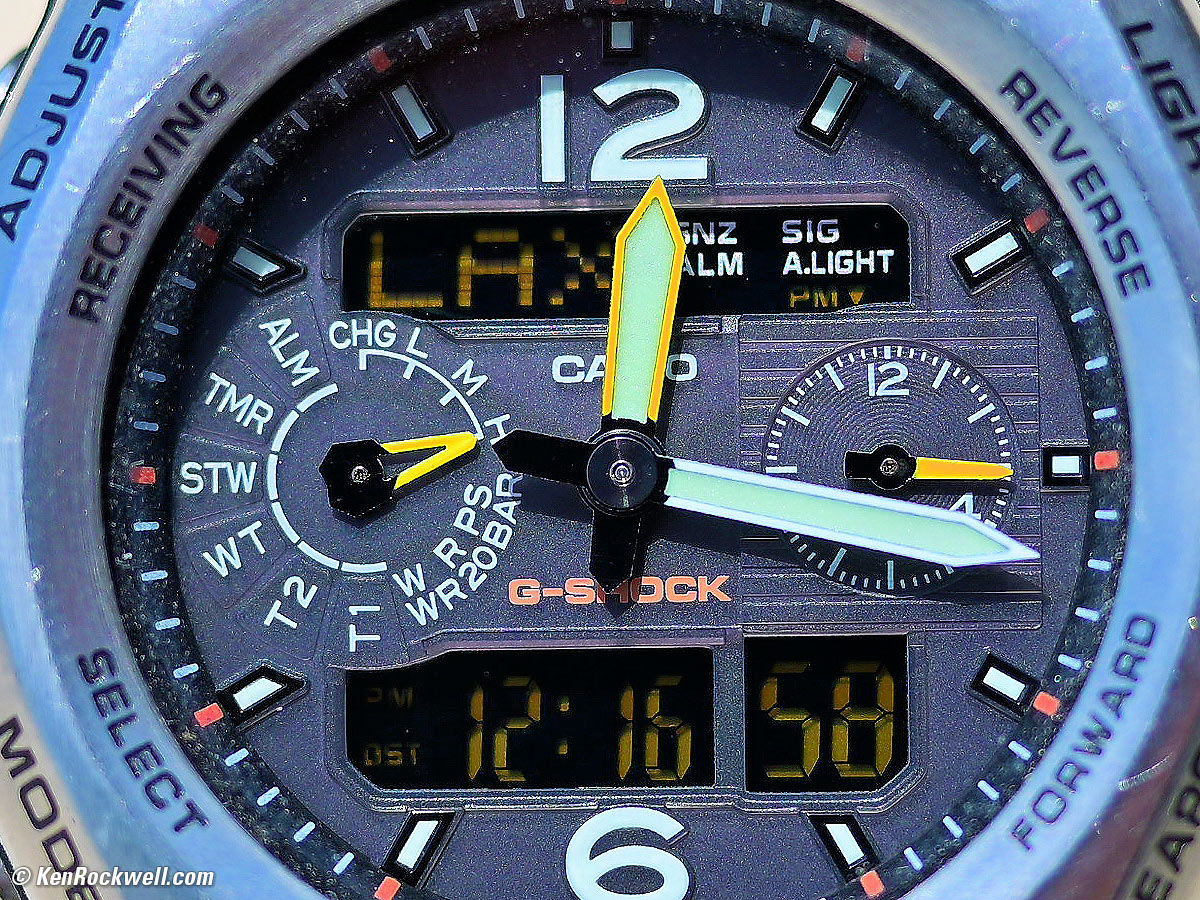
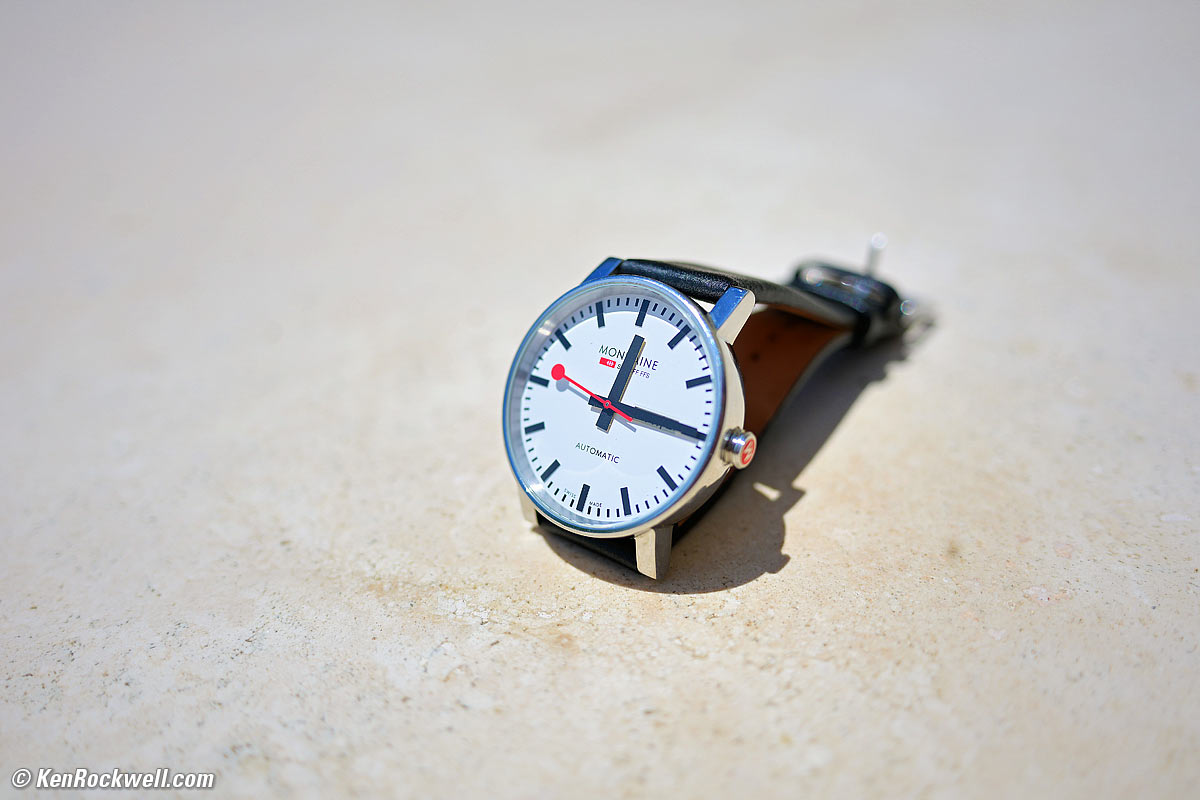
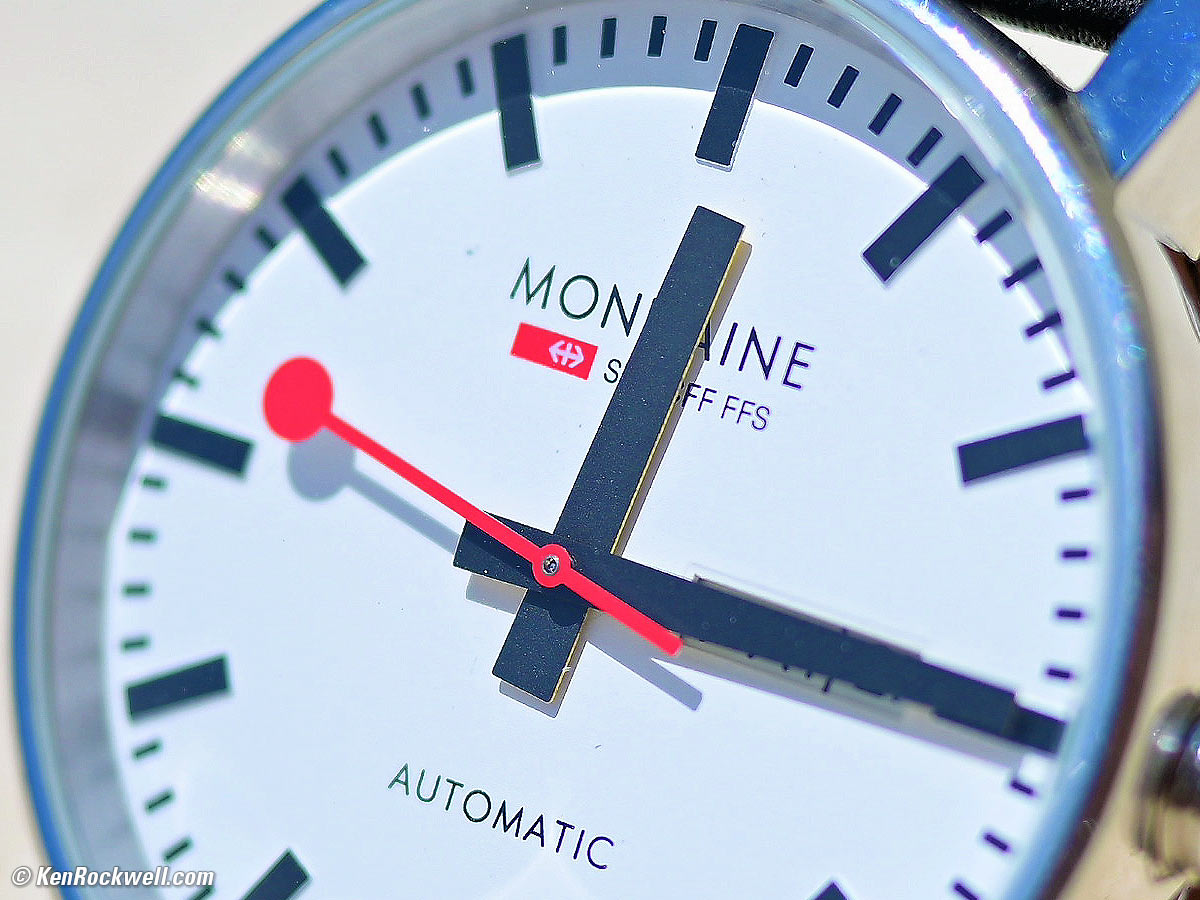
Macro Performance performance topThis lens doesn't focus particularly closely, but is it very, very sharp even wide-open. This is as close as it gets on full-frame, and it is super sharp even wide-open at f/2.8:
Casio G-Shock Solar Atomic Watch at close-focus distance, 20 July 2023. Nikon Z8, Z 26mm f/2.8 wide-open at f/2.8 at 1/16,000 at Auto ISO 64 (LV 15.1). bigger or camera-original © file.
1,200 × 900 pixel (5.16× magnification) crop from above. bigger or camera-original © file. If this 1,200 × 900 pixel crop is about 3" (7.5cm) wide on your phone, then the complete image printed at this same extreme magnification would be about 11 × 16" (0.9 × 1.3 feet or 25 × 40 cm). If this 1,200 × 900 pixel crop is about 6" (15cm) wide on your screen, then the complete image printed at this same extreme magnification would be about 21 × 31" (1.7 × 2.6 feet or 50 × 80 cm). If this 1,200 × 900 pixel crop is about 12" (30cm) wide on your screen, then the complete image printed at this same extreme magnification would be about 42 × 62" (3.5 × 5.2 feet or 1.05 × 1.6 meters).
Mechanical Quality performance top
Nikon Z 26mm f/2.8 with HB-111 hood. bigger. FinishBlack plastic.
HoodSolid plastic bayonet.
Front BumperNone.
Filter ThreadsNone on lens. 52mm plastic on HB-111 hood.
Hood Bayonet MountPlastic.
Front Barrel ExteriorPlastic.
Focus RingMetal.
BarrelPlastic.
IdentityPrinted around front of lens and also printed on top of barrel.
InternalsSeems like mostly plastic.
Dust Gasket at MountYes.
MountMetal; seems like solid aluminum.
MarkingsPainted. Hood markings engraved.
Serial NumberLaser engraved on bottom of barrel:
Nikon Z 26mm f/2.8. bigger.
Date CodeNone found.
Noises When ShakenMinor clunking of the inner focus barrel.
Made inMade in Thailand, which I'll take over China any day. It's hidden on the back of the light shield where no one will ever see it.
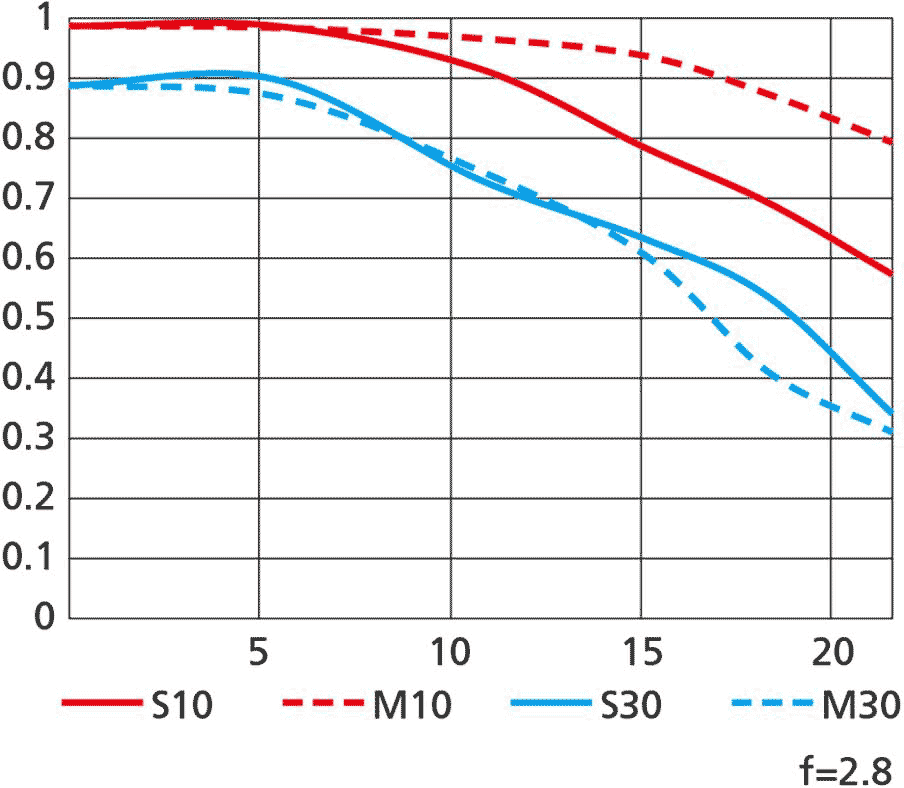
Sharpness performance topLens sharpness has nothing to do with picture sharpness; every lens made in the past 100 years is more than sharp enough to make super-sharp pictures if you know what you're doing. The only limitation to picture sharpness is your skill as a photographer. It's the least talented who spend the most time worrying about lens sharpness and blame crummy pictures on their equipment rather than themselves. Skilled photographers make great images with whatever camera is in their hands; I've made some of my best images of all time with an irreparably broken camera! Most pixels are thrown away before you see them, but camera makers don't want you to know that. If you're not getting ultra-sharp pictures with this, be sure not to shoot at f/11 or smaller where all lenses are softer due to diffraction, always shoot at ISO 100 or below because cameras become softer at ISO 200 and above, avoid shooting across long distances over land which can lead to atmospheric heat shimmer, be sure everything is in perfect focus, set your camera's sharpening as you want it (I usually set mine to the maximum) and be sure nothing is moving, either camera or subject. If you want to ensure a soft image with any lens, shoot at f/16 or smaller at ISO 1,600 or above at default sharpening in daylight of subjects at differing distances in the same image. People worry waaaaay too much about lens sharpness. It's not 1968 anymore when lenses often weren't that sharp and there could be significant differences among them; ever since about 2010 all new lenses are all pretty much equally fantastic. This lens is ultra sharp and contrasty corner-to corner at most apertures, limited of course by diffraction at the very smallest apertures. It can be a little softer in the full-frame corners when counting pixels wide-open at f/2.8, and it sharpens up as stopped down. I wouldn't worry about it; I'd never see this small amount of softening anyplace outside the lab. |








 Nikon's first 26mm lens.
 Tiny.
Tiny. Production dumped to Thailand, not made domestically in Japan.
 No
No