Nikon Z50 II
21 MP DX @ 30 FPS, 4K/60, ISO 100~51,200 (204,800 H2), 2024-
Nikon's Best Camera?
Sample Images Intro New Good Bad Missing
Lenses & Compatibility Specs USA Version
Accessories Performance Compared
User's Guide Recommendations More
Z9 Z8 Z7 II Z6 III Z6 II Z5 II Zƒ Z7 Z6 Z5
DX (APS-C): Zƒc Z50 II Z50 Z30
Z System Z Lenses All Nikon Lenses Flash
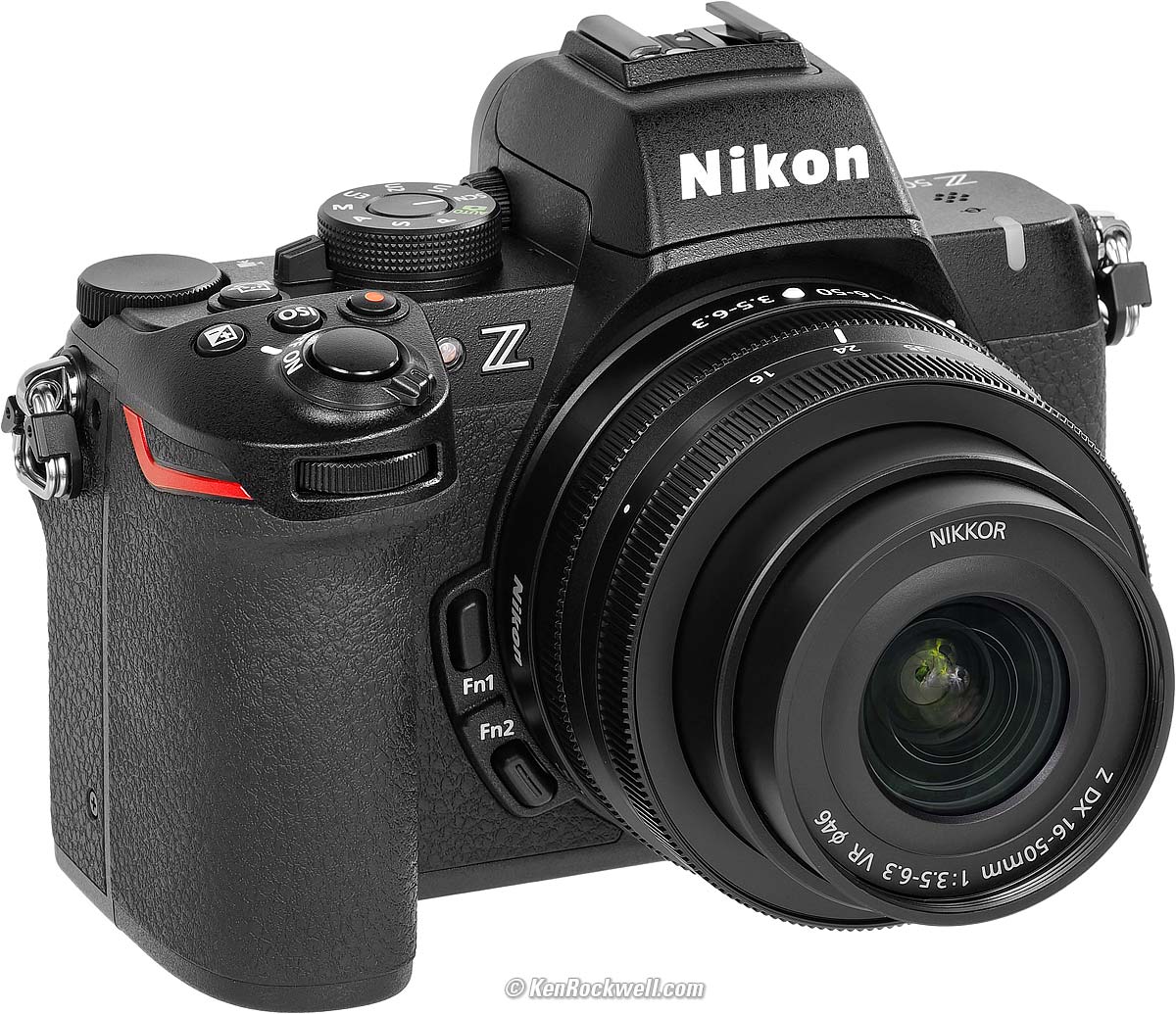
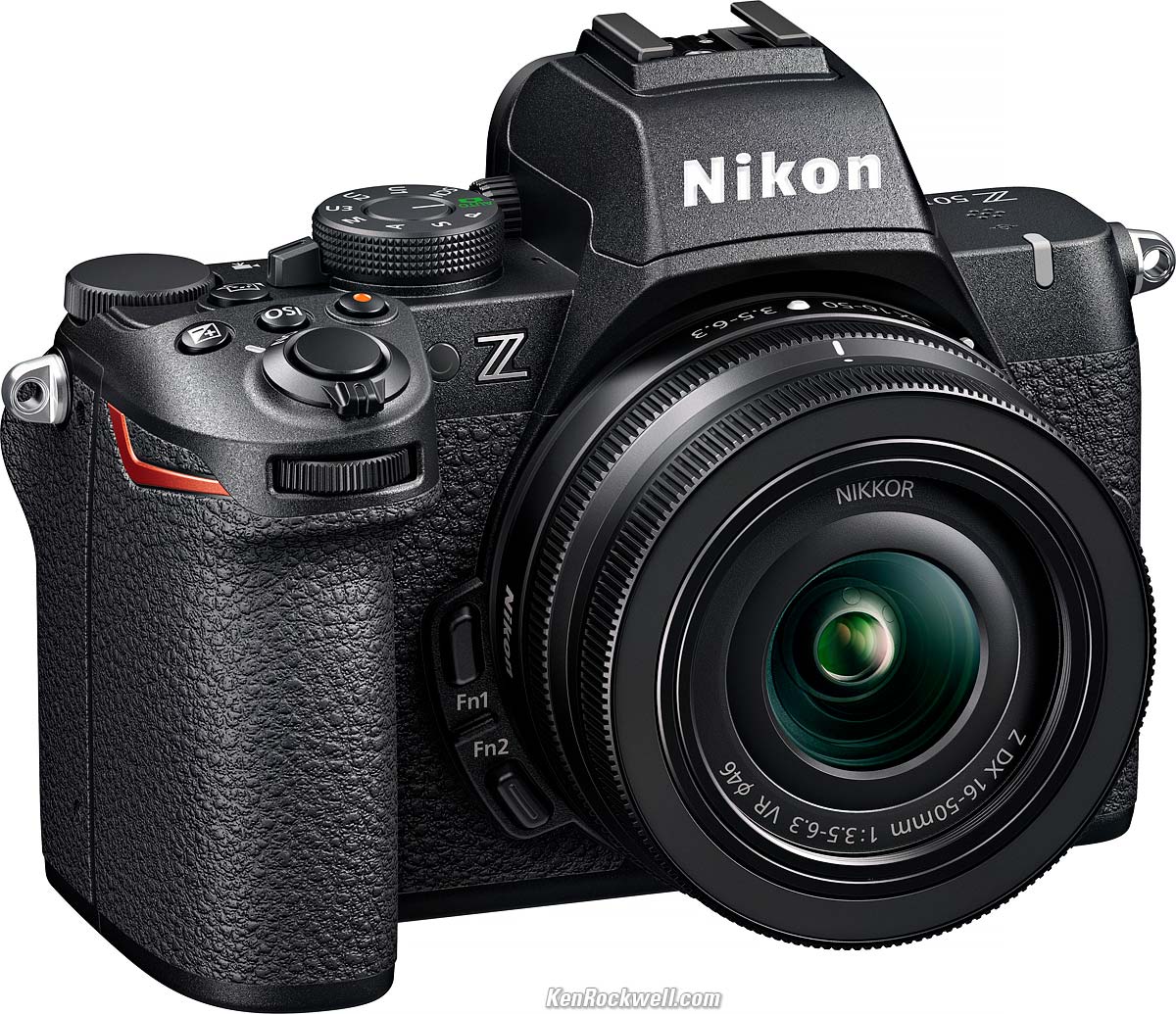
Nikon Z50 II (19.4 oz./550g with battery and card, one SD card slot, $907) and the superb Nikon Z 16-50mm DX VR. bigger. I ordered mine as a kit with the Z 16-50mm VR DX at B&H:
$907, Z50 II body-only at B&H, at Adorama, at Amazon and at Crutchfield.
$1,047, Z50 II kit with excellent 16-50mm lens as shown above at B&H, at Adorama, at Amazon and at Crutchfield.
$1,297, Z50 II system with both the 16-50mm and 50-250mm lenses at B&H, at Adorama, at Amazon and at Crutchfield.
$1,343, Z50 II system with the 18-140mm at B&H.
Get it used if you know How to Win at eBay.
This 100% all-content, junk-free website's biggest source of support is when you use those or any of these links to my personally approved sources I've used myself for way over 100 combined years when you get anything, regardless of the country in which you live. Nikon does not seal its boxes in any way, so never buy at retail or any other source not on my personally approved list since you'll have no way of knowing if you're missing accessories, getting a defective, damaged, returned, gray-market, store demo or used camera — and all of my personally approved sources allow for 100% cash-back returns for at least 30 days if you don't love your new camera. I've used many of these stores since the 1970s because I can try it in my own hands and return it if I don't love it, and because they ship from secure remote warehouses where no one gets to touch your new camera before you do. Buy only from the approved sources I've used myself for decades for the best prices, service, return policies and selection.
July 2025 Nikon Mirrorless Mirrorless Lenses All Nikon Lenses Nikon Flash All Reviews
Canon, Nikon, Sony, Fuji & OM SYSTEM Menu Systems Compared
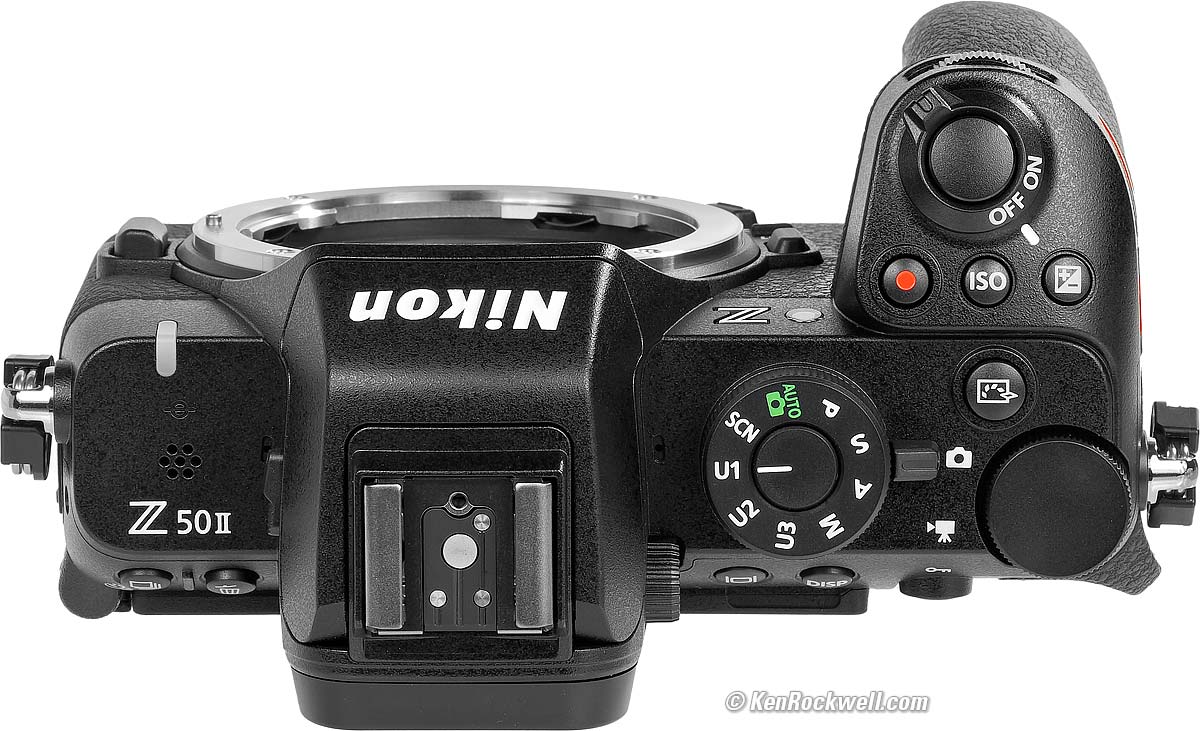
Nikon Z50 II. bigger.
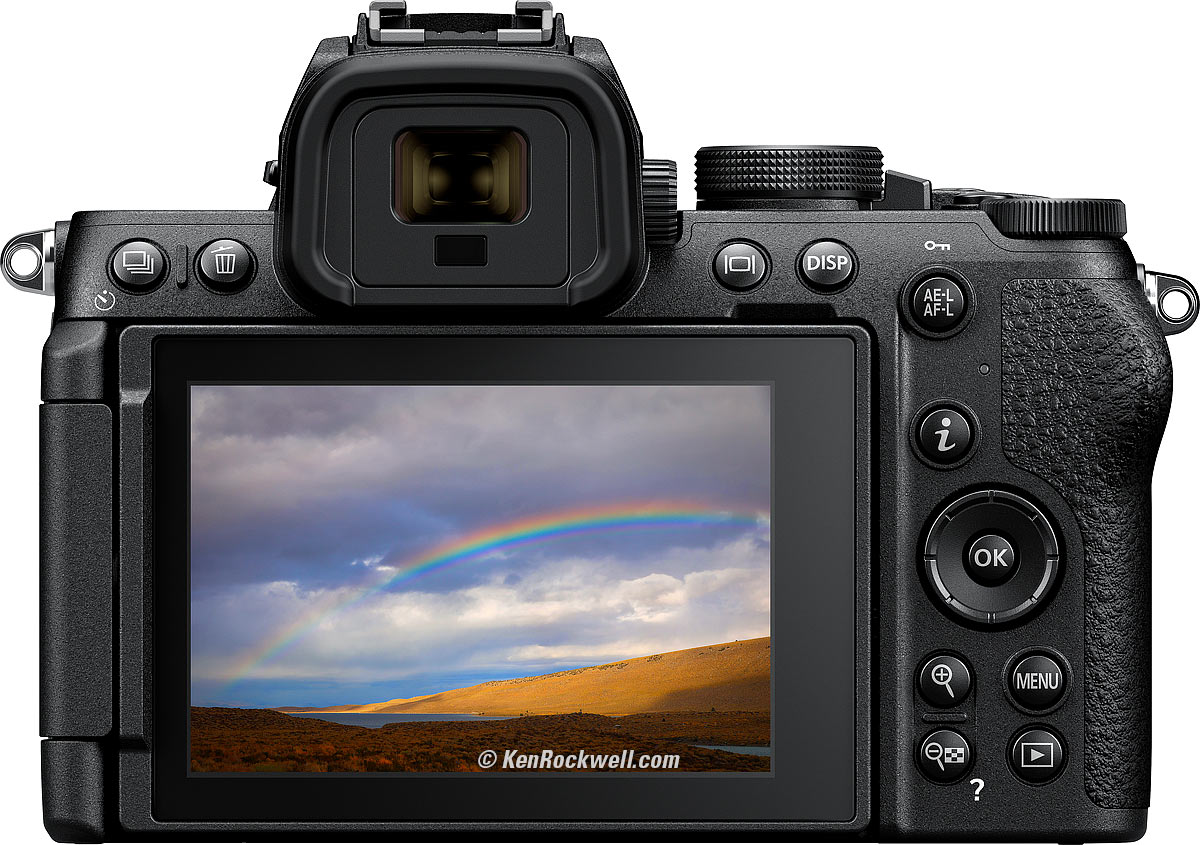
Nikon Z50 II. bigger.
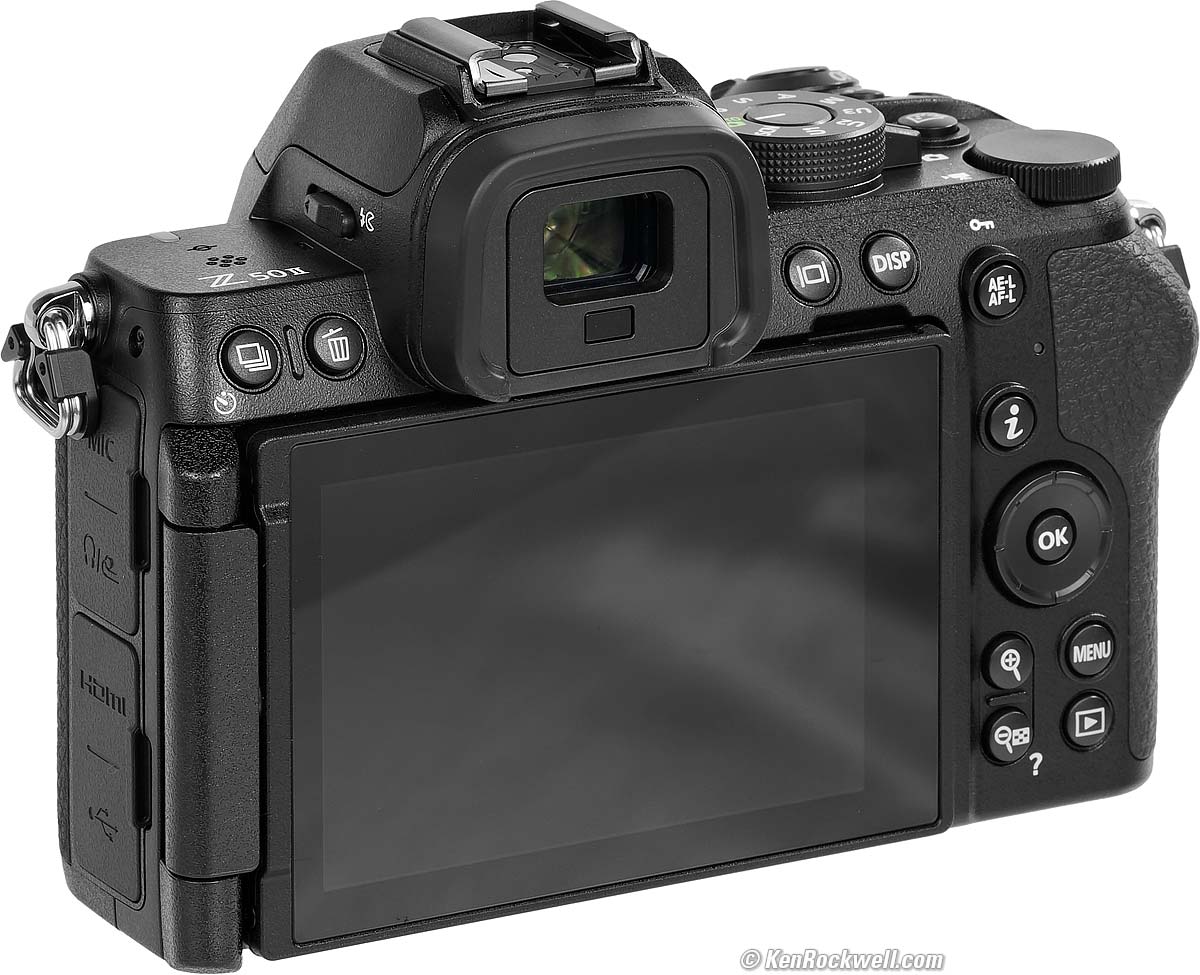
Nikon Z50 II. bigger.
Sample Images top
Sample Images Intro New Good Bad Missing
Lenses & Compatibility Specs USA Version
Accessories Performance Compared
User's Guide Recommendations More
These are just snapshots and there are many more throughout this review. My real work is in my Gallery.
These are all shot with the Nikon Z 16-50mm DX VR kit lens hand-held as BASIC JPGs. No RAW files, NORMAL or FINE JPGs or tripods were used or needed. Bah!
All are shot in the VIVID Picture Control setting with sharpening set to +9 and Saturation set to +3:
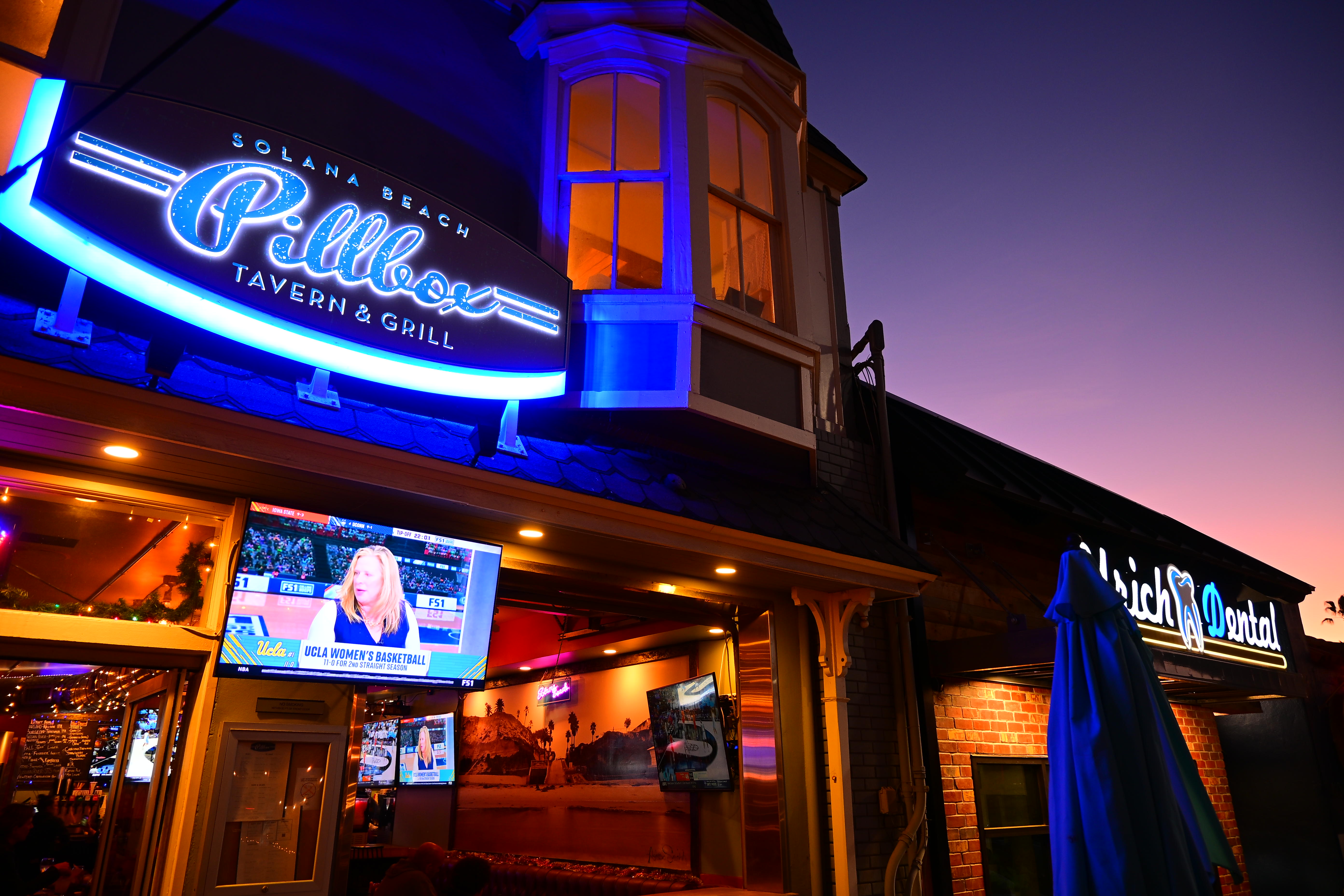
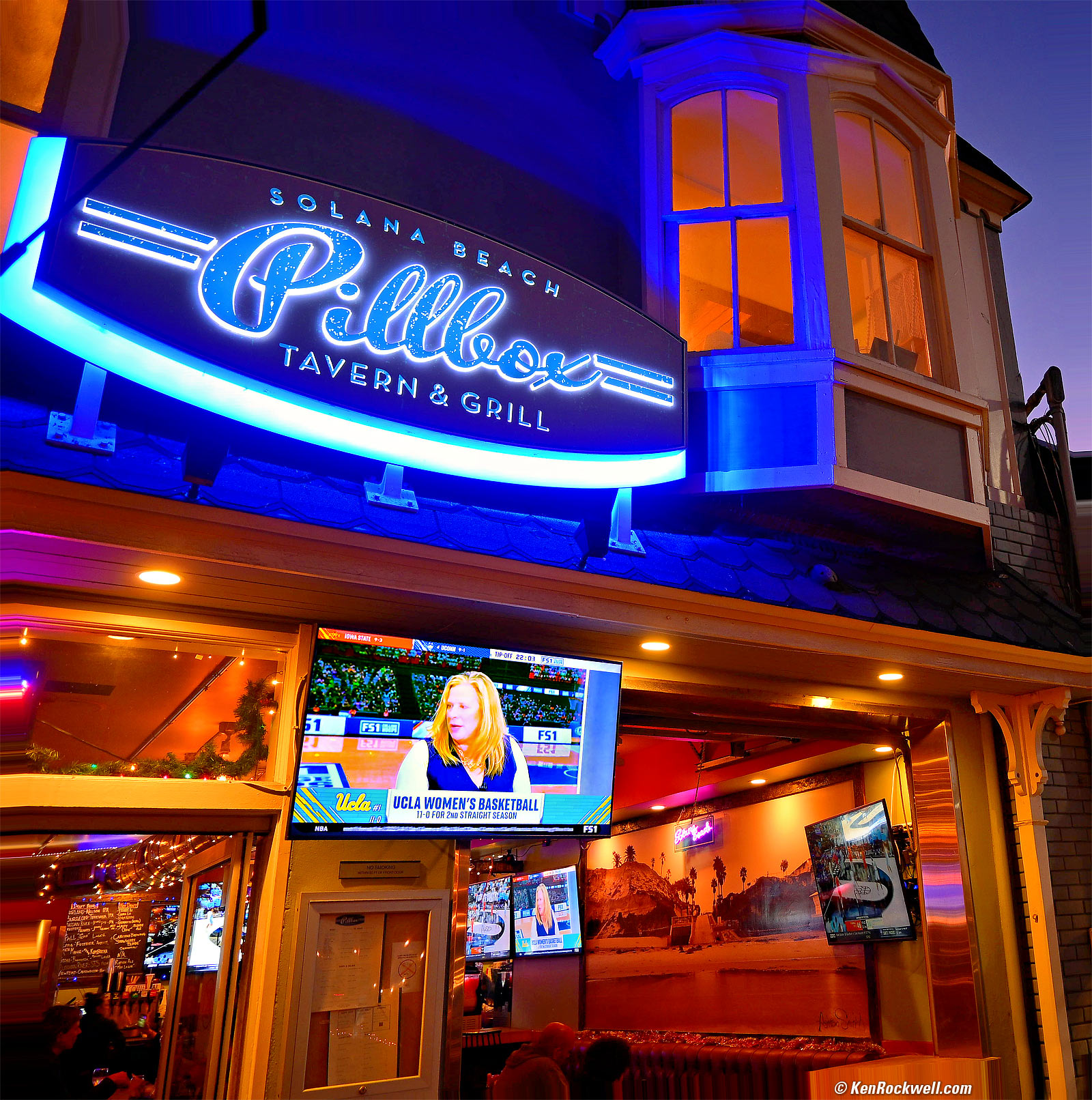
Pillbox Tavern and Annoying TV spoiling my Picture (but GO BRUINS!), Solana Beach, California, 5:09 P.M., Tuesday, 17 December 2024. Nikon Z50 II, Nikon Z 16-50mm DX VR at 16mm wide-open at f/3.5 hand-held at 1/6 of a second at Auto ISO 140 (LV 5.7), dark sections lightened in Radiant Photo software, a masked curves adjustment layer was used in Photoshop CC to control the too-blue TV mucking up my shot. bigger or camera-original 21 MP © 2.2 MB JPG BASIC file.
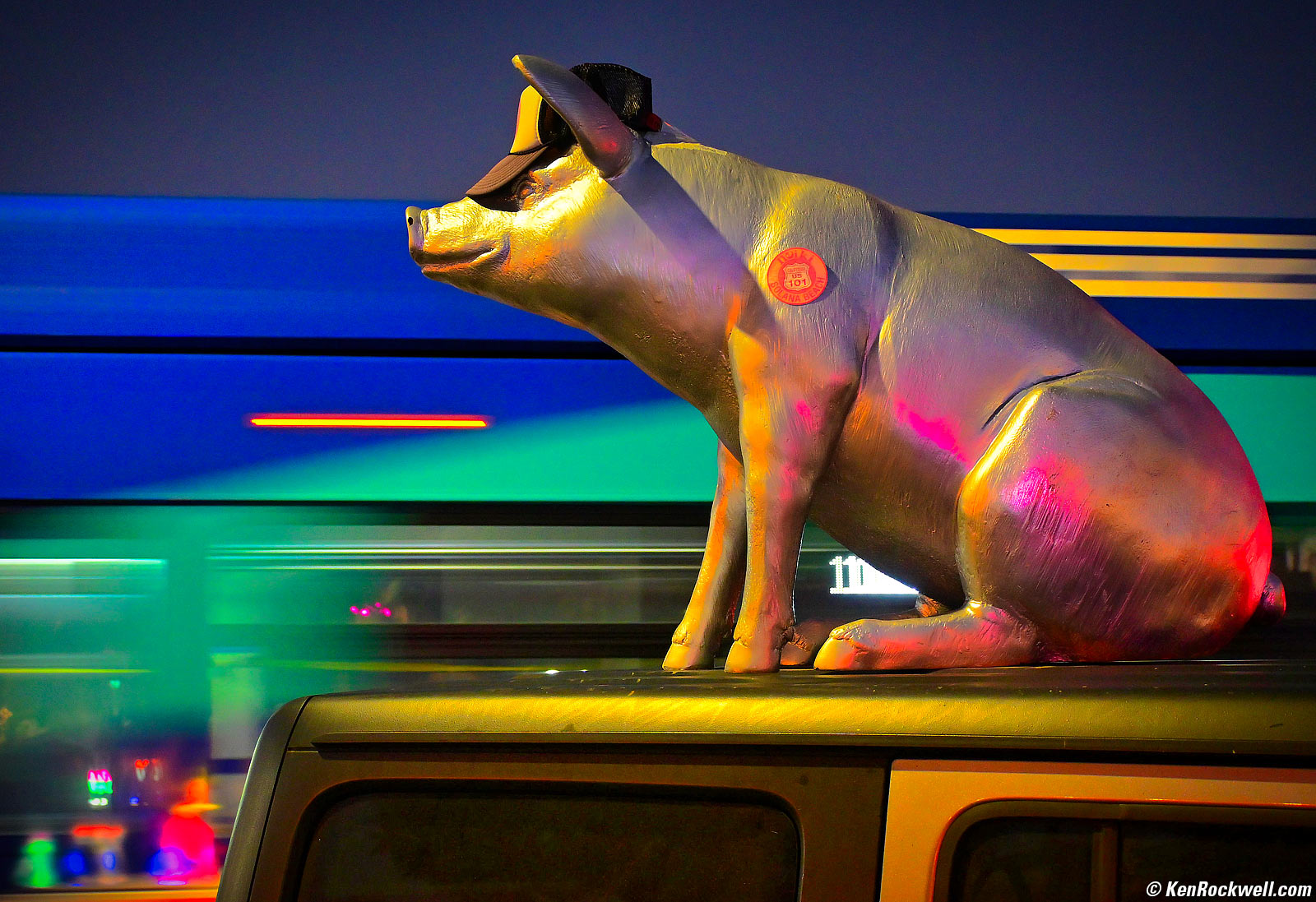
Super Pig and Passing NCTD Bus, Solana Beach, California, 5:15 P.M., Tuesday, 17 December 2024. Nikon Z50 II, Nikon Z 16-50mm DX VR at 32.5mm wide-open at f/5 hand-held at 1/13 of a second at Auto ISO 2,500 (LV 3.7), amped-up and vignetting added in Skylum Luminar Neo software. bigger.
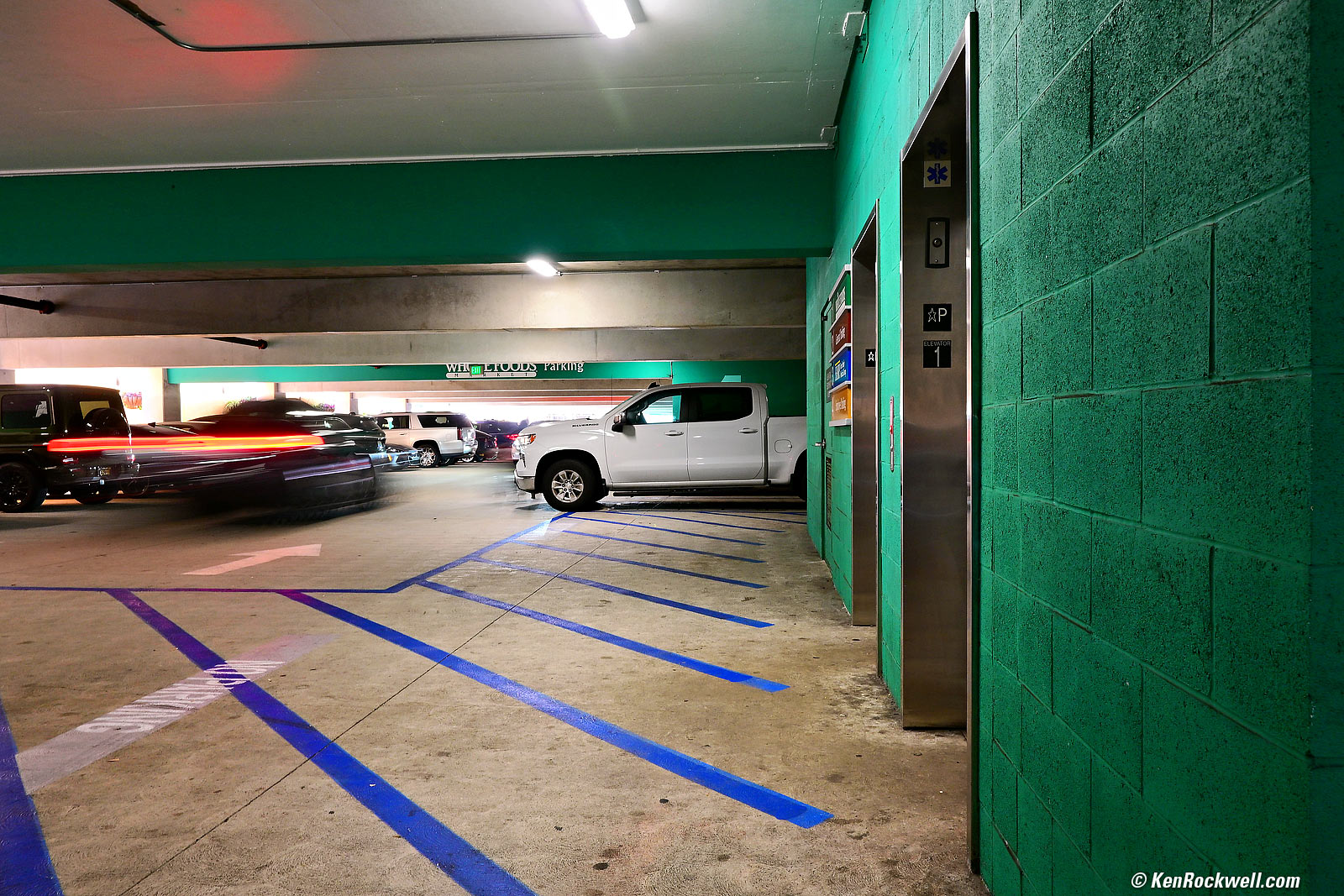
Parking Garage, Del Mar, California, 11:55 A.M., Sunday, 15 December 2024. Nikon Z50 II, Nikon Z 16-50mm DX VR at 16mm at f/11 for 1.3 seconds hand-held (braced against car window) at Auto ISO 200 (LV 5.5), Radiant Photo software. bigger.

Shore Club, Pacific Beach, California, 3:38 P.M., Saturday, 14 December 2024. Nikon Z50 II, Nikon Z 16-50mm DX VR at 22mm at f/10 at 1/320 at Auto ISO 100 (LV 15.0), Radiant Photo software. bigger or camera-original 21 MP © 2.7 MB JPG BASIC file.

Quiet Sunset with Curious Contrail, Solana, Beach, California, 4:45 P.M., Tuesday, 17 December 2024. Nikon Z50 II, Nikon Z 16-50mm DX VR at 16mm at f/6.3 at 1/160 at Auto ISO 100 (LV 12.6), exactly as shot except cropped from a horizontal shot. bigger or camera-original 21 MP © 1.4 MB JPG BASIC file.

Beautiful Solana Beach, California, 5:06 P.M., Tuesday, 17 December 2024. Nikon Z50 II, Nikon Z 16-50mm DX VR at 16mm wide-open at f/3.5 hand-held at 1/6 of a second at Auto ISO 220 (LV 5.1), Radiant Photo software and then quite a lot of fiddling with Hue and Curves Adjustment Layers and Masks in Photoshop CC to get the colors correct from the magnificent but faded mural. bigger.
The only thing in focus are her eyes, but the DX format's short lenses (16mm in this case) render everything else sharp enough. Funny thing is I'd never noticed this awesome mural before, and it wasn't until I got to editing this shot that I noticed she's flashing a shaka! Awesome!

Fishermen at Sunset, Cardiff Seaside Reef Tide Pools, Encinitas, California, 4:30 P.M., Tuesday, 17 December 2024. Square crop from Nikon Z50 II, Nikon Z 16-50mm DX VR at 50mm at f/11 at 1/500 at Auto ISO 100 (LV 15.9), Skylum Luminar Neo software. bigger or camera-original 21 MP © 1.8 MB JPG BASIC file.

Introduction top
Sample Images Intro New Good Bad Missing
Lenses & Compatibility Specs USA Version
Accessories Performance Compared
User's Guide Recommendations More

I buy only from these approved sources. I can't vouch for ads below. |



The Z50 II is a great little camera. I greatly prefer its controls and ergonomics to Nikon's bigger and more expensive Z9, Z8, Z7 II and Z6 III cameras because the Z50 II has a real, dedicated MODE dial sorely missing on the others. The Z9, Z8, Z7 II and Z6 III instead have a foolish mode button which has to be held while you spin another dial and have to look at a screen to set — while with the Z50 II we can switch modes with a click or two of the MODE dial. Done!
The Z50 II is small and light and takes great pictures. Full frame is mostly obsolete; this isn't 2004 anymore. Sensors today are so good that DX cameras like this take the same pictures, with more in-focus than on full-frame because the shorter focal lengths used on DX for the same angle-of-view have deeper depth of field.
Is it Nikon's best camera? Quite possibly so; the Z50 II is not only a great starter camera, it's a fantastic camera for just about any use, hobbyist or professional. For the first time in history, technology has come so far that this inexpensive "starter" camera takes photos just as good and is just as competent for sports and action and low light as any of Nikon's older "pro" cameras like the Z9, Z8, Z7 II and Z6 III were.
Stabilization works great. I consistently get great shots handheld at 1/6 of a second.
If Nikon's your thing, this is arguably one of their top cameras. Personally I prefer Canon's superior APS-C lineup of the EOS R7, R10, R50 and R100, so if you're not already stuck in the Nikon mirrorless system, I'd suggest the similarly priced EOS R10 over this little Z50 II. It's not just about the camera; it's about the lens line, domestic Japanese manufacturing and far better customer support.
The Z50 II is a miniature Z7 II or Z6 III with a smaller sensor, but the same lens mount, and adds a built-in flash and superior ergonomics. With my Z50 II I get the same fantastic image quality as I've always loved from my Nikons, with less ergonomic hassles between me and my picture than with my Z7 II or Z6 III. The Z50 II is even more similar to the Z5 full-frame camera, with the same mode dial I prefer over the pricier Nikons.
Everything works faster and easier than on my Z7 II or Z6 III. Autofocus is super fast, and nothing gets in my way. The Z50 II and its line of DX lenses are significantly smaller and lighter than their full frame equivalents.
The finder is superb; the original Z50's finder was excellent and this one gets even brighter.
Look at the Sample Images; I snapped these with my original Z50 five years ago as I ran errands and am astonished at just how great they look; great colors and tones right out of the Z50 with no twiddling needed.
More great news is that the 16-50mm and 50-250mm lenses are each superb: ultra sharp at every setting, completely devoid of distortion as shot on the Z50 II, light, compact, collapse for travel and have fantastic optical image stabilization (VR). It's about time Nikon hit another one out of the park; I'm LOVING my Z50 II system!
I ordered mine as a kit with the Z 16-50mm VR DX at B&H:
$907, Z50 II body-only at B&H, at Adorama, at Amazon and at Crutchfield.
$1,047, Z50 II kit with excellent 16-50mm lens as shown above at B&H, at Adorama, at Amazon and at Crutchfield.
$1,297, Z50 II system with both the 16-50mm and 50-250mm lenses at B&H, at Adorama, at Amazon and at Crutchfield.
$1,343, Z50 II system with the 18-140mm at B&H.
I prefer one do-everything Z 18-140mm VR DX lens rather then swapping between the 16-50mm and 50-250mm. I greatly prefer being able to zoom from wide to tele with a flick of my wrist rather than wasting time and missing pictures swapping between two lesser lenses. I much prefer not having to change lenses over having a slightly reduced range at the widest and longest ends. I'd order the lens separately along with the body, or ideally get them both with a package discount from B&H.
Get it used if you know How to Win at eBay.
New since the original Z50 intro top
This new Nikon Z50 II has many updates from the original Z 50, and the good news is it doesn't cost much more than the original Z 50, so I'd certainly get this new -II model over a new original Z 50, unless you prefer to get the get the original Z50 used if you know How to Win at eBay.
This Z50 II has the same image sensor, autofocus system, finder, eyepiece and LCD as the original Z 50. Good news is that even though this new Z50 II isn't much different from the original Z 50, it does add some better buttons and controls and doesn't cost much more, and the original Z 50 was an awesome little camera (I prefer it to the Z7 II and Z6 III for its superior ergonomics), so all good news!
Oddly this little guy is Nikon's top APS-C mirrorless camera. The Zf c is simply the original Z 50 with different cosmetics, and the old Z30 is a toy without a viewfinder.
 30 FPS with electronic shutter (up from 11 FPS with the mechanical shutter), but it has many restrictions on settings at these speeds.
USB-C rather than Micro USB data and charging.
USB charging is now twice as fast, 1 hr 40 mins versus 3.5 hours. The Z50 II draws 10 W versus the old Z50 drawing 2.4 W over micro-USB.
The MH-32 external battery charger is no longer included.
Improved autofocus. Now the Auto-Area AF setting tends to focus on a closer object once that object gets in front of a background. (The old Z50 would often keep focussing on the background, even when your subject was right in front of the camera and obvious!)
A new U3 setting replaces the EFCT setting on the mode dial, another big improvement for experienced shooters, giving us three U settings, up from two.
The three (+), (-), and DISP touch controls on the right of the rear LCD of the old Z50 are now real buttons. Hallelujah! Those were the worst things about the old Z50, and are now as they should be.
The Advance Mode and TRASH buttons are now on the left side, requiring a second had to use them. Boo!
Precapture.
1,000 cd/m2 (nits) finder brightness, up from maybe 600 cd/m2 in the original Z50.
Dedicated Picture Control button (DSLRs like the D850 have also had this).
Skin softening option.
While Nikon claims 1/250 sync, up from 1/200, my Z50 II only goes up to 1/200 with flash.
4K/59.94 video, up from 4K/29.97; no big deal, Hollywood shoots everything at 23.976 or 24.00 FPS, not 30 and certainly not 60.
Longest video take length now 125 minutes, up from 30.
Manual shutter speeds out to 15 minutes, up from 32 seconds.
Ø 3.5mm headphone jack (this and the original Z50 both have 3.5mm mic inputs).
USB-C connector replaces Micro-B.
Greatly improved LCD flipping mechanism.
Works with UHS-II SD cards, up from UHS-I.
Bluetooth 5.0, up from 4.2. So?
New 1,250 mAh EN-EL25a replaces the 1,120 mAh EN-EL25 Lithium-ion rechargeable battery of the original Z50.
19.4 oz (550g) with battery and card, up from 15.7 oz. (446g).
Slightly taller and deeper (same width).
The "blue playback banding" common in the original Z50 is largely fixed.
No more "Night Vision" video mode of the old Z50 that automatically went from ISO 100 to as high as ISO H+4, which might be about ISO 409,600.
The Self Timer no longer resets to Single advance mode after sleep or power off. It always wake up in Self Timer until you set it back to something else.
Good intro top
 Great ergonomics, a joy to shoot. Everything works as it should. MENU and PLAY buttons are both on the right side for one-handed shooting.
Same unmatched spectacular image quality we've taken for granted in Nikon digital since 2007. Colors, highlights and shadows look awesome. As an artist whose work has explored color for many, many decades, no other brand of camera gives me better images right out of the camera than my Nikons. Sony and Fuji are inferior, and Canon is just as good, just different.
Extremely accurate exposures; I never had to use any exposure compensation Bravo!
Has a built-in flash sorely lacking in most cameras:

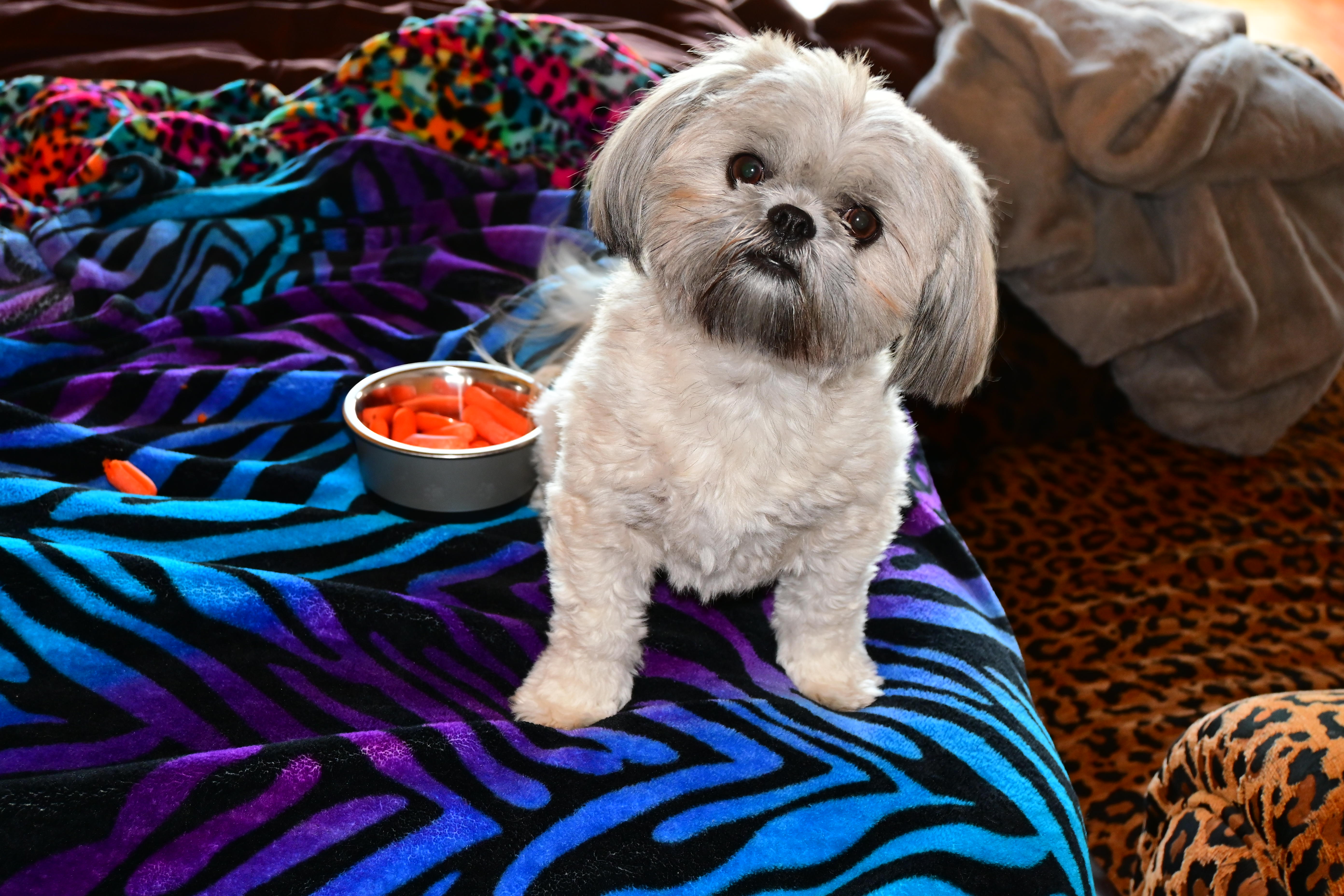
Zoey and Her Carrots, 7:19 AM, 30 November 2019. Cropped from Nikon Z50, Nikon SB-400 flash, Nikon Z 16-50mm DX VR at 35mm wide-open at f/5.3 hand-held at 1/15 of a second at Auto ISO 640 (LV 6.0), Perfectly Clear. bigger, full resolution 20MP file or camera-original © JPG file.
I love how the Z50 balances flash perfectly for fill-flash. If I hadn't used flash, Zoey would have been nothing but a shadow as the only other source of light was a window behind Zoey — and I love the color rendition!
The built-in flash should have done the same thing; I just happened to have my tiny SB-400 on top of my Z50.
Smaller, lighter and less expensive than Nikon's full-frame cameras — and takes the same pictures!
Silent electronic shutter.
Smart playback rotates with the camera, like an iPhone (something Canons can't do).
Can save and recall all the settings to and from a card.
Square and 16:9 as-shot crops.
Video tally (front recording) light.
UVC/UAC video streaming.
Electronic video stabilization.
Lots of direct and programmable controls and dials.
Charges over USB or with optional MH-32 external battery charger.
Low, competitive price.
Bad intro top
 Offshored to Thailand; not made domestically in Japan.
Always puts a bogus mystery "NC_FLLST.DAT" file in each DCIM picture folder.
Missing intro top
 No sensor cleaner.
No battery percentage indication, just a three-segment battery bar icon.
While autofocus and auto exposure track great in any of the continuous shutter modes, Auto White Balance locks and does not adjust as you may track from one sort of lighting to another. It resets with each burst.
No pulled ISOs; ISO 100 is the slowest.
No search ability in menu system.
No "quality" based ★ JPG compression settings; just BASIC, NORMAL and FINE.
While smart playback rotate works great after you press the PLAY button, oddly it doesn't work during "image review" right after shooting.
The MH-32 external battery charger is no longer included. So?
No marked focus mode switch (AF-S / AF-C / MF); instead you program an Fn button to do this. This is better than Nikon's older AF mode switches because the Fn buttons are easy to reach right next to the lens and they press straight into the camera; the old-style buttons were on the bottom of the lens and had to be pressed sideways!
No automatic brightness control for rear LCD, something every iPhone has (has auto brightness control only for finder).
While the OLED electronic viewfinder screen has a 4:3 aspect ratio so data can fit above and below the 3:2 aspect-ratio camera image, oddly a zoomed image never fills the screen — even if there is no data above or below.
No 4:3 "Ideal Format" crop.
No in-camera sensor-shift Image Stabilization, but almost all Nikon's Z DX lenses have extraordinary optical stabilization built-in — which works better than in-camera stabilization.
No GPS — use an app to add that.
No NFC. So?

Nikon Z50 II and Z 16-50mm VR DX. bigger.

Capri by the Sea, Pacific Beach, California, 3:27 P.M., Saturday, 14 December 2024. Nikon Z50 II, Nikon Z 16-50mm DX VR at 16mm at f/8 at 1/250 at Auto ISO 100 (LV 14.0), Radiant Photo software, perspective correction in Photoshop CC. bigger or camera-original 21 MP © 2.6 MB JPG BASIC file.
Lenses & Compatibility top
Sample Images Intro New Good Bad Missing
Lenses & Compatibility Specs USA Version
Accessories Performance Compared
User's Guide Recommendations More
I ordered mine as a kit with the Z 16-50mm VR DX at B&H:
$907, Z50 II body-only at B&H, at Adorama, at Amazon and at Crutchfield.
$1,047, Z50 II kit with excellent 16-50mm lens as shown above at B&H, at Adorama, at Amazon and at Crutchfield.
$1,297, Z50 II system with both the 16-50mm and 50-250mm lenses at B&H, at Adorama, at Amazon and at Crutchfield.
$1,343, Z50 II system with the 18-140mm at B&H.
I prefer one do-everything Z 18-140mm VR DX lens rather then swapping between the 16-50mm and 50-250mm. I greatly prefer being able to zoom from wide to tele with a flick of my wrist rather than wasting time and missing pictures swapping between two lesser lenses. I much prefer not having to change lenses over having a slightly reduced range at the widest and longest ends. I'd order the lens separately along with the body, or ideally get them both with a package discount from B&H.
Get it used if you know How to Win at eBay.
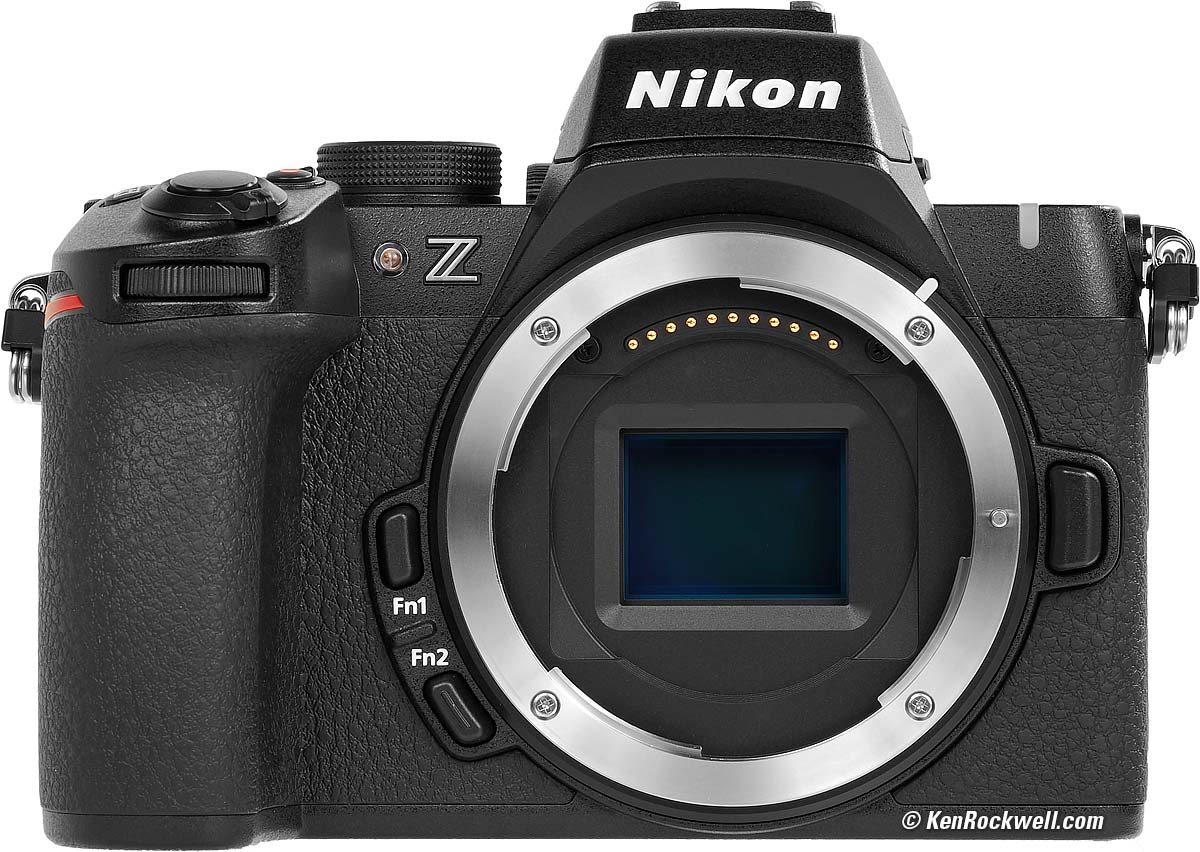
Nikon Z50 II. bigger.
The Z50 II works with all Nikon Z-Mount Lenses, both full-frame and DX.
It uses the same oversized mount as Nikon's full-frame cameras, so every Z lens works great.
The FTZ/II adapter lets us use Nikon's F-Mount lenses, made since 1959, with varying degrees of success; many lenses will not autofocus on this adapter.
The DX 16-50 VR and DX 50-250mm VR are superb and all you need for anything. Grab the Z 12-28mm VR DX if you need an ultrawide and the Z 180-600mm VR if you need an ultra-tele and you're done.
Ideally I prefer the Z 18-140mm VR DX over the DX 16-50 VR and DX 50-250mm VR combo. I don't miss the 140-250mm range and love not having to swap lenses to get from wide to tele. When you have to swap between the DX 16-50 VR and DX 50-250mm VR you miss a lot of pictures.
The Fringer EF-NZ Adapter adapts Canon EF lenses with often better results on my Nikon Z cameras than Nikon's own lenses give on the crappy FTZ adapter! It also works with other brands of lenses in Canon EF mount, adapting them to Nikon Z.
Stick with Nikon's Z-Mount Lenses for the best results.
Specifications top
Sample Images Intro New Good Bad Missing
Lenses & Compatibility Specs USA Version
Accessories Performance Compared
User's Guide Recommendations More
I ordered mine as a kit with the Z 16-50mm VR DX at B&H:
$907, Z50 II body-only at B&H, at Adorama, at Amazon and at Crutchfield.
$1,047, Z50 II kit with excellent 16-50mm lens as shown above at B&H, at Adorama, at Amazon and at Crutchfield.
$1,297, Z50 II system with both the 16-50mm and 50-250mm lenses at B&H, at Adorama, at Amazon and at Crutchfield.
$1,343, Z50 II system with the 18-140mm at B&H.
I prefer one do-everything Z 18-140mm VR DX lens rather then swapping between the 16-50mm and 50-250mm. I greatly prefer being able to zoom from wide to tele with a flick of my wrist rather than wasting time and missing pictures swapping between two lesser lenses. I much prefer not having to change lenses over having a slightly reduced range at the widest and longest ends. I'd order the lens separately along with the body, or ideally get them both with a package discount from B&H.
Get it used if you know How to Win at eBay.
Image Sensor

Nikon Z50 II. bigger.
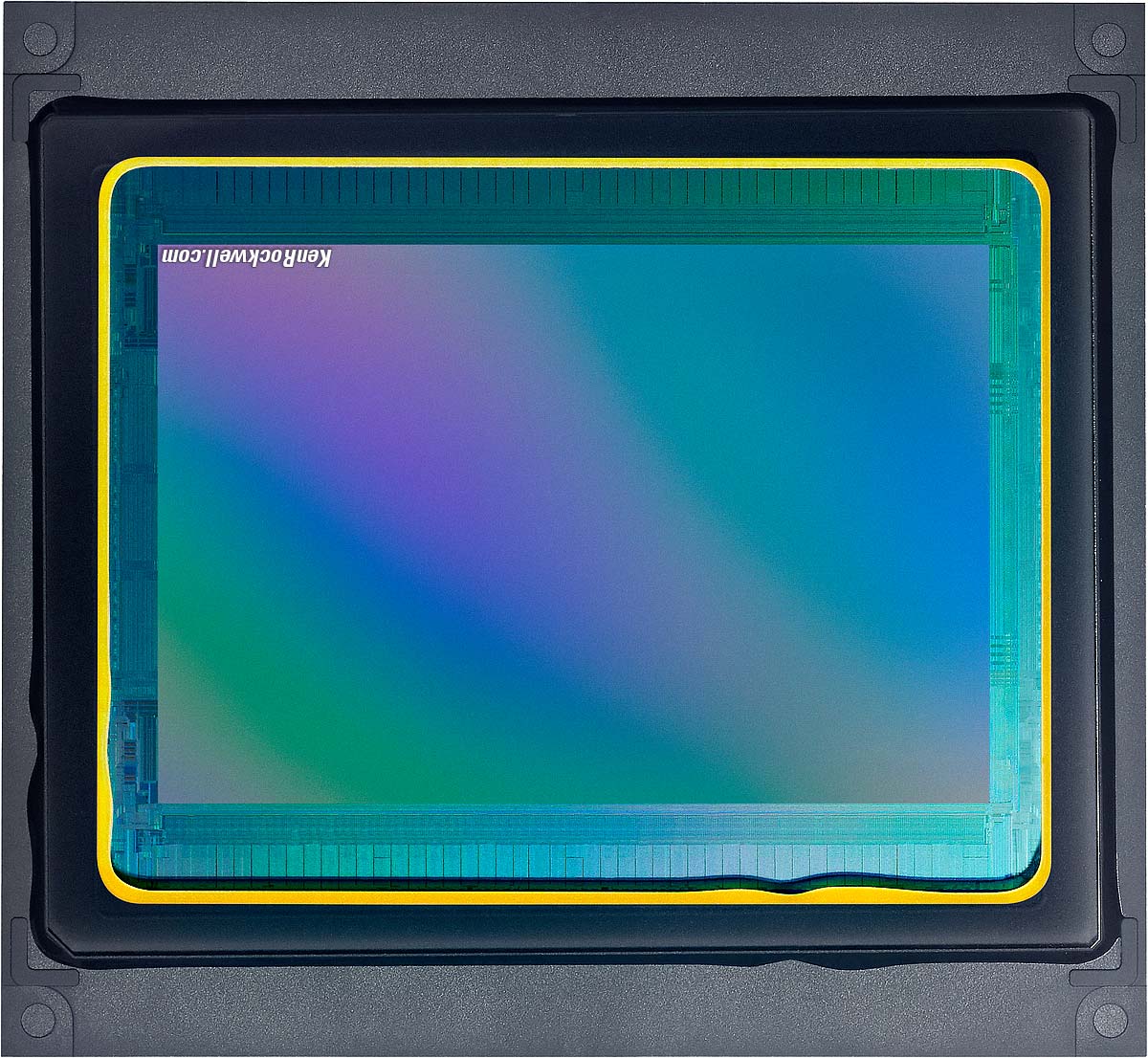
Nikon Z50 II sensor. bigger.
20.67 MP.
15.7 × 23.5 mm CMOS.
3:2 aspect ratio.
1.53 × crop factor.
No sensor cleaner.
ISO specifications top
Stills
ISO 100 ~ 51,200.
To ISO 102,400 and 204,800 in push modes.
Video
ISO 100 ~ 25,600.
Image Sizes specifications top
Full Gate (15.7 × 23.5 mm DX)
Large: 5,568 × 3,712 pixels native (20.67 MP).
Medium: 4,176 × 2,784 (11.6 MP).
Small: 2,784 × 1856 (5.2 MP).
Square Crop (1:1 or 15.7 × 15.7mm)
Large: 3,712 × 3,712 pixels native (13.8 MP).
Medium: 2,712 × 2,784 (7.8 MP).
Small: 1,856 × 1,856 (3.4 MP).
16:9 Crop (13.2 × 23.5mm)
Large: 5,568 × 3,128 pixels native (17.4 MP).
Medium: 4,176 × 2,344 (9.8 MP).
Small: 2,784 × 1,560 (4.3 MP).
Still Formats specifications top
JPG and/or raw.
12- or 14-bit raw.
sRGB and Adobe RGB.
Video specifications top
Electronic stabilization.
Time lapse 4K and 1,080p.
Longest Take
2 hours (125 minutes).
File Formats
.MOV or .MP4 files holding H.264/MPEG-4 Advanced Video Coding video and LPCM or AAC-coded audio data.
Frame Sizes and Rates
4K (3,840 × 2,160) at 59.94p, 50p, 29.97p, 25p or 23.976p.
1,920 × 1,080 at 119.88p, 100p, 59.94p, 50p, 29.97p, 25p or 23.976p.
1,920 × 1,080 (slow-motion) shot at 119.88b and presented at 29.97p (1/4×), shot at 100p and presented at 25p (1.4×) or shot at 119.88p and presented at 23.976p (1/5×).
Audio specifications top
Recorded only along with video.
S - t - e - r - e - O microphone built in.
3.5mm mic-in jack with plug-in power overrides built-in mic.
3.5mm headphone jack.
Autofocus specifications top
209 points(manual selection) or 231 points (auto selection).
Phase- and contrast-detection.
-9 ~ +19 LV range (lens unspecified).
Light Meter specifications top
Matrix, Average, Center-Weighted, Spot and Highlight-weighted.
Oddly no mention of Color or 3D Matrix metering; I don't know if Nikon dumbed-down the meter but I doubt it.
-4 ~ +17 LV range, lens unspecified.
Finder specifications top
0.39" (9.9mm) 2,360,000-dot XGA OLED.
100% coverage.
0.68× magnification w/35mm (50mm equivalent) lens.
Auto brightness control.
Auto LCD/Finder eye-sensor switching.
-3 ~ +3 diopters.
19.5 mm eyepoint.
Shutters specifications top
Vertical Metal Focal Plane, first-curtain electronic or silent electronic shutter.
The shutter does not close with the power off.
1/4,000 ~ 900 seconds (15 minutes), BULB, TIME and X200 (flash sync). Only to 1/2,000 with electronic front-curtain.
1/250 flash sync speed claimed, but in my use I only see 1/200 maximum.
Self Timer.
Multiple Exposures (standard, average, lighten or darken modes).
Buffer Depth specifications top
51 Shots raw.
59 shots JPG.
300 shots in C15 or C30 modes.
Of course it writes very quickly to the card so your effective shooting burst depth can be limited only by your card filling.
Frame Rates specifications top
30 FPS or 15 FPS, electronic shutter with many restrictions.
Up to 11 FPS in Continuous High Extended with mechanical shutter.
5 FPS, Continuous High.
1 ~ 4 FPS in Continuous Low.
Flash specifications top
1/250 sync speed.
i-TTL system.
The built-in flash cannot be used as a master flash or remote commander to control wireless remote flashes. For this you'll need to use another flash capable of that in the Z50 II's hot shoe.
Of course in manual mode the built-in flash can trigger other flash or studio strobes optically in their manual modes. It can fire them, but can't do anything else remotely.
Auto FP high speed sync setting.
Built-In Flash
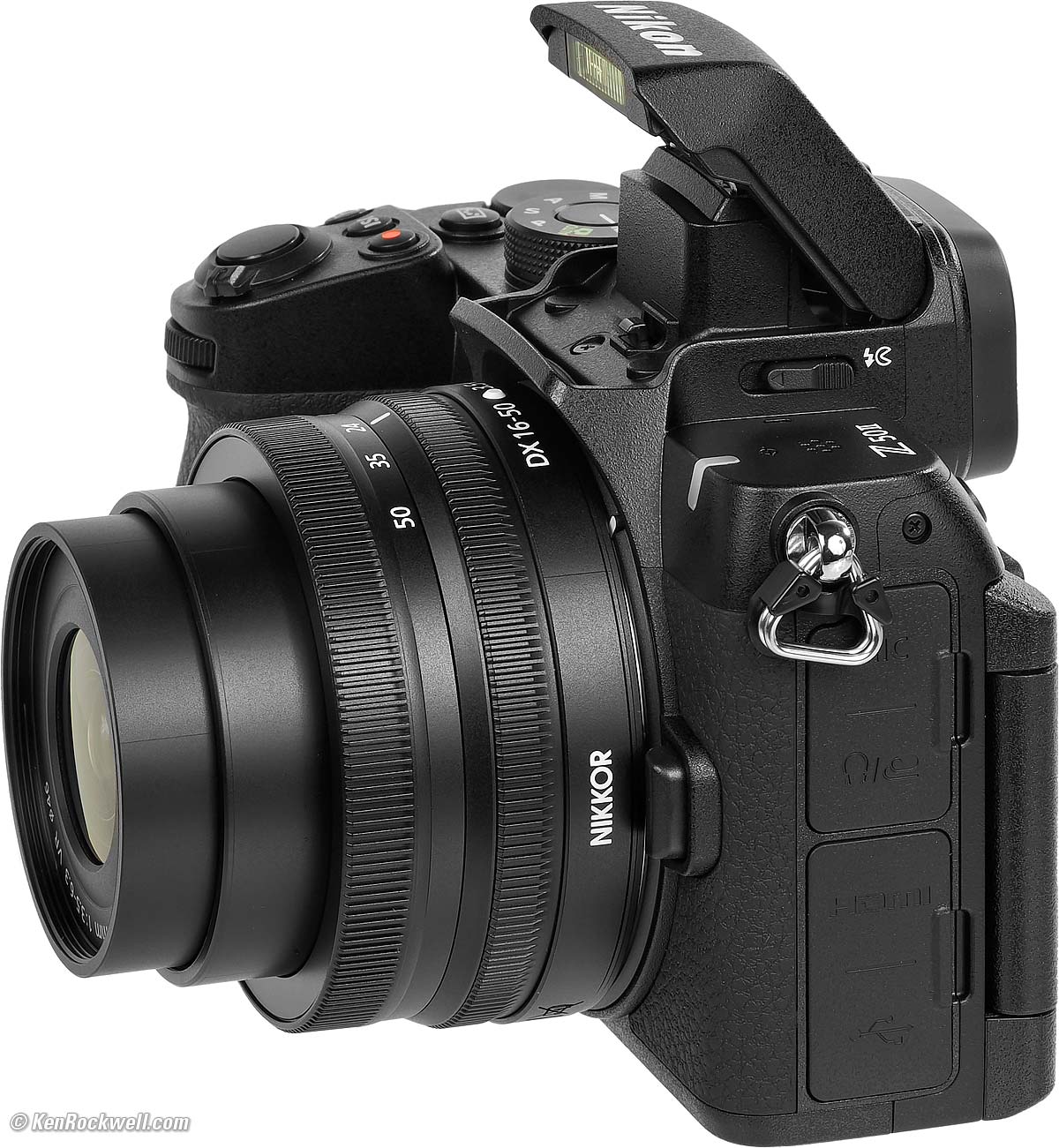
Nikon Z50 II built-in flash. bigger.
GN 22'/7m at ISO 100.
External Flash
Dedicated i-TTL ISO-518 hot shoe.
No Prontor-Compur (PC) terminal; use the built-in flash to trigger your slaves or just use a hot-shoe adapter for corded sync.
LCD Monitor specifications top
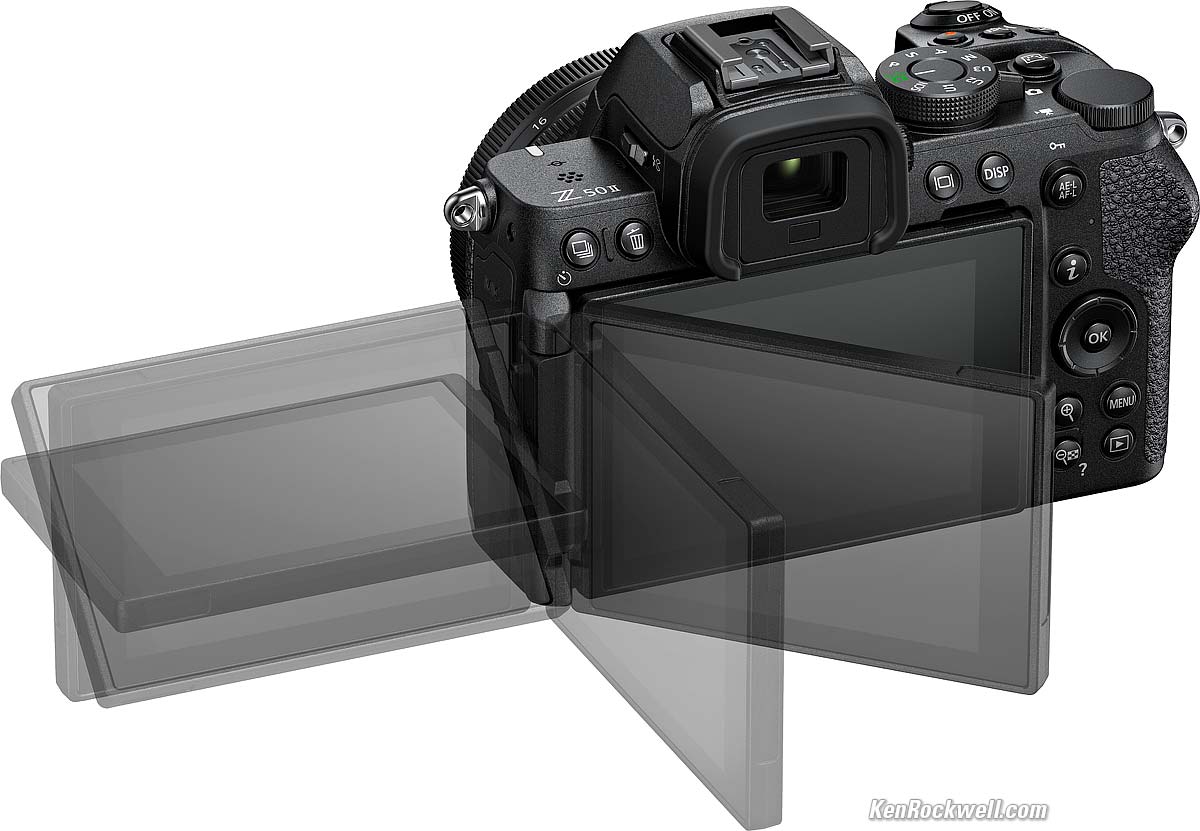
Nikon Z50 II flipping LCD. bigger.

Nikon Z50 II flipping LCD. bigger.
3.2" (80mm) diagonal.
1,040,000 dots.
No auto-brightness control (manual settings only).
Connectors specifications top

Nikon Z50 II. bigger.
3.5mm Ø mic-in with plug-in power.
3.5mm Ø headphone output.
HDMI type D.
USB-C.
WiFi specifications top
Wi-Fi 5 (802.11ac)
NFC specifications top
None.
Bluetooth specifications top
Version 5.0
GPS specifications top
None, try the app to tag locations as shot. Good luck.
Storage specifications top
One SD slot.
SD (up to 2GB), SDHC (up to 32GB) and SDXC (up to 512GB) cards.
UHS-II.
Power & Battery specifications top
Battery
New 1,250 mAh EN-EL25a battery replaces the 1,120 mAh EN-EL25 Lithium-ion rechargeable of the original Z50.
Rated 230 shots, or "up to more than 2 hours" of continuous video record (sic) time. As native English speakers know, "up to more than" means absolutely nothing!
|
|
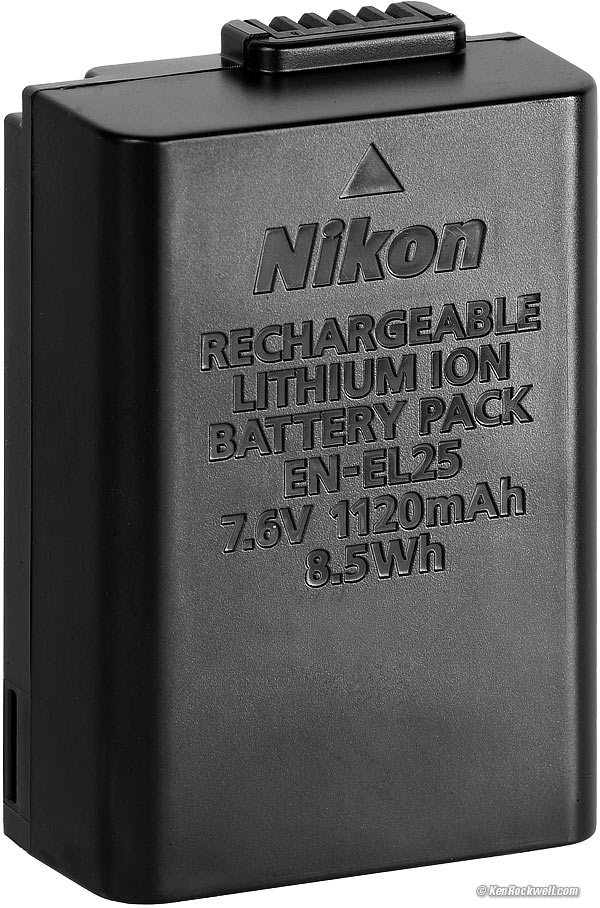
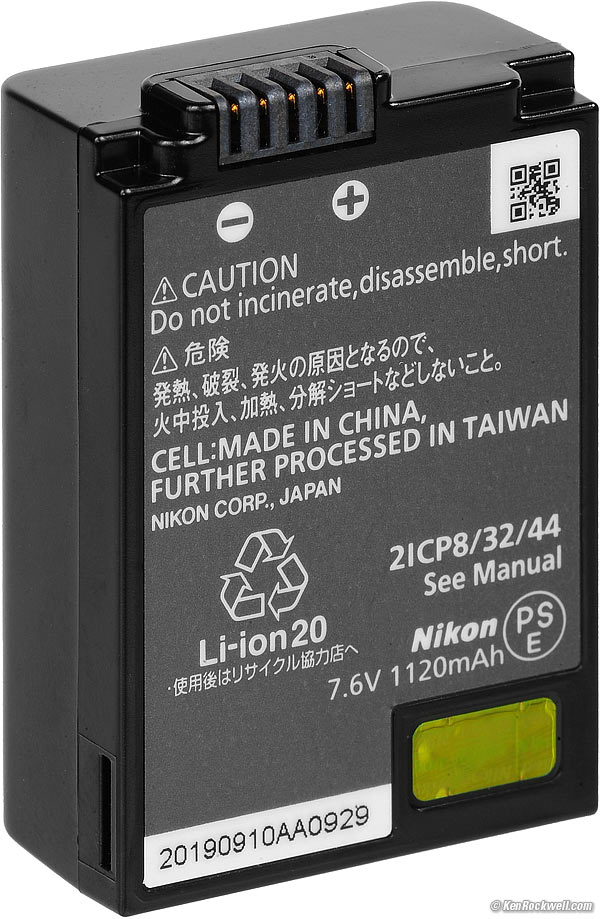
Charging
It charges with almost any USB-C cable from almost any USB-C source, power adapter, power bank or solar charger with any generic USB-C to USB-C cable.
It only charges from USB-C sources; it won't charge from a traditional rectangular USB-A socket with a USB-A to USB-C cable.
Nikon rates the full charge time via USB-C as 1 hour and 40 minutes.
You can also use the optional MH-32 plug-in external charger, but you won't need it unless you want to charge a second battery at the same time you're charging your first one in your camera via USB:
|
|
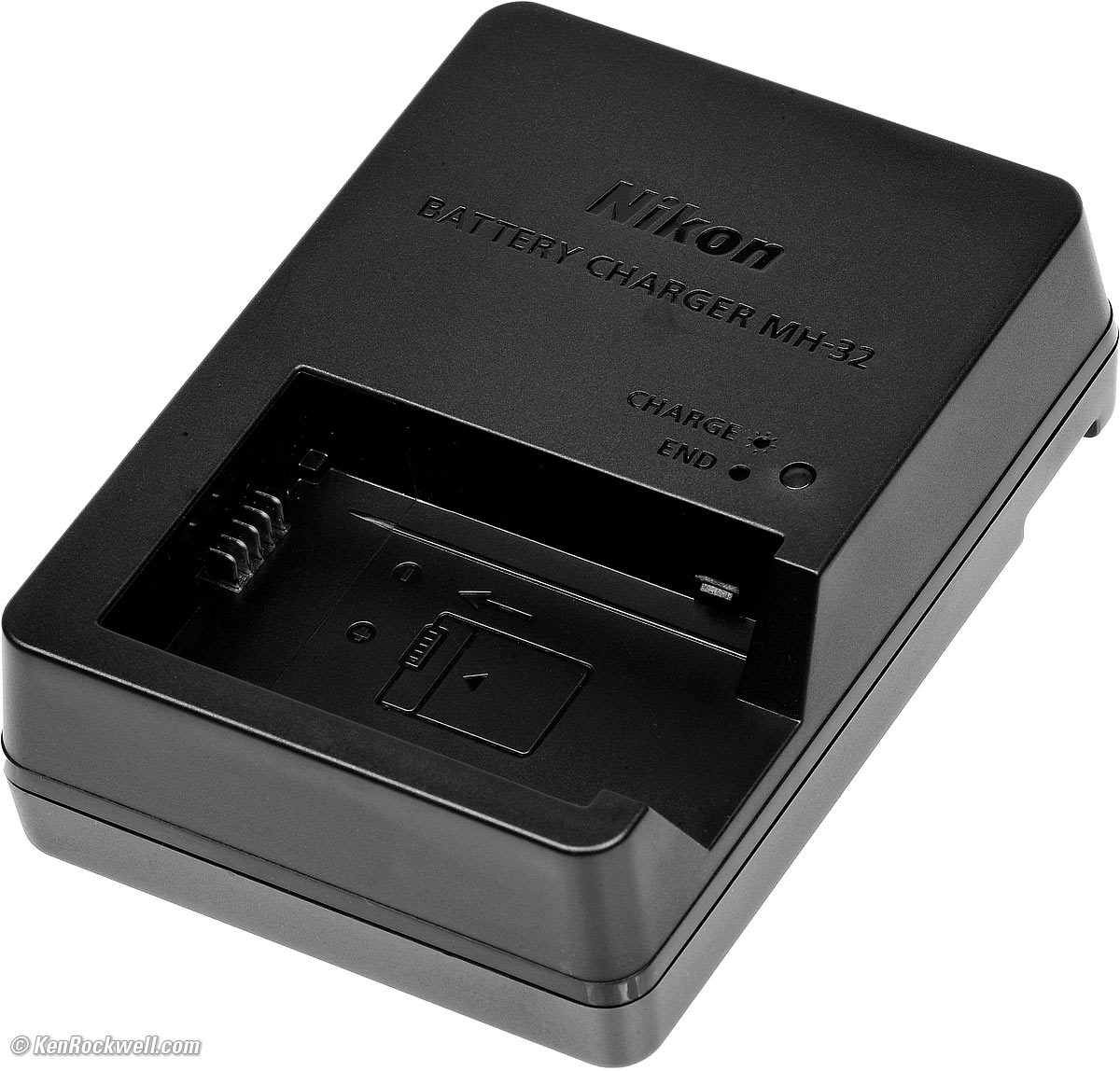
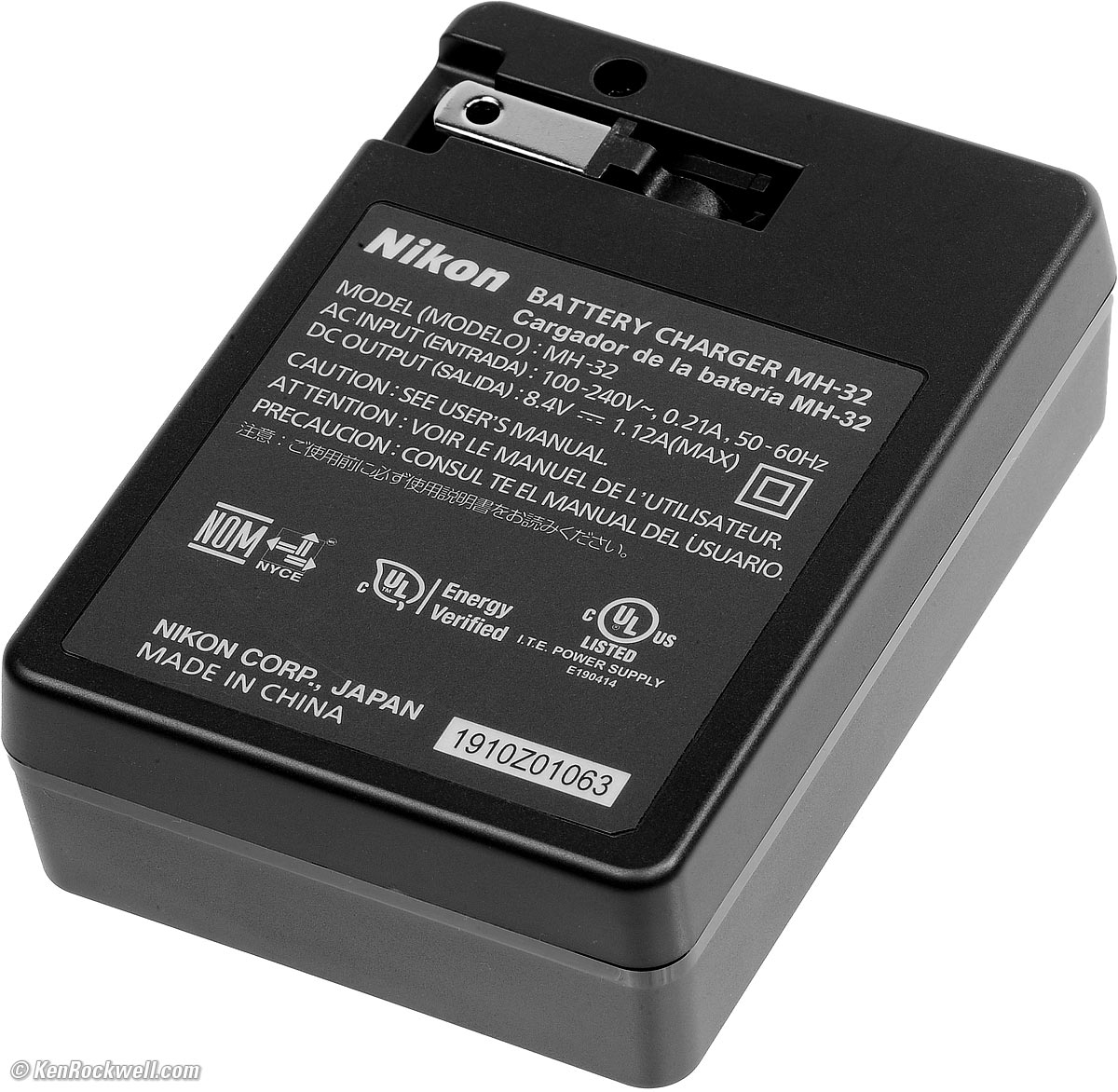






Nikon rates this charger for a full charge in 2.5 hours.
Size specifications top
3.8 × 5 × 2.6 inches HWD.
96.8 × 127 × 66.5 millimeters HWD.
Weight specifications top
19.4 oz (550g) with battery and card.
17.4 oz. (495g) naked.
Quality specifications top
Made in Thailand:
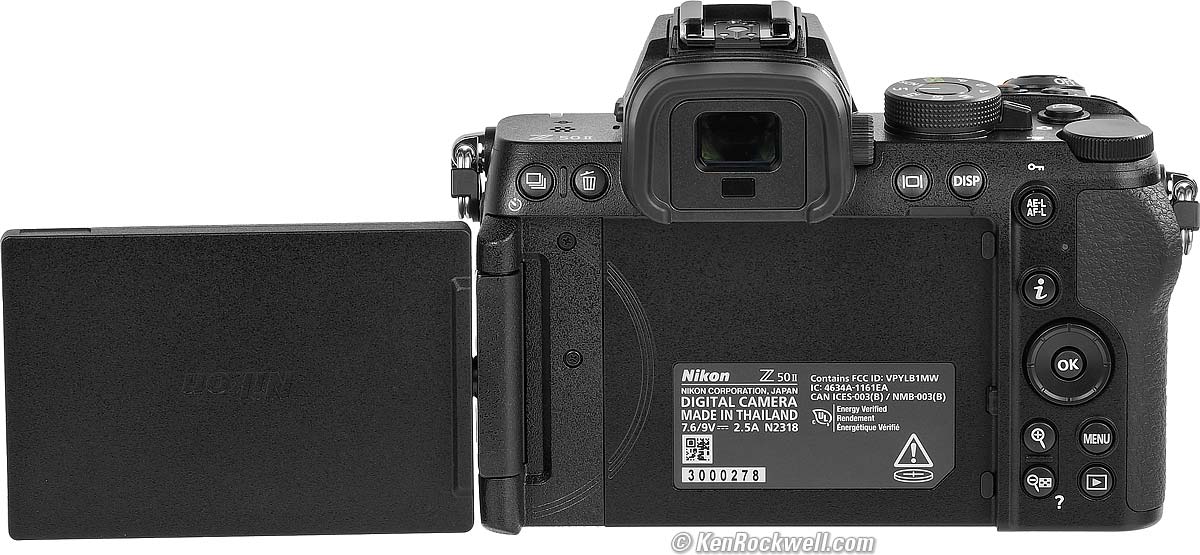
Nikon Z50 II. bigger.
Environment specifications top
Operating
0º ~ 40º C (32º ~ 104º F).
0% to 85% RH, no condensation.
Included specifications top
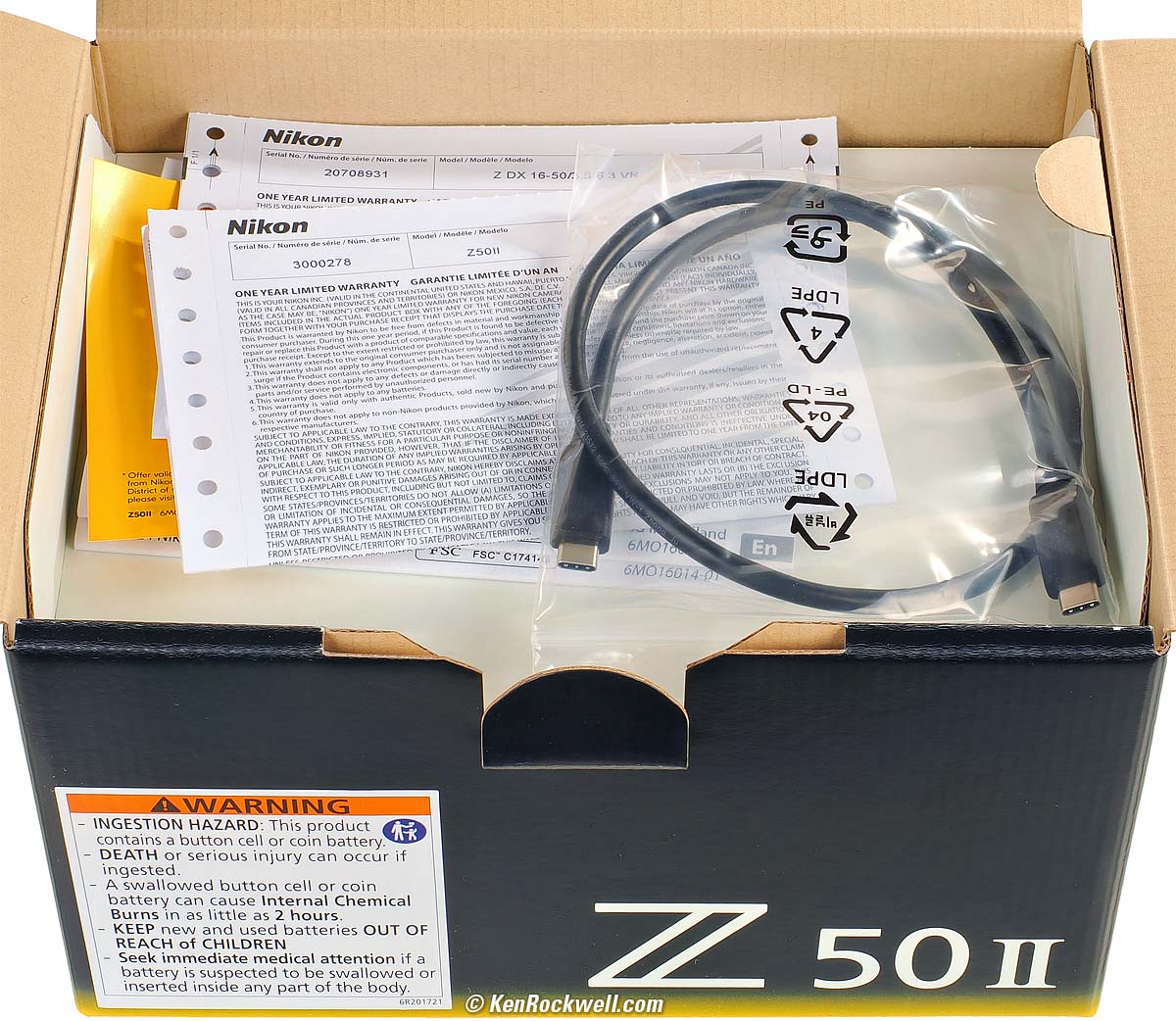
USA Warranty Cards and USB-C Cable. bigger.
Z50 II camera.
Two short instruction sheets (Nikon's complete Z50 II User's Manual is online):
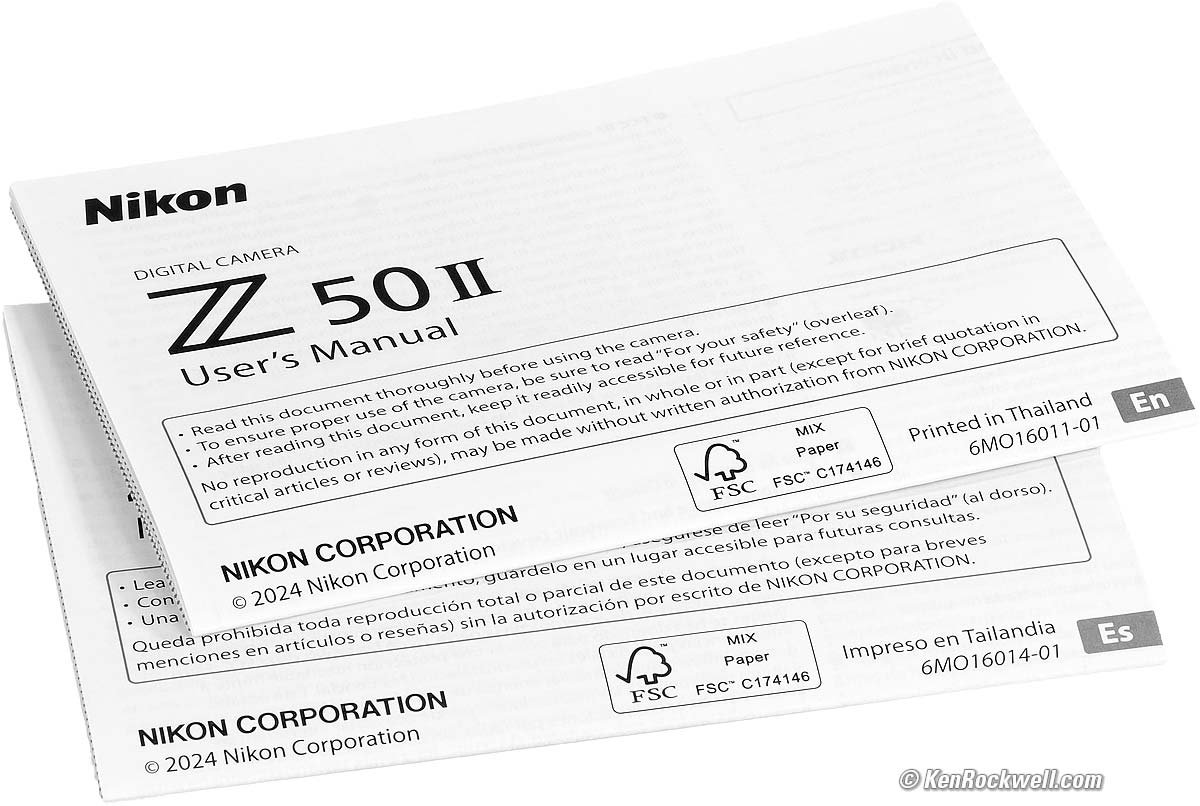
Two basic instruction sheets included: one big sheet for English and another for Spanish. bigger.
Announced specifications top
Just after midnight, Thursday, 07 November 2024, NYC time.
Promised for specifications top
Late November, 2024.
Price, U. S. A. specifications top
25 July 2025
$907, Z50 II body-only at B&H, at Adorama, at Amazon and at Crutchfield.
Oddly even after 8 months I can't see any having sold used at eBay.
$1,047, Z50 II kit with excellent 16-50mm lens as shown above at B&H, at Adorama, at Amazon and at Crutchfield.
$1,297, Z50 II system with both the 16-50mm and 50-250mm lenses at B&H, at Adorama, at Amazon and at Crutchfield.
$1,583, Z50 II system with the 18-140mm at B&H.
24 January 2025 (Amazon now has it)
$907, Z50 II body-only at B&H, at Adorama, at Amazon and at Crutchfield.
$1,047, Z50 II kit with excellent 16-50mm lens as shown above at B&H, at Adorama, at Amazon and at Crutchfield.
$1,297, Z50 II system with both the 16-50mm and 50-250mm lenses at B&H, at Adorama, at Amazon and at Crutchfield.
$1,343, Z50 II system with the 18-140mm at B&H.
About the same price used if you know How to Win at eBay; very few have sold so far used as it's a new model.
17 December 2024
$907, Z50 II body-only at B&H, at Adorama and at Crutchfield.
$1,047, Z50 II kit with excellent 16-50mm lens as shown above at B&H, at Adorama and at Crutchfield.
$1,297, Z50 II system with both the 16-50mm and 50-250mm lenses at B&H, at Adorama and at Crutchfield.
22 November 2024 (Crutchfield adds it)
$907, Z50 II body-only at B&H, at Adorama and at Crutchfield.
$1,047, Z50 II kit with excellent 16-50mm lens as shown above at B&H, at Adorama and at Crutchfield.
$1,297, Z50 II system with both the 16-50mm and 50-250mm lenses at B&H, at Adorama and at Crutchfield.
07 November 2024 (Introduction day)
$907, Z50 II body-only at B&H and at Adorama.
$1,047, Z50 II kit with excellent 16-50mm lens as shown above at B&H and at Adorama.
$1,297, Z50 II system with both the 16-50mm and 50-250mm lenses at B&H and at Adorama.
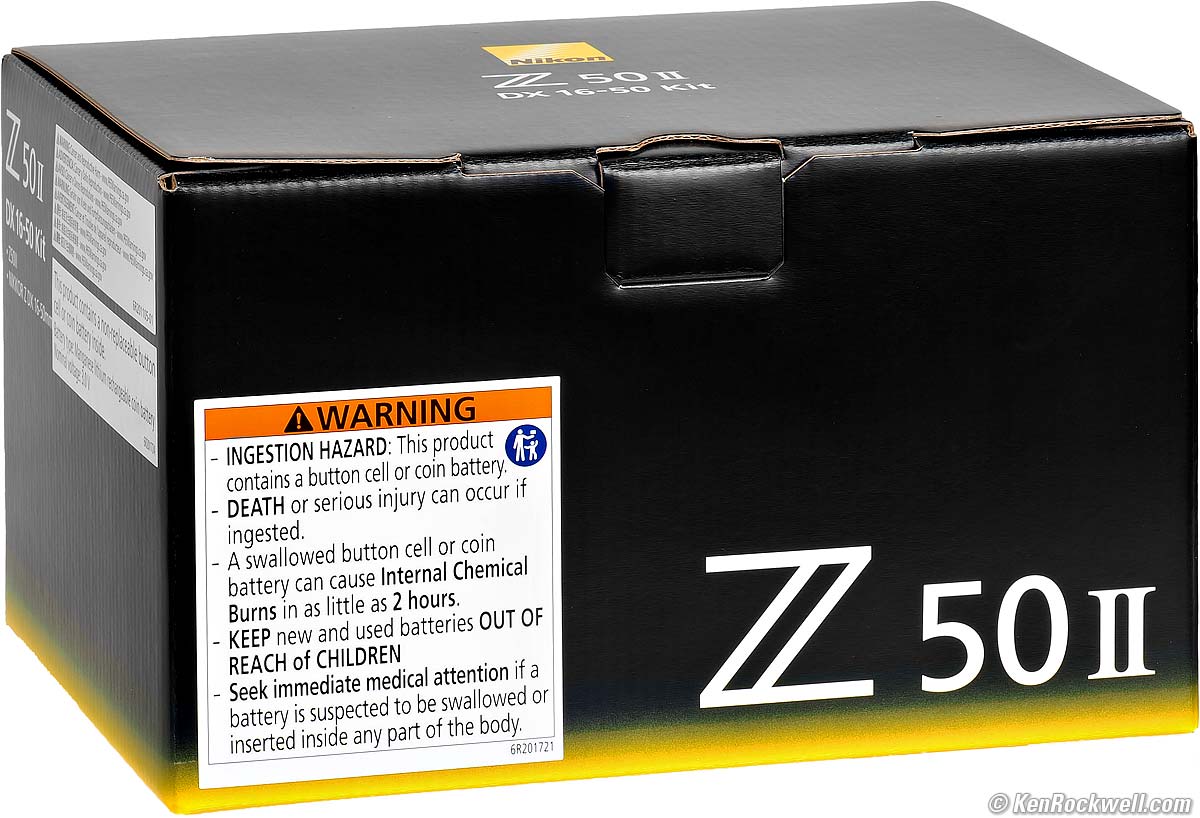
Box. bigger.
Getting a Legal U. S. A. Version top
Sample Images Intro New Good Bad Missing
Lenses & Compatibility Specs USA Version
Accessories Performance Compared
User's Guide Recommendations More
I ordered mine as a kit with the Z 16-50mm VR DX at B&H:
$907, Z50 II body-only at B&H, at Adorama, at Amazon and at Crutchfield.
$1,047, Z50 II kit with excellent 16-50mm lens as shown above at B&H, at Adorama, at Amazon and at Crutchfield.
$1,297, Z50 II system with both the 16-50mm and 50-250mm lenses at B&H, at Adorama, at Amazon and at Crutchfield.
$1,343, Z50 II system with the 18-140mm at B&H.
I prefer one do-everything Z 18-140mm VR DX lens rather then swapping between the 16-50mm and 50-250mm. I greatly prefer being able to zoom from wide to tele with a flick of my wrist rather than wasting time and missing pictures swapping between two lesser lenses. I much prefer not having to change lenses over having a slightly reduced range at the widest and longest ends. I'd order the lens separately along with the body, or ideally get them both with a package discount from B&H.
Get it used if you know How to Win at eBay.
This section applies in the U. S. A. only.
Your box should have "US" on the UPC sticker by the model number (BK means black):
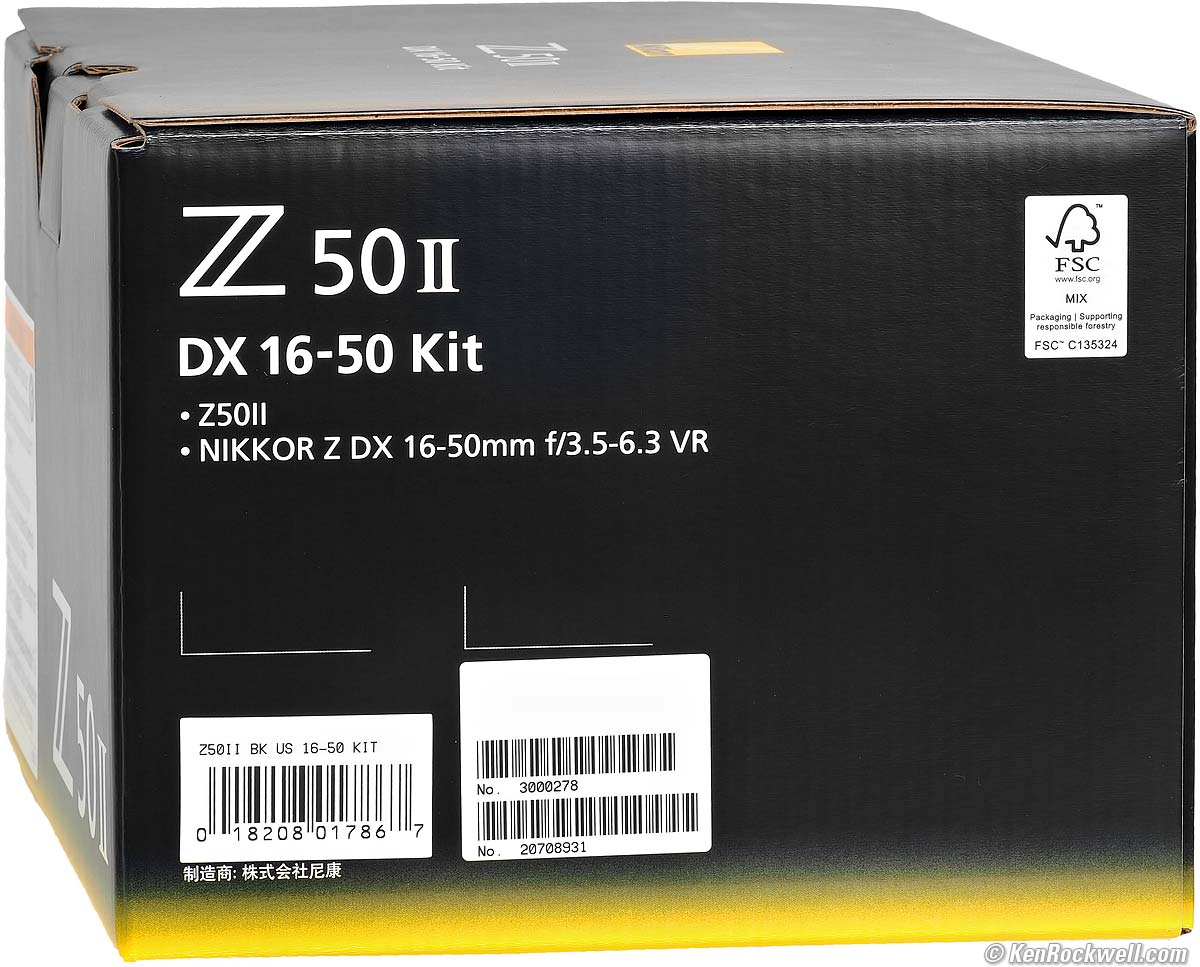
Box End. bigger.
Most importantly you need a USA Warranty Card, and the serial number must match the one on the back of your camera (and another card with a serial number that matches your lens/s if you got a kit), otherwise you have no warranty.
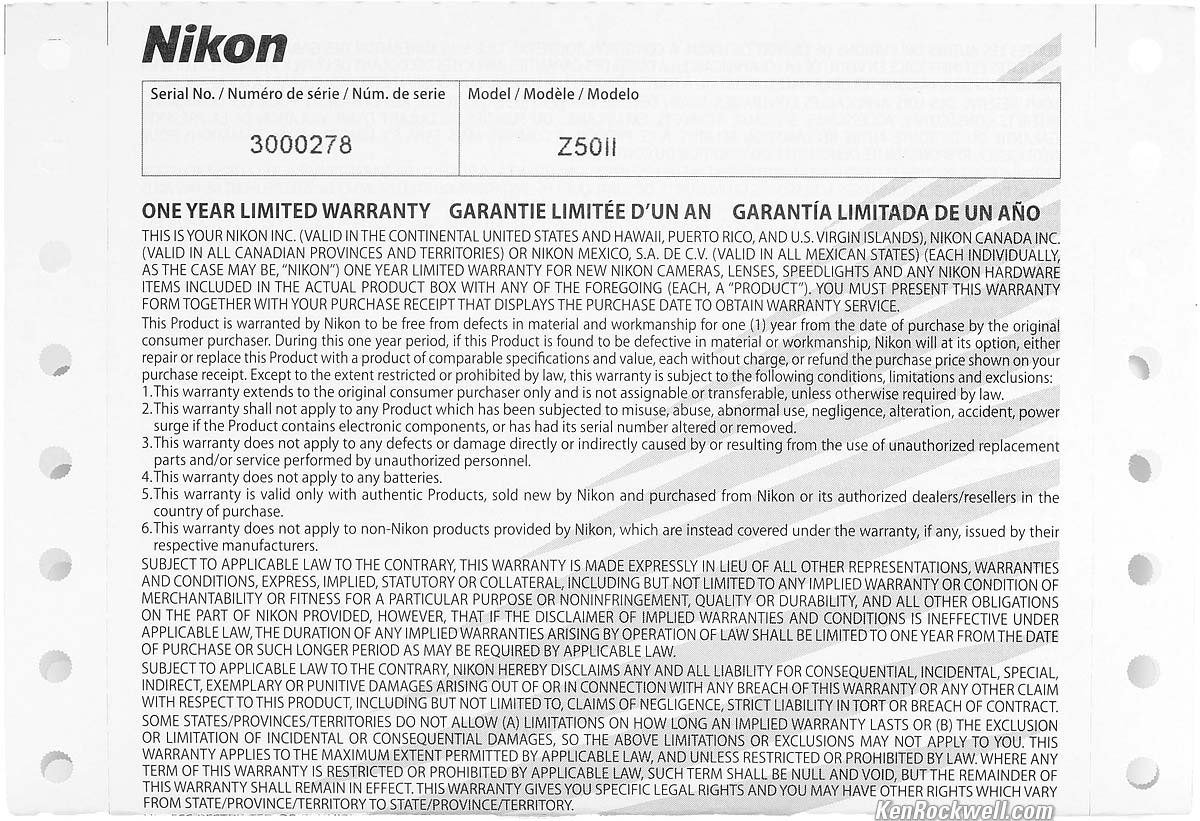
U. S. A. Warranty Card. bigger.
If you don't have this card, if the card doesn't say "VALID IN THE CONTINENTAL UNITED STATES" or the serial number on the card doesn't match the one on your camera or lens/s exactly, you got ripped off with a gray market version from another country. All legitimate cameras and lenses come with printed warranty cards, even if you prefer to register online. (The serial number on the outside of the box doesn't have to match, but if it doesn't it means you bought from a shady dealer who took cameras out of boxes and then resold these used cameras as new.)
The U. S. A. warranty card comes from "Nikon, Inc.," the U. S. A. office; the Japanese headquarters is "Nikon Corporation." The card should be inside your box. The serial number on the card must match the serial number on your camera lens.
The warranty is also valid only if you are the original purchaser and only if it was purchased from an authorized dealer. All because a store or someone claims to be authorized doesn't mean they are. That's why I only buy from my personally approved sources.
Shifty dealers may include copies of a card from a legitimate U. S. A. product in a gray-market box, hoping you won't check serial numbers and catch their fraud. A card with the wrong serial number means nothing other than that you have no warranty coverage.
Nikon stopped offering 5-year lens warranties in 2021 in an effort to save themselves money at our expense.
Did you notice the clever nod to ancient computer technology? This is printed on tractor-fed paper with tear-off sides and dot-matrix printing of model and serial numbers! If your card lacks these side perforations, beware. Everyone counterfeits laser holograms, but few people have dot-matrix printers floating around to fake these.
Always be sure to check your box, warranty card and serial numbers while you can still return it, or just don't buy from unapproved sources or at retail so you'll be able to have your camera serviced and get free updated firmware as needed.
This is why I never buy anyplace other than from my personally approved sources. You just can't take the chance of buying elsewhere, especially at any retail store, because non-USA versions have no warranty in the U. S. A., and you won't even be able to get firmware or service for it — even if you're willing to pay out-of-pocket for it when you need it!
Nikon U. S. A. enforces its trademarks strictly. It's unlikely, but possible that US customs won't let your camera back in the country if you bought a gray-market version in the U. S. A., carried it overseas, and try to bring it back in. (If you take the chance of buying one overseas, be sure you have a receipt to prove you bought it overseas and be prepared to pay duty on it.)
If a gray market version saves you $400 it may be worth it, but for $200 or less I wouldn't risk having no warranty or support.
U. S. A. versions include two small single-page printed manuals, one in English y uno en español.
Get yours from the same places I do and you won't have a problem, but if you take the risk of getting yours elsewhere, be sure to check everything while you still can return it.

Law Street Beach, Pacific Beach, San Diego, California, 3:24 P.M., Saturday, 14 December 2024. Nikon Z50 II, Nikon Z 16-50mm DX VR at 50mm at f/8 at 1/250 at Auto ISO 100 (LV 14.0), Radiant Photo software. bigger or camera-original 21 MP © 3 MB JPG BASIC file.

Accessories top
Sample Images Intro New Good Bad Missing
Lenses & Compatibility Specs USA Version
Accessories Performance Compared
User's Guide Recommendations More
I ordered mine as a kit with the Z 16-50mm VR DX at B&H:
$907, Z50 II body-only at B&H, at Adorama, at Amazon and at Crutchfield.
$1,047, Z50 II kit with excellent 16-50mm lens as shown above at B&H, at Adorama, at Amazon and at Crutchfield.
$1,297, Z50 II system with both the 16-50mm and 50-250mm lenses at B&H, at Adorama, at Amazon and at Crutchfield.
$1,343, Z50 II system with the 18-140mm at B&H.
I prefer one do-everything Z 18-140mm VR DX lens rather then swapping between the 16-50mm and 50-250mm. I greatly prefer being able to zoom from wide to tele with a flick of my wrist rather than wasting time and missing pictures swapping between two lesser lenses. I much prefer not having to change lenses over having a slightly reduced range at the widest and longest ends. I'd order the lens separately along with the body, or ideally get them both with a package discount from B&H.
Get it used if you know How to Win at eBay.
Optional Accessories
MH-32 external battery charger.
Included Accessories
Performance top
Sample Images Intro New Good Bad Missing
Lenses & Compatibility Specs USA Version
Accessories Performance Compared
User's Guide Recommendations More
Overall Autofocus Manual Focus Auto ISO
Auto White Balance Color Rendition Ergonomics
Exposure Finder Flash High ISOs Lens Corrections
Mechanics Menus U123 Shutter Noise & Vibration
Weather Sealing LCD Playback Data
Power & Battery Clock Accuracy
I ordered mine as a kit with the Z 16-50mm VR DX at B&H:
$907, Z50 II body-only at B&H, at Adorama, at Amazon and at Crutchfield.
$1,047, Z50 II kit with excellent 16-50mm lens as shown above at B&H, at Adorama, at Amazon and at Crutchfield.
$1,297, Z50 II system with both the 16-50mm and 50-250mm lenses at B&H, at Adorama, at Amazon and at Crutchfield.
$1,343, Z50 II system with the 18-140mm at B&H.
I prefer one do-everything Z 18-140mm VR DX lens rather then swapping between the 16-50mm and 50-250mm. I greatly prefer being able to zoom from wide to tele with a flick of my wrist rather than wasting time and missing pictures swapping between two lesser lenses. I much prefer not having to change lenses over having a slightly reduced range at the widest and longest ends. I'd order the lens separately along with the body, or ideally get them both with a package discount from B&H.
Get it used if you know How to Win at eBay.
Overall
The Z50 II is small and light, handles great, focuses super fast and takes awesome photos without me even trying.
I LOVE MY Z50 II!
Autofocus performance top
Autofocus is fast and accurate. Nothing to worry about here; all the AF modes are easy to select and it just goes; one less thing to worry about getting between you and a great picture.
It has an AF-A mode to select magically between continuous tracking for moving subjects or autofocus and lock for still subjects.
It also has auto subject detection, without which I wouldn't call it Autofocus. Other brands of cameras often require a manual setting to tell the camera what sort of subject you have for better tracking. While you can set the subject type manually, you don't have to; it will figure it out for itself thank goodness.
Luckily the camera comes with the autofocus options preset to where you want them (AF-A and Auto AF-Area Select) for the fastest and easiest shooting.
Manual Focus performance top
Manual focus is perfect; unlike Sony or Fuji or Canon, you always can just move the manual focus ring for instant manual-focus override even while in an autofocus mode. The other brands usually don't or can't do this unless you have them set just right — which no one ever can figure out.
It works great with AF lenses: either pick a focus point in MANUAL FOCUS, or just grab the focus ring even if you're in AUTOFOCUS and it instantly reverts to MANUAL FOCUS, and that one focus point goes from red to green as you hit perfect manual focus. Easy!
It has the usual programmable peaking and magnification aids, either of which works well with any lens, even manual-focus lenses on the FTZ/II. There is a lot of magnification if we need it for precise focus, and peaking makes it super fast to get manual focus as well.
The selected AF point blips green as soon at it's in focus, although this doesn't work with manual-focus lenses on the FTZ/II; it only works with native Z lenses or AF lenses on the FTZ/II.
Auto ISO performance top
IAuto ISO is the usual from Nikon, which is excellent.
You have total control of ISO ranges as well as minimum shutter speeds. There is an AUTO setting for minimum shutter speed, as well as the ability to shift this automatic setting ±2 stops.
Bravo!
Auto White Balance (AWB) performance top
Auto White Balance is excellent. There are four AUTO settings; see my Nikon Z50 II User's Guide for how to pick them.
Pick the right one and AWB works great, although having to pick one no longer makes it automatic, like an iPhone, does it?
Color & Tone Rendition performance top
Color rendition has nothing to do with color reproduction or color accuracy. Rendition is simply how colors look; do they match the artist's vision, or not? Every artist sees differently, thus every artist chooses the brand of camera which gets him closest to his vision. Ditto for tone (brightness) rendition; there is no "correct;" only what looks best to an individual artist.
As I show at my Sample Images, no camera has better color rendition than my Nikons. Your taste may vary, but as an artist whose work is all about color, I LOVE what I get from my Z50 II right out of the camera, no editing needed.
Ergonomics performance top
My Z50 II has superior ergonomics, much better than any of my Z9, Z8, Z7 II or Z6 III because my Z50 II (as well as original Z50 and the Z5) has a dedicated MODE dial right by my thumb, while the others lose the mode dial in favor of a top display, or have the mode dial away on the other side with a lock so it takes a second hand to use. The Z9 and Z8 require holding a MODE button while spinning a dial while looking at another screen to see what it's doing, while with the superior Z50 II (as well as original Z50 and the Z5) all you do is move the dial a click or two and you're done.


While the fancier cameras have top displays to impress part-time shooters, when you shoot all day, every day as I do, you realize that having a real, unlocked MODE dial right under your thumb trumps a vanity display.
I love that the Z50's mode dial just works; there is no lock in my way that requires two hands as does the mode dial of the Z7 II and Z6 III.
Often I hit the Picture Control button by accident when I want to hit the ISO button; they are very close.
The mode and rear control dials of the Z50 are plastic and much more comfortable than the hard metal dials of the Z7 and Z6.
Everything tends to default to being just right; all the things that drive me up the wall with lesser cameras like Sony and Fuji just aren't a problem with the Z50 II; with my Z50 II I just shoot and great great results without having to argue with my camera.
It ignores shooting inputs while PLAYing an image; you have to tap the shutter to bring it back to shooting mode.
While it remembers the setting of the self timer after power-off, it doesn't recall a manually set manual focus distance.
The touch screen works great, it's even easy to enter text.
Nikon Z50 II. bigger.
The SD card faces us, and goes in a slot between the battery and the edge of the bottom battery compartment hole, making it harder to find and push to get it to pop out.
It handles so much better than anything from Sony or Fuji, and better than most other Nikons.
Bravo!
Exposure performance top
Exposure is superb! I never have to use any exposure compensation. I'm sure I will eventually as I shoot it more, but for now it's stunning how I don't have to reach for the compensation control for many shots, which I so often had to do with every other camera I've shot for the past 55+ years.
This is a huge improvement that's literally taken decades to achieve.
Bravo!
Always use Matrix metering; the only people who have problems are people who for some reason use the obsolete Average, Center-Weighted or Spot meter modes. More at my Nikon Z50 II User's Guide.
Finder performance top
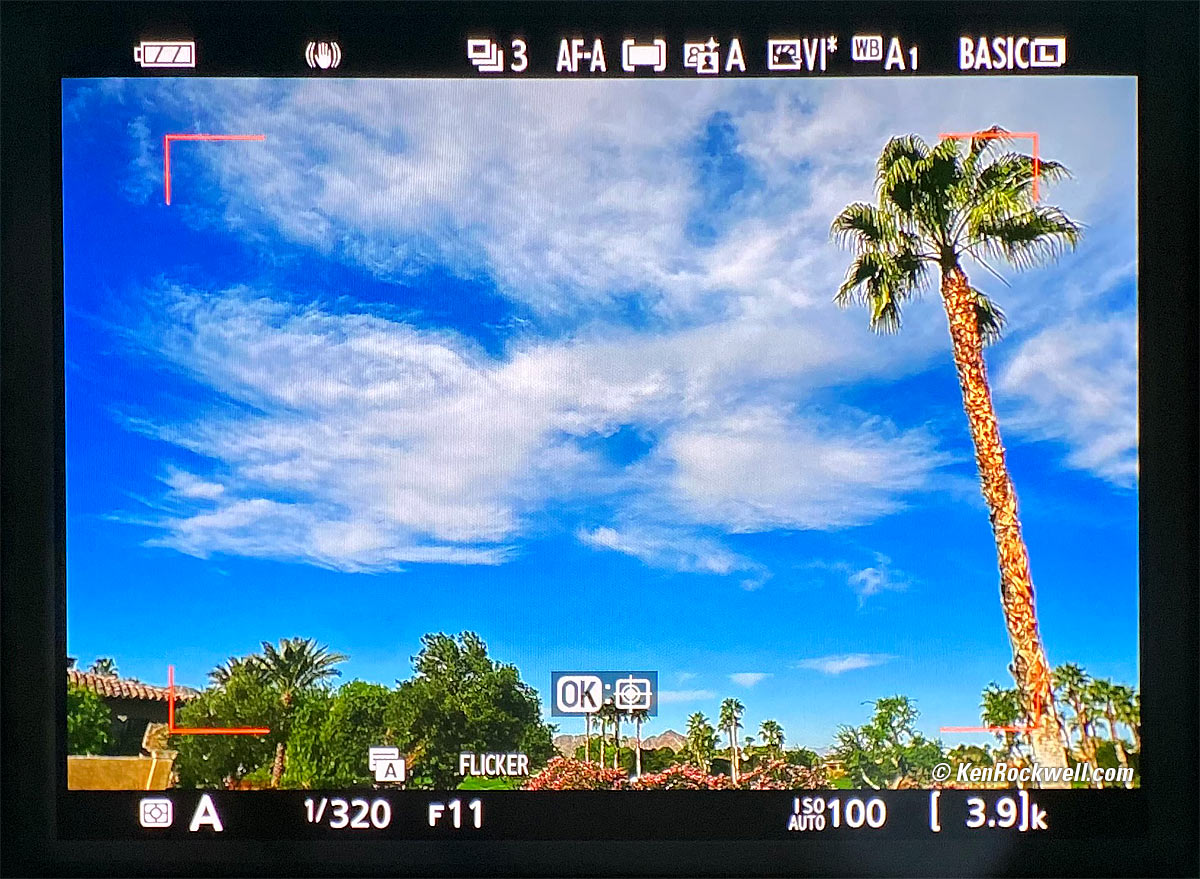
Actual view through the original Z50 finder optics. bigger. It's a lot sharper in actual use.
The electronic OLED finder is nice and bright and sharp. Auto brightness control works excellently.
While the OLED electronic viewfinder screen has a 4:3 aspect ratio so data can fit above and below the 3:2 aspect-ratio camera image, but oddly a zoomed image never fills the screen — even if there is no data above or below. The only things that appear along the top and bottom are data displays.
The flash bolt is blood orange.
Flash performance top
Flash sync speed is 1/200. While Nikon sometimes tries to claim 1/250, my Z50 II only goes to 1/200 with flash.
The built-in flash cannot be used as a master flash or remote commander to control wireless remote flashes. For this you'll need to use another flash capable of that in the Z50 II's hot shoe.
Of course in manual mode the built-in flash can trigger other flash or studio strobes optically in their manual modes. It can fire them, but can't do anything else remotely.
The built-in flash works great. Just pop it up, and it does the best it can with its limited power to provide perfect fill light:
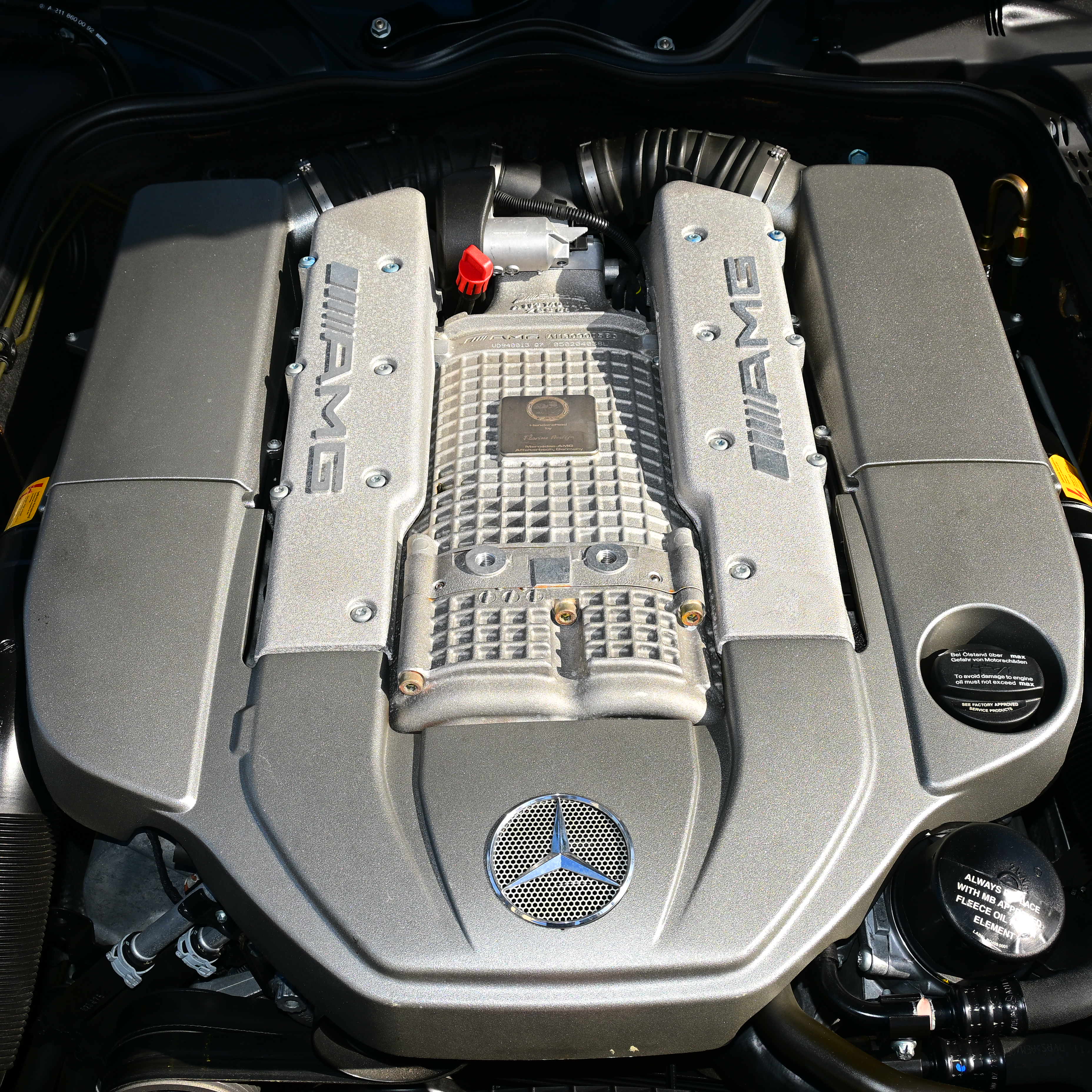
2004 Mercedes E55 Blown Powerplant, Carlsbad, California, 11:25 A.M., Saturday, 14 December 2024. Nikon Z50 II in square-crop mode, built-in flash ON, Nikon Z 16-50mm DX VR at 20.5mm at f/8 at 1/200 at Auto ISO 100 (LV 13⅔), Radiant Photo software. bigger or camera-original 21 MP © 2 MB JPG BASIC file.
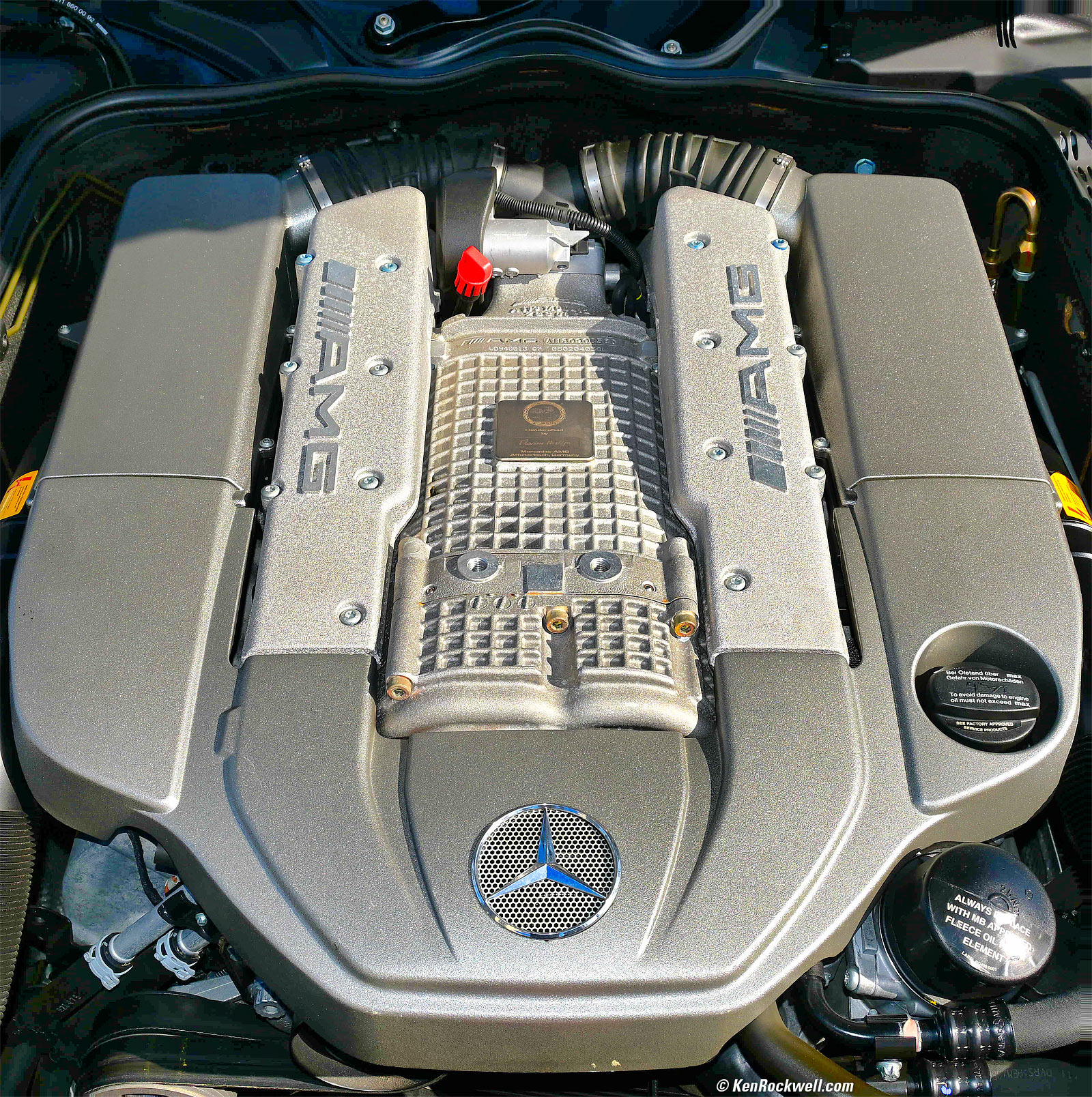
I popped-up the built-in flash to help with the extreme contrast. It helps keep details in the shadows.
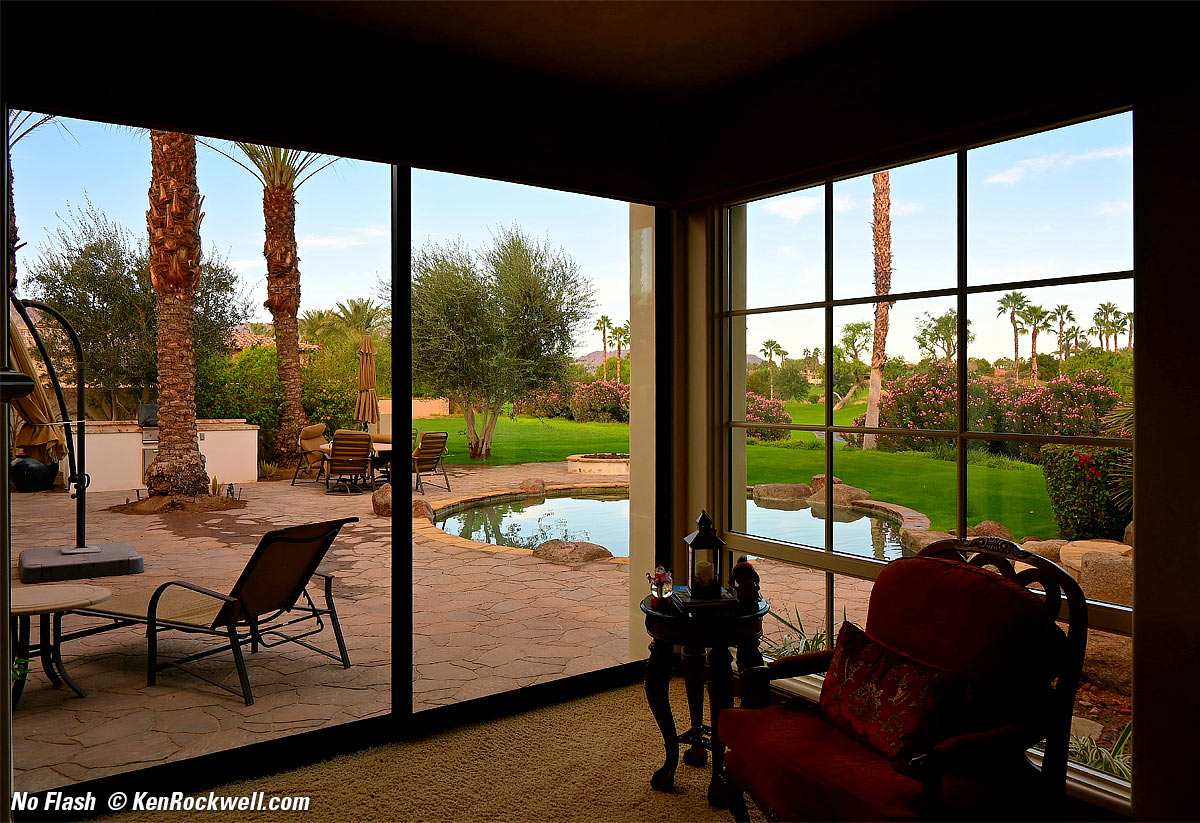
Shot without flash, The Hideaway, La Quinta, California. Nikon Z50, no flash, Nikon Z 16-50mm DX VR at 16mm at f/5.6 at 1/125 at Auto ISO 100 (LV 11.9). bigger.
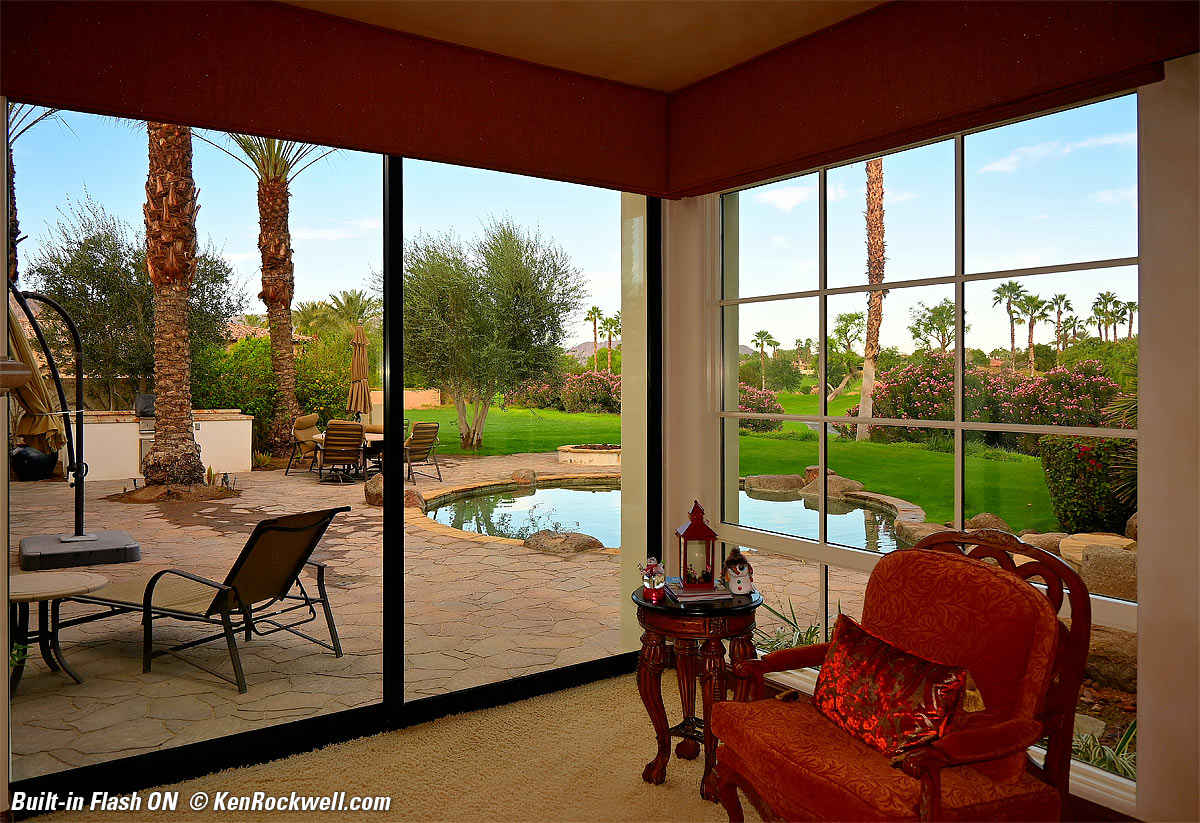
Shot with built-in flash, The Hideaway, La Quinta, California. Nikon Z50, Flash ON, Nikon Z 16-50mm DX VR at 16mm at f/4 at 1/200 at Auto ISO 100 (LV 11.6). bigger.
Nikon has always led the industry in fill-flash, and the Z50 does it great. In this case, the flash brings up the light indoors to look just right against the outdoor light. This is much better than using HDR because the flash throws more light into the shadows rather than hoping for synthetic results with HDR.
Zoey and Her Carrots, 7:19 AM, 30 November 2019. Cropped from Nikon Z50, Nikon SB-400 flash, Nikon Z 16-50mm DX VR at 35mm wide-open at f/5.3 hand-held at 1/15 of a second at Auto ISO 640 (LV 6.0), Perfectly Clear. bigger, full resolution 20MP file or camera-original © JPG file.

I love how the Z50 balances flash perfectly for fill-flash. If I hadn't used flash, Zoey would have been nothing but a shadow as the only other source of light was a window behind Zoey — and I love the color rendition!
The built-in flash should have done the same thing; I just happened to have my tiny SB-400 on top of my Z50.
High ISO Performance performance top
There's no mystery to comparing cameras; I shoot this same test at all the ISOs in every other camera I review so you can compare for yourself. Caveat: I repainted these walls white from their previous tan as of the beginning of 2023, so the background wall won't match in older reviews, and this set is lit by natural light which is different every day.
Complete Images High ISOs details dark detail performance top
High ISO performance is great as we expect. In fact, this Z50 II goes to ISO 204,800 rather than the full-frame Z7 II's maximum ISO of 102,400 — but this Z50 II looks awful at ISO 204,800 (but still better than the foolish D5 does at ISO 819,200 and higher)!
At the reasonable image sizes below, the Z50 II looks the same from ISO 100 up to about ISO 25,600. ISO 51,200 starts to look softer and mottled with green-shifted shadows.
For normal use, anything up to about ISO 25,600 looks the same as the lower ISOs, however the push H+1 ISO 102,400 and push +2 ISO 204,800 both look awful: colors are shifted, everything is fuzzy and there's all sorts of magenta-green blobs of color mottling. At ISO 204,800 the image is only barely usable; there is purple fogging all along the bottom of the image.
Click any for the camera-original © NORMAL JPG files:
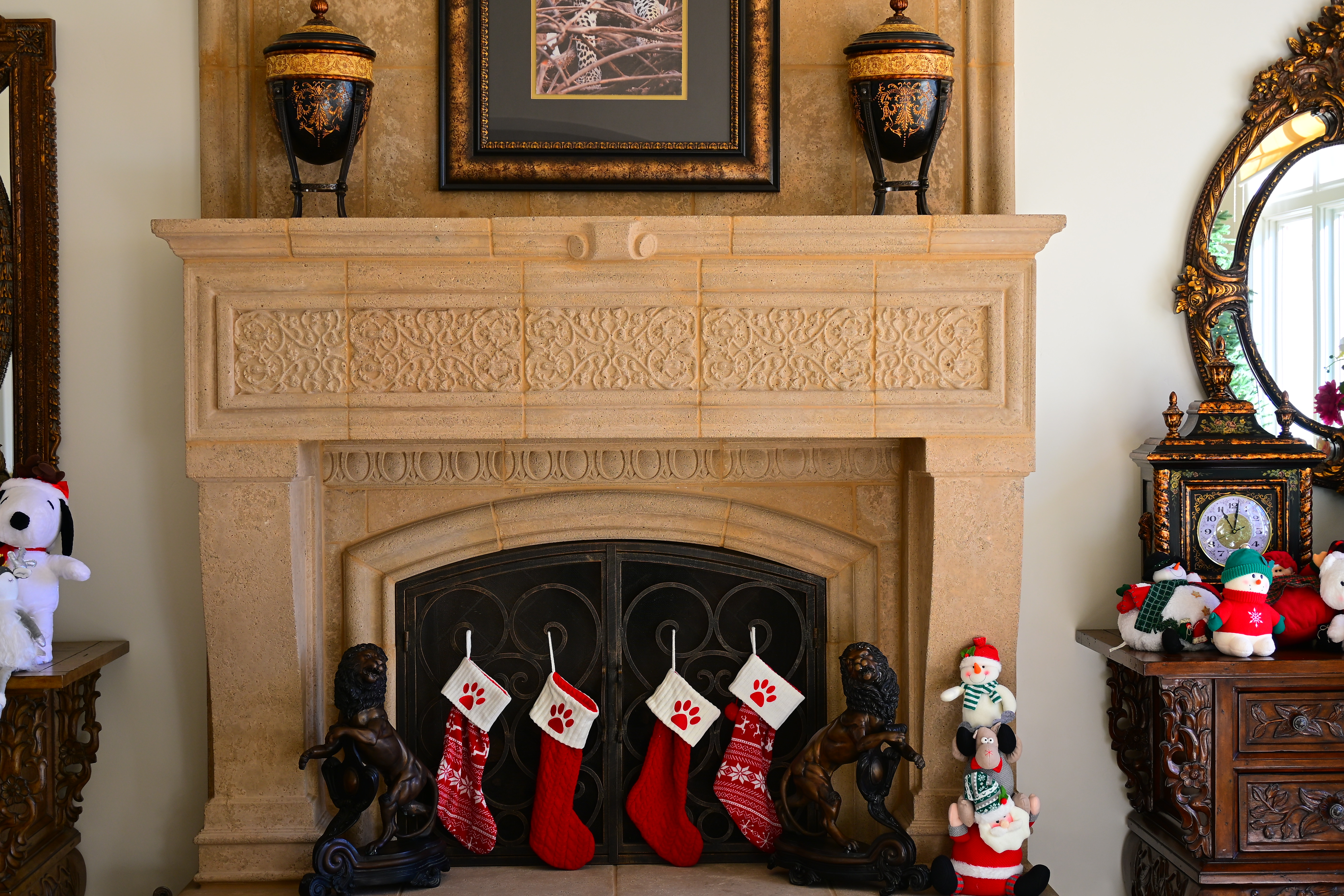
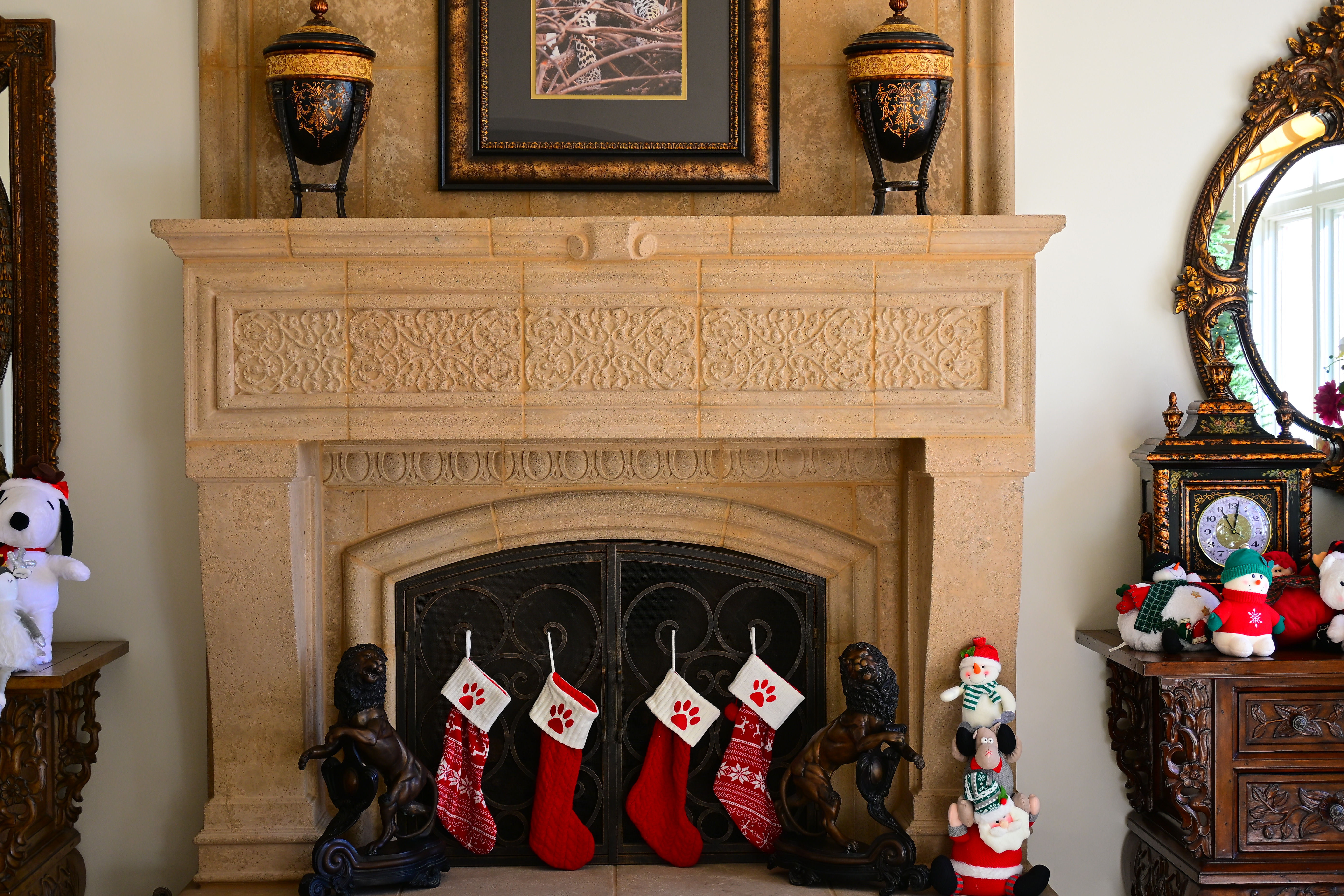
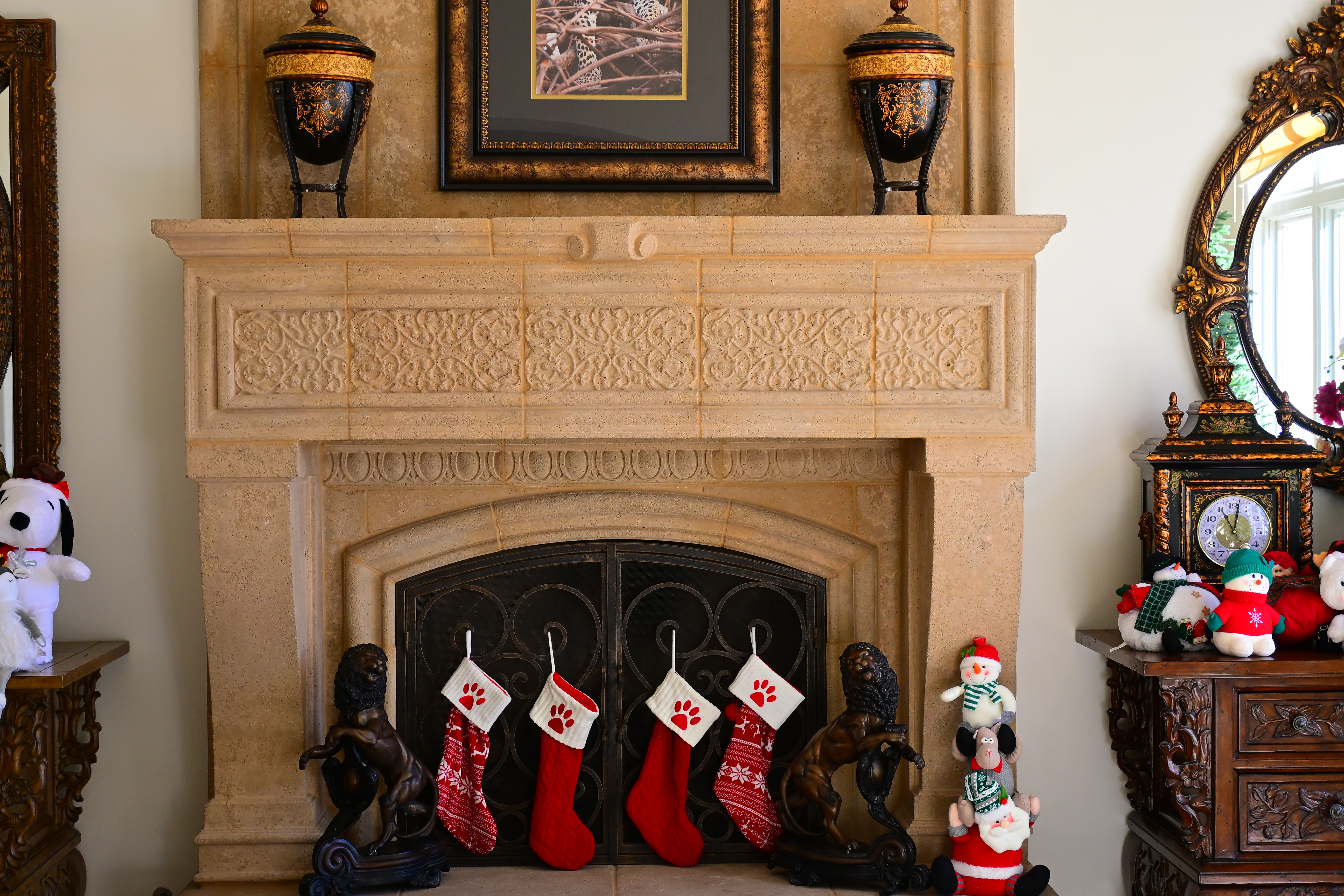
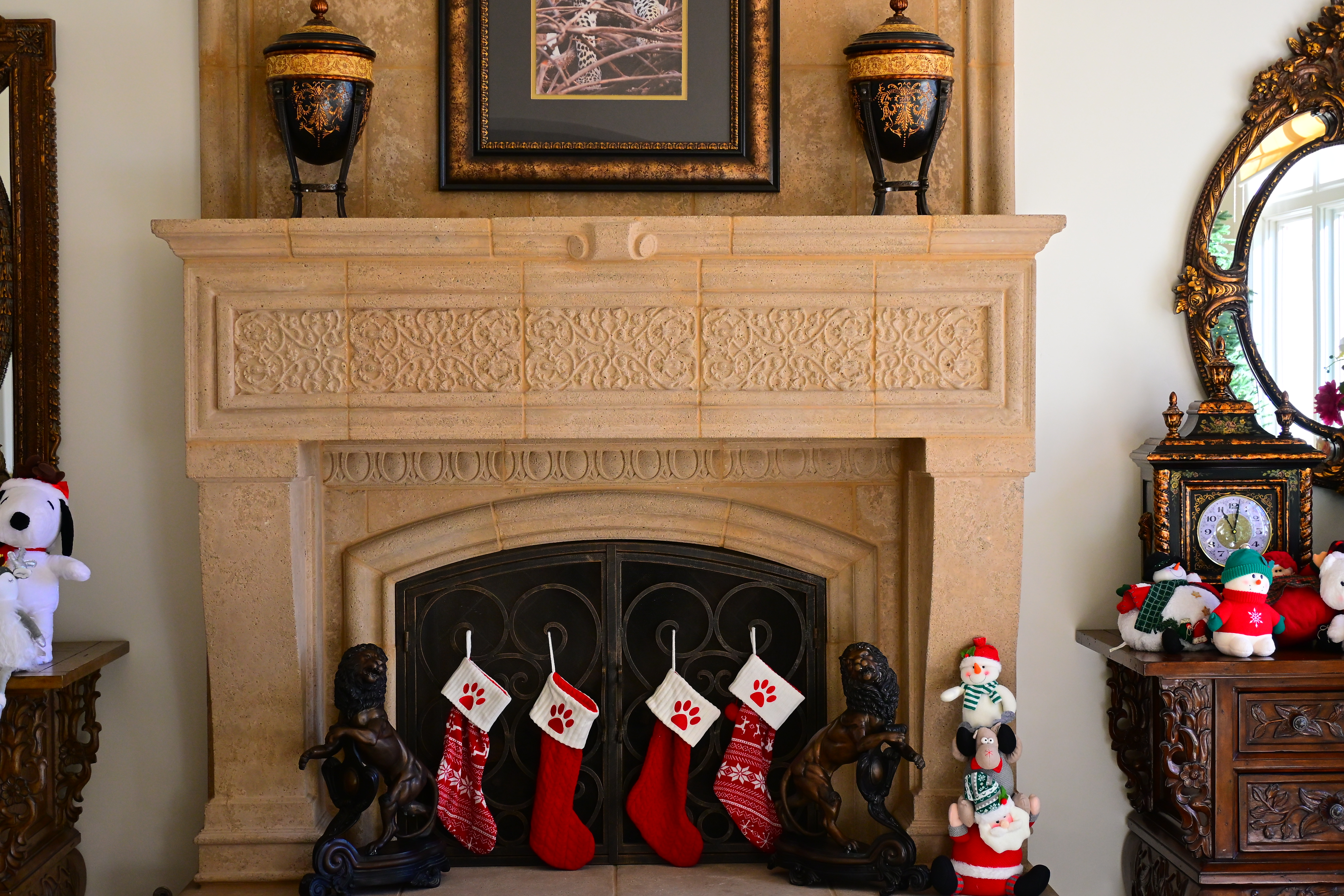

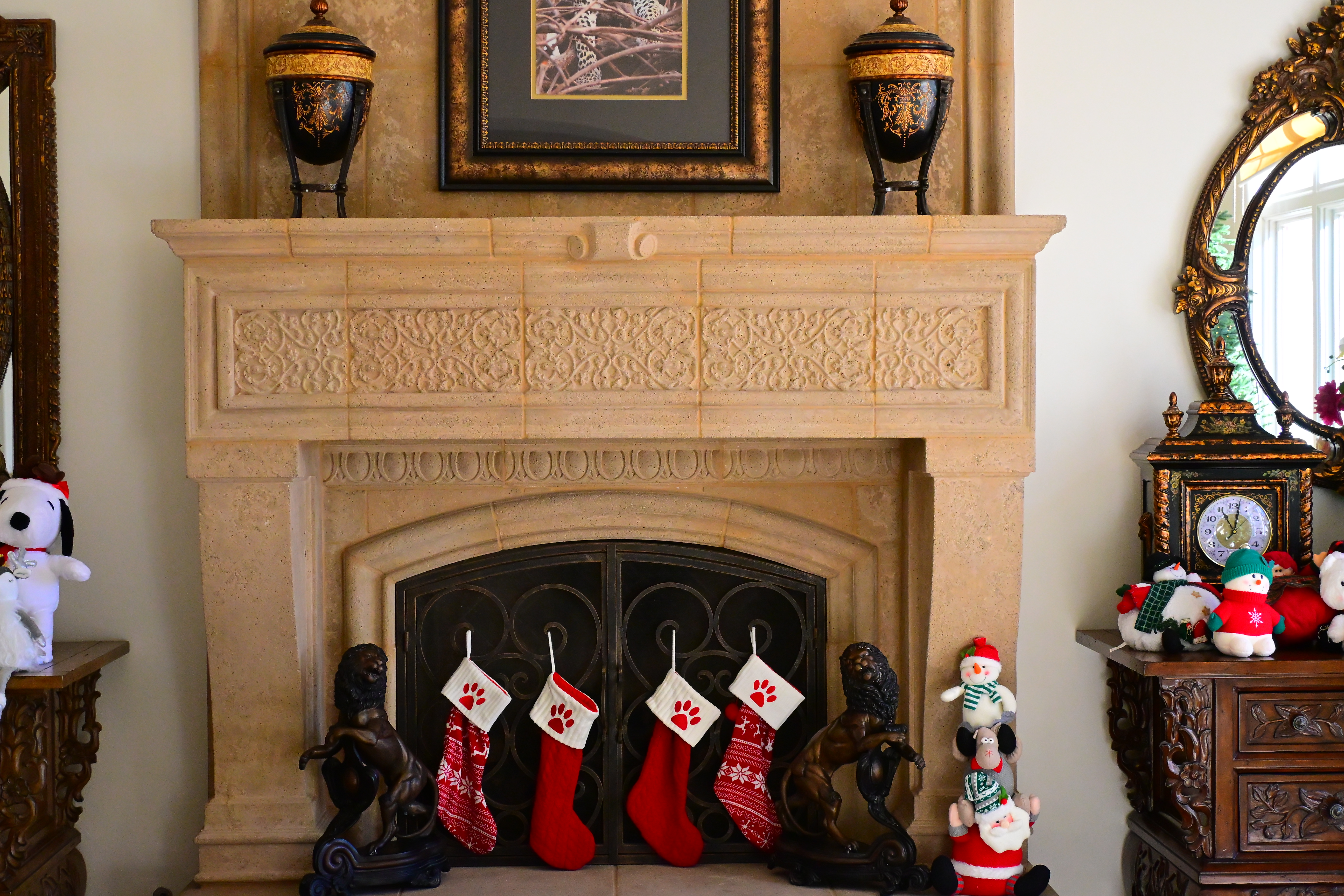






Click any for the camera-original © NORMAL JPG files.
Details: 600 × 450 Pixel Crops (9.3× magnification) High ISOs details dark detail performance top
Every digital camera becomes softer at each higher ISO, and this Z50 II does the same thing as you'll see below.
If these are about 3" (7.5cm) wide on your screen, the complete image would print at 18½ × 28" (50 × 75 cm) at this same magnification.
If these are about 6" (15cm) wide on your screen, the complete image would print at 37 × 56" (1 × 1.5 meters) at this same magnification.
If these are about 12" (30cm) wide on your screen, the complete image would print at 75 × 112" (2 × 3 meters) at this same extreme magnification.
These 600 × 450 pixel crops vary in size to fit your browser window. Even seen on your phone they represent very large enlargements, and would you ever really be looking at prints this big from arm's length? Probably not, but at least you can see how it looks. The main thing you lose as ISO increases is fine detail, which softens and goes away as we get to higher ISOs. At the highest ISOs the image look like it mostly has been erased, which is exactly what noise reduction does along with erasing the noise. All cameras do this.
Click any for the camera-original © files to explore:
Click any for the camera-original © NORMAL JPG files (about 6 MB each).
Dark-Area 600 × 450 Pixel Crops (9.3× magnification) High ISOs details dark detail performance top
Here are different crops from the same images as above, now showing the dark grillwork of the fireplace.
Higher ISOs reduce the details in the shadows even more than they do the highlights.
Note how the most detail in the fine screen is at ISO 100.
The screen is gone by ISO 800.
The bricks behind the grill go away by ISO 3,200.
At ISO 102,400 (H+2) you can't even see the iron bars, and it's total garbage at ISO 204,800 (H+2)!
Again, it's normal in all digital cameras for details to go away at higher ISOs.
If these are about 3" (7.5cm) wide on your screen, the complete image would print at 18½ × 28" (50 × 75 cm) at this same magnification.
If these are about 6" (15cm) wide on your screen, the complete image would print at 37 × 56" (1 × 1.5 meters) at this same magnification.
If these are about 12" (30cm) wide on your screen, the complete image would print at 75 × 112" (2 × 3 meters) at this same extreme magnification.
Click any for the camera-original © JPG files:
Click any for the camera-original © NORMAL JPG files (about 6 MB each).
Lens Corrections performance top
The Z50 II can correct for any or all of distortion, diffraction and falloff, any of which you may turn ON or OFF, if Nikon allows it for your lens. For some lenses, like the Z 16-50mm DX VR, Nikon won't let us turn off distortion correction.
The Z50 II always corrects for lateral color fringes (chromatic aberration); this is part of Nikon's secret sauce and never appears in any menu.
Mechanical Quality performance top
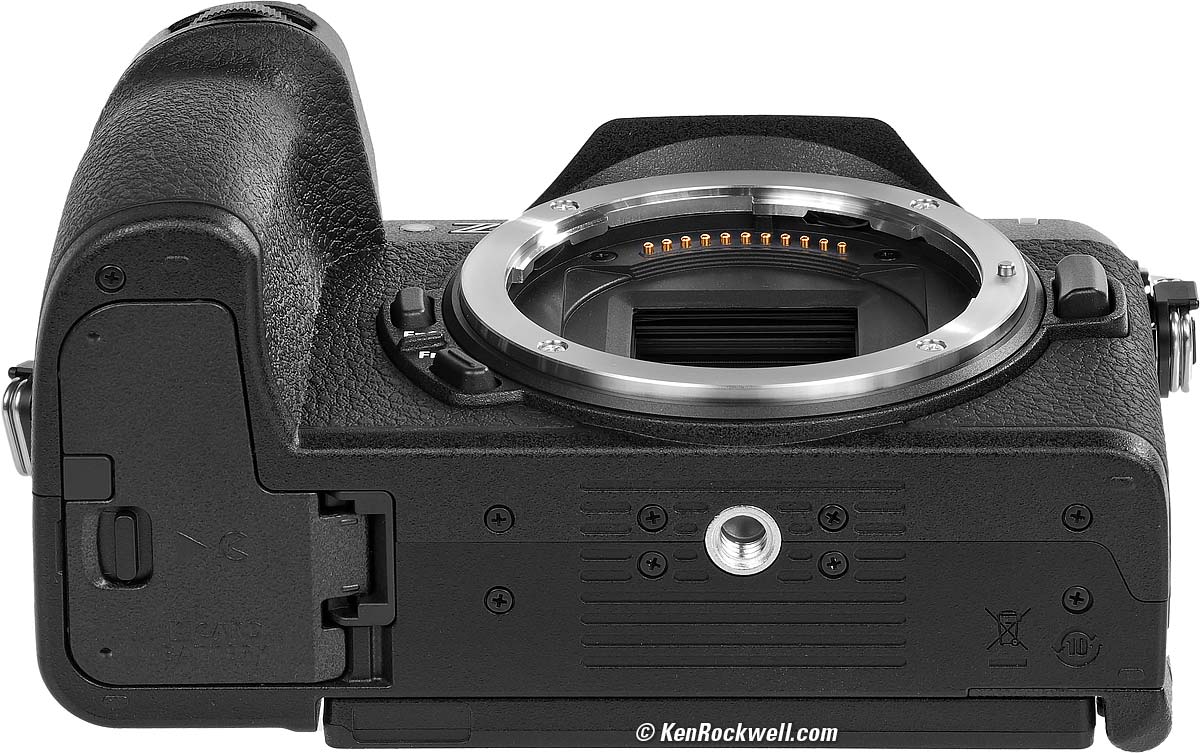
Nikon Z50 II. bigger.
This is a solid little camera with an ideal mix of plastic and metal that feels like a smaller, lighter Z8, except for the plastic knobs which work and feel better than the bare metal ones of the more expensive cameras.
Metal: Flash shoe, strap lugs, lens mount, front half of bottom cover and tripod socket.
Glass: Finder optics, LCD cover.
Plastic: Top cover, center flash hump (marked with a big Nikon logo), exposure mode dial and central index, Still/Movie mode lever, power lever, shutter and all buttons, front and rear control dials, rear LCD frame, rear bottom cover, battery and card door.
Menu System performance top
It's the same as other contemporary Nikons.
See also Canon, Nikon, Sony, Fuji & OM SYSTEM Menu Systems Compared.
U1, U2 and U3 modes performance top
New in the Z50 II is a U3 setting; the original Z50 only had U1 & U2 and had EFCT in the place of U3.

Nikon Z50 II. bigger.
I love the U1, U2 and U3 preset modes, which are programmable presets that recall many shooting settings like AF modes, Picture Control, resolution, white balance, advance modes, ISO and Auto ISO settings, and more.
I set my U1 for photos of places and things (high resolution, Vivid Picture Control with +3 Saturation, AUTO SLOW -2 minimum shutter speed in Auto ISO, etc.), U2 for people (medium resolution, normal Picture Control, 1/125 minimum shutter speed in Auto ISO) and U3 for action (AF-C all-area AF, 1/1,000 minimum shutter speed in Auto ISO, etc.).
More at my Z50 II User's Guide.
Sound, Noise & Vibration performance top
Even in its regular mechanical shutter mode the Z50 II is a very quiet and polite camera.
Weather Sealing performance top

Katie playing in the pouring rain, 10:18 A. M., 28 November 2019. Nikon Z50 in Square Crop Mode, Nikon Z 50-250mm DX VR at 155mm at f/5.3 at 1/125 at Auto ISO 1,100, -⅓ stop exposure compensation (LV 8.3). bigger.
While Katie brought her umbrella out to play in the rain, I didn't have one. My Z50 and and I got wet.
Nikon doesn't claim any weather sealing, but so what: no cameras were "weather sealed" until recently and we never noticed.
I have no problem running out in the rain when my kids are nutty enough to go run out there to play in the rain. My Z50 gets wet, I get wet, and it's all good.
Let's be real: if I'm going to shoot for any length of of time in the rain I'm going to be under an umbrella, and if not, my own tolerance for getting wet is probably about the same as the Z50's. I wouldn't worry about "weather sealing" unless I had to stand around in the rain unprotected for long periods of time. If you live in a place with frequent downpours and you have to run out in them, then sure, consider a weather sealed camera, but for reasonable use in bad weather, the Z50 works fine. Just try to keep it covered, don't overdo it, and I've never had problems.
Rear LCD & Touch Screen performance top
The touch screen works great for menus, text entry and playback and zoom control.
Playback performance top
It's the same Nikon playback system we're all used to; no news here. It works great!
It has smart playback rotate that rotates the image as we rotate the camera during playback just like an iPhone, but oddly it doesn't work during "image review" right after shooting.
Data performance top
It's all standard big-boy Nikon, except that a persistent design flaw always puts a bogus mystery "NC_FLLST.DAT" file in each picture folder.
There are but two folders on the card: DCIM and an empty NIKON folder.
21 MP BASIC JPGs vary their file size with image complexity. Their median file size is about 2.5 MB, ranging from about 1.0 MB to 3.6 MB.
NEFs are about 13.9 MB.
Card are properly formatted and titled as "NIKON_Z50_2"
JPGs are tagged at 300 DPI.
Power & Battery performance top
There's only a 3-segment battery icon, not a percentage charge readout or any indication of long-term battery health.
I've never been able to run down the battery if I charge every night. I don't yet know how many shots I can get on a charge.
My Z50 II draws 10 W (2A at 5V) via USB-C while charging.
Clock Accuracy performance top
Every sample is different, but mine runs fast about +143 milliseconds per day (about 4⅓ seconds a month), which is better than average.
This matters when you shoot multiple cameras (or this camera and an iPhone) and then sort all the images based on capture time to compare the similar views of each scene. The more accurate a camera's internal clock, the less often you need to reset it.
Compared top
Sample Images Intro New Good Bad Missing
Lenses & Compatibility Specs USA Version
Accessories Performance Compared
User's Guide Recommendations More
I ordered mine as a kit with the Z 16-50mm VR DX at B&H:
$907, Z50 II body-only at B&H, at Adorama, at Amazon and at Crutchfield.
$1,047, Z50 II kit with excellent 16-50mm lens as shown above at B&H, at Adorama, at Amazon and at Crutchfield.
$1,297, Z50 II system with both the 16-50mm and 50-250mm lenses at B&H, at Adorama, at Amazon and at Crutchfield.
$1,343, Z50 II system with the 18-140mm at B&H.
I prefer one do-everything Z 18-140mm VR DX lens rather then swapping between the 16-50mm and 50-250mm. I greatly prefer being able to zoom from wide to tele with a flick of my wrist rather than wasting time and missing pictures swapping between two lesser lenses. I much prefer not having to change lenses over having a slightly reduced range at the widest and longest ends. I'd order the lens separately along with the body, or ideally get them both with a package discount from B&H.
Get it used if you know How to Win at eBay.
Versus Canon APS-C
Nikon makes only one APS-C (DX) camera, this Z50 II (November 2024), which is very similar to the old Z50 (glorious October 2019). The Z Fc (June 2021) is simply the old Z50 put in a glitzier outer package. The only other Nikon DX mirrorless camera is the Z30 (June 2022) , which is only half a camera because it's missing a viewfinder. These are all decent cameras, but not much of a range and none of them are particularly new.
Canon makes a full and newer line of APS-C mirrorless cameras, the fancy R7 (May 2022), my favorite the R10 (May 2022), the basic R50 (February 2023) and bare-bones R100 (May 2023; also see Canon R7, R10, R50 and R100 Compared).
Within this line there are both fancier and simpler cameras than this Z50 II. Personally I prefer the similarly-priced Canon R10 to this Z50 II because I prefer its controls and ergonomics and the rest of the Canon system and support infrastructure, looking beyond just a camera body. Canon also makes just about everything domestically in Japan, while Nikon dumps most of their production to second- and third-world countries. Boo, Nikon!
It's as if Nikon isn't taking DX/APS-C mirrorless very seriously, while Fuji and Sony and Canon make loads of different models. In Nikon's defense, even though they only make one (this Z50 II), it's great camera I prefer to everything other than Canon. Nikon makes but this one model, and it's just about as perfect as it could be.
If you want a basic little camera that takes awesome pictures, this Z50 II or any of the Canons are a great choice.
The problem is that Nikon offers little today for you to expand past this camera, while Canons are part of a superior and larger infrastructure of more models and lenses and much better support.
Versus Sony and Fuji
See also Canon, Nikon, Sony, Fuji & OM SYSTEM Menu Systems Compared.
As always, every brand has its own feel to color rendition. I love my Nikons for how well they look for vivid nature and landscape photos as in-camera JPGs shot in VIVID picture control with +3 saturation. Sony and Fuji never look as good right out of the camera, even though Fuji excels for low-contrast, muted color for people photos.
The Z50 II menus and ergonomics are far superior to the awful menu systems of Sony and Fuji. The industrial design (shapes) of Nikon's cameras are also superior to Sony and Fuji, and feel much better and softer in-hand while Sony and Fuji feel hard and sharp.
Fuji makes cameras for people who prefer more metal; even their inexpensive X-E3 is mostly metal.
Sony's pictures don't look as good due to poorer color and far inferior ergonomics, while Sony excels at autofocus speed in the real world.
Sony vs. Nikon vs. Canon
User's Guide top
Sample Images Intro New Good Bad Missing
Lenses & Compatibility Specs USA Version
Accessories Performance Compared
User's Guide Recommendations More
I ordered mine as a kit with the Z 16-50mm VR DX at B&H:
$907, Z50 II body-only at B&H, at Adorama, at Amazon and at Crutchfield.
$1,047, Z50 II kit with excellent 16-50mm lens as shown above at B&H, at Adorama, at Amazon and at Crutchfield.
$1,297, Z50 II system with both the 16-50mm and 50-250mm lenses at B&H, at Adorama, at Amazon and at Crutchfield.
$1,343, Z50 II system with the 18-140mm at B&H.
I prefer one do-everything Z 18-140mm VR DX lens rather then swapping between the 16-50mm and 50-250mm. I greatly prefer being able to zoom from wide to tele with a flick of my wrist rather than wasting time and missing pictures swapping between two lesser lenses. I much prefer not having to change lenses over having a slightly reduced range at the widest and longest ends. I'd order the lens separately along with the body, or ideally get them both with a package discount from B&H.
Get it used if you know How to Win at eBay.
See my plain-English Nikon Z50 II User's Guide.
Also see Nikon's own Z50 II User's Manual.
To get the framing grid lines, check the box next to the ones you want at Custom Setting d19 [Custom monitor shooting display] or d20 [Custom viewfinder shooting display]. Select what kind you get at
Recommendations top
Sample Images Intro New Good Bad Missing
Lenses & Compatibility Specs USA Version
Accessories Performance Compared
User's Guide Recommendations More
I ordered mine as a kit with the Z 16-50mm VR DX at B&H:
$907, Z50 II body-only at B&H, at Adorama, at Amazon and at Crutchfield.
$1,047, Z50 II kit with excellent 16-50mm lens as shown above at B&H, at Adorama, at Amazon and at Crutchfield.
$1,297, Z50 II system with both the 16-50mm and 50-250mm lenses at B&H, at Adorama, at Amazon and at Crutchfield.
$1,343, Z50 II system with the 18-140mm at B&H.
I prefer one do-everything Z 18-140mm VR DX lens rather then swapping between the 16-50mm and 50-250mm. I greatly prefer being able to zoom from wide to tele with a flick of my wrist rather than wasting time and missing pictures swapping between two lesser lenses. I much prefer not having to change lenses over having a slightly reduced range at the widest and longest ends. I'd order the lens separately along with the body, or ideally get them both with a package discount from B&H.
Get it used if you know How to Win at eBay.
This Z50 II is a wonderful camera, and Nikon kits it with perfect lenses, the Nikon Z 16-50mm DX VR and Nikon Z 50-250mm DX VR which could be all you need for just about anything. This camera and the collapsible Z 16-50mm DX VR make a superior ultralight, compact combo that can shoot just about anything in any light.
Personally I prefer using just the Z 18-140mm VR DX instead of the excellent DX 16-50 VR and DX 50-250mm VR combo. I don't miss the 140-250mm range, and love not having to swap lenses to get from wide to tele. When you have to swap between the DX 16-50 VR and DX 50-250mm VR to get from wide to tele you miss a lot of pictures, while with the Z 18-140mm VR DX a flick of the wrist and you're done.
The Nikon Z 16-50mm DX VR and Nikon Z 50-250mm DX VR are excellent lenses at a low price. The 16-50mm is a tiny collapsible lens that makes this camera sing. The 50-250 is small but not tiny, and both lenses have ultra-sharp optics.
If you need an ultrawide (see How to Use Ultrawide Lenses), then the 12-28mm VR DX is also superb, and you're done.
Sadly this is not the camera to get if you want to expand beyond these basics. The Z50 II is a good place to be, but it's a dead end system-wise. If you plan on getting lots more gear to go with it, stick with the Canon EOS R10. For instance, Canon offers a superb, compact and inexpensive ultra-telephoto, the RF 100-400mm IS USM for about $650, while the next lens Nikon offers beyond 250mm is the huge Z 100-400mm which sells for about $2,500 (prices will vary over time).
The FTZ lens adapter has never won any prizes for performance, and it makes the whole system big and clunky — destroying the whole point of this great little camera. I would not bother using non-Z lenses on Z50 II with the FTZ; you'll lose the whole point of the Z50 II. The Z 16-50mm DX VR and Z 50-250mm DX VR or Z 18-140mm VR DX are incredibly high performance and lightweight lenses; if they do what you want you're set; if not, look away from Nikon.
This 100% all-content, junk-free website's biggest source of support is when you use those or any of these links to my personally approved sources I've used myself for way over 100 combined years when you get anything, regardless of the country in which you live. Nikon does not seal its boxes in any way, so never buy at retail or any other source not on my personally approved list since you'll have no way of knowing if you're missing accessories, getting a defective, damaged, returned, gray-market, store demo or used camera — and all of my personally approved sources allow for 100% cash-back returns for at least 30 days if you don't love your new camera. I've used many of these stores since the 1970s because I can try it in my own hands and return it if I don't love it, and because they ship from secure remote warehouses where no one gets to touch your new camera before you do. Buy only from the approved sources I've used myself for decades for the best prices, service, return policies and selection.
Thanks for helping me help you!
Ken Rockwell.
More Information top
Sample Images Intro New Good Bad Missing
Lenses & Compatibility Specs USA Version
Accessories Performance Compared
User's Guide Recommendations More
I ordered mine as a kit with the Z 16-50mm VR DX at B&H:
$907, Z50 II body-only at B&H, at Adorama, at Amazon and at Crutchfield.
$1,047, Z50 II kit with excellent 16-50mm lens as shown above at B&H, at Adorama, at Amazon and at Crutchfield.
$1,297, Z50 II system with both the 16-50mm and 50-250mm lenses at B&H, at Adorama, at Amazon and at Crutchfield.
$1,343, Z50 II system with the 18-140mm at B&H.
I prefer one do-everything Z 18-140mm VR DX lens rather then swapping between the 16-50mm and 50-250mm. I greatly prefer being able to zoom from wide to tele with a flick of my wrist rather than wasting time and missing pictures swapping between two lesser lenses. I much prefer not having to change lenses over having a slightly reduced range at the widest and longest ends. I'd order the lens separately along with the body, or ideally get them both with a package discount from B&H.
Get it used if you know How to Win at eBay.
My Plain-English Nikon Z50 II User's Guide.
Nikon's own Z50 II User's Manual.
© Ken Rockwell. All rights reserved. Tous droits réservés. Alle Rechte vorbehalten. Alla rättigheter förbehållna. Toate drepturile rezervate. Omnia jura reservata. Ken Rockwell® is a registered trademark.
Help Me Help You
I support my growing family through this website, as crazy as it might seem.
The biggest help is when you use any of these links when you get anything. It costs you nothing, and is this site's, and thus my family's, biggest source of support. These places always have the best prices and service, which is why I've used them since before this website existed. I recommend them all personally.
If you find this page as helpful as a book you might have had to buy or a workshop you may have had to take, feel free to help me continue helping everyone.
If you've gotten your gear through one of my links or helped otherwise, you're family. It's great people like you who allow me to keep adding to this site full-time. Thanks!
If you haven't helped yet, please do, and consider helping me with a gift of $5.00.
As this page is copyrighted and formally registered, it is unlawful to make copies, especially in the form of printouts for personal use. If you wish to make a printout for personal use, you are granted one-time permission only if you PayPal me $5.00 per printout or part thereof. Thank you!
Thanks for reading!
Ken Rockwell.