Viltrox AF 135mm f/1.8
For Nikon & for Sony (2025 ~ today)
Sample Images Intro New Good Bad Missing
Specifications Performance Compared
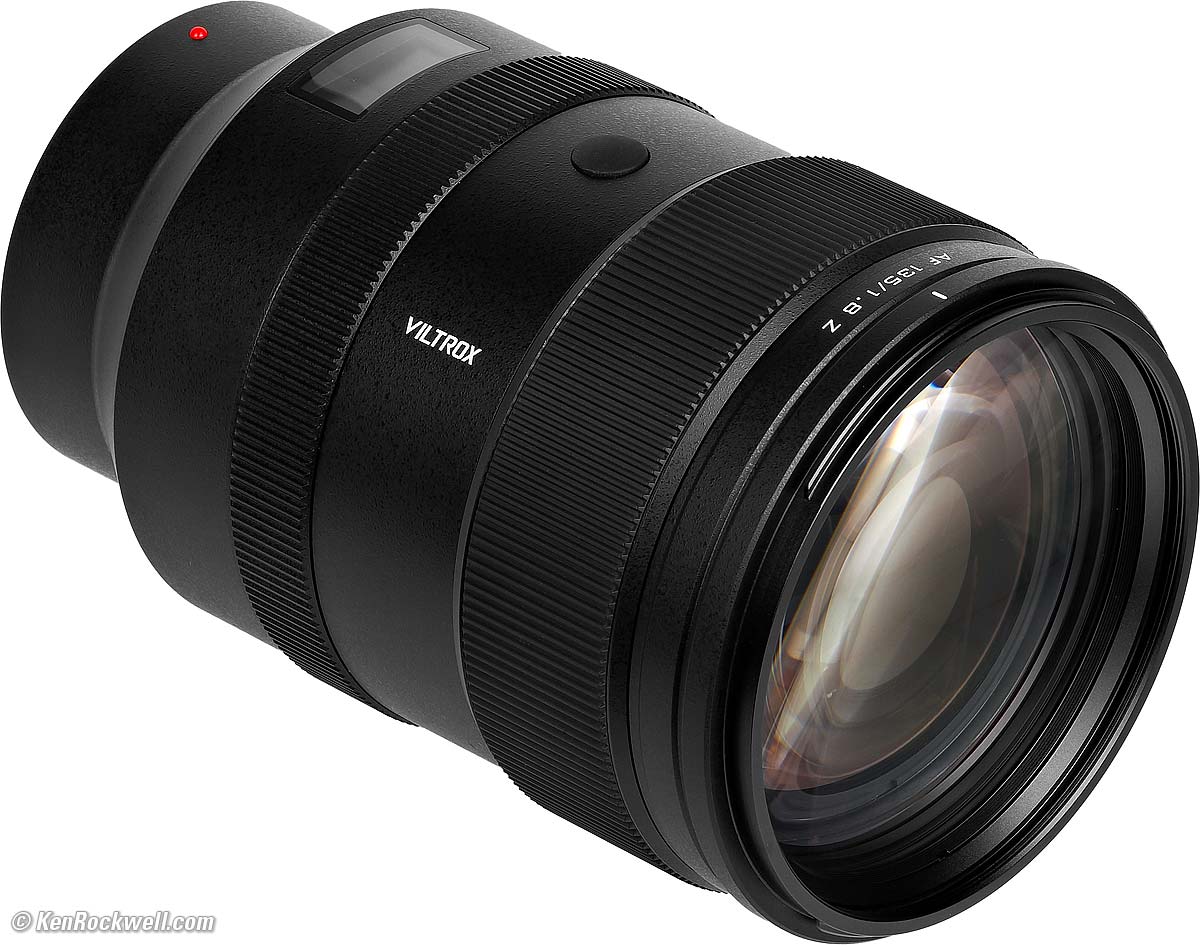
Viltrox AF 135mm f/1.8 (metal 82mm filter threads, 44.5 oz./1,262g, 2.4'/0.72m close focus, 0.25× macro ratio, $899). bigger.
For Nikon: I got mine directly from Viltrox (try coupon code KENROCKWELL at checkout possibly for an 8% discount). I'd also get it at B&H, at Adorama or at Amazon, or get it used at eBay (How to Win at eBay) or get it used at KEH.
For Sony: I'd get mine directly from Viltrox (try coupon code KENROCKWELL at checkout possibly for an 8% discount). I'd also get it at B&H, at Adorama or at Amazon, or get it used at eBay (How to Win at eBay), or get it used at KEH.
This all-content, junk-free website's biggest source of support is when you use those or any of these links to approved sources when you get anything, regardless of the country in which you live. Thanks for helping me help you! Ken.
September 2025 Better Pictures Viltrox Canon Nikon Sony Fuji OM SYSTEM LEICA Zeiss HASSELBLAD All Reviews
Why Fixed Lenses Take Better Pictures
Sample Images top
Sample Images Intro New Good Bad Missing
Specifications Performance Compared
More samples throughout this review at Bokeh, Falloff, Macro, Spherochromatism and Sunstars.
These are just snapshots; my real work is in my Gallery.
These are all shot hand-held as BASIC ★ JPGs; no tripods, NORMAL or FINE JPGs or RAW files were used or needed. Bah!
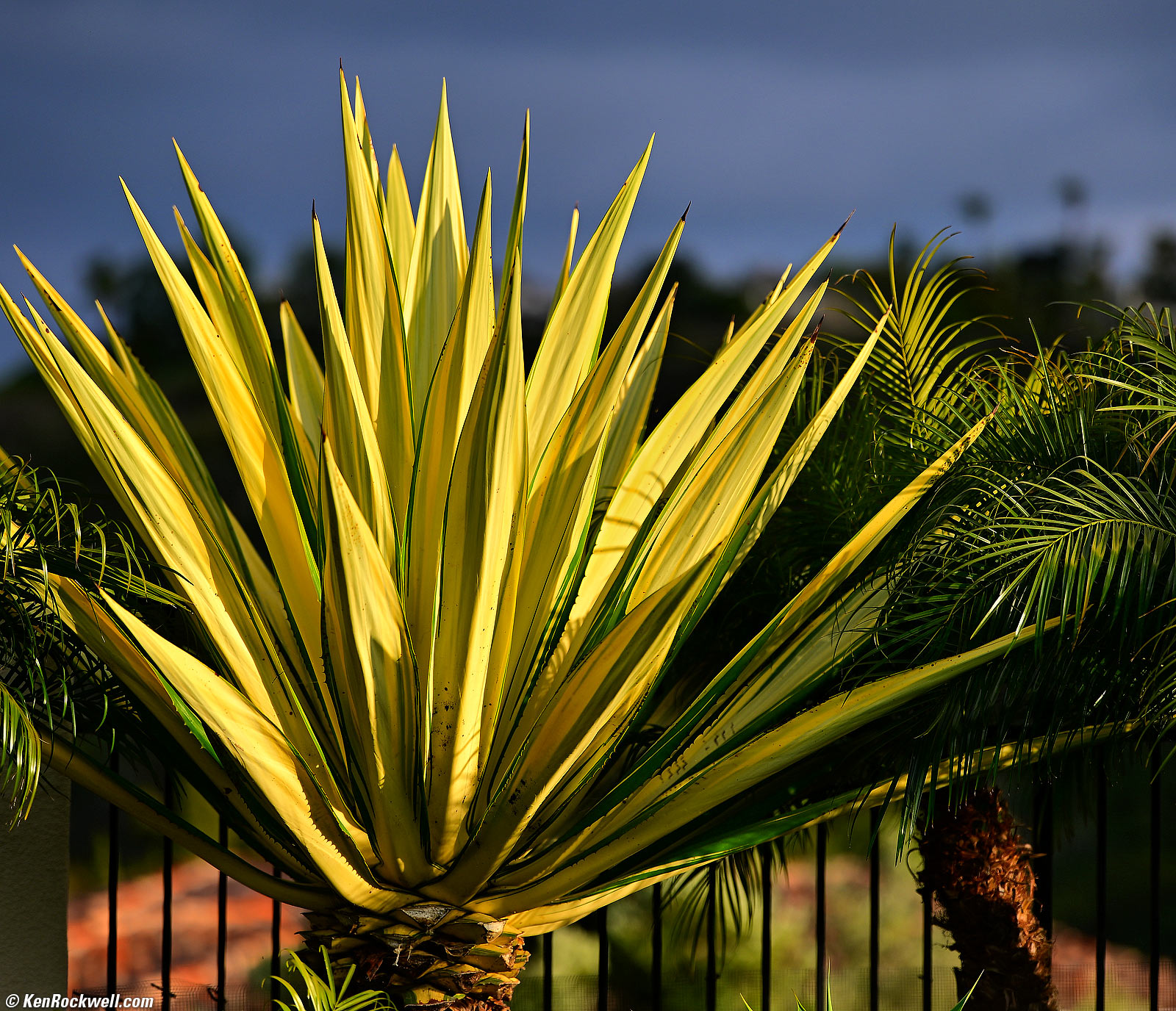
This one photo should say it all. It's ultra sharp and completely devoid of chromatic aberrations, even wide-open at f/1.8, and oh, such soft and flawless bokeh! It doesn't get any better than three-dimensional images like this:

Pelican Hood Ornament, Packard 8, 10:54 AM, Saturday, 31 May 2025. Nikon Z5 II, Viltrox AF 135mm f/1.8 wide-open at f/1.8 at 1/2,000 at Auto ISO 100, +0.3 stops exposure compensation (LV 12⅔), Radiant Photo software. bigger or full-resolution.
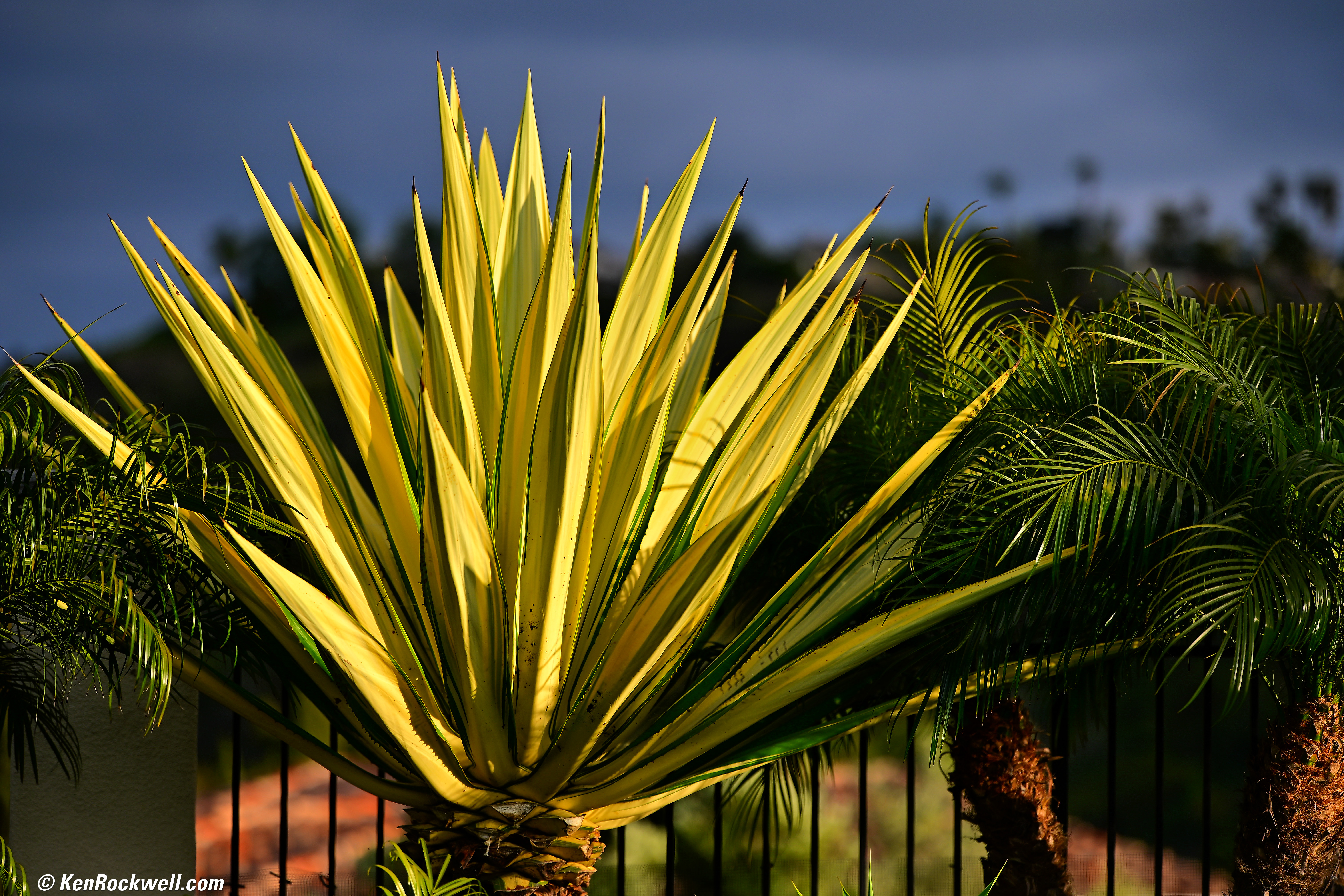
Agave by Last Light, 6:23 PM, Friday, 02 May 2025. Nikon Z5 II, Viltrox AF 135mm f/1.8 wide-open at f/1.8 at 1/4,000 at Auto ISO 100 (LV 13⅔), as shot. bigger or full-resolution.
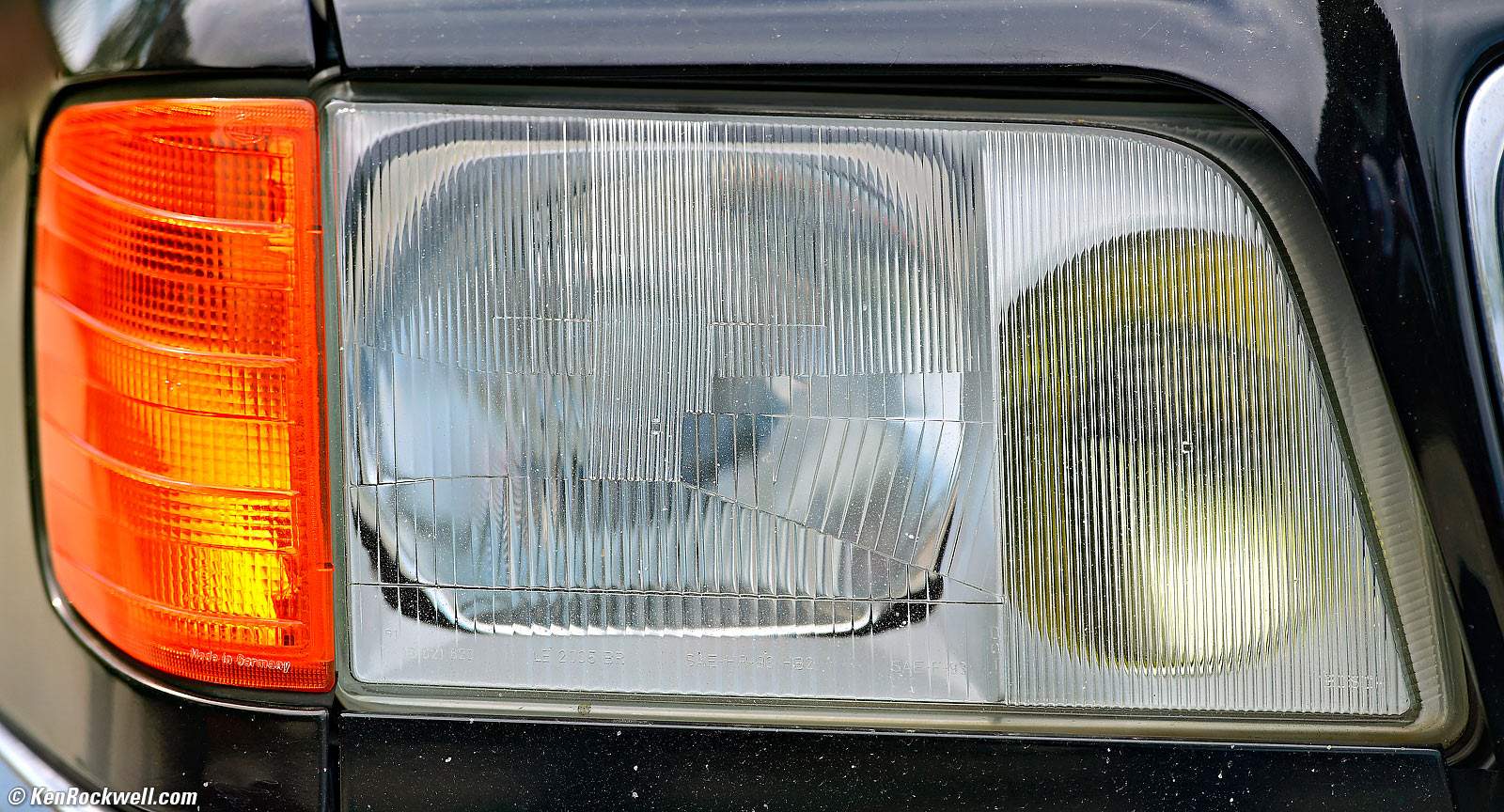
It's ultrasharp all the way out to the edges wide-open at f/1.8; just look at the full-resolution file, and look at this image as well at f/1.8:
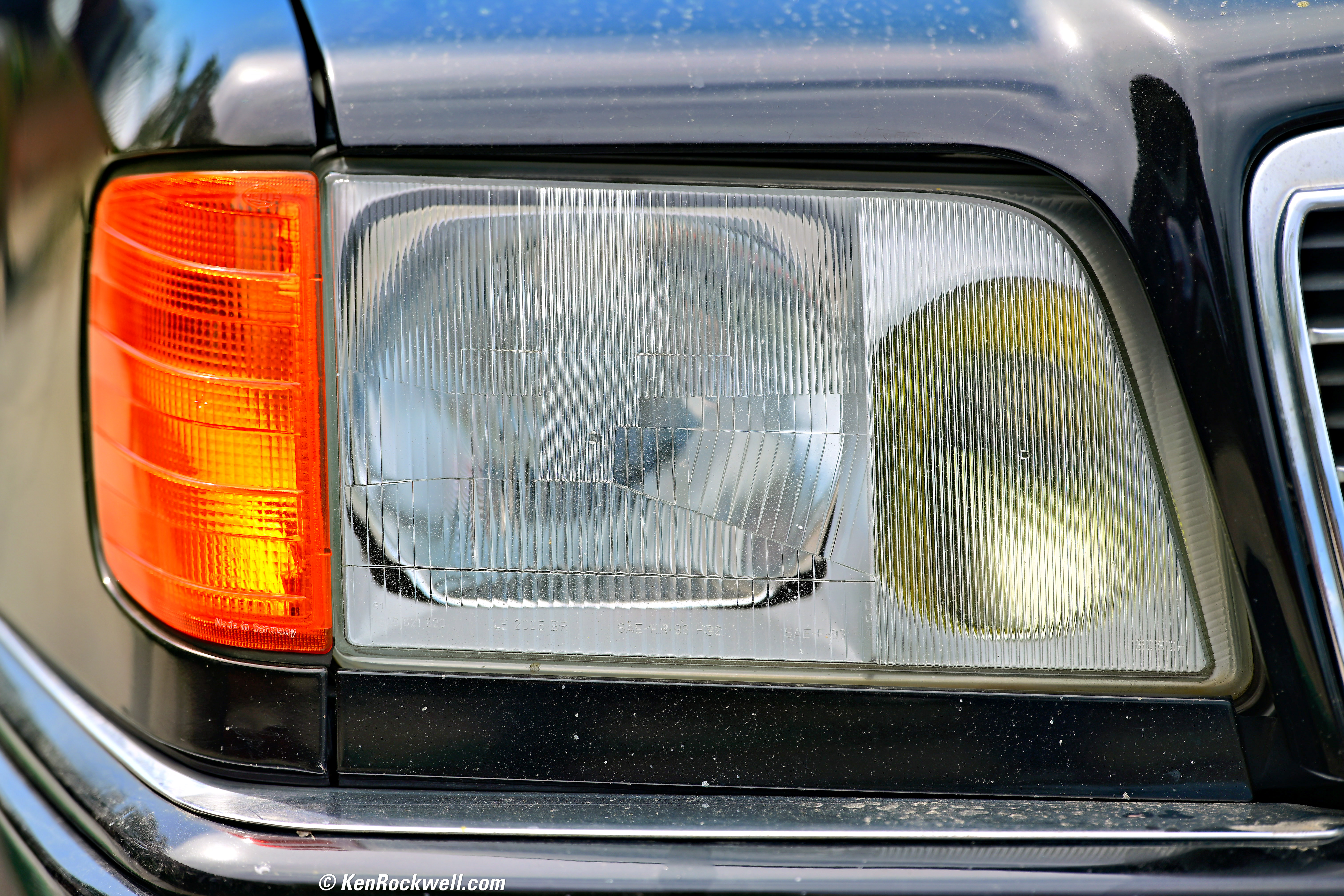
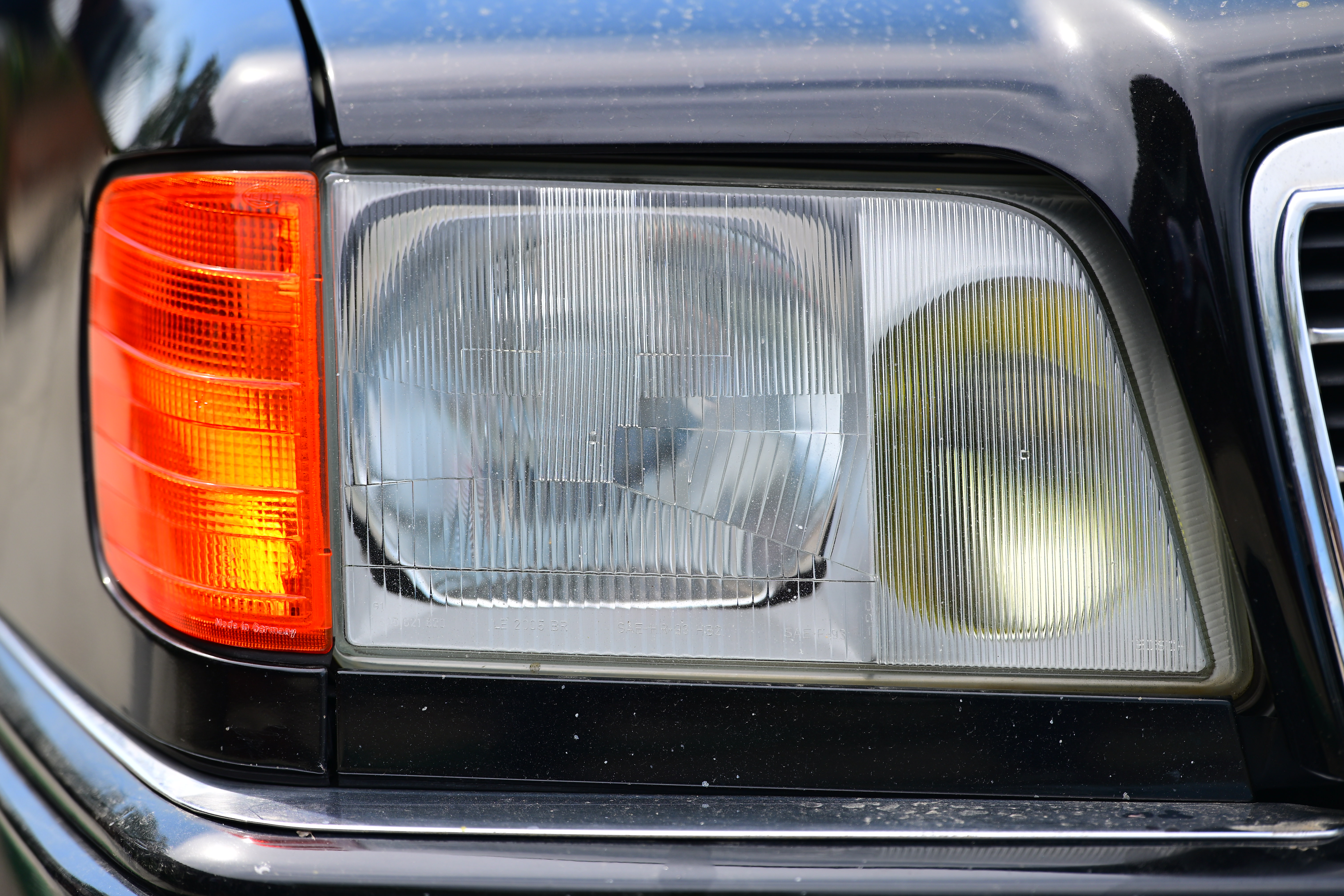
Headlight Lenses, Mercedes W124 Convertible, 10:23 AM, 31 May 2025. Nikon Z5 II, Viltrox AF 135mm f/1.8 wide-open at f/1.8 at 1/2,000 at Auto ISO 100, +0.7 stops exposure compensation (LV 12⅔). bigger, full-resolution or camera-original © JPG file.
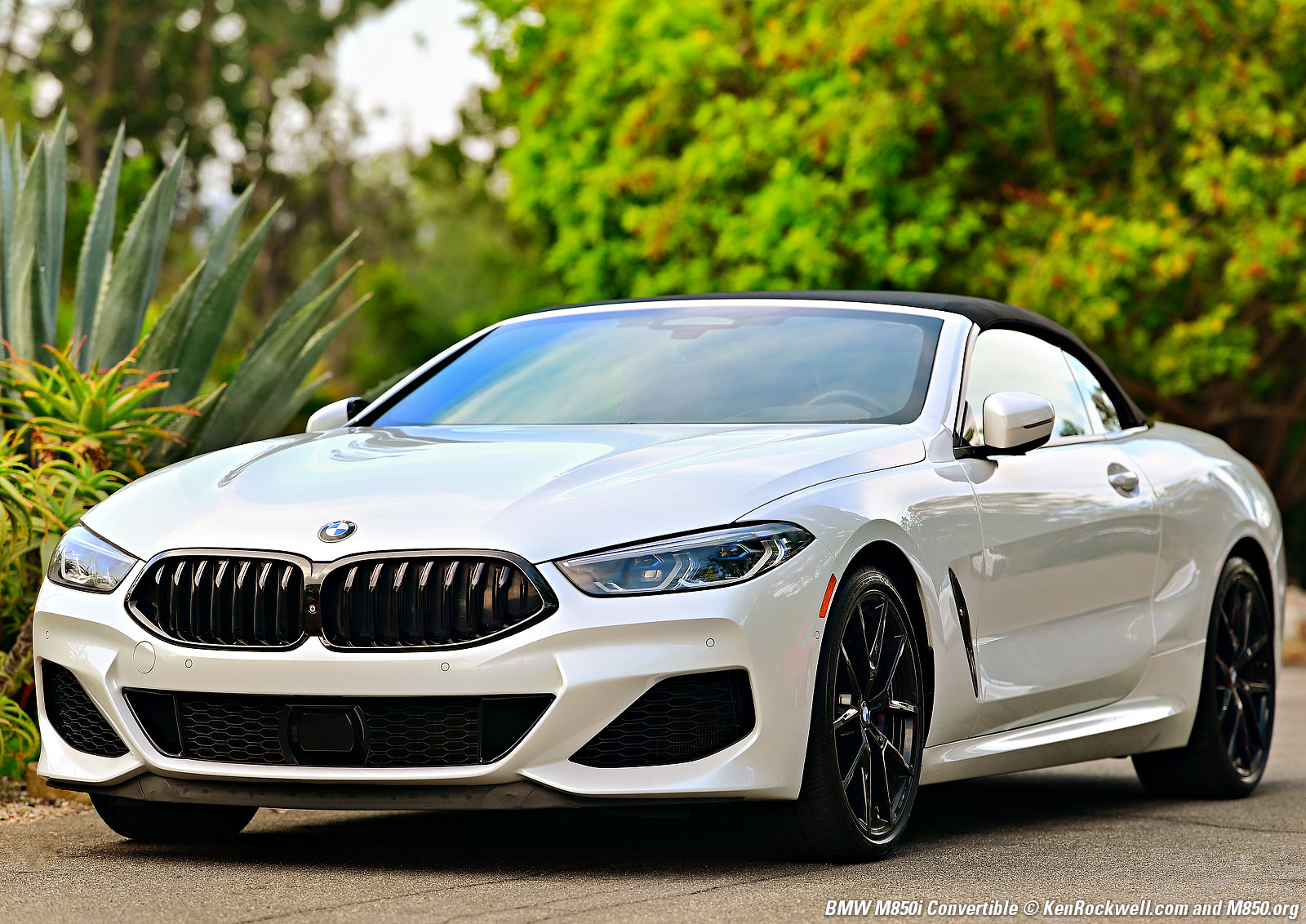
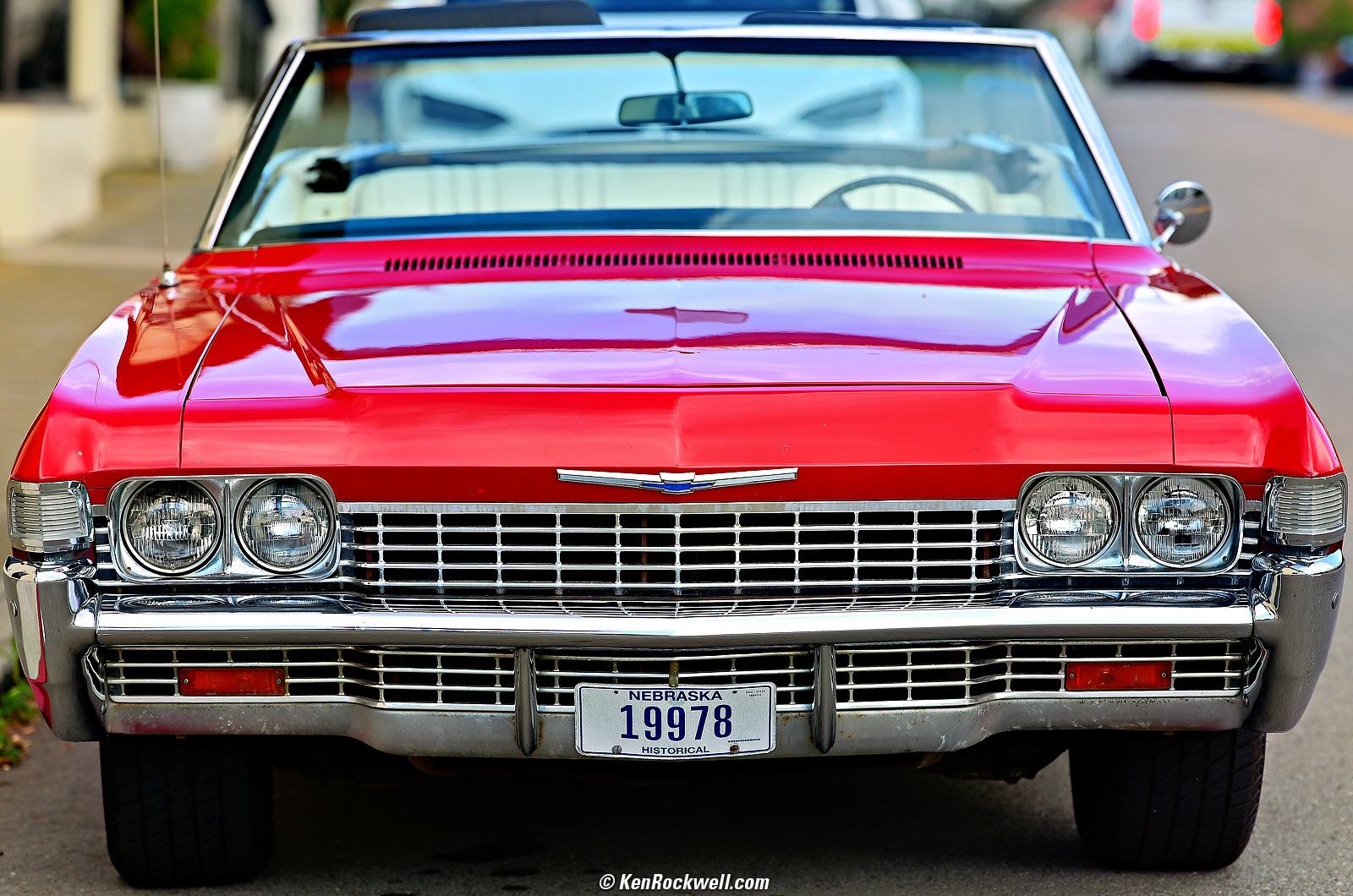
Bokeh is great at the other apertures, too:
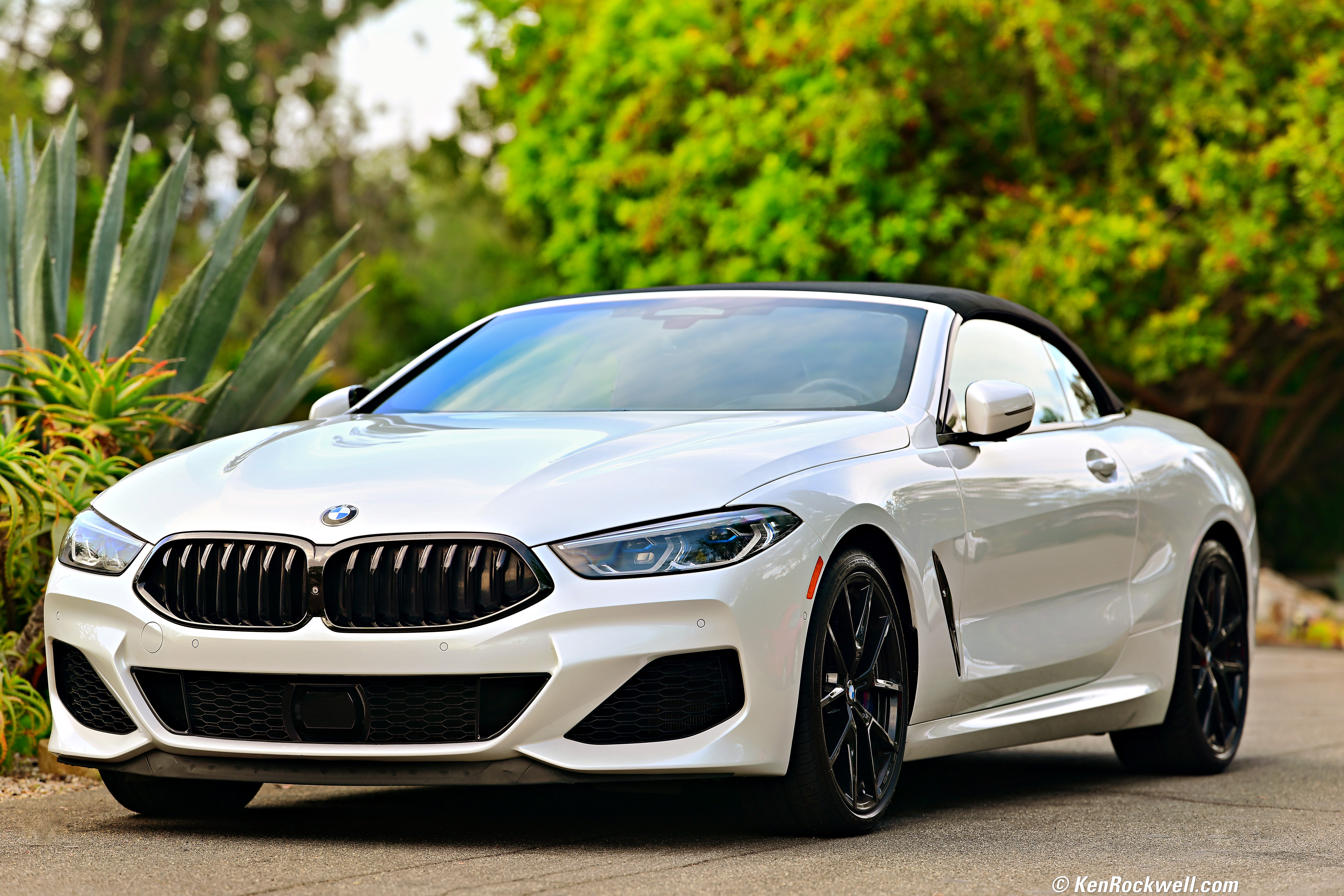
BMW M850i Convertible, 9:54 AM, 31 May 2025. Nikon Z5 II, Viltrox AF 135mm f/1.8 at f/2.8 at 1/500 at Auto ISO 100, +1 stop exposure compensation (LV 11.9), Radiant Photo software. bigger or full-resolution.
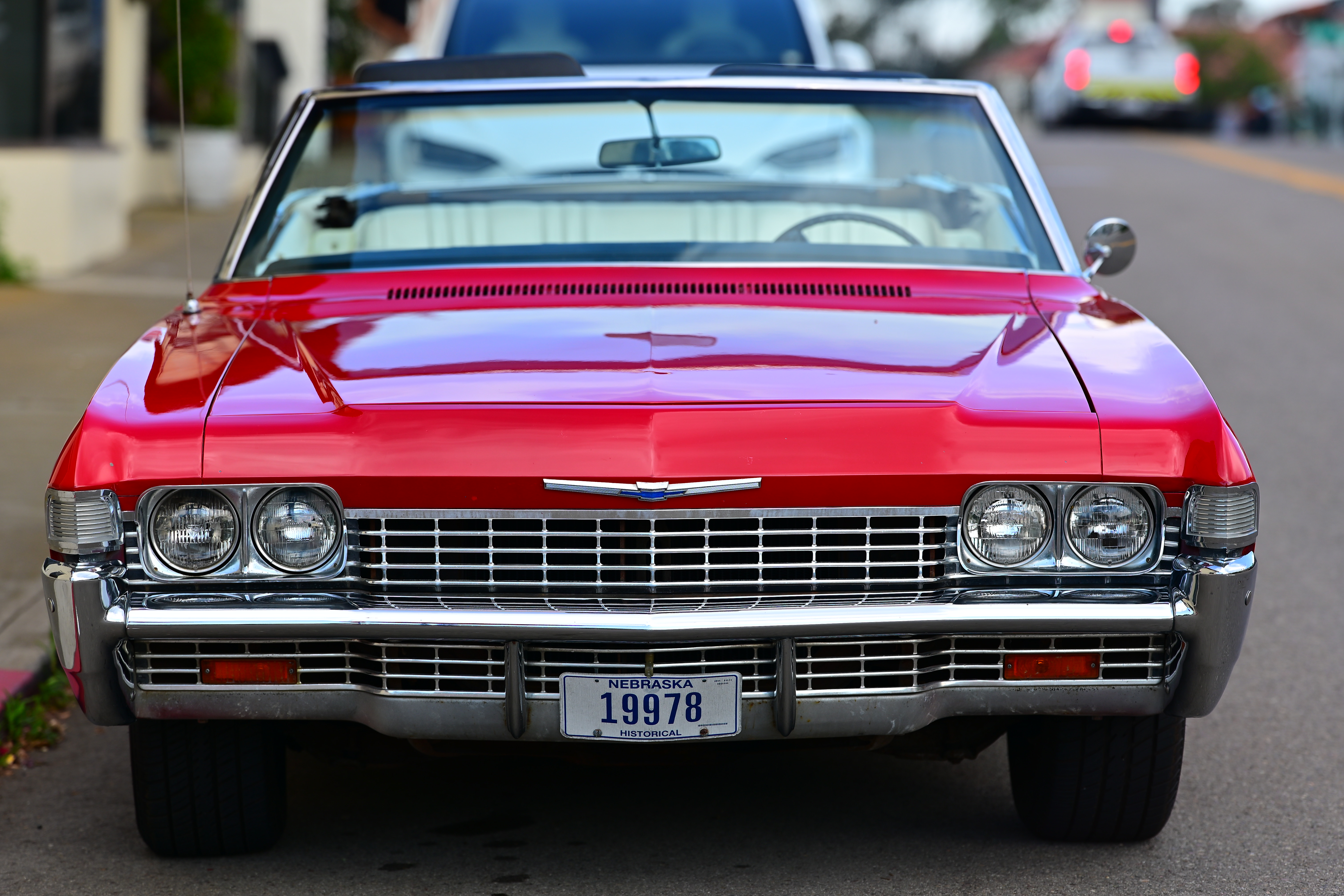
Fourth-Generation Chevrolet Impala Convertible, 9:58 AM, Saturday, 31 May 2025. Nikon Z5 II, Viltrox AF 135mm f/1.8 at f/2.8 at 1/1,000 at Auto ISO 100 (LV 12.9), Radiant Photo software. bigger or camera-original © JPG file.
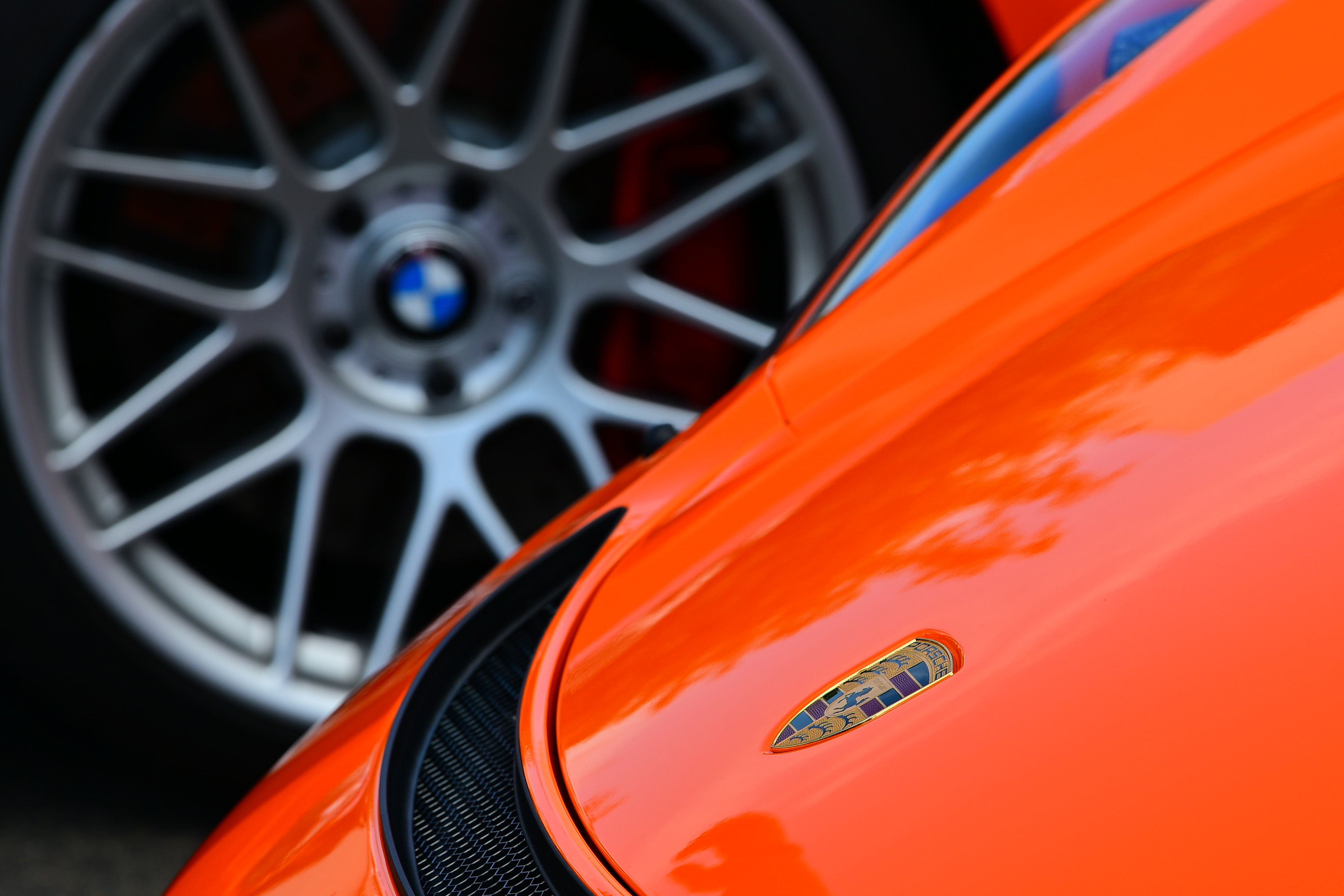
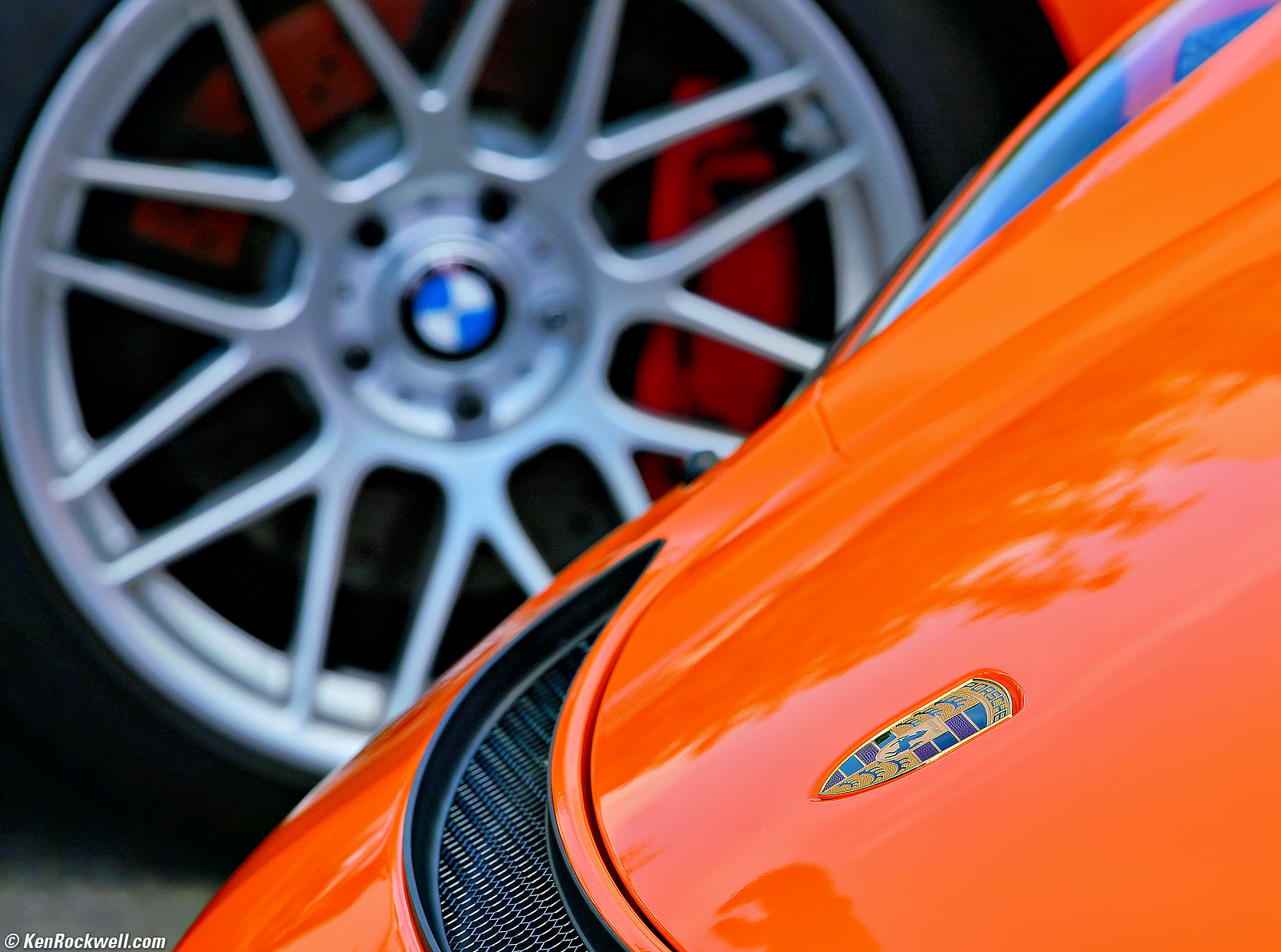
APS-C Crop: Porsche und BMW, 10:02 AM, Saturday, 31 May 2025. Nikon Z5 II in APS-C crop mode (200mm equivalent), Viltrox AF 135mm f/1.8 at f/8 at 1/125 at Auto ISO 100 (LV 13.0), Radiant Photo software. bigger or camera-original APS-C © JPG file.

Packard 8, 10:53 AM, Saturday, 31 May 2025. Nikon Z5 II in square-crop mode, Viltrox AF 135mm f/1.8 at f/4 at 1/250 at Auto ISO 100, +0.3 stops exposure compensation (LV 12.0, Radiant Photo software. bigger or full-resolution.
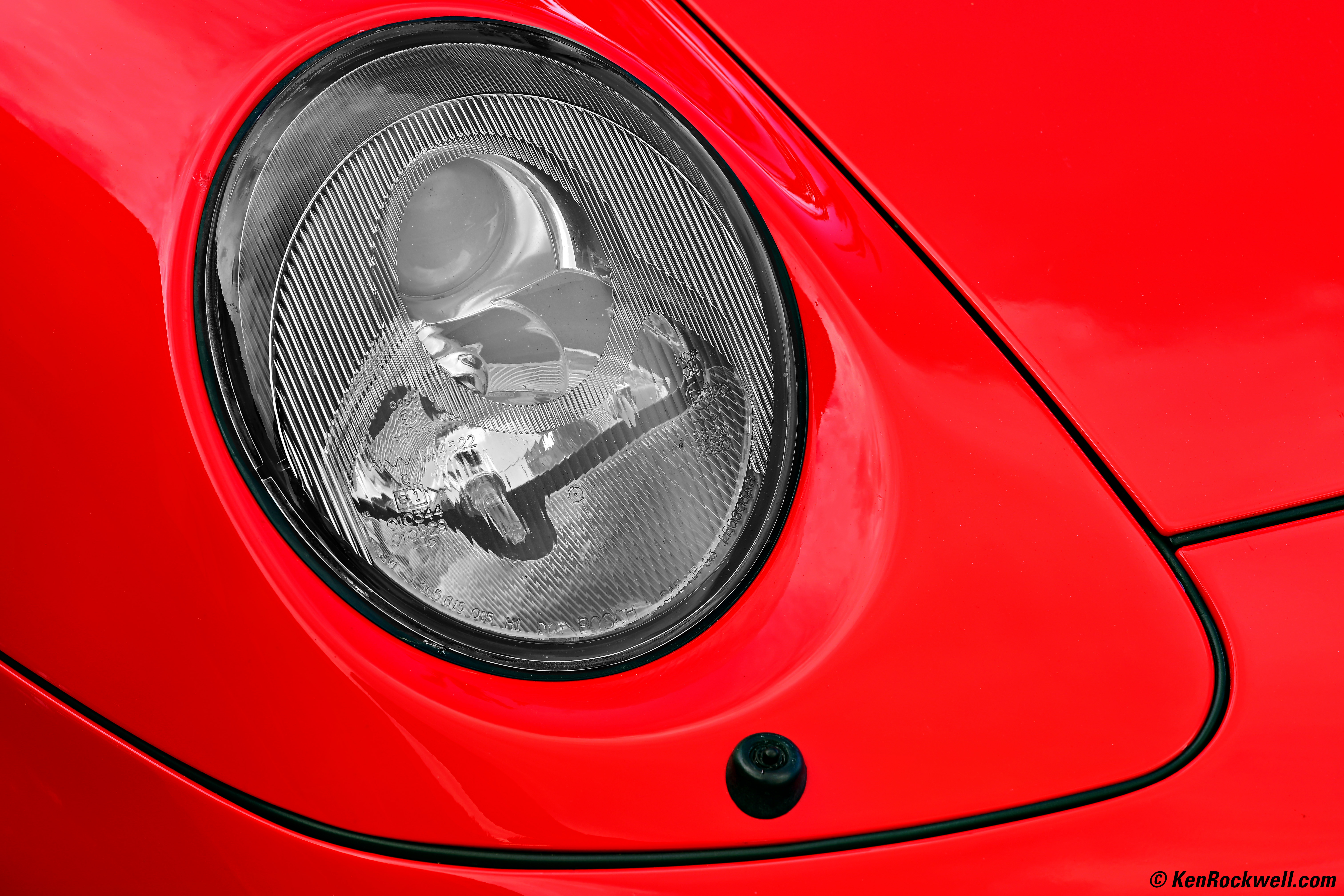
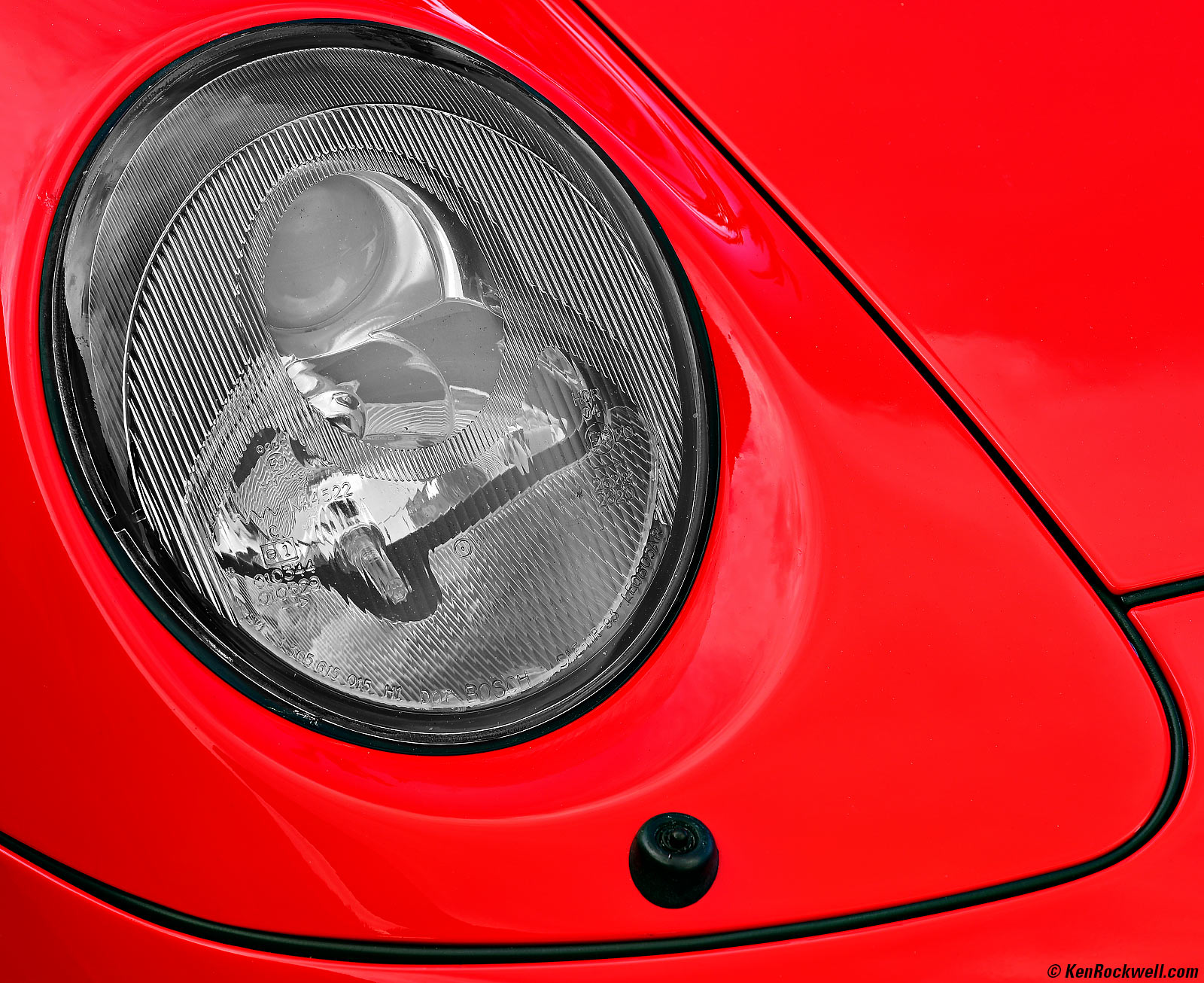
Guards Red Porsche (is there any other color?), 10:00 AM, 31 May 2025. Nikon Z5 II, Viltrox AF 135mm f/1.8 at f/8 at 1/125 at Auto ISO 100 (LV 13.0), Radiant Photo software, selective monochromatization in Photoshop CC. bigger or full-resolution.

Introduction top
Sample Images Intro New Good Bad Missing
Specifications Performance Compared

I buy only from these approved sources. I can't vouch for ads below. |



This is a big, heavy, autofocus and almost all-metal domestic Chinese lens. It has a real metal filter thread and feels so much better than the crummy plastic threads of Nikon's, Canon's and Sony's 135mm f/1.8 lenses.
Its optics are extraordinary, as you've just seen. Images jump off the page, if you're a good photographer.
This Viltrox comes for Nikon & for Sony. For Canon the RF 135/1.8L IS USM is superb except for the plastic filter ring; there's no Viltrox version for Canon, and Canon makes their lens domestically in Japan, unlike Nikon or Sony. Stick with Canon for Canon; the Canon RF 135/1.8L IS USM is also the only optically stabilized 135mm f/1.8.
This Viltrox' autofocus works great. It uses the same linear magnetic rail motor system as Canon's VCM (Voice-Coil Motor) and Sony's "XD Linear" Motor systems. This also means that half the lens floats around inside with the power off, so the clunking sounds you may hear are normal in these lenses; nothing locks-down with the power off.
I love it when third parties step in to offer innovation like an LCD screen and metal construction lacking in the other brands. I love having the choice, and this Viltrox is less than half the price. 出色 (Bravo)!
I'm not going to spend two large for a Sony's plasticy Chinese 135/1.8 when I can get what seems like a sturdier one directly from China myself and keep the price difference, rather than putting it in Nikon or Sony's pocket.
This lens has more metal on it than any of the Nikon Z 135mm f/1.8, Sony FE 135mm f/1.8 GM or Canon RF 135mm f/1.8L IS USM lenses, and the optics look at least as good.
Of course I have no idea what future support will be available from Viltrox as the years roll on, but for half the price of the big names I'm not worrying.
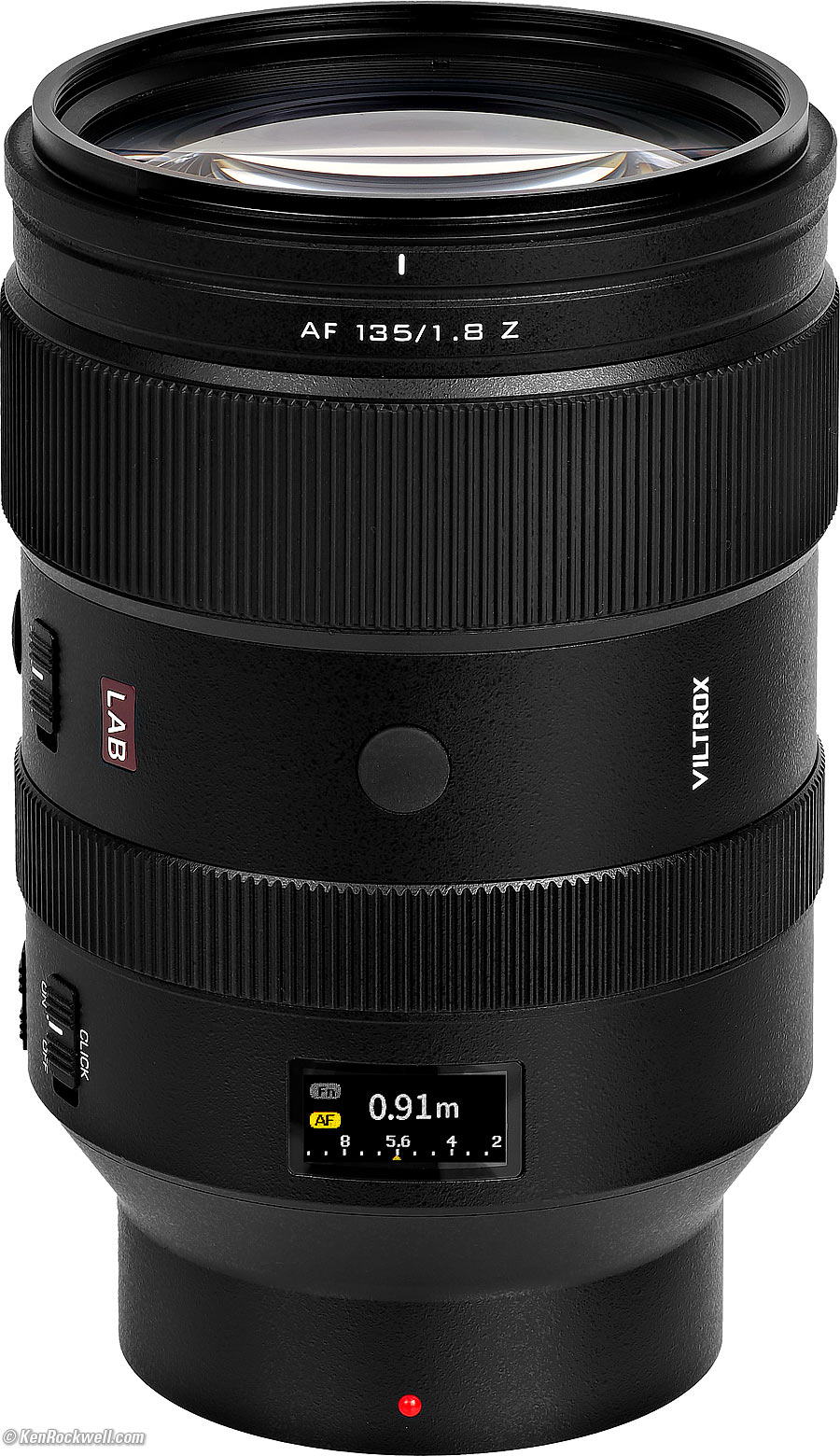
Flat Liquid-Crystal Display (LCD) panel; it isn't curved. bigger.
It dwarfs my Nikon Z5 II:
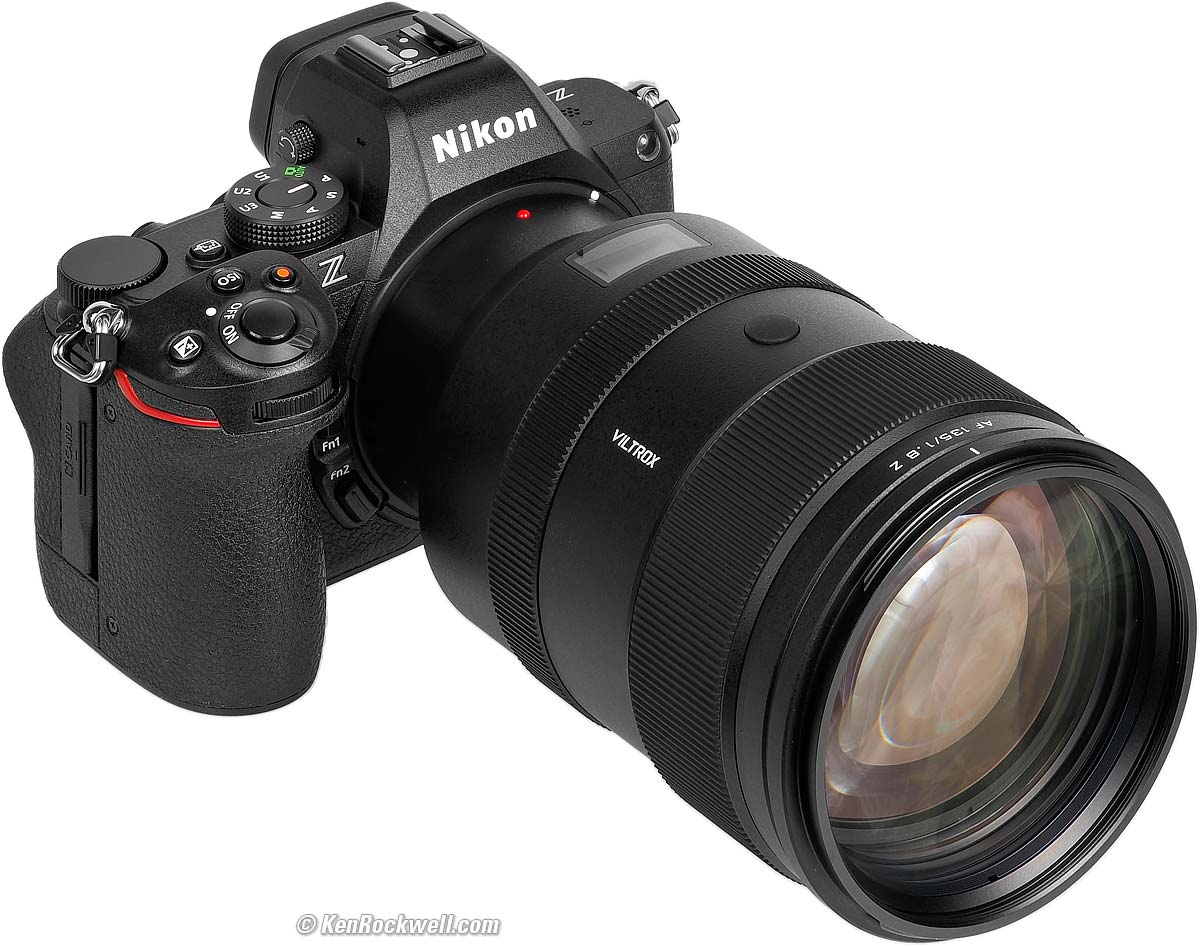
Viltrox AF 135mm f/1.8 on Nikon Z5 II. bigger.
For Nikon: I got mine directly from Viltrox (try coupon code KENROCKWELL at checkout possibly for an 8% discount). I'd also get it at B&H, at Adorama or at Amazon, or get it used at eBay (How to Win at eBay) or get it used at KEH.
For Sony: I'd get mine directly from Viltrox (try coupon code KENROCKWELL at checkout possibly for an 8% discount). I'd also get it at B&H, at Adorama or at Amazon, or get it used at eBay (How to Win at eBay), or get it used at KEH.
New intro top
 World's first AF mirrorless 135mm f/1.8 lens with a metal filter thread.
World's first 135mm f/1.8 with an LCD.
World's first telephoto with two programmable focus distance memories!
Good intro top
 Superb optics:
Super sharp, especially at f/1.8 where lenses used to be soft.
Superb bokeh.
No measurable distortion, even without correction!
Excellent macro performance.
Very well made mostly out of metal, not pathetic plastic.
Arrives in a sealed box, unlike anything from Nikon, Canon or Sony.
LCD is always on when the camera is awake.
LCD is very legible.
LCD shows aperture and focused distance.
11-blade diaphragm.
AF/MF switch.
Two programmable focus distance memories!
Excellent metal manual focus ring.
Always-active manual focus ring (at least on Nikon version).
Manual focus ring automatically changes its sensitivity based on the speed at which it's rotated.
Focus lock button.
Focus limiter switch.
Programmable second control ring, with defeatable clicks.
Locking hood.
Claimed dust and water resistance.
USB-C upgrade port.
We can get this directly from the factory in China rather than paying over twice as much for Nikon or Sony to offshore a similar lens and import it for us. No middlemen, no problem!
Bad intro top
 Big and heavy.
Having Fn buttons is good, but they work oddly.
Exactly like Sony's newest XD linear motor lenses and Canon's newest VCM lenses, half of the internal optics are floating around freely when the camera is off, so it sounds like there are loose parts inside — because there are! None of these lenses locks-down their insides with power off. This is normal, but unsettling.
Viltrox is a new company with little representation in the USA with an unproven service record; only time will tell.
Missing intro top
 No image stabilization, but works great with in-camera stabilization. (Neither the Nikon Z 135mm f/1.8 nor Sony FE 135mm f/1.8 GM are stabilized, either.)
No stabilizer switch for in-camera stabilization.
No dedicated aperture ring, however the clicked control ring can set this and display it on the lens' own LCD.
Only stops down to f/16, not f/22.
No depth-of-field scales.
No infra-red focus indices.
Specifications top
Sample Images Intro New Good Bad Missing
Specifications Performance Compared
For Nikon: I got mine directly from Viltrox (try coupon code KENROCKWELL at checkout possibly for an 8% discount). I'd also get it at B&H, at Adorama or at Amazon, or get it used at eBay (How to Win at eBay) or get it used at KEH.
For Sony: I'd get mine directly from Viltrox (try coupon code KENROCKWELL at checkout possibly for an 8% discount). I'd also get it at B&H, at Adorama or at Amazon, or get it used at eBay (How to Win at eBay), or get it used at KEH.
Name specifications top
Viltrox calls this the AF 135/1.8 LAB Z or AF 135/1.8 FE:
AF: Autofocus.
LAB: One of their better lenses.
Z: For Nikon's mirrorless cameras, or FE: Full-frame for Sony's E-mount cameras.
It also has:
ED: Magic Extra-low Dispersion glass for reduced secondary chromatic aberration.
IF: Internal focusing; nothing moves externally as focused.
∅82: 82mm filter thread.
Optics specifications top
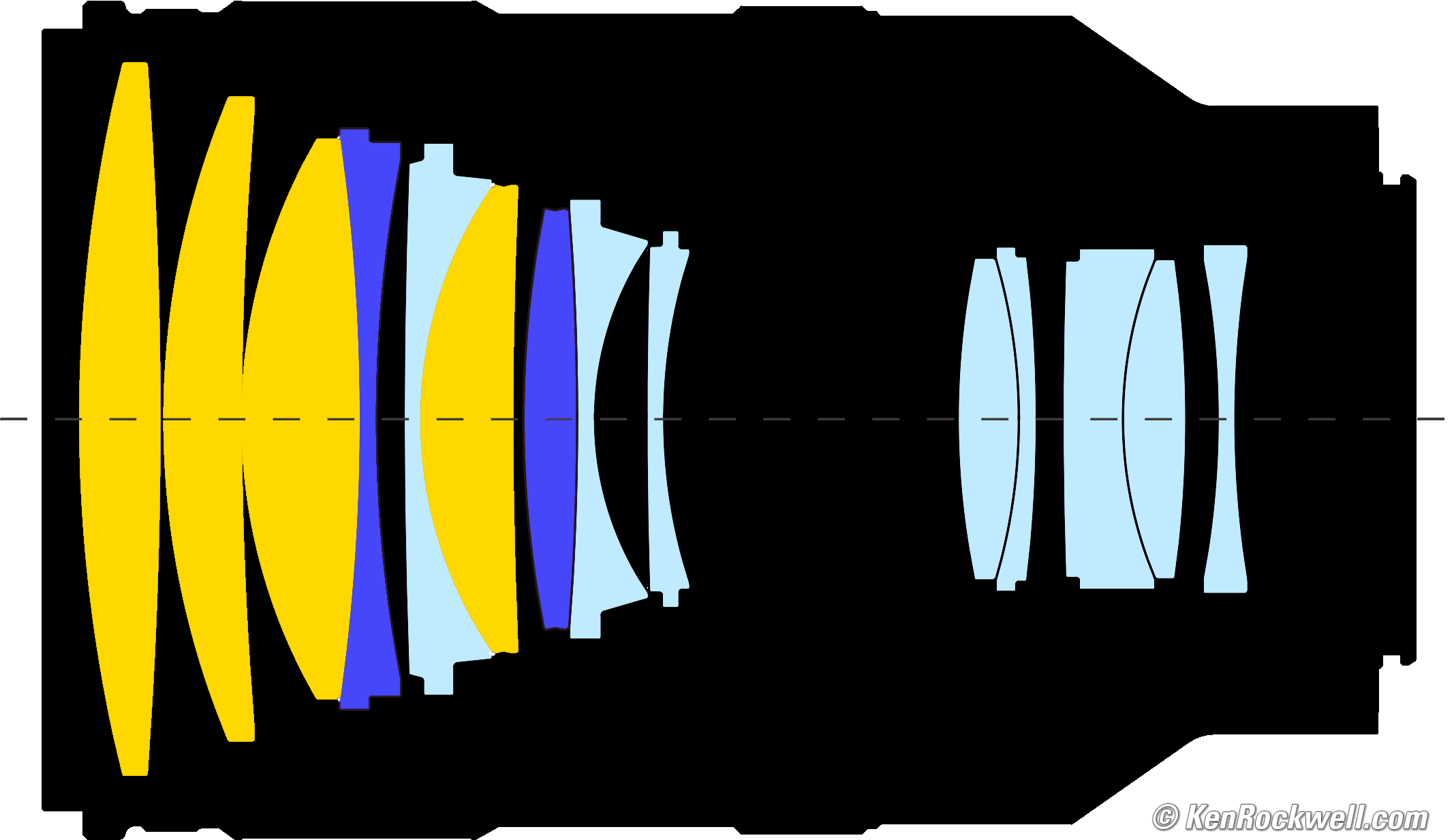
Internal Optical Construction. ED Extra-Low Dispersion, High Refractive Index and Regular Optical Glass. bigger
14 elements in 9 groups.
Two focus groups; this lens optimizes itself for every focussed distance.
4 ED elements: magic Extra-low Dispersion glass for reduced axial secondary chromatic aberration.
2 High Refractive Index elements.
Internal focusing with two floating groups moved by linear magnetic voice-coil motors.
Multicoating.
Claimed Nano and water- and crud-resistant coatings.
Diaphragm specifications top
|
|
At f/1.8. bigger. |
At f/4. bigger. |

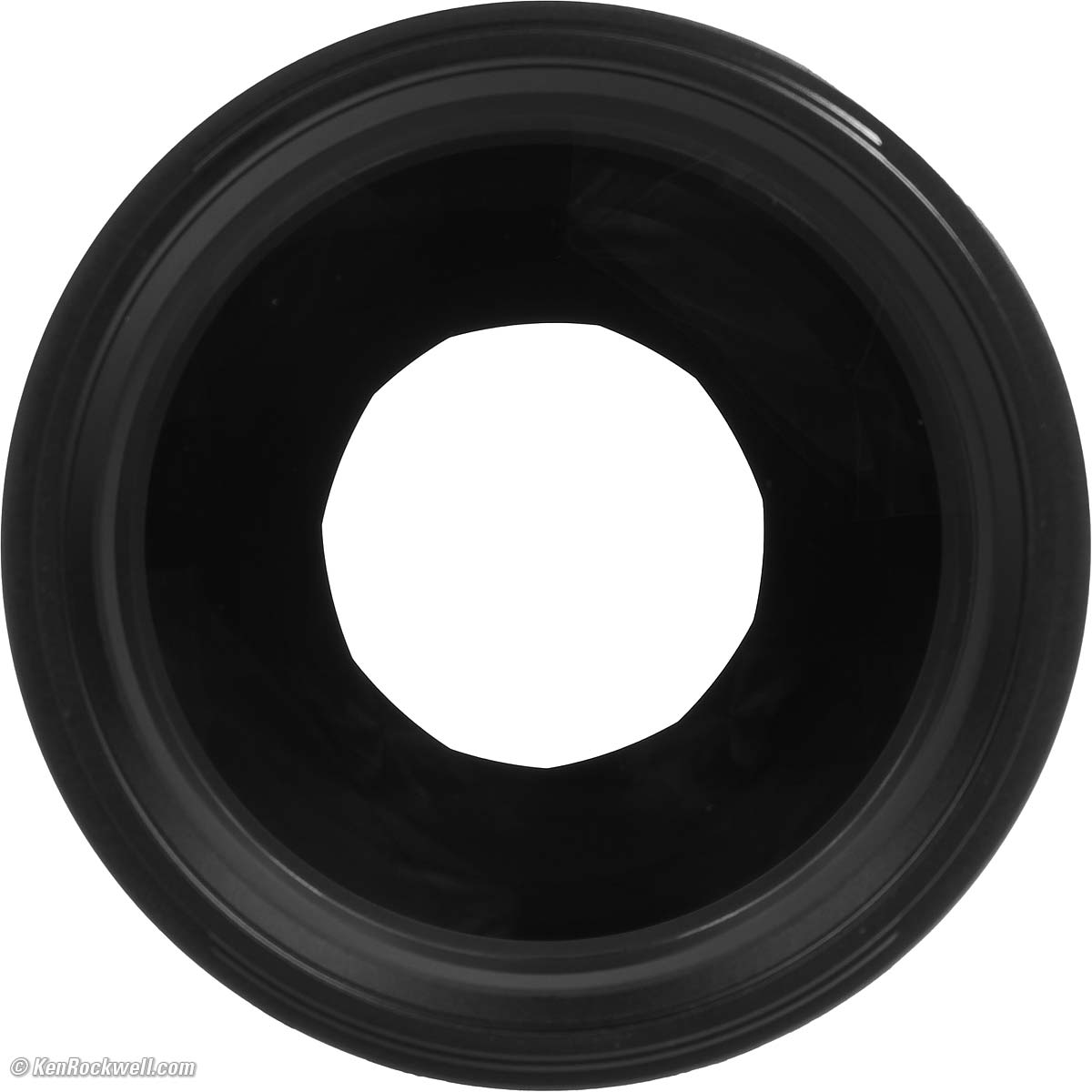
11 rounded blades.
Electronically actuated.
Stops down to f/16.
Filters specifications top
Metal 82mm filter thread.
Focal Length specifications top
135mm.
When used on an APS-C camera, it sees the same angle of view as a 200 mm lens sees when used on a full-frame or 35mm camera.
See also Crop Factor.
Angle of View specifications top
19.04º diagonal on full frame.
Autofocus specifications top
No external movement as focussed, so no air or dust is sucked in.
Focus Scale specifications top
Yes, on the LCD.
Infinity Focus Stop specifications top
No, however the function buttons can be used to set and recall infinity focus.
Depth of Field Scale specifications top
No.
Not on lens, but may be displayed in-camera.
Infrared Focus Index specifications top
No.
Close Focus (distance from subject to image plane) specifications top
2.36 feet (0.72 meters).
Maximum Reproduction Ratio specifications top
1:4.0 (0.25×).
Image Stabilizer specifications top
NONE.
Hood specifications top
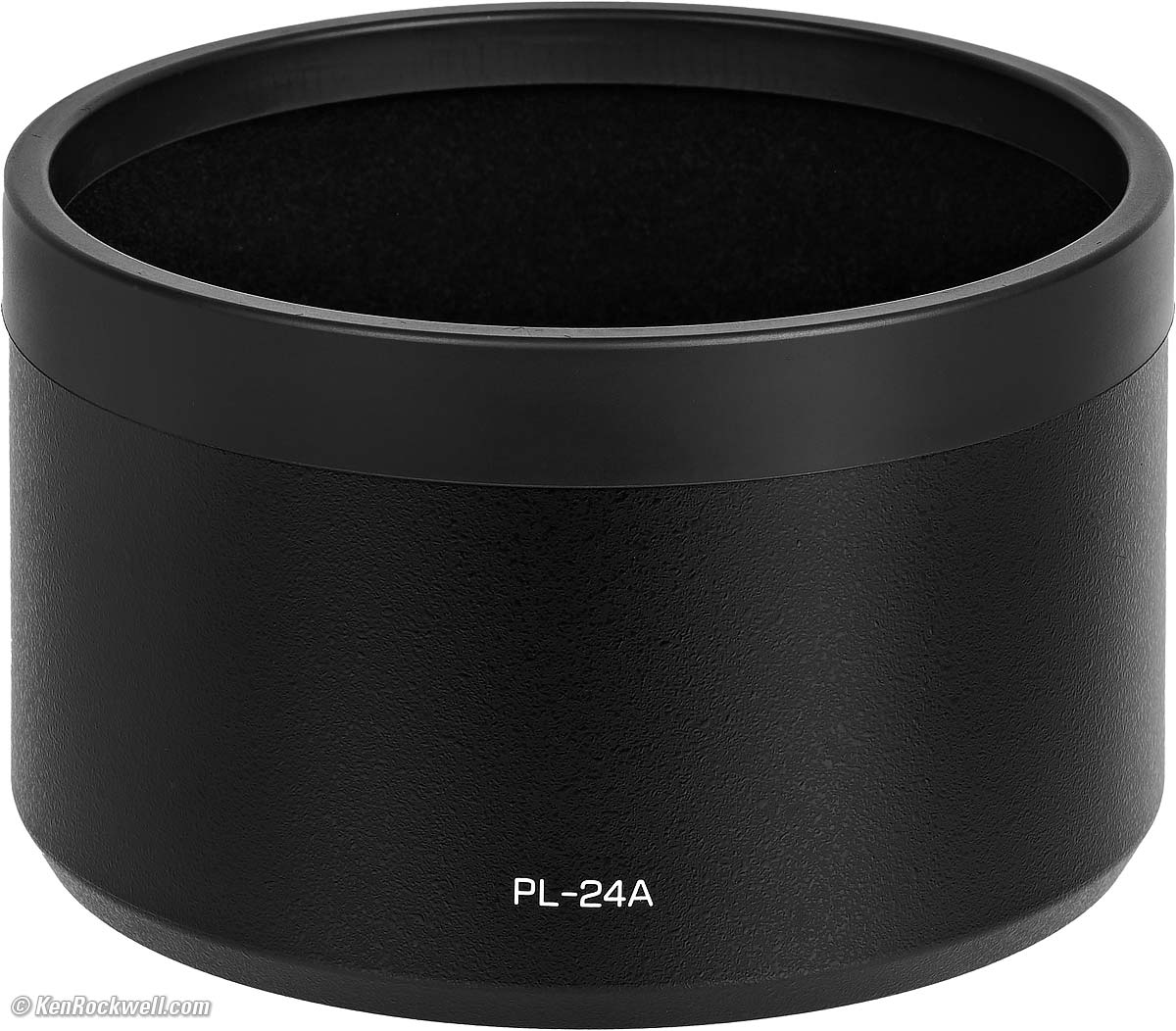
Included PL-24A Hood. bigger.
Case specifications top
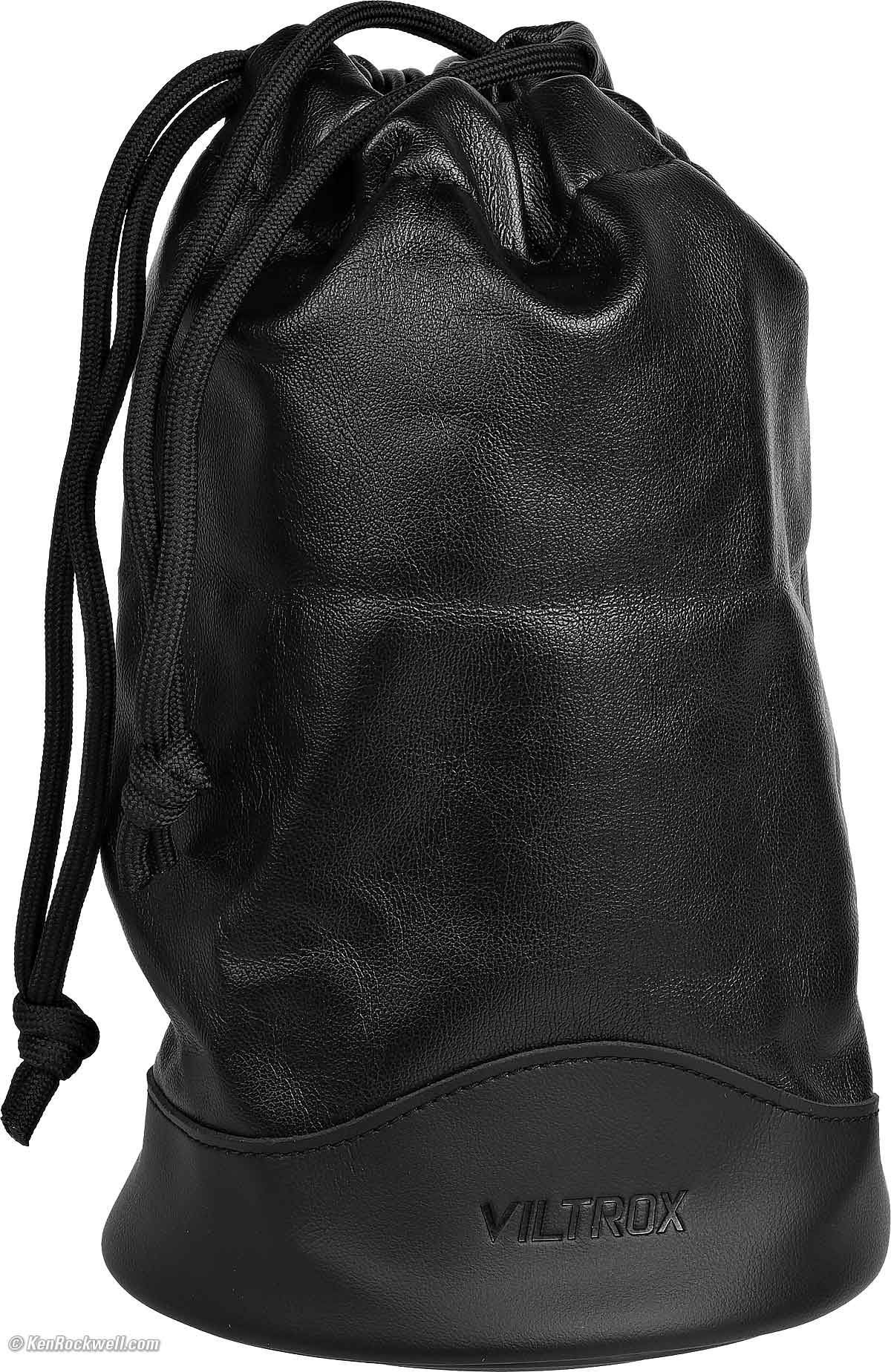
Included Sack. bigger.
Sizes specifications top
Nikon Z Version
3.66" ø maximum diameter × 5.81" extension from flange.
93mm ø maximum diameter × 147.6mm extension from flange.
Sony Version
3.66" ø maximum diameter × 5.74" extension from flange.
93mm ø maximum diameter × 145.7mm extension from flange.
Weights specifications top
44.525 oz. (1,262.35 g) actual measured weight, Nikon Z version.
Rated 44.6 oz. (1,265 g), Nikon Z version.
Rated 43.6 oz. (1,235 g), Sony version.
Quality specifications top
Made in China.
Announced specifications top
Spring 2025.
Included specifications top
Lens.
Caps.
Hood.
Case.
Packaging specifications top
Sealed box, with soft open-cell foam holding the lens inside:
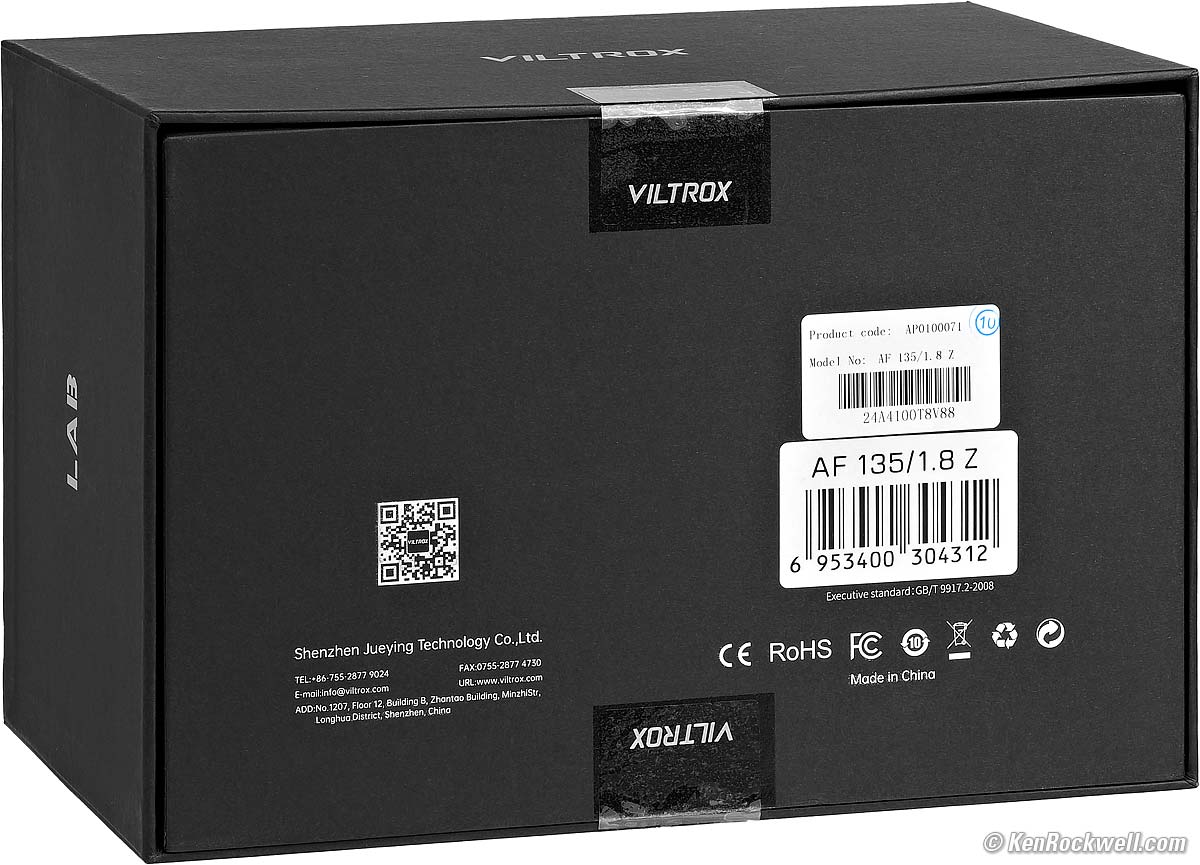
Viltrox AF 135mm f/1.8. bigger.
Price, U. S. A. specifications top
May ~ September 2025
Nikon
$899 directly from Viltrox. Hint: Try Coupon code KENROCKWELL at checkout possibly for an 8% discount.
$899 at Adorama, at Amazon and at B&H.
None have sold used as of 02 July 2025 (How to Win at eBay).
Sony
$899 direct from Viltrox. Hint: Try Coupon code KENROCKWELL at checkout possibly for an 8% discount directly from Viltrox.
$899 at Adorama, at Amazon and at B&H.
About $675 used at eBay, if you know How to Win at eBay.
Performance top
Sample Images Intro New Good Bad Missing
Specifications Performance Compared
Overall Autofocus Manual Focus Breathing
Distance Recording Bokeh Distortion
Ergonomics Falloff Filters Lateral Color Fringes
Lens Corrections LCD Display Macro Mechanics
Sharpness Spherochromatism Stabilization
Sunstars Teleconverters Weather Sealing
For Nikon: I got mine directly from Viltrox (try coupon code KENROCKWELL at checkout possibly for an 8% discount). I'd also get it at B&H, at Adorama or at Amazon, or get it used at eBay (How to Win at eBay) or get it used at KEH.
For Sony: I'd get mine directly from Viltrox (try coupon code KENROCKWELL at checkout possibly for an 8% discount). I'd also get it at B&H, at Adorama or at Amazon, or get it used at eBay (How to Win at eBay), or get it used at KEH.
Overall performance top
This is a surprisingly good lens: flawless optics in a sturdy, precise mount. Bravo!
Autofocus performance top
Autofocus is reasonably fast, and never hunts or misses, at least on my Nikon.
It makes a very quiet hum as it focuses.
Manual Focus performance top
Manual focusing is entirely electronic; the manual focus ring isn't connected to anything other than a digital encoder.
Manual focus is excellent. Its speed increases as you turn the ring more quickly, and becomes more precise as you turn the ring more slowly.
On Nikon, just grab the electronic manual focus ring for instant manual-focus override anytime the camera is awake. Unique to Nikon cameras, even if you're in AF-C and grab the manual-focus ring, it swaps to manual focus instantly and stays in manual focus. Other camera brands will try to fight you for focus if you're in continuous AF, while on Nikon this lens just does what you tell it to do. Bravo!
Focus Breathing performance top
Focus breathing is the image changing size (growing and shrinking slightly) as focused in and out. It's important to cinematographers that the image not breathe (change size) as focus gets pulled back and forth between different actors as they speak. The image is said to breathe because it expands and contracts as the focus follows the dialog back and forth.
The image from this lens grows as focussed more closely.
Focus Distance Recording performance top
I do not see the focused distance in the lower left of my screen in Photoshop's lens correction filter.
Bokeh performance top
Bokeh, the feel, character or quality of out-of-focus areas as opposed to how far out of focus they are, is superb. This is one of this lens' raisons d'être: it's reason to be.
Here are photos from headshot distance wide-open. I'm focused on the DAVIS logo. Click any for the © camera-original file:
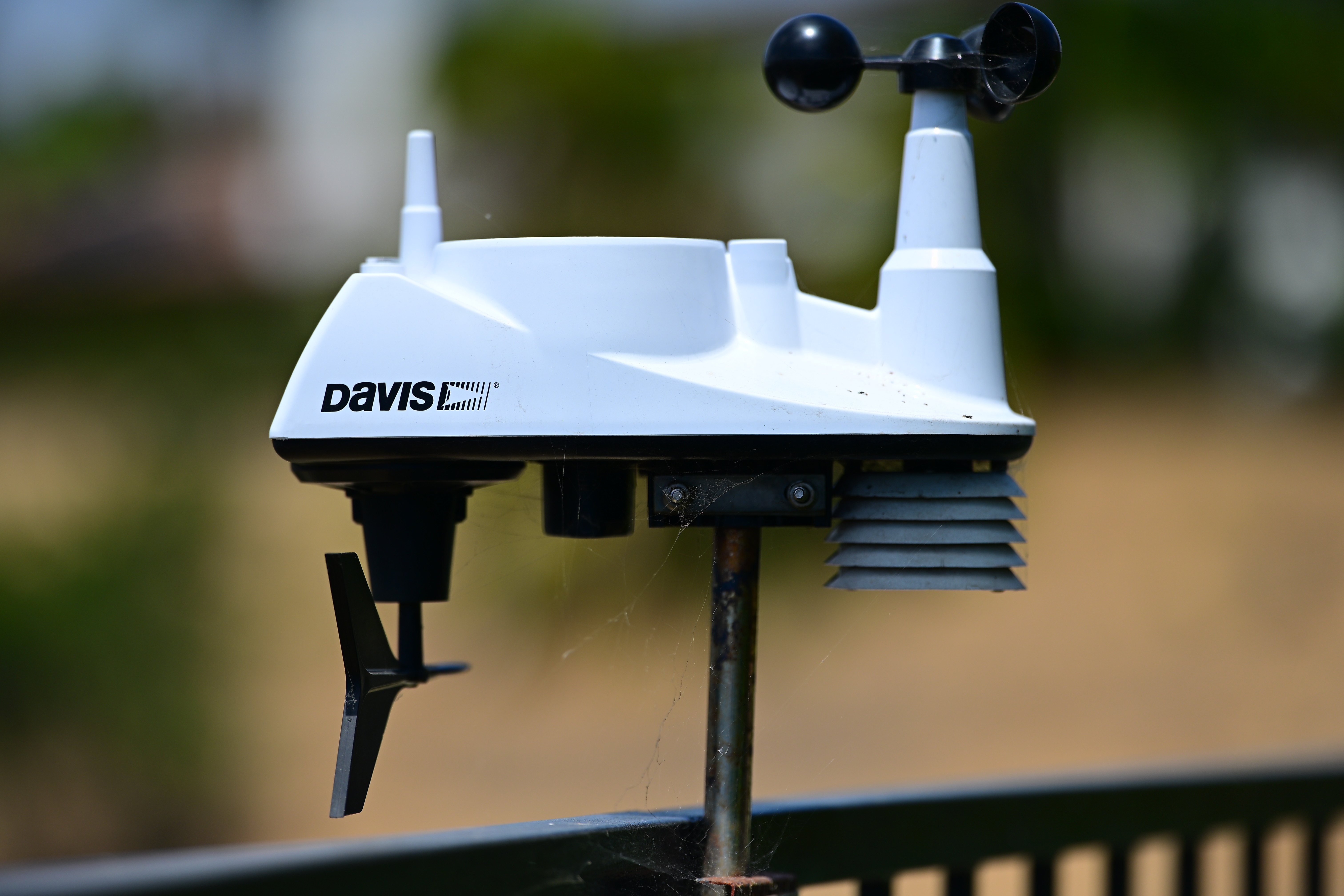
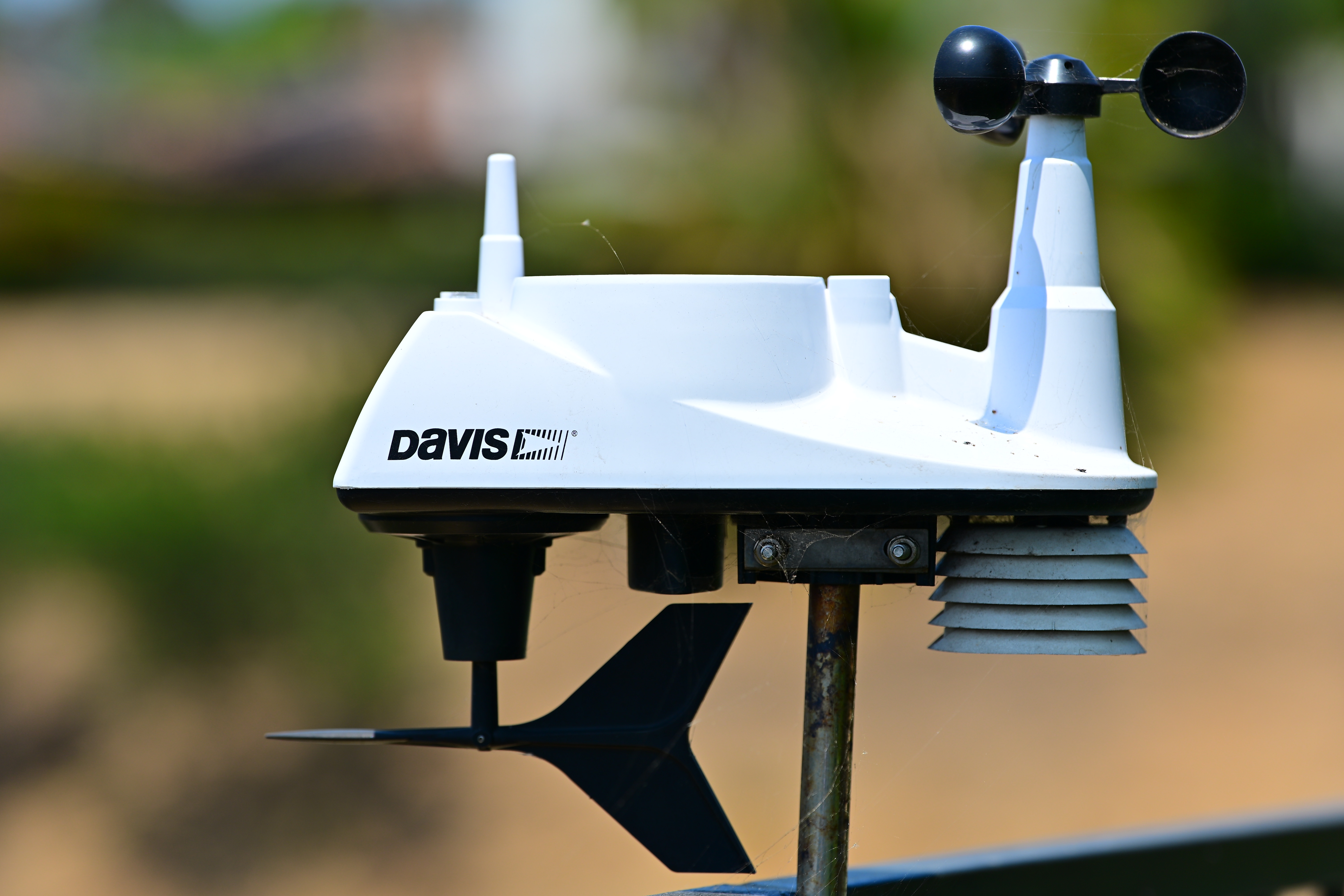
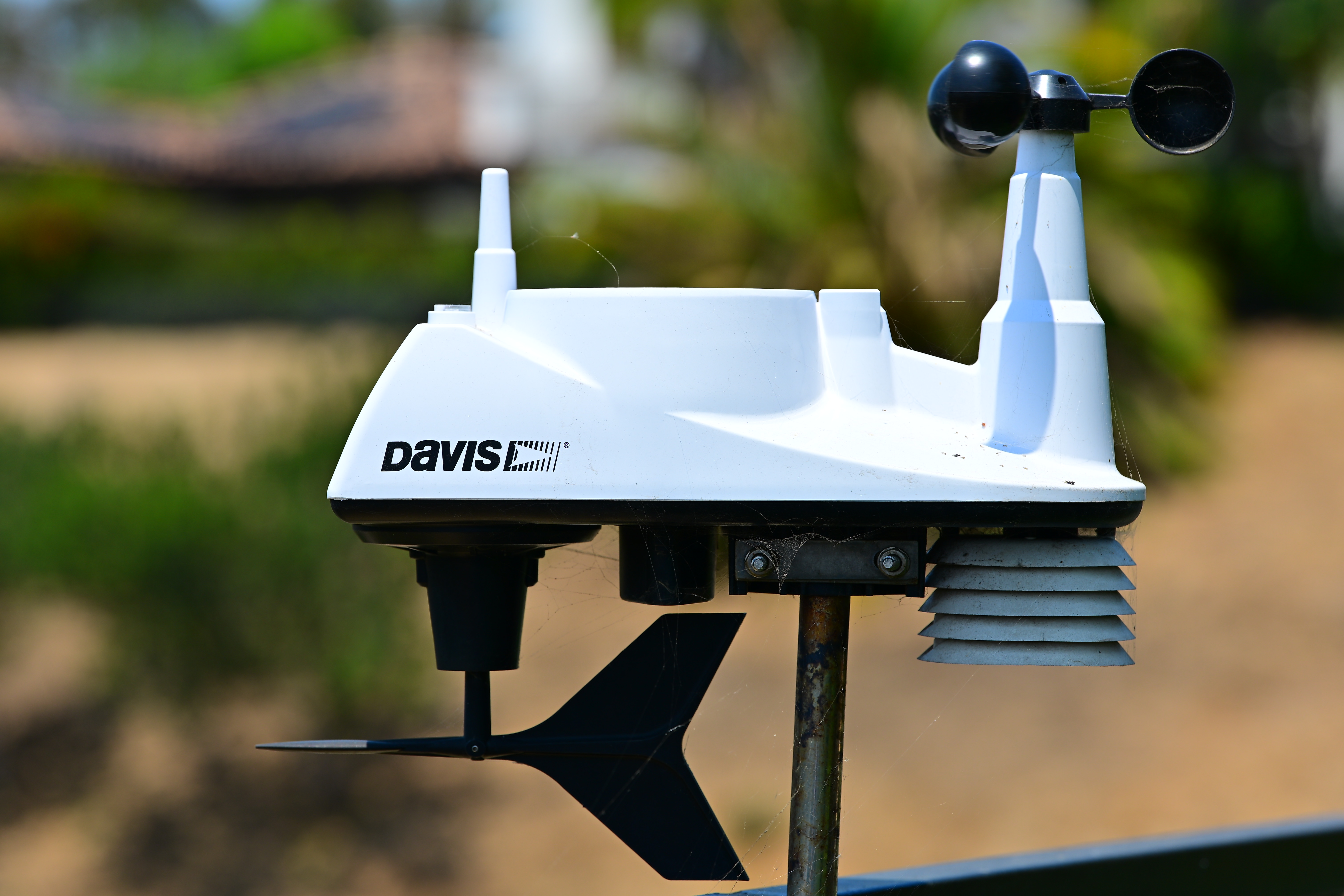
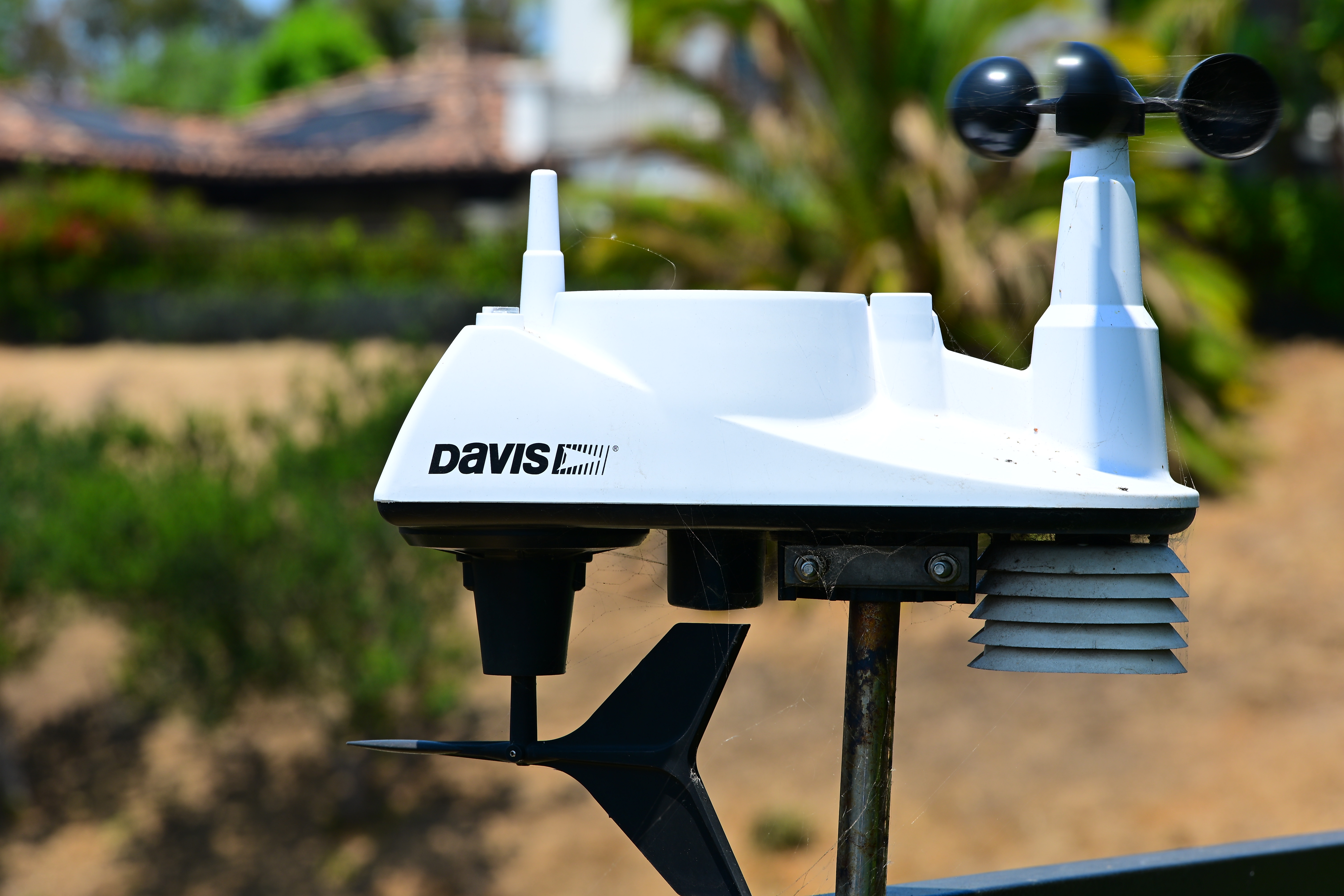
Made-in-U. S. A. Davis 6357 Vantage Vue Wireless Sensor Suite (use with WeatherLink console), 02-03 July 2025. Nikon Z5 II, Viltrox AF 135mm f/1.8 at 1/8,000, 1/2,000, 1/500 and 1/125 at Auto ISO 100 (LV 14⅔, 13.9, 13.9 and 13.9). Click any for the camera-original © file.
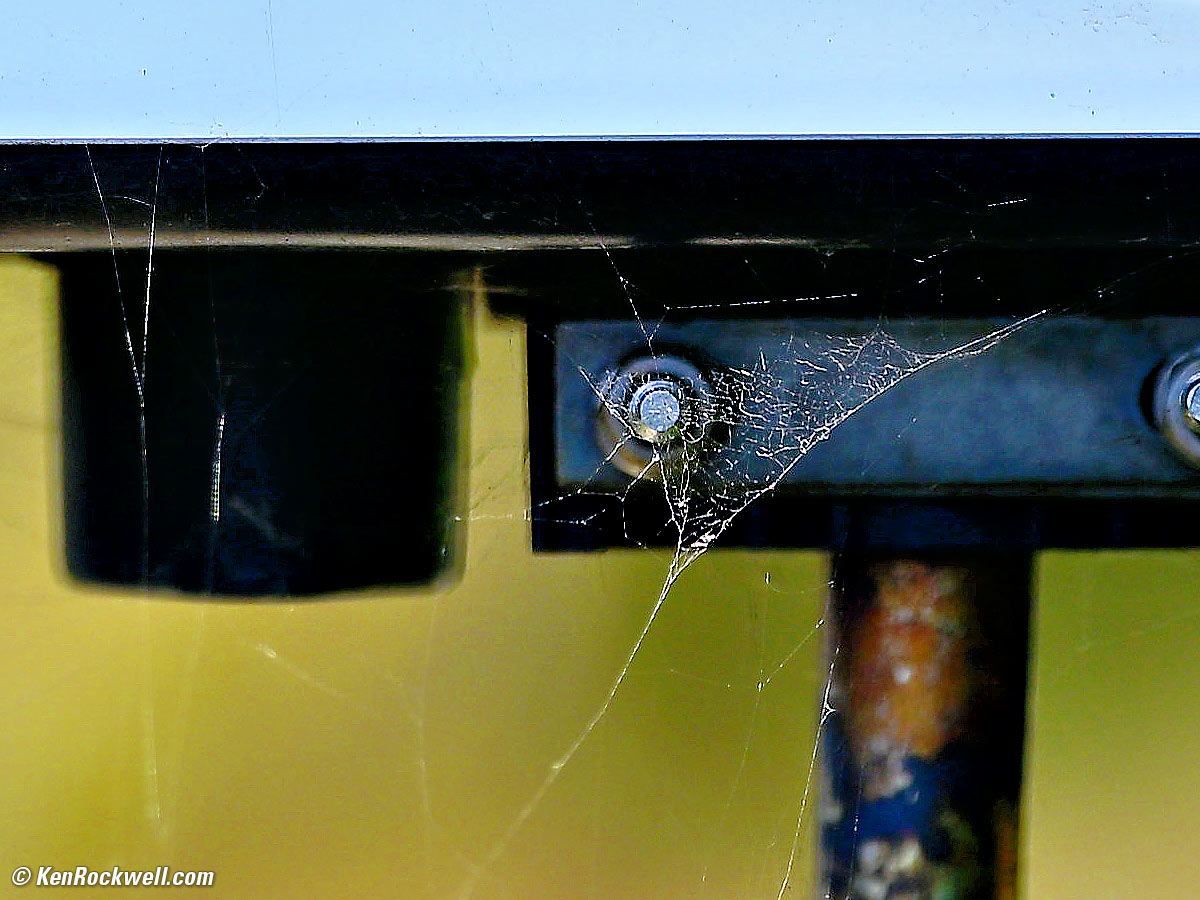
Look how sharp is the spider web under the weather station near the pole at f/1.8:
1,200 × 900 pixel (5× magnification) crop from above shot at f/1.8. bigger or camera-original © file.
As always, if you want to throw the background as far out of focus as possible, shoot at f/1.8 and get as close as possible.
Distortion performance top
This lens has no measurable distortion with or without distortion correction activated. Honestly even though I can turn it on and off in my Z5 II, I doubt there is any data with which to do anything, which is fine, as the distortion is less than what would need a factor of ±0.05 in Photoshop's lens correction filter to JPG images.
出色 (Bravo)!
Ergonomics performance top
|
|
|
Top. bigger. |
Bottom. bigger. |
Straight-on. bigger. |
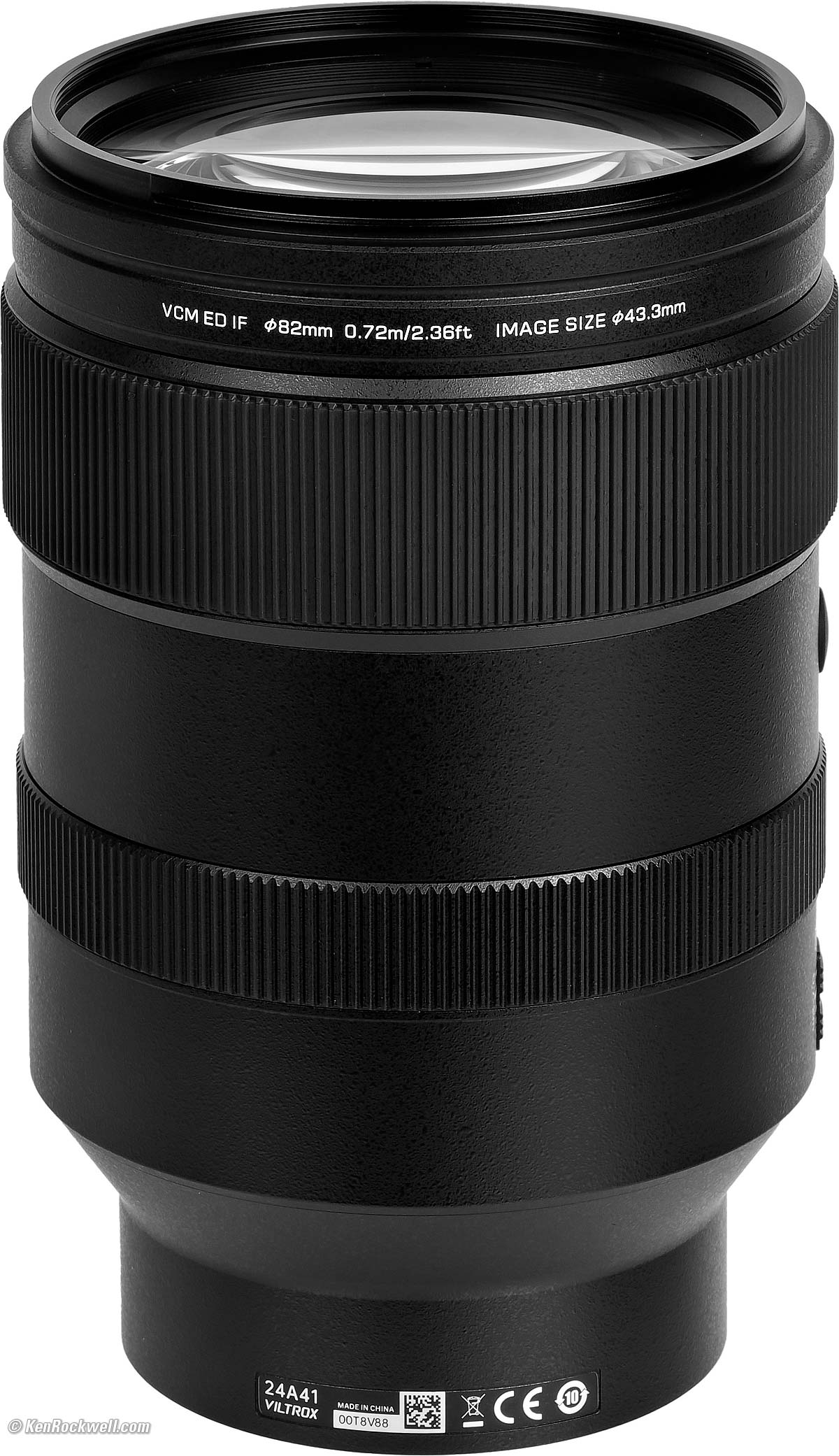
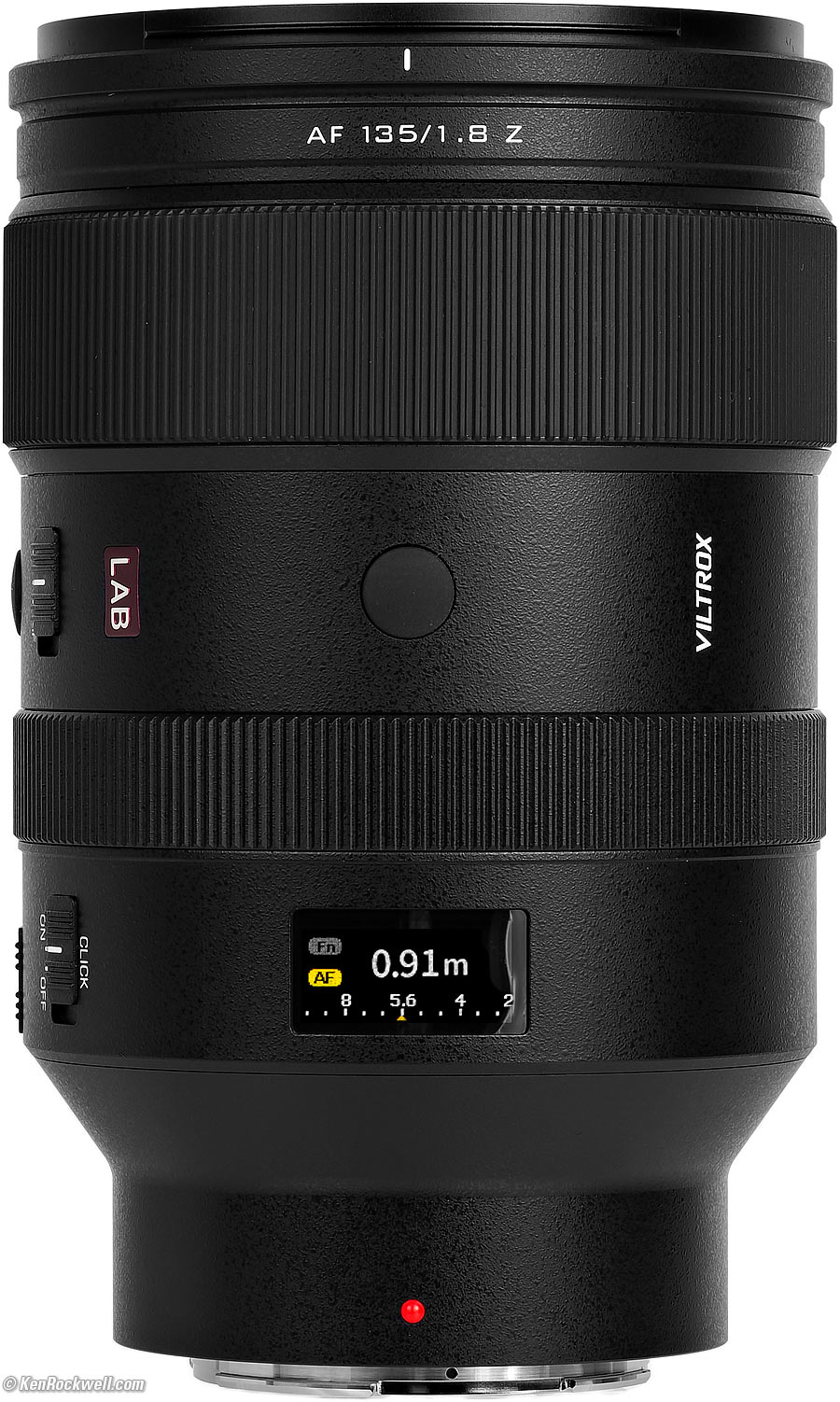
Other than being a big, fat, heavy lens, ergonomics are excellent.
There is no grip at the front as there is on the Nikon Z 135mm f/1.8.
The front ring is focus. Works great, and it's a rubber-covered metal ring, too!
Oddly the top Fn button is AF lock, and the side Fn button saves and recalls two preset distances. None of the Nikon Z 135mm f/1.8, Sony FE 135mm f/1.8 GM or Canon RF 135mm f/1.8L IS USM can do this. This is very handy for recalling distances to your bird feeder, home base or infinity for astronomers. This is with the Nikon version. I haven't tried the Sony version.
The rear control ring is programmable. It has clicks, with a switch to disable them.
See also my section on the Liquid Crystal Display (LCD).
Falloff performance top
Falloff is invisible, especially with correction ON.
I've greatly exaggerated the falloff by shooting a gray field and placing these on a gray background; it will not look this bad in actual photos of real things:
Falloff on full-frame at infinity, Vignetting correction at its default of NORMAL:
© 2025 KenRockwell.com. All rights reserved. |




If you save only raw data rather than create JPG images in-camera, whatever software you use to create visible images from that raw data later may or may not correct this as is done in-camera as JPGs. You're on your own there; I don't bother with raw data.
If you go out of your way to turn off the correction, or possibly in some raw software, this is what you get:
Falloff on full-frame at infinity, Vignetting correction turned OFF:
© 2025 KenRockwell.com. All rights reserved. |




Even without correction, it's invisible with real pictures.
Filters, use with performance top
There's no need for thin filters. I can stack several standard 82mm filters with no vignetting at any setting on full-frame.
Go ahead and use your standard rotating polarizer and grad filters.
Be careful; a lens this fast and long could be sensitive to poorly made filters. Check any filter you hope to use with this lens for flatness. Take photos with and without the filter, or even better, just hold it over the front of one side of a pair of binoculars or a small telescope. The image should be perfectly clear with or without the filter. If the filter is even slightly unflat, the image seen through the telescope will look awful! So long as it looks good when held in front of your scope, it will be perfect for pictures. This test instantly makes even slightly bad filters look absolutely awful, so if it looks OK through your scope, you're good.
Lateral Color Fringes performance top
There are no color fringes as shot on Nikon cameras as JPG, which by default correct for any that may be there.
If you shoot raw and then use non-manufacturer software to process that data into images then there is the possibility that there might be some, but I doubt it.
There is almost no spherochromatism, which can cause color fringes on things that aren't in perfect focus at large apertures. Spherochromatism is a completely different aberration in a different dimension than lateral color fringes.
Lens Corrections performance top
I doubt any camera has any correction data for use with this lens, however the Nikon Z9, Z8, Z7 II, Z6 III, Z6 II, Zƒ, Z7, Z6, Z5 II, Z5, Zƒc, Z50 II, Z50 and Z30 do allow us to select correction for any or all of distortion, diffraction and falloff (vignette control).
Each of these three may be turned ON or OFF as you like, and vignette control does indeed seem to correct for falloff. There's no distortion with correction either ON or OFF.
The Z9, Z8, Z7 II, Z6 III, Z6 II, Zƒ, Z7, Z6, Z5 II, Z5, Zƒc, Z50 II, Z50 and Z30 always correct for lateral color fringes (lateral chromatic aberration). This is part of Nikon's secret sauce and never appears in any menu and doesn't need lens data.
Color Liquid Crystal Display (LCD) performance top
The tiny color LCD is more useful than I had expected.
It's a color LCD, although it's usually showing black-and-white numbers. Some functions and scale indices are in color.
The LCD always shines at the same brightness, which is very clear indoors and in shade, and still visible in direct sunlight.
It's very visible indoors:
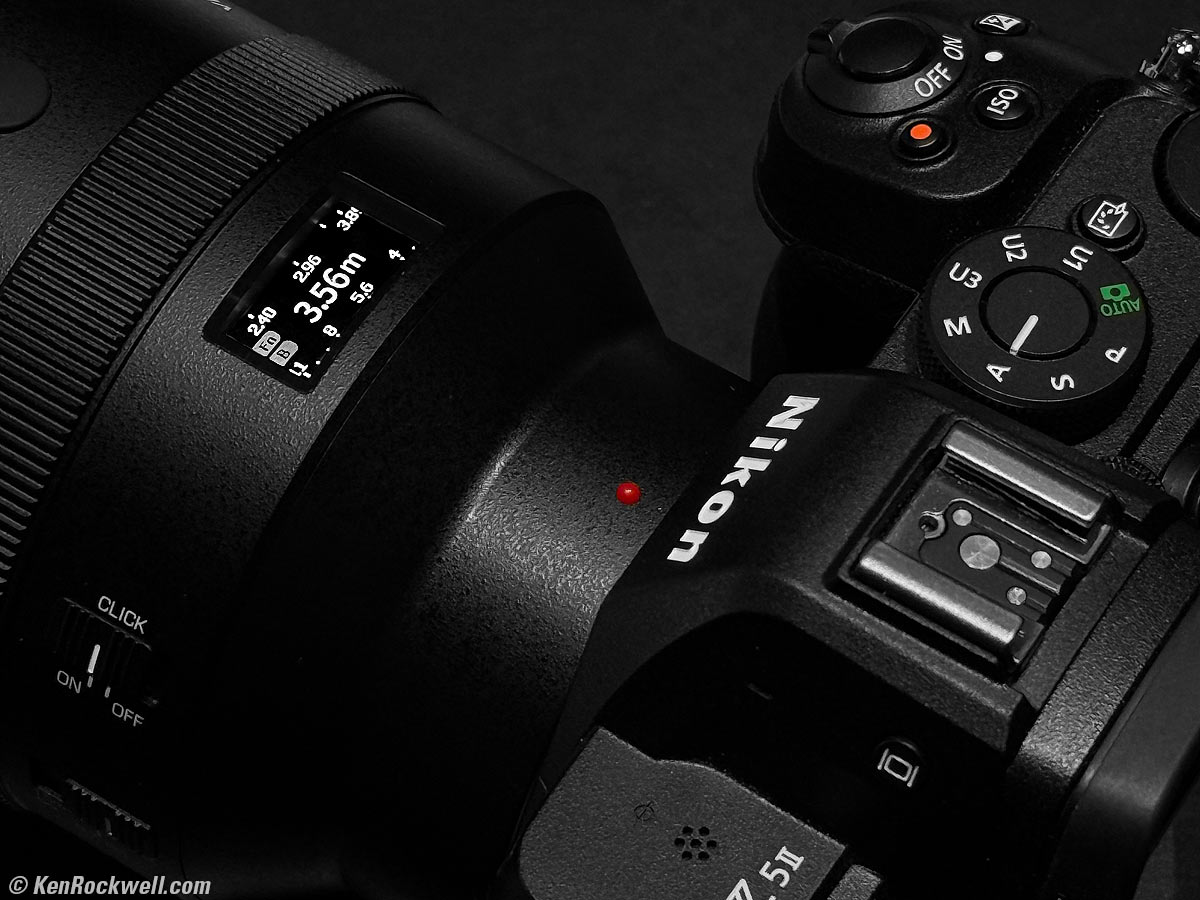
LCD indoors on my Nikon Z5 II. bigger.
It's also brilliant in outdoors shade:
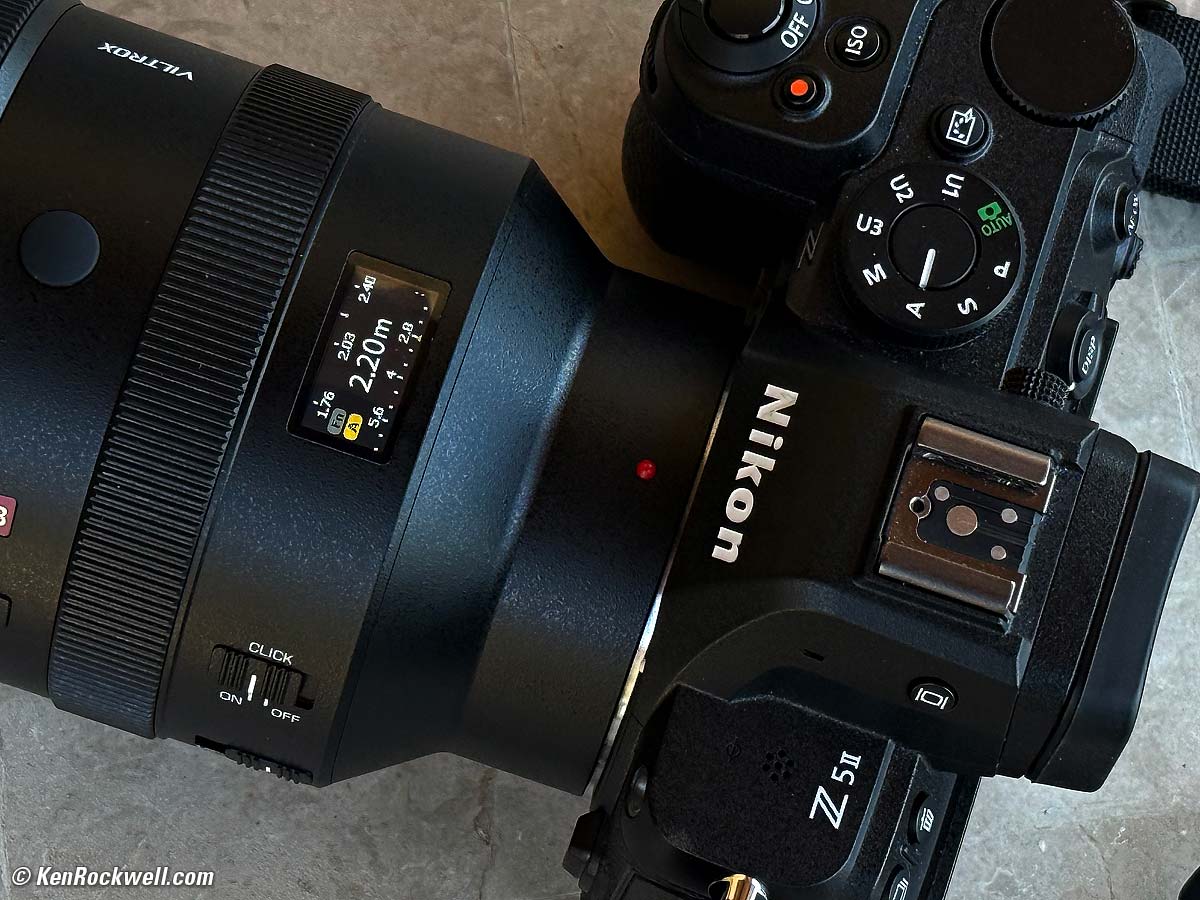
LCD in shade outdoors on my Nikon Z5 II. bigger.
It's even visible in direct sunlight, although you're better off if you can shield it with your hand:
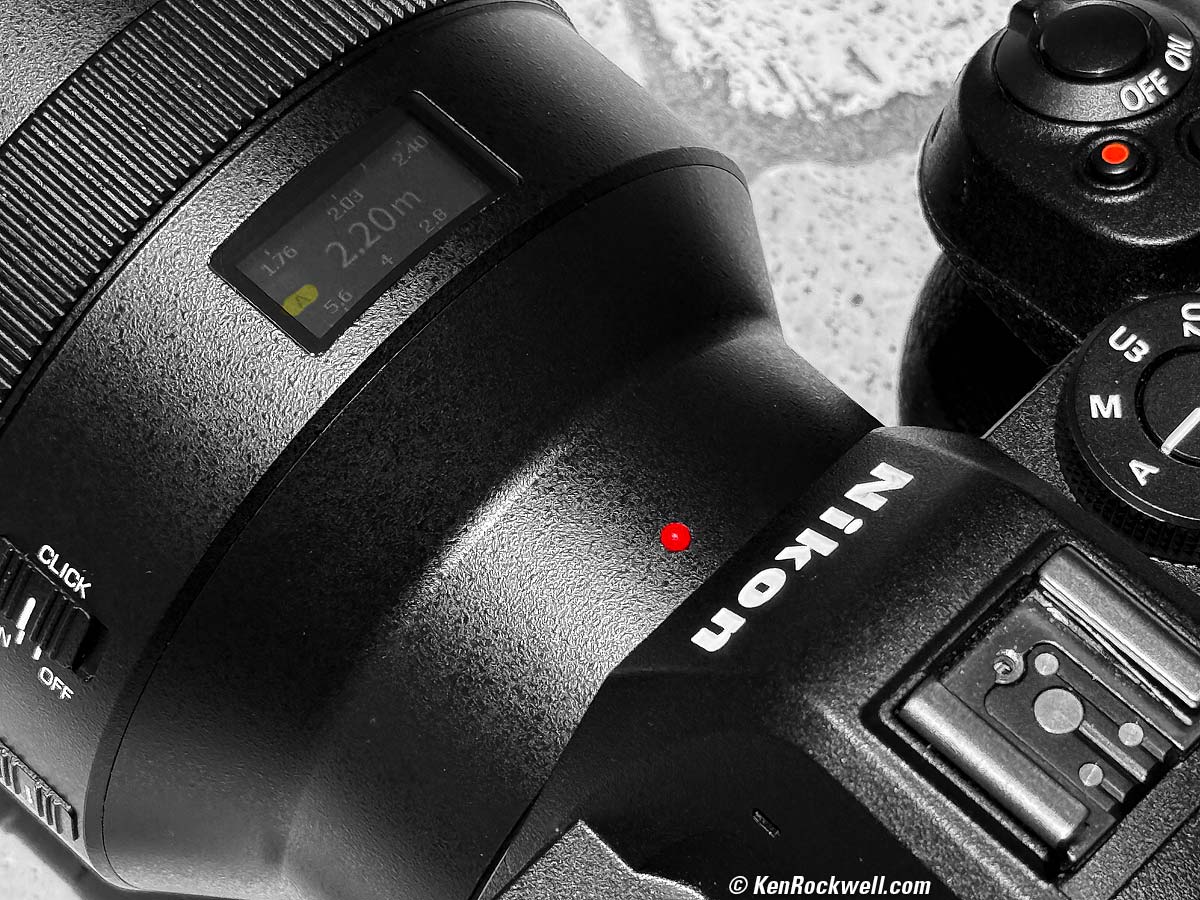
LCD in direct noonday summer sun on my Nikon Z5 II. bigger.
The LCD takes about 3 seconds to wake when the camera turns on or wakes back up.
The LCD goes to sleep after being ignored for 13 seconds. It wakes immediately when you move anything on the lens, so long as the camera is awake, and moving anything on the lens also keeps your camera awake.
It's very visible from any direction; it's a better quality screen than my kid's Acer Chromebook!
There is a slight delay in response, making it slower for setting things.
The LCD is easy; there's nothing to set.
It shows what it needs to show, no fiddling required.
Macro Performance performance top
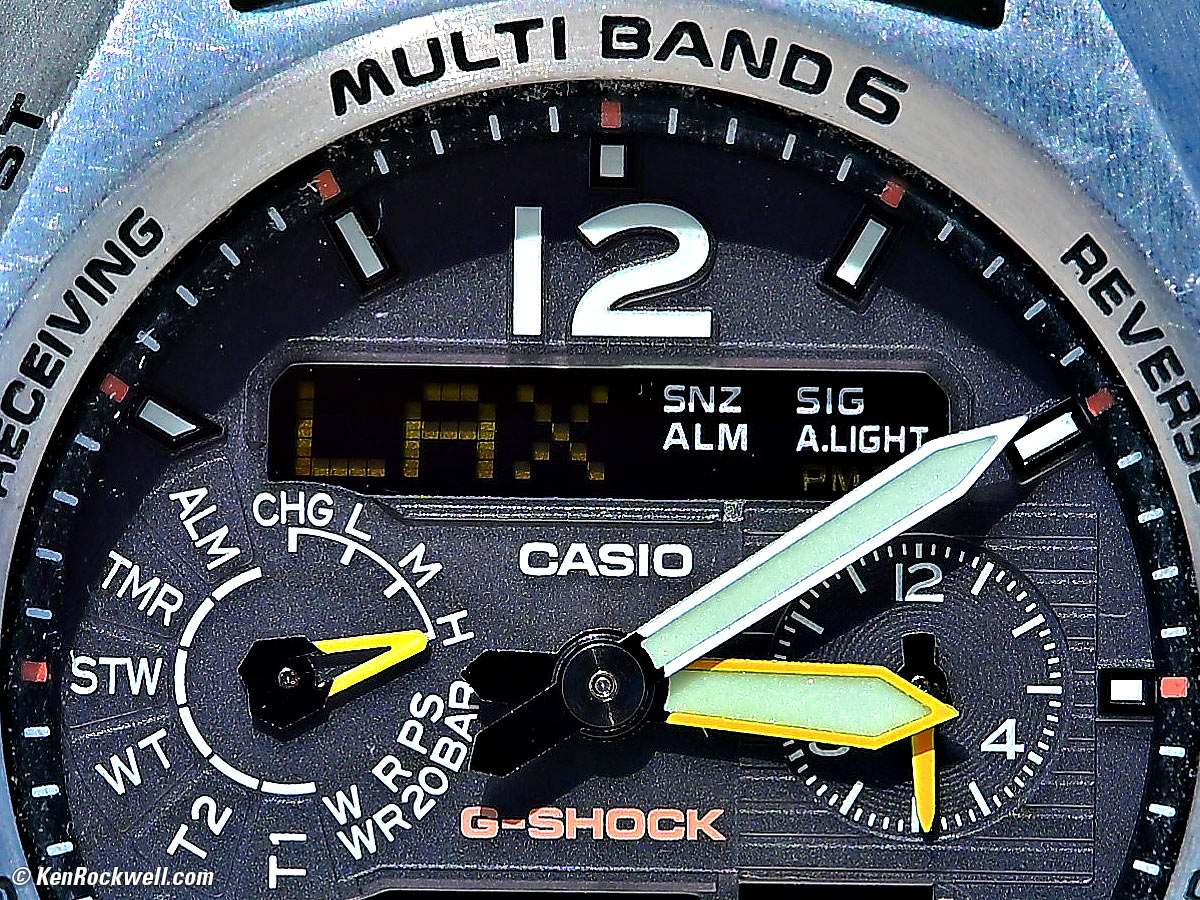
It's sharp, and gets reasonably close:
At f/1.8
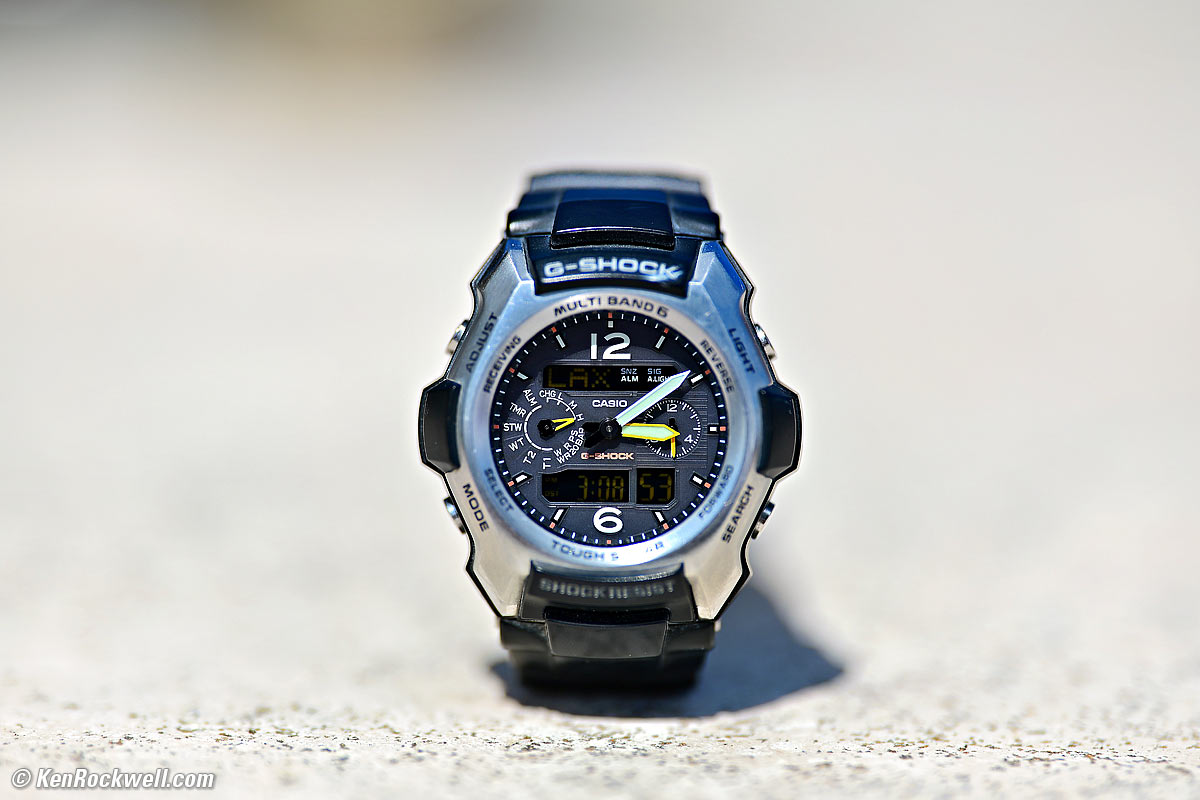
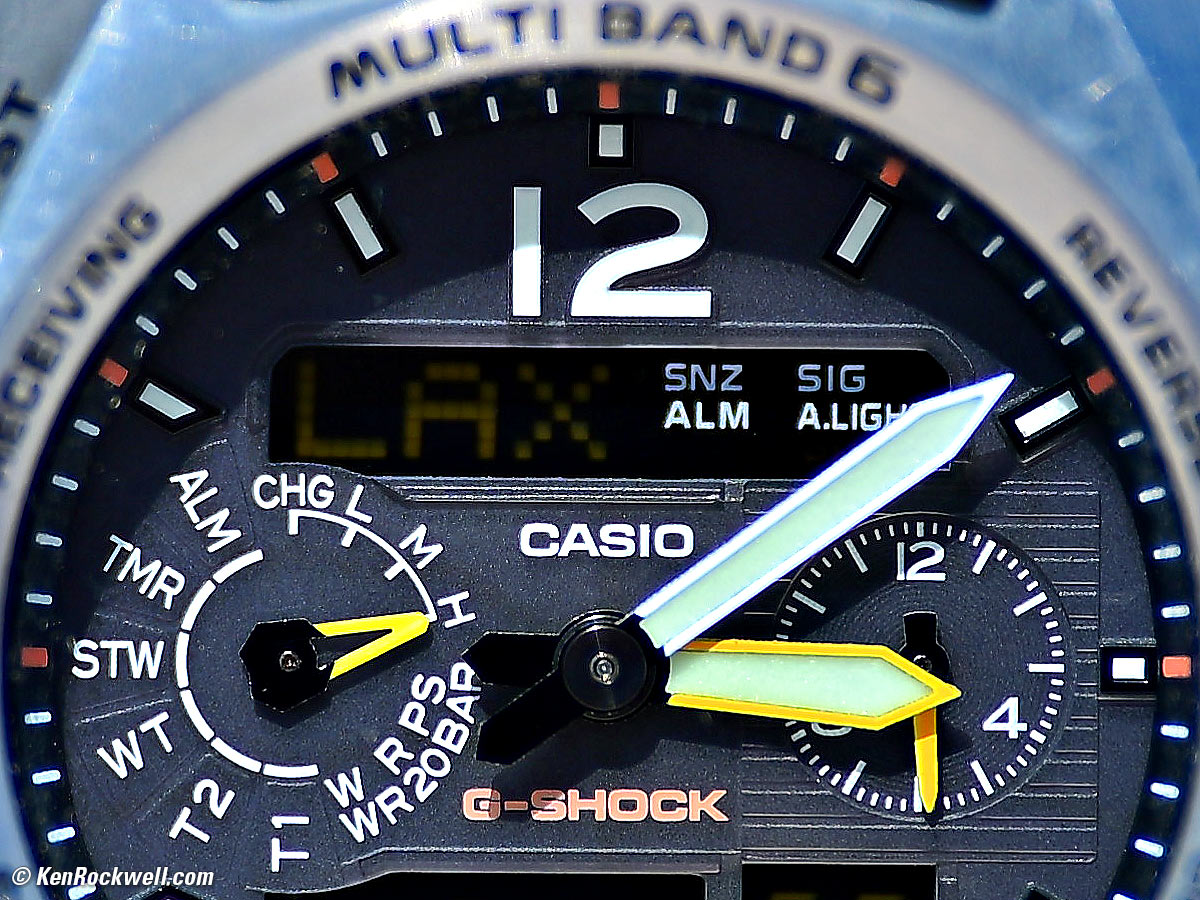
It's surprisingly sharp, and reasonably free from spherochromatism which keeps away color fringes:
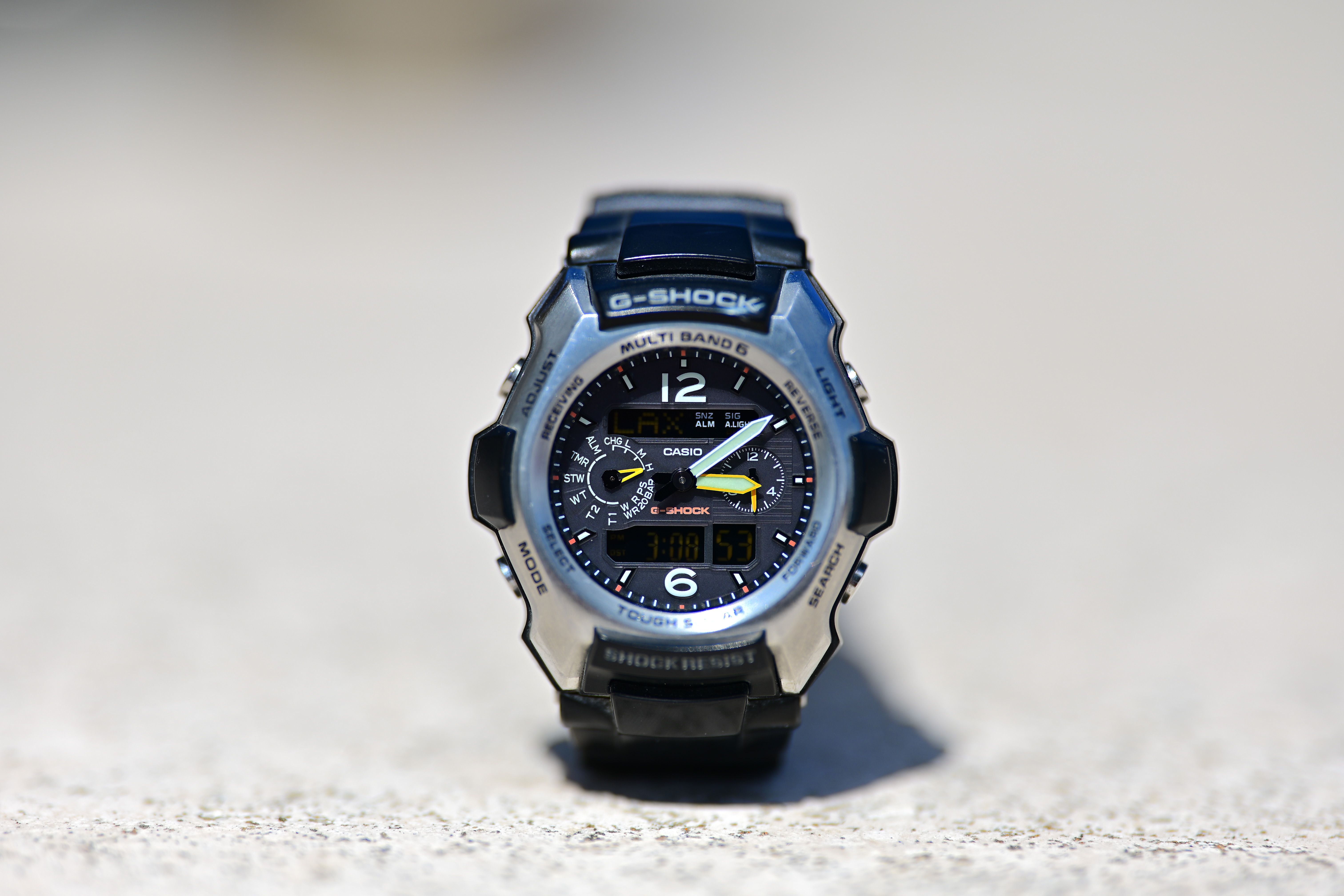
Casio G-Shock Solar Atomic Watch at close-focus distance, 13 June 2025. Nikon Z5 II, Viltrox AF 135mm f/1.8 at f/1.8 at 1/4,000 at ISO 50, +0.7 stops exposure compensation (LV 14⅔), Radiant Photo software. bigger or camera-original © file.
1,200 × 900 pixel (5× magnification) crop from above. bigger or camera-original © file.
If this 1,200 × 900 pixel crop is about 3" (7.5cm) wide on your screen, then the complete image printed at this same large magnification would be about 10 × 15" (25 × 38cm).
If this 1,200 × 900 pixel crop is about 6" (15cm) wide on your screen, then the complete image printed at this same extreme magnification would be about 20 × 30" (50 × 75cm).
If this 1,200 × 900 pixel crop is about 12" (30cm) wide on your screen, then the complete image printed at this same insanely high magnification would be about 40 × 60" (1 × 1.5 meters).
Click any for the camera-original © files.
At f/8
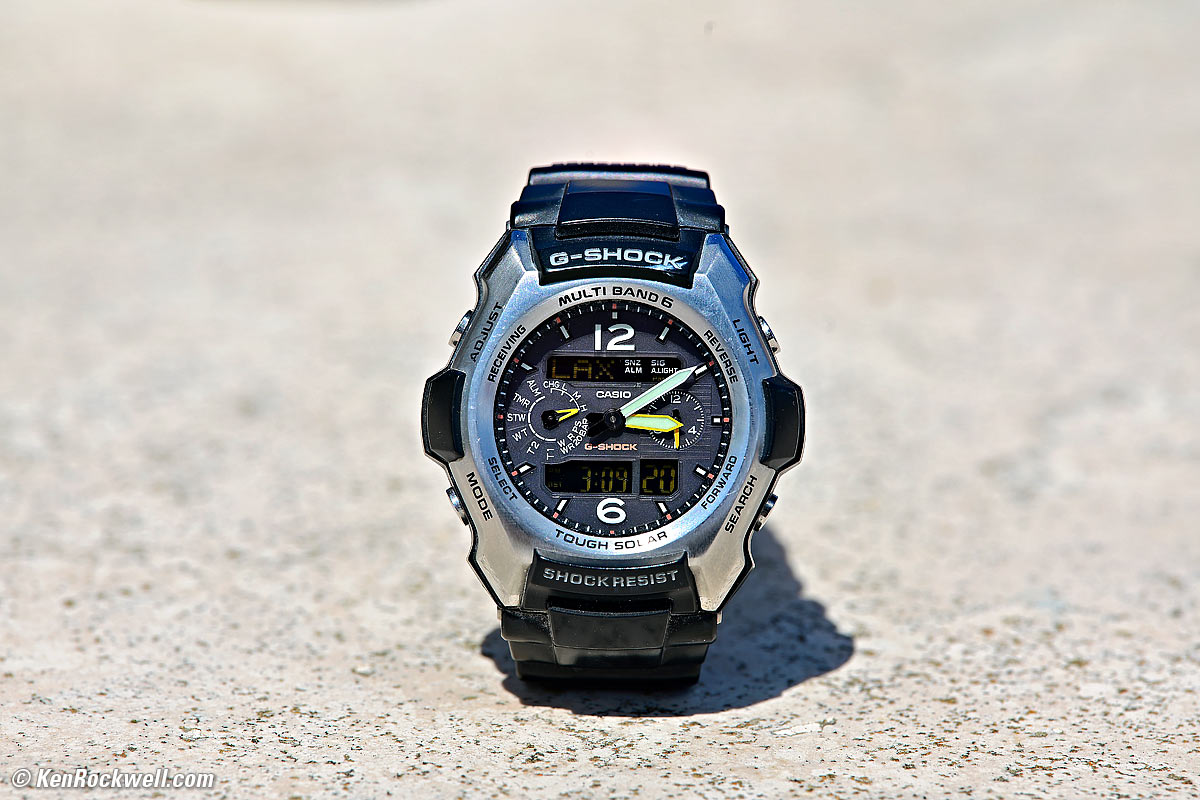
Like every lens, it's super sharp at f/8:
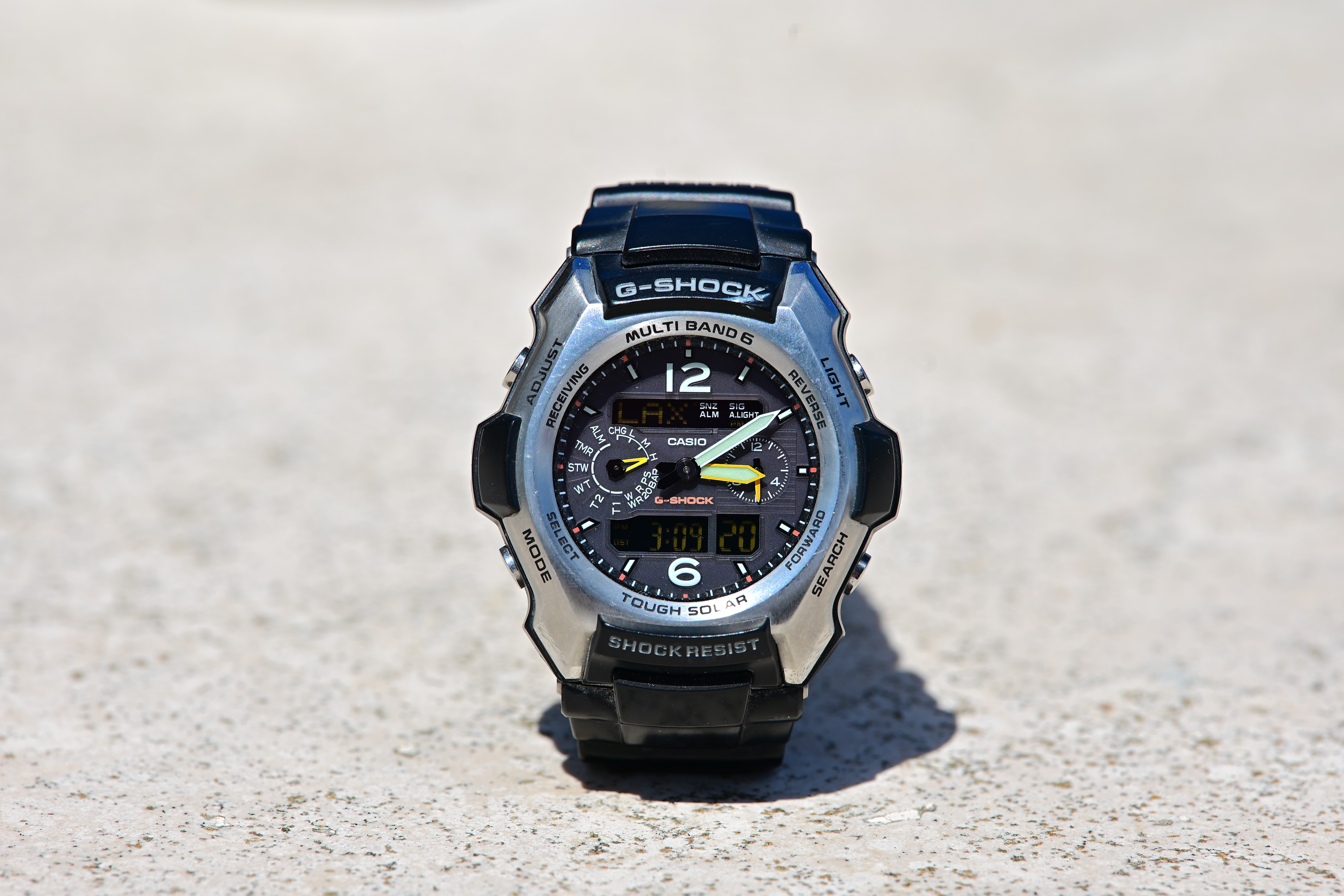
Casio G-Shock Solar Atomic Watch at close-focus distance, 13 June 2025. Nikon Z5 II, Viltrox AF 135mm f/1.8 at f/8 at 1/250 at ISO 50, +0.7 stops exposure compensation (LV 15.0), Radiant Photo software. bigger or camera-original © file.
1,200 × 900 pixel (5× magnification) crop from above. bigger or camera-original © file.
If this 1,200 × 900 pixel crop is about 3" (7.5cm) wide on your screen, then the complete image printed at this same large magnification would be about 10 × 15" (25 × 38cm).
If this 1,200 × 900 pixel crop is about 6" (15cm) wide on your screen, then the complete image printed at this same extreme magnification would be about 20 × 30" (50 × 75cm).
If this 1,200 × 900 pixel crop is about 12" (30cm) wide on your screen, then the complete image printed at this same insanely high magnification would be about 40 × 60" (1 × 1.5 meters).
Click any for the camera-original © files.
Mechanical Quality performance top
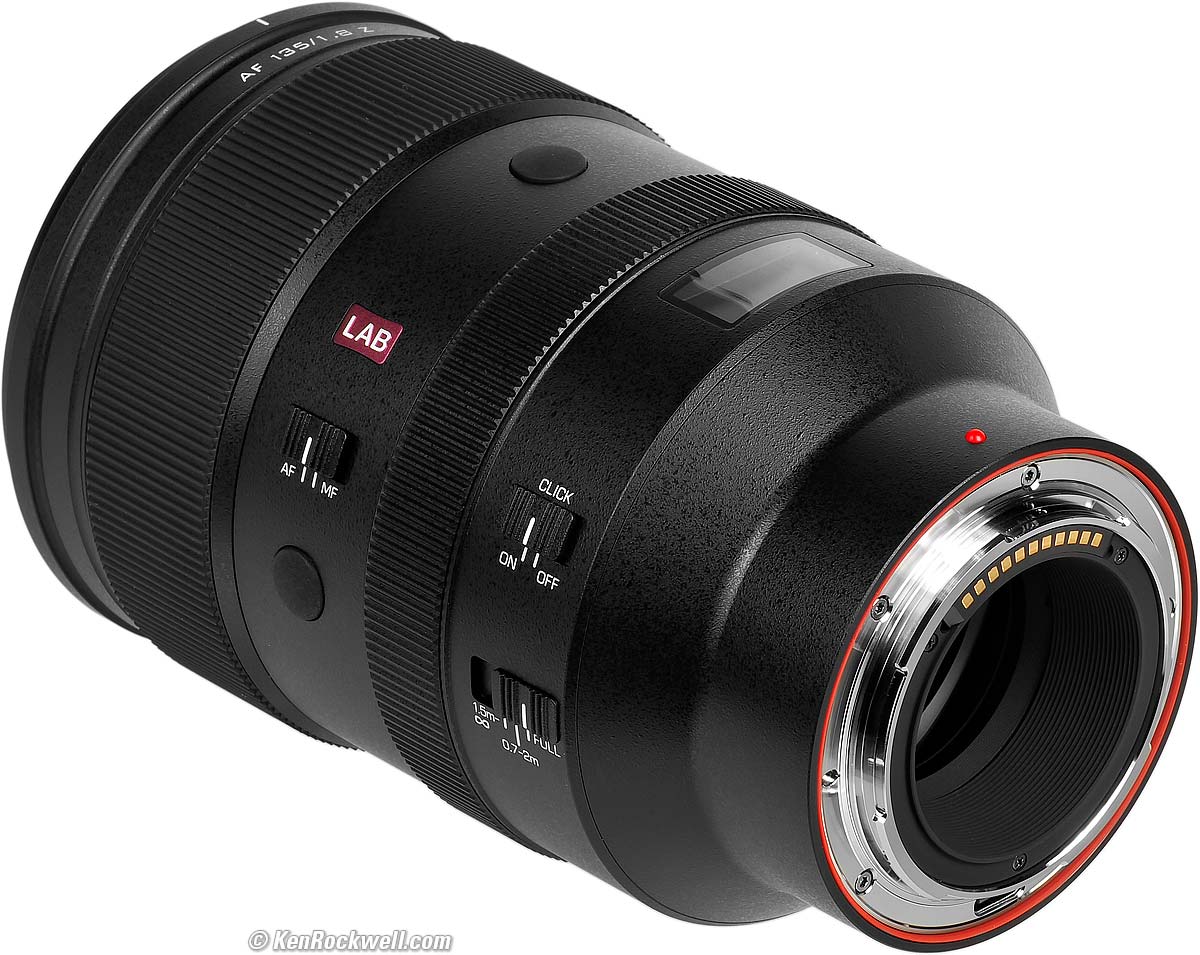
Viltrox AF 135mm f/1.8. bigger.
This lens has more metal on it than any of the Nikon Z 135mm f/1.8, Sony FE 135mm f/1.8 GM or Canon RF 135mm f/1.8L IS USM lenses.
Exterior Finish
Black anodized aluminum and black plastic.
Hood
Plastic bayonet.
Locks.
Front Bumper
None.
Filter Threads
Metal!
Hood Bayonet Mount
Metal!
Front Barrel Exterior
Metal!
Focus Ring
Rubber-covered metal.
Mid Barrel Exterior
Section with Fn buttons and AF/MF switch: plastic.
Programmable. Control Ring
Solid hard ribbed metal.
Rear Barrel Exterior (section with LCD and switches)
Plastic.
Rear Barrel Exterior (rearmost section near mount)
Metal!
Slide Switches
Plastic.
Identity
Laser engraved on metal ring at the front of the barrel, just behind the hood mount.
Internals
Looks like mostly or all-metal!
Dust Gasket at Mount
Yes, orange.
Mount
Chromed metal.
Markings
Painted on plastic parts.
Laser engraved on anodized aluminum parts.
Serial Number
Printed on a sticker on the bottom of the lens, which is not the way to attach a permanent serial number.
Date Code
None found.
Noises When Shaken
Strong clunking from half of the internal optics floating around freely when the power is off.
You don't even need to shake it; simply point it up or down and the inner elements glide from one end of their stops to the other.
Made in
Made domestically in China.
Sharpness performance top
Lens sharpness has nothing to do with picture sharpness; every lens made in the past 100 years is more than sharp enough to make super-sharp pictures if you know what you're doing. The only limitation to picture sharpness is your skill as a photographer. It's the least talented who spend the most time worrying about lens sharpness and blame crummy pictures on their equipment rather than themselves. Skilled photographers make great images with whatever camera is in their hands; I've made some of my best images of all time with an irreparably broken camera! Most pixels are thrown away before you see them, but camera makers don't want you to know that.
If you're not getting ultra-sharp pictures with this, be sure not to shoot at f/11 or smaller where all lenses are softer due to diffraction, always shoot at ISO 100 or below because cameras become softer at ISO 200 and above, avoid shooting across long distances over land which can lead to atmospheric heat shimmer, be sure everything is in perfect focus, set your camera's sharpening as you want it (I set mine to the maximum) and be sure nothing is moving, either camera or subject. If you want to ensure a soft image with any lens, shoot at f/11 or smaller at ISO 1,600 or above at default sharpening in daylight of subjects at differing distances in the same image.
People worry waaaaay too much about lens sharpness. It's not 1968 anymore when lenses often weren't that sharp and there could be significant differences among them; ever since about 2010 all new lenses are all pretty much equally fantastic.
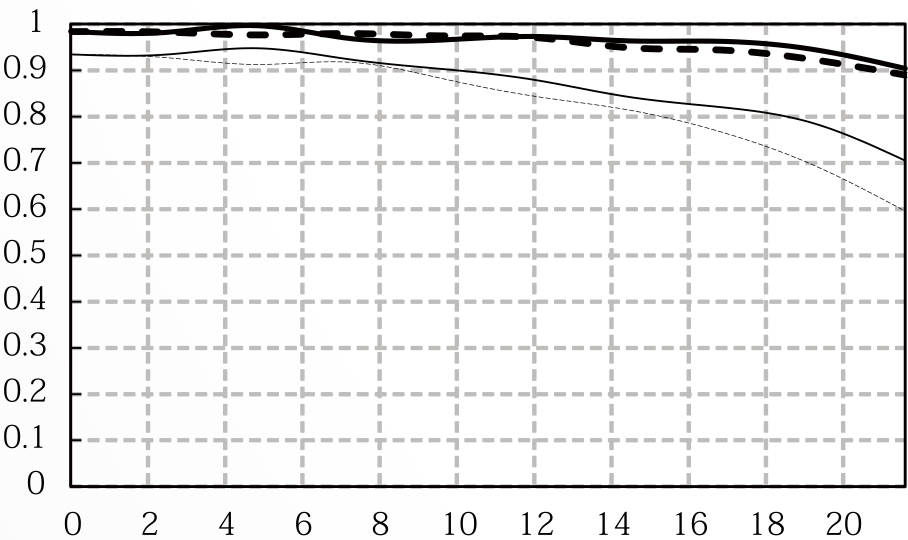
This lens is ultra sharp corner-to corner at every aperture, limited by your vision as an artist and of course by diffraction at the smallest apertures. See also How to Calculate the Sharpest Aperture.
This lens is exquisitely sharp, limited of course by diffraction at the smallest apertures and atmospheric heat shimmer.
 |
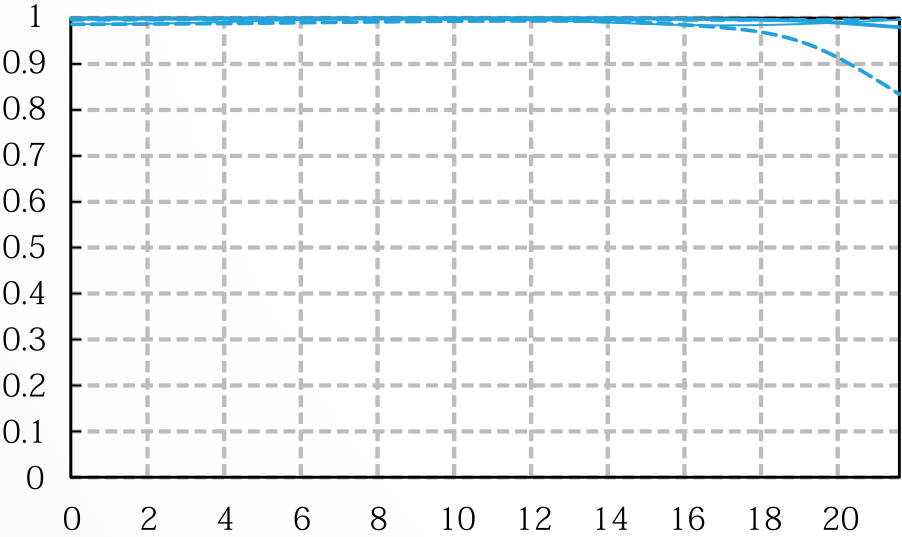 |
10 cyc/mm (bold) and 30 cyc/mm (light). Sagittal (radial) shown as solid lines. Meridional (tangential) shown as dashed lines.
While it's usually valid to compare rated MTFs between different lenses of similar vintage from the same maker, every maker measures or simply calculates MTF very differently, and therefore one cannot compare these curves between brands. For instance, Sony seems to ignore diffraction and simply calculate overly optimistic MTFs that hug 100%, which no real lens can do at f/8, while other brands are more realistic and include diffraction. Only Canon offers any insight on how they arrive at their curves.
See also my article on MTF and Canon's article on MTFs.
Spherochromatism performance top
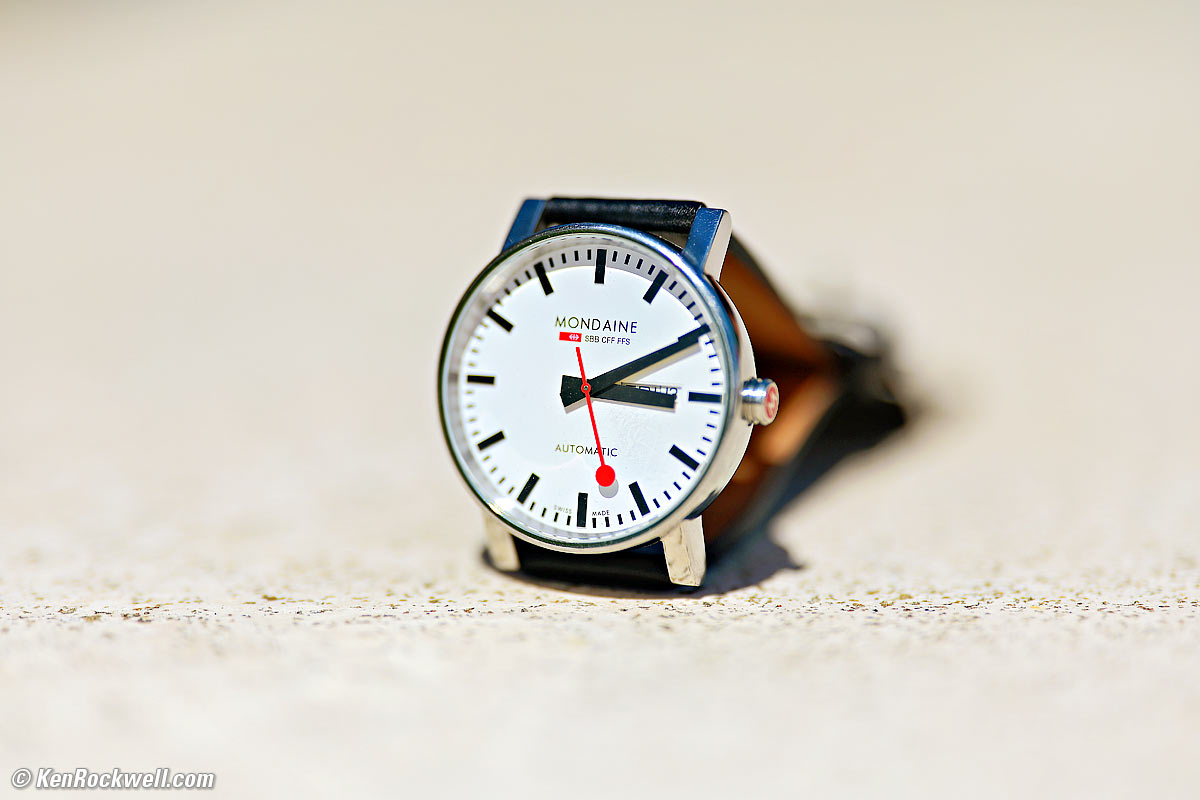
Spherochromatism, also called secondary spherical chromatic aberration or "color bokeh," is an advanced form of spherical and chromatic aberration in a different dimension than lateral chromatic aberration and therefore cannot be corrected with software or automatic corrections. It happens mostly in fast normal and tele lenses when spherical aberration at the ends of the color spectrum are corrected differently than in the middle of the spectrum. Spherochromatism can cause colored fringes on out-of-focus highlights, usually seen as green fringes on backgrounds and magenta fringes on foregrounds. Spherochromatism is common in fast lenses of moderate focal length when shooting contrasty items at full aperture. It goes away as stopped down.
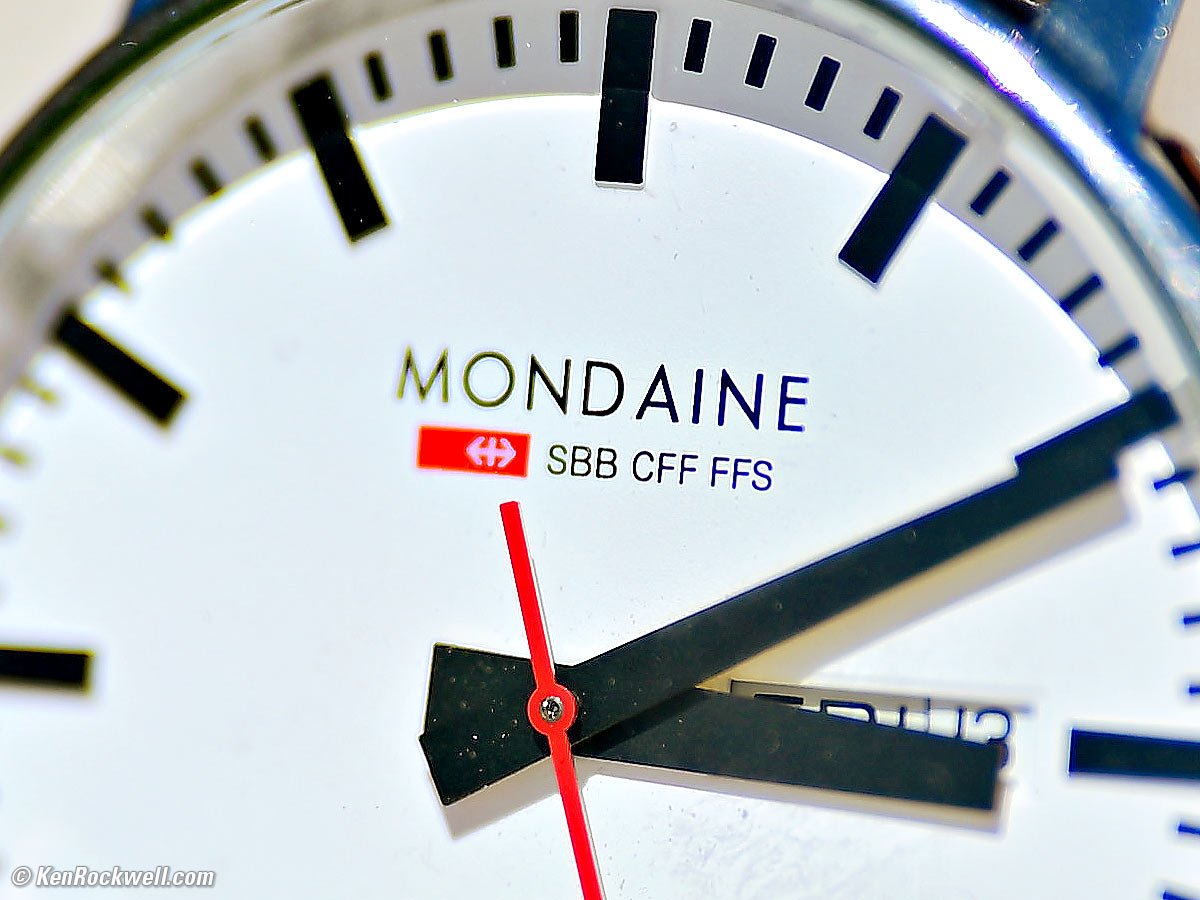
It has a small amount of spherochromatism, with yellowish-green fringes behind and blue fringes in front of the plane of perfect focus:
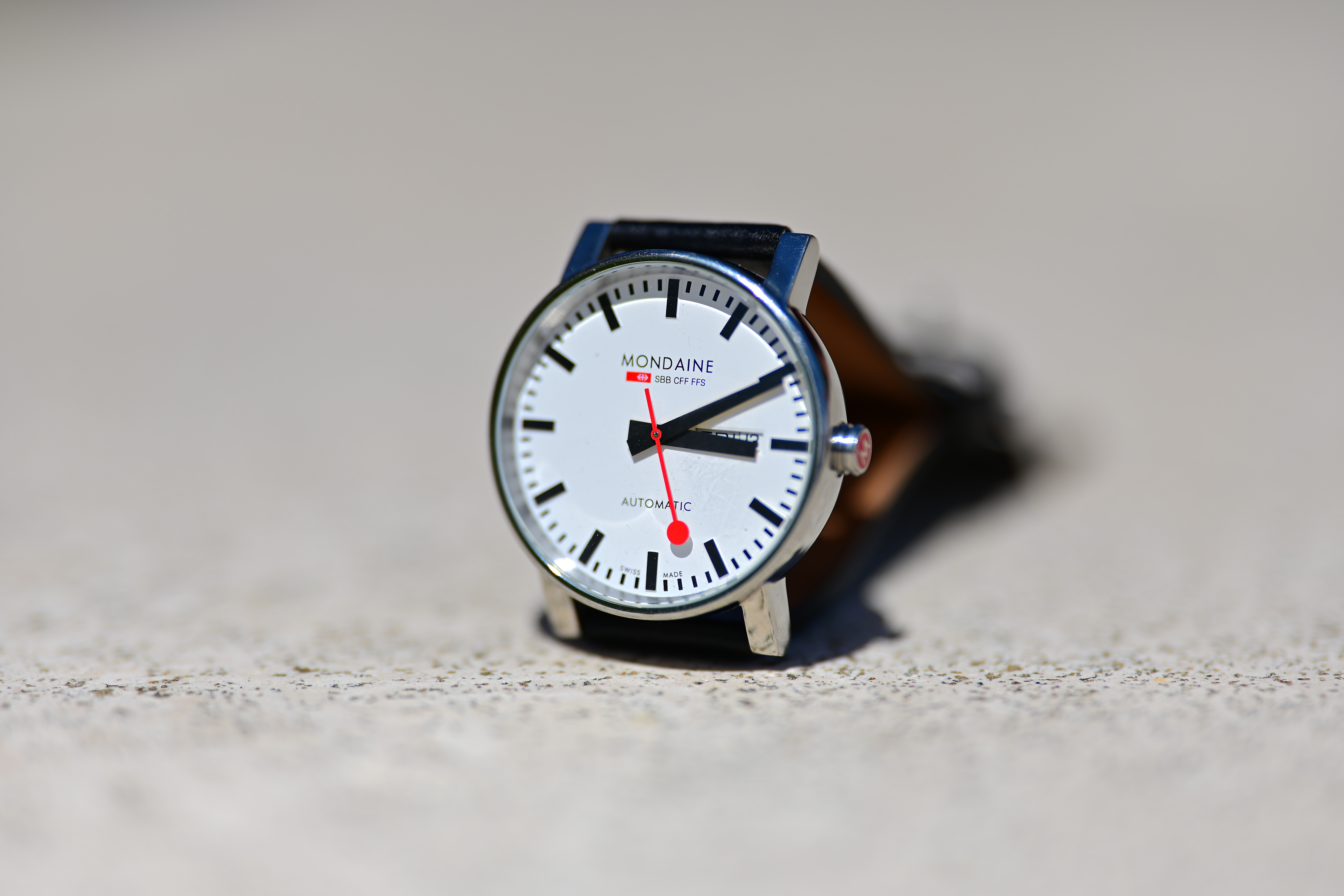
Mondaine A132.30348.11SBB at close-focus distance, 13 June 2025. Nikon Z5 II, Viltrox AF 135mm f/1.8 at f/1.8 at 1/8,000 at ISO 50, +0.7 stops exposure compensation (LV 15⅔), Radiant Photo software. bigger or camera-original © file.
1,200 × 900 pixel (5× magnification) crop from above. bigger or camera-original © file.
If this 1,200 × 900 pixel crop is about 3" (7.5cm) wide on your screen, then the complete image printed at this same large magnification would be about 10 × 15" (25 × 38cm).
If this 1,200 × 900 pixel crop is about 6" (15cm) wide on your screen, then the complete image printed at this same extreme magnification would be about 20 × 30" (50 × 75cm).
If this 1,200 × 900 pixel crop is about 12" (30cm) wide on your screen, then the complete image printed at this same insanely high magnification would be about 40 × 60" (1 × 1.5 meters).
Click any for the camera-original © files.
Image Stabilization (VR) performance top
It has NO Optical Image Stabilization (OIS, IS or VR (Vibration Reduction)), and it does work very well with the in-camera stabilization of my Nikon Z5 II. I get about 4½ stops of real-world improvement!!!
"Percent Perfectly Sharp Shots" are the percentage of hand-held, free-standing with no support or bracing, frames with 100% perfect tripod-equivalent sharpness as viewed at 300%. Hand tremor is a random occurrence, so at marginal speeds some frames will be perfectly sharp while others will be in various stages of blur — all at the same shutter speed.
This rates what percentage of shots are perfectly sharp, not how sharp are all the frames:
| % Perfectly Sharp Shots on my stabilized Nikon Z5 II | 2s |
1s |
1/2 |
1/4 |
1/8 |
1/15 |
1/30 |
1/60 |
1/125 |
1/250 |
| Stabilization ON | 0 |
10 |
10 |
20 |
80 |
90 |
100 |
100 |
100 |
100 |
| Stabilization OFF | 0 |
0 |
0 |
0 |
0 |
0 |
10 |
40 |
50 |
100 |
I see 4½ stops of real-world improvement.
Sunstars performance top
With an 11-bladed rounded diaphragm, I can get mild 22-point sunstars on brilliant points of light at the smallest apertures.
Here's a sample at f/11:
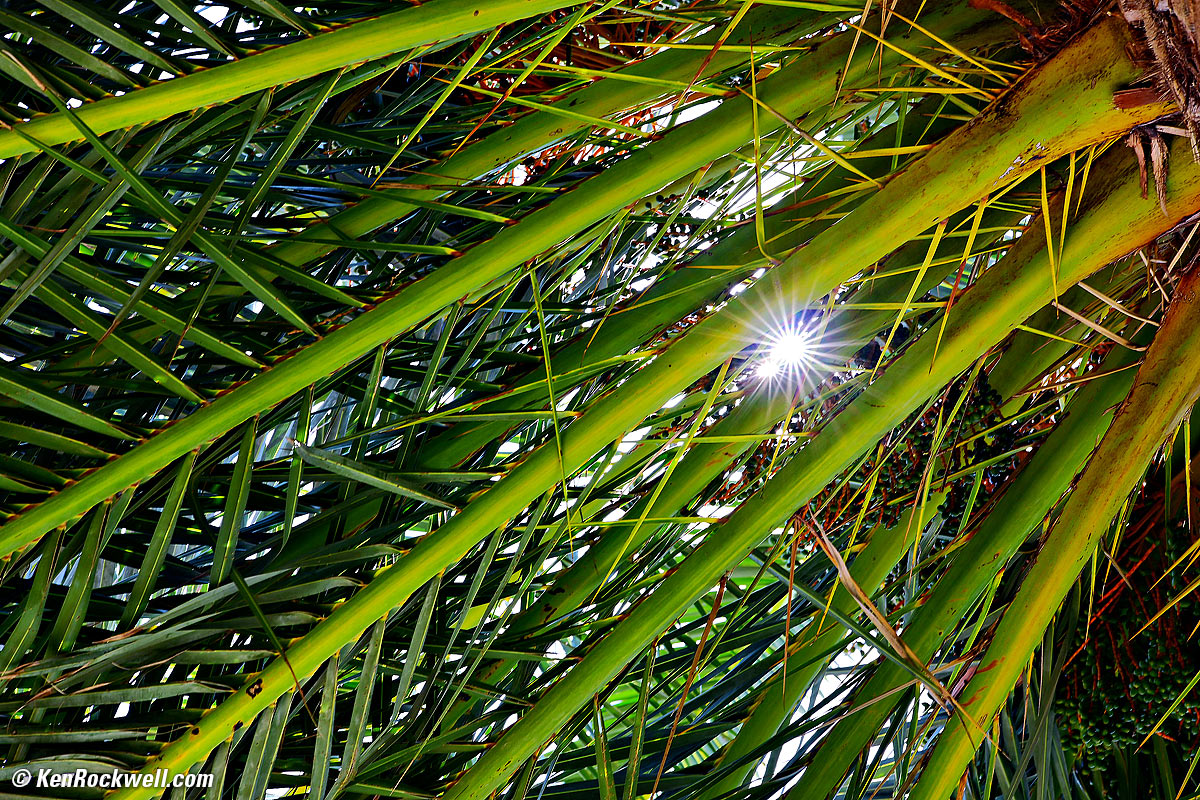
Sunstars and Canary Palm, 03 July 2025. Nikon Z5 II, Viltrox AF 135mm f/1.8 at f/11 at 1/60 at Auto ISO 100 (LV 12.8), Radiant Photo software. bigger.
Teleconverters performance top
It has some space at the back, but I haven't tried it with any of the Nikon Z TC 1.4×, Nikon Z TC 2×, Sony TC 1.4× or Sony 2× teleconverters to see what happens.
Weather Sealing performance top
It claims weather sealing and crud-resistant coatings.
I haven't tried it in the crud or rain.
"Weather sealing" is mostly a marketing feature to get you to pay more.
People have worried way too much about this ever since camera companies started FUD campaigns to make us think that our gear will melt unless it has weather sealing. How do you think we shot in the rain for the first 190 years of photography?
Compared top
Sample Images Intro New Good Bad Missing
Specifications Performance Compared
For Nikon: I got mine directly from Viltrox (try coupon code KENROCKWELL at checkout possibly for an 8% discount). I'd also get it at B&H, at Adorama or at Amazon, or get it used at eBay (How to Win at eBay) or get it used at KEH.
For Sony: I'd get mine directly from Viltrox (try coupon code KENROCKWELL at checkout possibly for an 8% discount). I'd also get it at B&H, at Adorama or at Amazon, or get it used at eBay (How to Win at eBay), or get it used at KEH.
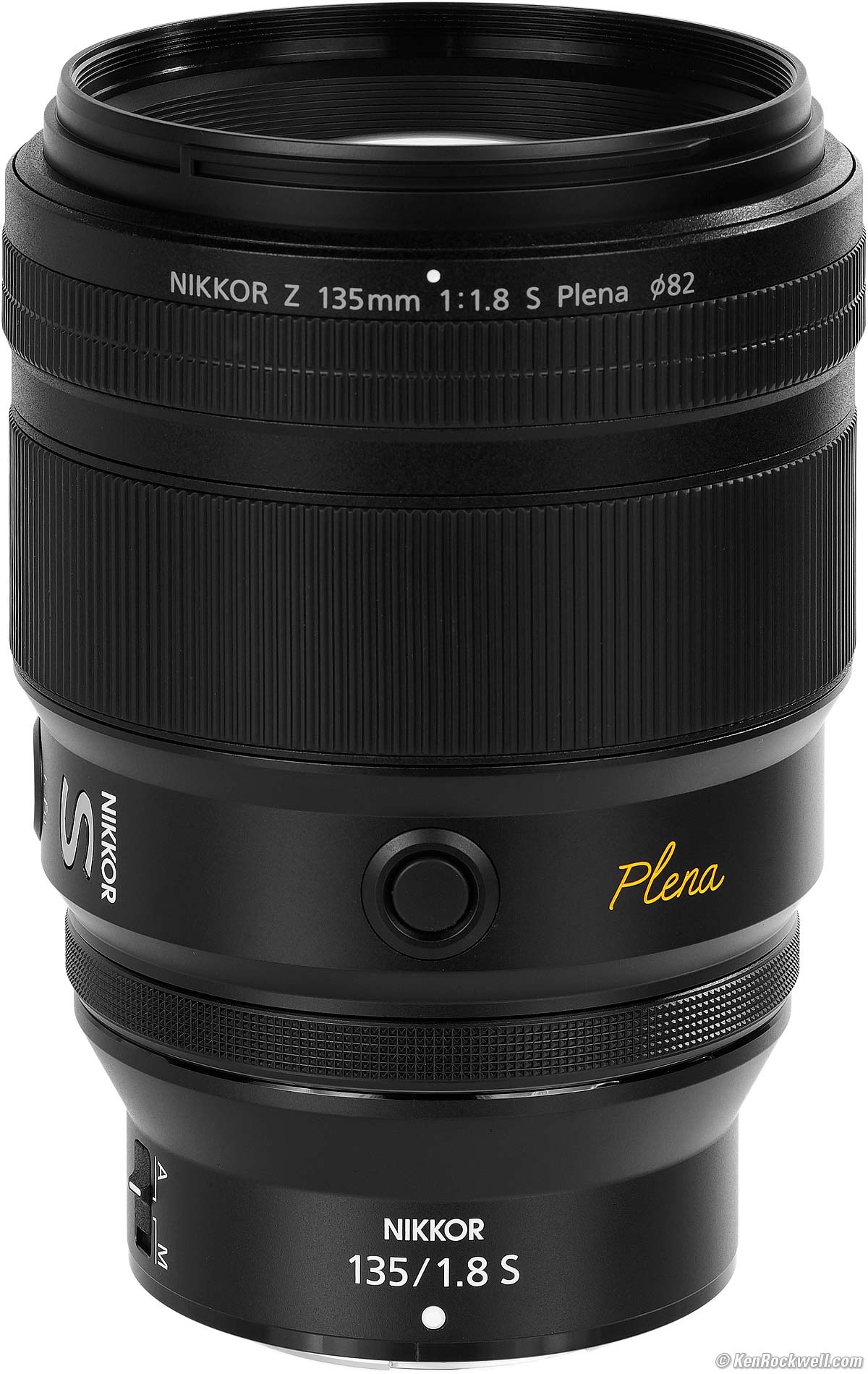
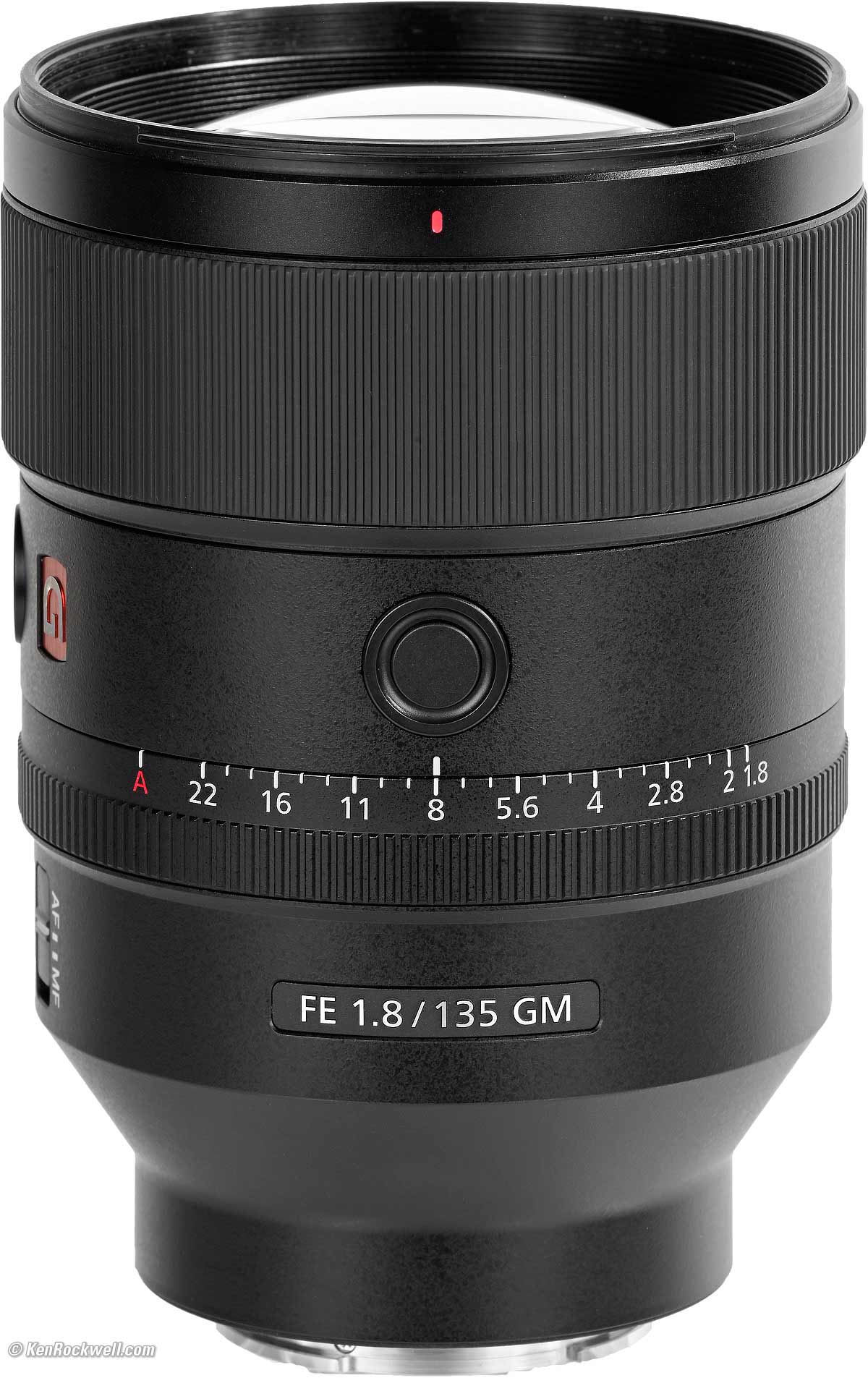
See All 135mm f/1.8 Lenses Compared:
|
|
|
|



User's Guide top
Sample Images Intro New Good Bad Missing
Specifications Performance Compared
For Nikon: I got mine directly from Viltrox (try coupon code KENROCKWELL at checkout possibly for an 8% discount). I'd also get it at B&H, at Adorama or at Amazon, or get it used at eBay (How to Win at eBay) or get it used at KEH.
For Sony: I'd get mine directly from Viltrox (try coupon code KENROCKWELL at checkout possibly for an 8% discount). I'd also get it at B&H, at Adorama or at Amazon, or get it used at eBay (How to Win at eBay), or get it used at KEH.
See also Viltrox' own user manual.
Fn-button Focus Presets user's guide top
My lens on my Nikon works differently than described in Viltrox' own user manual: Fn1 and Fn2 seem reversed. The manual makes sense if you consider the top button as Fn1 and the side button as Fn2.
Here's how my lens works on my Nikon:
The top button locks autofocus.
AF locks for as long as you keep it pressed.
FN lights in yellow on the top LCD and AF locks as long as the button's held down.
To save a preset focus distance:
There are two focus distance memories!
To set them:
Slide the AF/MF switch to MF.
Tap the side button until your choice of A or B is displayed on the LCD. A or B will light in yellow.
Focus manually as desired.
Hold the side button a couple of seconds until your choice of A or B turns green on the LCD, letting you know that distance has been SAVED to A or B.
To recall a preset focus distance:
Set the AF/MF switch to MF.
Tap the side button to recall A or B, and the lens motors quickly in or out to that distance.
Easy!
Fn Button Programming user's guide top
You may be able to reprogram what these do in your camera's menus. I haven't tried.
LCD user's guide top
The LCD is easy; there's nothing to set or adjust.
It only works at one brightness and it shows what it needs to show, no fiddling required.
1.5m-∞ / 0.7-2m / FULL Switch user's guide top
This is an autofocus limiter.
Leave it in FULL.
The 1.5m-∞ setting prevents the lens from autofocusing closer than 1.5 meters (5 feet). Use this setting only if you're having a problem with the lens attempting to focus on irrelevant close items, or if for some reason the lens is "hunting" from near to far while looking for distant subjects.
The 0.7-2m setting prevents the lens from autofocusing farther away than 2 meters (6 feet). Only use this if you're working close and for some reason you're having a problem with the lens getting distracted and trying to focus on far-away objects.
Manual focus always can be set anywhere regardless of the switch setting.
CLICK Switch user's guide top
This sets or removes the clicks in the second metal control ring.
I leave it at CLICK ON.
Recommendations top
Sample Images Intro New Good Bad Missing
Specifications Performance Compared
For Nikon: I got mine directly from Viltrox (try coupon code KENROCKWELL at checkout possibly for an 8% discount). I'd also get it at B&H, at Adorama or at Amazon, or get it used at eBay (How to Win at eBay) or get it used at KEH.
For Sony: I'd get mine directly from Viltrox (try coupon code KENROCKWELL at checkout possibly for an 8% discount). I'd also get it at B&H, at Adorama or at Amazon, or get it used at eBay (How to Win at eBay), or get it used at KEH.
With day-to-day changes in USA tariffs I can't vouch for what may happen getting it directly from Viltrox as I did. Last I asked them they were now shipping from a USA warehouse for USA orders to fix the potential problem. This can change at any minute; if it's a concern, ask Viltrox and be sure to tell them where you are located.
I love this lens, and prefer it over Sony and Nikon's plastic lenses.
I caution that Viltrox is new and has yet to establish a service record. Unlike the big camera makers, I have no way to know how long this lens will last or if it can be serviced if it ever needs it. Then again, for less than half the price, I could buy a new replacement and still be ahead.
I use a clear (UV) protective filter instead of a cap (exactly like an iPhone) so I'm always ready to shoot instantly. I only use a cap when I throw this in a bag with other gear without padding — which is never. The UV filter never gets in the way, and never gets lost, either.
The very best protective filter is the 82mm Hoya multicoated HD3 UV which uses hardened glass and repels dirt and fingerprints. The Nikon NC 82mm is also an excellent choice, but not as resistant to the environment, fingerprints and physical abuse as the HD3 UV.
For much less money, the Hoya multicoated 82mm UV is also optically superb, but the Hoya HD3 is the toughest.
Any of these filters protects as well and gives ultrasharp images, but since filters last a lifetime, you may as well get the best since the Hoya HD3 is tougher and stays cleaner than the others since it repels oil and dirt.
If I was working in nasty, dirty areas and didn't want to spring for the HD3 filter, I'd use a plain glass (uncoated) 82mm Tiffen UV filter instead. Plain glass filters are much easier to clean with soap and water or Windex out in the field, but more prone to ghosting.
The Nikon 82mm Polarizer is superb.
All these filters are just as sharp and take the same pictures, the difference is how much abuse they'll take and stay clean and stay in one piece. Since filters last a lifetime or more, there's no reason not to buy the best as it will last you for the next 50 years. Filters aren't throwaways like digital cameras which we replace every few years, like it or not. I'm still using filters I bought back in the 1970s!
For Nikon: I got mine directly from Viltrox (try coupon code KENROCKWELL at checkout possibly for an 8% discount). I'd also get it at B&H, at Adorama or at Amazon, or get it used at eBay (How to Win at eBay) or get it used at KEH.
For Sony: I'd get mine directly from Viltrox (try coupon code KENROCKWELL at checkout possibly for an 8% discount). I'd also get it at B&H, at Adorama or at Amazon, or get it used at eBay (How to Win at eBay), or get it used at KEH.
This all-content, junk-free website's biggest source of support is when you use those or any of these links to approved sources when you get anything, regardless of the country in which you live. Thanks for helping me help you! Ken.
Thanks for helping me help you!
Ken.
© Ken Rockwell. All rights reserved. Tous droits réservés. Alle Rechte vorbehalten. Alla rättigheter förbehållna. Toate drepturile rezervate. Niciun vampir nu a fost implicat în crearea acestei lucrări. Omnia jura reservata. Ken Rockwell® is a registered trademark.
Help Me Help You top
I support my growing family through this website, as crazy as it might seem.
The biggest help is when you use any of these links when you get anything. It costs you nothing, and is this site's, and thus my family's, biggest source of support. These places always have the best prices and service, which is why I've used them since before this website existed. I recommend them all personally.
If you find this page as helpful as a book you might have had to buy or a workshop you may have had to take, feel free to help me continue helping everyone.
If you've gotten your gear through one of my links or helped otherwise, you're family. It's great people like you who allow me to keep adding to this site full-time. Thanks!
If you haven't helped yet, please do, and consider helping me with a gift of $5.00.
As this page is copyrighted and formally registered, it is unlawful to make copies, especially in the form of printouts for personal use. If you wish to make a printout for personal use, you are granted one-time permission only if you PayPal me $5.00 per printout or part thereof. Thank you!
Thanks for reading!
Ken.