Canon RF 16-28mm f/2.8 IS STM
World's Smallest & Lightest f/2.8 Ultrawide Zoom (2025 ~ today)
Sample Images Intro New Good Bad Missing
Specifications USA Version Performance
Compared User's Guide Recommendations
R1 R3 R5 II R5 R5C R6 III R6 II R6 R R8 RP R7 R10 R50 R50V R100
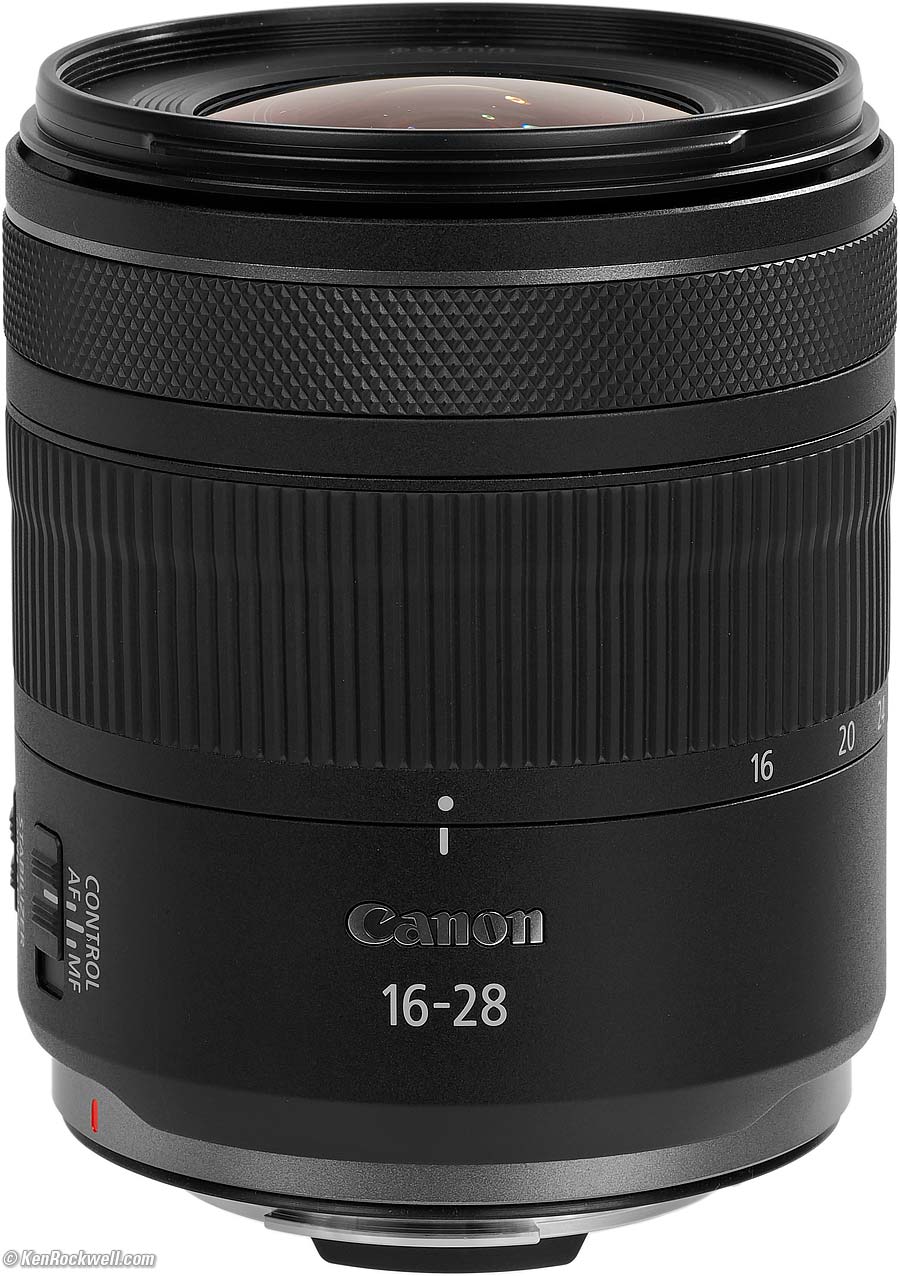
Canon RF 16-28mm f/2.8 IS STM (67mm filters, 15.5 oz./440g, 0.7'/0.2m close focus, 0.26× macro ratio, $1,049). bigger.
I got mine at B&H. I'd also get mine at Adorama, at Amazon or at Crutchfield, or get it used if you know How to Win at eBay, or get it used at KEH.
This 100% all-content, junk-free website's biggest source of support is when you use those or any of these links to my personally approved sources I've used myself for way over 100 combined years when you get anything, regardless of the country in which you live. Canon does not seal its boxes in any way, so never buy at retail or any other source not on my personally approved list since you'll have no way of knowing if you're missing accessories, getting a defective, damaged, returned, non-USA, store demo or used lens — and all of my personally approved sources allow for 100% cash-back returns for at least 30 days if you don't love your new lens. I've used many of these sources since the 1970s because I can try it in my own hands and return it if I don't love it, and because they ship from secure remote warehouses where no one gets to touch your new lens before you do. Buy only from the approved sources I've used myself for decades for the best prices, service, return policies and selection.
February 2026, March 2025 Better Pictures Canon Reviews RF Lenses EF Lenses Flash All Canon Reviews All Reviews
NEW: All Canon Ultrawides Compared.
RF 14-35mm f/4L IS USM: My favorite: not much bigger or more expensive, and adds L mechanical quality and a wider and longer zoom range. I don't need f/2.8.
RF 15-30mm IS STM: Smaller, lighter, zooms wider and longer and it's just as sharp and stabilized for less than half the price, but it's two stops slower.
RF 15-35mm f/2.8L IS USM: Bigger, heavier and much more expensive.
RF 16mm f/2.8 STM: Tiny, ultrasharp and nearly free, but no stabilization and no zooming.
Sample Images top
Sample Images Intro New Good Bad Missing
Specifications USA Version Performance
Compared User's Guide Recommendations
More samples throughout this review at Bokeh, Falloff, Macro, Sharpness, Spherochromatism and Sunstars.
These are just snapshots; my real work is in my Gallery.
These are all shot hand-held as the lowest Quality 1 NORMAL (▟ stairstep icon) setting JPGs; no tripods, FINE (quarter circle) JPGs or RAW CR3 files were used or needed.
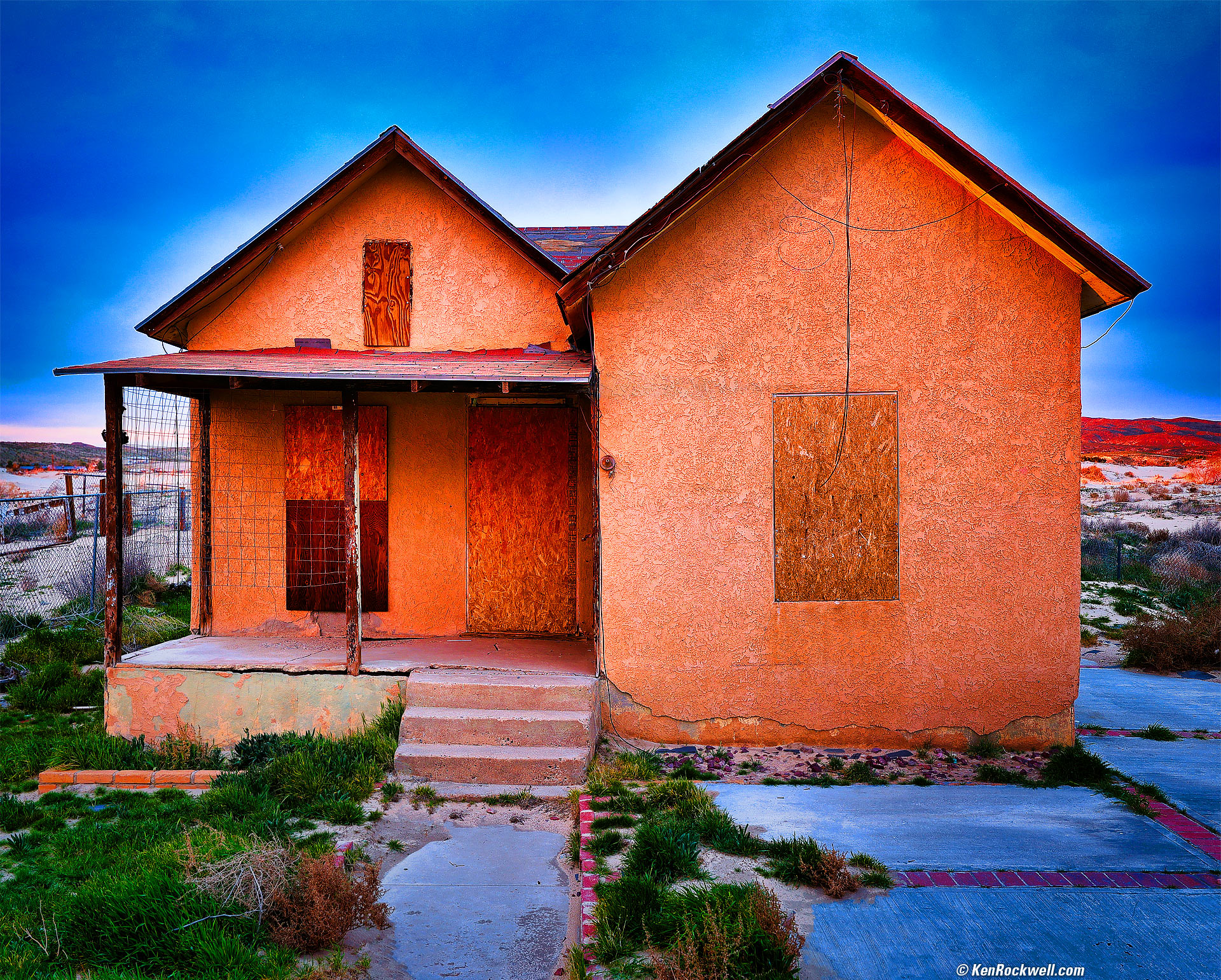
Decomposition, Route 66, Barstow, California, 5:15 P.M., 05 February 2026. Canon EOS R6 III, RF 16-28mm f/2.8 IS STM at 28mm at f/4 hand-held at 1/15 at Auto ISO 100 (LV 8.0), Radiant Photo and Skylum Luminar Neo software, perspective correction in Photoshop. More tech details. bigger or fit-to-screen.
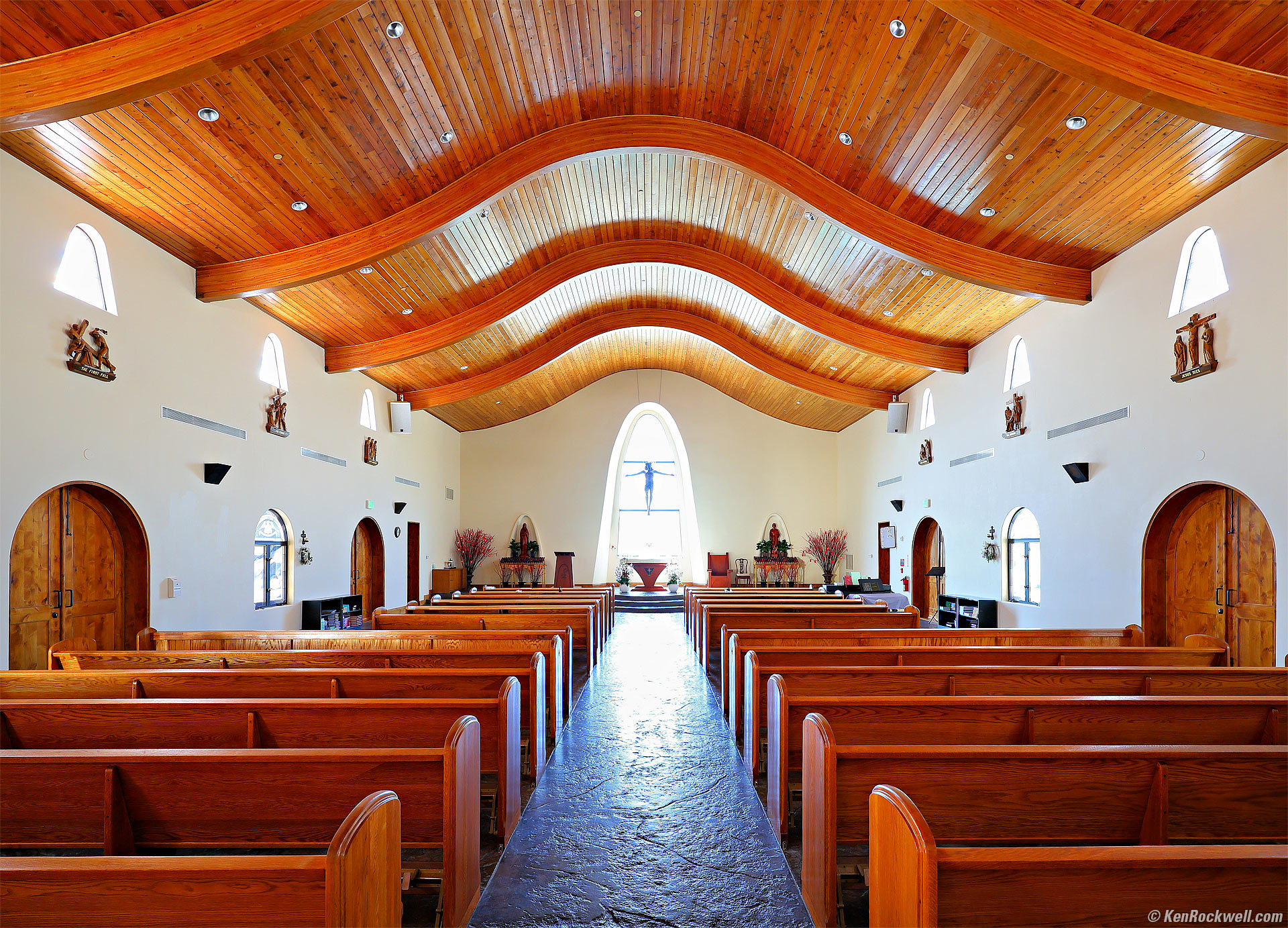
Monastery, Lucerne Valley, California, 11:09 A.M., 06 February 2026. Canon EOS R6 III, RF 16-28mm f/2.8 IS STM at 16mm wide-open at f/2.8, hand-held focus-bracketed sequence with each frame exposed at 1/10 at Auto ISO 100, +0.3 stops exposure compensation (LV 4.7), Radiant Photo and Skylum Luminar Neo software to add light, perspective correction in Photoshop. More tech details. bigger or fit-to-screen.
Almost no one knows that it's easy to shoot the R6 III hand-held for focus-bracketed sequences that are then composited in-camera to give perfect pan-focus results.
In English, it's easy to set the camera to take a series of hand-held photos at every focus distance, and then the camera combines all these into one photo with everything in perfect focus! This works hand-held, automatically aligning every frame as it combines them into a final result, all in-camera as you shoot — NO tripod needed.
This is brilliant. It lets me shoot at ultrasharp ISO 100 at f/2.8 with superb stabilization at a tenth of a second hand-held, and I still get better, sharper, deeper focus than if I had hauled a tripod to make a 3.2 second exposure at f/16. Bravo, Canon! Nikon and Sony still can't do this, requiring us to waste time later on a computer to combine their images, and I don't know if their software is smart enough to combine hand-held images as Canon does.
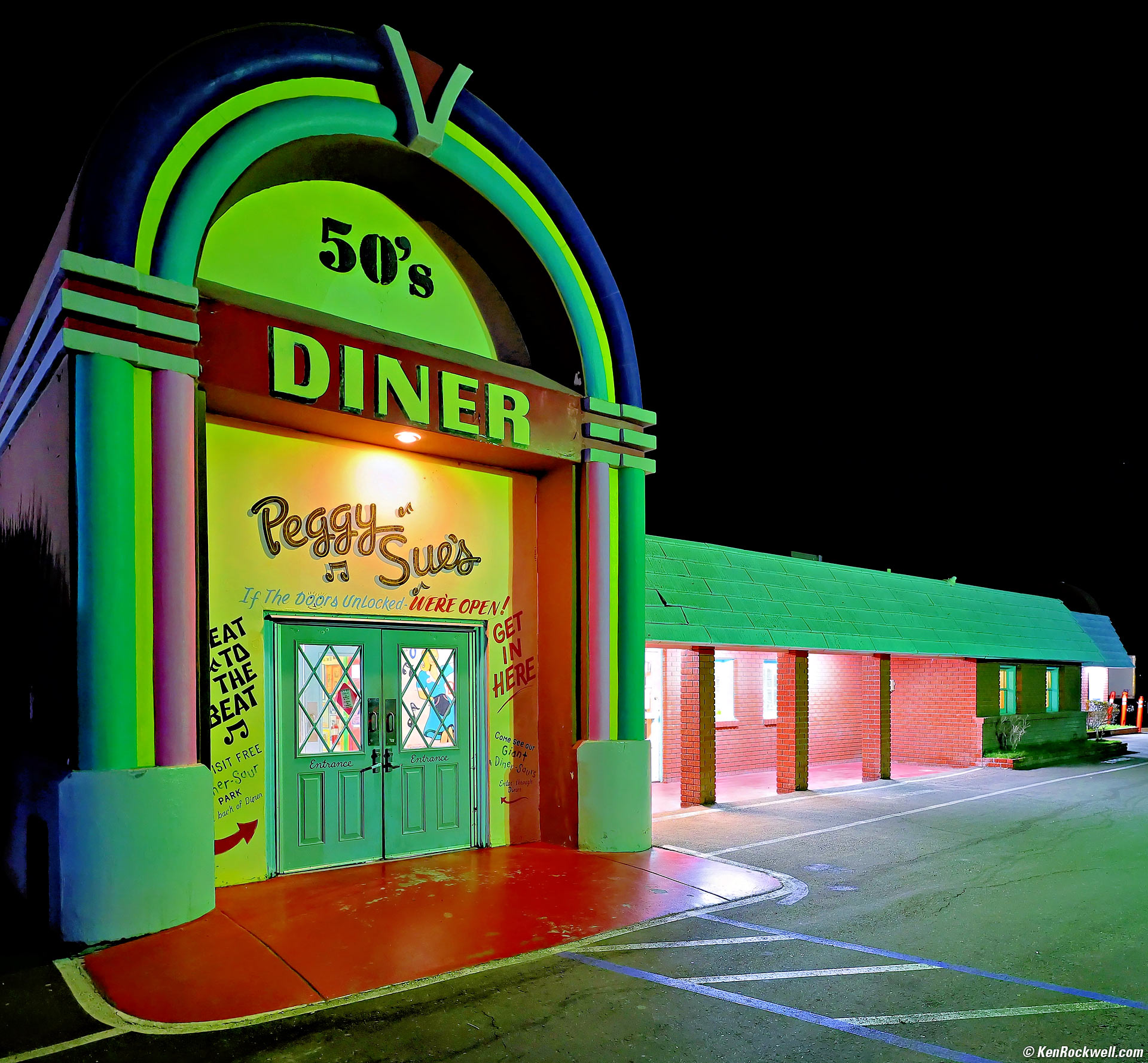
Peggy Sue's Diner, Yermo, California, 7:02 P.M., 07 February 2026. Canon EOS R6 III in square-crop mode, RF 16-28mm f/2.8 IS STM at 16mm wide-open at f/2.8 hand-held at 1/10 at Auto ISO 1,000 (LV 3.0), Radiant Photo software. More tech details. bigger or fit-to-screen.
This is a grab shot as I walked in. Monday-morning quarterbacking I see that my camera chose ISO 1,000 at 1/10, while I should have set it to Tv mode and forced it to shoot at 1 second for several frames. At a full second hand-held half or more of the frames would have been perfectly sharp at ISO 100, so I would have picked the sharp one to exhibit. No worries, even at ISO 1,000 this looks great.

Santa Fe Railroad Locomotive, Barstow, California, 8:55 A.M., 08 February 2026. Cropped to a square from Canon EOS R6 III, RF 16-28mm f/2.8 IS STM at 18mm at f/10 at 1/800 at Auto ISO 100, -0.7 stops exposure compensation (LV 16¼), Radiant Photo software. More tech details. bigger or fit-to-screen.
I added deliberate vignetting to keep your eyes in my picture.
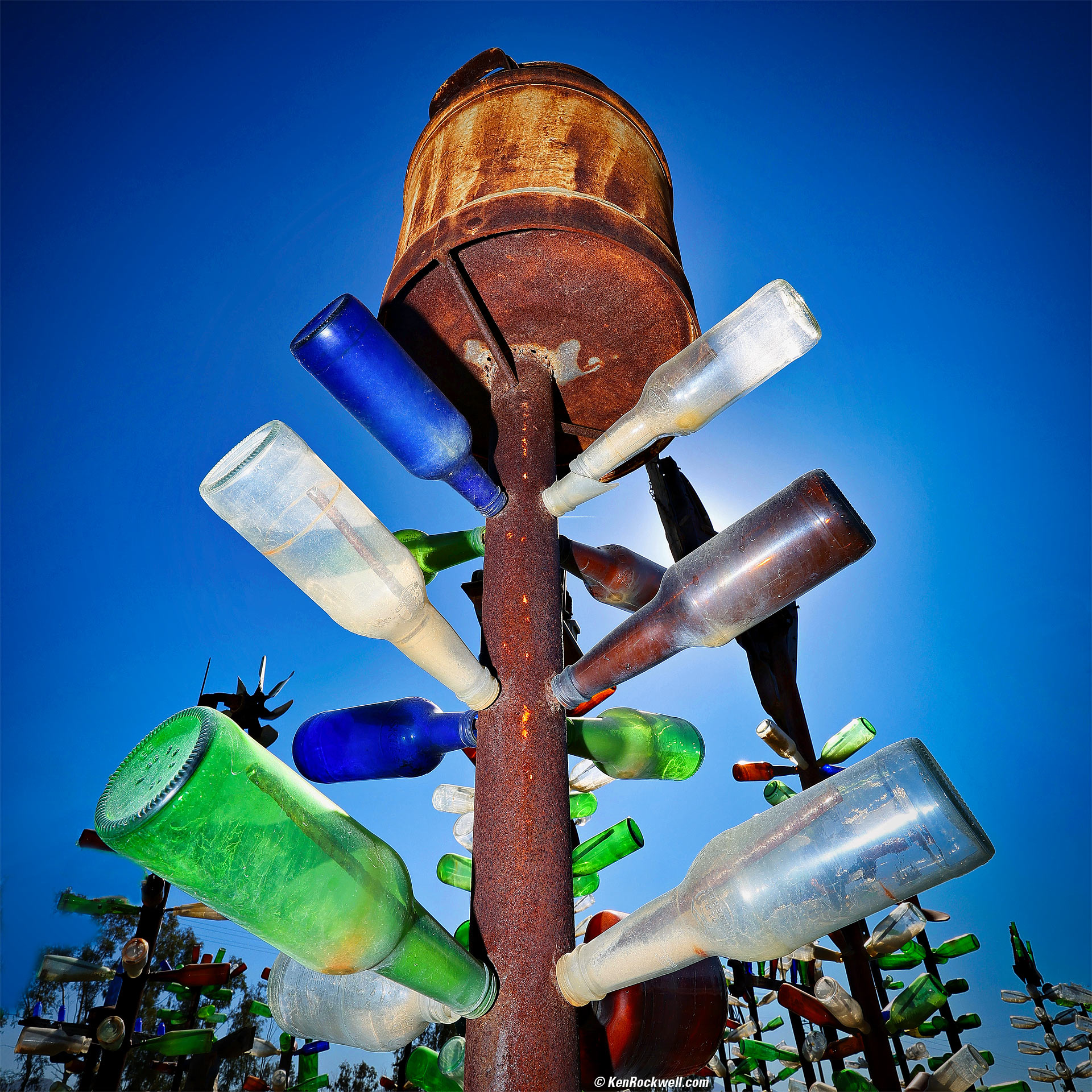
Elmer's Bottle Tree Ranch, Oro Grande, California, 10:56 A.M., 08 February 2026. Canon EOS R6 III in square-crop mode, Godox V480 flash on-camera, RF 16-28mm f/2.8 IS STM at 16mm at f/14 at 1/200 at Auto ISO 100, -0.7 stops exposure compensation (LV 15¼), Radiant Photo and Skylum Luminar Neo software. More tech details. bigger or fit-to-screen.
I added deliberate vignetting to keep your eyes in my picture.
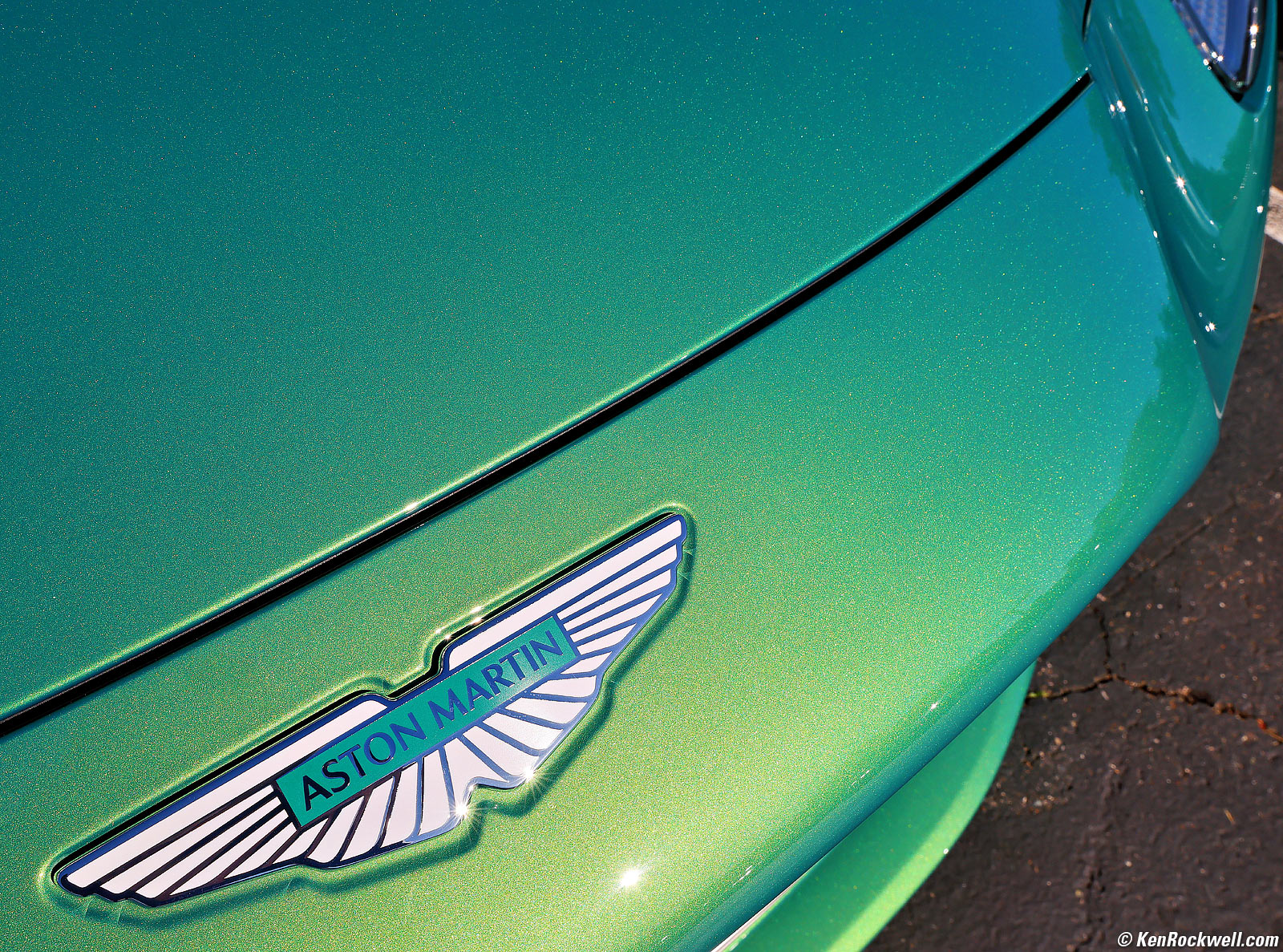
2025 Aston Martin DB12 in Q Iridescent Emerald, Rancho Santa Fe, California, 8:54 AM, Saturday, 08 March 2025. Canon R5 II, 28 mm at f/16 at 1/200 at Auto ISO 100, -0.7 stops exposure compensation, (LV 15.6), Radiant Photo software. bigger.
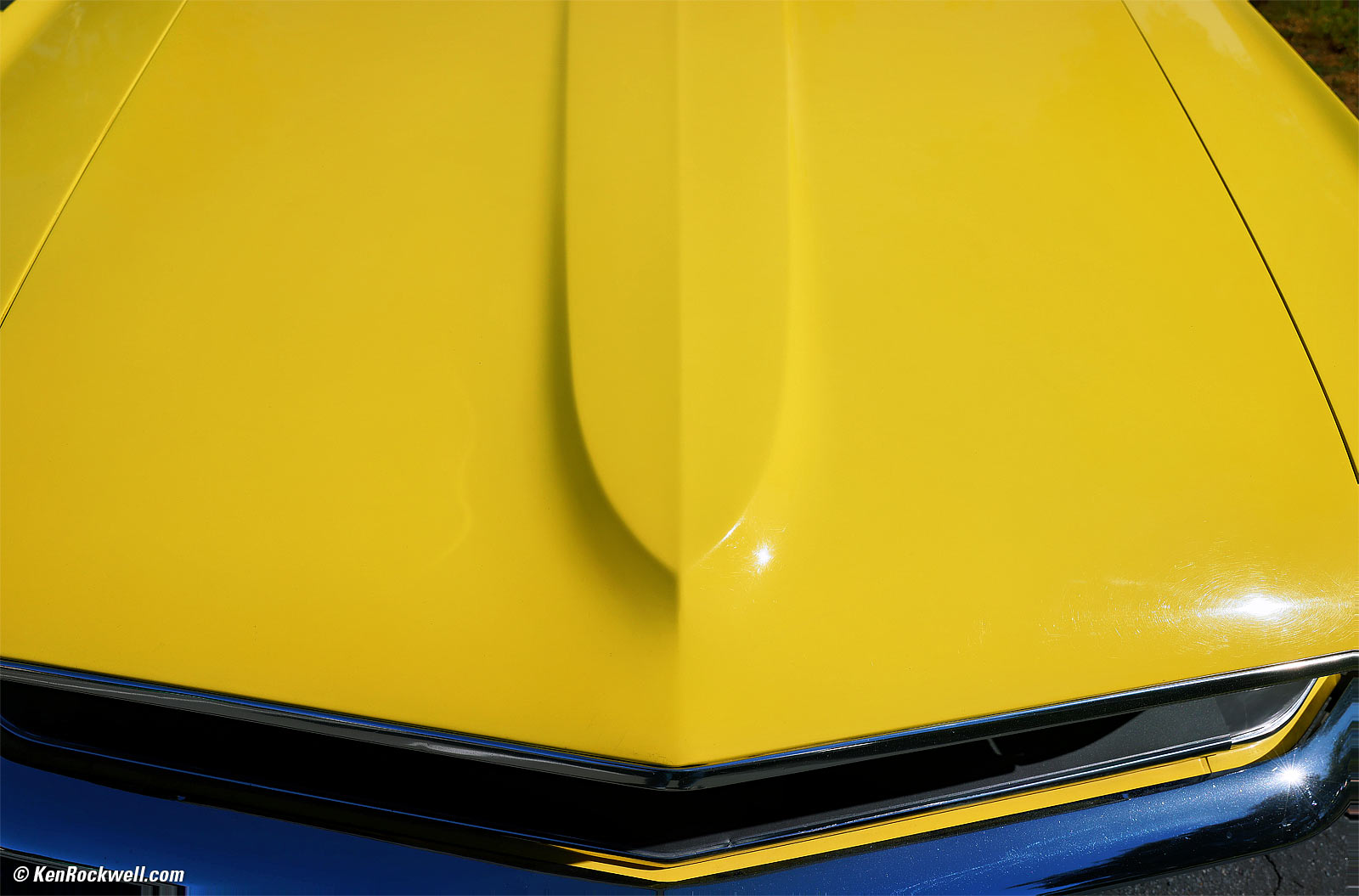
Yellow Mustang Hood, Rancho Santa Fe, California, 9:58 AM, Saturday, 08 March 2025. Canon R5 II, 28mm at f/8 at 1/1,000 at Auto ISO 100 (LV 16.0), Radiant Photo software. bigger.
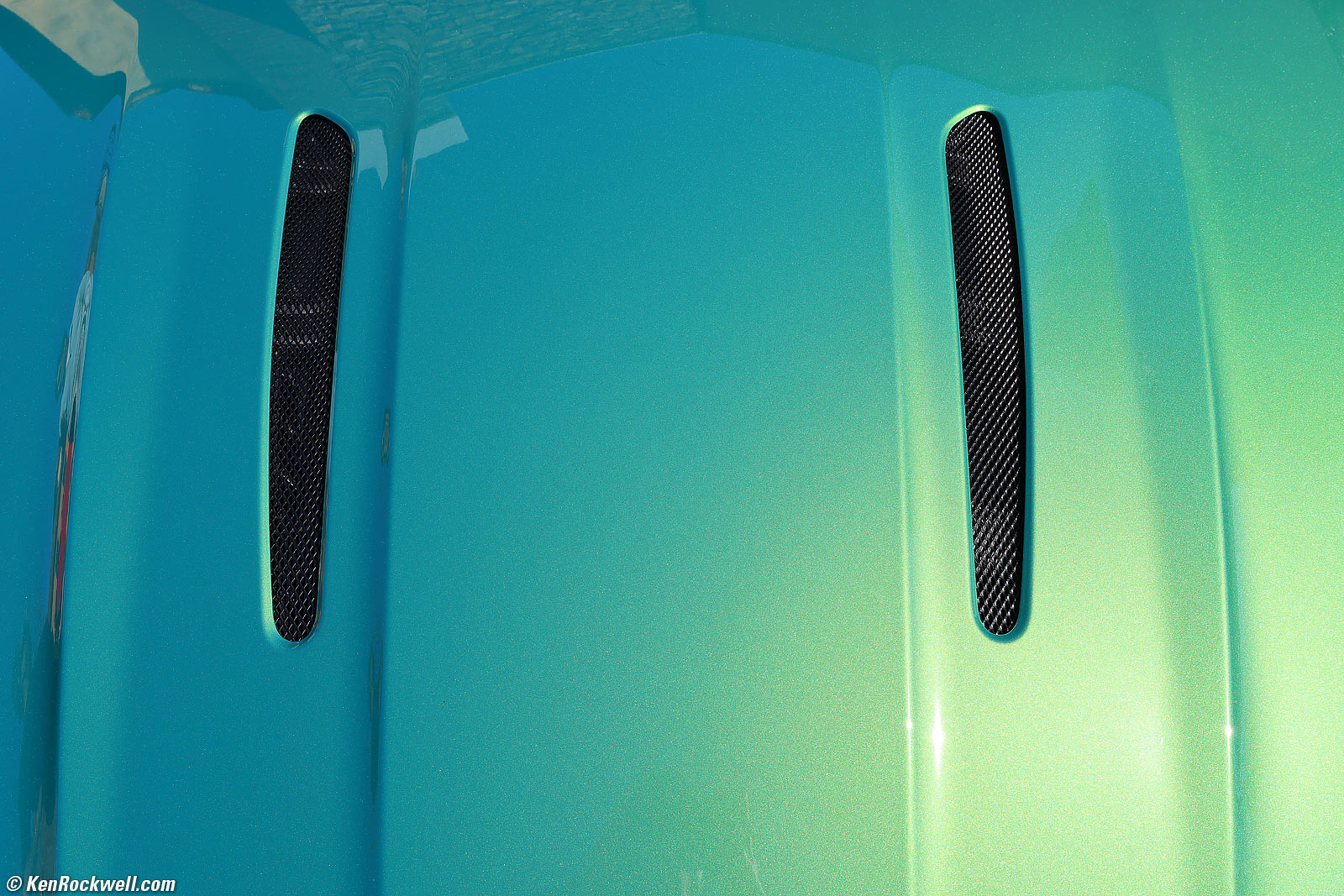
2025 Aston Martin DB12 in Q Iridescent Emerald, Rancho Santa Fe, California, 10:46 AM, Saturday, 08 March 2025. Canon R5 II, 23 mm at f/11 at 1/160 at Auto ISO 100 (LV 14.4), Radiant Photo software. bigger.
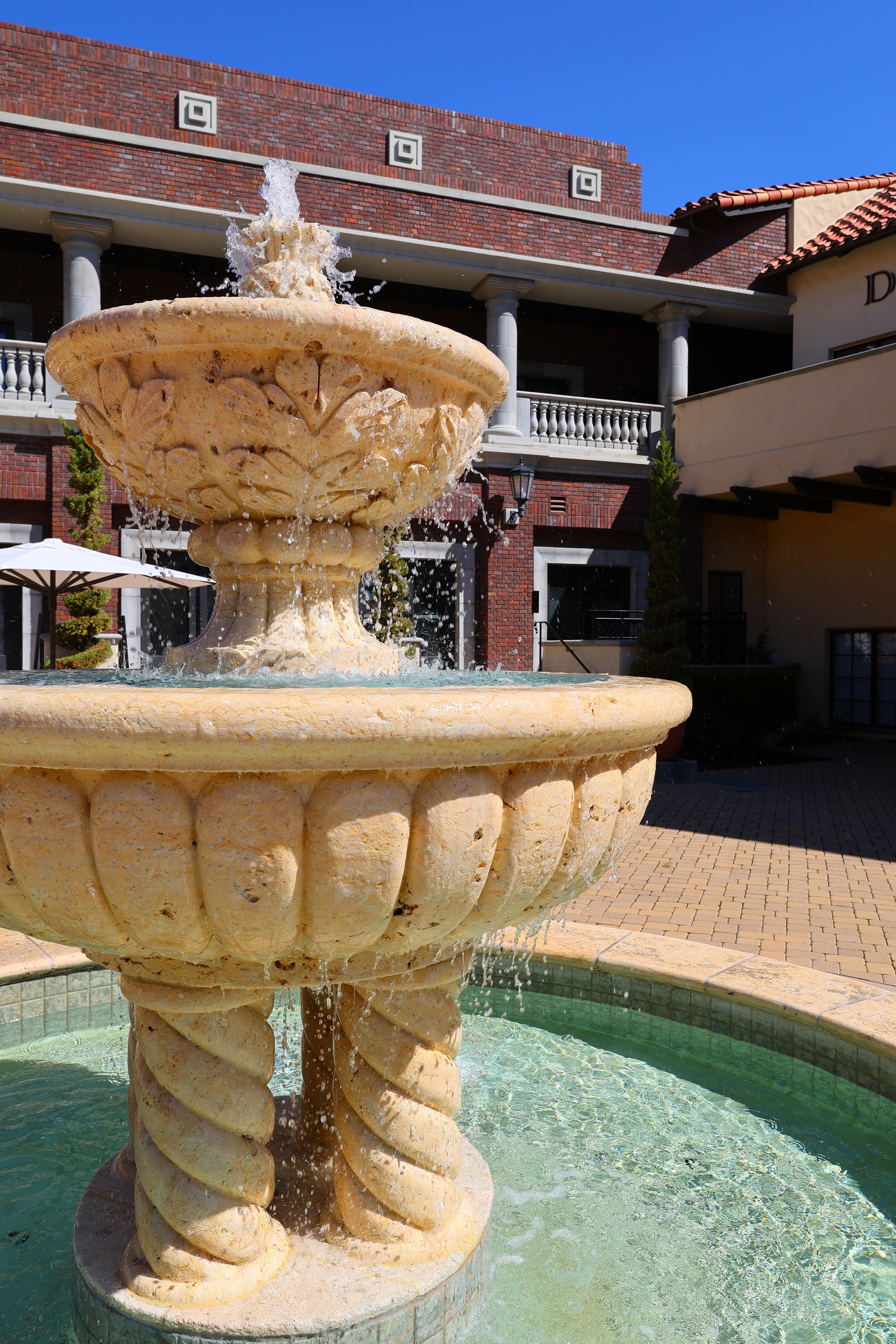
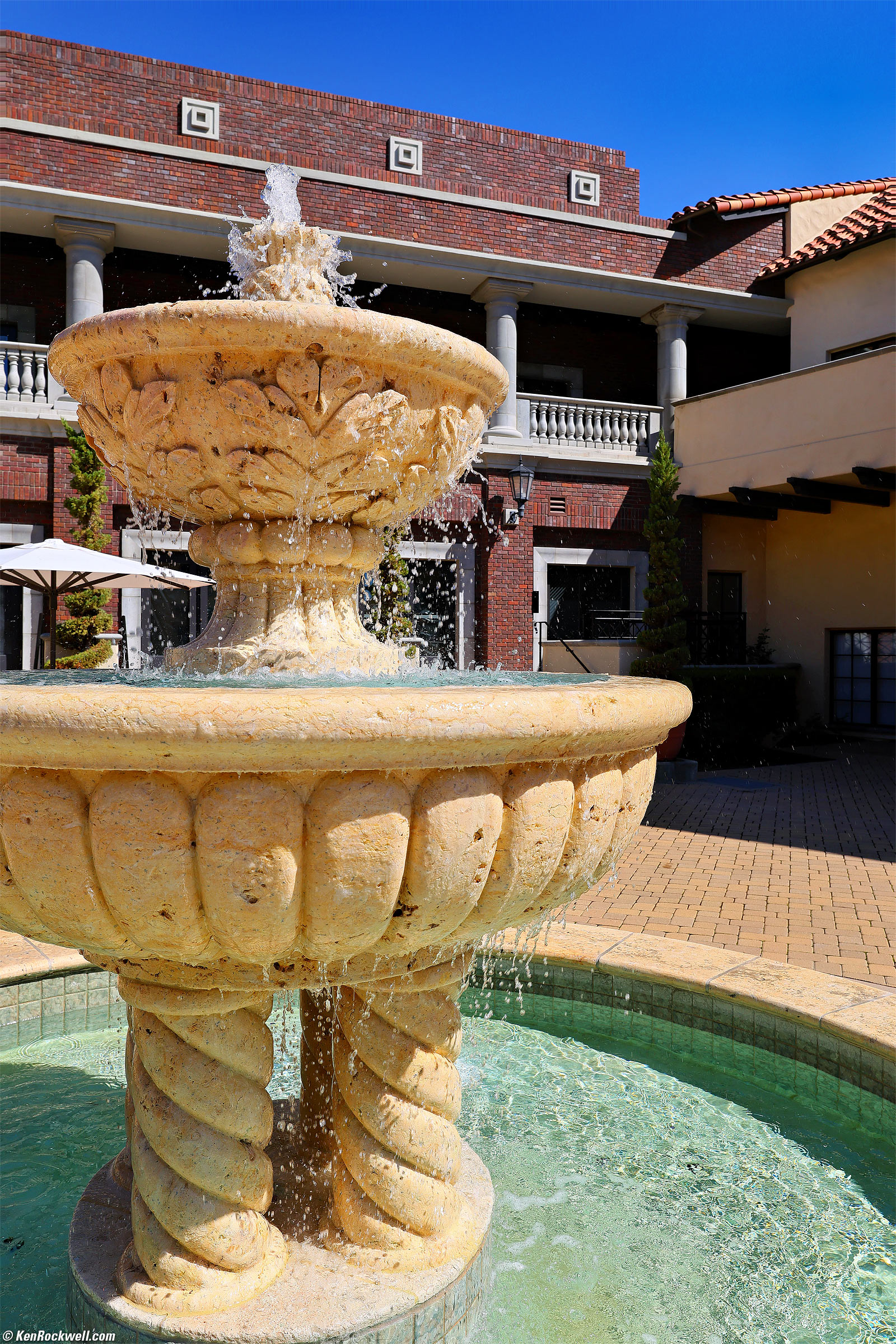
Fountain, Rancho Santa Fe, California, 10:50 AM, Saturday, 08 March 2025. Canon R5 II, 28 mm at f/8 at 1/400 at Auto ISO 100, -0.3 stops exposure compensation (LV 14.6), Radiant Photo software. bigger or camera-original 45 MP © 6 MB Quality 1 JPG file.
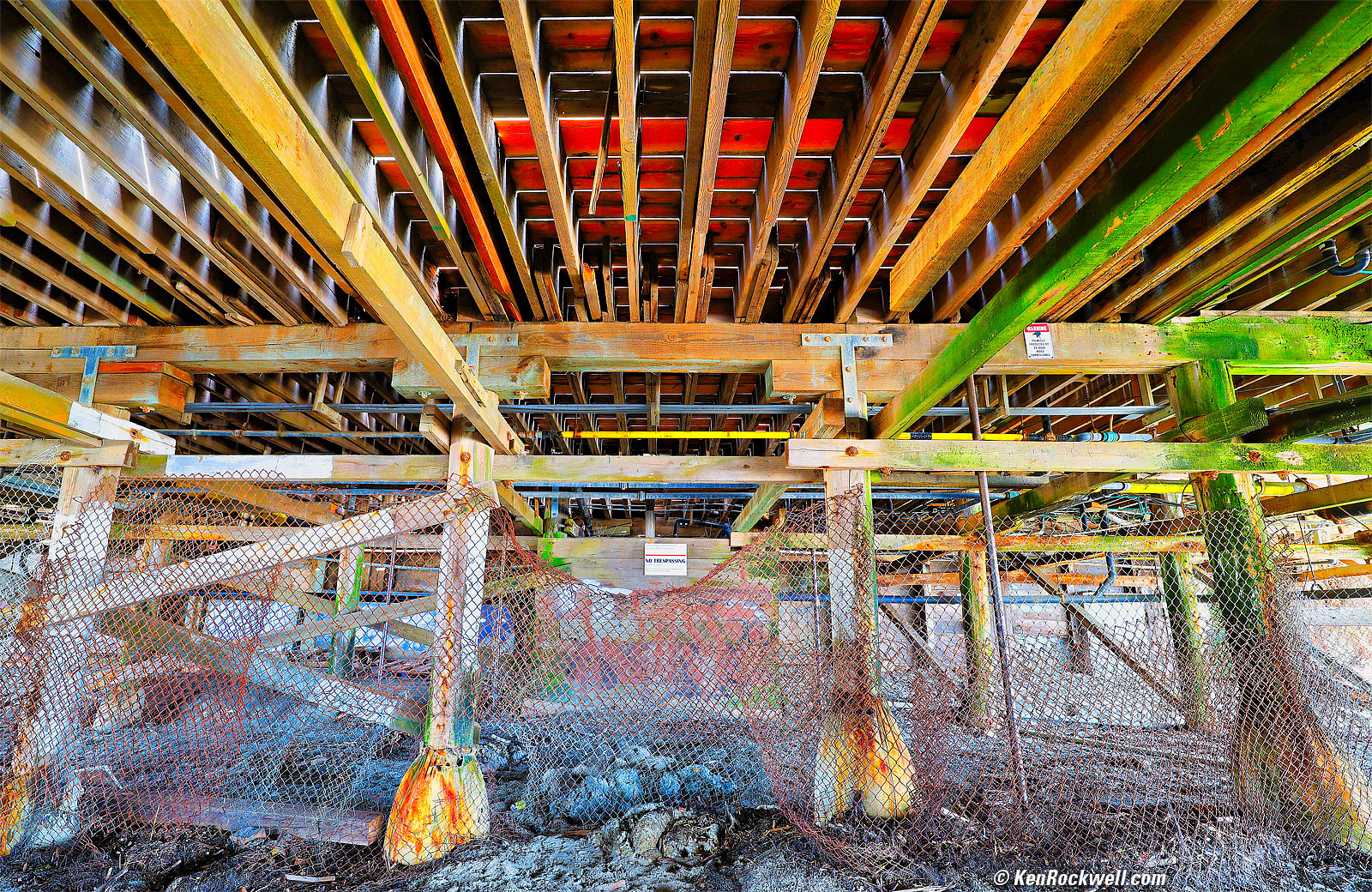
Yes, this lens is as ultra-sharp as the RF 15-35mm f/2.8 L IS USM, for a fraction of the price. It's ultrasharp even all the way out in the corners at 16mm wide-open at f/2.8 as seen in these next two shots:
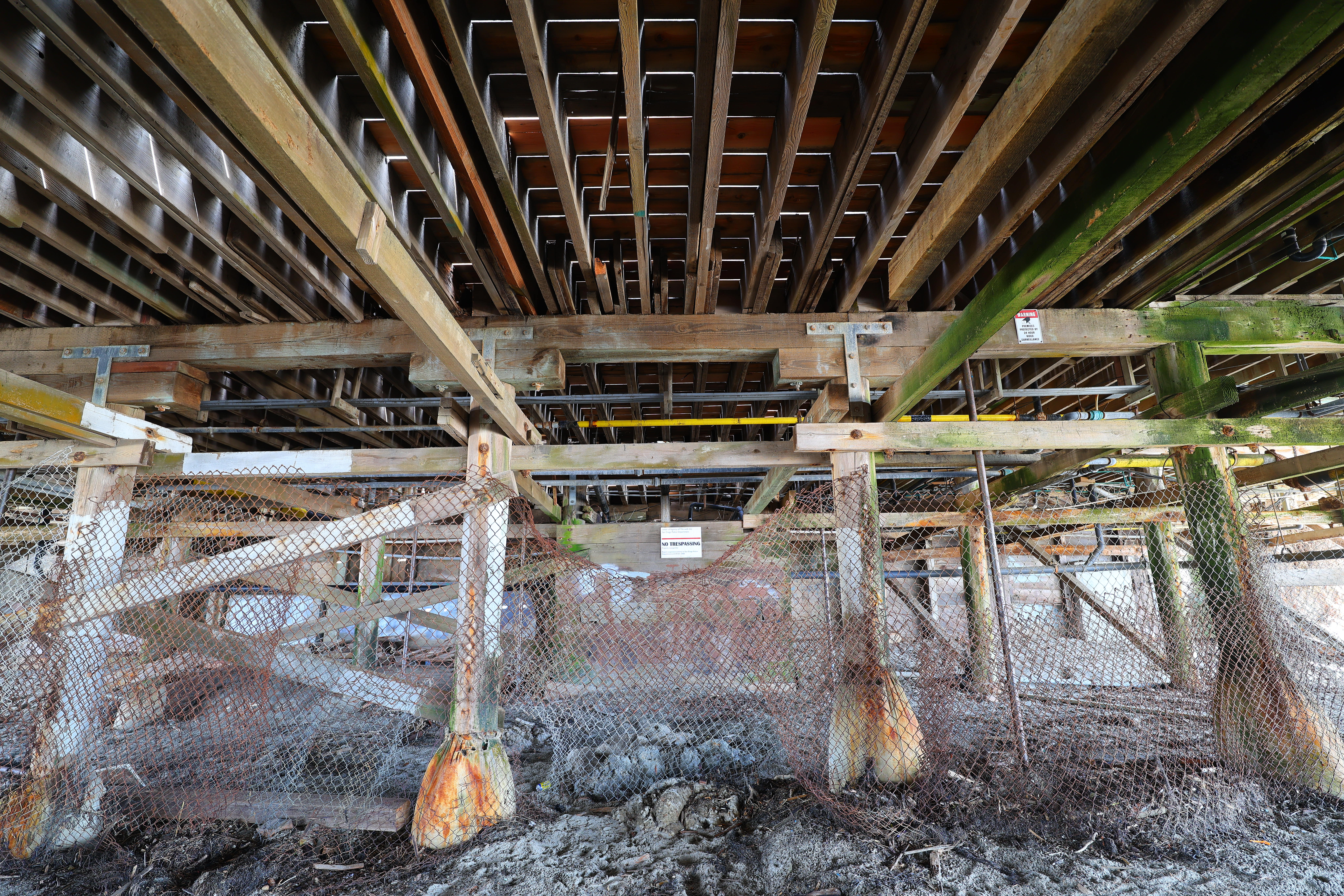
Psychedelic Insanity Under the Pacific Beach Pier, San Diego, California, 1:02 PM, Thursday, 06 March 2025. Canon R5 II, 16 mm wide-open at f/2.8 hand-held at 1/20 at Auto ISO 100 (LV 7.4), Radiant Photo and Skylum Luminar Neo software, perspective correction in Photoshop CC. bigger or camera-original 45 MP Quality 1 © 11 MB JPG file.

Canary Palm, 10:40 AM, Thursday, 06 March 2025. Canon R5 II, 16 mm wide-open at f/2.8 at 1/1,000 at Auto ISO 100 (LV 13.0), Radiant Photo software. bigger or camera-original 45 MP Quality 1 © 9 MB JPG file.

Introduction top
Sample Images Intro New Good Bad Missing
Specifications USA Version Performance
Compared User's Guide Recommendations

I buy only from these approved sources. I can't vouch for ads below. |



Don't let it's low price fool you: this new little gem is super-fast, sharp, and even has stabilization, sorely lacking in Nikon's and Sony's ultrawides. It's so sharp that its MTF curve is slightly better than the RF 15-35mm f/2.8L IS USM's MTF, but not that you'll ever see any difference. This is among the best ultrawide lenses ever made, so while Canon, as of March 2025 makes five fantastic full-frame mirrorless ultrawide lenses, if this is the range and speed you want, don't let the low price scare you away. I owe you a comparison article to sort out all five of these lenses.
This lens has exceptionally good stabilization, often giving me perfect tripod-equivalent sharpness at 45 megapixels at one-second hand-held! It also has magnificent sunstars, which are critical for ultrawide lenses.
As we all know due to the geometry involved with the sharp angles involved in the corners, only optical stabilization works properly to stabilize an ultrawide lens in the corners. A sensor would have to move about twice as far in the corners than the center to compensate for camera shake with an ultrawide, and clearly we don't yet have rubber sensors — so we need optical stabilization for sharp corners handheld at slow speeds. Here's another review showing how poorly sensor-shift stabilization works with an unstabilized ultrawide, and thank goodness this little gem uses superior in-lens optical stabilization.
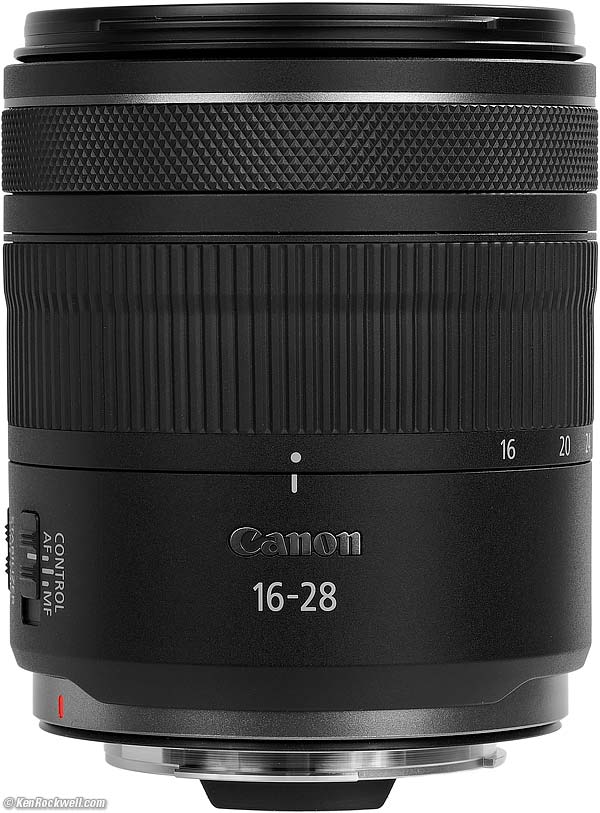
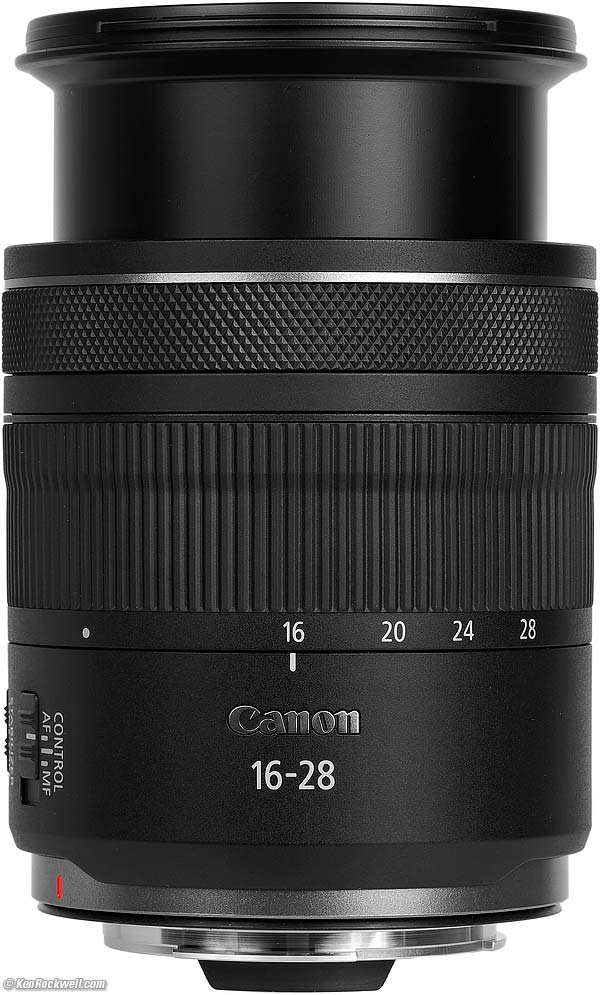
It's a pumper zoom that moves in and out slightly as zoomed, and it also collapses for easier carrying:
|
|
|
Collapsed for carrying. bigger. |
Ready to shoot at 16mm. bigger. |
Ready to shoot at 28mm. bigger. |
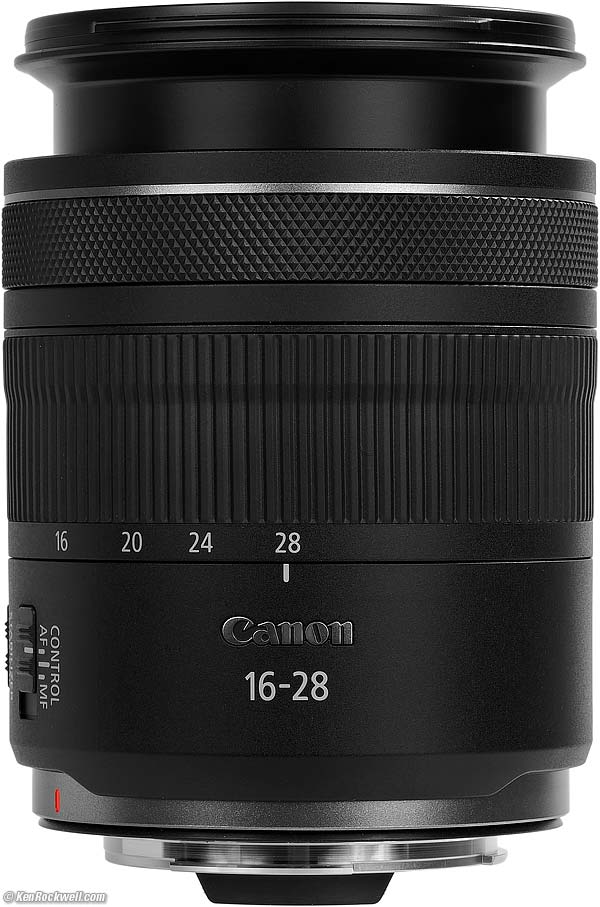
I got my RF 16-28mm f/2.8 IS STM at B&H. I'd also get mine at Adorama, at Amazon or at Crutchfield, or get it used if you know How to Win at eBay, or get it used at KEH.
New intro top
 World's smallest and lightest stabilized f/2.8 ultrawide zoom.
Good intro top
 Small.
Light.
Collapses for carrying.
Stabilized.
Stabilization is rated 5 stops optical, and 8 stops (7½ at the corners) with an internally-stabilized camera. I get about 3⅓ to 5½ stops of real-world improvement, often giving perfect results at one full second hand-held!
Stabilizer switch.
Magnificent Sunstars.
Programmable Control or Focus ring.
AF/MF/CONTROL switch.
Quality made in Japan.
100% U.S.A.-based high-quality technical support at (800) OK-CANON.
Bad intro top
Nothing! It's great little lens. Lenses this wide and fast used to cost a king's ransom back in the 1980s and 1990s, and they weren't stabilized (Nikon's and Sony's ultrawides still aren't stabilized today, either — ha ha 😛!)
Missing intro top
 No case included.
No hood included.
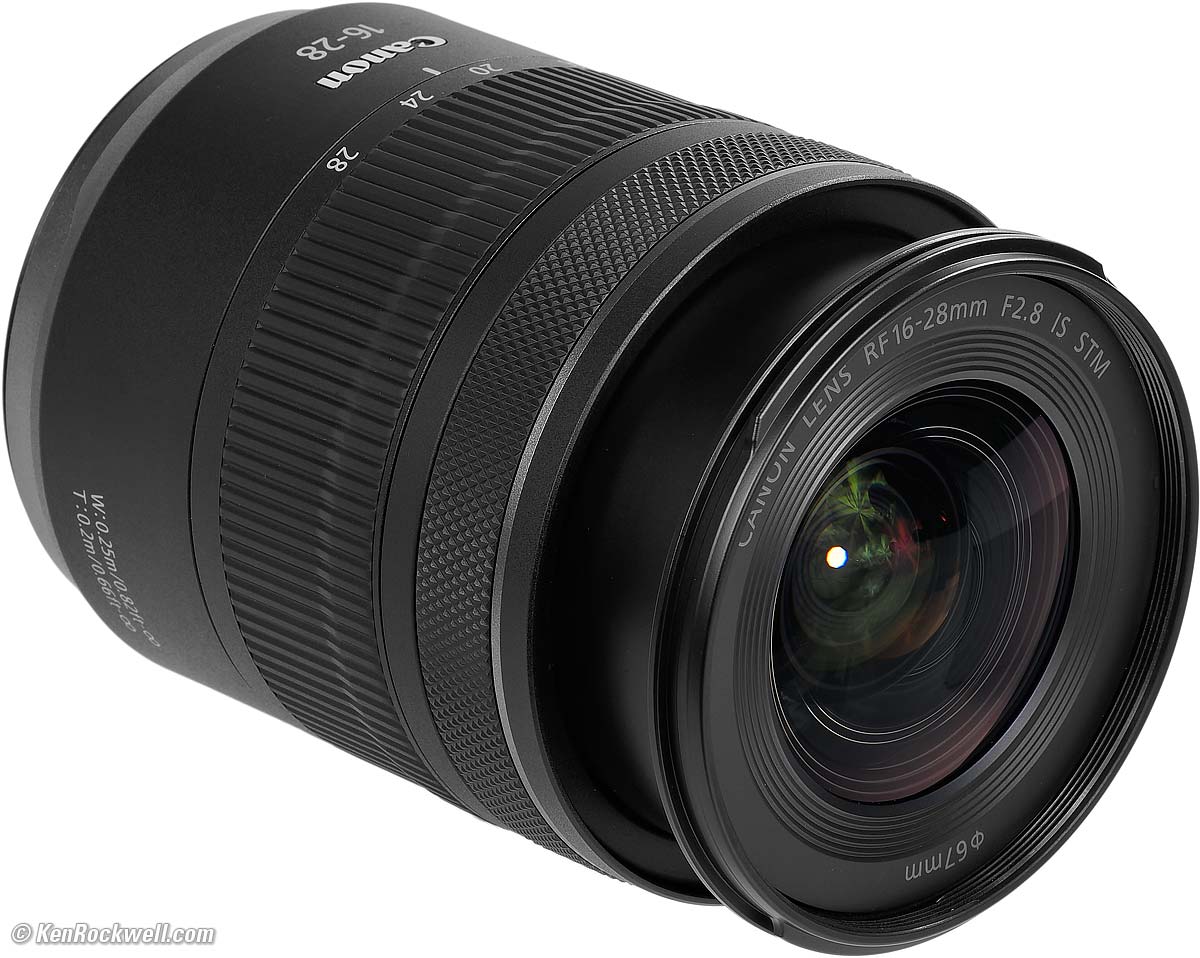
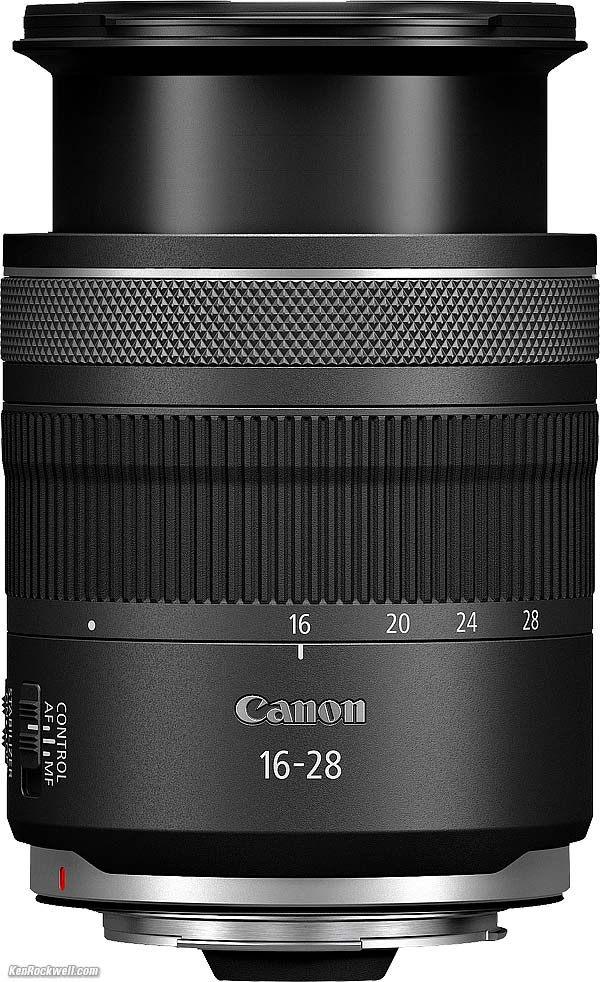
Canon RF 16-28mm f/2.8 IS STM. bigger.
Specifications top
Sample Images Intro New Good Bad Missing
Specifications USA Version Performance
Compared User's Guide Recommendations
I got my RF 16-28mm f/2.8 IS STM at B&H. I'd also get mine at Adorama, at Amazon or at Crutchfield, or get it used if you know How to Win at eBay, or get it used at KEH.
See also Canon's Own Specifications.
Name specifications top
Canon calls this the RF16-28mm F2.8 IS STM:
RF: Works only on Canon's EOS-R Mirrorless cameras.
IS: Image Stabilization.
STM: STepper (autofocus) Motor.
Optics specifications top
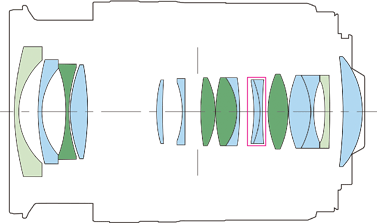
Internal Optical Construction. Regular Optical Glass, UD and Aspherical elements. IS section.
16 elements in 13 groups.
4 UD extra-low dispersion elements, which help reduce secondary axial chromatic aberration.
2 Aspherical elements.
Internal focusing: nothing moves externally as focused.
Pumper zoom: the front moves in and out as zoomed.
Super Spectra multicoating.
No Air Sphere variable-refractive index coatings.
No fluorine coatings.
Diaphragm specifications top
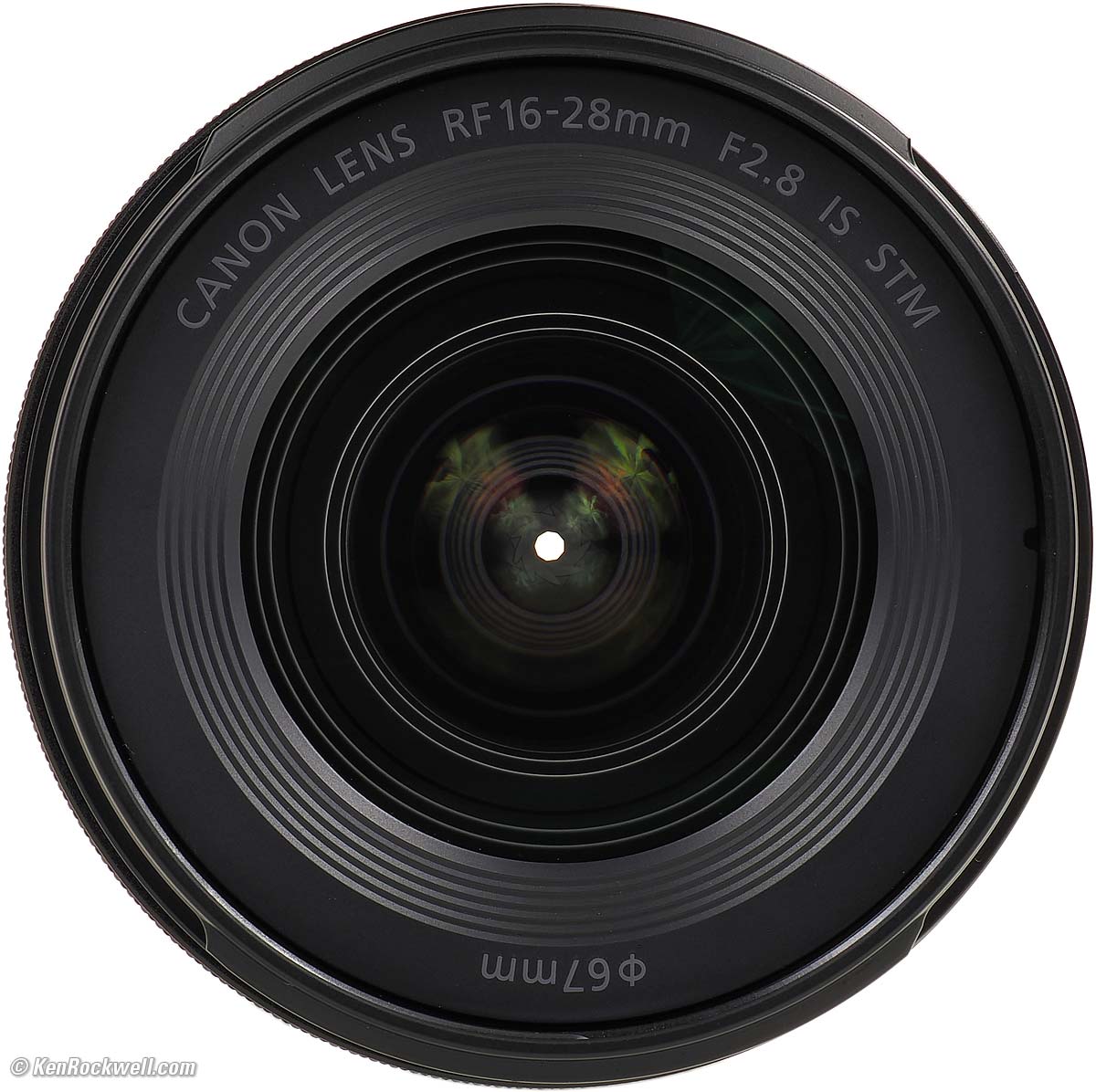
Canon RF 16-28mm f/2.8 IS STM. bigger.
9 rounded blades.
Electronically actuated.
Stops down to f/22.
Filters specifications top
Plastic 67mm filter thread.
Coverage specifications top
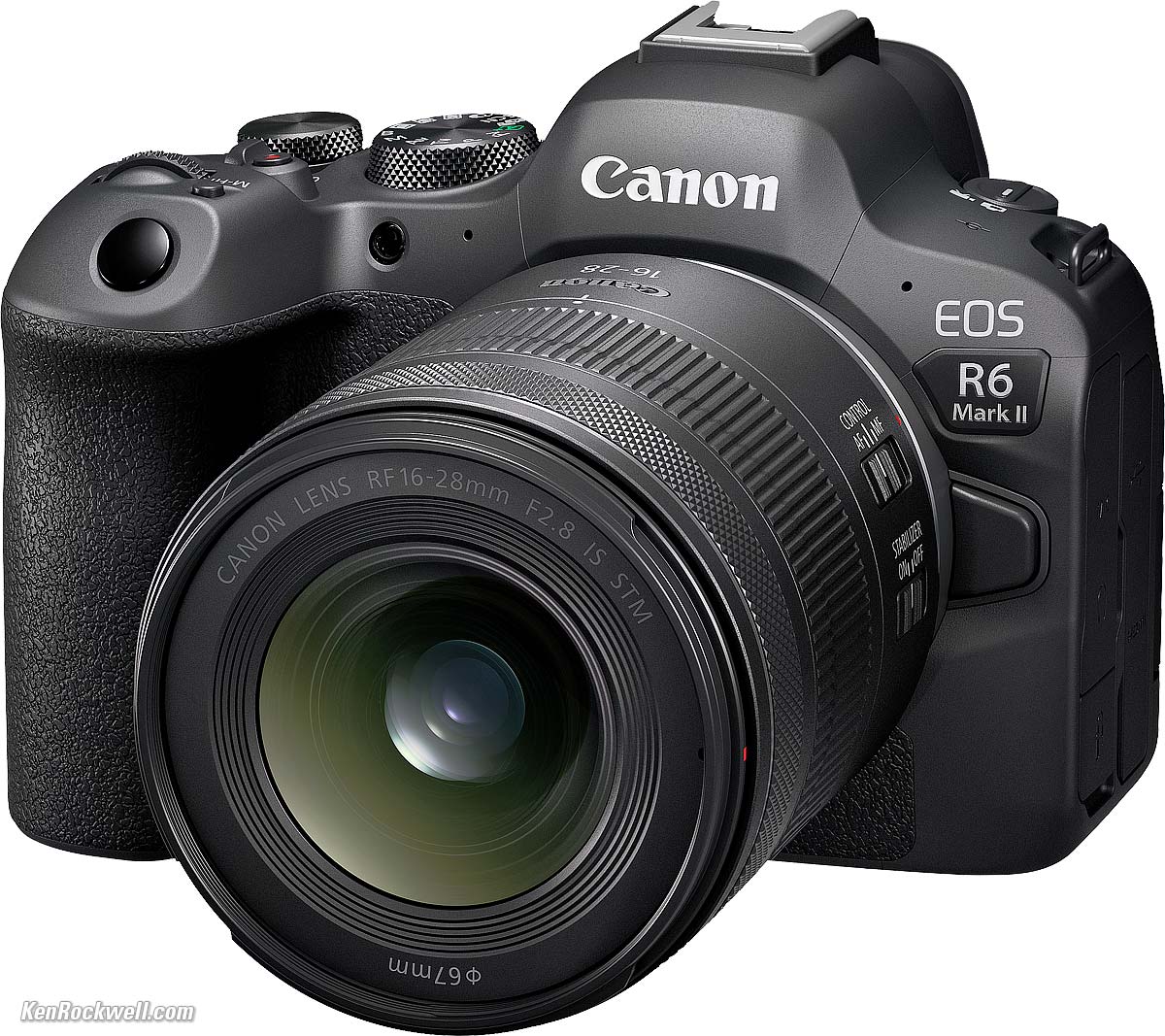
Canon RF 16-28mm f/2.8 IS STM on EOS R6 Mk II. bigger.
Covers and optimized for Full-Frame (24 × 36mm).
Also works great on APS-C (16 × 24mm), but the dedicated APS-C RF-S 18-45mm IS STM is smarter choice for APS-C if you want the same millimeter focal length range because it's smaller, lighter and much less expensive. Either of these lenses is simply a relatively normal lens on APS-C, not an ultrawide. (The RF-S 18-45mm IS STM won't work on full-frame as will this RF 16-28mm lens.)
If you want an ultrawide lens with a similar angle of view on APS-C as this lens gives on full-frame, then get the ultrawide RF-S 10-18mm IS STM instead.
See also Crop Factor.
Focal Length specifications top
16 ~ 28mm.
When used on an APS-C camera, it sees the same angle of view as a 26 ~ 45mm lens sees when used on a full-frame or 35mm camera.
See also Crop Factor.
Angles of View (full frame) specifications top
108º 10' ~ 75º diagonal.
98º ~ 65º horizontal.
74º 10' ~ 46º vertical.
Autofocus specifications top
No external movement as focussed, so no air or dust is sucked in.
Focus Scale specifications top
No.
Not on lens, but may be displayed in-camera.
Infinity Focus Stop specifications top
No.
You have to focus somehow to get precise focus at infinity, just like at every other distance.
Depth of Field Scale specifications top
No.
Not on lens, but may be displayed in-camera.
Infrared Focus Index specifications top
No.
Close Focus (distance from subject to image plane) specifications top
16mm: 0.82 feet (0.25 meters).
28mm: 0.66 feet (0.20 meters).
Maximum Reproduction Ratios specifications top
28mm: 1:3.8 (0.26 ×).
16mm: 1:9.1 (0.11 ×).
Minimum Subject Fields specifications top
28mm: 138.3 mm × 92.2 mm (5.4" × 3.6").
16mm: 318.2 mm × 212.1 mm (12.5" × 8.4").
Image Stabilizer specifications top
Rated 5 stops improvement optical, in the center.
Rated 8 or 7½ stops improvement in the center or corners when used with an internally-stabilized camera.
Actually gives about 3⅓ to 5½ stops of real-world improvement.
Caps specifications top
Canon E-67II 67mm front cap and RF Rear Cap (p/n 2962C001), both included.
Hood specifications top
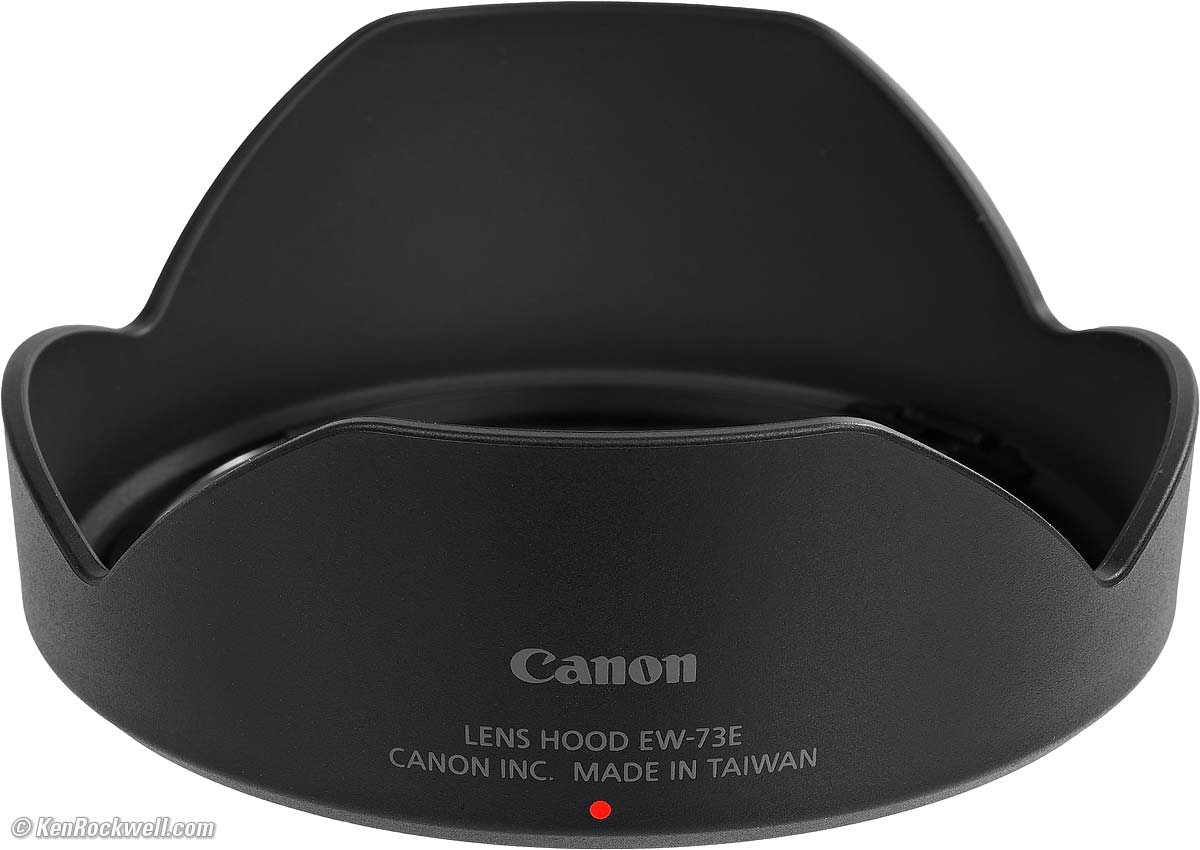
Optional EW-73E (same hood as RF 15-30mm IS STM).
There's also a knock-off by JJC at Amazon.
Case specifications top
Optional LP1116 carry sack.
Size specifications top
3.0 inches (76.5 mm) ø maximum diameter.
Collapsed: 3.58" (91.0 mm) extension from flange.
At 16mm: 4.44" (112.8 mm) extension from flange.
At 28mm: 4.02" (102.1 mm) extension from flange.
Weight specifications top
15.535 oz. (440.4 g) actual measured weight.
Rated 15.9 oz (445 g).
Announced specifications top
12:01 AM, Thursday 23 January 2025, NYC time.
Promised for specifications top
11 February 2025.
Included specifications top
Lens.
Canon E-67II 67mm front cap.
RF Rear Cap (p/n 2962C001).
Instructions and USA Warranty Card.
Optional specifications top
EW-73E hood (same hood as RF 15-30mm IS STM).
Model Numbers specifications top
Model number: RF16-28ISSTM.
Product code: 6906C002 (6906C001 in Japan).
JAN code: 4549292-241716.
Price, U. S. A. specifications top
26 February 2026
$1,049 at B&H, at Adorama, at Amazon and at Crutchfield.
About $885 used if you know How to Win at eBay
05 March 2025
$1,149 at B&H, at Adorama, at Amazon and at Crutchfield.
I don't see that any have sold used yet.
23 January 2025
$1,149 at Adorama and at B&H.
I don't see that any have sold used yet.
 |
 |
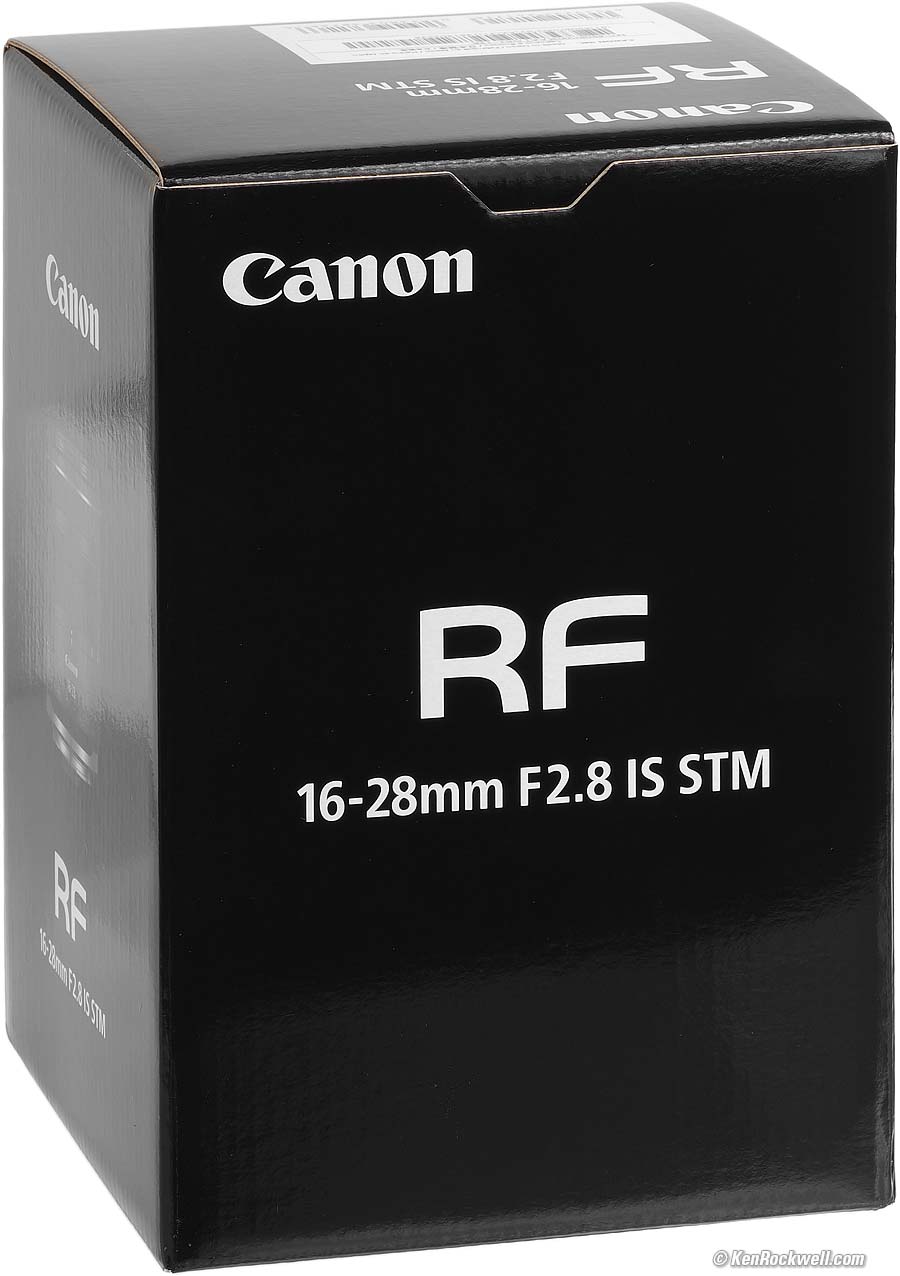
Box. bigger. |
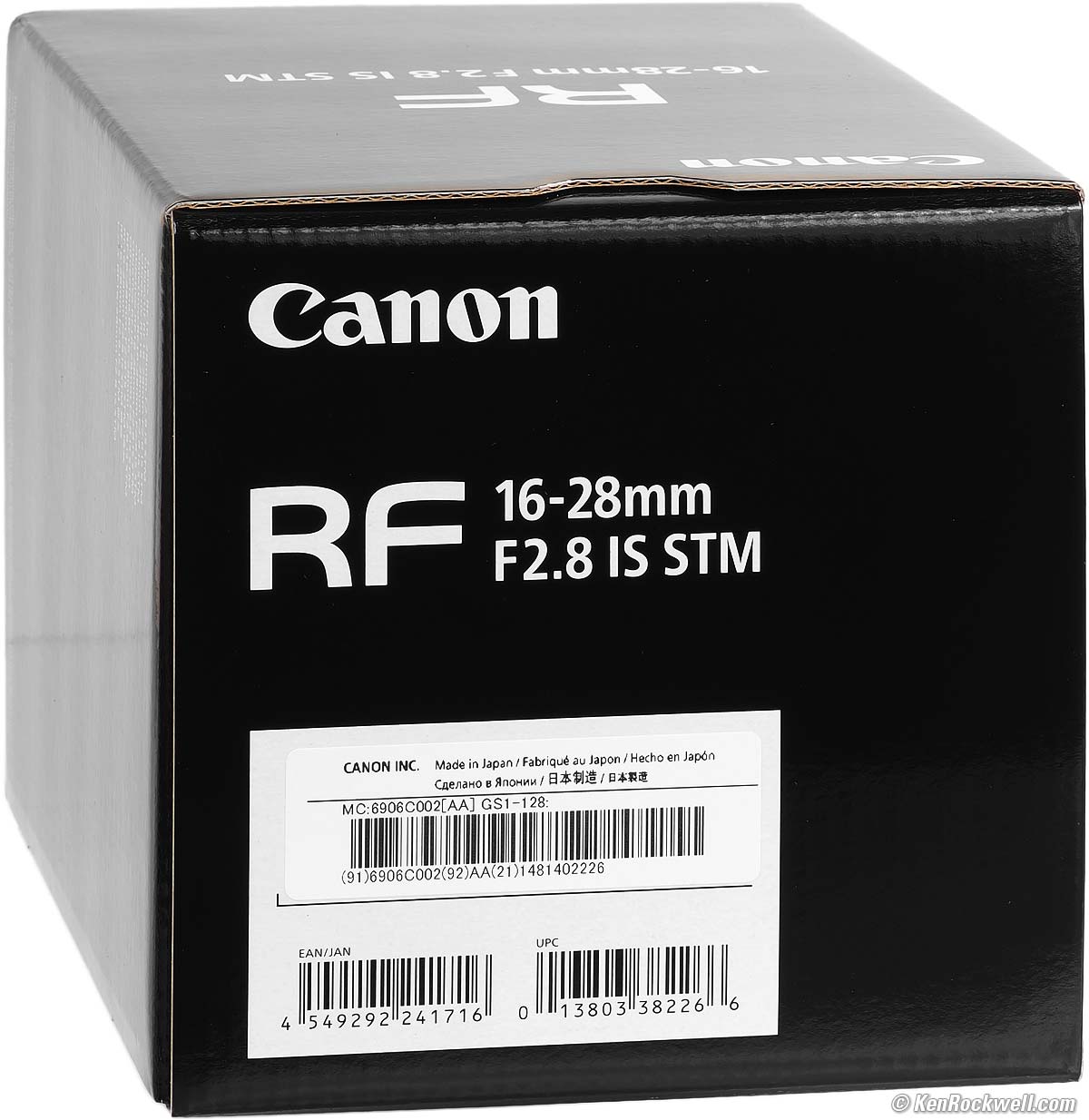
Box End. bigger. |
Getting a Legal U. S. A. Version top
Sample Images Intro New Good Bad Missing
Specifications USA Version Performance
Compared User's Guide Recommendations
I got my RF 16-28mm f/2.8 IS STM at B&H. I'd also get mine at Adorama, at Amazon or at Crutchfield, or get it used if you know How to Win at eBay, or get it used at KEH.
This section applies in the U. S. A. only.
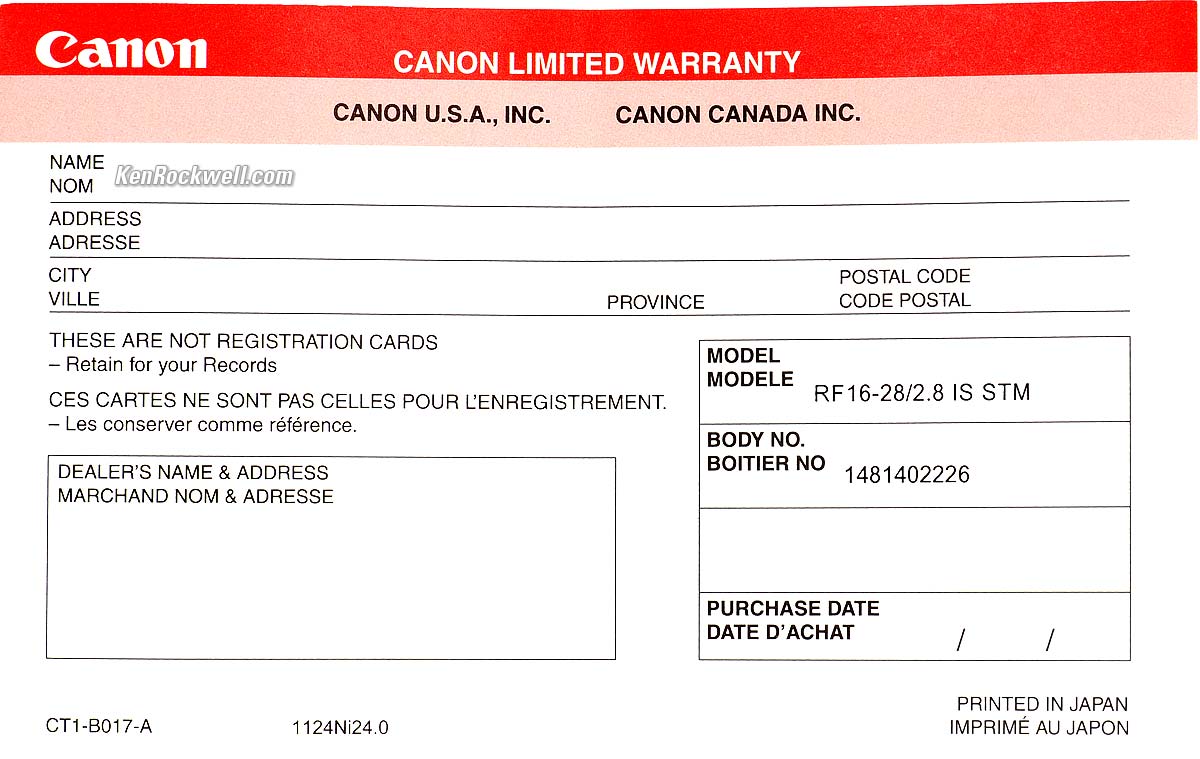
Canon RF 16-28mm f/2.8 IS STM USA Warranty Card. bigger.
Your lens must include a printed U. S. A. warranty card like the one shown above from Canon U.S.A., Inc. It should be on top inside your box as you open it. The serial number on the card must match the serial number on the bottom of your lens.
If you have no card or the serial number doesn't match, you got ripped off with a gray market version intended to be sold in another country. This is why I never buy from any place other than my personally approved sources. You just can't take the chance of buying elsewhere, especially at any retail store where strangers have probably opened your completely unsealed box and played with your camera, because non-U. S. A. versions have no warranty in the U. S. A., and you probably won't be able to get firmware or service for it — even if you're willing to pay out-of-pocket for it when you need it!
Shifty dealers may include color copies of a card from a legitimate U. S. A. product in a gray-market box, hoping you won't check serial numbers and catch their fraud. A card with the wrong serial number means nothing other than that you have no warranty coverage.
The serial number on the box doesn't have to match, but it should. It will be hidden someplace on the sticker with all the bar codes. If not, it means a shady dealer took things out of boxes and was too sloppy to put them back correctly — and it means you got a used lens if anyone other than you took it out of the box.
If a gray market version saves you $500 the risk might be worth it, but for $200 or less I wouldn't risk having no warranty or support.
Always be sure to check yours while you can still return it, or just don't buy from unapproved sources and never at retail so you'll be able to have your camera serviced and get free updated firmware as needed. Get yours from the same places I do and you won't have a problem.
Performance top
Sample Images Intro New Good Bad Missing
Specifications USA Version Performance
Compared User's Guide Recommendations
I got my RF 16-28mm f/2.8 IS STM at B&H. I'd also get mine at Adorama, at Amazon or at Crutchfield, or get it used if you know How to Win at eBay, or get it used at KEH.
Overall Autofocus Manual Focus Breathing
Distance Recording Bokeh Distortion Ergonomics
Falloff Filters Flare & Ghosts Lateral Color Fringes
Lens Corrections Macro Mechanics Sharpness
Spherochromatism Stabilization Sunstars
Overall performance top
The RF 16-28mm f/2.8 IS STM is optically superb, as well as light, compact, inexpensive and stabilized. Canon doesn't make this easy for us with so many different and excellent ultra wides, all of which are superb.
Autofocus performance top
Autofocus is fast, and nearly silent.
It's immediate, but not instantaneous.
It's what I expect for a very wide lens, which historically have always focussed quickly.
Manual Focus performance top
Manual focusing is entirely electronic; the manual focus ring isn't connected to anything other than a digital encoder.
You may need to set some menus to get manual-focus override on older cameras.
No matter what you do, all Canon EOS-R cameras as of March 2025 in SERVO AF mode will continue to autofocus as soon as you stop turning the manual focus ring. Sadly only Nikon has this all figured out today.
Focus Breathing performance top
Focus breathing is the image changing size (growing and shrinking slightly) as focused in and out. It's important to cinematographers that the image not breathe (change size) as focus gets pulled back and forth between different actors as they speak. The image is said to breathe because it expands and contracts as the focus follows the dialog back and forth.
The images from this 16-28/2.8 become noticeably smaller as focused more closely.
Focus Distance Recording performance top
The focused distance is recorded in the EXIF data.
I read this in the lower left of my screen in Photoshop's lens correction filter.
Bokeh performance top
Bokeh, the feel, character or quality of out-of-focus areas as opposed to how far out of focus they are, is very good, but it rarely matters because it's rare that anything is out of focus with a lens this wide.
Here are photos from headshot distance wide-open. I'm focused on the DAVIS logo. Click any for the © camera-original file:
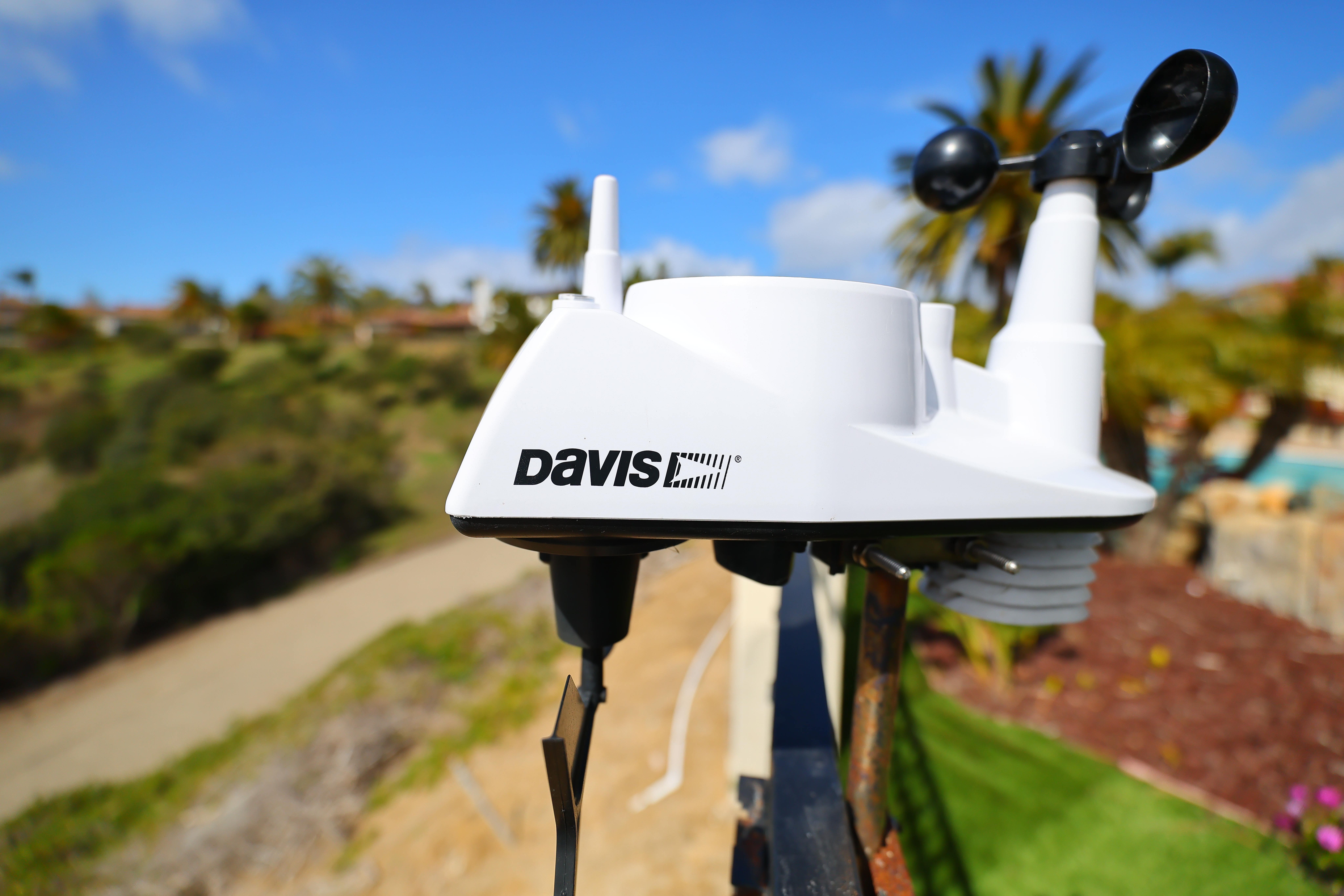
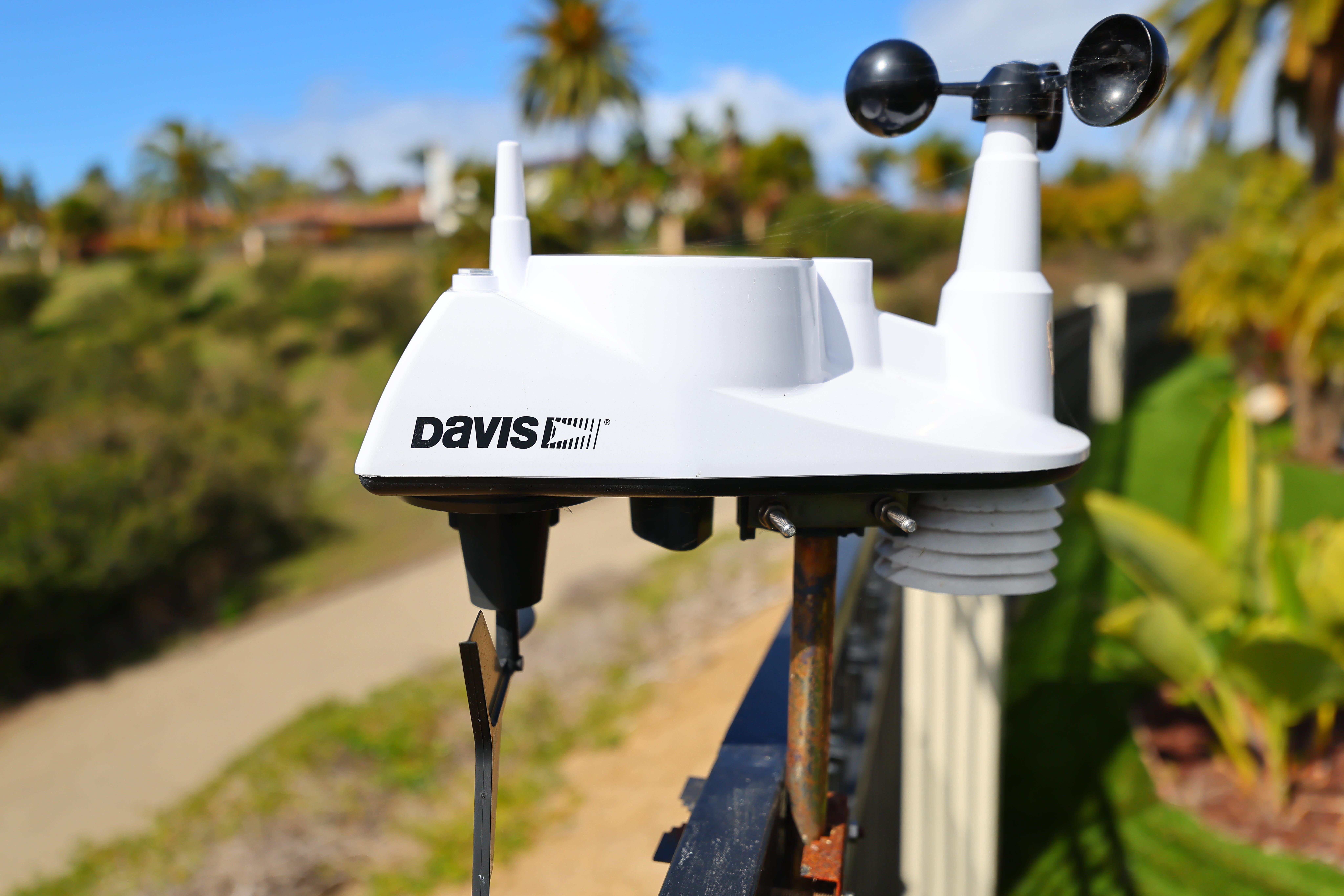
Made-in-U. S. A. Davis 6357 Vantage Vue Wireless Sensor Suite (use with WeatherLink console), 10:42 AM, Thursday, 06 March 2025. Canon R5 II at 1/4,000 and 1/3,200 at Auto ISO 100, +0.7 stops exposure compensation (LV 15.0 and 14.6).
Click either for the camera-original © file.
As always, if you want to throw the background as far out of focus as possible, shoot at 28mm at f/2.8 and get as close as possible.
Distortion performance top
The Canon RF 16-28mm f/2.8 IS STM has no visible distortion as shot, because the in-camera distortion correction can't be turned off.
If you collect raw data rather than create actual JPG images, whatever software you use to create visible images from that raw data may or may not correct the distortion as is done in-camera as JPGs. You're on your own there; I don't bother with raw data.
While Canon's own software probably also corrects this from 
For more critical scientific use, use these corrections in Photoshop's lens correction filter to JPG images.
These aren't facts or specifications, they are the results of my research that requires hours of photography and calculations on the resulting data.
On Full-Frame and 35mm at 30' (10m) |
Correction factor to use with images made with correction ON in R5 II |
16mm |
+0.80 |
20mm |
+0.20 |
24mm |
±0.00 |
28mm |
+0.50 |
© 2025 KenRockwell.com. All rights reserved.
Ergonomics performance top
It's a pumper zoom that moves in and out slightly as zoomed, and it also collapses for easier carrying:
|
|
|
Collapsed for carrying. bigger. |
Ready to shoot at 16mm. bigger. |
Ready to shoot at 28mm. bigger. |
It handles great. It has AF/MF and STABILZER switches, a manual focus ring and a mechanical zoom ring.
The CONTROL setting of the AF/MF switch repurposes the focus ring to become an unclicked programmable control ring. I don't find this helpful because the ring lacks clicks, without which it's very weird trying to set apertures or White Balance or whatever else to which it can be programmed.
There may not be an always-responsive instant manual-focus override unless you enable this in a menu. Manual focus override never works in SERVO AF; while the lens will focus manually as you turn the ring, as soon as you stop the AF system takes over again.
Falloff performance top
Falloff is invisible with correction left at its default of ON.
I've greatly exaggerated the falloff by shooting a gray field and placing these on a gray background; it will not look this bad in actual photos of real things:
Falloff on full-frame at infinity, correction at its default of ON:
© 2025 KenRockwell.com. All rights reserved. |






If you save only raw data to process later rather than create JPG images in-camera, whatever software you use to create visible images from raw data may or may not correct this as is done in-camera as JPGs. You're on your own there; I don't bother with raw data.
If you go out of your way to turn off the correction, or possibly with some raw software, this is what you get. Again, it's worse here than it will appear with real images:
Falloff on full-frame at infinity, correction deliberately turned OFF:
© 2025 KenRockwell.com. All rights reserved. |







Filters, use with performance top
It's fine with regular filters, however you have to be careful at 16mm on full-frame because you may get a tiny bit of vignetting if you use a thick rotating polarizer or grad filter.
This won't be a problem with regular UV filters and you shouldn't be using polarizers with ultrawide lenses because the sky's natural polarization can appear as a dark band across the sky. If you want to use a polarizer at 16mm (I don't), use a thin one like Nikon's excellent 67mm Circular Polarizer II.
If you have a problem with a thick or stacked filters, zoom a little longer.
Flare & Ghosts performance top
Flare and ghosts are well controlled.
See examples at Sunstars.
Lateral Color Fringes performance top
There are no color fringes when shot as JPG with the default Chromatic Aberration Correction left ON.
if you go out of your way to turn this OFF (or shoot raw and then use non-manufacturer software to process that data into images) then there is a tiny bit of yellow-green/magenta fringing in the far corners at 16mm and almost none at 28mm.
If you shoot raw data rather than JPG images you may — or may not — be responsible to correct this on your own.
Lens Corrections performance top
Other cameras may vary as the years roll on, but my EOS R1, R3, R5 II, R5, R5C, R6 II, R6, R, R8, RP, R7, R10, R50 and R100 all have options to correct for falloff (Peripheral Illumination Correction), Distortion and a Digital Lens Optimizer which corrects for a suite of other aberrations.
These are all ON by default.
This lens integrates electronic distortion correction as part of its design, so the Distortion setting is grayed-out because it can not be turned off.
You can turn off falloff correction and/or the Digital Lens Optimizer.
If you turn off the Digital Lens Optimizer, you are then offered à la carte ON/OFF options for Chromatic Aberration Correction and Diffraction Correction.
If you shoot raw data rather than JPG images, whatever software you use to create visible images from raw data may or may not correct these as is done in-camera as JPGs. You're on your own there; I don't bother saving raw data.
Macro Performance performance top
This lens has great magnification for macro, but because it's so wide that you have to get so close that you'll probably block much of your light unless you're careful:
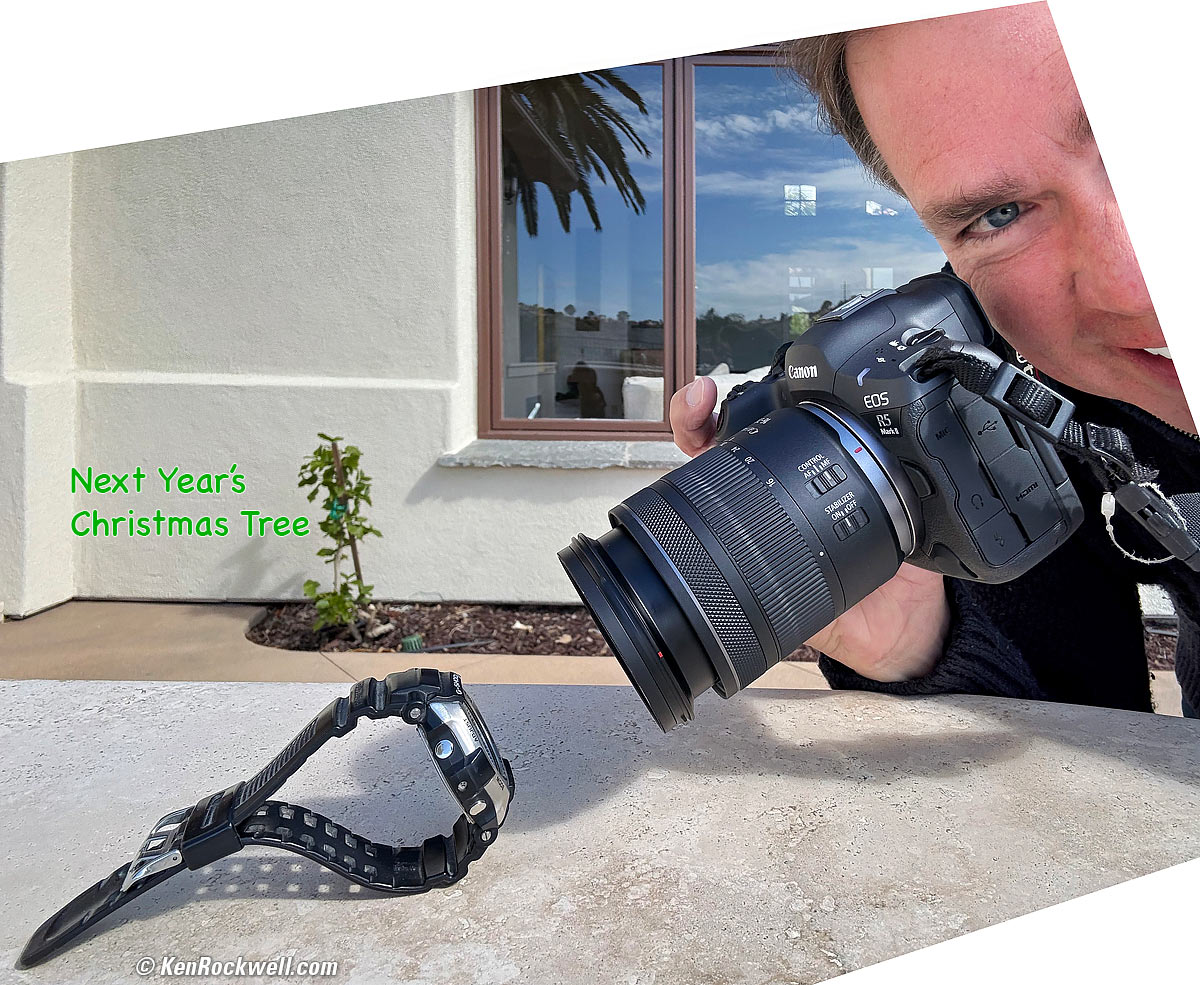
Canon RF 16-28mm f/2.8 IS STM Macro Working Distance for Making the Shots Below. bigger.
Here's how close it gets:
At f/2.8
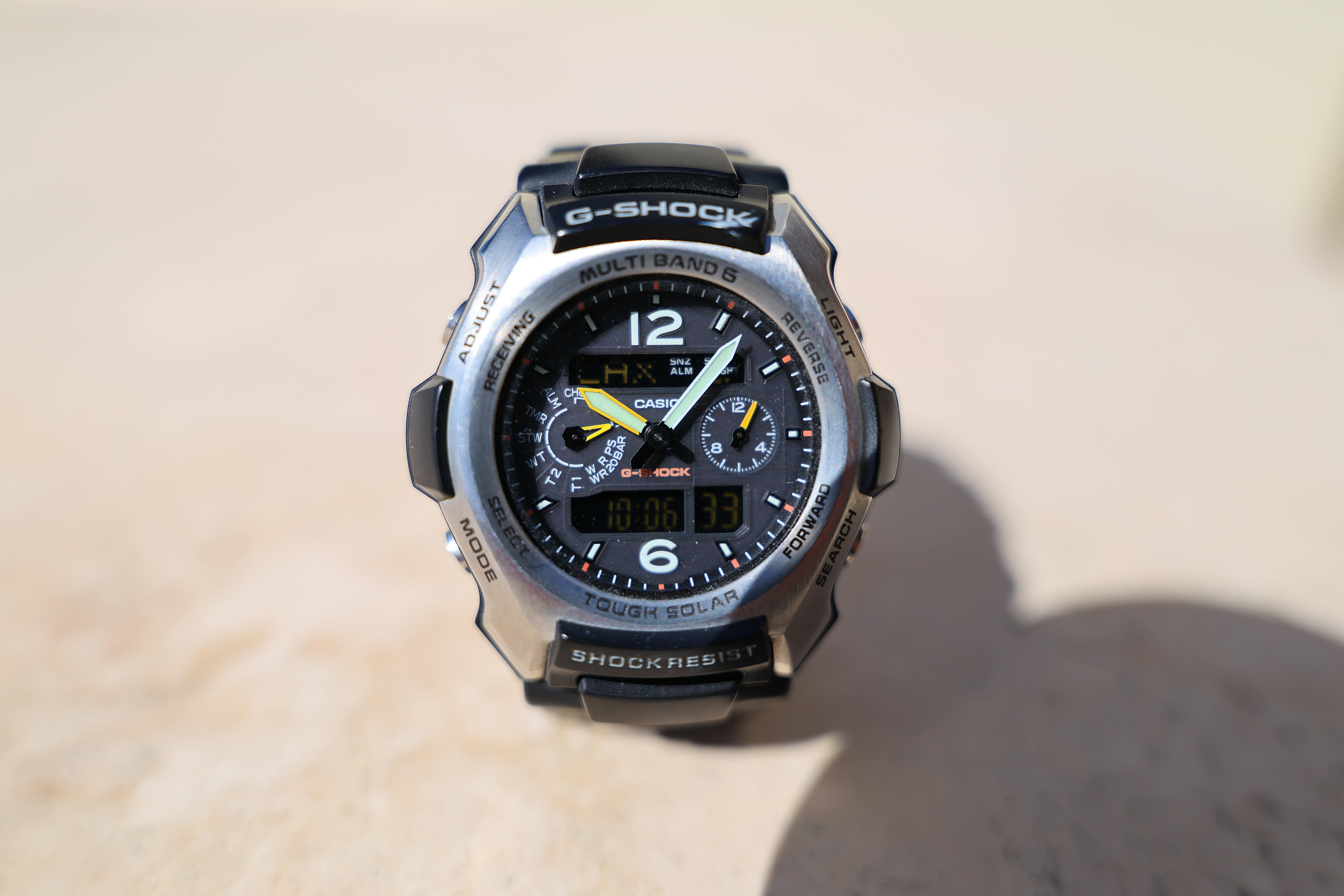
Casio G-Shock Solar Atomic Watch at close-focus distance, 10:07 AM, Thursday, 06 March 2025. Canon R5 II at 1/4,000 at Auto ISO 100, +0.7 stops exposure compensation (LV 15.0). bigger or camera-original © file.
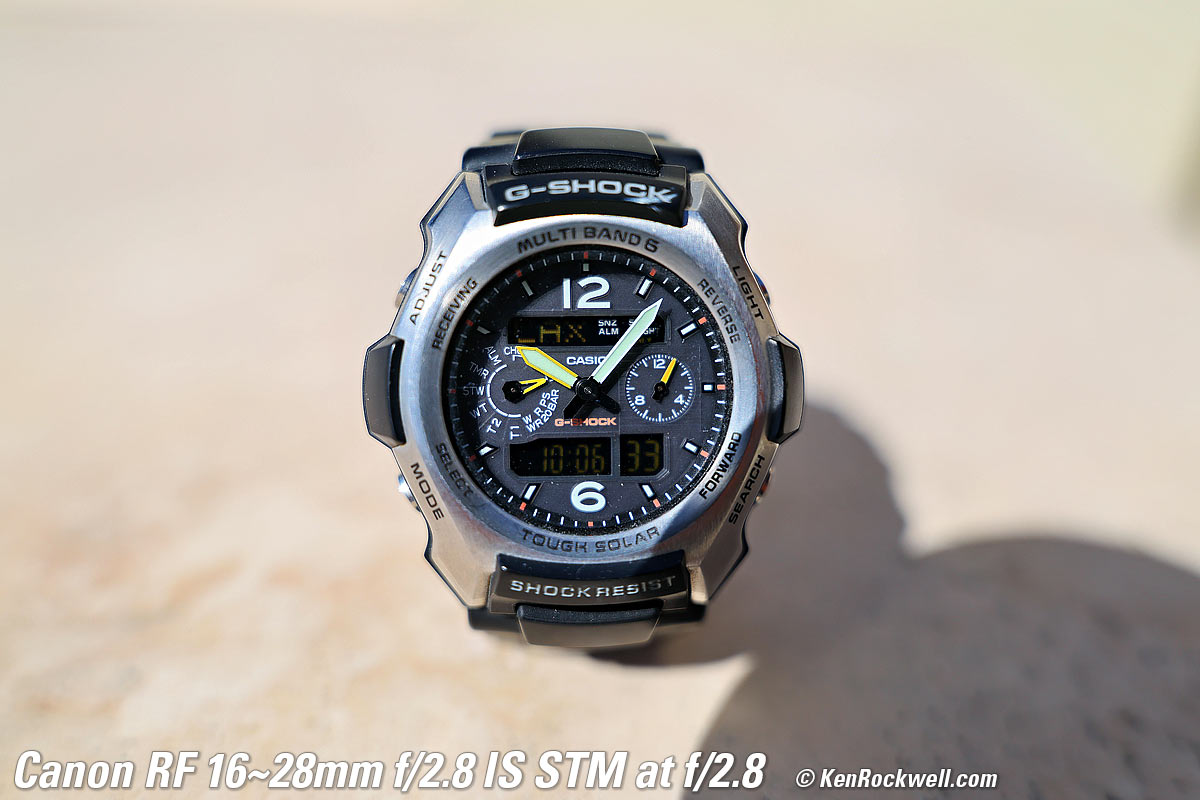
1,200 × 900 pixel (6.8× magnification) crop from above. bigger or camera-original © file.
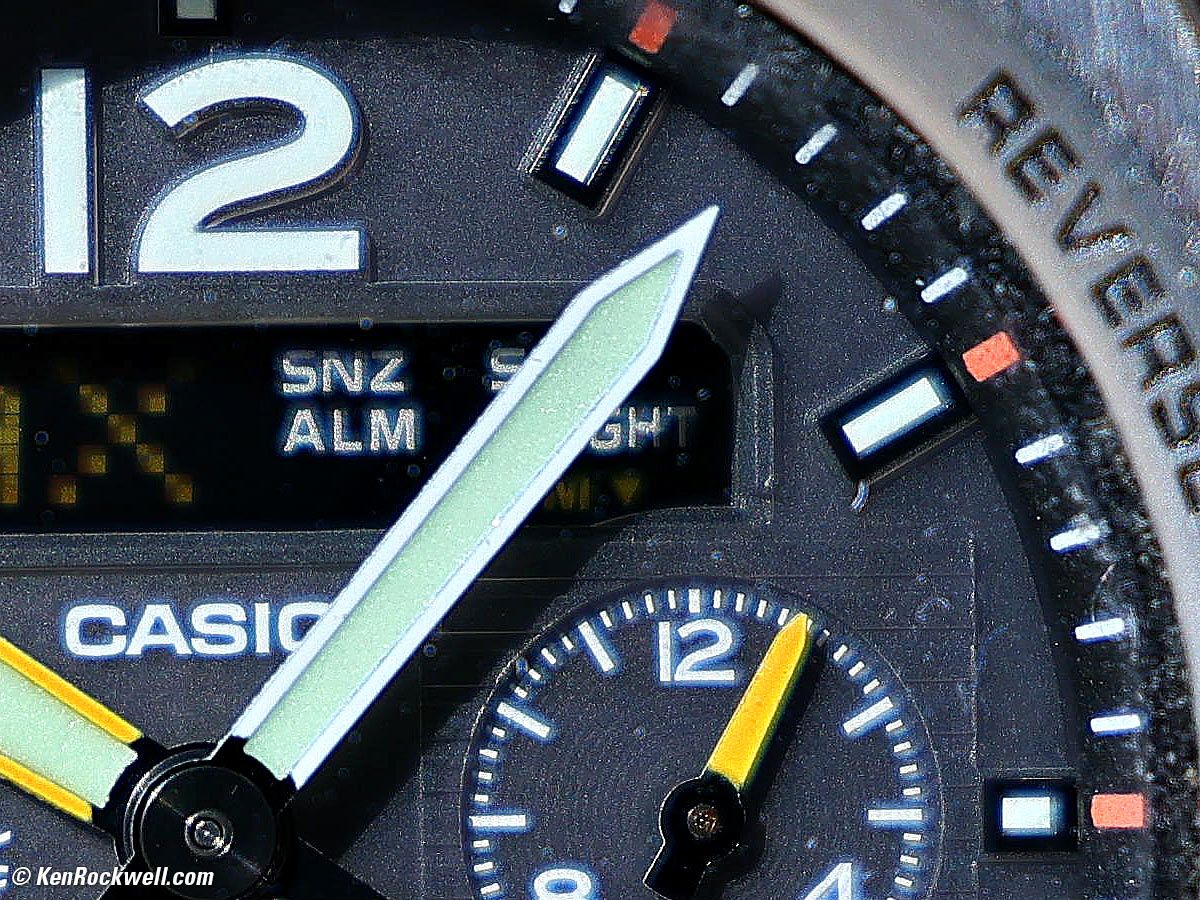
The cyan halos are from spherochromatism and the fact that this isn't all in perfect focus because I was hand-holding everything.
If this 1,200 × 900 pixel crop is about 3" (7.5cm) wide on your screen, the complete image would print at a large 14 × 21″ (35 × 55 cm) at this same high magnification.
If this 1,200 × 900 pixel crop is about 6" (15cm) wide on your screen, the complete image would print at a huge 27½ × 41¼″ (70 × 105 cm) at this same high magnification.
If this 1,200 × 900 pixel crop is about 12" (30cm) wide on your screen, the complete image would print at a mammoth 55 × 82½″ (1.4 × 2.1 meters) at this same extremely high magnification!
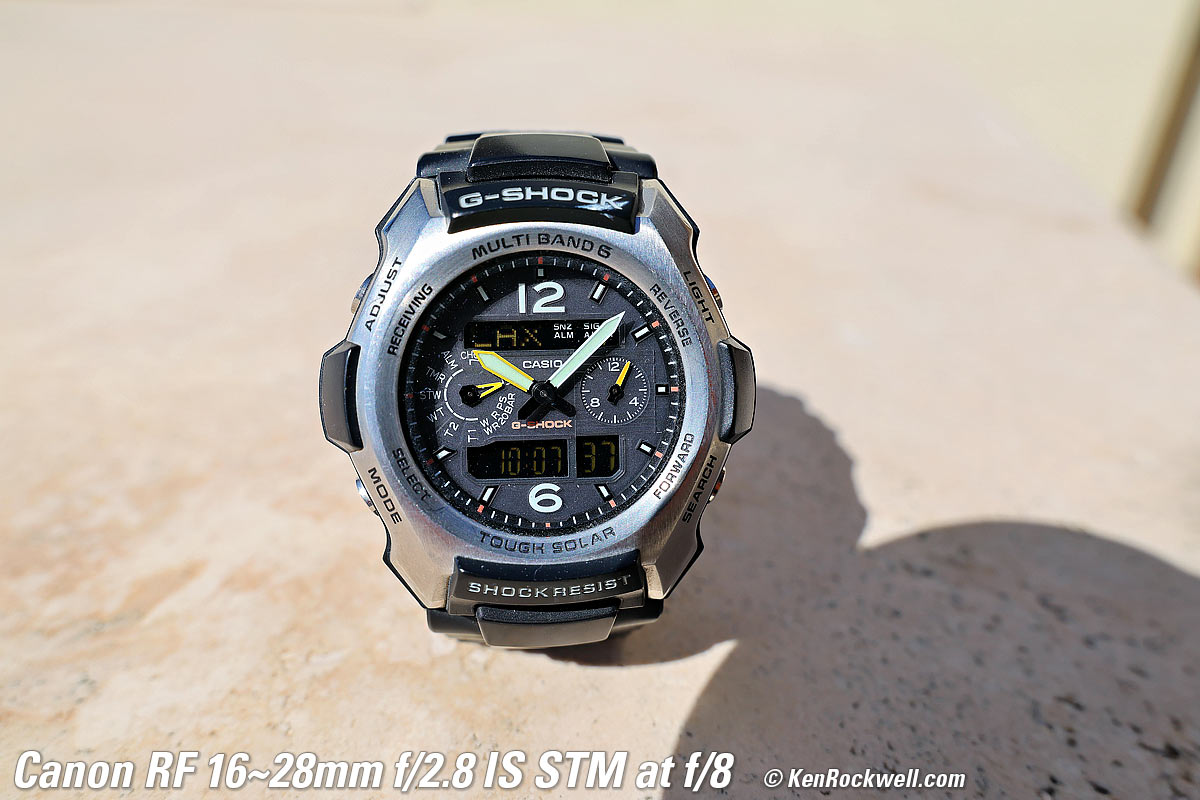
At f/8
Of course everything sharpens up at f/8:
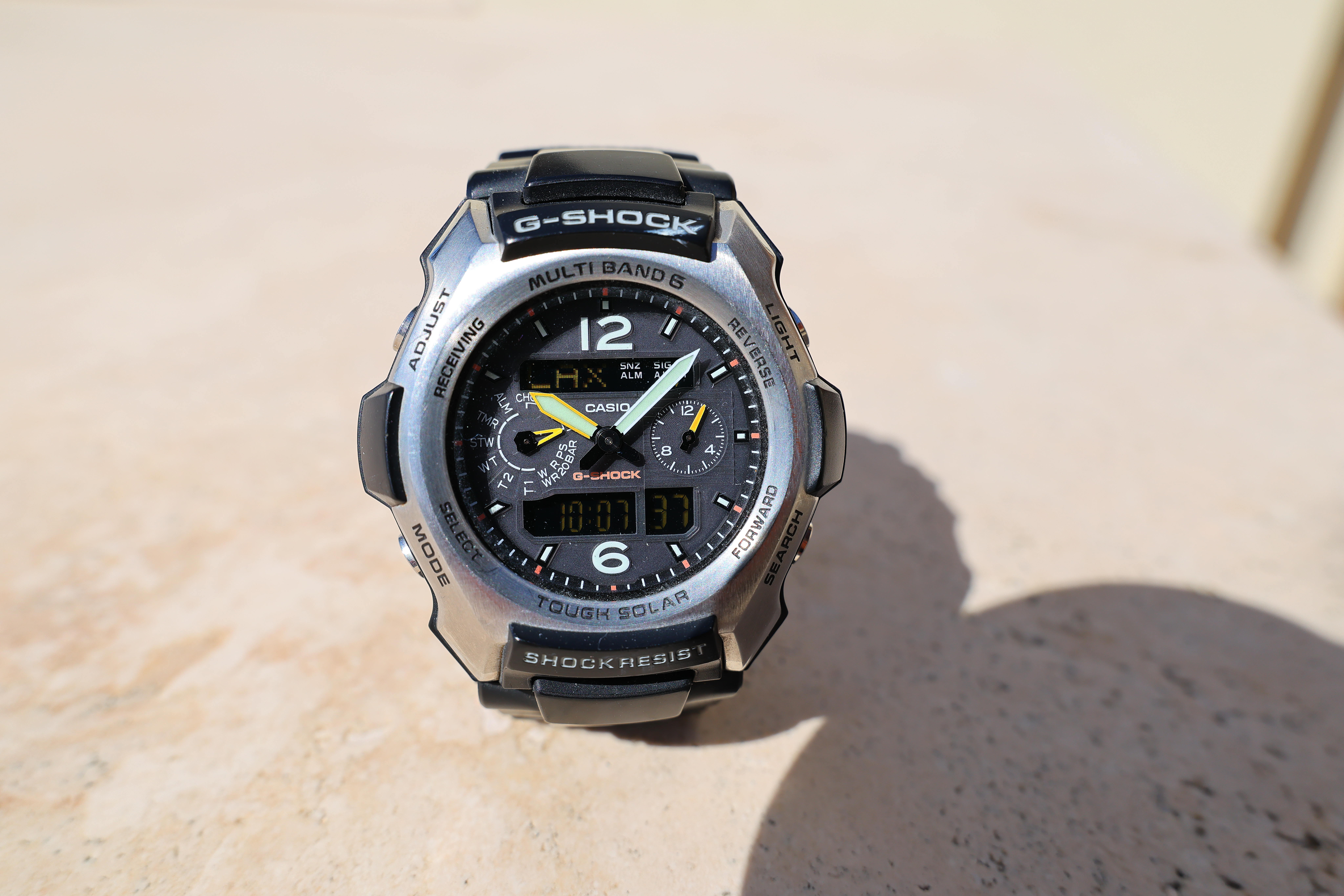
Casio G-Shock Solar Atomic Watch at close-focus distance, 10:07 AM, Thursday, 06 March 2025. Canon R5 II at 1/4,000 at Auto ISO 100, +0.7 stops exposure compensation (LV 15.0). bigger or camera-original © file.
1,200 × 900 pixel (6.8× magnification) crop from above. bigger or camera-original © file.
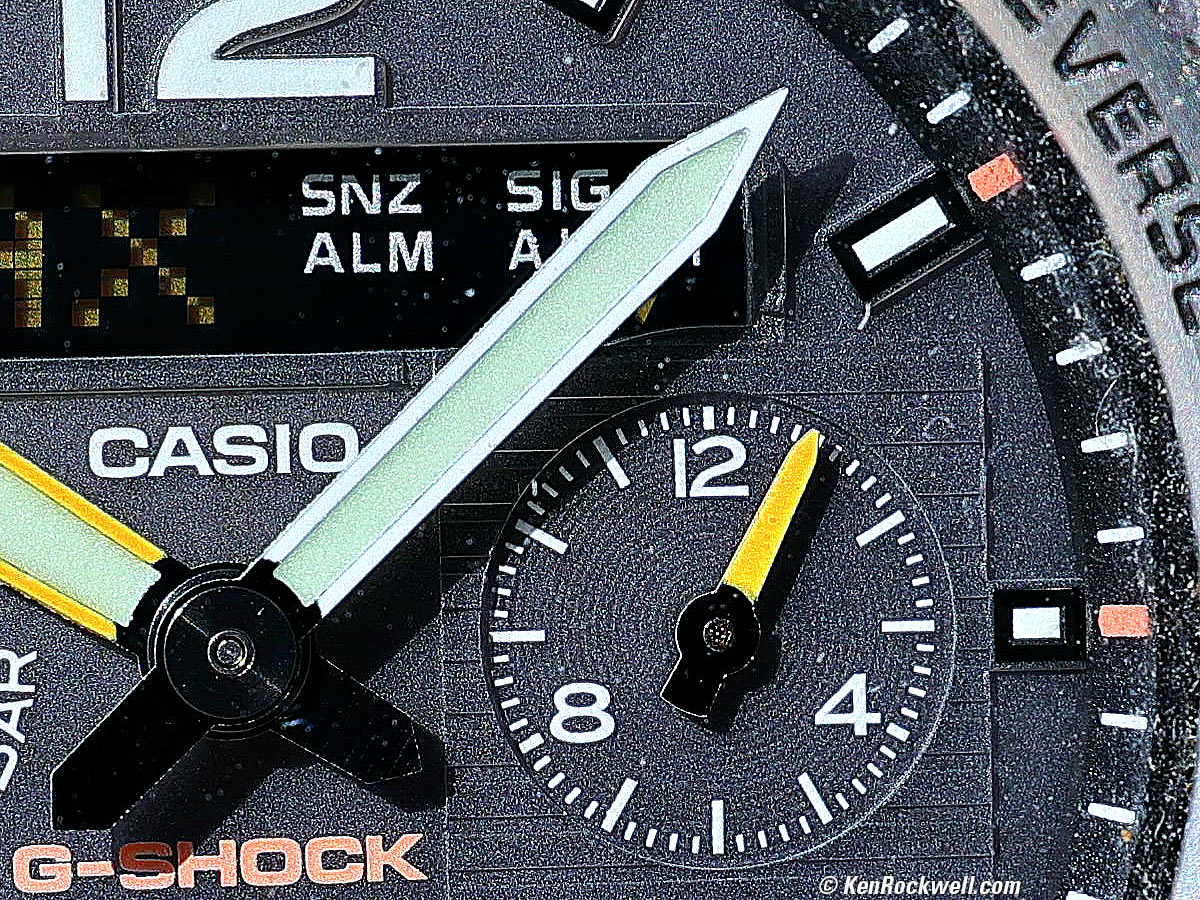
It's so sharp that the texture of the watch face is quite overemphasized with the standard sharping I use to publish these.
If this 1,200 × 900 pixel crop is about 3" (7.5cm) wide on your screen, the complete image would print at a large 14 × 21″ (35 × 55 cm) at this same high magnification.
If this 1,200 × 900 pixel crop is about 6" (15cm) wide on your screen, the complete image would print at a huge 27½ × 41¼″ (70 × 105 cm) at this same high magnification.
If this 1,200 × 900 pixel crop is about 12" (30cm) wide on your screen, the complete image would print at a mammoth 55 × 82½″ (1.4 × 2.1 meters) at this same extremely high magnification!
Mechanical Quality performance top
Canon RF 16-28mm f/2.8 IS STM. bigger.
This is all plastic on the outside, with a metal mount.
Exterior Finish
Black plastic.
Optional Hood
Plastic bayonet.
Front Bumper
None.
Filter Threads
Plastic.
Hood Bayonet Mount
Plastic.
Barrel Exterior
Plastic.
Zoom Ring
Rubber-covered plastic.
Focus/Control Ring
Hard knurled plastic.
Slide Switches
Plastic.
Identity
Printed around front of lens in nearly invisible gray ink on black, also "16-28" printed on top of barrel.
Internals
Seem like mostly or all plastic.
Dust Gasket at Mount
Yes.
Mount
Chromed metal.
Markings
Just paint; nothing's engraved except the serial number.
Serial Number
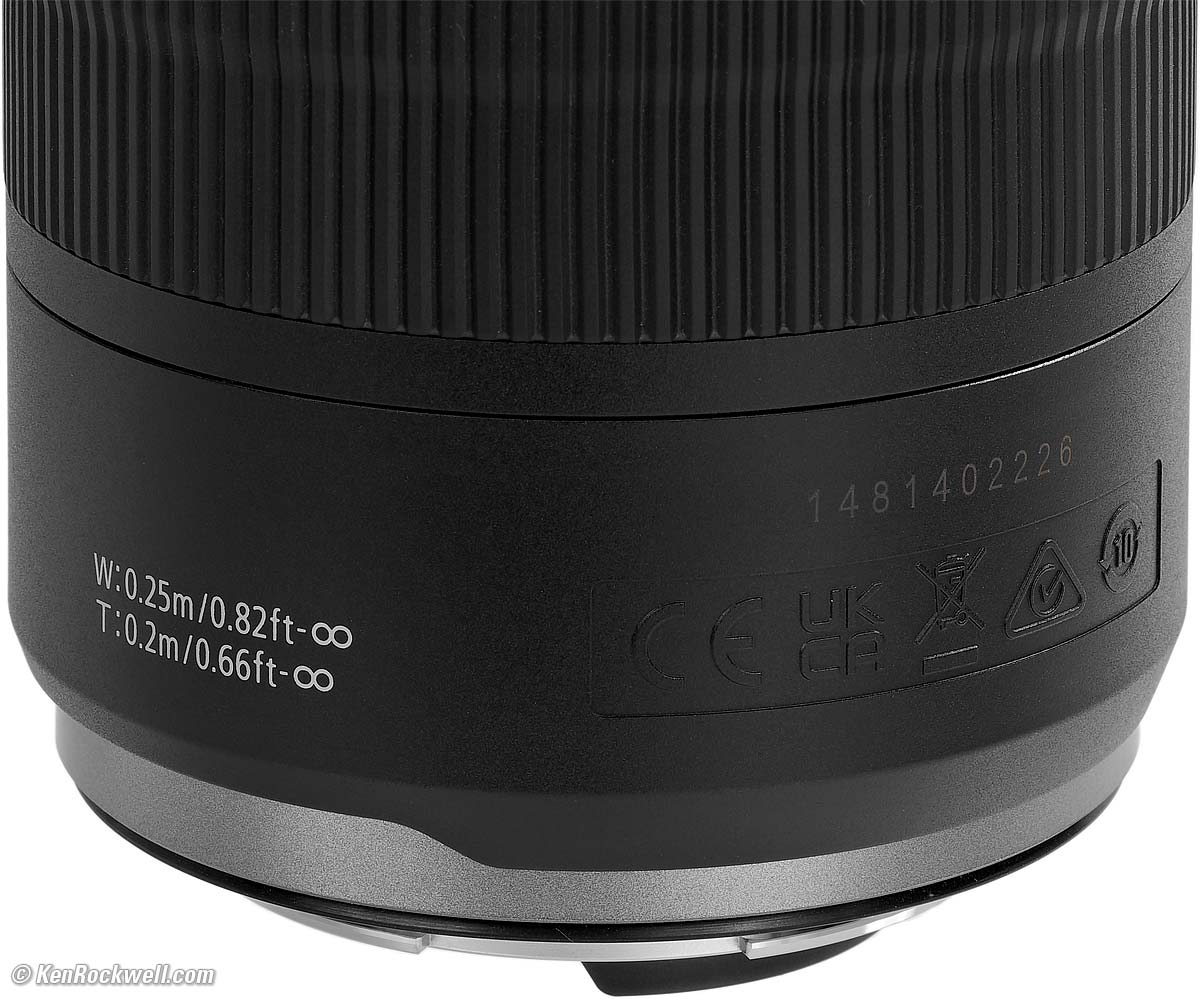
Canon RF 16-28mm f/2.8 IS STM. bigger.
Laser engraved on the bottom of the barrel. It's nearly invisible in most light.
Date Code
The serial number contains a date code.
My serial number starts with 148, which means it was made in December 2024.
Noises When Shaken
Minor clunking and clacking from the IS and focus groups.
Quality
Made in Japan.
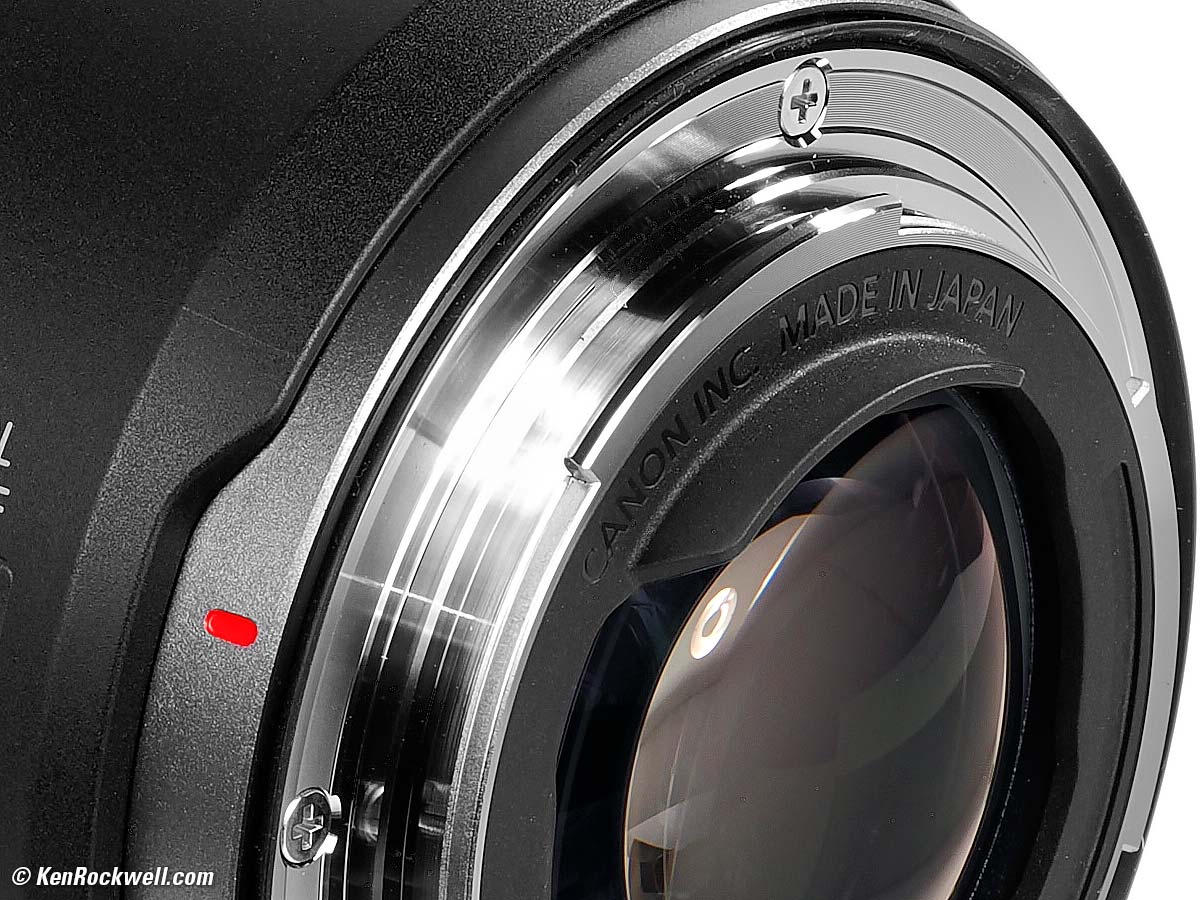
Canon RF 16-28mm f/2.8 IS STM. bigger.
The fact that it's hidden on the rear light baffle suggests that Canon's keeping its options open if it decides to relocate manufacturing to Taiwan in the future and only have to change the mold for the light shield rather than the whole barrel.
Sharpness performance top
Yes, this lens is as ultra-sharp as the RF 15-35mm f/2.8 L IS USM, for a fraction of the price. It's ultrasharp even all the way out in the corners at 16mm wide-open at f/2.8 as seen in these next two shots:
Psychedelic Insanity Under the Pacific Beach Pier, San Diego, California, 1:02 PM, Thursday, 06 March 2025. Canon R5 II, 16 mm wide-open at f/2.8 hand-held at 1/20 at Auto ISO 100 (LV 7.4), Radiant Photo and Skylum Luminar Neo software, perspective correction in Photoshop CC. bigger or camera-original 45 MP Quality 1 © 11 MB JPG file.
Canary Palm, 10:40 AM, Thursday, 06 March 2025. Canon R5 II, 16 mm wide-open at 1/1,000 at Auto ISO 100 (LV 13.0), Radiant Photo software. bigger or camera-original 45 MP Quality 1 © 9 MB JPG file.
However, lens sharpness has nothing to do with picture sharpness. Every lens made in the past 100 years is more than sharp enough to make super-sharp pictures if you know what you're doing. The only limitation to picture sharpness is your skill as a photographer. It's the least talented who spend the most time worrying about lens sharpness and blame crummy pictures on their equipment rather than themselves. Skilled photographers make great images with whatever camera is in their hands; I've made some of my best images of all time with an irreparably broken camera! Most pixels are thrown away before you see them, but camera makers don't want you to know that.
If you're not getting ultra-sharp pictures with this, be sure not to shoot at f/11 or smaller where all lenses are softer due to diffraction, always shoot at ISO 100 or below because cameras become softer at ISO 200 and above, be sure everything is in perfect focus, set your camera's sharpening as you want it (I set mine to the maximum of 7,1,1) and be sure nothing is moving, either camera or subject. If you want to ensure a soft image with any lens, shoot at f/16 or smaller at ISO 1,600 or above at default sharpening in daylight of subjects at differing distances in the same image.
People worry waaaaay too much about lens sharpness. It's not 1968 anymore when lenses often weren't that sharp and there could be significant differences among them; ever since about 2010 all new lenses are all pretty much equally fantastic.
This lens is super sharp corner-to corner at every aperture, limited by your vision as an artist and of course by diffraction at the smallest apertures. Avoid f/11 and smaller unless you really need them for extreme depth of field because diffraction takes its toll. See also How to Calculate the Sharpest Aperture.
This lens is sharp, limited of course by diffraction at the smallest apertures.
Used properly, all of Canon's RF lenses are equally sharp. The differences are in maximum apertures and focal lengths, but none of them are soft if you know how to use them. Lens sharpness has nothing to do with picture sharpness.
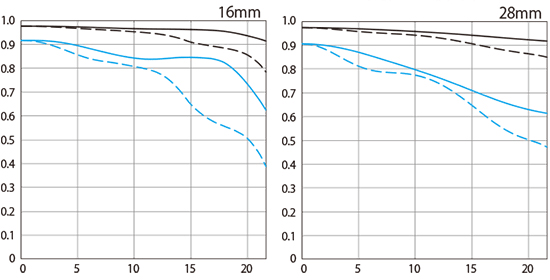
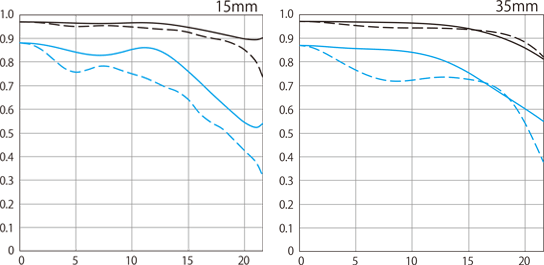
MTF wide-open at f/2.8 at 10 cyc/mm (black) and 30 cyc/mm (blue). Sagittal (solid) and meridional (dashed).
Secret: The MTF of the RF 16-28mm f/2.8 IS STM is actually a tiny bit better than the MTF of the RF 15-35mm f/2.8 L IS USM, but you'll never see any difference in actual photos.
While it's usually valid to compare rated MTFs between different lenses of a similar age from the same maker, every maker measures or simply calculates MTF very differently, and therefore one cannot compare these curves between brands. Sony seems to calculate and choose to ignore diffraction, while others don't, which lets these lenses hug 100% while other brands don't.
Spherochromatism performance top
Spherochromatism, also called secondary spherical chromatic aberration or "color bokeh," is an advanced form of spherical and chromatic aberration in a different dimension than lateral chromatic aberration and therefore cannot be corrected with software or automatic corrections. It happens mostly in fast normal and tele lenses when spherical aberration at the ends of the color spectrum are corrected differently than in the middle of the spectrum. Spherochromatism can cause colored fringes on out-of-focus highlights, usually seen as green fringes on backgrounds and magenta fringes on foregrounds. Spherochromatism is common in fast lenses of moderate focal length when shooting contrasty items at full aperture. It goes away as stopped down.
It has a small amount of spherochromatism, with slightly bluish fringes behind and slightly redder fringes ahead of the plane of perfect focus:
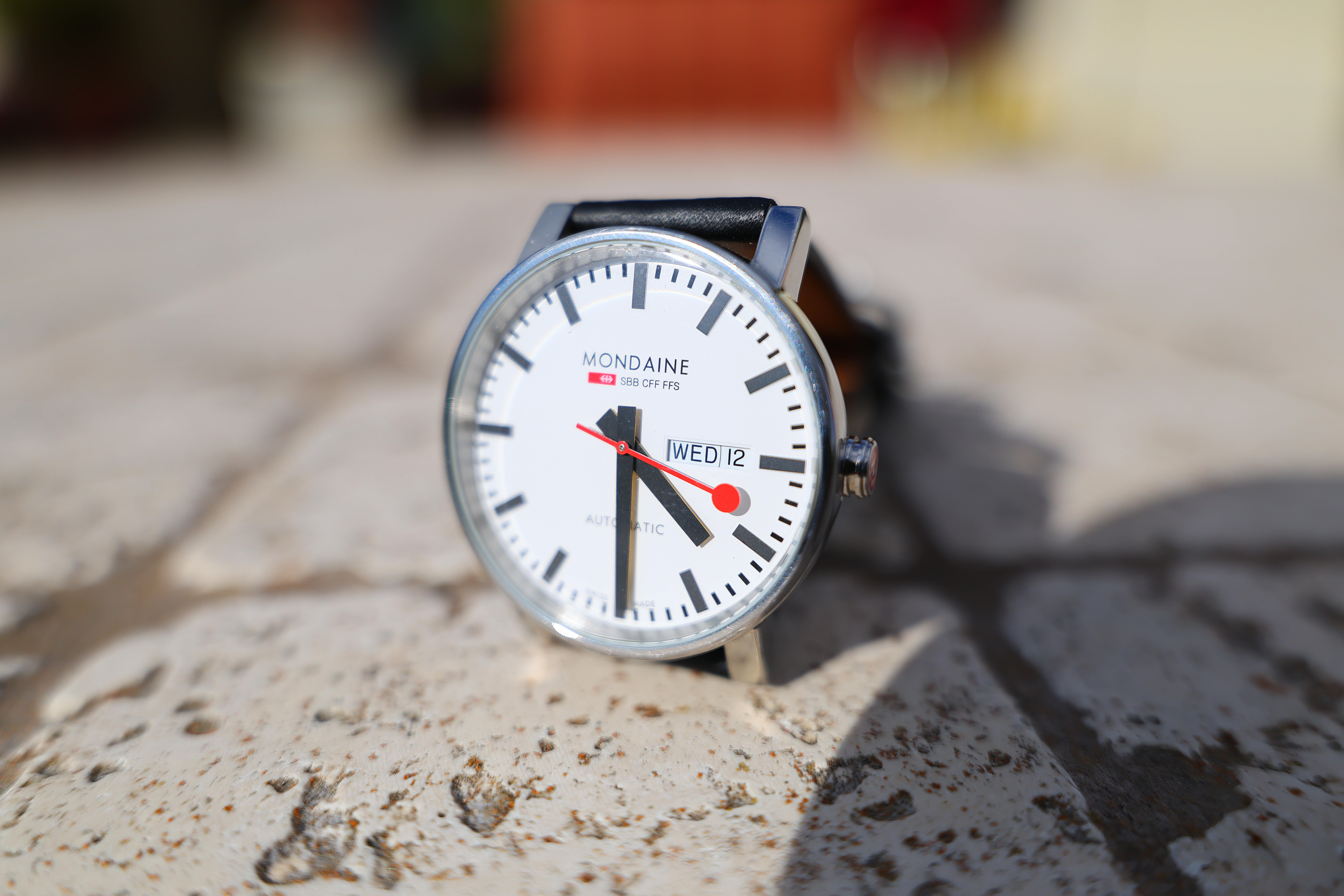
Mondaine A132.30348.11SBB at close-focus distance, 12 March 2025. Canon R5 II at 1/4,000 at Auto ISO 100, +0.7 stops exposure compensation (LV 15.0). bigger or camera-original © file.
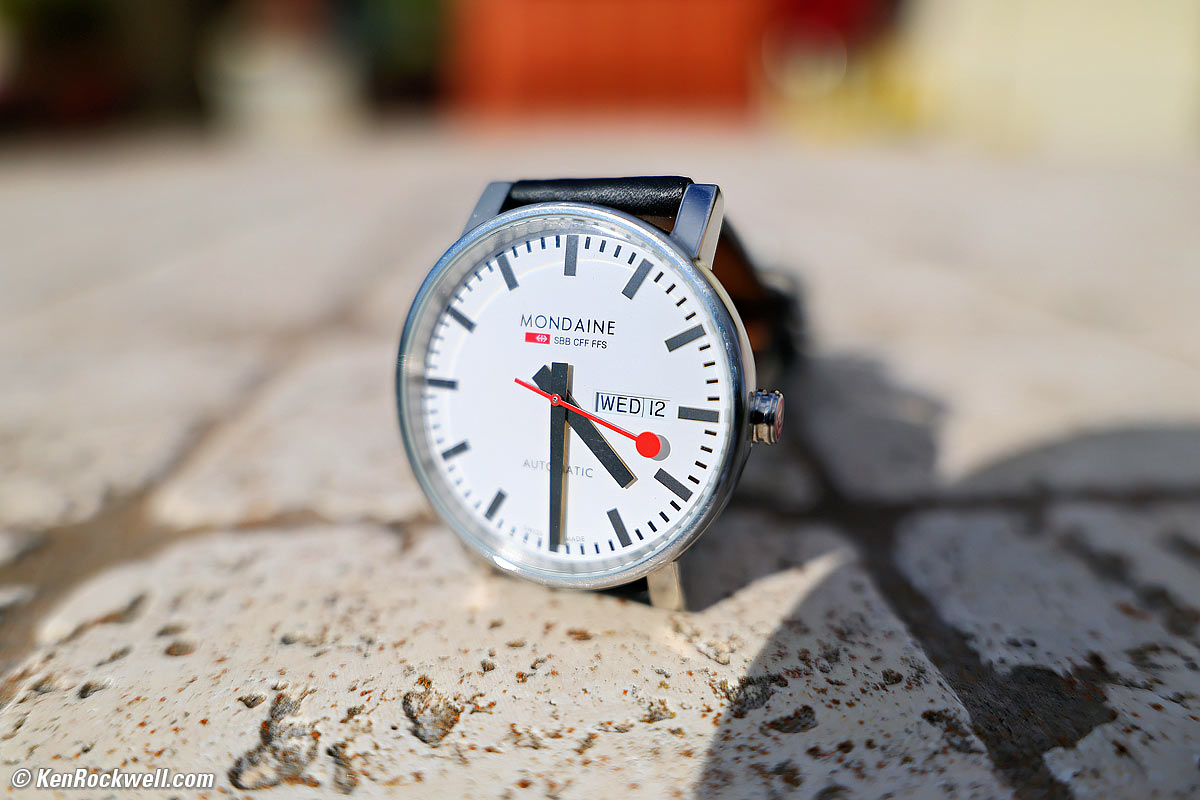
1,200 × 900 pixel (6.8× magnification) crop from above. bigger or camera-original © file.
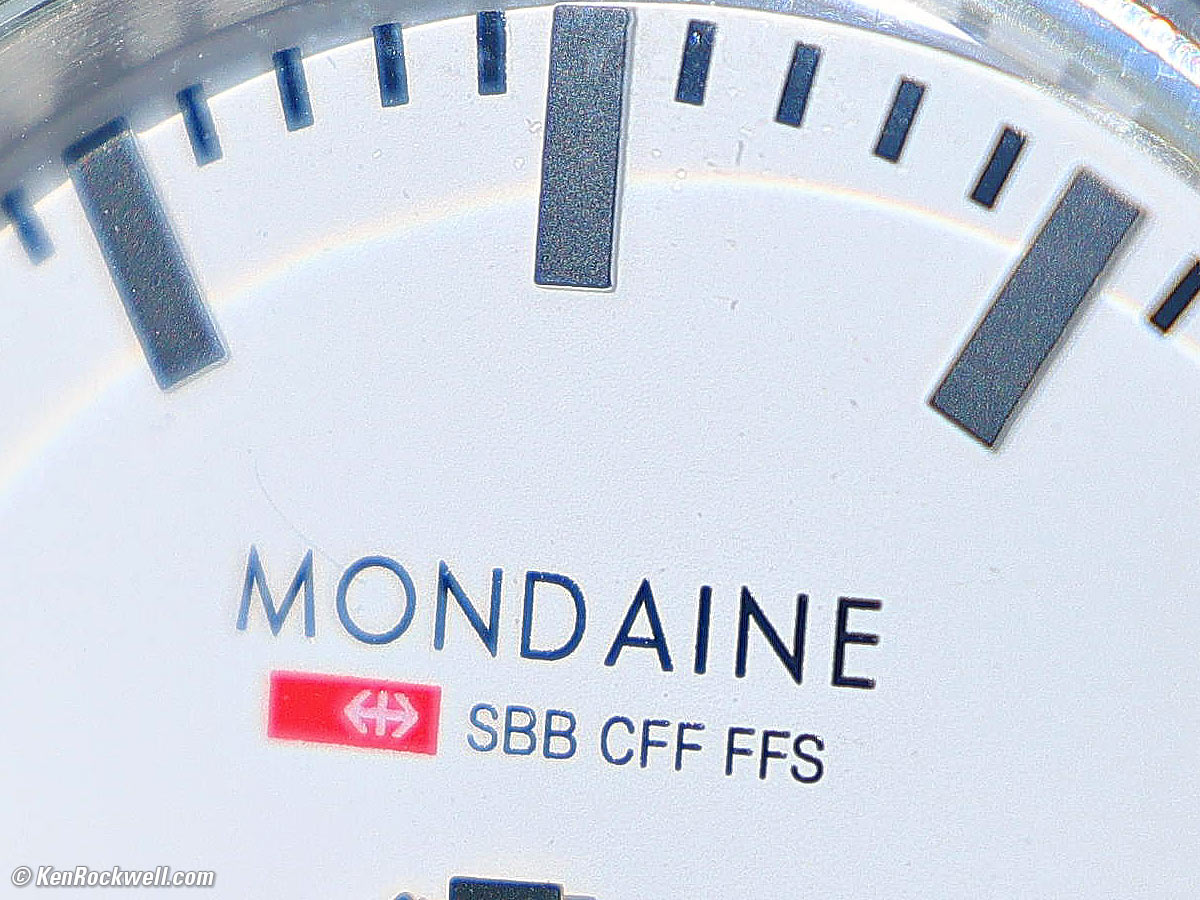
If this 1,200 × 900 pixel crop is about 3" (7.5cm) wide on your screen, the complete image would print at a large 14 × 21″ (35 × 55 cm) at this same high magnification.
If this 1,200 × 900 pixel crop is about 6" (15cm) wide on your screen, the complete image would print at a huge 27½ × 41¼″ (70 × 105 cm) at this same high magnification.
If this 1,200 × 900 pixel crop is about 12" (30cm) wide on your screen, the complete image would print at a mammoth 55 × 82½″ (1.4 × 2.1 meters) at this same extremely high magnification!
Image Stabilization (VR) performance top
Image Stabilization (OIS, IS or VR (Vibration Reduction)) is magnificent!
I get 3⅓ stops of real-world improvement at 16mm and 5½ stops of real-world improvement at 28mm on my stabilized R5 II, and probably will get results almost as good on an unstabilized camera. (My tests have shown that in-camera stabilization contributes very little if your lens is already stabilized).
"Percent Perfectly Sharp Shots" are the percentage of hand-held, free-standing with no support or bracing, frames with 100% perfect tripod-equivalent sharpness as viewed at 300%. Hand tremor is a random occurrence, so at marginal speeds some frames will be perfectly sharp while others will be in various stages of blur — all at the same shutter speed.
We're all different, but I get 100% perfect tripod-equivalent sharpness most of the time at 1/2 second at every focal length, and half my shots have 100% perfect tripod-equivalent sharpness at one full second hand-held — on my 45 megapixel R5 II as viewed at 300%! This means if I make a few shots I simply can pick the one that's perfectly sharp at one second!
It's so good that for the first time I gave up testing at 8 second exposures. It takes forever to hold the camera still and make all these shots, so I wasn't going to wait around any more for 16-second handheld exposures to see what happened. 10% perfectly sharp shots at 8 seconds means that for each series of ten shots, one was perfectly sharp! Insane!
This rates what percentage of shots are perfectly sharp, not how sharp are all the frames:
At 16mm
| % Perfectly Sharp Shots on stabilized R5 II | 8s |
4s |
2s |
1s |
1/2 |
1/4 |
1/8 |
1/15 |
1/30 |
| Stabilization ON | 10 |
10 |
10 |
50 |
70 |
100 |
100 |
100 |
100 |
| Stabilization OFF | 0 |
0 |
0 |
0 |
0 |
0 |
0 |
70 |
100 |
I see 3⅓ stops of real-world improvement.
At 28mm
| % Perfectly Sharp Shots on stabilized R5 II | 2s |
1s |
1/2 |
1/4 |
1/8 |
1/15 |
1/30 |
1/60 |
1/125 |
| Stabilization ON | 0 |
50 |
90 |
90 |
100 |
100 |
80 |
100 |
100 |
| Stabilization OFF | 0 |
0 |
0 |
0 |
0 |
10 |
30 |
80 |
100 |
I see 5½ stops of real-world improvement!
Sunstars performance top
With a 9-bladed rounded diaphragm I get excellent 18-pointed sunstars on brilliant points of light at moderate to small apertures. This is much better than most lenses!
Ignore the vertical smear at large apertures. This is a sensor artifact called interline transfer smear and is a camera, not a lens, defect.
Likewise ignore the crazy rainbow dots at small apertures; these are sensor artifacts caused by interference among the divisions between pixels on the sensor. These are made visible because we're using enough exposure to show the dark underside of a huge palm tree, and then putting the blinding disk of the mid-day sun in it. Doing this will show everything due to the insane lighting range.
Click any to enlarge:
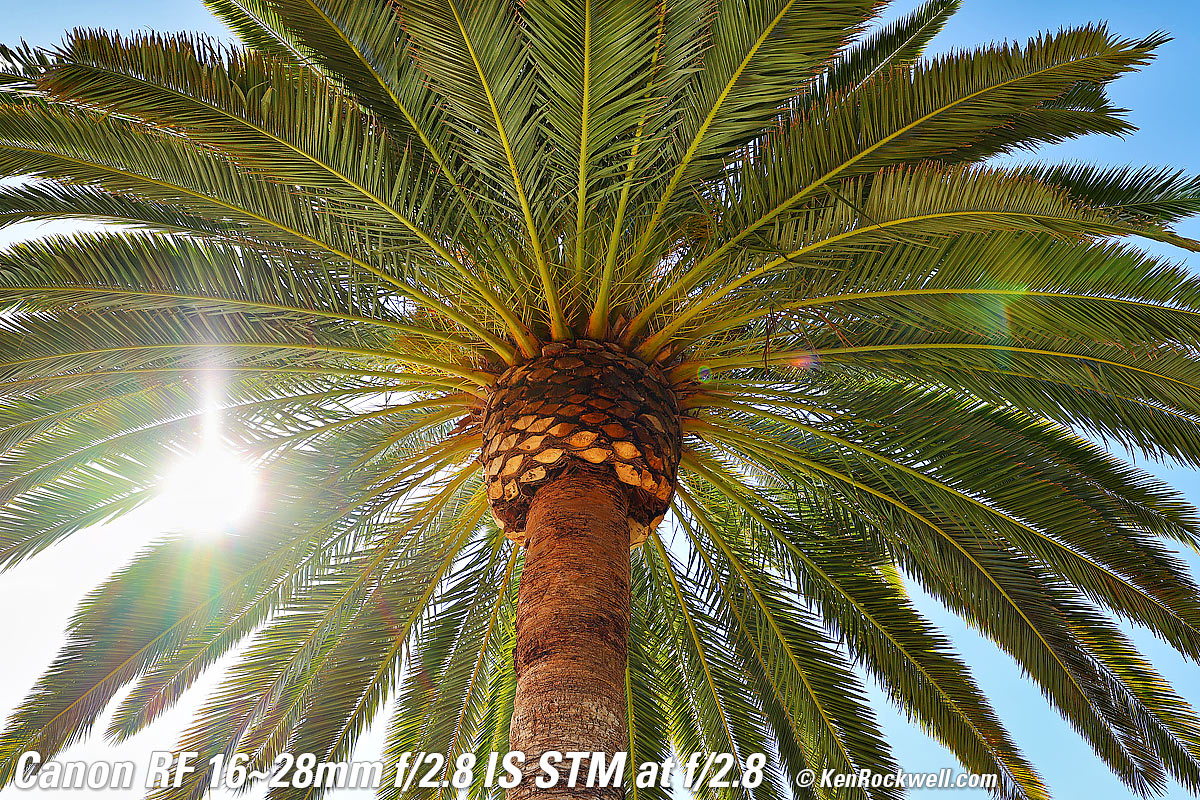
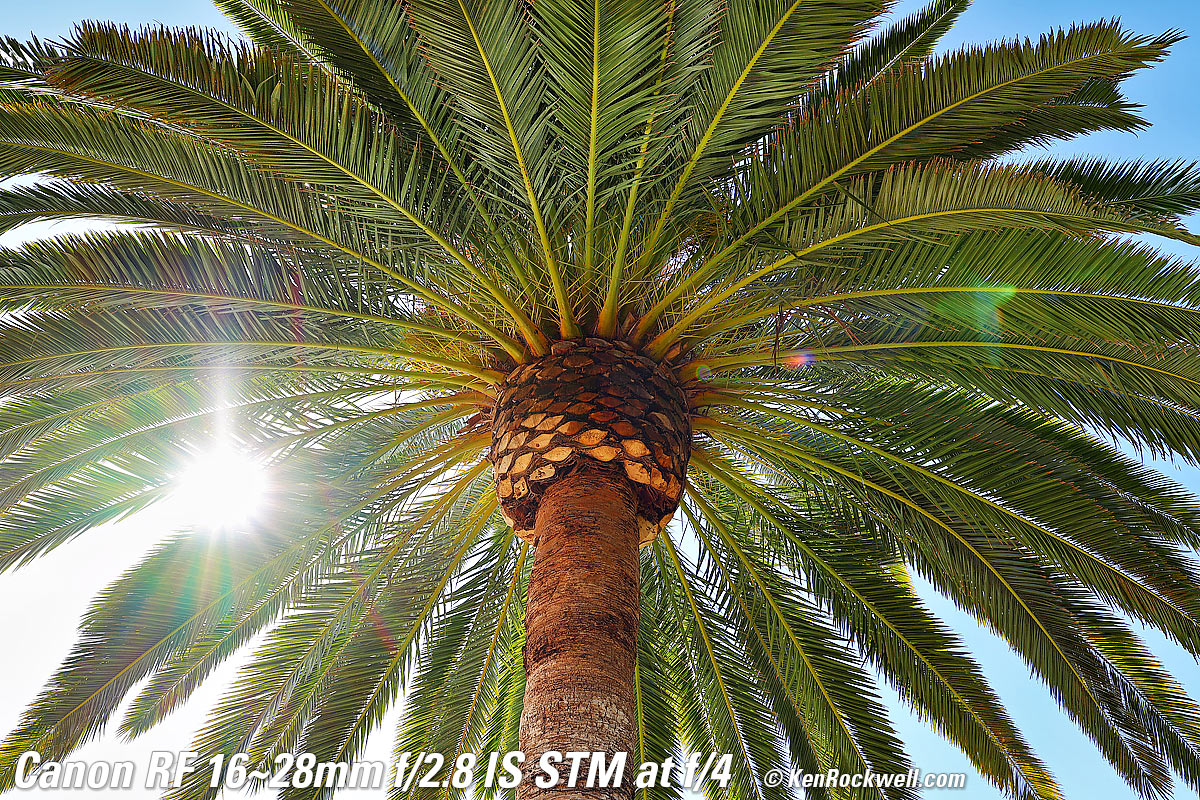
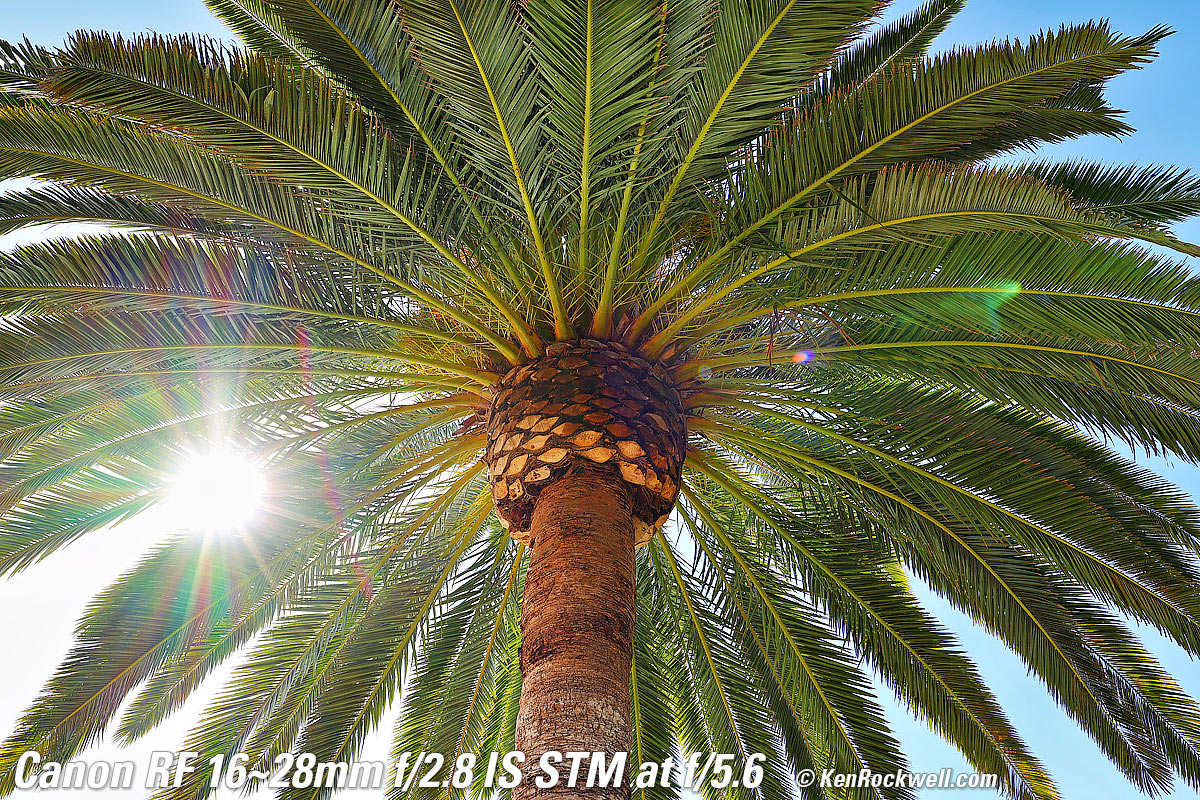
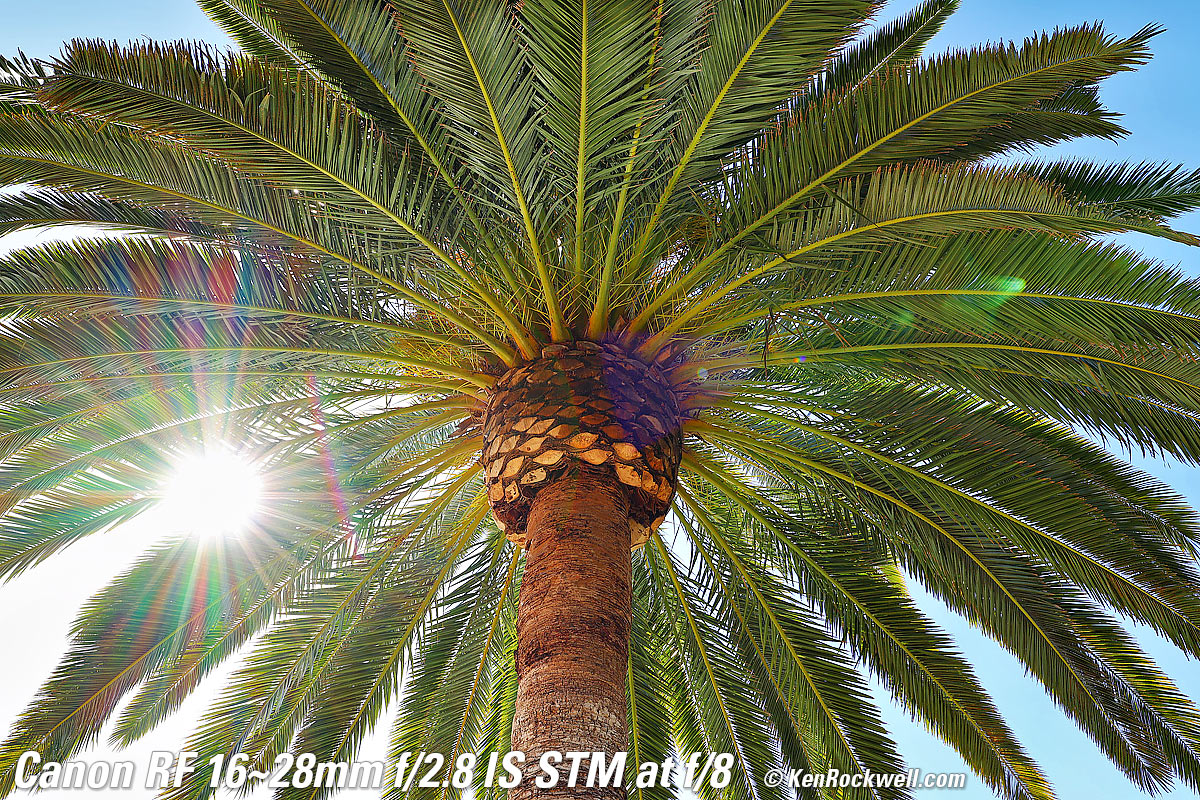
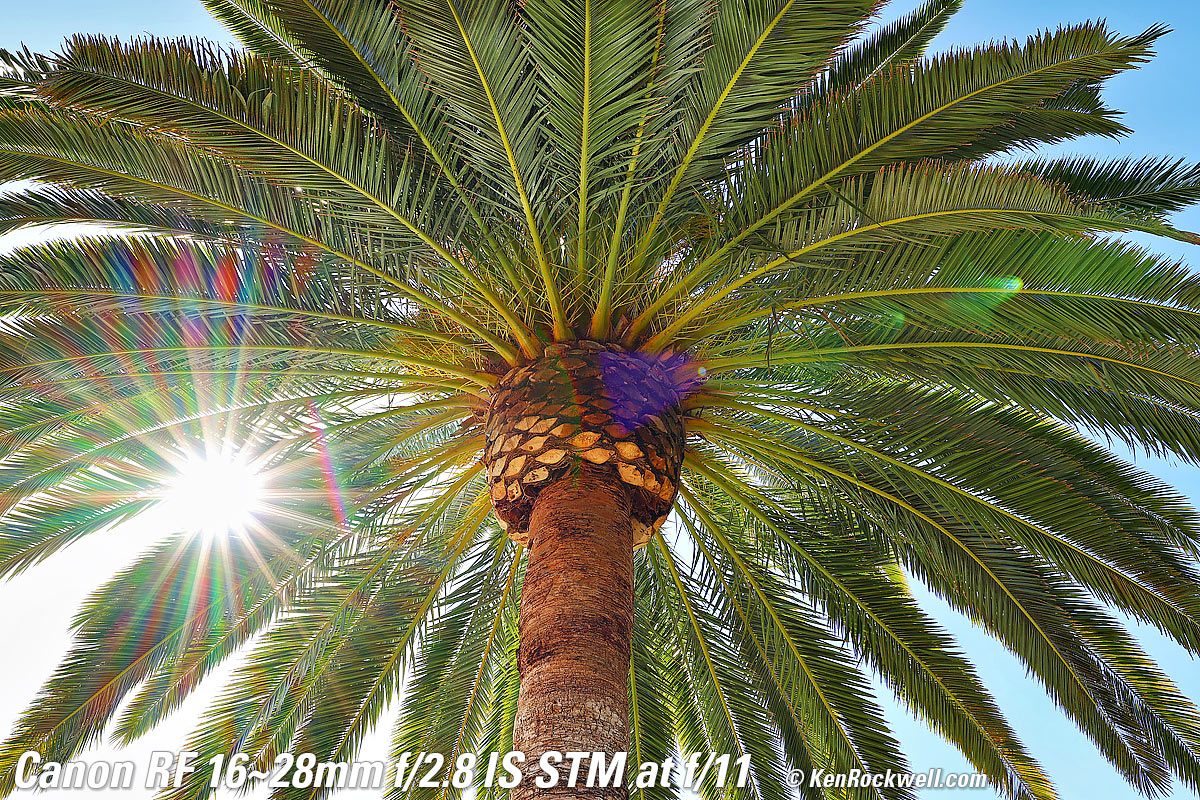
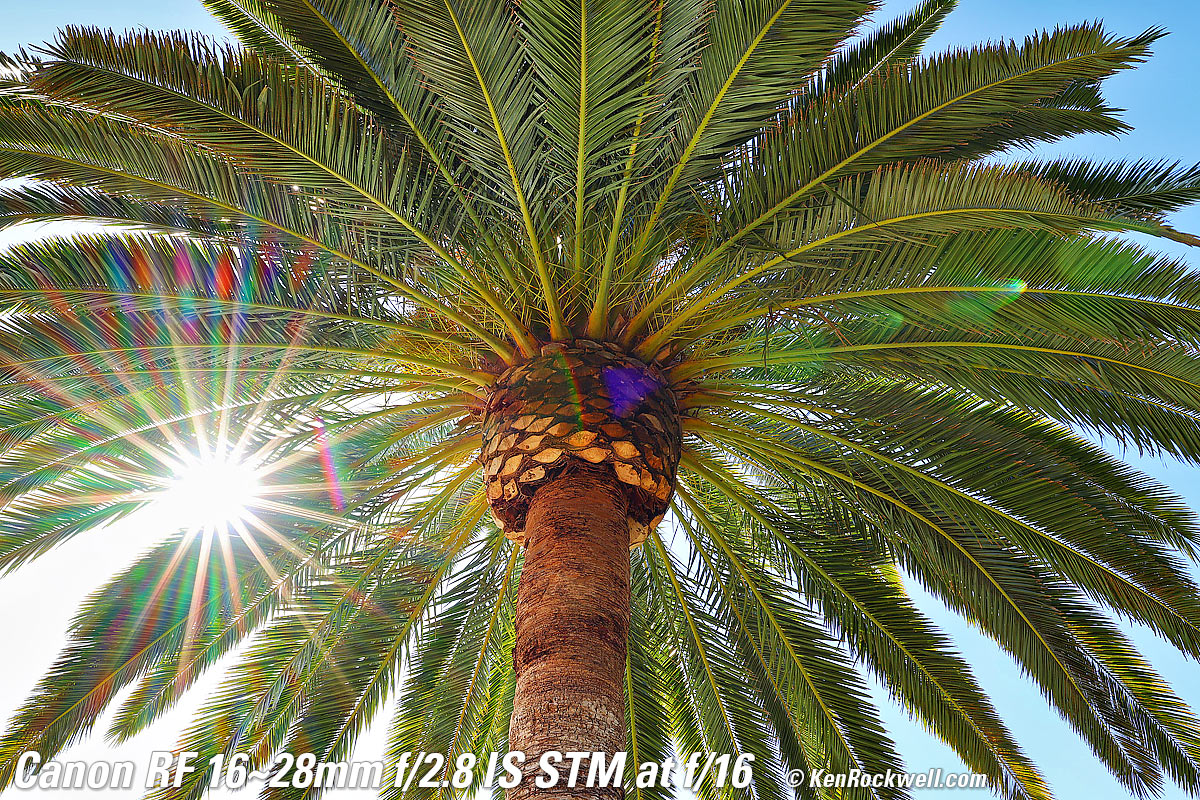
Click any to enlarge.
Compared top
Sample Images Intro New Good Bad Missing
Specifications USA Version Performance
Compared User's Guide Recommendations
I got my RF 16-28mm f/2.8 IS STM at B&H. I'd also get mine at Adorama, at Amazon or at Crutchfield, or get it used if you know How to Win at eBay, or get it used at KEH.
NEW: All Canon Mirrorless Ultrawide Lenses Compared.
Below is a partial summary, see All Canon Mirrorless Ultrawide Lenses Compared for all the details.
All of these lenses are equally ultra-sharp; there is NO significant difference between them.
All are plastic on the outside with a metal mount; mechanical differences are that the L lenses may or may not have more metal inside. All are stabilized except the tiny RF 16mm f/2.8 STM.
RF 14-35mm f/4L IS USM: My favorite: not much bigger or more expensive than any of the others. Has the widest zoom range of all of these, and has L supposed mechanical quality. I don't need f/2.8; f/4 is more than enough for my nature and landscapes.
RF 15-35mm f/2.8L IS USM: Bigger, heavier and much more expensive than any of these — but no sharper.
RF 15-30mm f/4.5-6.3 IS STM: Smaller and lighter than any of these zooms, and it's just as sharp and stabilized for less than half the price, but it's one or two stops slower than all the other lenses here.
RF 16-28mm f/2.8 IS STM: Compact, inexpensive, fast and ultralight, but has the most restricted zoom range. This restricted zoom range is why it's just as sharp as the others, but smaller, lighter and less expensive.
RF 16mm f/2.8 STM: Tiny, ultrasharp and nearly free, but no stabilization and no zooming.
User's Guide top
Sample Images Intro New Good Bad Missing
Specifications USA Version Performance
Compared User's Guide Recommendations
I got my RF 16-28mm f/2.8 IS STM at B&H. I'd also get mine at Adorama, at Amazon or at Crutchfield, or get it used if you know How to Win at eBay, or get it used at KEH.
How to Use Ultrawide Lenses
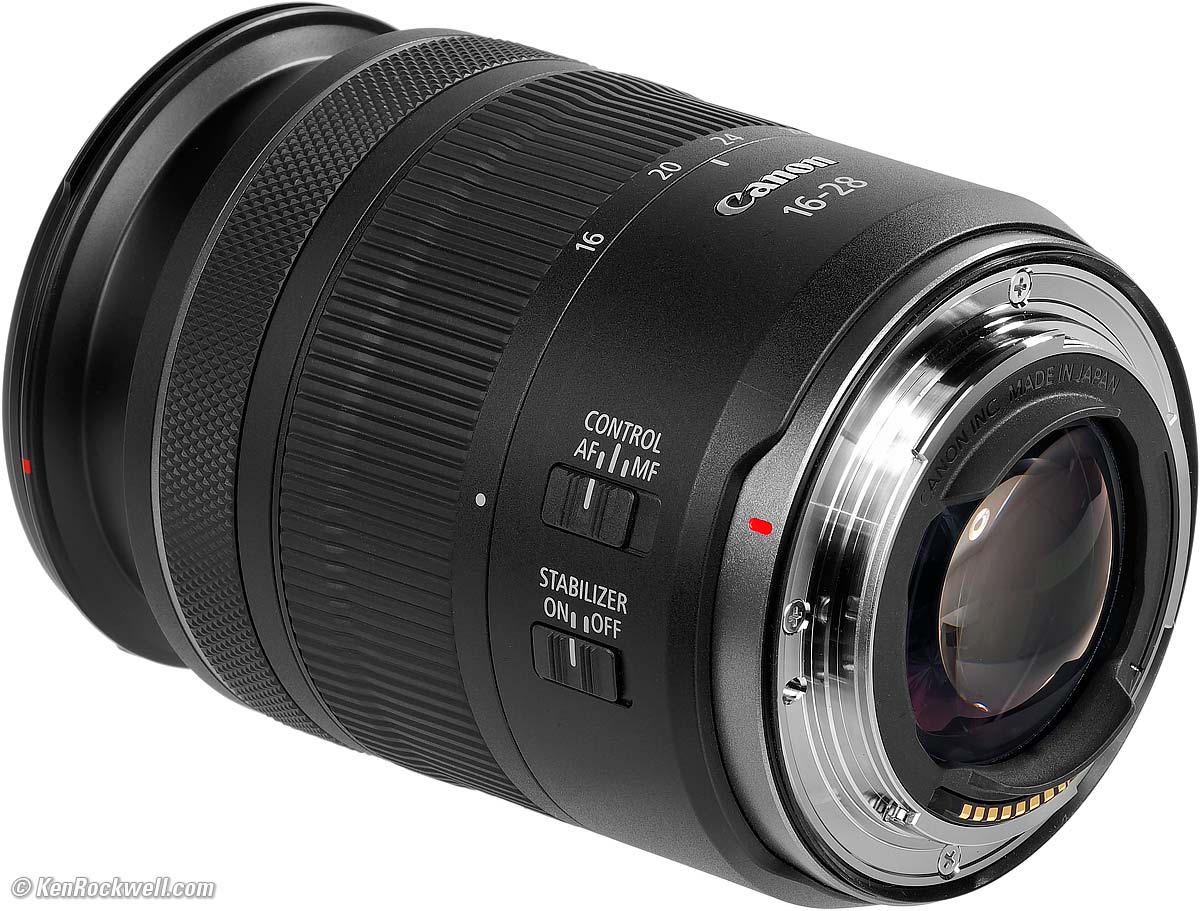
Canon RF 16-28mm f/2.8 IS STM. bigger.
Collapsing and Erecting user's guide top
Just twist the zoom ring past 16mm to the ● dot to collapse it, and back to 16mm to erect it for zooming and shooting. There are clicks, but no interlocks; perfect!
HINT: My R5 II locks up and won't even let me use its menu system until I extend this lens from the ● collapsed position.
AF - CONTROL - MF Switch user's guide top
AF: Use this. It gives you Autofocus, and possibly manual-focus override depending on your other settings.
CONTROL: The front ring now can be set to things like White Balance or exposure compensation rather than manual focus, but since it has no clicks I find it too weird for these settings.
MF: Manual focus only; Autofocus is disabled. Use this for things like astronomy where you want to focus it and then not have it vary between shots.
Manual-Focus Override user's guide top
Older EOS R cameras need a menu setting changed for manual-focus override, otherwise the focus ring is always ignored in AF. Newer cameras have this set by default.
Find the "Lens electronic AF" or "Electronic full-time MF" option in your AF menu (AF 6 in R5 II, R6 II, R7, R8 and R10, AF 4 in EOS R5 and EOS R6 or CAMERA 8 in EOS RP), and set it to either "One‑Shot‑> enabled," "One‑Shot‑> enabled (magnify)" or ON. Canon should have it set this way by default, but they didn't in older models. No big deal now that I figured it out, and it usually works by default in newer cameras.
Once set, manual-focus override works well in ONE SHOT AF (AF then lock) mode after the camera has finished autofocusing, but in SERVO AF mode all Canon EOS-R cameras as of March 2025 continue to autofocus as soon as you stop turning the manual focus ring! Sadly only Nikon has this all figured out today.
STABILIZER Switch user's guide top
Leave this ON unless you're on a very sturdy tripod, or if you're making exposures longer than about a second on any kind of tripod.
Recommendations top
Sample Images Intro New Good Bad Missing
Specifications USA Version Performance
Compared User's Guide Recommendations
I got my RF 16-28mm f/2.8 IS STM at B&H. I'd also get mine at Adorama, at Amazon or at Crutchfield, or get it used if you know How to Win at eBay, or get it used at KEH.
This lens is for someone who really needs f/2.8 in their ultrawide to stop action in dim light. Otherwise, the RF 15-30mm IS STM is smaller, lighter, zooms wider and longer and it's just as sharp and stabilized for less than half the price, and I have no problem hand-holding the RF 15-30mm IS STM out in the dark at night.
Personally my favorite is the RF 14-35mm f/4L IS USM for its broadest zoom range and still-small size and weight — and it costs not that much more than this lens as of March 2025. I'd much rather have the L lens at f/4 than this lens at f/2.8; as I said, this lens is for someone who really needs f/2.8, which isn't me.
The RF 15-35mm f/2.8L IS USM is bigger, heavier, older and much more expensive — but does zoom a little wider and longer than this lens.
I use a clear (UV) protective filter instead of a cap (exactly like an iPhone) so I'm always ready to shoot instantly. I only use a cap when I throw this in a bag with other gear without padding — which is never. The UV filter never gets in the way, and never gets lost, either.
The very best protective filter is the nearly indestructible Hoya multicoated HD3 67mm UV which uses hardened glass and repels dirt and fingerprints.
For less money, the Nikon 67mm NC (No Color/Neutral Clear), Hoya 67mm NXT Plus UV and Hoya 67mm UV MC are all excellent filters, but the Hoya HD3 is the toughest and the best.
If I was working in nasty, dirty areas, I'd use an uncoated 67mm Tiffen UV filter instead. Uncoated filters are much easier to clean, but more prone to ghosting.
Nikon's 67mm Circular Polarizer II is excellent, but I avoid using polarizers at the 16mm end because it makes the sky look weird.
Filters last a lifetime, so you may as well get the best to use on lenses you buy ten years from now. The Hoya HD3 stays cleaner than the others since it repels oil and dirt.
All these filters are just as sharp and take the same pictures, the difference is how much abuse they'll take and stay clean and stay in one piece. Since filters last a lifetime or more, there's no reason not to buy the best as it will last you for the next 50 years. Filters aren't throwaways like digital cameras which we replace every few years, like it or not. I'm still using filters I bought back in the 1970s! The Hoya HD3 stays cleaner than the others since it repels oil and dirt, and you'll be using it long after you've thrown this lens away in 50 years.
This 100% all-content, junk-free website's biggest source of support is when you use those or any of these links to my personally approved sources I've used myself for way over 100 combined years when you get anything, regardless of the country in which you live. Canon does not seal its boxes in any way, so never buy at retail or any other source not on my personally approved list since you'll have no way of knowing if you're missing accessories, getting a defective, damaged, returned, non-USA, store demo or used lens — and all of my personally approved sources allow for 100% cash-back returns for at least 30 days if you don't love your new lens. I've used many of these sources since the 1970s because I can try it in my own hands and return it if I don't love it, and because they ship from secure remote warehouses where no one gets to touch your new lens before you do. Buy only from the approved sources I've used myself for decades for the best prices, service, return policies and selection.
© Ken Rockwell. All rights reserved. Tous droits réservés. Alle Rechte vorbehalten. Alla rättigheter förbehållna. Toate drepturile rezervate. Omnia jura reservata. Ken Rockwell® is a registered trademark.
Help Me Help You top
I support my growing family through this website, as crazy as it might seem.
The biggest help is when you use any of these links when you get anything. It costs you nothing, and is this site's, and thus my family's, biggest source of support. These places always have the best prices and service, which is why I've used them since before this website existed. I recommend them all personally.
If you find this page as helpful as a book you might have had to buy or a workshop you may have had to take, feel free to help me continue helping everyone.
If you've gotten your gear through one of my links or helped otherwise, you're family. It's great people like you who allow me to keep adding to this site full-time. Thanks!
If you haven't helped yet, please do, and consider helping me with a gift of $5.00.
As this page is copyrighted and formally registered, it is unlawful to make copies, especially in the form of printouts for personal use. If you wish to make a printout for personal use, you are granted one-time permission only if you PayPal me $5.00 per printout or part thereof. Thank you!
Thanks for reading!
Ken.